What to do with grass clippings: leave them on the lawn when they are 1 inch or shorter, which returns about 1 to 2 lb of nitrogen per 1,000 sq ft a year. Bag long, matted or diseased clippings, then check your state’s landfill rule.
What to do with grass clippings also turns on a legal question most guides skip. We read the rule in 25 states that restrict yard waste or require its collection: 21 reach clippings in some form, 5 of those let a landfill with a gas or energy system take them, and Indiana, New Jersey and Pennsylvania leave grass out of their bans. The Rutgers trial supplies the rest of the answer: about 1,140 lb of fresh clippings a year off a 5,000 sq ft lawn, holding $15 to $31 of nitrogen.
What to do with grass clippings: 9 options and the limit on each
| Option | Use it when | The limit | Source |
|---|---|---|---|
| Leave on the lawn | Lawn is dry and healthy | Clippings 1 inch or shorter; cut no more than 1/3 of the blade | UMN Extension |
| Bag one cut, then go back to returning | You missed a mowing or two in wet weather or a growth surge | Resume once the grass is under control | Oregon State |
| Mulch beds and gardens | Clippings are dry and the lawn was not recently treated | 1 to 2 inches at one time | UMN Extension |
| Backyard compost | You have dry leaves or straw to mix in | About 6.8 lb dry leaves per 10 lb fresh grass | Cornell |
| Yard-waste cart or compost site | Your town collects it or you can haul it | No trash mixed in; bag type can be regulated | Minn. Stat. 115A.931 |
| Household trash | State and town allow it | Check the state table: fine in Indiana, barred in Wisconsin | IDEM; Wisconsin DNR |
| Over the fence to livestock | Not advised | Colic risk in horses; wet piles can mold and ferment in warm weather | Penn State |
| Burn | Check your state first | Nebraska says grass clippings cannot be burned at its community burn sites | Nebraska DWEE |
| Woods, street or storm drain | Not on land you do not own | 36 CFR 261.11(e) on National Forest land; up to $50 in Dyer, Tenn. | eCFR; City of Dyer |
Start with the first row, because it is the only option that adds no work. Mowing on the one-third rule keeps clippings short enough to use it: University of Minnesota turf scientist Jon Trappe works the example of a 3-inch lawn cut at 4.5 inches, about every 7 days in Minnesota, against a 4-inch lawn cut at 6 inches, every 10 to 12 days. Our guide on how often to mow your lawn covers the schedule.
1Will clippings be longer than 1 inch, or are you cutting more than 1/3 of the blade?
YesBag or rake this cut, or mow down in stages a few days apart (UMN).
NoGo to the next question
2Is the grass wet enough that clippings clump or mat?
YesBag this cut or wait; mats smother the grass beneath (UMN, Oregon State).
NoGo to the next question
3Is leaf spot, rust or dollar spot heavy in the lawn?
YesBag until it clears to reduce disease severity (UMN).
NoGo to the next question
4Was weed killer applied since your last 3 mowings?
YesLeave clippings on the lawn. Do not mulch or compost them until the label allows it.
NoGo to the next question
5Are clippings landing on a street, sidewalk or gutter?
YesBlow or sweep them back onto the lawn; many cities fine this (UMN, Dyer, Tenn.).
NoLeave them on the lawn. Weeds and thatch are not reasons to bag (UMN, Penn State).
How much nitrogen do clippings return?
About 1 to 2 lb of nitrogen per 1,000 sq ft a year on a lawn fed 2 lb. That figure comes from a four-year Rutgers trial on irrigated Kentucky bluegrass, which weighed clipping yield at three fertilizer rates and scored color on a 1 to 10 scale. Rutgers assumed 38 lb of dry clippings and tissue nitrogen of 2.5 to 5.1 percent. Clippings are about 85 percent water, so it multiplies dry weight by 6 to get fresh weight.
| Nitrogen applied (lb per 1,000 sq ft a year) | Dry clippings (lb) | Fresh clippings at x6 (lb) | Color, clippings removed | Color, clippings returned |
|---|---|---|---|---|
| 0 | 23 | 138 | 3.2 | 5.2 |
| 2 | 38 | 228 | 5.5 | 6.9 |
| 4 | 58 | 348 | 6.4 | 7.7 |
Read across the 2 lb and 4 lb rows. Returning clippings at 2 lb scored 6.9, while removing them at twice the fertilizer scored 6.4. Half the nitrogen with clippings beat double the nitrogen without them on the season average, although the 4 lb plots looked better in May alone.
Other research lands in the same place. The two-year Connecticut study by Kopp and Guillard (2002), run on a cool-season mixture at rates up to 392 kg of nitrogen per hectare, found fertilizer could drop 50 percent or more with no loss of quality. Extension figures are more cautious, from 20 percent up.
| Source | Setting | What it found |
|---|---|---|
| Kopp and Guillard, Crop Science 42:1225 | Storrs, Conn., 1998 to 1999, cool-season mix | Returning clippings raised dry yield 30 to 72 percent and nitrogen uptake 48 to 60 percent; fertilizer could fall 50 percent or more |
| Penn State Extension, updated Oct. 2025 | Kentucky bluegrass, 3 years | Clippings held 46 to 59 percent of the nitrogen applied as fertilizer |
| Trappe, University of Minnesota, 2019 | Minnesota lawns | Removing clippings takes away up to 2.0 lb of nitrogen per 1,000 sq ft a year |
| Oregon State Extension, reviewed 2025 | Oregon State research | Clippings run up to 3 to 4 percent N, 0.5 percent P, 2.5 to 3.5 percent K; fertilizer can fall almost by half |
| Purdue AY-22-W, 2013 | Indiana cool-season lawns | If you must remove clippings regularly, annual nitrogen may need to rise 25 to 50 percent |
| NC State Extension Gardener Handbook, ch. 9 | North Carolina lawns | Fertilizer use can fall 20 to 30 percent; studies show 1,000 sq ft can produce 500 lb of clippings in a growing season |
The trial numbers are cool-season, so treat them as direction, not a figure, on bermudagrass or St. Augustine. NC State, writing for a state with both, says to catch or rake clippings only when they are heavy enough to hold the grass down or shade it. For the nitrogen you still need after returning clippings, see how to add nitrogen to lawn soil and the product prices in our lawn fertilizer guide.
The math on a 5,000 sq ft lawn
| Step | Arithmetic | Result |
|---|---|---|
| Dry clippings a year, 2 lb N program | 38 lb per 1,000 sq ft x 5 | 190 lb |
| Fresh weight to bag and haul | 190 lb x 6 | 1,140 lb |
| Nitrogen inside them | 190 lb x 2.5 to 5.1 percent | 4.75 to 9.7 lb |
| Value at the cheapest bag in our fertilizer guide | $3.17 per lb of N | $15 to $31 |
| Value at the priciest of the 4 bags in the calculator | $10.40 per lb of N | $49 to $101 |
- Fresh clippings a year (lb)
- 1,140
- Nitrogen, low estimate (lb)
- 4.8
- Nitrogen, high estimate (lb)
- 9.7
Default: 5,000 sq ft at 2 lb N: 1,140 lb fresh, 4.8 to 9.7 lb of nitrogen, about $15 to $30 at $3.17 per lb N (rounded to $5). Yields are Rutgers' irrigated Kentucky bluegrass; tissue nitrogen of 2.5 to 5.1 percent is assumed at every rate. Estimate, nitrogen only.
The fertilizer saving is real but small: under 10 lb of nitrogen a year on this lawn. The weight is the larger argument. Moving more than half a ton of wet grass is what returning clippings spares you, and homeowners on Texas A&M AgriLife's Don't Bag It plan report mowing in 38 percent less time, a self-reported figure.
Is it better to mulch or bag grass?
Mulch by default and bag in the three cases UMN Extension names: leaf spot, rust or dollar spot is heavy; the grass is wet or too tall and clippings mat; or the mower is unsafe without its bag attached. Add one more from the same page: sweep clippings off curbs and gutters so they stay out of storm drains. Our pages on lawn fungus and mowing wet grass cover those two cases in depth.
Two common reasons to bag do not hold up. Weeds first: Trappe calls it a misconception, since seeds already in the soil stay viable for years or decades, and Rutgers counted significantly fewer August weeds where clippings were returned, in plots that also received preemergence herbicide each spring. Thatch second: Penn State says leaf tissue decomposes rapidly and does not contribute, and UMN blames vigorous varieties, excess nitrogen, infrequent mowing and low soil oxygen instead. If thatch tops 1/2 inch, the fix is in how to dethatch a lawn.
Do you need a mulching mower or kit?
No. Rutgers states that mulching mowers are not required and conventional rotary mowers also work, though its returned plots used a mulching mower. A kit chops finer, which Penn State says speeds decomposition. Oregon State puts blade sharpening at every 20 to 25 hours of use, and our blade sharpening guide shows how.
| Mower | Kit | What the maker lists | Price checked Nov. 5, 2026 |
|---|---|---|---|
| Most Cub Cadet, Craftsman and Troy-Bilt 42-inch riders, 2015 on | 19A70041GFP | 2 mulching blades, baffle, hardware | From $74.19 MSRP |
| John Deere 42A deck | BUC11053 MulchControl | Lever-operated baffle; side discharge mode still mulches about one third of the material | No price shown to us |
| Toro TimeCutter 42-inch fabricated deck | 139-3265 Recycler kit; manual | 2 mulching blades, baffle, decal, per the install manual | No price shown to us |
Can you use clippings from a lawn treated with weed killer?
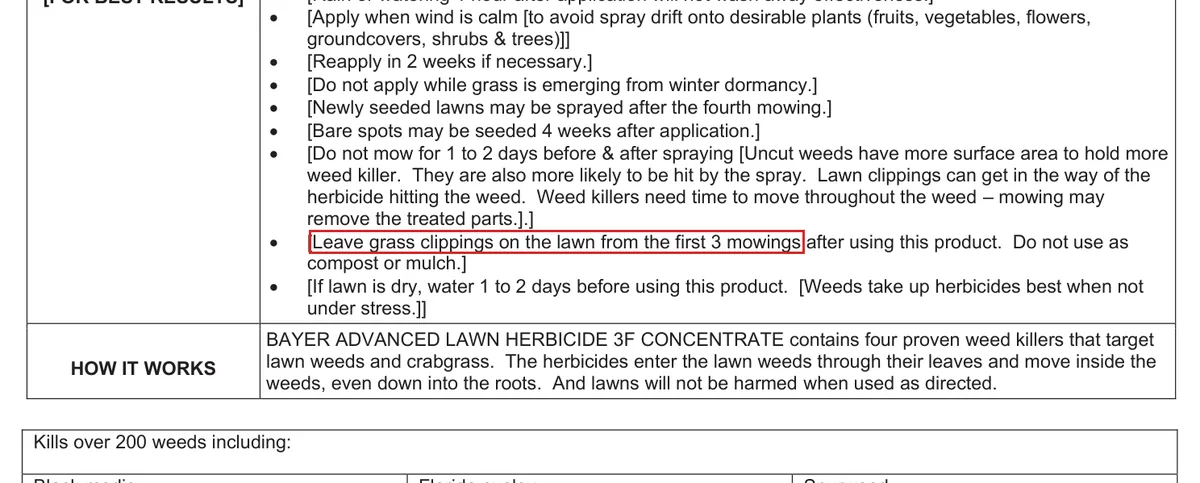
Return them to the lawn, and read the label before they go anywhere else. The label is the law, and wording differs by product: of the 5 labels below, 2 name 3 mowings, 2 set no end date and 1 is silent. UMN Extension says not to mulch with clippings from a lawn recently treated for dandelions or other broadleaf weeds, and gives no day count.
| Product and EPA Reg. No. | Active ingredients | What the label says about clippings |
|---|---|---|
| Lawn Herbicide 3F Concentrate, 92564-34 | 2,4-D, mecoprop-p, dicamba, fenoxaprop-p-ethyl | “Leave grass clippings on the lawn from the first 3 mowings after using this product. Do not use as compost or mulch.” Bracketed as optional label text |
| Spectracide Weed Stop for Lawns Plus Crabgrass Killer, 9688-337-8845 (Reg. No. from a posted copy of the maker’s SDS) | 2,4-D, quinclorac, dicamba, sulfentrazone | “Clippings from the first three mowings should be left on the treated area,” and not used as mulch or compost around flowers, ornamentals or trees, or in vegetable gardens |
| Solitare, 101563-310 | Sulfentrazone, quinclorac | “Do not use clippings as mulch or compost around flowers, ornamentals, trees or in vegetable gardens.” No end date given |
| Scotts Turf Builder Weed & Feed, 538-333 | 2,4-D, dicamba | No mulch or compost line in the 2018 accepted label we read; it says to leave clippings on your lawn |
| Imprelis (stop-sale order Aug. 2011) | Aminocyclopyrachlor | “Do not use grass clippings from treated areas for mulching or compost, or allow for collection to composting facilities” |
The persistent group is the pyridine herbicides aminopyralid, clopyralid and picloram. NC State AG-727 says they can stay active in clippings and compost for anywhere from 30 days to several years, but also that clopyralid products have not been registered for residential lawns since 2002. Golf course and commercial turf clippings are the higher risk, so ask for the product name and EPA Reg. No. before accepting free clippings. If a lawn service treats your turf, ask it the same question. Our lawn weed killer comparison lists the actives by product.
Those same actives come up in forum advice about thistles, though their labels bar home lawns; our page on what kills thistles but not grass lists the lawn labels to use instead.
This page is general information, not legal or pesticide-use advice. The label is the law for any pesticide, and state and local waste rules change; confirm with the agency linked for your state.
How to mulch or compost clippings
To use clippings as garden mulch, follow UMN Extension's conditions in order:
- Confirm no broadleaf herbicide went on recently, using the label table on this page.
- Dry the clippings first. Wet layers mat down, cut off oxygen and moisture, and can decompose anaerobically with a foul smell.
- Spread no more than 1 to 2 inches at one time around vegetables, flowers, shrubs or trees.
Composting is a mix problem. Cornell puts grass at 15 to 25:1 carbon to nitrogen and autumn leaves at 30 to 80:1, against a target near 30:1. Cornell's moisture and C:N worksheets then give two answers for the same 10 kg of grass, and the wetter one is the mistake to avoid.
| Leaves added to 10 kg fresh grass | Resulting C:N | Resulting moisture | What happens |
|---|---|---|---|
| 3.5 kg | 30:1 | Over 66 percent | Hits the C:N target, but wet enough to risk anaerobic odor |
| 6.8 kg | A little under 37:1 | 60 percent | Cornell’s pick: may compost slower, more likely to be trouble free |
So weigh in about 7 lb of dry leaves for every 10 lb of fresh grass, the same ratio in any unit, and never add a thick grass-only layer. For scale, Connecticut exempts a leaf-composting facility from certain permits only if it holds at least 3.0 leaves to 1.0 grass clippings (Conn. Gen. Stat. 22a-208i).
Can grass clippings go in the trash? Rules in 25 states
It depends on the state, then the town. Nationally, EPA counted 35.4 million tons of yard trimmings in 2018: 22.3 million composted or mulched, 10.5 million landfilled and 2.6 million combusted. The table sorts each state by what its rule does to a bag of grass, which is often not what a ban list implies.
Swipe the table sideways to see every column.
| State | Effect on clippings | Rule | In force | What it says |
|---|---|---|---|---|
| Arkansas | Reaches clippings, gas or energy exception | Ark. Code 8-6-220 | By 1994 | Illegal to place yard waste in a facility solely for disposal, beyond fugitive amounts. A landfill with a gas-to-energy system can seek a permit change to accept it. |
| California | Mandatory collection | SB 1383, CalRecycle | Not dated on the CalRecycle page | Jurisdictions must offer organic waste collection, landscape waste included, unless waived for low population or high elevation. NERC 2020 also lists grass as barred at landfills; we did not confirm that in a statute. |
| Connecticut | Landfill rule reaches clippings | Conn. Gen. Stat. 22a-208v | After Oct. 1, 1998 | Facilities other than composters may not accept “significant quantities of grass clippings.” The section is titled for clippings by name. |
| Delaware | Landfill rule reaches clippings | DNREC yard waste page | 2007 | Grass clippings named; banned from all landfills. NERC 2020 reports this as a permit condition at the 3 municipal landfills, not a statute. |
| Florida | Reaches clippings, gas or energy exception | Fla. Stat. 403.708(12)(c) | By 1994; exception 2010 | Barred from lined Class I landfills unless the landfill runs active gas collection with a beneficial use. Incidental amounts are tolerated. |
| Georgia | Landfill rule reaches clippings | O.C.G.A. 12-8-40.2, Georgia EPD | Sept. 1, 1996 | Grass clippings named. Must be separated from trash; barred at lined municipal landfills and vertically expanded landfills, not at every landfill type. |
| Illinois | Landfill rule reaches clippings | 415 ILCS 5/22.22; 5/3.270 | July 1, 1990 | Grass cuttings are landscape waste. No mixing with trash, and any landfill-bound container must be biodegradable. |
| Indiana | Grass left out | IC 13-20-9, IDEM | Not dated on the IDEM page | IDEM: the ban “does not apply to: Grass.” Leaves, and brush over 3 ft, stay banned; local ordinances can be stricter. |
| Iowa | Reaches clippings, gas or energy exception | Iowa Code 455D.9 | 1991; exception 2015 | Cities and counties must require separation. A landfill with a methane system producing energy may accept it, as may storm and pest loads. |
| Maryland | Only separated loads | Md. Env. 9-1724; NERC 2020 | 1992 | State report to NERC limits the ban to separately collected yard waste, which section 9-1724 routes to organics recycling. |
| Massachusetts | Landfill rule reaches clippings | 310 CMR 19.017 | Dec. 31, 1992; transfer stations Apr. 1, 2000 | Covers landfills, combustors and transfer stations. UMass counts grass as yard waste; contaminated loads need a DEP permit. |
| Michigan | Landfill rule reaches clippings | MCL 324.11514; EGLE | 1995 | No more than a de minimis amount. EGLE: only diseased, infested or invasive-control clippings can be landfilled. |
| Minnesota | Landfill rule reaches clippings | Minn. Stat. 115A.931; 115A.03 | Jan. 1, 1990 metro; Jan. 1, 1992 elsewhere | Lawn cuttings count. In metro counties, plastic bags at compost sites must meet ASTM D6400 unless emptied on the spot. |
| Missouri | Reaches clippings, gas or energy exception | RSMo 260.250 | Jan. 1, 1992; exception Aug. 28, 2007 | Allowed only in a state-approved bioreactor whose gas generates electricity. |
| Nebraska | Reaches clippings, gas or energy exception | Neb. Rev. Stat. 13-2039; state agency | Sept. 1994 | Seasonal: municipal landfills may accept it Dec. 1 to Mar. 31. Year-round only with approval for methane fuel, or if separated for composting. |
| New Hampshire | Landfill rule reaches clippings | RSA 149-M:27, NHDES | 1993 | Grass clippings named; landfills and incinerators. Dumping in a wetland without a permit is also illegal. |
| New Jersey | Grass left out | N.J.S.A. 13:1E-99.22 | Ordinances due Apr. 20, 1989 | The statute covers leaves only. Ewing Township treats grass clippings as solid waste: trash as a last resort. |
| North Carolina | Landfill rule reaches clippings | G.S. 130A-309.10(f)(3); NC DEQ | By 1994 | Yard trash barred except at landfills approved for it, or where separated loads go to on-site composting. |
| Ohio | Only separated loads | OAC 3745-27-01; Ohio bar | By 1994 | Landfills may not accept separated yard waste, yet bags mixed with trash count as commingled. The Ohio bar: you can put yard waste in the trash. |
| Pennsylvania | Grass left out | 25 Pa. Code 271.1; 273.201(j) | By 1994 | Bars loads composed primarily of leaf waste, and defines leaf waste as “not including grass clippings.” |
| South Carolina | Landfill rule reaches clippings | S.C. Code 44-96-190 | 24 months after the 1991 act | No knowingly mixing yard trash with landfill-bound trash; landfills may not take loads composed primarily of it without on-site composting. |
| South Dakota | Landfill rule reaches clippings | SDCL 34A-6-67; DANR | 1995 | No landfill may accept yard waste. No energy exception in the section. |
| Vermont | Landfill rule reaches clippings | Act 148, Vermont DEC; timeline | July 1, 2016 | Leaf and yard debris banned from trash. NERC 2020 lists grass. The state gave at least one town a variance (Troy and Jay). |
| West Virginia | Landfill rule reaches clippings | W. Va. Code 22-15A-22(c) | By 1994 | Unlawful in a solid waste facility, except one built to compost or reuse it. Composting at home is listed as a legal route. |
| Wisconsin | Landfill rule reaches clippings | Wis. Stat. 287.07(2), DNR WA-073; Racine | Jan. 3, 1993 | Grass clippings named; landfills and most incinerators. Energy-recovery incinerators are outside the ban. |
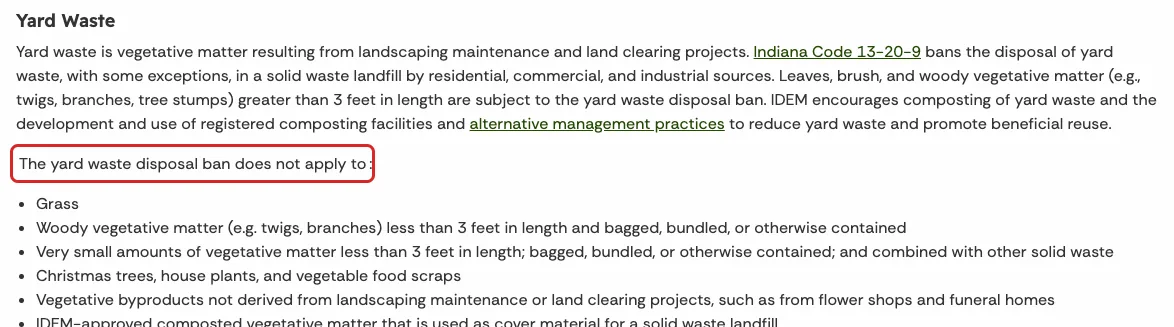
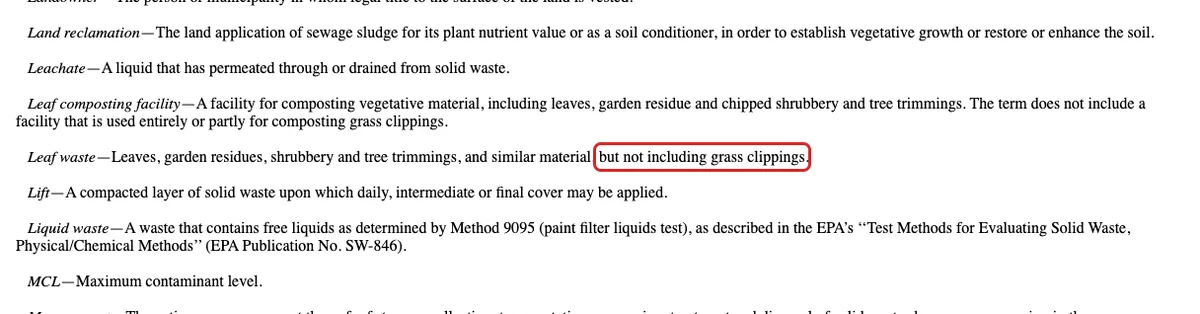
Bags matter in 2 of those states. Illinois requires a biodegradable container for landfill-bound landscape waste, and Minnesota requires ASTM D6400 bags at metro transfer stations and compost sites unless you empty the bag and take it away. Outside the 25, Texas, Tennessee, Arizona and Virginia report no organics ban in the 2020 NERC compendium, while Kansas reports some county bans. That leaves the city code, which can be stricter in any state: IDEM says so outright for Indiana.
Street and drain rules are almost always local. Pioneer, Ohio, section 521.15 bars clippings on public streets and sidewalks and in storm drains and makes the owner answer for vendors, and Dyer, Tennessee, fines up to $50 plus court costs. On private woods you own, no rule we read bars piling your own clippings, but New Hampshire prohibits dumping in a wetland without a permit and 36 CFR 261.11(e) bars dumping debris brought from private property on National Forest land.
How we compiled this
We read 25 state rules or state agency pages, 5 herbicide labels and 14 extension or peer-reviewed publications in November 2026; no field tests were run. Where an official code site did not load for us we linked a FindLaw or Cornell LII copy, and we cross-checked the state list against the state-reported NERC compendium, which dates from 2020. Fresh-weight, nitrogen-value and 5,000 sq ft figures are our arithmetic from Rutgers inputs and carry its limits: 1 site, irrigated Kentucky bluegrass, 1990s plots. The 3F and Scotts master labels carry bracketed optional text, so your container may read differently. We could not open a Michigan State study on 2,4-D residue in clippings, so it is not used.
Frequently asked questions
How do I get rid of a lot of grass clippings?
Bag that cut, then compost it with about 7 lb of dry leaves per 10 lb of grass, use 1 to 2 inches as mulch, or take it to a yard-waste site. A 5,000 sq ft lawn makes about 1,140 lb a year on Rutgers’ numbers, so the lasting fix is mowing often enough to return them (Rutgers).
What do landscapers do with grass clippings?
We found no survey of this. In our lawn mowing cost sample, nearly every company includes blowing clippings off hard surfaces, while bagging varies by company and moves the quote. State landfill rules such as Illinois' apply to any person, so ask a crew that bags where the clippings go.
Can I just leave grass clippings on my lawn?
Yes, when they are 1 inch or shorter. Longer clippings can shade or smother the grass beneath, and UMN Extension advises removing those. Rake out or re-mow clumps.
Does bagging grass clippings prevent weeds?
Research does not support it. Seed already in the soil stays viable for years or decades (Trappe, 2019), and Rutgers counted significantly fewer weeds where clippings were returned (Rutgers).
How long does it take for grass clippings to deteriorate?
A few weeks, according to both University of Minnesota and Oregon State, when clippings are short leaf tissue. Long clippings with wiry stem material decompose more slowly.
Can I put grass clippings in a garbage bag?
In Indiana, New Jersey and Pennsylvania the state ban does not cover grass, and Ohio treats bags mixed with trash as commingled. In Wisconsin, New Hampshire or Massachusetts it is not allowed. In Illinois any landfill-bound container must be biodegradable (415 ILCS 5/22.22). Check the town too.
Sources
- Rutgers Cooperative Extension, The Soil Profile, Vol. 9 No. 1: Use Less Fertilizer and Leave Clippings for a Better Lawn, Spring 1999. Accessed November 2026.
- Kopp and Guillard, Crop Science 42:1225-1231, Clipping Management and Nitrogen Fertilization of Turfgrass, 2002. Accessed November 2026.
- University of Minnesota Extension, What to do with lawn clippings, reviewed 2024. Accessed November 2026.
- University of Minnesota Turfgrass Science (Jon Trappe), Still bagging your grass clippings?, Aug. 8, 2019. Accessed November 2026.
- Oregon State University Extension, Leave grass clippings on the lawn, reviewed 2025. Accessed November 2026.
- Penn State Extension, Recycling Turfgrass Clippings, updated Oct. 15, 2025. Accessed November 2026.
- Penn State Extension, Do Not Toss Yard Waste Over the Horse Fence, Jan. 18, 2021. Accessed November 2026.
- Purdue Extension, AY-22-W, Fertilizing Established Cool-season Lawns, 2013. Accessed November 2026.
- NC State Extension, AG-727, Herbicide Carryover in Hay, Manure, Compost, and Grass Clippings, current edition. Accessed November 2026.
- NC State Extension, Extension Gardener Handbook, Chapter 9: Lawns, current edition. Accessed November 2026.
- Cornell Composting, Compost Chemistry, undated. Accessed November 2026.
- Cornell Composting (Richard and Trautmann), Moisture Content, undated. Accessed November 2026.
- Cornell Composting (Richard and Trautmann), C/N Ratio, undated. Accessed November 2026.
- U.S. EPA, Yard Trimmings: Material-Specific Data, 2018 data. Accessed November 2026.
- Texas A&M AgriLife (hosted by Town of Haslet), Don’t Bag It Lawn Care Plan, undated. Accessed November 2026.
- U.S. EPA, Accepted label, Lawn Herbicide 3F Concentrate, Reg. No. 92564-34, Jan. 17, 2024. Accessed November 2026.
- U.S. EPA, Accepted label, Scotts Turf Builder Weed & Feed, Reg. No. 538-333, Apr. 24, 2018. Accessed November 2026.
- U.S. EPA, Pesticide News Story: Imprelis clippings alert, Aug. 16, 2011. Accessed November 2026.
- Envu, Solitare herbicide label, Reg. No. 101563-310, current label. Accessed November 2026.
- Spectracide, Weed Stop for Lawns Plus Crabgrass Killer product and label text, current page. Accessed November 2026.
- eCFR, 36 CFR Part 261, section 261.11, current. Accessed November 2026.
- Northeast Recycling Council, Disposal Bans and Mandatory Recycling in the United States, July 2020, amended Oct. 2020. Accessed November 2026.
- Waste360, Why Iowa Overturned its Ban on Landfilling Yard Waste, July 21, 2015. Accessed November 2026.
- BioCycle, Organics Recycling In Maryland, undated. Accessed November 2026.
- Connecticut Office of Legislative Research, Report 94-R-0026, Yard Waste, Jan. 14, 1994. Accessed November 2026.
- Indiana Department of Environmental Management, Yard Waste and Composting Facilities, current. Accessed November 2026.
- Pennsylvania Code, 25 Pa. Code 271.1 and 273.201, current. Accessed November 2026.
- State statutes and agency pages, The remaining state sources are linked in the state table, checked Nov. 5, 2026. Accessed November 2026.
- Maker part pages, Cub Cadet 19A70041GFP, Nov. 5, 2026. Accessed November 2026.
- Maker part pages, John Deere BUC11053, Nov. 5, 2026. Accessed November 2026.
- Maker part pages, Toro 139-3265, Nov. 5, 2026. Accessed November 2026.
- Toro, 42in Recycler Kit installation manual, current. Accessed November 2026.