What kills thistles but not grass is a selective lawn herbicide whose label names your thistle: 2,4-D, MCPP and dicamba on most lawns, or triclopyr on cool-season turf. Spray Canada thistle at bud and again in fall; hit bull and musk thistle as rosettes.
We read 11 store-shelf EPA labels and sorted them by thistle, because no bottle covers every species on every grass: Scotts 538-333 names Canada and bull but not musk, and Roundup For Lawns Southern 2217-1010 names bull but not Canada. Two actives that keep coming up in forum threads, clopyralid and aminopyralid, are barred from home lawns by their own labels. Download the matrix, doses and state lists.
General information, not pesticide or legal advice, and no product endorsement. The label is the law: the label on your container overrides this page.
Which thistle is in your lawn?
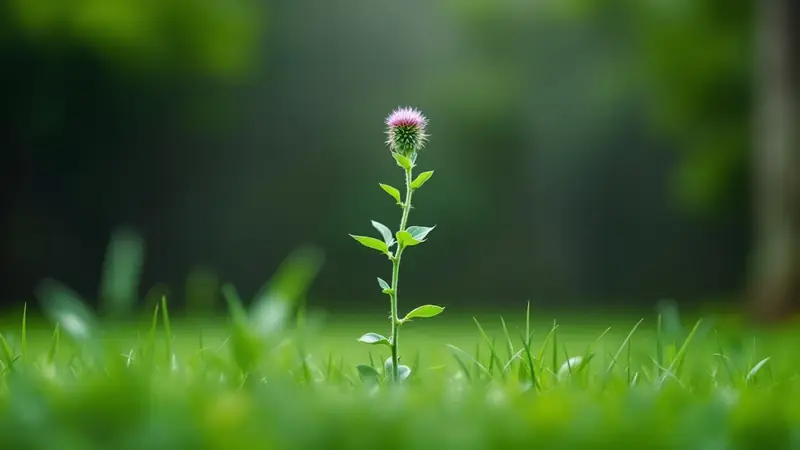
Check the stem first. Penn State separates them this way: Canada thistle has a smooth stem between the leaves and flower heads under 1 inch, while the biennials carry spiny wings along the stem. Canada thistle is the hard one, since one plant can colonize a circle 3 to 6 feet wide in 1 or 2 years (CSU). Bull and musk thistle spread only by seed and die after seeding, which makes them “much easier to control” (Iowa State).
| Thistle | Life cycle | Fastest tell | Flower head | Roots | Source |
|---|---|---|---|---|---|
| Canada thistle (Cirsium arvense) | Perennial | Stem smooth between the leaves, no spiny wings; grows in patches | 0.5 to 1 in tall, in clusters; bracts without sharp spines | Roots 15 ft or more sideways, 6 to 15 ft down | CSU; Iowa State; Penn State |
| Bull thistle (Cirsium vulgare) | Biennial | Hairy leaves, each narrow tooth tipped with a sharp spine; wings on upper stem | 2 to 3 in tall, gumdrop shape; long, stiff spine on each bract | Taproot, no spreading roots | Iowa State |
| Musk thistle (Carduus nutans) | Biennial | Silvery or white leaf margins; spiny wings; heads droop | 1 to 2 in tall, 2 to 3 in wide; broad, sharp bracts | Large, corky taproot, hollow near the crown | Iowa State; CSU |
| Annual sowthistle (Sonchus oleraceus) | Annual | Only very small spines on leaf edges; white sap when broken | Yellow, 0.75 in or smaller | Shallow taproot | Penn State; Cornell |
| Perennial sowthistle (Sonchus arvensis) | Perennial | Prickly teeth pointing toward the leaf base; white sap | Bright yellow, dandelion-like, 1 to 2 in wide | Up to 10 ft deep and 9 ft sideways | Cornell |
1Do broken stems or leaves ooze white sap, with yellow dandelion-like flowers?
YesSowthistle. Annual type: hand-pull the shallow taproot. Perennial type (flower heads 1 to 2 in, deep roots): check that your label covers it, and repeat as with Canada thistle.
NoGo to the next question
2Is the stem smooth with no spiny wings, in a patch, with flower heads under 1 inch?
YesCanada thistle. Spray a label that names it at flower bud and again in fall, for several years.
NoGo to the next question
3Are spiny wings on the stem, and is it still a flat rosette?
YesBull or musk thistle. Spray in fall or early spring, or sever the root below the crown.
NoGo to the next question
4Are spiny wings on the stem, and has it bolted into a flower stalk?
YesBull or musk thistle past the spray window. Cut below the crown with a spade before seed forms; musk starts 45 to 55 days after bolting.
NoNot one of these. Take a photo to your county extension office before you buy; some native thistles are not lawn invaders.
Which lawn labels name which thistle?
This table is the page’s core: each label’s own weed list, checked against 4 thistle groups, with its grass exclusions and yearly cap. “Named” means the species appears on the EPA master label. The Ortho triclopyr and Scotts master labels both warn that some or all listed weeds will appear on the package, so the container in your hand can list fewer. Rates are per 1,000 sq ft of lawn.
| Product (EPA Reg. No.) | Actives | Canada | Bull | Musk | Sowthistle | Do not use on | Yearly limit | Rate per 1,000 sq ft |
|---|---|---|---|---|---|---|---|---|
| Ortho WeedClear / Weed B Gon Lawn Weed Killer concentrate (239-2744) | 2,4-D, MCPP-p, dicamba | Named | Named | Named | Named (common) | Bentgrass, carpetgrass, dichondra, lippia, seashore paspalum, Floratam | 2 a year, 30 days apart | 4 fl oz cool-season; 2 fl oz warm-season; 1 fl oz centipede or St. Augustine on the pressure-sprayer chart |
| Spectracide Weed Stop For Lawns Concentrate2 (9688-342-8845) | 2,4-D, MCPP-p, dicamba, sulfentrazone | Named | Named | Named | Named (annual, spiny) | Floratam, Bitterblue, carpetgrass, dichondra | 2 a year, 2 weeks apart | 4 fl oz cool-season and zoysia; 2 fl oz bahia, bermuda, centipede; 1.5 fl oz St. Augustine |
| Gordon’s Trimec Lawn Weed Killer (2217-539-33955) | 2,4-D, MCPP-p, dicamba | Named | Named | Named | Named (annual, spiny) | Carpetgrass, dichondra, Floratam in Florida | 2 a year, 30 days apart | 4 fl oz cool-season, bahia, bermuda, zoysia; 2 fl oz centipede or St. Augustine |
| BioAdvanced Southern Weed Killer for Lawns (92564-4) | 2,4-D, MCPP-p, dicamba | Named | Named | Named | Named (spiny and unspecified) | Carpetgrass, dichondra, Floratam | 2 a year, 30 days apart | 4 fl oz northern grasses, bermuda, buffalo, zoysia; 2 fl oz bahia, centipede, St. Augustine |
| Preen Lawn Weed Control granules (961-418) | 2,4-D, MCPP-p, dicamba | Named | Named | Named | Named (spiny and unspecified) | Carpetgrass, dichondra, St. Augustine | 2 a year, 30 days apart | 2 lb granules |
| Scotts Turf Builder Weed & Feed5 (538-333) | 2,4-D, dicamba, fertilizer | Named | Named | No | Named (unspecified) | Creeping bentgrass, St. Augustine, dichondra, carpetgrass, lippia | 2 a year | 2.82 lb granules, on wet grass |
| Roundup For Lawns1, Northern (no glyphosate) (2217-917-71995) | MCPA, quinclorac, dicamba, sulfentrazone | Named | Named | Named | Named (annual, spiny) | Bentgrass, St. Augustine, bahia, centipede, carpetgrass, dichondra | 2 spot sprays a year, 21 days apart | Ready to use; at most 1 gal |
| Roundup For Lawns Southern concentrate (no glyphosate) (2217-1010-71995) | 2,4-D, dicamba, penoxsulam, sulfentrazone | Only as “Thistle” | Named | Only as “Thistle” | No | Bentgrass, carpetgrass, dichondra (Floratam allowed) | 2 broadcasts a season, 30 days apart | 5.2 to 8.6 fl oz St. Augustine; 7.2 to 10.6 fl oz bluegrass |
| Ortho Weed B Gon Chickweed, Clover & Oxalis Killer (239-2491) | Triclopyr | Lawn sublabel: “Thistle”; brush sublabel: Canada | Only as “Thistle” | Only as “Thistle” | No | Bahia, bermuda, centipede, kikuyu, St. Augustine | Repeat after 2 to 3 weeks; 5.4 fl oz per 100 sq ft a year | 1 fl oz in 1 gal per 200 sq ft (5 fl oz per 1,000) |
| Southern Ag 2,4-D Amine (signal word Danger) (48273-4-829) | 2,4-D amine | Warned: “usually require repeated applications” | Named | Named | Named (annual) | Injury warning: bentgrass, St. Augustine, carpetgrass, centipede, dichondra, clovers | 2 a year | 3 pints per acre (6.5 tsp) |
| Sunday Dandelion Doom (67702-27-93737) | Iron HEDTA | Named, not in California | Named | No | No | Bentgrass, dichondra | Repeat in 3 to 4 weeks | Ready to use; spray weeds thoroughly |
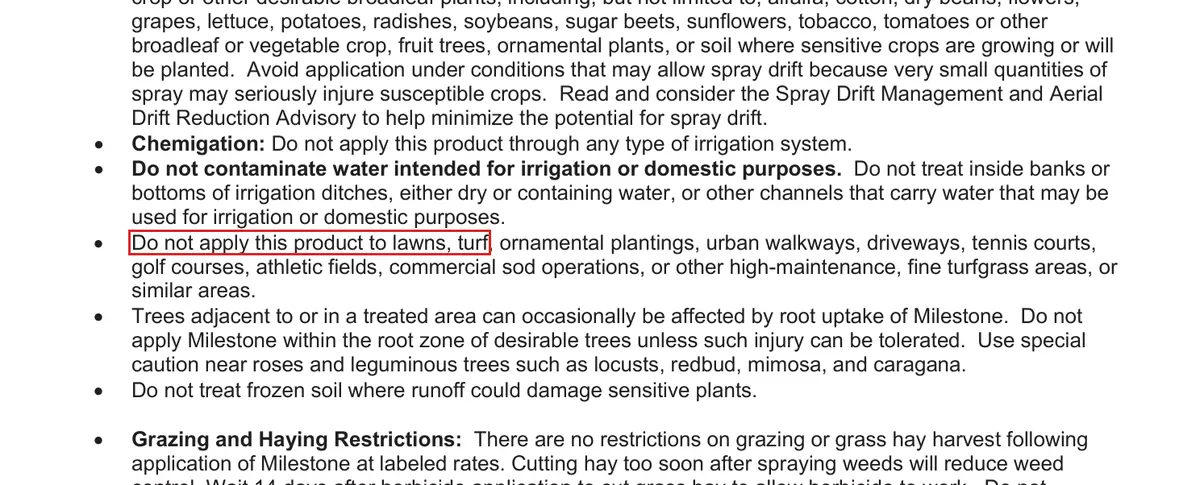
For Canada thistle on bluegrass, fescue or ryegrass, the 2,4-D, MCPP and dicamba concentrates from Ortho and Gordon’s name it at 4 fl oz per 1,000 sq ft, and Iowa State lists those actives as effective. On St. Augustine the rate falls to 1 to 2 fl oz, and Floratam is off most labels. Of these 11, only Roundup For Lawns Southern names Floratam as allowed, and it does not name Canada thistle. No label here names perennial sowthistle; 4 list plain “sowthistle”, so ask the registrant whether that covers it.
Triclopyr suits cool-season lawns only: the Ortho label excludes bahia, bermuda, centipede, kikuyu and St. Augustine, but it permits seeding 1 week after spraying, against 3 to 4 weeks for the three-way. SDSU warns that “Brush Killer” bottles are likely not approved for lawns and that ester triclopyr is the more volatile form near trees. Our weed killer comparison covers the wider product set. Professional labels naming Canada thistle include Turflon Ester Ultra (62719-566), Tenacity (100-1267) and Celsius WG (432-1507).
Why not clopyralid or aminopyralid?
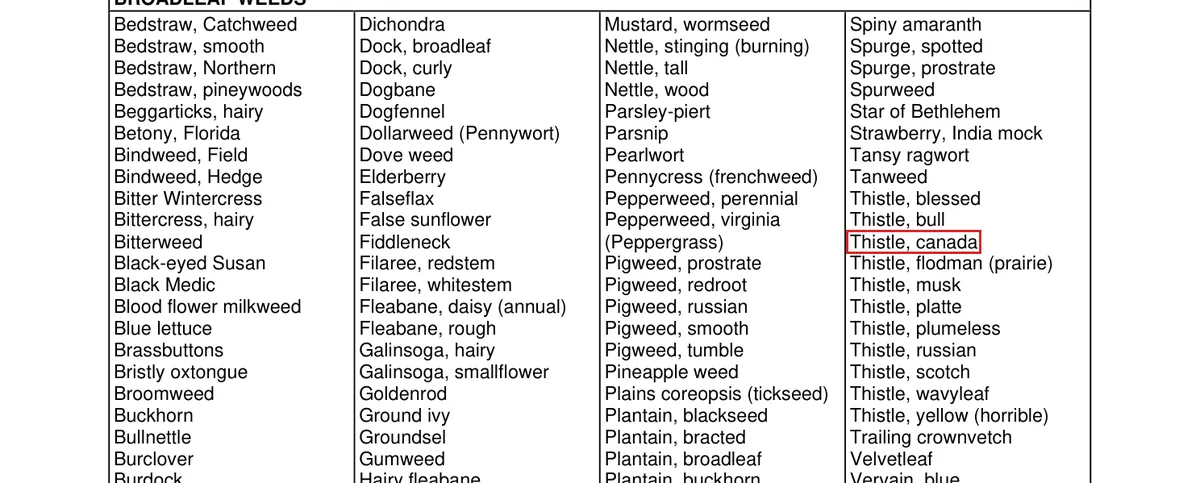
Because the labels forbid it on home lawns, even though they are the thistle specialists. SDSU lists clopyralid as the best active for Canada thistle, then notes Lontrel cannot go on residential turf. EPA wrote in its December 2020 interim decision that residential lawn uses of clopyralid have been canceled. A license does not change this on these labels: the Confront restriction is on the site, not the person.
One conflict to settle: Penn State’s home-garden page calls clopyralid and aminopyralid “often used for lawn settings,” while Penn State’s turf fact sheet says certain clopyralid products should not go on residential turf and NativeKlean should not go on home lawns. We side with the labels below.
| Product or active | Thistle record | On your home lawn? | Source |
|---|---|---|---|
| Confront, triclopyr + clopyralid (62719-92) | Label lists Canada and musk thistle | No: “Do not use on residential turf.” Also bars clippings from compost and mulch | Label |
| Lontrel, clopyralid | SDSU: better thistle control than common lawn blends | No: cannot be applied to residential turfgrass | SDSU |
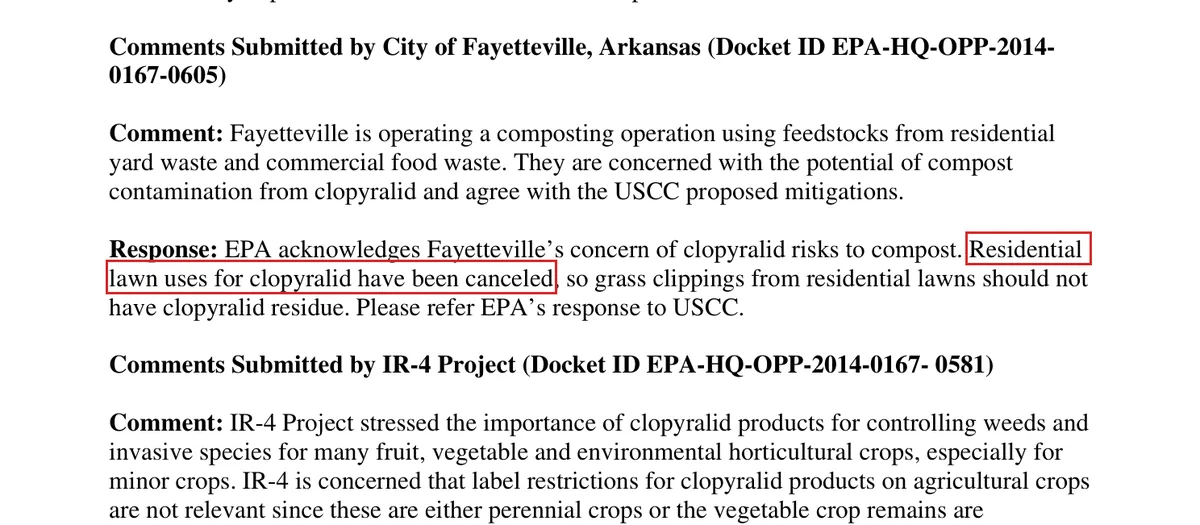
| Milestone, aminopyralid (62719-519) | 88 to 93% Canada thistle control in western pasture and range work, per Landschoot 2023 | No: “Do not apply this product to lawns, turf, ornamental plantings” | Label; GCM |
| NativeKlean, aminopyralid + 2,4-D | Fast burndown in Penn State trials | No: native or natural areas that are not regularly mowed | Penn State; GCM |
| Glyphosate (standard Roundup) | Bud to flower spot treatment works on thistle | Only if you accept dead grass: it is non-selective | Iowa State |
| Vinegar | Top growth only; roots regrow | Not advised: it can kill the surrounding turf | Ask Extension |
You may give up less than that sounds. In Penn State trials on Chewings fescue rough in 2021 and 2022, AquaSweep (triclopyr + 2,4-D) produced injury comparable to Lontrel and Confront in both years. The limits matter: one spray per season, foliar injury ratings to 40 and 55 days, no root counts, a golf rough rather than a lawn, and AquaSweep itself is not labeled for Canada thistle.
Why a lawn spray takes years on Canada thistle
Lawn labels deliver less 2,4-D than the pasture programs behind most thistle advice. At the rates below, the common concentrates apply 0.74 to 0.84 lb acid equivalent per acre, about 37 to 42 percent of the 2 lb per acre in CSU‘s pasture program. That is one plausible reason SDSU expects “several applications over multiple years” from store blends. It is our inference, not a trial result, and raising the dose is not the fix: the Ortho label says exceeding directed rates may damage turf.
| Program | 2,4-D, lb acid equivalent per acre, one application | How we got it |
|---|---|---|
| Roundup For Lawns Southern, 10.6 fl oz (2217-1010) | 0.40 | As stated on the label |
| Gordon’s Trimec, 4 fl oz (2217-539) | 0.74 | As stated on the label |
| Spectracide Concentrate2, 4 fl oz (9688-342) | 0.74 | As stated on the label |
| Ortho concentrate, 4 fl oz (239-2744) | 0.84 | As stated on the label |
| Preen granules, 2 lb (961-418) | 1.20 | As stated on the label |
| Southern Ag Amine, 3 pints per acre (48273-4) | 1.43 | 3 pints x 3.8 lb acid equivalent per gallon, our arithmetic |
| Scotts Weed & Feed5 (538-333) | 1.50 | As stated on the label |
| CSU pasture program, Canada thistle, 2 qt per acre | 2.00 | Assumes the common 4 lb per gallon product |
| Iowa State pasture program, biennial thistles, top of 1 to 2 qt | 2.00 | Iowa State states 4 lb acid equivalent per gallon |
When to spray each thistle
| Thistle | Spray window | Too late or wrong | Source |
|---|---|---|---|
| Canada | Fall while leaves are green, even after first frost; and early summer as flower buds form (late May to mid-June in New Jersey) | Spring-only spraying: new shoots keep coming from root buds, so one spring application rarely lasts the season | Iowa State; Rutgers; GCM |
| Bull, musk | Rosettes in fall, even after several frosts, or early spring before bolting | After bolting, when tolerance rises sharply. Cut instead: musk starts making seed 45 to 55 days after bolting | Iowa State; CSU |
| Annual sowthistle | Hand-pull; the shallow taproot comes out easily. Seedlings form a low rosette that often goes unnoticed | Waiting until late summer to October, when yellow flowers set wind-borne seed | Penn State |
| Perennial sowthistle | We found no lawn-specific timing study. Spray while actively growing, per label, if your label covers it | No spray window to miss, but non-chemical work is slow: hay mown 3 times a season for 2 years substantially cut density | Cornell |
Most three-way labels allow only 2 applications a year, at least 30 days apart (Ortho, Gordon’s, BioAdvanced), so spend them on the 2 Canada thistle windows: bud stage, then fall. Ask Extension told a Denver homeowner to plan on 2, more likely 3, applications. Spray day runs like this:
- Match the grass and thistle to your container’s label. Mixed lawn: BioAdvanced says use the lowest rate.
- Check the forecast: under 90°F on most labels, 85°F on St. Augustine with Roundup For Lawns Southern and on bermuda with Roundup For Lawns1. Montana State goes lower, at 80°F, to limit dicamba vapor drift. For fall sprays, SDSU wants highs above 60°F for several days around the application.
- Do not mow for 2 days before or after (Ortho). Skip it above 10 mph wind (Ortho triclopyr).
- Mix fresh, use a coarse nozzle, and wet the thistle without runoff. Keep it off exposed tree roots and ornamentals.
- Keep it dry: 24 hours on Ortho, 6 hours on Ortho triclopyr, 3 hours on Roundup For Lawns1.
- Wait 30 days. Ortho says repeat if tough weeds are not dead by then; dead Canada thistle stems can stay rigid and upright for much of the summer (Penn State).
- Seed bare patches only after the label wait, then follow our overseeding steps. A dense canopy starves thistle seedlings of light (Penn State).
How much to mix for a thistle patch
The label rate is small per square foot: 4 fl oz per 1,000 sq ft is 0.024 teaspoons per sq ft. Measure the patch, then use the rate your label gives for your grass. Gordon’s defines a spot treatment as no more than 1,000 sq ft per acre, and the 4 fl oz per 1,000 sq ft ceiling still applies.
- Concentrate (fl oz)
- 0.40
- Concentrate (teaspoons)
- 2.4
- Concentrate (tablespoons)
- 0.8
Default: 100 sq ft at 4 fl oz per 1,000 sq ft needs 0.40 fl oz, or 2.4 teaspoons. Label rates, read November 2026. Your container's label overrides this tool; water volume also differs by label.
| Patch | Concentrate at 4 fl oz per 1,000 sq ft | Concentrate at 2 fl oz per 1,000 sq ft | Spray volume at Ortho’s 1 gal per 1,000 sq ft |
|---|---|---|---|
| 25 sq ft | 0.1 fl oz (0.6 tsp) | 0.05 fl oz (0.3 tsp) | 3.2 fl oz |
| 100 sq ft | 0.4 fl oz (2.4 tsp) | 0.2 fl oz (1.2 tsp) | 12.8 fl oz |
| 250 sq ft | 1 fl oz (2 Tbsp) | 0.5 fl oz (1 Tbsp) | 1 qt |
| 1,000 sq ft | 4 fl oz (8 Tbsp) | 2 fl oz (4 Tbsp) | 1 gal |
Do mowing, pulling or digging work?
On biennials, yes, and fast. On established Canada thistle, only as a multi-year campaign, because root pieces 0.25 inch long can restart a plant and shoots return about 15 days after disturbance (CSU). Sources disagree on the cutting interval, so the table gives each one.
| Method | Thistle | Schedule or threshold | Result reported | Source |
|---|---|---|---|---|
| Hand-pull | Canada seedlings | Before 3 leaves, on a regular schedule, spring through fall. Seedlings turn perennial 7 to 8 weeks after germination | Drastic reduction over 2 years | Rutgers; CSU |
| Pull or dig | Canada, a few plants | Every 2 to 3 weeks, or when new stems show; bag the plants | Useful only for small numbers | Montana State |
| Cut, do not pull | Canada, home garden | Every 2 to 3 weeks with shears or a trimmer. Pulling can stimulate root buds | 2, 3 or more years | Penn State |
| Mow or trim | Canada, established | Every 7 to 10 days, late spring through bloom | Stops seed; lowers root reserves | Rutgers |
| Mow | Canada, established | 6 or more times a season for several years | May control it; fewer mowings only contain it | Iowa State |
| Mow plus spray | Canada, high water table | Start at 12 to 15 in tall, monthly, 3 times, then Curtail in October (pasture, not lawns), 2 years running | Better than Curtail alone | CSU |
| Shovel or hoe | Bull, musk | Sever the root below the crown, once | Removes the plant | Iowa State; CSU |
| Mow | Bolted bull, musk | At least 2 mowings in summer, since crown buds resprout | Stops seed | Iowa State |
Routine lawn mowing helps young plants more than old ones: Iowa State says frequent mowing can exhaust young Canada thistle and prevent bloom, while established stands are often unfazed. Our mowing frequency page covers intervals. Buried seed can last 20 to 22 years (Rutgers; CSU), though most near the surface die within a few years, so scout every spring.
Does your state make you control thistles?
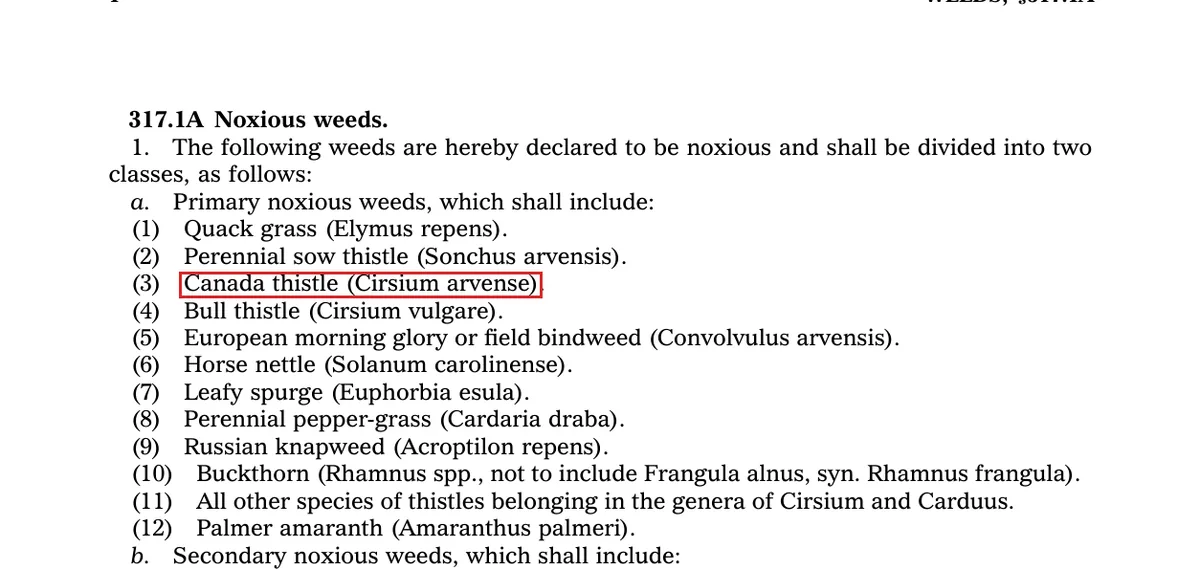
In many states, yes, and a thistle in your lawn can be a legal matter as well as a nuisance. Maryland requires landowners to eradicate or control listed thistles, Minnesota says Canada and plumeless thistle must be controlled on all lands, and Illinois lets counties do the work and bill the owner. These 11 are a sample from states whose official or extension lists loaded for us, not a national survey; ask your county weed office what applies locally.
| State | Thistles on the state list | Rule or duty as written | Source |
|---|---|---|---|
| Iowa | Primary noxious: perennial sowthistle, Canada, bull and every other Cirsium and Carduus thistle | Iowa Code 317.1A | Source |
| Illinois | Canada, musk, perennial sowthistle | 505 ILCS 100; counties may manage infestations and bill the landowner | Source |
| Pennsylvania | Canada, musk, bull | 7 Pa. Code 110.1 | Source |
| Ohio | Canada, musk, perennial sowthistle | Ohio Adm. Code 901:5-37-01; management required on public and private land | Source |
| Minnesota | Canada, plumeless (Prohibited Control) | Must be controlled on all lands in the state | Source |
| Nebraska | Canada, musk, plumeless | Nebraska Department of Agriculture state list | Source |
| Colorado | List B: bull, Canada, musk, plumeless, Scotch. List C: perennial sowthistle | List B must be managed to stop spread | Source |
| Kansas | Category B: Canada. Category C: musk | K.A.R. 4-8-44 | Source |
| Maryland | Bull, Canada, musk, plumeless | Landowners must eradicate or control; mowing, cultivating or an approved herbicide count | Source |
| Washington | Class C: bull, Canada, perennial sowthistle | WAC 16-750-015 | Source |
| Oregon | List B: bull, Canada, musk, Scotch, Italian, milk, slender-flowered. List A: plumeless | Oregon Department of Agriculture list | Source |
Paying someone to spray changes the paperwork, not the chemistry: at least 49 of 51 jurisdictions require a commercial credential for store-bought weed killer applied for pay. Ask any bidder which EPA Reg. No. they plan to use, and refuse Confront or Milestone on a home lawn.
How we compiled this
We read 21 EPA lawn, turf and pasture herbicide labels and searched each for every thistle name, plus 11 state lists and 14 extension and trade-research pages, in November 2026. We ran no field tests. Michigan State, Minnesota and Oklahoma State extension pages refused our scripts, so we did not use them. Dose figures come from the labels; the pasture comparison and the percent-of-pasture inference are our arithmetic and are not a measured control rate.
Frequently asked questions
What kills thistles permanently?
No single spray does. Bull and musk thistle die for good when you sever the root below the crown or kill the rosette, but the seed bank can return them. Established Canada thistle takes 2, 3 or more years of repeat work (Penn State), and buried seed can last 20 to 22 years.
What is the best weedkiller to kill thistles?
On a home lawn, the best legal choice is a 2,4-D, MCPP and dicamba concentrate whose label names your thistle and allows your grass. SDSU rates clopyralid higher for Canada thistle, but its labels bar residential turf. On cool-season lawns, triclopyr is the alternative.
Dandelions take the same products on a different calendar, and our guide on how to kill dandelions but not grass sorts 12 dandelion labels by grass type.
Is it better to pull thistles or cut them?
Cut established Canada thistle: Penn State says pulling can stimulate root buds to send up new shoots. Pull only young shoots before 3 leaves (Rutgers). For bull and musk thistle, sever the root below the crown with a spade (Iowa State).
When’s the best time to spray thistles?
Fall, for all of them. Iowa State calls fall the most susceptible time for Canada thistle, with early summer at flower bud second, and sprays still work after first frost if leaves are green. Bull and musk rosettes also respond in early spring before bolting.
How do you stop thistles from growing back?
Use both yearly label applications for several years, then cut seed sources and thicken the grass. Penn State found denser fescue canopies held less thistle than open ones, and Iowa State advises removing each new plant while young.
How long does it take for vinegar to kill thistle?
Hours for the leaves, but not the roots. Our vinegar page cites USDA ARS seeing 20 percent vinegar kill Canada thistle top growth in about 2 hours, and regrowth from roots follows. Ask Extension advises against it in lawns because it can kill surrounding turf.
Sources
- EPA, Ortho WBG 553 Concentrate label, Reg. 239-2744, Aug. 2023. Accessed November 2026.
- EPA, Ortho Brush-B-Gon and Chickweed, Clover & Oxalis label, Reg. 239-2491, Aug. 2024. Accessed November 2026.
- EPA, Chemsico Lawn Weed Killer Concentrate (Spectracide) label, Reg. 9688-342, June 2021. Accessed November 2026.
- EPA, Gordon’s BL 8000 Lawn Weed Killer label, Reg. 2217-539, Aug. 2021. Accessed November 2026.
- EPA, Lawn Herbicide JD Concentrate (BioAdvanced Southern) label, Reg. 92564-4, June 2026. Accessed November 2026.
- EPA, Turf Broadleaf Weed Control (Preen) label, Reg. 961-418, July 2020. Accessed November 2026.
- EPA, Turf Builder Weed & Feed 211 label, Reg. 538-333, Sept. 2026. Accessed November 2026.
- EPA, EH-1462 Herbicide (Roundup For Lawns1) label, Reg. 2217-917, Sept. 2025. Accessed November 2026.
- EPA, EH-1573 Herbicide (Roundup For Lawns Southern) label, Reg. 2217-1010, June 2024. Accessed November 2026.
- EPA, Amine 4 D (2,4-D amine) label, Reg. 48273-4, Sept. 2008. Accessed November 2026.
- EPA, NEU1173H RTU (Sunday Dandelion Doom) label, Reg. 67702-27, Sept. 2026. Accessed November 2026.
- EPA, Turflon Ester Ultra label, Reg. 62719-566, March 2019. Accessed November 2026.
- EPA, Tenacity label, Reg. 100-1267, Sept. 2022. Accessed November 2026.
- EPA, Celsius WG label, Reg. 432-1507, Sept. 2021. Accessed November 2026.
- EPA, Milestone label, Reg. 62719-519, June 2020. Accessed November 2026.
- Dow AgroSciences, Confront Specialty Herbicide label, Reg. 62719-92 (distributor copy), undated. Accessed November 2026.
- EPA, Clopyralid Interim Registration Review Decision, Case 7212, Dec. 2020. Accessed November 2026.
- Penn State Extension, Lawn and Turfgrass Weeds: Canada Thistle, undated. Accessed November 2026.
- Penn State Extension, Removing Canada Thistle from the Home Garden, undated. Accessed November 2026.
- Penn State Extension, Annual Sowthistle, Oct. 2025. Accessed November 2026.
- Iowa State Extension, Control Canada Thistle, undated. Accessed November 2026.
- Iowa State Extension, Biennial Thistles of Iowa, undated. Accessed November 2026.
- Iowa State Extension, Spring Control of Canada Thistle, May 2021. Accessed November 2026.
- Colorado State University Extension, Canada Thistle, reviewed Aug. 2025. Accessed November 2026.
- Colorado State University Extension, Musk Thistle, undated. Accessed November 2026.
- South Dakota State University Extension, Perennial Weed Control in Lawns and Turf With Fall Herbicide Applications, undated. Accessed November 2026.
- Golf Course Management, Landschoot, Canada thistle control in fine fescue rough, May 2023. Accessed November 2026.
- Rutgers NJAES, Fact Sheet FS1344, Canada Thistle, undated. Accessed November 2026.
- Montana State University Extension, Managing Canada Thistle in Lawns, Aug. 2020. Accessed November 2026.
- Cornell University, Perennial Sowthistle weed profile, undated. Accessed November 2026.
- Ask Extension, Question 848221, thistle in a suburban lawn in Denver, Sept. 2023. Accessed November 2026.
- Iowa Legislature, Iowa Code 317.1A, current. Accessed November 2026.
- University of Illinois Extension, Invasive plant regulations, Illinois Noxious Weed Law, current. Accessed November 2026.
- Pennsylvania Code, 7 Pa. Code 110.1, current. Accessed November 2026.
- Ohio Department of Agriculture, Noxious Weeds, OAC 901:5-37-01, current. Accessed November 2026.
- Minnesota Department of Agriculture, Minnesota Noxious Weed List, current. Accessed November 2026.
- Nebraska Department of Agriculture, Noxious Weeds, current. Accessed November 2026.
- Colorado Department of Agriculture, Colorado Noxious Weed List, current. Accessed November 2026.
- Cornell LII, Kan. Admin. Regs. 4-8-44, current. Accessed November 2026.
- Maryland Department of Agriculture, Noxious Weed Control, current. Accessed November 2026.
- Washington Legislature, WAC 16-750-015, current. Accessed November 2026.
- Oregon Department of Agriculture, Oregon Noxious Weeds, current. Accessed November 2026.