How to dethatch a lawn: cut a plug first and act only if the compressed brown layer tops 1/2 inch. Then run a vertical mower set for your grass in its growing window, rake, water, and feed one week later.
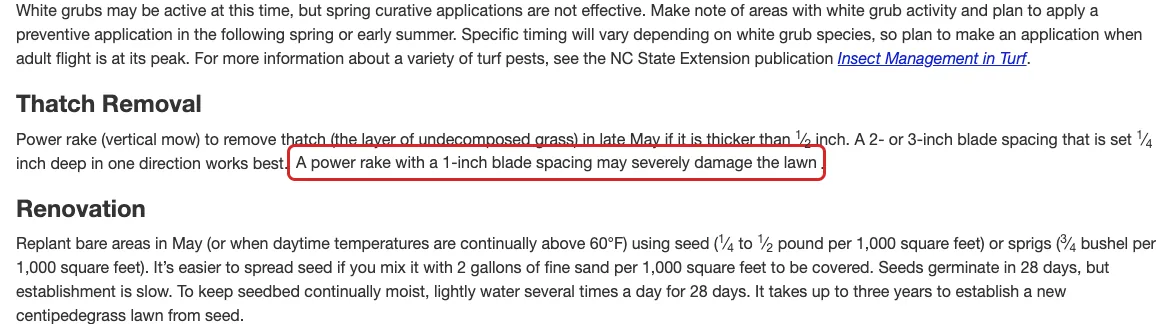
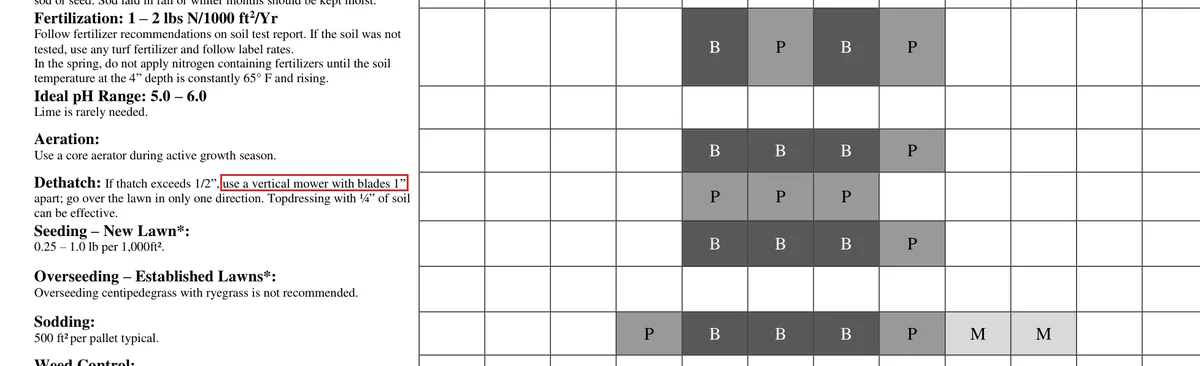
The check most guides skip comes after the plug: the reel. Clemson and NC State want blades 2 to 3 inches apart on centipedegrass, and UF/IFAS wants 3 inches on St. Augustinegrass. The standard reels on Sunbelt Rentals’ dethatcher spec sheet list 11/16 inch or 1 inch where a spacing is stated. NC State warns that 1-inch spacing “may severely damage” centipedegrass. So the order here is plug, tool, reel, month. Prices live in our dethatching cost guide.
Step 1: Cut a plug and measure the thatch
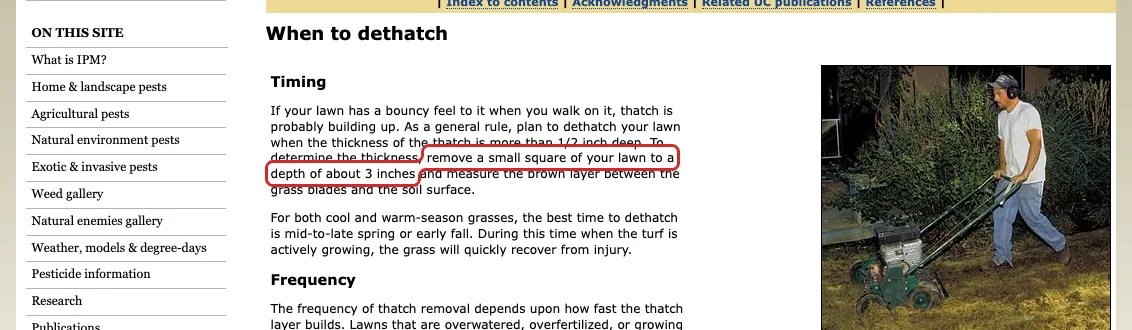
- Cut a wedge with a knife or spade, 2 inches deep (Minnesota) to 3 inches deep (UC IPM). It must reach mineral soil (Arkansas FSA-6139).
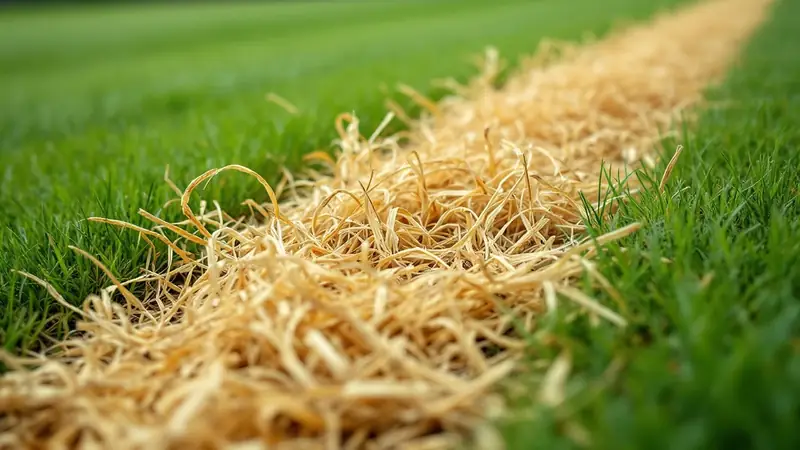
- Find the layer between the green stems and the soil. It looks stringy or felt-like (Oklahoma State HLA-6604) and light brown, like peat moss (K-State).
- Press it, then read a ruler. UMass takes its 1/2 to 3/4 inch reading “when you compress it,” so an uncompressed plug can push you over the line.
- Repeat in several spots. Oklahoma State says to lift several plugs however healthy the lawn looks; take one each from the front, the back and any shade.
- Set each plug back and water it.
A bouncy walk is a clue, not a measurement. C-shaped white larvae in the wedge point to a different problem, covered in our lawn grubs guide. Tall fescue rarely gets this far: NC State says removal is “generally not necessary” on it, and UGA prints the same words.
| Compressed depth | Who treats this as the line | What they say |
|---|---|---|
| 1/3 inch | Oklahoma State | Cool-season limit: fescue, bluegrass, ryegrass |
| 1/2 inch | UC IPM, Clemson HGIC 2360, Minnesota, Texas A&M E-139, Arkansas, Colorado State, NC State (bermudagrass, zoysiagrass, centipedegrass), UGA, Oklahoma State (warm-season) | Dethatch, or start managing it. The default trigger for home lawns |
| 1/2 to 3/4 inch | UMass, Pacific Northwest handbook, NC State (St. Augustinegrass, 3/4) | Upper edge of acceptable; plan removal past it |
| 1 inch | Penn State, UF/IFAS LH010 (St. Augustinegrass), Milorganite, Sunday | Penn State: past this, “turf problems will likely result.” Two brand how-to pages use it as the trigger |
A guide that says to wait for 1 inch sits at the loose end: 9 of the 13 land-grant services above act at 1/2 inch or less on most grasses. Use 1/2 inch unless your state’s service says otherwise. Waiting has a cost, since Penn State says preventive care alone will not control a layer of 1 inch or more.
1Does the compressed plug read 1/2 inch or less?
YesLeave the thatch. Core aerate if the soil is compacted (K-State) and cut a new plug next year.
NoGo to the next question
2Is the grass weak, drought stressed or not yet fully green?
YesWait. Dethatch only when it is actively growing with 3 to 4 weeks to recover (Penn State, LSU).
NoGo to the next question
3Is the layer over 1 inch?
YesPlan partial passes over 2 to 3 years (Oklahoma State), or strip it with a sod cutter and re-establish (Purdue).
NoGo to the next question
4Is the lawn or patch small?
YesUse a thatching rake (UC IPM, Clemson).
NoGo to the next question
5Is it St. Augustinegrass or centipedegrass?
YesUse 2 to 3 inch blade spacing, one direction (Clemson, NC State). If the rental reel is tighter, test a hidden strip or ask a lawn company.
NoUse a vertical mower with blades 1 to 2 inches apart, start high, and make a second perpendicular pass only if thatch remains (Clemson, Penn State, UC IPM).
Step 2: Pick the tool from the depth
| Compressed depth or job | Tool | The trade-off | Source |
|---|---|---|---|
| 1/2 inch or less | No dethatcher. Core aerate if the soil is also compacted | Slow: 1 pass with 1/2-inch tines at 2-inch spacing removes about 10% of thatch | K-State; Colorado State |
| Small lawn or patch | Thatching rake with thick blades | Hand labor; no published square-foot limit, only “small” | UC IPM; Clemson |
| Over 1/2 to 1 inch, large lawn | Vertical mower with knives or fixed blades | Lawn looks ragged; reseeding may be needed | Purdue AY-8 |
| Light debris only | Spring-tine or wire power rake | Arkansas: usually ineffective at removing a large amount of thatch | Arkansas; Penn State |
| Over 1 inch | Several partial passes over 2 to 3 years, or a sod cutter and a new lawn | Partial: years of work. Sod cutter: full re-establishment | Oklahoma State; PNW; Purdue |
| 2 inches or more | Vertical mower plus a seeding plan | Most roots sit in the thatch, so removal severely thins turf | Penn State |
| Spring blade on a rotary mower | Skip it | “Quite destructive” (Minnesota); “may be hazardous” to you and the mower (PNW) | Minnesota; PNW; Purdue |
“Power rake” is not one machine. NC State and Minnesota use it as another name for a vertical mower, Utah State means hinged blades, and Arkansas means flexible wires. Ask the rental counter what is on the reel, then see the next table. This matters most on the 1/2 to 1 inch band, where Purdue prefers blades over flexible tines.
Step 3: Match blade spacing, depth and passes to your grass
| Grass | Blade spacing | Depth | Passes | Source |
|---|---|---|---|---|
| Kentucky bluegrass, red fescue | 1 to 2 in (Clemson); 1 in (UGA) | Into the soil, per Clemson; Utah State and the PNW handbook stay above it | Several directions (Clemson); 2 (UGA) | Clemson; UGA; Utah State; PNW |
| Bermudagrass | 1 to 2 in (Clemson); 1 in (UGA) | Through thatch into the soil surface (Texas A&M) | 2 (UGA); 2 or 3 (Texas A&M) | Clemson; UGA; E-139 |
| Zoysiagrass | 1 to 2 in (Clemson); 1 in (UGA) | Light: NC State warns it recovers slowly, so split removal over seasons | Several (Clemson); 2 (UGA) | Clemson; UGA; NC State |
| St. Augustinegrass | 3 in (UF/IFAS, NC State); 2 to 3 in (Clemson); 1 in (UGA) | Slightly into the soil (UF/IFAS) | 1 (Clemson, UGA); never all 4 directions (UF/IFAS) | LH010; NC State; Clemson; UGA |
| Centipedegrass | 2 to 3 in (NC State, Clemson); 1 in (UGA) | 1/4 in (NC State) | 1 (all three) | NC State; Clemson; UGA |
| Tall fescue, perennial ryegrass | Wider than creeping grasses, if at all | Higher than creeping grasses | Rarely needed | UC IPM |
Depth is where publications split hardest. Clemson wants blades at least 1/2 inch into soil and UC IPM about 1 inch for creeping grasses, while Utah State says blades should not touch soil and the Pacific Northwest handbook starts 1/4 inch above a sidewalk. The two western sources write mainly for cool-season lawns. Our reading: begin at Penn State’s high setting, check one strip, then step down.
| Machine | Standard reel | Listed reel option | Width | Source |
|---|---|---|---|---|
| Billy Goat PR550H | Flail; spacing not listed | Spring tine, Vertaslicing | 20 in | Sunbelt |
| Classen TR-20H | Flail, 11/16 in | Adjustable up to 1 3/8 in | 20 in | Sunbelt |
| Classen TRC-20H1 | Flail, 11/16 in | Adjustable up to 1 3/8 in | 20 in | Sunbelt |
| Ryan Ren-O-Thin IV | Flail, 1 in | Verticut, 3/4 to 2 in | 18 in | Sunbelt |
| Ryan Ren-O-Thin (dealer listing) | Fixed, 1 in | Flail 1 in; spring 3/4 in. Depth: 1 in above ground to 7/8 in into it | 18 in | Arco Lawn |
Only the Ren-O-Thin’s optional verticut reel on that sheet reaches 2 inches, and none lists 3. That is fine for bluegrass or bermudagrass, where Clemson allows 1 to 2 inches. On St. Augustinegrass or centipedegrass, measure the reel with a tape before paying. If it is tighter than 2 inches, UGA’s calendars accept 1 inch in a single direction but NC State, Clemson and UF/IFAS do not, so the cautious choices are a hidden test strip at NC State’s 1/4-inch depth or asking a lawn company what spacing it runs.
Step 4: Choose the month: a dethatching calendar by grass
Swipe the table sideways to see every column.
| Grass, state (source) | J | F | M | A | M | J | J | A | S | O | N | D |
|---|---|---|---|---|---|---|---|---|---|---|---|---|
| Kentucky bluegrass, Pa. (Penn State) | ● | ● | ||||||||||
| Kentucky bluegrass, Ind. and Ill. (Purdue) | ● | ● | ||||||||||
| Kentucky bluegrass, Kan. (K-State) | ● | |||||||||||
| Cool-season, Minn. (Minnesota) | ● | ● | ● | |||||||||
| Cool-season, Okla. (Oklahoma State) | ● | ● | ||||||||||
| Cool-season, western Ore. (PNW) | ● | ● | ● | ● | ● | |||||||
| Kentucky bluegrass, Ga. (UGA) | ○ | ○ | ○ | ○ | ○ | ○ | ○ | |||||
| Bermudagrass, N.C. (NC State) | ● | ● | ● | ● | ||||||||
| Bermudagrass, Ga. (UGA) | ○ | ● | ● | ○ | ||||||||
| Bermudagrass and zoysiagrass, Okla. (Oklahoma State) | ● | ● | ||||||||||
| Zoysiagrass, N.C. (NC State) | ● | ● | ● | |||||||||
| Zoysiagrass, Ga. (UGA) | ○ | ● | ● | ○ | ||||||||
| Zoysiagrass, Md. (Maryland) | ● | |||||||||||
| St. Augustinegrass, Fla. (UF/IFAS) | ● | ● | ● | ● | ● | |||||||
| St. Augustinegrass, Ga. (UGA) | ○ | ○ | ○ | ○ | ||||||||
| Centipedegrass, N.C. (NC State) | ● | |||||||||||
| Centipedegrass, Ga. (UGA) | ○ | ○ | ○ |
Two patterns stand out. September appears in 6 of the 7 cool-season rows, and June in 8 of the 10 warm-season rows. LSU AgCenter gives the reason: the grass needs active growth and about 3 to 4 weeks to recover. For warm-season lawns, NC State says to vertical mow only after complete green-up, “or recovery will be very slow.”
Oklahoma State’s February and March window, before green-up, and Texas A&M’s “early spring” are the outliers. We side with the majority unless you live under those two services. Spring work on cool-season lawns also invites weeds, as Penn State notes, and UC IPM says to apply preemergence herbicide after dethatching, not before; label wait times are in our crabgrass guide. Core aeration windows are in our aeration timing guide.
The dethatching job, in order
- Flag sprinkler heads and hidden objects (Milorganite gives this tip too).
- Lightly moisten the soil surface (UC IPM). UMass says not to dethatch wet soil, and LSU says very dry soil stops the blades.
- Mow a little lower than normal (UC IPM). NC State uses 2 1/2 inches on St. Augustinegrass.
- Set depth on a sidewalk: the PNW handbook starts about 1/4 inch above the hard surface. Make a test strip somewhere hidden, as Penn State advises, and adjust.
- Make one pass at a slow, steady pace (PNW) in one direction, using the settings in the table above.
- Rake up the debris and look. Stop “when you start tearing chunks of turf out of the ground” (PNW).
- On bluegrass, bermudagrass or zoysiagrass, make a second pass perpendicular to the first if thatch remains (UC IPM). Skip this on St. Augustinegrass and centipedegrass.
- Remove all debris, mow to tidy the surface and irrigate immediately so exposed roots do not dry out (UF/IFAS). Compost the debris; Colorado State says composting kills living grass in it before it goes on beds as mulch.
Recovery: the first 4 weeks after dethatching
| When | Do this | Rate or limit | Source |
|---|---|---|---|
| Same day | Water thoroughly so exposed roots do not dry | Immediately after cleanup | UF/IFAS; Clemson |
| Same day, after dethatching | Topdress, lime or seed: after the dethatcher, not before | Topdress 1/8 inch (UMass, Texas A&M) to 1/4 inch (UF/IFAS, UGA) | Oklahoma State; UMass |
| Same day or week, cool-season lawn | Overseed thin areas | May be needed once removal starts at 1/2 inch or more | Purdue; Penn State |
| 1 week later | Feed and water in | St. Augustinegrass 1/2 lb N per 1,000 sq ft (UF/IFAS); 1 lb (Clemson). Minnesota uses 1/2 to 3/4 lb with no stated wait | LH010; Clemson; Minnesota |
| Weeks 1 to 4 | Keep mowing and irrigating. No repeat dethatching | About 3 to 4 weeks to recover | LSU AgCenter |
| Next year | Cut a new plug before booking anything | Act only past your threshold | UC IPM |
Use the lowest nitrogen figure if the lawn was fed in the past month, and check the calendar first: NC State says not to feed centipedegrass before mid-May, and Arkansas caps zoysiagrass and centipedegrass at 1 to 2 lb per year. The bag arithmetic is in our lawn fertilizer guide, and seed rates are in our overseeding guide. St. Augustinegrass “cannot be established from seed” (UGA), so its bare spots need sod or plugs.
What thatch is, what it is not, and which grasses build it
Thatch is mostly stems, crowns, rhizomes, stolons and roots, about 25 percent of it decay-resistant lignin (Penn State). Clippings are not the cause: they are 85 percent water (Texas A&M), and a 1967 University of Rhode Island study (Ledeboer and Skogley, Agronomy Journal 59:320) found leaves and clippings do not contribute. Arkansas FSA-6139 summarizes later work, including only a 3 percent rise in zoysiagrass thatching tendency when clippings stay.
One caveat: Oklahoma State says infrequent mowing can leave long clippings that cannot reach the soil, and Arkansas says heavy clipping loads can tie up decomposing microbes. Decisions on what to do with them are in our grass clippings guide.
| Grass | Thatch tendency | How often it may need removal | Source |
|---|---|---|---|
| Zoysiagrass | High | Every 1 to 2 years (UF/IFAS); every 3 to 5 (NC State) | Arkansas; LH011; NC State |
| Bermudagrass | High; medium to high (LSU) | Yearly possible; monthly in summer at most if recovery allows (NC State) | Arkansas; LSU; UC IPM; NC State |
| Kentucky bluegrass | Medium (Arkansas); heavy (Clemson) | Yearly or every other year | Clemson; PNW |
| St. Augustinegrass | Medium; medium to high (LSU) | When a plug passes your threshold | Arkansas; LSU |
| Centipedegrass | Medium (Arkansas); low to medium (LSU) | Rarely thick in Oklahoma; use moderation | Arkansas; LSU; Oklahoma State |
| Creeping red fescue, creeping bentgrass | Thatch formers; bentgrass medium (Arkansas) | Bentgrass may need it yearly | Penn State; Arkansas; UC IPM |
| Tall fescue, perennial ryegrass | Low | Every few years at most | Arkansas; UC IPM |
| Buffalograss, bahiagrass | Rarely a problem | Rarely | Colorado State; UF/IFAS LH006 |
What drives buildup is nitrogen, water, pH and soil life. Texas A&M caps nitrogen at 1 lb per 1,000 sq ft per application, Penn State says soil at pH 5.5 or lower inhibits the decomposers (see soil testing and lime), and both Texas A&M and PNW say bacteria or enzyme products have not been shown to work.
Soil life may matter most. A bluegrass study in the 1973 Michigan Turfgrass Conference proceedings ran from 1962 and found no significant thatch difference in fall 1972 across two mowing heights, clippings returned or removed, annual dethatching or none, and 4 to 14 lb of nitrogen a year. An adjacent alley that received chlordane in 1963 and 1966 did have thatch, and the paper credited earthworms. That is one site and one observation, but it fits Penn State’s warning about insecticides.
How we compiled this
We read 30 extension publications from 18 land-grant programs, one 1973 conference paper, one national rental company’s spec table, one dealer listing and two brand how-to pages in November 2026, and compiled thresholds, blade settings and months into one CSV. Nothing here was field-tested by us. Clemson’s and UGA’s settings are quoted as printed even where they disagree.
Frequently asked questions
Is it better to dethatch a lawn when wet or dry?
Slightly moist. UC IPM lightly moistens the soil surface first, UMass says not to dethatch when soil is wet, and LSU AgCenter says very dry soil is too hard for blades while saturated soil increases turf damage.
What is the easiest way to dethatch your lawn?
At 1/2 inch or less, skip it and core aerate, as K-State advises. On a small lawn use a thatching rake (UC IPM). On a large lawn with more than 1/2 inch, a rented vertical mower or a hired crew is the practical route.
Can I turn my lawn mower into a dethatcher?
Spring-tine blades for rotary mowers exist (Oklahoma State), but Minnesota calls them ineffective and quite destructive, PNW says they may be hazardous to you and the mower, and Purdue says to avoid them.
Is it okay to cut grass and then dethatch it?
Yes, that is the published order. UC IPM says to mow a little lower than normal first, and UF/IFAS adds a regular mowing after cleanup to tidy the surface.
Do I need to reseed after dethatching?
Sometimes. Purdue says reseeding may be necessary after removing 1/2 inch or more, and Penn State says a layer of 2 inches or more needs a seeding plan. The PNW handbook reads the need to reseed as a sign you removed too much.
What happens if you never dethatch your lawn?
Often nothing: Oklahoma State says some lawns never form a thatch layer. Where one does build, bluegrass can look healthy in spring and die in large patches in summer heat and drought, and warm-season grasses thin out and pick up disease.
This page is general information. Follow the label on any fertilizer or herbicide you apply after dethatching, and the operator manual and safety decals on any rented machine.
Sources
- Penn State Extension, Managing Thatch in Lawns, Updated Oct. 14, 2025. Accessed November 2026.
- Clemson Cooperative Extension, HGIC 2360, Controlling Thatch in Lawns, Reviewed Aug. 2018. Accessed November 2026.
- University of California IPM, Dethatching: When to dethatch, 2017. Accessed November 2026.
- University of California IPM, Dethatching methods, 2017. Accessed November 2026.
- University of Minnesota Extension, How to control thatch in your lawn, Reviewed 2024. Accessed November 2026.
- UMass Extension Turf Program, What is Thatch?, Revised June 2012. Accessed November 2026.
- Oklahoma State University Extension, HLA-6604, Thatch Management in Lawns, Feb. 2017. Accessed November 2026.
- Purdue Extension and University of Illinois, AY-8, Mowing, Dethatching, Aerifying and Rolling Turf, Page modified May 2026. Accessed November 2026.
- Kansas State University, Power Raking or Core Aeration? That is the question!, Aug. 25, 2015. Accessed November 2026.
- Colorado State University Extension, Lawn Care Basics, Reviewed Aug. 2025. Accessed November 2026.
- Utah State University Extension, Turfgrass Cultivation (Aerification), March 2011. Accessed November 2026.
- LSU AgCenter, Thatch Management, Current edition. Accessed November 2026.
- Texas A&M AgriLife Extension, E-139, Thatch Management for Home Lawns, Nov. 1998. Accessed November 2026.
- University of Arkansas, FSA-6139, Thatch Prevention and Control, File modified Oct. 2021. Accessed November 2026.
- Pacific Northwest Pest Management Handbooks, Thatch in Home Lawns, Reviewed March 2023. Accessed November 2026.
- UF/IFAS, LH010, St. Augustinegrass for Florida Lawns, Current edition. Accessed November 2026.
- UF/IFAS, LH011, Zoysiagrass for Florida Lawns, Current edition. Accessed November 2026.
- UF/IFAS, LH006, Bahiagrass for Florida Lawns, Current edition. Accessed November 2026.
- NC State Extension, Bermudagrass Lawn Maintenance Calendar, Current edition. Accessed November 2026.
- NC State Extension, Zoysiagrass Lawn Maintenance Calendar, Current edition. Accessed November 2026.
- NC State Extension, St. Augustinegrass Lawn Maintenance Calendar, Current edition. Accessed November 2026.
- NC State Extension, Centipedegrass Lawn Maintenance Calendar, Current edition. Accessed November 2026.
- NC State Extension, Tall Fescue Lawn Maintenance Calendar, Current edition. Accessed November 2026.
- University of Maryland Extension, Lawn Maintenance Calendar, Current edition. Accessed November 2026.
- University of Georgia, Bermudagrass Lawn Calendar, Sept. 2023. Accessed November 2026.
- University of Georgia, Zoysiagrass Lawn Calendar, Sept. 2023. Accessed November 2026.
- University of Georgia, St. Augustinegrass Lawn Calendar, Sept. 2023. Accessed November 2026.
- University of Georgia, Centipedegrass Lawn Calendar, Sept. 2023. Accessed November 2026.
- University of Georgia, Kentucky Bluegrass Lawn Calendar, Sept. 2023. Accessed November 2026.
- University of Georgia, Tall Fescue Lawn Calendar, Sept. 2023. Accessed November 2026.
- Michigan Turfgrass Conference Proceedings, via MSU Turfgrass Information File, Factors Associated With Thatch Accumulation, p. 30, 1973. Accessed November 2026.
- Sunbelt Rentals, Gas Powered Dethatcher specifications, Checked Nov. 5, 2026. Accessed November 2026.
- Arco Lawn Equipment, Ren-O-Thin Power Rake specifications, Checked Nov. 5, 2026. Accessed November 2026.
- Milorganite, How and When to Dethatch a Lawn, Undated. Accessed November 2026.
- Sunday, How to Dethatch a Lawn, Updated Jan. 21, 2025. Accessed November 2026.