An arborist is a tree care professional who prunes, diagnoses, assesses and removes individual trees. The title is unregulated in most states: ISA certification takes 3 years of experience and a 200-question exam, and 8 states have tree licenses.
Key takeaways
- ISA Certified Arborist candidates need 3 years of full-time experience (about 1,795 hours a year) or a degree plus 1 to 2 years, must score 76 percent on 200 questions, and recertify every 3 years with 30 CEUs (ISA Program Guide, Aug. 2025).
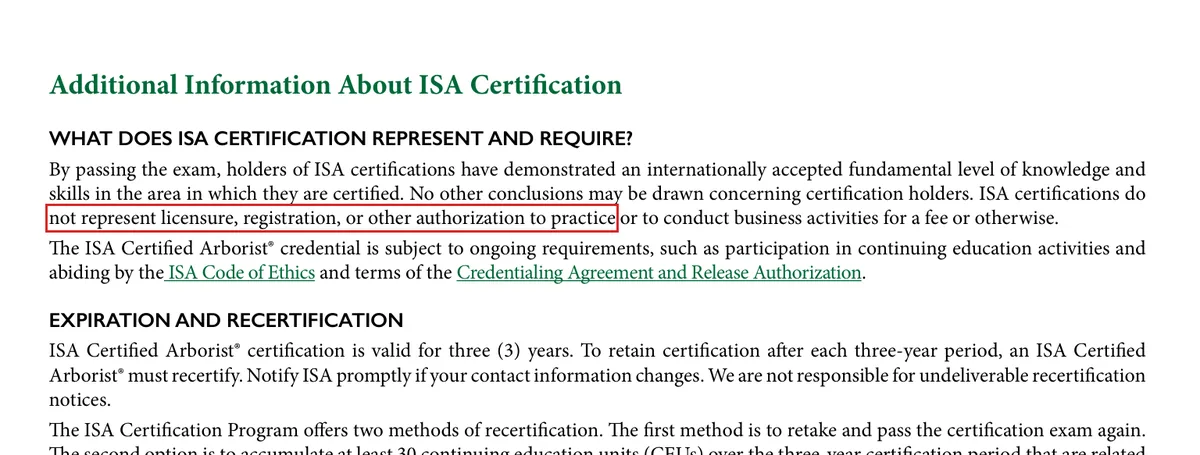
- ISA says its certifications “do not represent licensure.” Eight states have their own tree credential, from Maryland’s Licensed Tree Expert to New Jersey’s, which requires $1,000,000 in liability coverage (N.J.A.C. 7:3A).
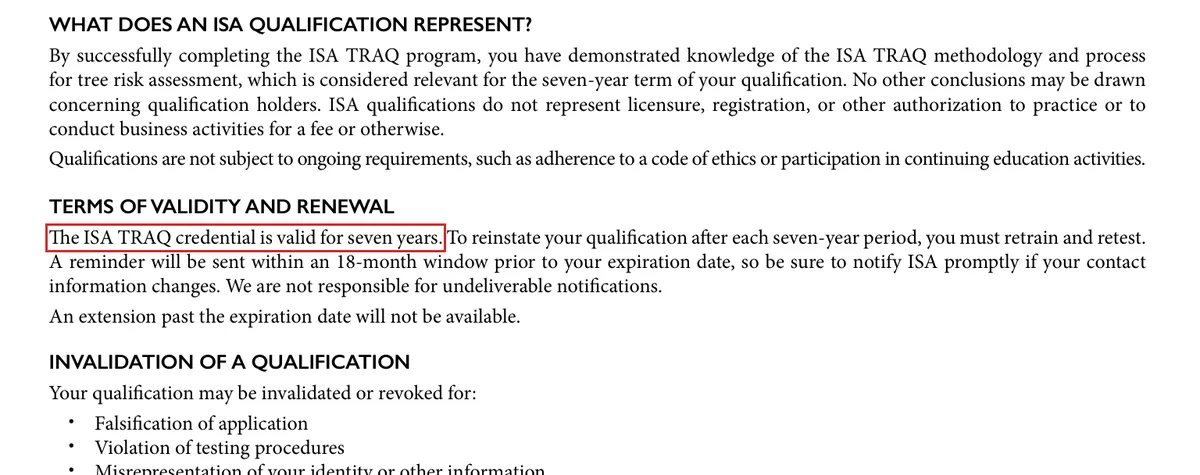
- The Tree Risk Assessment Qualification now lasts 7 years, up from 5, and requires a 2-day course, a 110-question exam and a field test (ISA TRAQ Program Guide, July 2026).
- Public contracts from 2024 to 2026 bill consulting arborists at $113 to $240 an hour; Chino Hills, CA, lists arborist reports at $165.15 per man-hour (Chino Hills fee schedule, Jan. 2026).
- Work should follow ANSI A300 (consolidated 2023) and ANSI Z133-2026, and federal rules keep unqualified workers 10 feet from power lines at 50 kV or below (29 CFR 1910.333).
What does an arborist do?
An arborist cares for individual trees rather than whole forests: pruning, removal, planting, diagnosis and treatment, cabling and bracing, risk assessment and written reports. OSHA lists pruning, removal, plant health care, cabling and bracing, transplanting, consulting, fertilization and lightning protection as the services tree care companies sell. The ISA exam weights safe work practices at 15 percent and pruning at 14 percent.
Ohio State University Extension defines an arborist as “an individual trained in the art and science of selecting, planting, and maintaining individual trees” (OSU Extension, HYG-1032, March 2025). That definition carries no legal weight. Anyone can print “arborist” on a truck door; what separates a credentialed arborist is an exam, an experience requirement and continuing education, which the tables below spell out.
The clearest public map of an arborist’s skills is the content outline of the ISA Certified Arborist exam, which the International Society of Arboriculture (ISA) Certified Arborist Program Guide (revised August 2025) splits into 10 weighted domains. The weights come from a job task analysis of working arborists, so they show where the job’s time and risk sit.
| Exam domain | Share of questions | What it covers on a residential job | Source |
|---|---|---|---|
| Safe work practices | 15% | Climbing, rigging, chainsaw and aerial lift safety, work near power lines | ISA CA Program Guide |
| Pruning | 14% | Pruning types and cuts, how much crown to remove, young-tree structure | ISA CA Program Guide |
| Tree biology | 11% | How trees grow, seal wounds and store energy | ISA CA Program Guide |
| Tree risk | 11% | Spotting defects, judging likelihood of failure and the target below | ISA CA Program Guide |
| Tree identification and selection | 9% | Naming species, right tree for the site | ISA CA Program Guide |
| Installation and establishment | 9% | Planting depth, staking, first-year watering | ISA CA Program Guide |
| Diagnosis and treatment | 9% | Insects, diseases, abiotic damage, treatment choices | ISA CA Program Guide |
| Trees and construction | 9% | Root protection zones and construction damage | ISA CA Program Guide |
| Soil management | 7% | Soil testing, compaction, mulch and fertilization | ISA CA Program Guide |
| Urban forestry | 6% | Street trees, inventories, municipal programs | ISA CA Program Guide |
What is arborist mulch?
Arborist mulch, or arborist wood chips, is the chipped bark, wood and leaves a tree crew produces while pruning or removing trees, and many crews give it away rather than pay to dump it. Washington State University Extension found the mix resists compaction better than uniform bark or sawdust mulch and recommends a depth of 4 to 6 inches for weed control (WSU Extension FS160E, 2015).
Whether those free chips beat shredded bark is a narrower question than most pages admit: our wood chips vs mulch review sets 14 published trials side by side.
WSU also says to taper chips to almost nothing at the trunk, because mulch piled against bark keeps it wet and invites fungi; the publication is now marked archived but has not been replaced. For bed and ring sizes, our mulch calculator converts square feet and depth into cubic yards.
How is an arborist different from a tree service, tree surgeon, forester or landscaper?
“Arborist” names a person and a skill set; “tree service” names a business, which may or may not employ one. A forester manages stands of trees for timber, wildlife or watersheds, a landscaper installs and maintains planting, and “tree surgeon” is the British term that survives in U.S. law: Alabama and Mississippi still license “tree surgery.” The ASCA list of arborist types says foresters “may lack field experience with individual trees.”
| Title | What it means | Who regulates it | Typical work | Source |
|---|---|---|---|---|
| Arborist (title alone) | A person trained in caring for individual trees; no exam is needed to use the word | Nobody, unless a state license covers tree work for hire | Pruning, removal, planting, diagnosis | OSU Extension HYG-1032 |
| ISA Certified Arborist | Passed a 200-question exam after 3 years of experience or an equivalent; recertifies every 3 years | ISA, a voluntary program accredited by ANAB to ISO 17024 | Same work, with tested knowledge | ISA |
| Tree service or tree care company | A business that sells tree work; it may or may not employ credentialed arborists | OSHA rules for employers; a state license in the 8 licensing states listed below | Removal, pruning, stump grinding, storm cleanup | OSHA |
| Tree surgeon | British term for a tree worker; in U.S. law it survives in state “tree surgery” licenses | Alabama Tree Surgery permit (ADAI); Mississippi Tree Surgery License (MDAC) | Same as a tree service | Ala. Code 2-28-1; MDAC |
| Consulting arborist (ASCA RCA) | An independent expert who writes reports, appraisals and testimony and usually sells no tree work | ASCA, voluntary | Risk reports, tree appraisals, construction protection plans, disputes | ASCA |
| Line-clearance tree trimmer | A worker trained to prune near energized power lines | OSHA, 29 CFR 1910.269 | Utility right-of-way pruning | 29 CFR 1910.269 |
| Forester | Manages forests and stands for timber, wildlife or watersheds rather than single yard trees | Some states require a forester to write forest management plans; the SAF Certified Forester credential is voluntary | Management plans, timber sales | ASCA, Types of Arborists |
| Landscaper | Installs and maintains lawns, beds and plantings | State landscape contractor licenses in some states; California’s C-49 tree class excludes a gardener’s incidental pruning | Planting, mowing, beds, pruning shrubs and small trees | CSLB, C-49 |
For residential work the useful split is person versus company. A homeowner hires a company, so the questions are whether a credentialed arborist is on that crew, whether the company holds a state license where one is required, and whether it carries liability and workers’ compensation insurance. Our guide to checking a contractor license covers the lookup step for landscapers.
What do arborist certifications and credentials mean?
ISA runs seven tree credentials, and the ISA credential list as of October 2026 is: Certified Arborist, Board Certified Master Arborist, Certified Arborist Utility Specialist, Certified Urban Forest Professional, Certified Tree Climber, Certified Tree Worker Aerial Lift Specialist and the Tree Risk Assessment Qualification (TRAQ). The American Society of Consulting Arborists adds the Registered Consulting Arborist (RCA). All are voluntary and none is a license.
The table compares what each credential demands. ISA states plainly that its certifications “do not represent licensure, registration, or other authorization to practice or to conduct business activities for a fee” (ISA CA Program Guide, p. 8). A homeowner should read every credential as proof of tested knowledge, then check the state license and the insurance certificate separately.
| Credential | Eligibility | Exam | Pass mark | Validity and renewal | Source |
|---|---|---|---|---|---|
| ISA Certified Arborist | 3 years full-time, or degree or training plus 1 to 2 years | 200 multiple-choice questions, 3.5 hours | 76% | 3 years; 30 CEUs plus $220, or retest | ISA, Aug. 2025 |
| ISA Certified Tree Climber | 18 months of climbing experience | 65 questions in 90 minutes plus a 45-minute climbing practicum | 80% written, 70% skills | 3 years; 15 CEUs, CPR and first aid, aerial rescue practice, $220 | ISA, Aug. 2025 |
| ISA Certified Tree Worker Aerial Lift Specialist | 18 months of experience, 6 of them operating an aerial lift | 65 questions in 90 minutes plus a 45-minute lift practicum | 70% written, 80% skills | 3 years | ISA, Mar. 2020 |
| ISA Certified Arborist Utility Specialist | Certified Arborist plus 2,000 hours of utility vegetation work in 2 years, or 36 months in the past 10 | 115 questions, 2 hours | 75% | 3 years; 6 CEUs plus $95 | ISA, Aug. 2025 |
| ISA Certified Urban Forest Professional | Certified Arborist, or 3 years managing urban trees, or education plus experience | 115 questions, 2 hours | 70% | 3 years; 30 CEUs plus $220 | ISA, Aug. 2025 |
| ISA Board Certified Master Arborist | Certified Arborist plus 8 points from certification years, degrees, credentials and experience | 165 questions, 4 hours; $495 enrollment | 70% | 3 years; 60 CEUs plus $320 | ISA, May 2026 |
| ISA Tree Risk Assessment Qualification (TRAQ) | An ISA certification, a related degree, or an approved state license | 2-day course, then 110 questions in 2 hours plus a 1-hour field assessment | 75% written, pass field | 7 years, then retrain and retest; no CEUs | ISA, July 2026 |
| ASCA Registered Consulting Arborist | ASCA member (5 years of experience plus degree, BCMA or 240 CEUs), Consulting Academy graduate, 420 CEUs | Two reports scored by ASCA ($100 each) | 75% per report | Annual: $56 RCA fee plus $549 dues; 30 CEUs every 2 years | ASCA, Apr. 2026 |
Exam length tracks scope. The Certified Arborist exam has 200 multiple-choice questions in 3.5 hours with 20 unscored pretest items; the Board Certified Master Arborist exam has 165 questions in 4 hours and a 70 percent pass mark (ISA BCMA Program Guide, May 2026). TRAQ pairs a 110-question written exam with a 1-hour outdoor assessment of a real tree (ISA TRAQ Program Guide, July 2026).
How long does it take to become an ISA Certified Arborist?
At least 1 year and usually 3. ISA requires three years of full-time arboriculture experience, defining one year as about 1,795 hours, or a shorter stint combined with a degree or assessed training (ISA CA Program Guide, p. 4). The arithmetic below converts each route into field hours, the number an employer’s reference letter has to document.
| Eligibility route | Field experience required | Field hours (years x 1,795) | Training hours |
|---|---|---|---|
| Experience only | 3 years full-time | 3 x 1,795 = 5,385 | None beyond the degree |
| Two-year associate degree (2+ arboriculture courses) | 2 years full-time | 2 x 1,795 = 3,590 | None beyond the degree |
| Four-year bachelor degree (4+ arboriculture courses) | 1 year full-time | 1 x 1,795 = 1,795 | None beyond the degree |
| 900 hours of assessed training (90+ in arboriculture) | 2 years full-time | 2 x 1,795 = 3,590 | 900 classroom hours |
| 1,800 hours of assessed training (180+ in arboriculture) | 1 year full-time | 1 x 1,795 = 1,795 | 1,800 classroom hours |
Fees are the second hurdle. ISA charges a $50 application fee and a $369 exam enrollment fee to non-members ($40 and $295 for members), then $220 every three years to recertify with 30 continuing education units (ISA CA Program Guide). Over the first six years that is about $859 for a non-member who never fails, before study materials or membership dues.
| Cost item | Non-member | ISA member | When |
|---|---|---|---|
| Application fee | $50 | $40 | Year 0 |
| Exam enrollment fee | $369 | $295 | Year 0 |
| Recertification fee (30 CEUs) | $220 | $220 | Year 3 |
| Recertification fee (30 CEUs) | $220 | $220 | Year 6 |
| Total, first six years | $859 | $775 | Excludes retakes ($120 each), dues and courses |
What is a Board Certified Master Arborist or a consulting arborist?
A Board Certified Master Arborist (BCMA) is an ISA Certified Arborist who has banked 8 eligibility points, earned at 1 point per year certified, 1 to 4 for a degree, 3 for being an ASCA Registered Consulting Arborist and 1 per six years of work, then passed the 165-question exam (ISA BCMA Program Guide). Recertification takes 60 CEUs every three years, double the Certified Arborist load.
A Registered Consulting Arborist writes reports, appraisals and expert opinions rather than selling tree work. ASCA requires membership (five years of arboriculture experience plus a four-year degree, BCMA status or 240 CEUs), graduation from its Consulting Academy, 420 CEUs and two reports that each score at least 75 percent (ASCA RCA eligibility, April 2026 capture; ASCA membership eligibility).
Which states license arborists or tree work?
Eight states have their own arborist or tree-work credential: Alabama, Connecticut, Louisiana, Maine, Maryland, Mississippi, New Jersey and Rhode Island. California and Hawaii license tree contractors as a class, and Minnesota requires registration with no exam. Elsewhere the title is unregulated at state level; UNH Extension notes that certification “is not required by the State of New Hampshire” (UNH Extension).
| State | Credential and law | Who needs it | Exam and eligibility | Insurance | Fees and renewal | Lookup |
|---|---|---|---|---|---|---|
| Alabama | Tree Surgery permit, Ala. Code 2-28-1 | Paid cavity filling, bracing, cabling and wound treatment; the law excludes pruning | $75 exam; written statement of training and experience | None stated for tree surgery | $175 a year, Oct. 1 to Sept. 30 | ADAI |
| Connecticut | Arborist license, CGS 23-61b | Anyone who advertises, solicits or contracts to do arboriculture; 1 licensee per business location | Written 75%, tree ID 80%, oral practical 70%; age 18 | None stated | $200 exam; $285 license valid 5 years; 12 CE credits per cycle | DEEP |
| Louisiana | Arborist and Utility Arborist licenses, La. R.S. 3:3804 | Paid tree removal or care, or working under a licensee’s direct supervision | 70% exam; ISA-certified exam option | Public liability and workers’ compensation | $150 exam; $125 license; renews by Jan. 31 yearly | LDAF lists |
| Maine | Licensed Arborist, 7 M.R.S. 2179 | Paid arborist work, including pruning that requires leaving the ground | Written and oral, 70% (Master 75%); ISA Certified Arborists exempt from exam | $150,000 per occurrence, $300,000 aggregate | $60 exam; $30 license a year | DACF list |
| Maryland | Licensed Tree Expert, Nat. Res. 5-415 and 5-418 | Paid care or removal of trees taller than 20 feet; supervised employees exempt | 140 questions, 70% in each of 10 domains; 3 years of experience, or 2 years of college plus 1 year | Required by DNR; amount set by the Department | $30 exam; $20 renewal every 2 years; 8 CE hours (COMAR 08.07.07.07) | DNR |
| Mississippi | Tree Surgery License, MDAC | Only firms that advertise as licensed, bonded or insured | 100 questions, 70%; 2 years of experience in the last 3, or education routes | At least $100,000 | No fee; valid indefinitely | MDAC |
| New Jersey | Licensed Tree Expert or Tree Care Operator, N.J.A.C. 7:3A | Every tree care business; exempts ground work with no climbing, lifts or rigging and no removal of trees over 6 inches DBH | Expert: written 70% plus field 65%, 5 years or degree routes; Operator: written 70%, 3 years | $1,000,000 general liability plus workers’ compensation | $150 license for 2 years; $200 business registration; 32 CE credits per 2 years (fees) | NJBTE |
| Rhode Island | Arborist license, 250-RICR-70-00-1 | Anyone working alone on paid arboriculture; 1 licensee on every crew site | 70% exam ($25), or ISA certification | None stated | $25 a year, expires Dec. 31 | DEM |
| California | C-49 Tree and Palm contractor, CSLB | Planting, maintaining and removing trees and palms; jobs of $1,000 or more | 4 years of experience; CSLB exams | $25,000 bond | CSLB license fees | CSLB |
| Hawaii | C-27b tree trimming and removal, DCCA | Pruning, trimming and removing trees and stumps; jobs over $1,000 or needing a permit | Contractor licensing exams | Per contractor rules | Contractor license fees | DCCA |
| Minnesota | Tree care registration, Minn. Stat. 18G.07 | All paid tree care, trimming or removal | None | None stated | $25 a year, expires Dec. 31 | MDA |
| New Hampshire | No state arborist license | Not applicable | Voluntary state association certification | Not applicable | Not applicable | UNH Extension |
The rules differ more than the titles suggest. Maryland’s law reaches only trees taller than 20 feet (Nat. Res. 5-415), New Jersey’s carves out ground-based maintenance, and Mississippi’s license is optional unless you advertise as licensed. Insurance floors run from none stated in Connecticut to $1,000,000 in New Jersey. Our 50-state landscaping license table covers the pesticide and contractor licenses that sit alongside these.
How do you check an arborist’s credentials?
Check three things separately: the ISA credential, the state license where one exists, and the insurance. ISA’s Find an Arborist directory verifies credential holders by name or location, but listing is voluntary, so a missing name is a prompt to ask for the ISA digital certificate, not proof of fraud. In the eight states with a tree license, the state lookup is the legal test.
- Ask for the arborist’s full name, credential and ISA certification number, and which crew members will be on site. A company can employ one Certified Arborist and send a crew with none.
- Look the person up in ISA’s Find an Arborist directory or the ISA certificate directory. ISA says names, credentials and digital certificates appear there unless the holder opts out (ISA CA Program Guide, Privacy).
- Check that the credential has not expired. Most ISA certifications run 3 years and TRAQ runs 7 (ISA TRAQ Program Guide).
- In a licensing state, search the state’s licensee lookup; the state table above links each agency. Mississippi’s list shows only firms that chose to license, because its law requires the license only for those who advertise as licensed, bonded or insured.
- Ask for a certificate of insurance showing general liability and workers’ compensation, then phone the insurer to confirm the policy is current, as OSU Extension advises.
- Get the scope in writing in ANSI A300 terms, and reject any bid that proposes topping or climbing spikes on a tree you are keeping (OSU Extension, HYG-1032).
One trap catches people searching “ISA credential directory”: the page at connect.isa.org belongs to the International Society of Automation, which also abbreviates itself ISA and lists cybersecurity and automation certificates. Arborist credentials live only on isa-arbor.com, treesaregood.org and ISA’s certificate directory. Insurance is the third check; our tree service insurance guide covers what a certificate should show.
What standards should an arborist’s work follow?
Two ANSI standards govern U.S. tree work: ANSI A300 for how trees are cared for and ANSI Z133 for worker safety. TCIA consolidated A300’s 10 parts into one document available from January 1, 2024, on a single five-year review cycle (TCIA). ISA reports that Z133-2026 is now approved and that the 2017 edition was effective until May 27, 2026 (ISA, Z133-2026).
| Standard or rule | Current edition | What it governs | What to ask for | Source |
|---|---|---|---|---|
| ANSI A300 Tree Care Standards | Consolidated 2023 edition, available from Jan. 1, 2024; reviewed every 5 years | Pruning, soil, support systems, lightning protection, risk assessment and other care practices | A written specification that cites the A300 objective | TCIA |
| ANSI Z133 Safety and Health Requirements for Arboricultural Operations | Z133-2026; the 2017 edition was effective until May 27, 2026 | Climbing, rigging, chain saws, aerial lifts, electrical hazards | A crew that follows it; ISA offers the digital standard free and print at $29.95 retail | ISA |
| 29 CFR 1910.333(c)(3) | Current federal rule | Unqualified workers and their tools must stay 10 feet from lines at 50 kV or below, more above 50 kV | Utility or line-clearance crew for anything closer | eCFR |
| 29 CFR 1910.269 | Current federal rule | Training and work rules for line-clearance tree trimmers | Proof of line-clearance training | eCFR |
| ANSI A300 Part 9 (tree risk assessment) | 2011 part, now inside the consolidated A300 | Levels 1, 2 and 3 of tree risk assessment | The assessment level in the contract | A300 Part 9 |
A300 matters to a homeowner because it is how a quote should be written. TCIA says the standards “are used to develop written specifications for work assignments,” so a proposal that names the A300 pruning objective, the branch sizes and the percentage of crown to remove can be checked after the crew leaves (TCIA, ANSI A300). Our tree trimming cost guide shows how those specifications change the price.
What are the three levels of tree risk assessment?
The A300 risk standard defines three levels, and the level sets how closely the tree is examined. Level 1 is a limited visual check of many trees, Level 2 a 360-degree ground inspection of one tree, and Level 3 adds tools such as resistance drilling or sonic testing when Level 2 cannot judge a defect (ANSI A300 Part 9-2011, 93.4.2). TRAQ trains assessors in this method.
| Level | What the standard requires | Typical use |
|---|---|---|
| Level 1: limited visual | “A limited visual assessment of an individual tree or a population of trees near specified targets” from foot, vehicle or aerial patrol | Screening street trees or a utility corridor for obvious defects |
| Level 2: basic | “A 360-degree, ground-based visual inspection of the tree crown, trunk, trunk flare, above-ground roots, and site conditions”; sounding with a mallet when specified | One yard tree near a house, driveway or play area |
| Level 3: advanced | All Level 2 work plus methods such as resistance drilling, sonic assessment, pull testing or sub-surface root assessment, used when Level 2 cannot judge a defect | Large trees with hidden decay or high-value targets |
How much does an arborist cost?
No national price list exists, so we used public contracts and city fee schedules. From 2024 to 2026 they bill consulting arborist time at $113 to $240 an hour, most often $165 to $225, and cities that require arborist review charge permit applicants extra: Burlingame bills $190 an hour with a 1-hour minimum (Burlingame FY 2025-26). Tree work itself is priced per job, not per hour.
| Payer and document | Role | Rate | Date | Source |
|---|---|---|---|---|
| Menlo Park, CA, on-call agreement proposal | Senior Consulting Arborist | $240 per hour | May 2024 | Staff Report 24-084-CC |
| Stevenson, WA, project cost table | Senior associate consulting arborist | $225 per hour ($90 labor plus overhead and fee) | Sept. 2024 | Council packet |
| Burlingame, CA, fee schedule | City arborist review charged to applicant | $190 per hour, 1-hour minimum | FY 2025-26 | Master Fee Schedule |
| Escondido, CA, consultant proposal | ISA Certified Arborist, project manager | $185 per hour | Sept. 2026 | Council agenda |
| Chino Hills, CA, fee schedule | Arborist report or risk assessment (levels 1 to 3) | $165.15 per man-hour | Jan. 2026 | Table 10 |
| Menlo Park, CA, on-call agreement proposal | ISA Certified Arborist | $113 per hour | May 2024 | Staff Report 24-084-CC |
| Pearland, TX, tree maintenance contract | Consulting arborist line item inside a $975,698 maintenance bid | $40 per hour | March 2026 | Council agenda |
Why the gap between a tree worker’s wage and the bill? Stevenson’s table shows it: $90 an hour of direct labor plus 120 percent overhead and a 30 percent fee becomes $225 billed (Stevenson, WA). BLS puts the median tree trimmer and pruner wage at $24.50 an hour in May 2025 (BLS OEWS), and OSU Extension notes that trucks, booms, chippers and insurance sit in every price (OSU Extension).
What does an arborist report for a tree permit cost?
In cities that require one, the permit and review fees can rival the report itself. The arithmetic below uses published city fees and contract rates; the 2 and 4 hour report times are our assumptions for a single residential tree, so treat the totals as estimates. Cupertino’s arborist-review permit costs $386 more than its permit without review (Cupertino FY 2025-26).
| Scenario | Arithmetic | Estimate |
|---|---|---|
| Burlingame: protected-tree application plus minimum city arborist review | $451 + (1 x $190) | $641 |
| Cupertino: first-tree permit with arborist review vs without | $851 minus $465 | $386 added by review |
| Private report at Chino Hills’ contract rate, 2 hours | 2 x $165.15 | $330.30 |
| Private report at the Stevenson rate, 4 hours | 4 x $225 | $900 |
| Saratoga: tree removal permit plus arborist review deposit | $141 + $1,000 deposit | $1,141 up front (FY 2024-25) |
Prices for the work itself are on separate pages: our tree trimming cost guide, the tree removal cost guide and the stump grinding cost guide build ranges from published inputs.
When do you need an arborist, and which credential should you ask for?
Match the credential to the risk. Ground-level pruning of a small tree needs no credential; work above the ground, near power lines, on a tree that could hit a house, or for a permit, lawsuit or insurance claim does. ISA advises hiring an arborist when a tree is “dead or dying, an unacceptable risk, causing an obstruction, crowding other trees” or near new construction (ISA, Why Hire an Arborist).
| If your situation is… | Do this | Why (source) |
|---|---|---|
| Any branch or the work zone is within 10 feet of an overhead line | Call the utility; hire only a line-clearance crew | Unqualified workers must keep 10 feet from lines at 50 kV or below (29 CFR 1910.333(c)(3)) |
| A tree could hit a house, car, road or play area if it failed | Hire a TRAQ-qualified arborist and get a Level 2 assessment in writing | TRAQ trains the A300 risk method (ISA TRAQ guide) |
| You need a report for a permit, insurer, lawyer, appraisal or neighbor dispute | Hire a consulting arborist (ASCA RCA or BCMA) who will not bid the work | RCAs pass two scored reports and 420 CEUs (ASCA) |
| Your city requires a permit to remove a protected tree | Hire an ISA Certified Arborist or ASCA consulting arborist the city accepts, and budget for the city’s review fee | Palo Alto accepts reports from ISA Certified or ASCA registered arborists (PAMC 8.10); Cupertino charges $851 for a first-tree permit with arborist review (Cupertino FY 2025-26) |
| Pruning or removal needs climbing or a lift | Hire an insured company with an ISA Certified Arborist plus a Certified Tree Climber or Aerial Lift Specialist on the crew | Those credentials test climbing and lift skills in a practicum (ISA) |
| You live in a state with a tree license | Get the license number and check the state lookup before signing | New Jersey requires every tree care business to register and employ a licensee (N.J.A.C. 7:3A-2.1); Maine requires a license to work as an arborist for pay (7 M.R.S. 2179) |
| Leaves, bark or branches show disease or insects | Hire an ISA Certified Arborist; ask for lab confirmation before paying for treatment | OSU advises proof from a non-biased diagnostic clinic (OSU Extension) |
| Construction or trenching will come within the root zone | Bring in a consulting arborist before digging for a tree protection plan | Trees and construction is 9 percent of the Certified Arborist exam (ISA) |
| Small tree, hand tools, both feet on the ground | No credential needed; follow ISA pruning guidance | ISA says pruning or removing large trees “can be dangerous work” (ISA) |
1Is any branch or the work zone within 10 feet of an overhead power line?
YesCall the utility. Only a line-clearance crew trained under 29 CFR 1910.269 should work there.
NoGo to the next question
2Do you need a written opinion for a permit, insurer, lawyer, appraisal or neighbor dispute?
YesHire a consulting arborist (ASCA RCA or ISA BCMA) who will not bid the work.
NoGo to the next question
3Could the tree hit a house, car, road or play area if it failed?
YesHire a TRAQ-qualified arborist and ask for a Level 2 assessment in writing.
NoGo to the next question
4Does the job need climbing, rigging or an aerial lift?
YesHire an insured company with an ISA Certified Arborist plus a Certified Tree Climber or Aerial Lift Specialist on the crew, licensed if your state requires it.
NoGo to the next question
5Do leaves, bark or branches show disease or insects?
YesHire an ISA Certified Arborist and ask for lab confirmation before paying for treatment.
NoGround-level pruning of a small tree with hand tools needs no credential.
After a storm, the order matters more than the credential: stay clear of any downed or sagging line and report it to the utility, then document damage for the insurer before anything is cut. Our emergency tree removal guide covers storm pricing and insurance claims, and the tree removal cost guide covers planned removals.
What do popular guides get wrong about arborist credentials?
Several pages that rank for arborist questions repeat facts that ISA has since changed. We checked each claim below against the current ISA program guide or standard page, accessed October 2026. The most common errors are the TRAQ renewal period, which ISA extended from five to seven years, and credential names that ISA retired, such as Municipal Specialist and Tree Worker Climber Specialist.
| What some guides say | Where we saw it | What the primary source says | Source |
|---|---|---|---|
| TRAQ is valid for five years | ISA Rocky Mountain Chapter TRAQ page | “The ISA TRAQ credential is valid for seven years”; then retrain and retest | ISA TRAQ Program Guide, July 2026 |
| Credentials named Municipal Specialist and Climber Specialist | OSU HYG-1032 (March 2025); ISA RMC six certifications page | ISA now lists Certified Urban Forest Professional and Certified Tree Climber | ISA Types of Credentials |
| Workers “cannot attain any other ISA credential without first earning” Certified Arborist | OSU HYG-1032 | Tree Climber needs 18 months of climbing; Urban Forest Professional accepts 3 years managing urban trees; TRAQ accepts degrees and state licenses | ISA Climber guide; CUFP guide; TRAQ guide |
| The arboricultural safety standard is “Z133.1” | OSHA tree care standards page | The current standard is Z133-2026; the 2017 edition was effective until May 27, 2026 | ISA, Z133-2026 |
| ANSI A300 is a set of separate parts | Older pages that cite A300 Part 1, Part 9 and so on | TCIA consolidated all 10 parts into one standard, available from Jan. 1, 2024 | TCIA |
| The “ISA Credential Directory” at connect.isa.org | Search results for “ISA credential directory” | That page belongs to the International Society of Automation; arborist lookups are on treesaregood.org | ISA Find an Arborist |
Is being an arborist a dangerous job?
Yes, by federal data. In 2024, 99 tree trimmers and pruners died on the job: 39 in falls and 39 from contact with objects or equipment, plus 12 from harmful exposures such as electricity (BLS CFOI, Table A-5, 2024). BLS publishes a rate only for grounds maintenance workers as a group: 20.9 deaths per 100,000 full-time workers, against 3.3 for all workers (BLS CFOI rates, 2024).
| Occupation (SOC code) | Employment | Median hourly | Median annual | Source |
|---|---|---|---|---|
| Tree trimmers and pruners (37-3013) | 55,160 | $24.50 | $50,960 | BLS OEWS, May 2025 |
| Foresters (19-1032) | 10,430 | $36.73 | $76,400 | BLS OEWS, May 2025 |
| All occupations | 155,495,730 | $24.51 | $50,980 | BLS OEWS, May 2025 |
BLS’s handbook calls tree trimmers and pruners “also called arborists” and says “professional certification is not required” but “demonstrates competency and reliability” (BLS Occupational Outlook Handbook, Sept. 2026). It projects the occupation growing 4 percent from 2025 to 2035. For pay in the wider trade, see our landscaper salary data.
How we compiled this
We compiled this in October 2026 from 9 ISA and ASCA program guides and eligibility pages, TCIA and ISA standards pages, OSHA rules, statutes and agency pages for 12 states, 10 city fee schedules and contract documents, and BLS wage and fatality data. Pages that blocked scripts were read from Internet Archive copies, noted in Sources. We priced no jobs and interviewed no one; report hours in the cost example are labeled assumptions.
Frequently asked questions
What’s the difference between an arborist and a tree service?
An arborist is a person with tree care training; a tree service is a business that sells tree work and may or may not employ one. Ask the company which crew member holds an ISA credential and check it in ISA’s Find an Arborist directory. In New Jersey every tree care business must employ a licensed tree expert or tree care operator (N.J.A.C. 7:3A).
What is the difference between an arborist and a certified arborist?
Anyone can call themselves an arborist. An ISA Certified Arborist has documented 3 years of experience or a degree route, passed a 200-question exam with at least 76 percent, signed ISA’s code of ethics and recertifies every 3 years with 30 continuing education units or a retest (ISA Certified Arborist Program Guide, August 2025).
How long is schooling to be an arborist?
No degree is required. ISA accepts 3 years of full-time experience alone, a two-year associate degree plus 2 years of work, or a four-year bachelor degree plus 1 year, with at least 2 or 4 arboriculture courses respectively (ISA Program Guide). New Jersey’s Tree Expert license accepts a four-year forestry or arboriculture degree in place of 5 years of work (N.J.A.C. 7:3A).
How much does it cost for an arborist to look at a tree?
Public contracts from 2024 to 2026 bill consulting arborist time at $113 to $240 an hour, and Chino Hills, California, lists arborist reports and risk assessments at $165.15 per man-hour (Chino Hills, Jan. 2026). Tree companies often fold a free estimate into a bid for work; an independent written report costs more because the arborist is not selling the job.
Can an arborist save a dying tree?
Sometimes, if the cause is found early. OSU Extension advises asking for proof from a non-biased diagnostic clinic, such as Ohio State’s C. Wayne Ellett Plant and Pest Diagnostic Clinic, before paying for disease treatment. It also notes that removing a doomed tree while alive is usually cheaper than removing it dead, because brittle dead wood adds risk (OSU Extension HYG-1032).
Do you need an arborist to cut down a small tree?
Usually not. Maryland’s tree expert law excludes trees 20 feet tall or less (Md. Nat. Res. 5-415), and New Jersey exempts ground-based work with no climbing, lifts or rigging and no removal of trees over 6 inches in diameter at breast height (N.J.A.C. 7:3A-1.1). Any tree within 10 feet of a power line is the exception.
Is an arborist and a tree surgeon the same thing?
Mostly, yes. “Tree surgeon” is the British term and an older U.S. one. It survives in law in Alabama, whose Tree Surgery permit covers cavity filling, bracing, cabling and wound treatment but not pruning (Ala. Code 2-28-1), and in Mississippi’s Tree Surgery License, which requires at least $100,000 of insurance (MDAC).
What is the average salary for an arborist in the US?
BLS does not track arborists separately; its closest category, tree trimmers and pruners (SOC 37-3013), had a median wage of $24.50 an hour, or $50,960 a year, in May 2025, with 55,160 employed. The mean was $55,970. Foresters earned a median $76,400 (BLS OEWS, May 2025).
Why are arborists so expensive?
Mostly overhead and risk. A Stevenson, Washington, contract table turns $90 an hour of consulting arborist labor into $225 billed after 120 percent overhead and a 30 percent fee (Stevenson, WA, 2024). Tree work also carries high insurance costs: 99 tree trimmers and pruners died on the job in 2024 (BLS CFOI).
This page is general information, not legal or safety advice. Licensing rules, credential requirements and fees change; confirm with the state agency or credentialing body linked in each row before you hire or apply.
Sources
- International Society of Arboriculture (ISA), ISA Certified Arborist Program Guide, Revised August 2025. Accessed October 2026.
- ISA, ISA Board Certified Master Arborist Program Guide, Revised May 2026. Accessed October 2026.
- ISA, ISA Tree Risk Assessment Qualification Program Guide, Revised July 2026. Accessed October 2026.
- ISA, ISA Certified Arborist Utility Specialist Program Guide, Revised August 2025. Accessed October 2026.
- ISA, ISA Certified Urban Forest Professional Program Guide, Revised August 2025. Accessed October 2026.
- ISA, ISA Certified Tree Climber Program Guide, Revised August 2025. Accessed October 2026.
- ISA, ISA Certified Tree Worker Aerial Lift Specialist Candidate Handbook, Revised March 2020. Accessed October 2026.
- ISA, Types of Credentials, Page as of October 2026. Accessed October 2026.
- ISA, Z133-2026 Safety Standard, Approved 2026; prior edition effective until May 27, 2026. Accessed October 2026.
- ISA, TreesAreGood.org, Find an ISA-Credentialed Arborist, Page as of October 2026. Accessed October 2026.
- ISA, ISA credential holder certificate directory (Accredible), Live directory, October 2026. Accessed October 2026.
- ISA, TreesAreGood.org, Why Hire an Arborist?, Consumer brochure page, current. Accessed October 2026.
- Ohio State University Extension, HYG-1032, How and Why to Hire an Arborist, Published March 18, 2025. Accessed October 2026.
- American Society of Consulting Arborists (ASCA), Internet Archive copy, Types of Arborists, Captured April 22, 2026. Accessed October 2026.
- ASCA, Internet Archive copy, RCA Eligibility/Fees, Captured April 22, 2026. Accessed October 2026.
- ASCA, Internet Archive copy, Eligibility/Dues, Captured April 22, 2026. Accessed October 2026.
- Tree Care Industry Association (TCIA), ANSI A300 Tree Care Standards, Page updated Nov. 18, 2025. Accessed October 2026.
- TCIA (copy hosted by PG&E), ANSI A300 (Part 9)-2011 Tree Risk Assessment, a. Tree Structure Assessment, 2011 edition, sections 93.4.2.1 to 93.4.2.3. Accessed October 2026.
- Occupational Safety and Health Administration (OSHA), Tree Care Industry: Overview, Page as of October 2026. Accessed October 2026.
- eCFR, 29 CFR 1910.333, Selection and use of work practices, Current as of October 2026. Accessed October 2026.
- eCFR, 29 CFR 1910.269, Electric power generation, transmission, and distribution, Current as of October 2026. Accessed October 2026.
- Washington State University Extension, FS160E, Using Arborist Wood Chips as a Landscape Mulch, Published January 2015 (now marked archived). Accessed October 2026.
- ISA Rocky Mountain Chapter, Tree Risk Assessment Qualification, Page as of October 2026. Accessed October 2026.
- ISA Rocky Mountain Chapter, The Six ISA Certifications, Page as of October 2026. Accessed October 2026.
- International Society of Automation, Credential Directory, Page as of October 2026. Accessed October 2026.
- ISA, ISA Certified Arborist, Page as of October 2026. Accessed October 2026.
- OSHA, Tree Care Industry: Standards, Page as of October 2026. Accessed October 2026.
- NJ Board of Tree Experts, N.J.A.C. 7:3A, Tree Expert and Tree Care Operator rules, Rules adopted 2017. Accessed October 2026.
- NJ Board of Tree Experts, Fees, Page as of October 2026. Accessed October 2026.
- NJ Board of Tree Experts, Licensee directory, Live directory, October 2026. Accessed October 2026.
- Maryland General Assembly, Natural Resources 5-415, Definitions (tree expert), Current statute. Accessed October 2026.
- Maryland General Assembly, Natural Resources 5-418, License qualifications, Current statute. Accessed October 2026.
- Maryland Division of State Documents, COMAR 08.07.07.07, Tree expert fees and continuing education, Current regulation. Accessed October 2026.
- Maryland DNR Forest Service, Licensed Tree Experts, Page as of October 2026. Accessed October 2026.
- Connecticut General Assembly, Chapter 451, Arboriculture (CGS 23-61a to 23-61m), Current statute. Accessed October 2026.
- Connecticut DEEP, Commercial Arborist License, Page as of October 2026. Accessed October 2026.
- Louisiana State Legislature, La. R.S. 3:3804, Horticulture Commission licensing, Current statute. Accessed October 2026.
- Louisiana Department of Agriculture and Forestry, Arborists, Page as of October 2026; licensee lists as of July 2026. Accessed October 2026.
- Rhode Island DEM, 250-RICR-70-00-1, Arborist licensing rules, Current rule. Accessed October 2026.
- Rhode Island DEM, Find RI Arborists, Page as of October 2026. Accessed October 2026.
- Alabama Legislature, Code of Alabama 2-28-1, Definitions (tree surgery work), Current statute. Accessed October 2026.
- Alabama Department of Agriculture and Industries, Professional Services licensing, Page as of October 2026. Accessed October 2026.
- Mississippi Department of Agriculture and Commerce, Tree Surgery Licensing, Page as of October 2026. Accessed October 2026.
- Maine Legislature, 7 M.R.S. 2179, License required (arborists), Current statute. Accessed October 2026.
- Maine DACF, Licensed Arborist List, Page as of October 2026. Accessed October 2026.
- California Contractors State License Board, C-49 Tree and Palm Contractor classification, Current classification. Accessed October 2026.
- Minnesota Revisor of Statutes, Minn. Stat. 18G.07, Tree care registry, Current statute. Accessed October 2026.
- Hawaii DCCA Contractors License Board, Description of Contractor License Classifications (C-27b), January 2026. Accessed October 2026.
- University of New Hampshire Extension, Selecting an Arborist, Page as of October 2026. Accessed October 2026.
- U.S. Bureau of Labor Statistics, Occupational Employment and Wage Statistics, May 2025 national tables (SOC 37-3013, 19-1032), May 2025 estimates. Accessed October 2026.
- U.S. Bureau of Labor Statistics, Census of Fatal Occupational Injuries, Table A-5, 2024, 2024 data. Accessed October 2026.
- U.S. Bureau of Labor Statistics, CFOI hours-based fatal injury rates, 2024, 2024 data. Accessed October 2026.
- U.S. Bureau of Labor Statistics, Occupational Outlook Handbook, Grounds Maintenance Workers, Last modified Sept. 14, 2026. Accessed October 2026.
- City of Menlo Park, CA, Staff Report 24-084-CC, on-call arborist master agreements (proposal rate sheets), Council meeting May 21, 2024. Accessed October 2026.
- City of Stevenson, WA, Council packet, Lasher Street project consultant cost table, Meeting Sept. 19, 2024. Accessed October 2026.
- City of Chino Hills, CA, Master Schedule of Fees, Table 10 Tree Trimming Service Fees, Effective Jan. 1, 2026. Accessed October 2026.
- City of Escondido, CA, Council agenda Sept. 16, 2026, Item 5, Urban Forestry Management Plan proposal, Sept. 16, 2026. Accessed October 2026.
- City of Pearland, TX, Council agenda March 23, 2026, tree maintenance contract price sheet (ITB 06-26), March 23, 2026. Accessed October 2026.
- City of Burlingame, CA, Fiscal Year 2025-26 Master Fee Schedule, FY 2025-26. Accessed October 2026.
- City of Cupertino, CA, FY 2025-26 Fee Schedule C, Planning (Resolution 25-098), Effective Sept. 1, 2025. Accessed October 2026.
- City of Saratoga, CA, Adopted Fee Schedule, Effective July 1, 2024. Accessed October 2026.
- City of Palo Alto, CA, Tree Ordinance Information (PAMC 8.10), Ordinance effective May 1, 2024. Accessed October 2026.