Short answer: Tree service insurance is four policies: general liability, workers’ comp, commercial auto and equipment cover. Before comp, a one-truck owner pays about $3,542 to $6,135 a year at insurer-published prices. Comp for climbers is the big line: class 0106 base figures run from $1.31 per $100 of payroll (Texas) to $13.78 (New Jersey).
99 tree trimmers and pruners killed on the job in 2024 (BLS CFOI, 2024)
~111 deaths per 100,000 employed tree trimmers vs ~3.1 for all workers (our arithmetic, see method)
$12.39 California class 0106 pure premium per $100 of payroll, 2.2 times landscape class 0042 (WCIRB, Sept. 2026)
$1,000,000 general liability New Jersey requires of every registered tree care business (N.J.A.C. 7:3A-2.11)
Tree service insurance costs more than lawn care insurance for one main reason: tree trimmers die on the job at a rate in the same range as loggers. This guide prices tree service insurance from public documents instead of quote forms: workers’ comp class 0106 figures from 14 state rating filings, the licensing rules that make coverage mandatory, insurer-published premiums (labelled as such), and the exclusions that leave tree companies uninsured for the jobs they do most. Lawn-only operators should read our lawn care business insurance guide instead; their comp class and liability pricing are different.

What insurance does a tree service need?
A tree service needs general liability for damage to clients’ property and passers-by, workers’ compensation for every employee who climbs, rigs or runs a chipper, commercial auto for bucket trucks and chip trucks, and inland marine cover for saws, climbing gear and the chipper itself. An umbrella, hired and non-owned auto, and professional liability for arborist reports are the usual add-ons.
| Coverage | What it pays for | Tree-specific catch | Published price |
|---|---|---|---|
| General liability | Injury to the public and damage to property you don’t own: a limb through a roof, a fence crushed by a log | Many trim-only policies exclude removals, stump grinding, work near power lines or trees over a set height | $951–$1,875 a year for $1M/$2M (Insurance Canopy trim-only to Insureon median) |
| Workers’ compensation | Medical bills and lost wages for injured employees; required by state law above a headcount threshold | Priced per $100 of payroll under the tree class (0106 in most states), 1.0 to 3.2 times the landscape class in the states we checked | Payroll × state rate; see the state table |
| Commercial auto | Liability and physical damage for trucks, bucket trucks, and the trailer or chipper while towed | A personal auto policy typically won’t cover a truck used for business; ask how the chipper is scheduled | $2,436–$3,590 a year per vehicle (Progressive contractors median to Insureon) |
| Inland marine (tools and equipment) | Theft or damage to saws, ropes, saddles, stump grinders and chippers on the job or in transit | Insureon notes items over $2,500 may need to be scheduled one by one | $155–$670 a year at Insurance Canopy tiers; $637 Insureon figure |
| Commercial umbrella | Extra liability above GL and auto limits | Used when a contract asks for higher limits than the primary policies carry | No tree-specific published price found |
| Professional liability | Claims that an assessment, risk report or recommendation was wrong | Relevant for consulting arborists who sign tree risk reports | No tree-specific published price found |
Why insurers rate tree care next to logging
BLS counted 99 fatal injuries among tree trimmers and pruners in 2024, up from 84 in 2023 (BLS CFOI table A-5, 2024; 2023). That is nearly twice the 51 deaths among logging workers the same year, in an occupation of only about 89,000 employed people (BLS CPS table 11, 2024 annual average).
BLS does not publish a separate hours-based fatality rate for tree trimmers. Dividing the 99 deaths by the 89,000 employed gives roughly 111 deaths per 100,000 workers. The same arithmetic for all U.S. workers (5,070 deaths, 161.3 million employed) gives about 3.1, so tree trimming runs at about 35 times the all-worker rate. For scale, BLS’s own hours-based 2024 rates are 110.4 for logging workers, 48.7 for roofers, 20.9 for grounds maintenance workers as a group and 3.3 for all workers (BLS CFOI hours-based rates, 2024).
- Tree trimmers and pruners
- Logging workers
Source: BLS Census of Fatal Occupational Injuries (series FWU00X3730138ON00 and FWU00X45402X8ON00 for 2011–2022; table A-5 for 2023–2024) Counts, all sectors. Tree trimmers had about 89,000 employed in 2024 (CPS).
Show the numbers
| Tree trimmers and pruners | Logging workers | |
|---|---|---|
| 2011 | 83 | 65 |
| 2012 | 71 | 63 |
| 2013 | 71 | 59 |
| 2014 | 68 | 78 |
| 2015 | 66 | 67 |
| 2016 | 84 | 91 |
| 2017 | 78 | 55 |
| 2018 | 77 | 56 |
| 2019 | 97 | 46 |
| 2020 | 82 | 42 |
| 2021 | 78 | 43 |
| 2022 | 74 | 54 |
| 2023 | 84 | 52 |
| 2024 | 99 | 51 |
How they died matters for underwriting, because each cause maps to a coverage or an exclusion:
| Event (2024) | Tree trimmer deaths | Share |
|---|---|---|
| Falls, slips, trips | 39 | 39% |
| Contact with objects and equipment | 39 | 39% |
| Exposure to harmful substances or environments (includes electrocution) | 12 | 12% |
| Transportation incidents | 7 | 7% |
| Other or not shown separately | 2 | 2% |
- Falls from trees and lifts are the reason comp class 0106 is “applicable by job site to tree pruning contracts requiring any aboveground level work” (NCCI item B-1394, see below).
- Exposure deaths include electrocution. OSHA keeps unqualified workers in an elevated position at least 10 feet from overhead lines up to 50 kV (29 CFR 1910.333(c)(3)); OSHA points line-clearance tree trimming to 1910.269 (OSHA), and the trim-only policy priced below excludes work within 15 feet of lines.
- Contact incidents (struck by a falling tree, limb or log, or caught in machinery such as a chipper) matched falls in 2024, at 39 deaths each.
There is no OSHA standard written for tree care. OSHA says the industry “must comply with all the general industry standards (29 CFR 1910)” and lists ANSI Z133 (arboricultural safety) as a voluntary consensus standard that is not an OSHA regulation (OSHA tree care standards page). A tree-care rule has been in the works since a 2008 advance notice; OSHA’s page says the next step is a proposed rule (OSHA tree care rulemaking). Insureon lists documented training and ISA-certified arborists among the things that may lower rates (Insureon).
Tree service workers’ comp: class 0106 rates by state
Workers’ comp is priced per $100 of payroll for each class of work. Most states use the NCCI code 0106 for tree pruning, repairing and trimming; Pennsylvania (0005), North Dakota (0004) and Washington (0106, priced per hour) use their own systems.
Formula: workers’ comp premium from payroll
Premium = (payroll ÷ 100) × class rate × experience mod. Where a state publishes loss costs (pure premiums) instead of full rates, the insurer multiplies the loss cost by its own factor first; SAIF’s 2026 tiers run from 1.13 to 2.10, which we use as an illustrative range.
Worked example: one climber in Georgia paid the state’s OEWS mean of $46,610. Loss cost 6.27 × 1.13 = $7.09 per $100; × 2.10 = $13.17. Premium = 466.10 × $7.09 to 466.10 × $13.17 = about $3,302 to $6,137 a year, before experience mod, assessments and minimum premium.
Swipe the table sideways to see every column.
| State | Tree class | Per $100 payroll | Basis | Effective | Landscape class, same basis | Tree vs landscape | Tree trimmer mean wage (May 2025) | Est. comp per full-time tree worker a year | Source |
|---|---|---|---|---|---|---|---|---|---|
| California | 0106 Tree pruning, repairing or trimming | 12.393 | Loss cost | Sept. 1, 2026 | 5.58 (0042) | 2.2× | $63,610 | $8,908–$16,555 | filing |
| New Jersey | 0106 Tree pruning, spraying, repairing, trimming or fumigating | 13.779 | Full rate | Jan. 1, 2026 | 8.973 (0042) | 1.5× | $69,760 | $9,612 | filing |
| Ohio | 0106 Tree pruning, repairing or trimming | 6.7604 | Full rate | July 1, 2026 | 2.7014 (0042) | 2.5× | $51,230 | $3,463 | filing |
| Georgia | 0106 Tree pruning, repairing or trimming | 6.27 | Loss cost | Mar. 1, 2025 | 3.17 (0042) | 2.0× | $46,610 | $3,302–$6,137 | filing |
| Massachusetts | 0106 Tree pruning, repairing or trimming | 5.41 | Full rate | July 1, 2024 (still in force) | 2.29 (0042) | 2.4× | $66,100 | $3,576 | filing |
| Pennsylvania | 0005 Tree pruning, spraying, repairing or fumigating | 5.135 | Loss cost | Apr. 1, 2026 | 2.487 (0012) | 2.1× | $59,450 | $3,450–$6,411 | filing |
| North Dakota | 0004 Tree planting, trimming, harvesting | 5.89 | Full rate | July 1, 2026 | 1.05 (0003) | 5.6× | $45,130 | $2,658 | filing |
| North Carolina | 0106 Tree pruning, repairing or trimming | 4.8 | Loss cost | Apr. 1, 2025 | 1.93 (0042) | 2.5× | $52,020 | $2,822–$5,244 | filing |
| Missouri | 0106 Tree pruning, repairing or trimming | 4.422 | Loss cost | Jan. 1, 2026 | 4.27 (0042) | 1.0× | $57,080 | $2,852–$5,301 | filing |
| Colorado | 0106 Tree pruning, repairing or trimming | 4.064 | Loss cost | Jan. 1, 2026 | 2.131 (0042) | 1.9× | $54,020 | $2,481–$4,610 | filing |
| New York | 0106 Tree pruning, repairing or trimming | 3.665 | Loss cost | Oct. 1, 2026 | 1.865 (0042) | 2.0× | $63,130 | $2,614–$4,859 | filing |
| Oregon | 0106 Tree/shrub pruning and trimming above ground | 3.568 | Loss cost | Jan. 1, 2026 | 2.201 (0042) | 1.6× | $73,630 | $2,969–$5,517 | filing |
| Texas | 0106 Tree pruning, repairing or trimming | 1.308 | Loss cost | July 1, 2026 | 0.916 (0042) | 1.4× | $42,510 | $628–$1,168 | filing |
| Washington | 0106 Tree care and pruning services | 7.0142 per hour | Full rate, per hour worked | Jan. 1, 2026 | 2.1811 (0301) | 3.2× | $66,980 | $14,590 (2,080 hours) | L&I |
Workers' comp = payroll ÷ 100 × the class figure in our state table × your mod; other lines use insurer-published figures. Excludes assessments, minimum premiums, umbrella and crane or line-clearance endorsements. Washington (per hour) not included. Not a quote; see How we built these numbers.
Three things stand out. California’s 0106 pure premium of 12.393 rose from 11.24 a year earlier (WCIRB 2026), and after any insurer multiplier a California climber costs more to insure than many crews elsewhere. Texas has the lowest figure here, and Texas also lets private employers opt out of comp entirely (Tex. Lab. Code ch. 406). And tree work costs 1.0 to 3.2 times the landscape class in every state shown except North Dakota, which rates landscaping with nurseries and so shows a 5.6× gap.
Pruning from the ground vs. climbing: 0106 or 9102
The class turns on where the saw is. NCCI’s wording for 0106 makes it “applicable by job site to tree pruning contracts requiring any aboveground level work,” and it covers the whole contract, chipping and cleanup included. Lawn maintenance code 9102 “also applies to tree pruning if pruning is performed from the ground,” and “the use of walls, ladders, roofs, scaffolds, hoisting equipment, etc., is not considered working from the ground” (NCCI item B-1394 as reproduced in WCRIBMA circular 2384, 2021, PDF pp. 63 and 66). Oregon’s 2010 order quotes the NCCI Scopes the same way: “Code 0106 applies to specialist contractors who use hand tools or mechanical equipment to prune, spray, repair, trim, or fumigate trees” (Oregon order INS 10-11-006).
California draws the same line in its own words: landscape class 0042 includes pruning “when none of the operations at a particular job or location require elevation,” while any job needing ladders, lifts or climbing goes to 0106 (WCIRB class 0042 scope). Because 0106 applies by job site, a lawn crew that takes a pole saw up a ladder is, for that job, doing tree work.
Removal-only companies can land in the logging class
Under NCCI’s wording, incidental removal on a developed site stays in 0106 because the tree is “removed by cutting it into sections,” often with a guide rope. But “Code 0106 is not applicable to a specialty contractor performing tree removal”; those firms go to 2702, Logging or Lumbering. Stump grinding by a specialist moved into 0106 in the same item. The logging figure is far higher:
| State | Tree pruning 0106 | Logging 2702 | Logging vs tree | Basis | Source |
|---|---|---|---|---|---|
| California | 12.393 | 19.223 | 1.6× | Loss cost | WCIRB approved pure premium rates, Sept. 1, 2026 |
| New Jersey | 13.779 | 21.445 | 1.6× | Full rate | NJCRIB 2026 rate and classification handbook |
| Ohio | 6.7604 | 11.2599 | 1.7× | Full rate | Ohio Adm. Code 4123-17-06, App. A (BWC base rates, July 1, 2026) |
| Georgia | 6.27 | 9.08 | 1.4× | Loss cost | Ga. SBWC, NCCI loss costs eff. Mar. 1, 2025 |
| Massachusetts | 5.41 | 12.17 | 2.2× | Full rate | WCRIBMA circular 2432 (rates eff. July 1, 2024) |
| North Carolina | 4.8 | 9.52 | 2.0× | Loss cost | NCRB loss costs and assigned-risk rates, Apr. 1, 2025 |
| Missouri | 4.422 | 12.807 | 2.9× | Loss cost | Mo. DCI, NCCI loss costs eff. Jan. 1, 2026 |
| Colorado | 4.064 | 6.989 | 1.7× | Loss cost | NCCI Colorado loss cost filing, Jan. 1, 2026 |
| New York | 3.665 | 4.859 | 1.3× | Loss cost | NYCIRB circular RC 2659 (Oct. 1, 2026) |
| Oregon | 3.568 | 7.897 | 2.2× | Loss cost | SAIF table of Oregon pure premiums, Jan. 1, 2026 |
| Texas | 1.308 | 3.505 | 2.7× | Loss cost | TDI, NCCI Texas loss costs eff. July 1, 2026 |
The practical point: classification follows what the business actually does, so if most of your revenue is removals, say so on the application rather than leave it for the year-end payroll audit to find.
Ohio, North Dakota and Washington: buy from the state
In these three states, comp comes only from the state fund. Ohio’s base rate for 0106 is $6.7604 per $100 before assessments (Ohio Adm. Code 4123-17-06). North Dakota puts tree trimming, pruning, stump grinding and tree removal in class 0004 at $5.89 per $100, capped at $46,600 of payroll per worker (WSI 2026 rates; WSI classification manual). Washington charges $7.0142 per hour worked for class 0106 in 2026, up 8% from $6.4751, and part of that comes out of the worker’s pay (L&I 2026 rates).
When the law requires comp for a tree crew
Most states require comp from the first employee. Several set a higher bar: Alabama five (Ala. Code 25-5-50), Missouri five for non-construction employers (RSMo 287.030), Georgia three (Ga. SBWC) and North Carolina three (N.C. Industrial Commission). Florida is the trap: landscape class 0042 is on its construction list, which means coverage from one employee, but 0106 is not (Fla. Admin. Code 69L-6.021), so a pure tree firm falls under the four-employee rule for non-construction businesses (Fla. DWC). Texas makes comp optional, but a non-subscriber loses key defenses if an injured worker sues (Tex. Lab. Code ch. 406). A client contract can still require a comp certificate where the state does not.
How much is tree service insurance per month?
For a tree service with no employees, published figures put liability, one truck and equipment at roughly $295 to $511 a month. Insureon’s tree service customers pay a median of $156 a month for general liability and $215 a month for workers’ comp (Insureon, updated Sept. 30, 2026). Payroll for climbers, not the GL bill, decides the total.
| Coverage | Monthly | Annual | Who it describes | Publisher |
|---|---|---|---|---|
| General liability ($1M/$2M, $500 deductible) | $156 | $1,875 | tree care businesses buying through Insureon | Insureon |
| Workers’ compensation | $215 | $2,580 | tree service professionals | Insureon |
| Commercial auto | $299 | $3,590 | landscaping companies including tree services | Insureon |
| Tools and equipment | $53 | $637 | tree care and other landscaping businesses | Insureon |
| Business owner’s policy | $92 | $1,101 | landscaping professionals | Insureon |
| License and permit bonds | $9 | $112 | landscaping companies | Insureon |
| General liability, base $1M/$2M | $33.75 | $375 | Insurance Canopy published price (lawn and landscaping base) | Insurance Canopy |
| Tree trimming add-on | $48 | $576 | Trees up to 30 ft; excludes removals, stump grinding, arborist work and trimming within 15 ft of power lines | Insurance Canopy |
| Additional insured, each | $0.83 | $10 | Per certificate holder added to the policy | Insurance Canopy |
| Commercial auto, contractors | $203 median | $2,436 | 2025 new policies, per vehicle, liability and physical damage | Progressive |
Three worked budgets
| Business | Workers’ comp | General liability | Commercial auto | Equipment | Total a year |
|---|---|---|---|---|---|
| Owner-operator, trims only, no employees | $0 (no employees) | $951–$1,875 | $2,436–$3,590 | $155–$670 | $3,542–$6,135 |
| 3 climbers in Texas, $167,910 payroll | $2,482–$4,612 | $1,875 | $4,872–$7,180 (2 trucks) | $670 | $9,899–$14,337 |
| 3 climbers in Ohio, $167,910 payroll | $11,351 | $1,875 | $4,872–$7,180 (2 trucks) | $670 | $18,768–$21,076 |
| 3 climbers in California, $167,910 payroll | $23,514–$43,699 | $1,875 | $4,872–$7,180 (2 trucks) | $670 | $30,931–$53,424 |
The California crew pays more for comp than the solo owner pays for everything else combined, several times over. That is why tree companies fight hard over class assignment and payroll splits, and why a shop that does both lawn and tree work keeps separate payroll records: NCCI allows the lower class only “when separation of payroll exists” (NCCI B-1394).
How much is $1,000,000 liability insurance a month for a tree service?
Published figures for $1 million per occurrence and $2 million aggregate run from about $82 a month (Insurance Canopy’s $33.75 base plus its $48 tree trimming add-on, for trees up to 30 feet with no removals) to Insureon’s $156 a month median for tree care customers. A company that removes trees, uses a crane or works near lines should expect to be quoted above that range, often in the excess and surplus market (Progressive).
General liability for tree service: the exclusions to read first
Cheap tree service insurance is usually cheap because of what it leaves out. Insurance Canopy’s published add-on is a clean example: it covers trimming “shrubs and trees up to 30 feet,” and it “excludes removals, stump grinding, arborist work, and tree trimming within 15ft of power lines.” Its FAQ adds that “some policies exclude crane picks, aerial-lift work, or rigging unless specifically endorsed” (Insurance Canopy). Progressive notes tree services often need GL from the excess and surplus market (Progressive).
| Exposure | What published policies say | What to ask the agent |
|---|---|---|
| Tree removal | Trim-only policies exclude it outright | Confirm removals are a listed operation, with no height cap below the trees you take down |
| Height limit | 30 ft on Insurance Canopy’s add-on | Match the cap to your tallest regular job, not your average one |
| Work near power lines | Excluded within 15 ft on Insurance Canopy’s add-on | OSHA’s 10 ft minimum applies to unqualified workers anyway; line clearance needs qualified staff and its own endorsement |
| Crane picks, aerial lifts, rigging | Excluded on some policies unless endorsed | Name each one on the application and get the endorsement in writing |
| Stump grinding | Excluded on Insurance Canopy’s add-on | Ask whether damage to buried utility lines is covered |
| Damage to the property you are working on | Not addressed on the published pages we read | Ask how the policy treats the client’s tree, lawn and driveway under your equipment |
| Storm and emergency work | NCCI has a separate 0106 phrasing for pruning and removal after a natural catastrophe, and sends heavy-equipment debris clearing to 6217 | Confirm storm cleanup and debris hauling are listed operations on both comp and GL |
If your crew handles storm damage, read our emergency tree removal guide for how those jobs are priced, and price the insurance side of storm work before the season, not during it.
Tree service insurance requirements by state license
A handful of states make insurance a condition of the tree license itself. Where a state licenses tree work, the license board can pull it if coverage lapses.
| State | License | Insurance required | Notes | Source |
|---|---|---|---|---|
| New Jersey | Tree care business registration (Board of Tree Experts) | $1,000,000 general liability or a $1,000,000 letter of credit, plus workers’ comp under the applicable NJCRIB class | Certificate must show liability code 99777 and comp code 0106; registration fee $200 every two years | N.J.A.C. 7:3A-2.11; renewal form |
| Maryland | Licensed tree expert | Liability and property damage insurance “in the form and amount required by the Department” | The licensee must report the insurance and workers’ comp of every company working under the license | Md. Nat. Res. 5-418; 5-417 |
| Louisiana | Arborist and utility arborist licenses | “Proof of current and sufficient general liability and workers compensation insurance, if applicable” | Covers removal, pruning, trimming, cabling, fertilization and cavity work; $125 license fee a year | La. Dept. of Agriculture and Forestry |
Most states have no tree-specific license, but tree work can still fall under contractor or pesticide licensing (tree spraying is pesticide application). Our landscaping license requirements by state covers those rules, and homeowners can use our steps to check a contractor’s license before hiring.
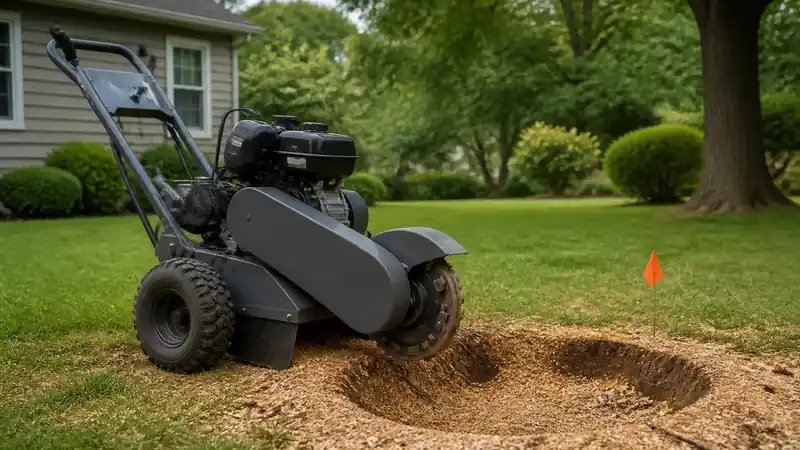
Commercial auto for bucket trucks and chippers
Insureon’s figure for landscaping companies including tree services is $299 a month, $3,590 a year (Insureon); Progressive reports a $203 monthly median per vehicle for contractors on 2025 new policies (Progressive). Two tree-specific points:
- A truck and chipper with a combined weight rating of 10,001 lb or more used across state lines is a commercial motor vehicle (49 CFR 390.5) and needs a USDOT number; FMCSA lists states that require one for intrastate carriers too (FMCSA).
- Ask whether damage caused by the aerial device while the truck is parked and working falls under the auto policy or the general liability policy, and get the answer in writing.
Ways to lower tree service insurance without gutting coverage
- Split payroll by class with real time records. Ground-only pruning and lawn work can go to 9102 or 0042 only where payroll is kept separately.
- Protect the experience mod. Once a firm is experience-rated, its claims feed the mod that multiplies its comp premium.
- Put safety on paper. Insureon names documented training, equipment maintenance and ISA-certified arborists among things that may lower rates; OSHA lists ANSI Z133 as the reference standard.
- Buy the limits your contracts require. If a city, utility or property manager asks for more than $1M per occurrence, price an umbrella against a higher primary limit.
- Bid it in. Comp and GL are job costs; our guide to bidding landscaping jobs shows how to load overhead into a price, and our landscaper salary data gives the wage side. More operator guides sit in our business section.
Tree insurance questions, answered
What type of insurance should a tree service have?
General liability, workers’ compensation for employees, commercial auto for trucks and chippers, and inland marine for equipment. Add an umbrella when clients require limits above $1 million, and professional liability if you sign tree risk assessments. Check that removals, climbing height, cranes and line work are not excluded.
How much is tree service insurance per month?
Without employees, about $295 to $511 a month for liability, one truck and equipment, using insurer-published prices. Employees add workers’ comp under class 0106, which runs from about $1.31 to $13.78 per $100 of payroll before insurer factors, depending on the state.
How much is $1,000,000 liability insurance a month?
For tree work, published figures run from about $82 a month for a trim-only policy capped at 30-foot trees (Insurance Canopy) to a $156 a month median among Insureon’s tree care customers, both for $1 million per occurrence and $2 million aggregate.
Is there such a thing as tree insurance?
For homeowners, trees are usually covered inside a homeowners policy with tight limits. Wisconsin’s insurance regulator (OCI guide PI-015) says trees, plants and shrubs are usually covered for 5 percent of the dwelling limit, up to $500 per item, and not for windstorm. For tree companies, “tree insurance” means the business policies on this page.
How much to cut down a 30ft tree?
That depends on access, hazards and haul-away, and is a homeowner pricing question this page does not cover. Our emergency tree removal guide covers storm jobs, and our stump grinding cost guide covers the stump. For insurers, 30 feet is also where some trim-only liability policies stop.
Do I need workers’ comp if I run a tree service alone?
Usually not for yourself: state comp laws generally target employees, and owners can often exclude themselves; check your state agency. You need it once you hire, and in most states from the first employee. A client contract can still require a comp certificate or an exemption form.
Is cheap tree service insurance worth it?
Only if it covers the work you do. The lowest published prices are for trim-only policies that exclude removals, stump grinding, trees over a set height and work near power lines. A claim from an excluded job is paid by the business, not the insurer.
How we built these numbers
Workers’ comp figures are the class 0106 (or state-equivalent) values in each state’s 2024 to 2026 rating bureau or state-fund filing, read October 18, 2026. NCCI tables are copyrighted, so we quote single class values only. Loss costs are the claims part of the premium; insurers multiply them by their own factor, so we show a range of × 1.13 to × 2.10, the lowest and highest SAIF 2026 tiers (SAIF). Full-rate states (New Jersey, Ohio, Massachusetts, North Dakota, Washington) are shown as filed. Georgia and North Carolina figures are the latest public filings (2025).
Per-worker comp = state OEWS May 2025 mean annual wage for SOC 37-3013 × class figure ÷ 100. Washington = hourly rate × 2,080 hours. These ignore overtime rules, experience mods, schedule credits, assessments, expense constants and minimum premiums.
Fatality rate: 99 tree trimmer deaths (CFOI 2024) ÷ 89,000 employed tree trimmers (CPS 2024 annual average) × 100,000 = 111. All workers: 5,070 ÷ 161,346,000 × 100,000 = 3.1. This is a headcount rate, not BLS’s hours-based method, and the CPS estimate for a small occupation has wide sampling error; treat it as an order of magnitude. Annual death counts for 2011 to 2022 come from the CFOI time series and 2023 to 2024 from table A-5.
Premium figures are published by insurers and brokers about their own customers; we label them and do not average them. Budgets add the lowest and highest published figure for each line. No quotes were requested and no policies were reviewed beyond the publishers’ web pages.
This page is general information, not insurance, legal or safety advice. Rates, classes and license rules change; confirm with a licensed agent and the agency linked for your state before you buy coverage or bid work.
Sources
- U.S. Bureau of Labor Statistics, Census of Fatal Occupational Injuries, table A-5 (fatal injuries by occupation and event), 2024, 2024 data, released Dec. 2025. Accessed October 2026.
- U.S. Bureau of Labor Statistics, CFOI table A-5, 2023, 2023 data. Accessed October 2026.
- U.S. Bureau of Labor Statistics, CFOI hours-based fatal injury rates, 2024, 2024 data. Accessed October 2026.
- U.S. Bureau of Labor Statistics, CFOI series FWU00X3730138ON00, tree trimmers and pruners, 2011–2022. Accessed October 2026.
- U.S. Bureau of Labor Statistics, CFOI series FWU00X45402X8ON00, logging workers, 2011–2022. Accessed October 2026.
- U.S. Bureau of Labor Statistics, Current Population Survey table 11, employed persons by detailed occupation (archived copy), 2024 annual averages. Accessed October 2026.
- U.S. Bureau of Labor Statistics, OEWS, Tree Trimmers and Pruners (37-3013), May 2025. Accessed October 2026.
- U.S. Bureau of Labor Statistics, OEWS state files (oesm25st.zip), May 2025. Accessed October 2026.
- WCIRB California, Approved pure premium rates, Effective Sept. 1, 2026. Accessed October 2026.
- WCIRB California, Class 0042 Landscape Gardening scope (archived copy), Read October 2026. Accessed October 2026.
- New Jersey Compensation Rating and Inspection Bureau, Rate and classification handbook, numeric, Effective Jan. 1, 2026. Accessed October 2026.
- Ohio Bureau of Workers’ Compensation, Ohio Adm. Code 4123-17-06, Appendix A base rates (archived copy), Effective July 1, 2026. Accessed October 2026.
- Georgia State Board of Workers’ Compensation, NCCI advisory loss costs, Effective Mar. 1, 2025. Accessed October 2026.
- WCRIBMA (Massachusetts), Circular letter 2432, rates and rating values, Effective July 1, 2024. Accessed October 2026.
- Pennsylvania Compensation Rating Bureau, PCRB rating values, Effective Apr. 1, 2026. Accessed October 2026.
- Pennsylvania Compensation Rating Bureau, Classifications, code 0005 tree pruning, Version Sept. 25, 2026. Accessed October 2026.
- North Dakota Workforce Safety & Insurance, Manual rates 2026/2027, Effective July 1, 2026. Accessed October 2026.
- North Dakota Workforce Safety & Insurance, 2026 classification manual, 2026. Accessed October 2026.
- North Carolina Rate Bureau, Loss costs and assigned risk rates (archived copy), Effective Apr. 1, 2025. Accessed October 2026.
- Missouri Department of Commerce and Insurance, NCCI advisory voluntary loss cost filing, Effective Jan. 1, 2026. Accessed October 2026.
- NCCI via Colorado Division of Insurance, Colorado loss cost filing (archived copy), Effective Jan. 1, 2026. Accessed October 2026.
- New York Compensation Insurance Rating Board, Circular RC 2659, Effective Oct. 1, 2026. Accessed October 2026.
- SAIF Corporation, Oregon pure premiums, ELRs and D-ratios; rate tiers, Effective Jan. 1, 2026. Accessed October 2026.
- Texas Department of Insurance, NCCI Texas advisory loss costs (archived copy), Effective July 1, 2026. Accessed October 2026.
- Washington Department of Labor & Industries, 2026 rates by class, Effective Jan. 1, 2026. Accessed October 2026.
- WCRIBMA (reproducing NCCI item B-1394), Circular letter 2384, classification changes (archived copy), Apr. 12, 2021. Accessed October 2026.
- Oregon Division of Financial Regulation, Order INS 10-11-006, 2010. Accessed October 2026.
- Occupational Safety and Health Administration, Tree care: standards, Read October 2026. Accessed October 2026.
- Occupational Safety and Health Administration, Tree care operations rulemaking, Read October 2026. Accessed October 2026.
- eCFR, 29 CFR 1910.333, selection and use of work practices, Current to October 2026. Accessed October 2026.
- Cornell LII, N.J. Admin. Code 7:3A-2.11, insurance, Read October 2026. Accessed October 2026.
- New Jersey Board of Tree Experts, Business registration biennial renewal application, 2026 cycle. Accessed October 2026.
- New Jersey Board of Tree Experts, Benefits of hiring a registered business, Read October 2026. Accessed October 2026.
- Maryland General Assembly, Natural Resources 5-418, Read October 2026. Accessed October 2026.
- Maryland General Assembly, Natural Resources 5-417, Read October 2026. Accessed October 2026.
- Louisiana Department of Agriculture and Forestry, Arborists, Read October 2026. Accessed October 2026.
- Cornell LII, Fla. Admin. Code 69L-6.021, construction classification codes, Read October 2026. Accessed October 2026.
- Florida Division of Workers’ Compensation, Coverage requirements, Read October 2026. Accessed October 2026.
- Texas Legislature, Labor Code chapter 406, Read October 2026. Accessed October 2026.
- Alabama Legislature, Code of Alabama 25-5-50, Read October 2026. Accessed October 2026.
- Missouri Revisor of Statutes, RSMo 287.030, Read October 2026. Accessed October 2026.
- Georgia State Board of Workers’ Compensation, Workers’ compensation insurance FAQs, Read October 2026. Accessed October 2026.
- North Carolina Industrial Commission, Workers’ compensation insurance requirements, Read October 2026. Accessed October 2026.
- Insureon (broker), Tree service insurance cost, Updated Sept. 30, 2026. Accessed October 2026.
- Insurance Canopy, Tree service insurance (prices and exclusions), Read October 2026. Accessed October 2026.
- Progressive Commercial, Commercial auto insurance cost, 2025 new-policy data. Accessed October 2026.
- Progressive Commercial, Tree service insurance, Read October 2026. Accessed October 2026.
- Wisconsin Office of the Commissioner of Insurance, Consumer’s guide to homeowners insurance (PI-015), Read October 2026. Accessed October 2026.
- eCFR, 49 CFR 390.5, definitions, Current to October 2026. Accessed October 2026.
- Federal Motor Carrier Safety Administration, Do I need a USDOT number?, Read October 2026. Accessed October 2026.