Short answer: A lawn care contract template should name the property and services, the mowing height and visit frequency, the price and billing terms, a rain-day rule, cancellation notice, renewal terms, pesticide notices, damage and insurance, and consent to e-signatures. Copy the free 16-clause template below, fill in the brackets, then check your state’s renewal and pesticide rules in the table.
15–30 days before the opt-out deadline: when New York requires the renewal reminder on service contracts (N.Y. Gen. Oblig. Law 5-903)
3 business days to cancel a lawn deal of $25 or more signed at the customer’s home after a sales visit (FTC Cooling-Off Rule, 16 CFR 429)
24 hours minimum that lawn pesticide markers stay up in New York, Ohio, Michigan and Massachusetts (state rules; see table)
53.7% of landscaping industry revenue came from exterior commercial services in 2022 (Census, 2022 Economic Census)
This lawn care contract template is a plain-English service agreement you can copy into a word processor, fill in and sign. It is written for a lawn care business mowing and treating residential lawns, with a short addendum for commercial accounts. Under it, each clause is explained, along with the state statutes that change what a clause must say: automatic renewal laws in California, New York, Florida, Virginia and Minnesota, pesticide posting and notice rules in seven states, the federal three-day cancellation rule for door-to-door sales, and the federal E-SIGN Act.
The free templates that rank for this search are short: the two top-ranked samples run 9 and 21 numbered sections. In the sample text the ranking pages show, we found no rain-day rule, no renewal-reminder clause that tracks a state notice law, and no pesticide-notice clause, and one sample is headed “Delivery Driver Service Contract”. Those gaps are where lawn care disputes start, so the template below closes them. More guides for running the business side of a lawn care company are in our Business section.
How to make a contract for lawn care in 6 steps
A lawn care contract only works if the customer and the crew read the same thing into it. Build it in this order:
- Define the property. Write the service address and what counts as the service area (front, back, all turf, or a marked site map) and roughly how many square feet. Disputes over “the side yard too” start here.
- List the services and the standard. Mowing height, trimming, edging, blowing, and whether clippings are mulched or bagged. A height such as “3 inches” is checkable; “mow as needed” is not.
- Pick the pricing model. Per visit, flat monthly, or a season price paid in installments. Each one shifts weather risk differently (see the comparison below). For how to set the number itself, use our guide to bidding landscaping jobs.
- Write the exceptions. Rain days, skipped visits in drought, locked gates, dogs in the yard, overgrowth, and extra work. These cause more arguments than the price.
- Check the state rules that override your wording. Auto-renewal notice windows, pesticide notices and posting, and the three-day cancellation right for sales made at the customer’s door. The state table below lists the statutes.
- Sign it and hand over a copy. In person or with an e-signature tool. Keep the signed copy and any consent records; California requires renewal-consent records to be kept at least three years.
Free lawn care contract template (16 clauses)
This page is general information, not legal advice. Contract, consumer-protection and pesticide rules vary by state and change. Have a lawyer licensed in your state review the agreement before you rely on it, and confirm pesticide rules with your state’s pesticide regulatory agency.
Copy everything from the title to the signature lines. Text in [brackets] is for you to fill in or choose; delete the options you don’t use. Section numbers are referred to inside the clauses, so keep the numbering if you delete a clause (write “Not used”).
LAWN CARE SERVICE AGREEMENT
1. Parties and property. This agreement is between [BUSINESS LEGAL NAME], [address, phone, email] (“Contractor”), and [CLIENT NAME], [mailing address, phone, email] (“Client”).
Contractor will service the property at [SERVICE ADDRESS] (the “Property”). The service area is [all turf areas / front and side lawns only / the areas marked on the attached site map], about [__] square feet of turf.
2. Term. This agreement starts on [START DATE] and ends on [END DATE] (the “Season”). [Choose one: It ends on the end date. / It renews only as described in Section 14.]
3. Services included. At each regular visit Contractor will: (a) mow all turf in the service area at [__] inches, raising the deck when needed so that no more than one-third of the grass blade is removed in one mowing; (b) string-trim around fences, trees, beds and obstacles; (c) edge sidewalks, driveways and curbs [every visit / every other visit]; (d) blow clippings off paved surfaces; (e) [leave clippings on the lawn / bag and remove clippings].
Seasonal services included in the price: [spring cleanup between __ and __; fall leaf cleanup, up to __ visits; core aeration once in __; __ fertilizer applications as listed in Section 11; other: __].
4. Extra work. Work not listed in Section 3 is extra. Examples: leaf removal beyond the included visits, storm cleanup, debris hauling, shrub pruning, bed weeding, irrigation repair. Contractor will give a price before starting extra work and will start only after Client approves it in writing (a text or email counts). Extra work is billed at [the quoted price / $__ per crew-hour plus materials].
5. Visit schedule. Regular visits are [weekly / every 14 days] on or about [DAY], from about [START WEEK] through [END WEEK], for about [__] visits in the Season.
Contractor may skip a visit when the grass has not grown enough to need cutting, for example during drought dormancy. A skipped visit is [not billed / covered by the flat monthly price, which already assumes some skipped visits].
6. Rain and weather. If rain, wet ground, lightning, extreme heat or other weather makes mowing unsafe or likely to damage the turf, Contractor will move the visit to the next workable day, normally within [2] business days. A weather delay is not a missed visit.
If Client postpones or blocks a visit and the grass grows more than [__] inches past the mowing height, Contractor may charge an overgrowth fee of [$__ / __ percent of the visit price] for the next visit.
7. Price. Client will pay [choose one: $__ per visit / $__ per month for __ months, which is the Season price divided into equal installments / $__ for the Season, paid as follows: __].
Prices [include / do not include] sales tax. Where the state or locality taxes lawn services, the tax is added to each invoice.
8. Billing, payment and late charges. Contractor will invoice [after each visit / on the 1st of each month]. Payment is due within [__] days of the invoice date by [card on file / bank transfer / check / cash]. If Client authorizes automatic payments, Contractor will charge only amounts set by this agreement and extra work Client approved.
A balance unpaid [__] days after the due date accrues a late charge of [$__ / __ percent per month], but never more than the highest rate allowed by the law of the state where the Property is located. A returned payment costs $[__]. After giving written notice, Contractor may pause service while any invoice is more than [__] days past due.
9. Price changes. Prices stay fixed for the Season. Contractor will give written notice of any price change for a renewal term at least [30] days before it takes effect, and Client may cancel before it takes effect without penalty.
10. Client responsibilities and access. Client will: (a) give Contractor access to every service area on the scheduled day, including unlocked gates; (b) keep pets inside or secured during visits; (c) clear toys, hoses, furniture, pet waste and debris from the lawn; (d) mark, or tell Contractor in writing about, sprinkler heads, low-voltage lighting, buried pet-fence wire, septic parts, shallow utility lines and other hidden objects; (e) tell Contractor about anyone on the Property with a known sensitivity to pesticides.
If a locked gate, loose animal or other condition within Client’s control prevents service, the visit counts as performed and is billed [in full / at __ percent].
11. Fertilizer and pesticide applications. [Delete this section if you do not apply products.] Contractor will apply only products registered for the use, following the label, through an applicator licensed or certified as [STATE] requires. Planned applications for the Season: [approximate dates, type of product, number of applications], total cost $[__].
Before the first application, Contractor will give Client the product names, active ingredients and label precautions, plus any registry, notice or posting information that state or local law requires, and will post lawn markers where the law requires them. Client will not remove markers before the time shown on them and will tell household members, tenants and visitors about re-entry instructions. Client may stop future applications by written notice at any time, and applications not yet made will not be billed.
12. Damage, liability and insurance. Contractor carries commercial general liability insurance of at least $[__] per occurrence [and workers’ compensation where required by law] and will provide a certificate on request.
Contractor will repair or pay for damage it causes through its own negligence, such as a window broken by a thrown stone. Client must report damage within [__] days of the visit, with photos where possible. Contractor is not responsible for: (a) damage to hidden objects that were not marked under Section 10(d); (b) conditions that existed before service, including turf disease, grubs, drought stress and bare spots; (c) results that depend on weather, watering or other things outside Contractor’s control. Except where the law does not allow a limit, Contractor’s liability for any one visit is limited to [repair or replacement of the damaged item / __].
13. Cancellation. Either party may cancel this agreement for any reason with [14 / 30] days’ written notice. Either party may cancel at once if the other materially breaches it and does not fix the problem within [7] days after written notice.
On cancellation, Client pays for services already performed and Contractor refunds any prepaid amount for services not yet performed within [__] days. [For installment plans: if Client cancels early, Client owes $__ for each visit already performed, minus installments already paid.]
14. Renewal. [Option A, no automatic renewal:] This agreement ends on the end date. Contractor may offer a new agreement for the next Season.
[Option B, automatic renewal:] THIS AGREEMENT RENEWS AUTOMATICALLY for one more Season of the same length unless either party cancels in writing at least [__] days before the end date. Contractor will send Client a written reminder stating the renewal date, the price for the renewal term and how to cancel, between [__] and [__] days before the cancellation deadline, by [the delivery method your state requires]. Client may cancel the renewal the same way Client signed up, including online if Client signed up online.
15. Independent contractor. Contractor is an independent business, not Client’s employee. Contractor controls how the work is done, supplies its own equipment and labor, and is responsible for its workers’ pay, taxes and insurance. Contractor may use subcontractors who meet the same insurance and licensing requirements.
16. Electronic signatures, notices and other terms. The parties may sign this agreement electronically, and an electronic signature has the same effect as a handwritten one. Notices may be sent by email or text to the contact details in Section 1 unless a law requires another method, such as certified mail.
This document [and the attached site map and price sheet] is the entire agreement. Changes must be in writing and accepted by both parties. The law of the state where the Property is located governs this agreement. If any part is unenforceable, the rest stays in effect.
Signatures. Contractor: ____________________ Name and title: ____________________ Date: __________
Client: ____________________ Printed name: ____________________ Date: __________
Add-on for sales made at the customer’s door
If you sell a residential program at the customer’s home after knocking or a sales visit, and the price is $25 or more, the FTC Cooling-Off Rule (16 CFR 429.1) requires a completed two-copy “Notice of Cancellation” form and, next to the customer’s signature in at least 10-point bold type and in the language used in the sales pitch, this sentence: “You, the buyer, may cancel this transaction at any time prior to midnight of the third business day after the date of this transaction. See the attached notice of cancellation form for an explanation of this right.” Refunds are due within 10 business days of a valid cancellation. The rule does not cover deals made entirely by phone or mail.
Add-on clauses for commercial accounts
- C1. Scope by specification. Services and frequencies are listed in the attached specification and site map, stated as visits per year for each task (for example, “mowing: [__] visits; shrub pruning: [__] visits”).
- C2. Insurance certificate. Before work starts, Contractor will deliver a certificate showing the limits in the bid documents and naming [Owner / Property Manager] as additional insured where required.
- C3. Inspections and corrections. Client’s representative may inspect after each visit. Contractor will correct reported defects within [__] business days at no charge.
- C4. Service log. Contractor will keep a dated log of visits, tasks and any product applications and share it [monthly / on request].
- C5. Multi-year pricing. For terms longer than one year, prices adjust on each anniversary by [__ percent / the method in the price sheet], with [__] days’ written notice.
- C6. Termination for convenience. Either party may end the agreement with [30] days’ written notice; Client pays for work performed through the end date.
- C7. Snow and ice (if bundled). Trigger depth, response time, and per-push or seasonal pricing are set in a separate snow schedule.
How we built this template
We compared the sample contracts on the four non-forum pages ranking for “lawn care contract template” on Oct. 15, 2026 (eSign, eForms, FieldCentral and LegalTemplates), listed what each one leaves out, and wrote the clauses to cover the gaps. Every state-law statement on this page comes from the statute or regulation text, read on Oct. 18, 2026; the links are in the tables and the Sources list. No attorney reviewed this template, and it does not cover every state. Treat it as a starting draft.
What each clause does, and the law that can override it
Most of a lawn care contract is ordinary contract law: the parties agree, and a court enforces what they wrote. Three areas are different, because a statute sets terms the contract cannot waive: automatic renewal, pesticide applications, and sales made at the customer’s door. The table maps each clause to the problem it prevents and the rule to check.
| Clause | What it settles | Typical dispute it prevents | Statute or rule to check |
|---|---|---|---|
| 1. Parties and property | Who is bound; which turf is covered | “I thought the side lot was included” | None specific |
| 3. Services included | Height, trimming, edging, clippings | Scalped lawns, missed edging | Mowing height guidance: Univ. of Arkansas FSA6023 |
| 4. Extra work | Price approval before extra tasks | Surprise charges for leaves or hauling | None specific |
| 5–6. Schedule and rain | When a visit moves, when it’s skipped | Billing for a visit that didn’t happen | None specific |
| 7–9. Price, billing, changes | Due dates, late charges, price notice | Late fees above the legal cap; mid-season price hikes | State interest caps, e.g. Fla. Stat. 687.03; renewal price notice in Cal. B&P 17602(g) |
| 10. Client responsibilities | Gates, pets, hidden objects | Cut invisible-fence wire; broken sprinkler heads | None specific |
| 11. Pesticide applications | What is applied, notice, markers | Neighbor complaints; missing required notices | N.Y. ECL 33-1001, Conn. 22a-66a, 333 CMR 13.06, Ohio 901:5-11-09, Mich. R 285.637.11 |
| 12. Damage and insurance | Who pays for what; proof of coverage | Thrown-stone window claims | See our lawn care business insurance guide |
| 13. Cancellation | Notice period, refunds of prepayments | Prepaid season, client moves in June | 16 CFR 429 for door-to-door sales |
| 14. Renewal | Whether and how the contract rolls over | Unenforceable renewal; charges after cancellation | Cal. B&P 17602, N.Y. GOL 5-903, Fla. Stat. 501.165, Va. Code 59.1-207.46, Minn. Stat. 325G.57 |
| 16. E-signatures and notices | Signing on a phone; email notices | “I never signed that” | 15 U.S.C. 7001 (E-SIGN Act) |
Auto-renewal clauses: state notice windows for lawn contracts
An auto-renewal clause is only safe if you send the renewal reminder inside your state’s window. New York’s rule is the strictest for lawn care: under General Obligations Law 5-903, an automatic renewal clause in any contract for service, maintenance or repair of real property cannot be enforced against the customer unless you deliver written notice in person or by certified mail 15 to 30 days before the customer’s opt-out deadline. It covers business customers as well as homeowners, and the only exception is a renewal period of one month or less.
| State and law | Which contracts | Reminder window | Other requirements | If you get it wrong |
|---|---|---|---|---|
| New York, GOL 5-903 | Service, maintenance or repair of real or personal property; any customer | 15–30 days before the opt-out deadline | Personal delivery or certified mail; must call attention to the renewal clause | Renewal clause unenforceable against the customer |
| California, B&P 17602 | Consumer auto-renewal offers | 15–45 days before renewal (initial term 1 year or longer) | Clear terms near consent; affirmative consent; retainable acknowledgment; fee-change notice 7–30 days ahead; annual reminder; consent records kept 3+ years | Statutory violation (2024 amendments apply from July 1, 2025) |
| Florida, Stat. 501.165 | Consumer service contracts of 12+ months renewing for more than 1 month | 30–60 days before the cancellation deadline | Renewal disclosed clearly in the contract; cancellation by the same means as acceptance | Renewal provision void and unenforceable |
| Virginia, Code 59.1-207.46 | Consumer offers renewing for more than 30 days and extending more than 12 months | 30–60 days before the cancellation deadline or term end | Cancellation at least as easy as sign-up; online or phone cancellation for in-person sign-ups | Statutory violation |
| Minnesota, Stat. 325G.57 | Consumer indefinite subscription agreements | At least once per calendar year | Retainable confirmation with termination options; notice before any material change | Unnoticed material change void |
The practical answer for a small lawn care company: use Option A in clause 14 (no automatic renewal) and send a new agreement each spring, or use Option B and put a reminder in your software for the window that fits your state. If you serve customers in more than one state and set the opt-out deadline on the renewal date itself, a reminder sent 30 days before that date lands inside all four windows charted above, and certified mail satisfies New York’s delivery rule. There is no federal “click to cancel” rule to add: the U.S. Court of Appeals for the Eighth Circuit vacated the FTC’s amended negative-option rule on July 8, 2025 (Custom Communications v. FTC, No. 24-3137), so the state laws are what apply.
Pesticide and fertilizer clauses: notice and posting rules by state
If your program includes weed control or insect control, several states attach paperwork to the contract itself, not just to the application. New York requires a written contract before any commercial lawn application, stating the approximate dates, number of applications and total cost, plus the product names, label warnings and your registration and applicator ID numbers before the first treatment (ECL 33-1001). Connecticut requires you to give the customer the state notification-registry notice and key label information before you enter a written or oral agreement (Conn. Gen. Stat. 22a-66a). Massachusetts requires a Department-approved written statement before you sign or renew a residential turf agreement (333 CMR 13.06).
| State | Before or at signing | Markers or signs | Neighbor notice |
|---|---|---|---|
| New York | Written contract with dates, number of applications, total cost; product and label information before application | 4 × 5 in. markers, 12 in. above ground, at least 24 hours (ECL 33-1003) | 48 hours before, to abutting dwellings within 150 ft, where the county adopts it (ECL 33-1004) |
| Connecticut | Registry notice and label portion before any written or oral agreement | Sign at entry points and every 150 ft of road frontage | Registered abutters, by 24 hours before application |
| Massachusetts | Approved written statement before agreement or renewal; offer prior notice of each application | Approved signs at access points, at least 24 and no more than 72 hours | Not in this section |
| Ohio | Written product and timing information at or before application | 5 × 4 in. signs, bottom 14 in. above ground, within 5 ft of access points, 24 hours | Abutting residents who asked in writing, by the preceding business day |
| Michigan | Tell customer markers stay 24 hours | 4 × 5 in. marker at primary entry points, 12 in. above turf | Not covered in this rule |
| Minnesota | None in this section | Sign 18 in. above grass, 2–5 ft from street, up to 48 hours, in cities that adopt the ordinance | None in this section |
| Pennsylvania | None in this section | Not in this section | Neighbors within 100 ft who requested in writing, 12 hours before; requests expire Dec. 31 |
Clause 11 in the template handles this by promising the notices “state or local law requires” and by making the customer responsible for leaving markers up and warning others in the household. It also lists the planned applications and total cost, which is what New York’s statute asks for. States also license businesses and applicators that apply pesticides for hire; our state licensing table lists the agencies, and homeowners can verify a company with our license lookup guide.
Rain days, skipped visits and the one-third rule
What is the 1/3 rule in lawn care? Never remove more than one-third of the grass blade in a single mowing. University of Arkansas Cooperative Extension puts it plainly: if the mower is set at 3 inches, mow before the lawn reaches 4.5 inches (FSA6023, Mowing Your Lawn). Cutting more than that stresses the plant, which is why the template ties the mowing height to the rule and lets you charge for overgrowth caused by visits the customer postponed.
| Mowing height | Mow before grass reaches | Grass removed | Extension’s estimated interval |
|---|---|---|---|
| 2.0 in. | 3.0 in. | 1.0 in. | 5.0 days |
| 2.5 in. | 3.75 in. | 1.25 in. | 6.3 days |
| 3.0 in. | 4.5 in. | 1.5 in. | 7.5 days |
| 3.5 in. | 5.25 in. | 1.75 in. | 8.8 days |
| 4.0 in. | 6.0 in. | 2.0 in. | 10.0 days |
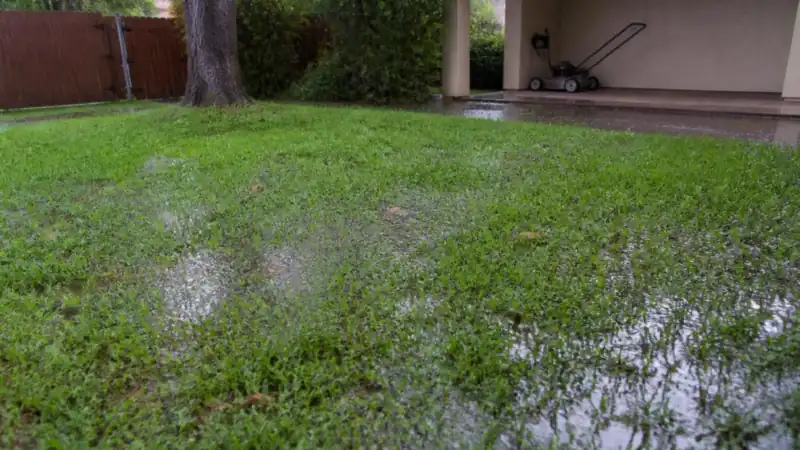
The table explains why weekly service is the default and why a rain week matters: at a 3-inch height, a visit pushed back more than a few days can put the lawn past the one-third line. Clause 6 sets a 2-business-day window to make up a weather delay. If your crews cannot reliably hit that in a wet spring, write a longer window rather than a promise you’ll miss.
Price, billing and late fees
How to calculate how much to charge for lawn care: start from what each visit costs you, then add overhead and profit. The labor part is a formula:
Labor cost per visit = crew-hours × hourly wage × (1 + employer payroll tax rate)
Worked example, 3 hours of mowing by one worker at the national median wage for landscaping and groundskeeping workers, $18.82 an hour (BLS OEWS, May 2025), with the employer’s 7.65 percent share of Social Security and Medicare tax (6.2 plus 1.45 percent, IRS Publication 15, 2026): 3 × $18.82 × 1.0765 = $60.78. That is the floor before equipment, fuel, insurance, unemployment tax, overhead and profit. Our bidding guide walks through each of those layers with state wage data.
For late charges, the safest wording is the one in clause 8: a stated fee or monthly percentage “but never more than the highest rate allowed” in the property’s state. Interest caps vary. Florida, for example, makes it usury to charge more than the equivalent of 18 percent a year simple interest on obligations up to $500,000 (Fla. Stat. 687.03), and a 1.5 percent monthly charge equals 18 percent a year. Whether a late fee on an invoice counts as interest depends on the state, so check yours before you go above a modest flat fee.
Seasonal contract vs per-cut pricing
| Question | Per-cut (per visit) | Flat monthly | Season price in installments (including 12-month plans) |
|---|---|---|---|
| Who carries weather risk | Contractor: no cut, no pay | Shared: price assumes some skipped visits | Customer: payments are level all year |
| Cash flow | Follows the growing season | Level in season | Level all year, including winter |
| Rain-day clause needed | Short: reschedule or skip | Must say skipped visits are priced in | Must define how many visits the season includes |
| Early cancellation | Simple: pay for visits done | Pay through the notice period | Needs a true-up formula (clause 13) |
| Renewal law exposure | Low if month-to-month | Low if month-to-month | Highest: a 12-month term triggers notice rules in CA, FL and VA |
| Best fit | Irregular or new customers | Mowing-only routes | Full programs with treatments and cleanups |
A 12-month lawn care contract spreads a season’s price over 12 equal payments. It smooths cash flow for the contractor and the customer’s budget, but it means the customer has prepaid for visits by late summer, so the cancellation clause needs the true-up line (visits performed times the per-visit price, minus installments paid). If the plan bundles seasonal work, price it from our lawn aeration cost and leaf removal cost guides before you divide by 12. Software that handles recurring billing and e-signatures is compared in our software section.
Is a lawn care contract signed on a phone valid?
Yes, in general. The federal E-SIGN Act (15 U.S.C. 7001) says a signature, contract or record relating to a transaction in interstate commerce may not be denied legal effect solely because it is electronic. Two limits apply. First, if a law requires that information be given to a consumer in writing, an electronic copy satisfies it only after the consumer has affirmatively consented to electronic records. Second, an electronic record that the law requires to be in writing can be denied effect if the parties cannot keep and reproduce it. Send the signed PDF to the customer’s email and keep your own copy.
Some notices have their own delivery rules that e-signature law does not change. New York’s renewal reminder must go by personal delivery or certified mail (GOL 5-903), so clause 16 of the template carves out notices that a law says must be sent another way.
Commercial landscaping contracts: what changes
Commercial accounts are the bigger half of the business. In the 2022 Economic Census, exterior commercial landscaping services brought in $61.9 billion, 53.7 percent of the $115.4 billion industry, and 69.6 percent of landscaping establishments reported revenue from them; residential landscaping services were $36.8 billion, or 31.8 percent (U.S. Census Bureau, 2022 Economic Census, Industry by Products, NAICS 561730).
A commercial landscaping contract usually starts from the client’s bid documents, not yours. Expect a scope written as a specification with visits per year for each task, insurance limits set by the owner with the owner added as an insured, inspection and correction procedures, and termination for convenience on 30 days’ notice. The add-on clauses C1 to C7 above cover those. State consumer protections such as California’s auto-renewal law apply to consumers, but New York’s GOL 5-903 applies to businesses too. Commercial work that bundles snow plowing needs its own trigger-depth and pricing schedule (clause C7).
How to get commercial landscaping contracts
Commercial work comes from three places: public bids, property managers and HOAs, and direct outreach to owners. Each has a different entry ticket.
- Federal bids. You must be registered in SAM before you submit an offer (FAR 4.1102). Landscaping (NAICS 561730) counts as a small business up to $9.5 million in average annual receipts (13 CFR 121.201), which covers almost every lawn care company. Federal grounds contracts carry Service Contract Act wage and fringe-benefit minimums set by the Labor Department for the locality (41 U.S.C. 6703), so price the bid from the wage determination, not your usual pay.
- State and local bids. Cities, counties, school districts and transit agencies post mowing and grounds bids on their own procurement portals. Registration is usually free; bonding, insurance certificates and prevailing-wage rules vary by agency.
- Property managers and HOAs. Contracts are typically rebid when the term ends. The ask is a site walk, a priced specification, a certificate of insurance and references. A clear contract with the commercial add-on clauses is part of what they evaluate.
- Direct to owners. Small offices, retail centers, churches and medical buildings often have no formal bid process. A one-page proposal with a per-visit price and the contract attached shortens the sale.
Whatever the channel, the price has to come from crew-hours on that site. Our bidding guide has a section on commercial bids, and the insurance limits property managers ask for are in our insurance guide.
Lawn care contract questions, answered
Do lawn care companies do contracts?
Many do, especially for seasonal programs, fertilizer and weed-control plans, and commercial accounts. Some mowing-only operators work per cut with no written contract, but then nothing settles rain days, cancellations or damage. In New York a written contract is required before any commercial lawn pesticide application (ECL 33-1001).
How to write a lawn care contract?
Define the property and service area, list services with a mowing height, choose per-visit, monthly or seasonal pricing, add rain-day, access and damage rules, check your state’s renewal and pesticide laws, then sign and give the customer a copy. The 16-clause template on this page follows that order.
What should a landscaping contract include?
Parties and property, scope and standards, schedule, weather rules, price and billing, late charges within state limits, price-change notice, client responsibilities, product applications, damage and insurance, cancellation, renewal, independent-contractor status, and e-signature and notice terms. Commercial contracts add specifications, insurance certificates, inspections and termination for convenience.
How to calculate how much to charge for lawn care?
Multiply crew-hours by the hourly wage and add the employer’s payroll taxes, then add equipment, fuel, insurance, overhead and profit. At the May 2025 national median wage of $18.82 an hour plus 7.65 percent FICA, one crew-hour of labor costs about $20.26 before the other layers.
How much to charge for 3 hours of mowing?
Start at the labor floor: 3 hours at $18.82 plus 7.65 percent employer FICA is about $60.78 for one worker, before equipment, fuel, insurance, overhead and profit. The final price depends on your local wages and costs; build it with the bidding formula rather than a flat national rate.
How to get contracts for lawn mowing?
Residential contracts usually come from a signed seasonal agreement offered after the first few cuts. Commercial mowing contracts come from public bid portals (federal work requires SAM registration first), property managers and HOAs that rebid each year, and direct proposals to small commercial owners.
How much does a commercial landscaper make?
BLS puts the May 2025 national median at $28.09 an hour ($58,430 a year) for first-line supervisors of landscaping and groundskeeping workers, and $18.82 an hour ($39,150 a year) for landscaping and groundskeeping workers. Owner earnings depend on the company’s margins and are not measured by BLS. Pay by experience level is in our landscaper salary guide.
Can I get this lawn care contract template in Word or PDF?
Copy the template text from this page into Word, Google Docs or any editor and save it as .docx or PDF; it is plain text with no formatting to break. The state rules table is downloadable as CSV.
Sources
- Legal Information Institute (Cornell Law School), 15 U.S. Code 7001, General rule of validity (E-SIGN Act), Current code, read Oct. 2026. Accessed October 2026.
- Federal Trade Commission via eCFR, 16 CFR Part 429, Rule Concerning Cooling-Off Period for Sales Made at Homes, eCFR current as of Oct. 2026. Accessed October 2026.
- California Legislature, Business and Professions Code 17602 (Automatic Purchase Renewals), As amended by Stats. 2024, ch. 515 (AB 2863). Accessed October 2026.
- New York State Senate, General Obligations Law 5-903, automatic renewal of service contracts, Current law, read Oct. 2026. Accessed October 2026.
- Florida Legislature, Florida Statutes 501.165, Automatic renewal of service contracts, 2026 Florida Statutes. Accessed October 2026.
- Virginia General Assembly, Code of Virginia 59.1-207.46, automatic renewal or continuous service offers, Includes 2026 amendments. Accessed October 2026.
- Minnesota Revisor of Statutes, Minnesota Statutes 325G.57, requirements for automatic renewal or continuous service, 2024 c. 114. Accessed October 2026.
- New York State Senate, Environmental Conservation Law 33-1001, commercial lawn application requirements, Current law, read Oct. 2026. Accessed October 2026.
- New York State Senate, Environmental Conservation Law 33-1003, visual notification, Current law, read Oct. 2026. Accessed October 2026.
- New York State Senate, Environmental Conservation Law 33-1004, lawn applications in certain municipalities, Current law, read Oct. 2026. Accessed October 2026.
- Connecticut General Assembly, General Statutes chapter 441, section 22a-66a, notification of the application of pesticides, 2026 supplement. Accessed October 2026.
- Legal Information Institute (Cornell Law School), 333 CMR 13.06, Application for Turf Pests (Massachusetts), Current regulation, read Oct. 2026. Accessed October 2026.
- Legal Information Institute (Cornell Law School), Ohio Admin. Code 901:5-11-09, notification requirements for lawn pesticide applicators, Current rule, read Oct. 2026. Accessed October 2026.
- Legal Information Institute (Cornell Law School), Mich. Admin. Code R 285.637.11, commercial notification and posting requirements, Current rule, read Oct. 2026. Accessed October 2026.
- Minnesota Revisor of Statutes, Minnesota Statutes 18B.09, pesticide application in cities, Current law, read Oct. 2026. Accessed October 2026.
- Pennsylvania Code and Bulletin, 7 Pa. Code 128.85a, ornamental or turf application notification, Code current through Aug. 8, 2026. Accessed October 2026.
- Florida Legislature, Florida Statutes 687.03, unlawful rates of interest defined, 2026 Florida Statutes. Accessed October 2026.
- University of Arkansas Cooperative Extension Service, FSA6023, Mowing Your Lawn, Revised Nov. 2018. Accessed October 2026.
- U.S. Bureau of Labor Statistics, Occupational Employment and Wage Statistics, national estimates (oesm25nat.zip), May 2025 estimates, released May 15, 2026. Accessed October 2026.
- Internal Revenue Service, Publication 15 (Circular E), Employer’s Tax Guide, 2026. Accessed October 2026.
- U.S. Census Bureau, 2022 Economic Census, Industry by Products (ECNNAPCSIND2022), NAICS 561730, 2022 data, posted Apr. 23, 2026. Accessed October 2026.
- U.S. Small Business Administration via eCFR, 13 CFR 121.201, size standards by NAICS industry, eCFR current as of Oct. 2026. Accessed October 2026.
- Federal Acquisition Regulation via eCFR, 48 CFR 4.1102, SAM registration policy, eCFR current as of Oct. 2026. Accessed October 2026.
- Legal Information Institute (Cornell Law School), 41 U.S. Code 6703, required contract terms (Service Contract Act), Current code, read Oct. 2026. Accessed October 2026.
- U.S. Court of Appeals for the Eighth Circuit, Custom Communications, Inc. v. FTC, No. 24-3137 (opinion vacating the amended Negative Option Rule), Filed July 8, 2025. Accessed October 2026.