Short answer: Commercial lawn care that covers mowing, string trimming, edging and blowing costs an estimated $118 to $242 per acre per visit, or about $3,300 to $6,800 per acre for a 28-visit season. Full service with bed care, pruning and a five-round fertilizer program runs about $6,300 to $12,600 per acre a year. Large open fields bid far lower.
$118–$242 per acre per visit, standard commercial mowing (estimate; see method)
$41.50–$239 per acre per mowing cycle in 2025 city bids (Omaha, Johnson City)
$61.9 billion commercial landscaping revenue, 53.7% of the industry (Census, 2022)
+13.9% lawn care service prices, year to September 2025 (BLS CPI)
This page is for both sides of a commercial grounds contract: the property manager or HOA board writing a scope and comparing bids, and the landscaping company pricing one. Every price on it either comes from a public document (city, county, school district and community development district bid files dated 2024 to 2026) or is built from government wage and industry data with the arithmetic shown. Commercial customers buy most of what this industry sells: landscaping companies reported $61.9 billion of revenue from the product line Census labels “exterior commercial landscaping services” in 2022, against $36.8 billion from residential landscaping services (U.S. Census Bureau, 2022 Economic Census, product lines for NAICS 561730).
What a commercial maintenance contract covers
A commercial lawn care contract is a recurring scope with a visit count. The best public specifications spell out each task, how often it happens and how it is paid. The table below pulls those details from seven real solicitations so you can see what “standard” looks like in writing, not in a sales brochure.
Swipe the table sideways to see every column.
| Service | What public specs require | Frequency in 2024 to 2026 specs | How it is usually priced |
|---|---|---|---|
| Mowing | Set height, never remove more than one-third of the blade, clippings off paved surfaces | 12 cycles (Omaha rights-of-way), 21 (Lee County, Fla., parks), 24 (New Orleans housing authority), up to 36 (Washington, Iowa, schools) | Per acre per cycle, per mow by site, or inside an annual price |
| String trimming | Fences, poles, signs, trees, building edges; mechanical, not chemical | Every visit, or every other cycle at minimum (Washington schools) | Inside the mowing price |
| Edging hard surfaces | Sidewalks, curbs and drives | Every visit on most commercial sites; “at least once per year” in the Washington schools spec | Inside the mowing price or per event |
| Blowing and litter | Lots, walks and curbs blown clean; litter picked up before mowing | Every visit (Lee County); weekly (Washington schools) | Inside the mowing price |
| Bed care | Beds weed-free; weeds over 6 inches hand-pulled; pre-emergent once a year | Every visit or monthly | Per event or inside a full-service price |
| Shrub and tree pruning | Shrubs 18 inches off structures and walks; trees lifted to 12 feet | Twice a year (Washington schools; New Orleans housing authority) | Per event or inside a full-service price |
| Turf fertilizer and weed control | Licensed applicator, product and rate on record | Five applications (Middletown, Conn.); spring plus one more weed control (Washington schools) | Per application or per year |
| Hardscape weed control | Sidewalk and parking-lot cracks | 3 to 5 applications (Washington schools) | Per application |
| Mulch | 3-inch bed top-dressing; 4-inch tree rings | 1 or 2 times a year | Per cubic yard, usually outside the base price |
| Seasonal color | Annual flowers changed out | Up to 4 rotations a year (a Florida community district) | Per flat or per plant, outside the base price |
| Irrigation | Start-up, inspections, repairs, winterization | Monthly checks are common; repairs as found | Inspections in the base or per event; repairs per hour plus parts |
| Leaves | Leaves off turf, beds and playgrounds, hauled away | Weekly in October and November (Washington schools) | Inside the base price or per cleanup |
| Snow and ice | Lots and walks plowed, salted or shoveled | Per storm | Per hour, per push, per ton of salt or seasonal |
The mowing rule behind most of those specs is agronomy, not taste. Extension turf guidance says to never remove more than a third of the leaf blade at once, so a lawn kept at 3 inches gets mowed before it passes 4.5 inches; in peak growth that can mean more than one cut a week (Ohio State University CFAES, Lawn mowing fact sheet). That is why visit counts track climate. University of Florida guidance puts St. Augustinegrass on a 5- to 14-day mowing interval and bahiagrass on 7 to 17 days (UF/IFAS Gardening Solutions, Mowing your Florida lawn), while Omaha’s right-of-way contract runs April 15 to October 31.
Contract start times are limited by local code as well, and legal mowing hours by city run from 6 a.m. in Mesa to 8 a.m. in New York City on weekdays.
What is usually not in the base price matters as much. The Washington, Iowa, schools spec leaves large tree and stump removal at the district’s expense and makes the district pay for grass seed, mulch, water and replacement plants, with the contractor supplying labor, equipment, fuel and chemicals. Read every scope for that split before comparing totals.
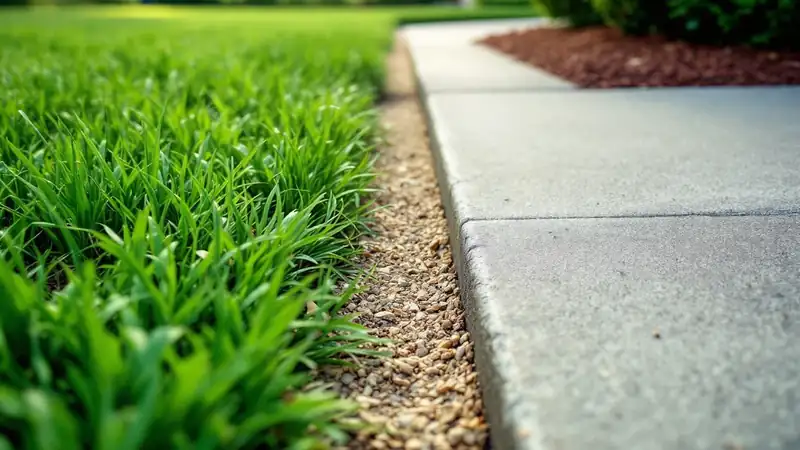
Commercial lawn care cost per acre
We have no contract data of our own, so the ranges below are built from labor hours per acre and a sold rate per on-site worker-hour of $59 to $69, which is what a three-person crew costs to field and sell at a 10 percent margin in a low-wage state (Texas) and a high-wage state (New York or Massachusetts), using May 2025 BLS wages. The hours per acre are our assumptions, checked against what cities actually paid. The method box further down shows every input.
| Service level | Worker-hours per acre per visit | Per acre per visit | Per acre per year (28 visits) | What it includes |
|---|---|---|---|---|
| Open-area mow and trim | 0.6 to 1.1 | $35–$76 | $980–$2,130 | Wide-deck mowing and perimeter trim on fields, rights-of-way, detention areas |
| Standard maintenance | 2.0 to 3.5 | $118–$242 | $3,300–$6,780 | Mow, string-trim, edge hard surfaces, blow off, pick up litter |
| Full service | 3.5 to 6.0, plus a turf program | $207–$414, plus $530–$1,020 a year for fertilizer and weed control | $6,330–$12,610 | Standard plus bed weeding and detailing, shrub pruning on rotation, five-round turf program |
The low end of each range fits large, open, flat sites with few obstacles and a 72-inch mower. The high end fits sites broken up by islands, signs, curbs and beds, where most of the time goes to trimmers and blowers rather than the mower. Use the calculator for your acreage and season length; it applies the same per-acre ranges.
Per-acre ranges match the price table on this page (28-visit basis). Sites under about 1 acre usually price higher per acre; sites over 10 acres toward the low end. Excludes snow, irrigation repairs and plant replacement. Estimates, not quotes; see How we built these numbers.
Small sites cost more per acre, every time
Lee County, Florida’s parks mowing agreement prices each of 79 sites separately, which makes it a clean test of site size. We transcribed every mowing line from the executed contract and divided price by acres. Sites of 1 acre or less had a median price of $150 per acre per mowing. Sites over 10 acres had a median of $51, about a third as much (Lee County, Fla., agreement B240118WCD with P & T Lawn & Tractor Service, 2024). Travel, unloading and trimming take roughly the same time whatever the acreage, so they swamp the per-acre price on a small lot. A quarter-acre pocket park in the same contract priced at $360 an acre per mowing.
For buyers, that means a per-acre quote on a 0.7-acre medical office is not comparable to one on a 12-acre office park, and a contractor quoting one rate across both is mispricing one of them. For contractors, it argues for a per-visit minimum on small sites rather than a pure per-acre rate.
What cities, schools and community districts paid: 2024 to 2026 bid tabulations
Public bid tabulations are the only place commercial grounds prices are published with the scope attached. These are the ones we read in full.
| Buyer and date | Scope | Prices bid | Visits a year | Implied per acre per year |
|---|---|---|---|---|
| City of Omaha, Neb., bids closed Oct. 8, 2025 | Right-of-way mowing and trimming, about 1,160 acres in 9 areas; 4 bidders | $41.50–$75.00 per acre per cycle; broadleaf weed spraying $30–$75 per acre | 12 | $498–$900 |
| Johnson City, Tenn., opened May 9, 2025 | Zone 8 mowing and litter pickup, 8.88 acres; 4 bidders | $210.00–$239.00 per acre per cycle | 28 (estimated annual cost $52,214.40 ÷ $1,864.80 per cycle) | $5,880–$6,692 |
| Lee County, Fla., 2024 agreement | Park mowing at 79 sites, bahiagrass at 3 to 4 inches | Median $51 to $150 per acre per mowing, by site size | 21 | $1,071–$3,150 at the medians |
| City of Bangor, Maine, opened April 9, 2025 | Mowing and landscaping, Maine Business Enterprise Park; 9 proposals | $28,400–$100,600 for the 2025 season; add or delete $22.50–$350 per acre | Seasonal | Not stated |
| Meridian Township, Mich., 2025 | Mowing at 11 municipal sites; 5 bidders | All sites $2,233–$6,450 per mow (3 bids); bed mulching labor $68–$100 per hour | Per mow | Not stated |
| City of Middletown, Conn., Bid 2025-019 (tab printed March 24, 2026) | Five-application fertilizer program on 7 fields and parks, 3.6 to 14.9 acres; 3 bidders | $504–$1,555 per acre per year; spot broadleaf control $75–$150 per acre | 5 applications | $504–$1,555 (turf program only) |
| City of Pearland, Tex., council agenda March 23, 2026 | Tree and minor landscape and irrigation services | Seasonal color $42.50 per flat installed; irrigation inspection $40 per hour; minor irrigation repair $120 per hour | As needed | Unit prices |
Three things stand out.
- Bids on the same scope routinely differ by 2 to 3.5 times. Bangor’s nine proposals for one business park ran from $28,400 to $100,600 for the season. Meridian Township’s three complete bids for all sites ran from $2,233 to $6,450 per mow. Labor costs cannot explain that: by our model, the sold rate per worker-hour differs by only about 22 percent between New Orleans and Seattle (table below). The spread is production assumptions, overhead and how badly each firm wants the work.
- Rights-of-way are a different product. Omaha’s 12-cycle roadside mowing at $41.50 to $75 per acre is tractor work with almost no detail. Johnson City’s $210 to $239 per acre includes litter pickup on small urban parcels. Both are “mowing,” and they sit three to five times apart.
- Agencies buy add-ons as unit prices. Bangor asked for an add-or-delete price per acre and an hourly rate for extra work ($55 to $150 an hour across bidders). Pearland priced seasonal color per flat and irrigation work per hour. That structure is worth copying in private contracts.
How commercial contracts are priced: per acre, per visit or per year
The billing format decides who carries the risk of a wet spring, a dry summer or a wrong estimate. Four formats show up in the documents above.
| Format | Real example | Good for the buyer | Good for the contractor |
|---|---|---|---|
| Per acre per cycle | Omaha computes its unit price as the bid per mow divided by the area’s acres, then adds or removes acres at that rate | Pay only for cycles performed; easy to add or drop parcels | Extra cycles in a wet year are paid; acreage changes are priced in advance |
| Per visit, by site | Meridian Township, $35 to $2,800 per mow, depending on the site and bidder | Simple to audit against a service log | Small sites can carry a proper minimum |
| Annual price in equal installments | Washington, Iowa, schools pay nine equal monthly payments, March to November; a Florida community district budgeted $35,393 a month for fiscal 2025 | Flat budget; frequency follows growth, not invoices | Smooth cash flow, but the contractor eats extra visits in a wet year |
| Unit prices for extras | Bangor’s hourly extra-work rate; Pearland’s per-flat and per-hour schedule; Concord Station’s request for hourly rates by crew type | No renegotiation for every change | Extras are billed at a known margin |
Our view: an annual price paid monthly works when the scope states a firm visit count and a per-visit credit for missed visits. Without both, the buyer has no way to tell a 24-visit season from a 30-visit one, and the format quietly rewards skipping. Per-acre-per-cycle pricing is the most transparent format for large turf; per-visit pricing is the most honest for small, detailed sites.
How a contractor builds the per-acre price
Every commercial maintenance price reduces to worker-hours per visit times a sold rate per hour. The sold rate covers wages, payroll taxes and workers’ comp, equipment, overhead and profit. Our full step-by-step method, including state payroll taxes and a worked bid, is in our guide to bidding landscaping jobs, part of our business coverage for landscaping operators; this section applies it to commercial acreage.
Step 1: Mowing time per acre
Agricultural engineers estimate machine output with one formula: acres per hour equals cutting width in feet times speed in miles per hour times field efficiency, divided by 8.25 (43,560 square feet per acre over 5,280 feet per mile). Field efficiency is the share of theoretical capacity left after turns, overlaps and stops (Iowa State University Extension, Ag Decision Maker A3-28, Farm Machinery Selection). Applied to mowers, with our assumed speeds and efficiencies for commercial sites:
| Mower | Assumed mowing speed | Assumed field efficiency | Acres per hour | Minutes per acre |
|---|---|---|---|---|
| 36-inch walk-behind | 3.5 mph | 60% | 0.76 | 79 |
| 48-inch rider | 4 mph | 60% | 1.16 | 52 |
| 60-inch zero-turn | 5 mph | 65% | 1.97 | 30 |
| 72-inch zero-turn | 6 mph | 70% | 3.05 | 20 |
| 15-foot tractor rotary mower | 5 mph | 75% | 6.82 | 9 |
The mower is rarely the bottleneck on a commercial site. On a 3-acre office park, a 60-inch mower finishes in about 1.5 hours, while two people trimming, edging and blowing curbs, islands and walks can easily spend 3 to 5 hours. That is why our standard level assumes 2.0 to 3.5 worker-hours per acre, against 0.6 to 1.1 for open fields.
Step 2: The sold rate per worker-hour, by metro
We priced a crew of one supervisor and two workers at each metro’s May 2025 median wages, added 14.8 percent statutory burden (employer Social Security and Medicare under IRS Publication 15, unemployment taxes, and workers’ comp at Washington L&I’s 2026 lawn care maintenance rate), divided by 0.85 because only 85 percent of paid hours are billable on site, added $22.06 of overhead and $4.85 of equipment per billable hour, and priced for a 10 percent margin.
Swipe the table sideways to see every column.
| Metro area | Worker median (37-3011) | Supervisor median (37-1012) | Sold rate per on-site worker-hour | Standard service, per acre per visit | Per acre per year, 28 visits |
|---|---|---|---|---|---|
| Seattle-Tacoma-Bellevue, WA | $23.31 | $36.78 | $71.62 | $143–$251 | $4,010–$7,020 |
| Boston-Cambridge-Newton, MA-NH | $23.57 | $32.74 | $69.86 | $140–$245 | $3,910–$6,850 |
| New York-Newark-Jersey City, NY-NJ | $21.89 | $35.87 | $69.74 | $139–$244 | $3,910–$6,840 |
| Minneapolis-St. Paul, MN-WI | $22.67 | $31.25 | $68.21 | $136–$239 | $3,820–$6,690 |
| Denver-Aurora-Centennial, CO | $22.25 | $29.52 | $66.93 | $134–$234 | $3,750–$6,560 |
| Omaha, NE-IA | $22.10 | $28.55 | $66.29 | $133–$232 | $3,710–$6,500 |
| Los Angeles-Long Beach-Anaheim, CA | $21.46 | $29.49 | $66.12 | $132–$231 | $3,700–$6,480 |
| Chicago-Naperville-Elgin, IL-IN | $21.77 | $25.23 | $64.30 | $129–$225 | $3,600–$6,300 |
| Atlanta-Sandy Springs-Roswell, GA | $18.51 | $28.35 | $62.60 | $125–$219 | $3,510–$6,140 |
| Phoenix-Mesa-Chandler, AZ | $18.82 | $27.26 | $62.36 | $125–$218 | $3,490–$6,110 |
| Tampa-St. Petersburg-Clearwater, FL | $17.89 | $25.86 | $60.73 | $121–$213 | $3,400–$5,950 |
| Dallas-Fort Worth-Arlington, TX | $18.12 | $23.00 | $59.53 | $119–$208 | $3,330–$5,830 |
| Houston-Pasadena-The Woodlands, TX | $17.44 | $22.46 | $58.58 | $117–$205 | $3,280–$5,740 |
| New Orleans-Metairie, LA | $17.03 | $23.11 | $58.50 | $117–$205 | $3,280–$5,730 |
Johnson City’s $210 to $239 per acre bids sit at and just above the top of our standard range for that metro ($120 to $210), which fits a scope that adds litter collection on small roadside parcels. Omaha’s roadside bids sit near our open-area range. The model is not a price list; it is a way to check whether a bid has enough hours in it.
A worked example: 3-acre office park, standard service
Three acres of turf, curbed islands and 1,800 feet of sidewalk. Mowing with a 60-inch unit: 1.5 hours. Trimming, edging, blowing and litter: we assume 6.3 worker-hours. Total: 7.8 worker-hours a visit, or 2.6 per acre. At the national sold rate of $62.78, that is $490 a visit, $13,720 for 28 visits, or $4,573 per acre per year, about $1,143 a month if billed in 12 installments. In a Houston-rate market it is $457 a visit; in a Boston-rate market, $545. Pricing software can hold these production rates per site; our landscape software coverage compares the main options.
Fertilization, weed control and the pesticide license
Middletown, Connecticut’s 2025 turf care bid is the clearest public price for a fertilizer program. Three bidders priced five applications a season on seven fields and parks of 3.6 to 14.9 acres. Converted to dollars per acre per year, 19 of the 21 site prices fell between $532 and $1,017; the full span was $504 to $1,555. Spot treatments were priced per acre: broadleaf weed control at $75 to $150, crabgrass pre-emergent at $75 to $165 and grub control at $75 to $275 (City of Middletown, Bid 2025-019 tabulation). Omaha’s right-of-way bidders priced broadleaf spraying at $30 to $75 per acre, the floor for very large areas.
Who may apply the product is a legal question, not a scope detail. Federal law requires anyone who applies or supervises restricted use pesticides to be certified under EPA rules and state law (U.S. EPA, Certification standards for pesticide applicators; 40 CFR Part 171). Most lawn products are general use, and many states go further for work done for hire:
- Nebraska: anyone applying lawn care pesticides to another’s property for hire must be a licensed commercial applicator, general use or not (Nebraska Department of Agriculture). Omaha’s contract requires a certified applicator for all weed spraying.
- Georgia: any business applying pesticides to the land of another needs a pesticide contractor license and at least one full-time certified commercial applicator (Georgia Department of Agriculture).
- Illinois: anyone applying restricted or general use pesticides in the course of employment must be licensed, and commercial applicators must show a certificate of insurance (Illinois Department of Agriculture).
- Indiana: a business applying pesticides or fertilizer to another person’s property for hire needs a business license, liability insurance and a certified applicator (Office of Indiana State Chemist, March 2024).
Buyers check this less often than they should. In Meridian Township’s 2025 bid, one of five bidders answered “No” to “Certified for applying pesticides and insecticides to grounds?” and another did not respond. The Washington, Iowa, schools require a copy of a current applicator license every year before any chemical goes down, from the contractor or a named subcontractor. Our state-by-state landscaping and pesticide license table lists each state’s agency and category, and how to check a landscaper’s license walks through the lookup.
This page is general information, not legal, insurance or pesticide-use advice. Licensing rules and insurance requirements change; confirm with your state agency, your insurer and your counsel before you bid, sign or apply any product.
Irrigation, seasonal color and mulch: the add-ons that move the budget
Base mowing contracts are predictable. The extras are where commercial landscape budgets miss. These are the unit prices we found, and the adder amounts the calculator uses.
| Add-on | Published unit prices | Calculator adder (one site, per year) | How we sized it |
|---|---|---|---|
| Irrigation program | Inspection $40/hr (Pearland, 2026); winterization $90–$100/hr (Meridian, 2025, 3 of 4 bids); minor repair $120/hr (Pearland) | $640–$1,600 | 16 technician-hours: spring start-up, monthly checks, winterization, at $40 to $100 an hour. Repairs and parts extra. |
| Seasonal color | $42.50 per flat, materials and installation (Pearland, 2026) | $850–$1,275 | Two change-outs of 10 to 15 flats each |
| Mulch refresh | Mulch $25–$45 per cubic yard (3 of 4 bids) and bed mulching labor $68–$100/hr (Meridian, 2025) | $1,860–$2,900 | 20 cubic yards at about one worker-hour per yard |
| Snow plowing | $70–$195 per hour; salting $70–$150 per hour or $220 a ton (Meridian, 2025) | Not in calculator | Event-driven; price per hour, per push or per season |
Irrigation is the line most likely to blow up. Concord Station Community Development District in Pasco County, Florida, budgeted $30,000 for irrigation repair in fiscal 2025 and spent $49,211, 64 percent over (Concord Station CDD, statement for Oct. 1, 2024 to Sept. 30, 2025). Write the contract so the maintenance firm must report every fault with a photo and a priced proposal, and so mowing damage to heads is repaired at the contractor’s cost, as Lee County’s agreement requires.
Snow and ice as a winter add-on
In snow states, the winter contract often decides who keeps the summer one. Landscaping firms reported $3.27 billion from snow removal for parking lots and driveways in 2022, and 14.4 percent of establishments (16,814) had some (Census, 2022 Economic Census product lines). The Meridian Township bids show how wide snow pricing runs: $70 to $195 an hour to plow lots and shovel walks, and salt at $70 to $150 an hour or $220 a ton. Whichever basis you choose, the contract should define the trigger depth, the response window after snowfall stops, who decides when to salt, and whether walks are cleared by hand before the building opens.
What an HOA landscape budget actually looks like
Private HOAs do not publish their books, but Florida community development districts must, and they buy landscaping the same way large HOAs do. Concord Station’s fiscal 2025 statement breaks the spending out line by line.
| Budget line | FY2025 adopted budget | FY2025 actual | Actual vs. budget |
|---|---|---|---|
| Landscape maintenance (base contract) | $253,040 | $264,458 | +4.5% |
| Irrigation repair | $30,000 | $49,211 | +64.0% |
| Mulch | $45,238 | $34,375 | -24.0% |
| Fertilizer | $18,800 | $18,267 | -2.8% |
| Replacement plants, shrubs, trees | $15,000 | $13,860 | -7.6% |
| Annuals and flowers | $8,800 | $6,105 | -30.6% |
| Landscape pest control | $2,000 | $5,267 | +163.4% |
| Fire ant treatment and palm injections | $10,000 | $0 | -100.0% |
| Total landscape-related | $382,878 | $391,543 | +2.3% |
The base contract was about two-thirds (67.5 percent) of what the district actually spent on its grounds. A board that budgets only the contract price comes up short by nearly half of that price again. Another district, Rivers Edge II in St. Johns County, Florida, budgeted $416,388 for landscape maintenance in fiscal 2024 and proposed $424,716 for fiscal 2025, a 2.0 percent increase, or $35,393 a month (Rivers Edge II CDD agenda package, May 15, 2024).
California boards have a deadline to plan around. Assembly Bill 1572 (2023) bars potable water irrigation of nonfunctional turf on HOA and common-interest-development common areas starting January 1, 2029, and on commercial, industrial and institutional properties starting January 1, 2028; common areas with more than 5,000 square feet of irrigated area must certify compliance starting June 30, 2031 (Los Angeles County Public Works, Nonfunctional turf). Sports fields, play areas and other functional turf are not affected. A maintenance contract signed now for a California property should say who designs and prices the turf conversion, and how the mowing price drops when the turf goes.
A model scope of work for commercial lawn care
We compiled this checklist from the specifications cited on this page. Copy it into an RFP, or use it to audit a proposal you have already received. Every line should end with a quantity, a frequency and a price basis.
- Site data: a map with turf acres by mowing method (wide-deck, small-deck, slope, tractor), bed square feet, hard-edge linear feet, shrub and tree counts, irrigation controllers and zones, and areas excluded.
- Mowing: height by grass type; the one-third rule; number of visits per season and the season dates; whether the buyer can add or cancel cycles, and with how much notice (Lee County requires one week).
- Trimming, edging, blowing: which surfaces, how often, clippings kept out of beds, streets and storm drains, heavy clippings removed from turf.
- Litter and debris: picked up before every mow, including lots and walks; trash receptacles, if any.
- Beds: weed-free standard, hand-pulling threshold, pre-emergent schedule, soft-edging frequency.
- Shrubs and trees: pruning cycles per year, clearances from buildings and walks, the height above which tree work is excluded.
- Turf program: number of fertilizer and weed-control applications, products and rates recorded, licensed applicator named, notice before spraying.
- Irrigation: start-up and shutdown dates, inspection frequency, written fault reports, repair rate per hour and parts markup, damage by mowing repaired at contractor cost.
- Mulch and color: cubic yards and depth per application; number of color rotations and flats or plants per rotation; who buys materials.
- Leaves and seasonal cleanups: dates, haul-off, and the final cleanup before the contract ends.
- Snow (if included): trigger depth, response time, salt basis, sidewalk standard.
- Communication and records: a single point of contact, a service log after each visit, monthly reporting (the Washington, Iowa, schools require it), damage reported in writing within 24 hours (Lee County).
- Price schedule: a price for each line, unit prices for extras (per acre, per hour, per cubic yard, per flat), the escalation rule for renewal years and the payment schedule.
Contract terms that protect both sides
Insurance minimums in real contracts
| Buyer | General liability | Auto liability | Workers’ comp and employer’s liability | Other |
|---|---|---|---|---|
| Lee County, Fla. (2024) | $1M per occurrence, $2M aggregate, $1M products and completed operations | $1M combined single limit | Statutory; employer’s liability $500,000 per accident and per disease | Umbrella may make up limits |
| Pearland, Tex. (2026) | $1M per occurrence, $2M aggregate | $1M combined single limit | Statutory; employer’s liability $1M | Waiver of subrogation on comp, liability and auto; 30-day cancellation notice |
| Huntsville, Tex. (Sept. 2025) | $1M per occurrence, $2M aggregate, $1M products and completed operations | $300,000 combined single limit | Waiver of subrogation required | City named additional insured |
| Washington CSD, Iowa (2025 to 2027) | $1M or more | Not stated | Not stated | Proof at bid time and every January 1 |
| Omaha, Neb. (2026 to 2027 seasons) | Certificate for the contract term | Not summarized here | Not summarized here | Performance bond for the full two-year contract value within 10 days of award |
The pattern is consistent: $1 million per occurrence and $2 million aggregate general liability, statutory workers’ comp, and the owner named as additional insured. A small lawn company that carries only a $1 million aggregate policy is locked out of most public work and many managed properties until it raises its limits, which is worth pricing before you chase commercial accounts.
Term, renewals and escalation
Multi-year terms are the norm: Lee County’s agreement runs three years; Omaha’s runs two seasons plus two one-year extensions; Johnson City’s is three years, renewable annually, with a fuel price adjustment; the Washington, Iowa, schools spec is 2025 to 2027 and renewable “without increase in the annual cost.” How the price moves in later years varies widely. Omaha adjusts unit prices by 75 percent of the change in the Midwest CPI-W each December. Meridian Township’s bidders offered fixed renewal increases from 0 to 4 percent a year.
An escalator tied to headline inflation has lagged this trade badly. Consumer prices for gardening and lawn care services rose 52.0 percent from September 2019 to September 2025, against 26.5 percent for all items, and 13.9 percent in the final year of that span alone, against 3.0 percent (BLS CPI, gardening and lawncare services; BLS CPI, all items). A three-year contract with a flat or CPI-only escalator transfers that gap to the contractor, who tends to recover it by cutting visits or detail. Boards get a better result from an honest index clause than from a low year-one number.
Performance standards, penalties and termination
- Correction windows: Omaha gives 2 business days to fix a reported deficiency, then deducts $25 every 2 days until the cycle ends. Huntsville, Texas, can deduct $100 from an invoice for work not finished on time, with weather allowances.
- Response times: Lee County requires mowing within 3 calendar days of notice and reserves the right to use another vendor if service slips.
- Termination: the Washington, Iowa, board may terminate for nonperformance or poor workmanship. Add a no-cause termination with 30 days’ notice if you want an exit that avoids a dispute.
- Damage: Lee County requires written damage reports within 24 hours and makes the contractor repair irrigation damaged by mowing or trimming.
- Extra work: Lee County denies extra mowing charges that were not approved in advance. Put the same rule in private contracts, alongside the unit-price schedule.

How big the commercial market is, and who does the work
Commercial customers are the larger half of the landscaping industry. In 2022, 81,273 landscaping establishments, 69.6 percent of the total, reported revenue from exterior commercial landscaping services, and that line brought in $61.9 billion, 53.7 percent of the industry’s $115.4 billion (Census, 2022 Economic Census product lines; Census, EC2256BASIC). Grass cutting is the largest named piece, but more than a third falls into “other” commercial services such as cleanups, mulching and irrigation upkeep.
That revenue is spread across many small firms competing for the same bid lists, which helps explain the price spreads in public tabulations. For state counts of firms, workers and revenue, see our landscaping industry data by state; for what crews earn, our landscaper salary breakdown.
Red flags in a commercial lawn care bid
- No visit count. “Weekly as needed” is not a number. Ask for visits per season and a credit per missed visit.
- A lump sum with no line items. You cannot compare it, audit it or cut one service from it.
- A price with too few hours in it. Divide the per-visit price by $58 to $72 (the metro sold rates above). If the answer is far below the worker-hours your site plausibly needs, expect missed edging and short visits.
- No applicator license number on a bid that includes fertilizer or weed control, or a “we subcontract that” with no subcontractor named.
- Insurance below $1 million per occurrence and $2 million aggregate, or a certificate that does not name the property owner.
- No escalation clause on a multi-year term, which usually means a mid-term price demand or a quiet cut in service.
- Irrigation “included” with no definition of inspections, repairs or parts.
How we built these numbers
Sold rate per on-site worker-hour. Crew of one first-line supervisor (SOC 37-1012) and two landscaping workers (SOC 37-3011) at May 2025 median hourly wages from BLS OEWS (state or metro). Average crew wage × 1.148 for statutory burden (employer Social Security 6.2 percent and Medicare 1.45 percent per IRS Publication 15, FUTA and a 2.7 percent SUTA on a $9,000 base, and workers’ comp at Washington L&I’s 2026 class 0308 rate less the worker deduction, $1.1625 an hour, which equals 14.8 percent at the national median wage). Divided by 0.85 because we assume 85 percent of paid hours are billable on site. Plus $22.06 overhead per billable hour (an assumed $180,000 overhead budget over 8,160 billable hours for a two-crew firm) and $4.85 equipment per billable hour (a $12,399 Toro 60-inch zero-turn list price over 3,000 hours at 20 percent resale, 1 gallon of fuel an hour at EIA’s $4.354 national average for the week of Oct. 5, 2026, $1.50 an hour of repairs, $2.00 per crew hour of handheld equipment and IRS’s 76-cent mileage rate on a 40-mile, six-stop route). Divided by 0.90 for a 10 percent profit margin. National median: $62.78. Texas: $59.02. New York: $68.49. Massachusetts: $68.64.
Service levels. Worker-hours per acre per visit are our assumptions, informed by the mowing capacities in the mower table (Iowa State formula) and checked against the bid tabulations: open-area 0.6 to 1.1; standard 2.0 to 3.5; full service 3.5 to 6.0. Low ends use $59, high ends $69. Per-year figures multiply the rounded per-visit range by 28 visits. Full service adds a five-application turf program of $530 to $1,020 per acre per year, rounded from the middle 19 of 21 site prices in Middletown, Conn.’s Bid 2025-019 tabulation.
Bid arithmetic. Lee County: we transcribed 79 “Mowing” lines (site acres and price per service) from the scanned executed agreement and grouped them by site size; medians were $150 (33 sites of 1 acre or less), $77 (18 sites over 1 to 3 acres), $62 (18 sites over 3 to 10 acres) and $51 (10 sites over 10 acres). Johnson City: visits = estimated annual cost ÷ cost per cycle. Middletown: each bidder’s five application prices per site summed and divided by the site’s acres (square feet ÷ 43,560). Concord Station totals and percentages are sums of the published budget lines.
Calculator. Acres × the per-acre-per-year range for the chosen service level (at 28 visits) × the visit factor (visits ÷ 28), plus the fixed adders in the add-on table. The visit factor also scales the turf program inside the full-service level, which overstates it slightly for short seasons. Sites under about 1 acre usually price above these ranges; sites over 10 acres toward the low end. These are estimates, not quotes. Our general approach is described on our methodology page.
Commercial lawn care questions, answered
What should a commercial landscaping contract include?
A site map with quantities, a task list with frequencies (visits per season, edging, pruning cycles, fertilizer applications), what is excluded, who buys materials, unit prices for extra work, insurance minimums (typically $1 million per occurrence and $2 million aggregate), the pesticide applicator license, response and correction times, an escalation rule for renewal years, the payment schedule and termination terms.
How much does commercial lawn care cost per acre?
An estimated $118 to $242 per acre per visit for standard mowing, trimming, edging and blowing, or $3,300 to $6,780 per acre for 28 visits. Open fields and roadsides run $35 to $76 per acre per visit; 2025 city bids ranged from $41.50 per acre in Omaha to $239 in Johnson City, Tenn. Full service with beds, pruning and fertilizer runs about $6,330 to $12,610 per acre a year.
Do HOA fees cover landscaping?
Dues usually pay for common-area landscaping, such as entrances, medians, ponds and amenity grounds, and the governing documents say whether front yards are included. The cost is real: one Florida community development district spent $391,543 on landscaping lines in fiscal 2025, of which the base maintenance contract was only $264,458.
What are the new rules for HOA landscaping in California?
Under AB 1572, potable water may not be used to irrigate nonfunctional turf on HOA and common-interest-development common areas starting January 1, 2029 (January 1, 2028 for commercial, industrial and institutional property). Functional turf such as play areas is exempt, individual yards are not covered, and common areas over 5,000 square feet of irrigated area must certify compliance from June 30, 2031.
What is the 1/3 rule in lawn care?
Never remove more than one-third of the grass blade in a single mowing. A lawn kept at 3 inches should be cut before it reaches 4.5 inches, which sets the visit frequency during fast growth. Commercial specs, such as the Washington, Iowa, schools contract, write the rule directly into the scope.
Our mowing interval guide gives measured growth rates for writing that visit count into a scope.
How do you get commercial lawn mowing contracts?
Register on the purchasing portals of cities, counties, school districts and housing authorities near you, watch community development district and HOA board agendas for landscape RFPs, carry at least $1 million per occurrence and $2 million aggregate in liability coverage, hold the pesticide license your state requires, and attend pre-bid site walks. Public bid tabulations show the winning unit prices, so read them before you price.
How much to charge for 2 hours of mowing?
For one worker with commercial equipment, about $118 to $138 using our $59 to $69 sold rate per on-site hour, which already covers burden, equipment, overhead and a 10 percent margin. For a three-person crew on site for 2 hours, about $354 to $414. Add travel time if the site is off your route.
Sources
- U.S. Census Bureau, 2022 Economic Census, Industry by products (ECNNAPCSIND2022), NAICS 561730 Landscaping services, 2022 data, file posted April 23, 2026. Accessed October 2026.
- U.S. Census Bureau, 2022 Economic Census, Administrative and support services: summary statistics (EC2256BASIC), 2022 data. Accessed October 2026.
- U.S. Bureau of Labor Statistics, Occupational Employment and Wage Statistics, state and metropolitan estimates (SOC 37-3011, 37-1012), May 2025. Accessed October 2026.
- U.S. Bureau of Labor Statistics, CPI-U, Gardening and lawncare services, U.S. city average (CUUR0000SEHP02), September 2019 to August 2026. Accessed October 2026.
- U.S. Bureau of Labor Statistics, CPI-U, All items, U.S. city average (CUUR0000SA0), September 2019 to August 2026. Accessed October 2026.
- Internal Revenue Service, Publication 15, Employer’s Tax Guide, 2026. Accessed October 2026.
- Washington State Department of Labor & Industries, 2026 workers’ compensation rates by business type and class code, 2026. Accessed October 2026.
- The Toro Company, Z Master 4000 Series 60-inch zero-turn mower (model 74004), product page, List price checked October 7, 2026. Accessed October 2026.
- U.S. Energy Information Administration, Weekly retail gasoline and diesel prices, Week of October 5, 2026. Accessed October 2026.
- Internal Revenue Service, Standard mileage rates, Rate from July 1, 2026. Accessed October 2026.
- Iowa State University Extension and Outreach, Ag Decision Maker A3-28, Farm Machinery Selection (field capacity formula), Accessed October 2026. Accessed October 2026.
- The Ohio State University CFAES, Lawn mowing fact sheet, Accessed October 2026. Accessed October 2026.
- University of Florida IFAS, Mowing your Florida lawn, Gardening Solutions, Accessed October 2026. Accessed October 2026.
- Douglas County Purchasing for the City of Omaha, Neb., Event CI-2025-0137, Grounds Maintenance for Right of Ways: bid tabulation and specifications, Bids closed October 8, 2025. Accessed October 2026.
- City of Johnson City, Tenn., City Commission agenda summary and tabulation, ITB R6833 Zone Mowing and Litter Collection, Zone 8, Bids opened May 9, 2025; approved June 5, 2025. Accessed October 2026.
- Lee County, Fla., Procurement Management, Agreement for Landscape Maintenance and Mowing, Parks, Annual (B240118WCD), with fee schedule and insurance requirements, Solicitation issued February 20, 2024. Accessed October 2026.
- City of Bangor, Maine, Finance Committee agenda with bid tabulation P25-49, Lawn Mowing and Landscaping, Bids opened April 9, 2025; agenda May 19, 2025. Accessed October 2026.
- Charter Township of Meridian, Mich., 2025 Grounds Maintenance Contract bid tab, 2025. Accessed October 2026.
- City of Middletown, Conn., Bid 2025-019 Turf Care Services, department review report (bid tabulation), Printed March 24, 2026. Accessed October 2026.
- City of Pearland, Tex., City Council regular meeting agenda packet, tree maintenance services contract, Attachments B and C, March 23, 2026. Accessed October 2026.
- Washington Community School District, Washington, Iowa, Landscaping/Grounds Specifications and Request for Proposals, Bid Package 1, Issued November 12, 2024, for 2025 to 2027. Accessed October 2026.
- Housing Authority of New Orleans, RFQu 25-913-15, Grass Cutting Services at the Estates, Issued April 14, 2025. Accessed October 2026.
- City of Huntsville, Tex., Invitation for Bid 25-36, right-of-way mowing and grounds maintenance, Bid opening September 24, 2025. Accessed October 2026.
- Concord Station Community Development District, Land O’ Lakes, Fla., Board of Supervisors agenda package: General Fund statement FY2025 and landscape services project manual, November 13, 2025 (FY Oct. 1, 2024 to Sept. 30, 2025). Accessed October 2026.
- Rivers Edge II Community Development District, St. Johns County, Fla., Board of Supervisors agenda package, FY2025 proposed budget, May 15, 2024. Accessed October 2026.
- Los Angeles County Public Works, Nonfunctional turf (AB 1572, California Water Code 10608.14), Accessed October 2026. Accessed October 2026.
- U.S. Environmental Protection Agency, Certification standards for pesticide applicators, Accessed October 2026. Accessed October 2026.
- Electronic Code of Federal Regulations, 40 CFR Part 171, Certification of pesticide applicators, Current as accessed October 2026. Accessed October 2026.
- Nebraska Department of Agriculture, Pesticide applicator certification, Accessed October 2026. Accessed October 2026.
- Georgia Department of Agriculture, Pesticide contractors, Accessed October 2026. Accessed October 2026.
- Illinois Department of Agriculture, Pesticide certification and licensing, Accessed October 2026. Accessed October 2026.
- Office of Indiana State Chemist, Pesticide training, certification and licensing requirements summary, March 1, 2024. Accessed October 2026.