Crabgrass or bermuda grass: bend a leaf back and look at the ligule. Crabgrass has a papery membrane and blades 5 to 15 mm wide; bermuda has a fringe of hairs, blades 3 mm or narrower, and runners. Crabgrass dies at frost; bermuda goes tan.
We put the identification keys from 8 university extension services side by side and kept only the features that do not overlap. Three of them settle almost every case: the ligule (membrane vs hairs), blade width (NC State measures bermudagrass at 1.5 to 3 mm and crabgrass at 5 mm or more) and whether the plant survived last winter. The feature most people reach for, counting the fingers on the seedhead, is the weakest: the published spike counts overlap at 3 to 5 for both grasses. What separates the seedheads is where the fingers attach, and UC IPM gives that gap in fractions of an inch.
Six checks, fastest first
Work down the list and stop at the first check that gives a clear answer. Check 5 or 6 full-size, healthy leaves from the middle of the patch: seedlings, scalped shoots and drought-curled leaves read narrower and hide the ligule. A ruler with 1 mm marks and a phone camera on macro are the only tools needed.
- Did it live through winter? A patch that sat as a tan mat from the first frost to spring and greened up from the same runners is bermudagrass. Crabgrass turns reddish-brown and dies after fall frosts (Penn State), so nothing green or tan stays rooted in the spot over winter, except in frost-free coastal California where UC IPM says plants can overwinter.
- Pull one stem and dig 3 inches down. Bermudagrass has above-ground stolons with a papery sheath at each node and below-ground rhizomes, usually 1 to 6 inches deep in undisturbed soil (UC IPM). Crabgrass has no rhizomes; its stems fan out from one crown and only root where a lower node lies on the soil.
- Bend the leaf back at the collar. A fringe of white hairs 1 to 3 mm long is bermudagrass. A thin, see-through membrane, 1 to 3 mm tall and often toothed or reddish on large crabgrass, is crabgrass (NC State, large crabgrass).
- Measure the blade at its widest point. 3 mm (1/8 inch) or narrower points to bermudagrass; 5 mm (3/16 inch) or wider points to crabgrass. No extension key we read puts either species between 3.2 mm (UGA’s 1/8 inch for bermudagrass) and 5 mm.
- Roll the newest leaf open. Bermudagrass leaves are folded in the bud, creased flat like a closed book; crabgrass leaves are rolled, round in cross-section (UF/IFAS EP646; NC State, smooth crabgrass).
- If a seedhead is present, look at where the fingers leave the stem. All from one point is bermudagrass. Spaced about 1/8 to 1/4 inch apart up the tip of the stalk is crabgrass, and fingers longer than 2 1/2 inches can only be large crabgrass (UC IPM).
1Did the patch stay rooted as a tan mat through winter and green up from the same runners?
YesBermudagrass. Crabgrass dies after fall frost (Penn State).
NoGo to the next question
2Digging 3 inches down, do you find white, jointed rhizomes?
YesBermudagrass. Crabgrass has no rhizomes (UC IPM; NC State).
NoGo to the next question
3Bent back, is the ligule a fringe of hairs rather than a papery membrane?
YesBermudagrass (fringe of hairs 1 to 3 mm, NC State).
NoGo to the next question
4Is a full-size blade 5 mm (3/16 inch) wide or wider?
YesCrabgrass. Bermudagrass blades are 1.5 to 3 mm (NC State).
NoGo to the next question
5Do the seedhead fingers leave the stem 1/8 to 1/4 inch apart?
YesCrabgrass. Bermudagrass fingers all start at one point (UC IPM).
NoStill unsure: mark the patch and check it in January, or compare against goosegrass and dallisgrass in our common lawn weeds chart.
The ID key, with each university’s measurement
Every cell below is a value printed in one of 12 extension documents, not an estimate. Where two sources give different numbers, both are shown so you can see how wide the published range really is. Smooth crabgrass (Digitaria ischaemum) is the common lawn species; large or hairy crabgrass (D. sanguinalis) is hairier and coarser.
Swipe the table sideways to see every column.
| Feature | Crabgrass | Bermudagrass | Source |
|---|---|---|---|
| Life cycle | Summer annual; dies after fall frost | Warm-season perennial; dormant and tan in winter | Penn State; UC IPM |
| Ligule | Membrane: 1 to 2 mm, toothed, often reddish (large); 1.5 to 3 mm, blunt, slightly wavy (smooth); Penn State: 1 to 1.5 mm | Fringe of hairs, 1 to 3 mm | NC State; NC State; NC State; Penn State |
| Vernation (newest leaf) | Rolled in the bud | Folded in the bud | NC State; Virginia Tech; UF/IFAS; UGA |
| Blade width | 5 to 10 mm (smooth); 5 to 15 mm (large); UC IPM: 1/4 to 1/3 inch for smooth | 1.5 to 3 mm; UGA and K-State: 1/8 inch | NC State; NC State; UC IPM; K-State MF2031 |
| Blade length | Up to 5 in (smooth); about 3 in in turf (large) | Short | UC IPM; UGA |
| Leaf hairs | Large: short hairs on both surfaces, long hairs on sheath. Smooth: a few hairs near the blade base | Smooth or sparsely hairy; edges rough | NC State; NC State; UGA |
| Collar | Large: flattened, hairy sheath, often purple veins. Smooth: divided, few hairs at edge | Narrow; UGA and K-State: covered with long hairs | NC State; NC State; K-State |
| Auricles | Absent | Absent | NC State; UF/IFAS |
| Growth habit | Tillers radiate from one crown, flat rosette; more than a dozen tillers by late summer | Mat with no single center; uneven spacing between leaves on runners | Penn State; UF/IFAS |
| Runners and rhizomes | No rhizomes; prostrate stems may root at lower nodes | Stolons and rhizomes, both stout; rhizomes 1 to 6 in deep | NC State; NC State; UC IPM |
| Seedhead attachment | Fingers leave the stem about 1/8 to 1/4 in apart | All fingers from one point | UC IPM; UC IPM |
| Spikes per seedhead | 5 to 7 (smooth), 3 to 11 (large) per UC IPM; 2 to 9 per NC State | 3 to 7 per UC IPM; 3 to 5 per NC State, UF and UGA | UC IPM; NC State |
| Spike length | 1/2 to 2 1/2 in (smooth); 2 to 5 in (large) | 1 to 2 in | UC IPM; UC IPM |
| Seedling | Fat seed leaf; large crabgrass hairy on every leaf and stem | Fine, folded leaves from seed or runners | Virginia Tech; UF/IFAS |
| Germination or green-up | Seed sprouts at 53 to 58°F soil at 4 in, March to early May in North Carolina | Greens up from runners; NC State first feeding comes several weeks after full green-up, early April to May | NC State; NC State calendar |
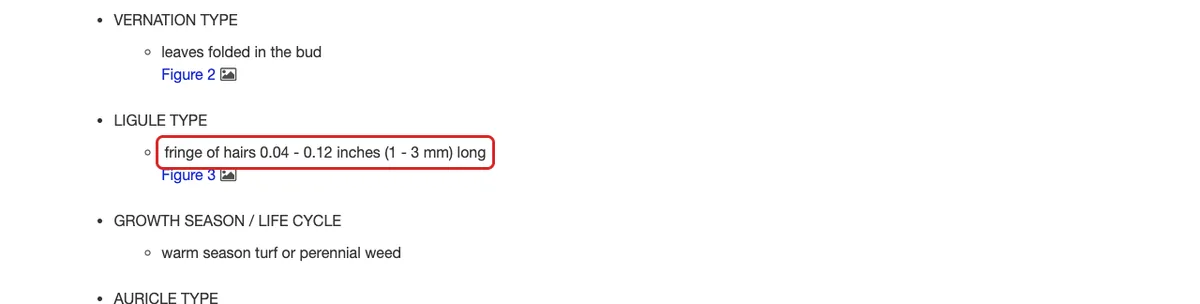
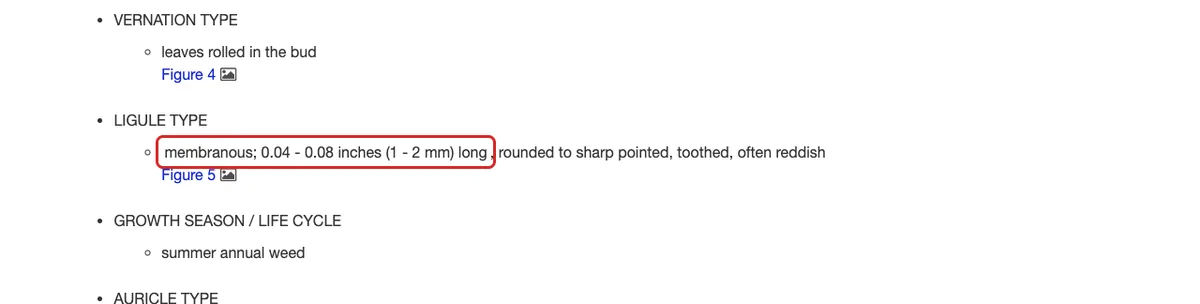
Ligule length does not separate them: both are 1 to 3 mm. What separates them is what the ligule is made of. A membrane catches light like a thin film of plastic; a fringe of hairs looks like a short white eyelash line when the blade is bent back. The NC State profiles below show both, with the measured lengths highlighted.
Blade width: the ruler test
Blade width is the fastest field check because it needs no magnifier. NC State puts bermudagrass at 0.06 to 0.1 inch (1.5 to 3 mm), and UGA and K-State both say 1/8 inch, about 3.2 mm. The narrowest crabgrass in the same keys is 5 mm: NC State gives 5 to 10 mm for smooth and 5 to 15 mm for large crabgrass, and UC IPM gives 1/4 to 1/3 inch (6.4 to 8.5 mm) for smooth.
Two cautions apply. Common bermudagrass is coarser than hybrids such as Tifway and TifTuf, and NC State notes it has a wider blade and more seedheads, so measure 5 or 6 leaves and use the widest. And Penn State prints crabgrass blades as 1/2 to 3/4 inch wide, 2 to 3 times what NC State and UC IPM give; if your crabgrass measures 6 mm, it still fits the majority of the keys.
Seedheads: measure the gap, do not count the fingers
Both grasses carry finger-like spikes from midsummer, and the counts published for them overlap almost completely. Penn State and Virginia Tech give crabgrass 3 to 5 spikes; NC State, UF/IFAS and UGA give bermudagrass 3 to 5. A 4-finger seedhead fits every key for both species.
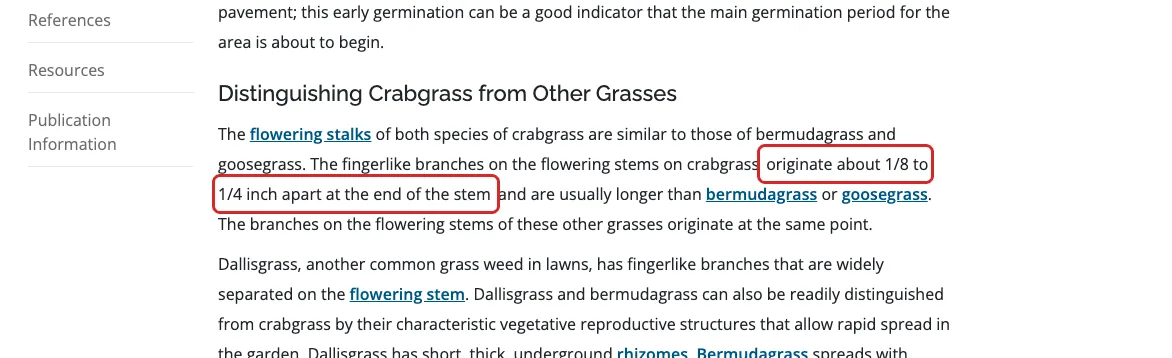
The difference is the attachment. UC IPM says crabgrass fingers originate about 1/8 to 1/4 inch apart at the end of the stem, while bermudagrass and goosegrass fingers originate at the same point. Hold the stalk against a ruler: a 3 to 6 mm stretch of stem carrying the fingers is crabgrass. The top Google result for this query, a grass-ID app page, tells readers the seedhead alone cannot separate the two; on attachment, UC IPM says it can.
What each grass looks like by season
The calendar is the check that needs no close-up at all. Crabgrass seed sprouts when the soil 4 inches down reaches 53 to 58°F (NC State), which is March to early May in North Carolina, and plants die with the first frost. Bermudagrass is present all year as runners and only changes color.
| Months | Crabgrass | Bermudagrass | Source |
|---|---|---|---|
| December to February | Nothing alive where frost has occurred; seed waits in the soil | Tan, dormant mat; runners still rooted and pliable | Penn State; UC IPM |
| March to early May | Seedlings appear once soil at 4 in holds 53 to 58°F; pale, single-crown plants in bare or thin spots | Greens up from existing runners and crowns | NC State; NC State calendar |
| May to June | Tillers spread flat from one crown; peak germination a few weeks after the first | New runners cross bare soil, edges and pavement | Penn State; UC IPM |
| July to September | Seedheads; one large plant can shed more than 100,000 seeds | Seedheads, more on common than on hybrid types | UC IPM; NC State calendar |
| October to November | Turns reddish-brown, then dies after frost; Central Valley California typically late October | Goes tan after frost, stays rooted | Penn State; UC IPM |
This makes a summer guess testable. If you cannot decide by August 31, flag the patch with a stake and look again in January: a bare spot means crabgrass, a tan mat that peels up in runners means bermudagrass.
Where the published keys disagree
| Question | One source says | Another says | What to do with it |
|---|---|---|---|
| Does crabgrass have stolons? | UC IPM: no rhizomes or stolons | NC State: stolons present, rhizomes absent | Treat crabgrass stems that root at the lower nodes as a weak runner; the test that holds is rhizomes, which only bermudagrass has |
| Bermudagrass collar hairs | UGA and K-State: collar covered with long hairs | NC State: collar not hairy, may be hairy on edges | Do not rely on the collar; check the ligule hairs just above it |
| Crabgrass blade width | NC State: 5 to 10 mm (smooth); UC IPM: 1/4 to 1/3 in | Penn State: 1/2 to 3/4 in | Use 5 mm as the lower bound; it is the narrowest figure any key prints |
| Spikes per bermudagrass seedhead | UC IPM: 3 to 7 | NC State, UF/IFAS, UGA: 3 to 5 | Ignore the count; check that every spike leaves the same point |
| Can the seedhead separate them? | A top-ranked ID app page: no | UC IPM: yes, by the 1/8 to 1/4 in spacing | Use the spacing, not the count or the shape |
The pull test that several top results lead with has a limit too. A young crabgrass plant does lift out as one crown, but NC State notes that its stems may root at the lower nodes, so a large August plant can hold. The deciding sign after a pull is a white, jointed rhizome below the surface: crabgrass never has one.
What the answer changes
The identification decides which tools work, because one is a seed problem and the other is a root-system problem. UC IPM says preemergence herbicides are generally not a practical way to control bermudagrass in turf, since they do not touch established stolons and rhizomes.
| Tool | On crabgrass | On bermudagrass | Source |
|---|---|---|---|
| Spring preemergent | Stops seedlings if down before soil reaches 53 to 58°F at 4 in; mid-February to early March in North Carolina | No effect on established runners | NC State calendar; UC IPM |
| Hand pulling | Works on young plants before seedheads | Fragments of stolons and rhizomes left in moist soil regrow | UC IPM; UC IPM |
| Waiting for frost | Kills every plant; the seed bank remains | Only turns it tan | Penn State |
| Where to go next | Our crabgrass preventer dates and actives | Our bermuda grass removal rates by lawn type | GIR guides |
If the patch is bermudagrass in a bermudagrass lawn, it is the lawn: its mowing, feeding and cultivar data are in our bermuda grass guide. If it is spreading into tall fescue, our sibling page on fescue vs bermuda grass compares the two lawns, and the common lawn weeds ID chart covers goosegrass, dallisgrass and the other look-alikes.
This page is identification guidance, not a pesticide recommendation. Any herbicide named here or on our linked pages, such as the quinclorac and topramezone products in the FAQ, must be used only as its EPA-registered label directs; the label is the law.
How we compiled this
In November 2026 we read 12 extension documents from UC IPM, Penn State, NC State, UF/IFAS, UGA, Kansas State, Virginia Tech and the University of Arkansas, dated 2017 to 2025, and copied every published identification measurement into the key and the CSV. Inch-to-millimeter conversions are ours. Where keys disagree we show both values. We did not collect or measure plants, and the photos on this page are a generated scene and screenshots of the source documents.
Frequently asked questions
Do I have bermuda grass or crabgrass?
Bend back a full-size leaf. A fringe of hairs at the joint and a blade 3 mm or narrower means bermuda grass; a papery membrane and a blade 5 mm or wider means crabgrass (NC State). If a patch stayed rooted and tan through winter, it is bermuda.
Will crabgrass choke out bermuda grass?
Not a dense stand. NC State says crabgrass competes best in thin, open turf, with mowing at the wrong height, summer fertilizing and light, frequent watering. It moves into gaps in a bermuda lawn and dies at frost, but each large plant can shed more than 100,000 seeds (UC IPM), so gaps refill next spring.
Will bermuda grass outgrow crabgrass?
Over a season, in full sun, usually yes, because bermuda runners keep spreading into gaps while crabgrass starts over from seed. Spring is the weak point: crabgrass sprouts at 53 to 58°F soil (NC State), often before bermuda is fully green, so bare patches fill with crabgrass first.
How do I kill crabgrass in my bermuda lawn?
The University of Arkansas schedule for bermuda lawns is a preemergent in late February or early March, then a quinclorac product for escapes, applied twice 14 days apart. Avoid topramezone (Pylex) on bermuda: Penn State says severe injury will result. Timing and actives are in our crabgrass guide.
Sources
- UC Statewide IPM Program, Pest Notes: Crabgrass, updated September 2025. Accessed November 2026.
- UC Statewide IPM Program, Pest Notes: Bermudagrass, updated July 2025. Accessed November 2026.
- Penn State Extension, Lawn and Turfgrass Weeds: Smooth Crabgrass and Large Crabgrass, updated Sept. 10, 2025. Accessed November 2026.
- NC State Extension, TurfFiles, Large Crabgrass, Nov. 8, 2017. Accessed November 2026.
- NC State Extension, TurfFiles, Smooth Crabgrass, Nov. 9, 2017. Accessed November 2026.
- NC State Extension, TurfFiles, Bermudagrass, Aug. 22, 2022. Accessed November 2026.
- NC State Extension, Bermudagrass Lawn Maintenance Calendar, July 30, 2021. Accessed November 2026.
- UF/IFAS Extension, EP646 (ENH1382): Florida Turfgrass Identification, 2024. Accessed November 2026.
- University of Georgia CAES, Georgia Turf, Bermudagrass, current web page. Accessed November 2026.
- Kansas State University Research and Extension, MF2031: Turfgrass Identification, Professional Series, July 2017. Accessed November 2026.
- Virginia Tech Weed Identification Guide, Large crabgrass, Digitaria sanguinalis, current web page. Accessed November 2026.
- University of Arkansas Cooperative Extension, Bermudagrass (lawn care calendar), current web page. Accessed November 2026.