Bermuda grass vs fescue: plant bermuda in full sun, 6 to 8 hours a day, where summers bring 60+ days of 90°F. Plant tall fescue in shade or where winters bring 5 or more nights at 10°F or colder. Elsewhere, sun and traffic decide.
For bermuda grass vs fescue, the deciding numbers are local. We pulled NOAA’s 1991 to 2020 climate normals for 20 cities across the transition zone and set two counts side by side: the hot days and warm nights that thin tall fescue, and the hard-freeze nights that kill bermudagrass. Next to each city is what that state’s own extension service recommends, from NC State to University of Kentucky and Oklahoma State. Six of the 20 cities average 5 or more nights a year at 10°F or colder, six average 60 or more hot days or warm nights, and Wichita is on both lists. Find your city, then let the sun on the actual patch of ground settle it.
Start with your city: the heat count and the cold count
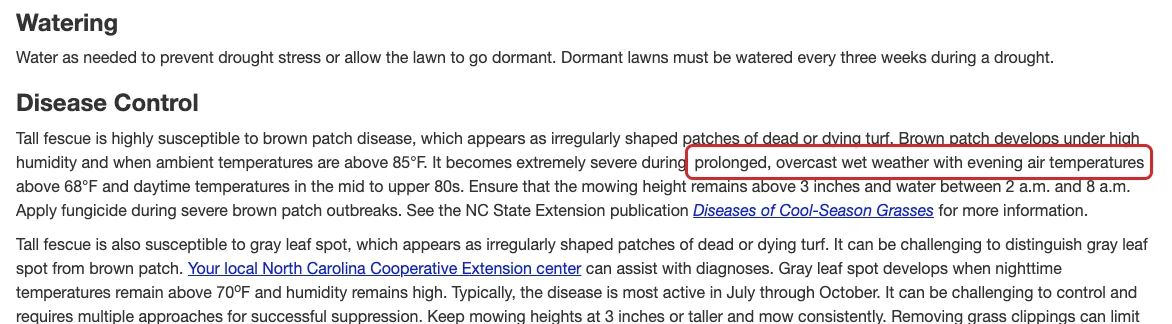
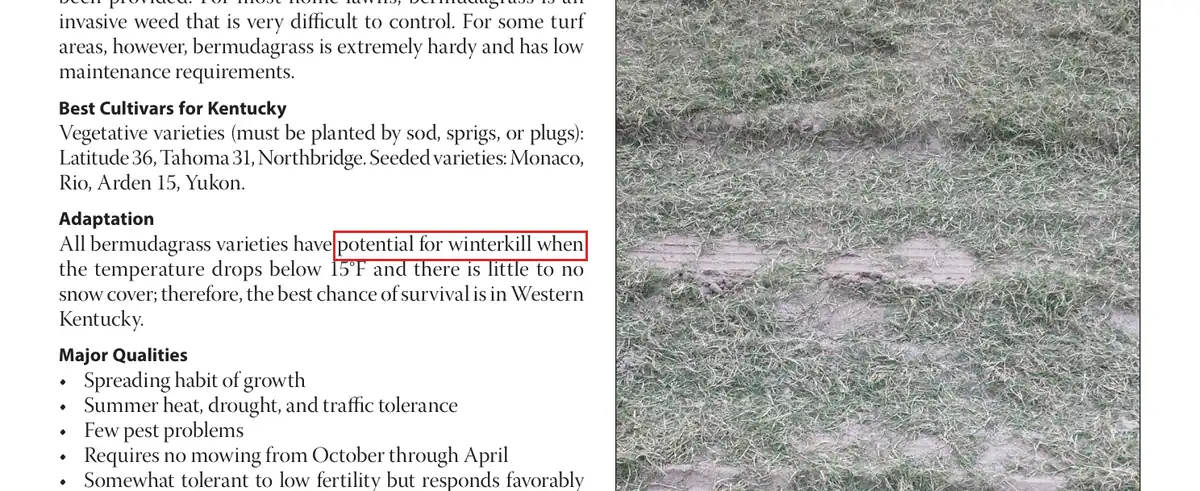
Tall fescue fails in summer. NC State’s tall fescue calendar (AG-367) says brown patch develops above 85°F with high humidity and turns extremely severe when evenings stay above 68°F, and gray leaf spot takes over when nights stay above 70°F, mostly July to October. Bermudagrass fails in winter: the University of Kentucky (AGR-52) warns every bermudagrass variety can winterkill when the temperature drops below 15°F with little or no snow cover. The table counts both, per average year.
Swipe the table sideways to see every column.
| City (NOAA station) | Days 90°F or hotter | Nights above 70°F | Nights 10°F or colder | January normal low | Our flag | State extension call | Our read |
|---|---|---|---|---|---|---|---|
| Asheville, NC | 9.1 | 1.2 | 2 | 28.6°F | Neither | NC State: Table 9-1 lists no bermudagrass for the Mountains-Foothills | Tall fescue |
| Raleigh, NC | 52.4 | 37.2 | 0.6 | 31.8°F | Neither | NC State: both listed for the Piedmont; tall fescue best adapted to mountains and piedmont | Either; sun decides |
| Charlotte, NC | 49.2 | 35.4 | 0.5 | 31.8°F | Neither | NC State: both listed for the Piedmont | Either; sun decides |
| Greensboro, NC | 33.3 | 27.6 | 1 | 30.1°F | Neither | NC State: both listed for the Piedmont | Either; sun decides |
| Roanoke, VA | 30.4 | 15.8 | 1.6 | 28.7°F | Neither | Virginia Tech SPES-748: any cool-season grass in the mountain regions | Tall fescue |
| Richmond, VA | 44.9 | 35.6 | 1.2 | 28.8°F | Neither | Virginia Tech SPES-748: tall fescue and cold-tolerant bermudagrass both listed for the Southern Piedmont | Either; sun decides |
| Norfolk, VA | 36.2 | 66.2 | 0.2 | 33.6°F | Heat | Virginia Tech SPES-748: tall fescue and all four warm-season grasses used on the Coastal Plain | Either; fescue faces brown patch |
| Knoxville, TN | 36.5 | 23.6 | 1.4 | 30.0°F | Neither | UT PB1935: tall fescue for most home lawns in East and Middle Tennessee | Tall fescue |
| Nashville, TN | 54.1 | 42.9 | 1.8 | 30.1°F | Neither | UT PB1935: tall fescue for most Middle Tennessee lawns; bermudagrass for full-sun lawns | Either; sun decides |
| Memphis, TN | 72.1 | 80.1 | 0.6 | 33.3°F | Heat | UT PB1935: bermudagrass for full-sun lawns in Tennessee | Bermuda in sun |
| Lexington, KY | 25.1 | 15.4 | 7 | 25.4°F | Cold | UK AGR-52: tall fescue adapted statewide; bermudagrass winterkill risk below 15°F | Tall fescue |
| Louisville, KY | 42.7 | 44.6 | 4.1 | 27.8°F | Neither | UK AGR-52: bermudagrass has its best chance in Western Kentucky | Tall fescue |
| Tulsa, OK | 73.9 | 63.6 | 2.6 | 28.0°F | Heat | OSU HLA-6418: bermudagrass best adapted for full sun; tall fescue for shaded or irrigated sites | Bermuda in sun |
| Oklahoma City, OK | 73.4 | 48.9 | 1.9 | 27.0°F | Heat | OSU HLA-6418: same statewide split | Bermuda in sun |
| Wichita, KS | 64.9 | 40.6 | 7.7 | 22.5°F | Heat and cold | K-State MF2032: seeded bermudagrass works well in southern Kansas | Split by sun |
| Topeka, KS | 49.6 | 31.4 | 13.3 | 20.0°F | Cold | K-State MF2032: Kansas is the northern edge for bermudagrass; tall fescue most widely adapted | Tall fescue |
| Kansas City, MO | 36.3 | 27.9 | 14.7 | 19.5°F | Cold | MU IPM: tall fescue the most appropriate lawn species in Missouri | Tall fescue |
| St. Louis, MO | 47.1 | 49.9 | 6.9 | 23.8°F | Cold | MU IPM: tall fescue the most appropriate and popular lawn species in Missouri | Tall fescue |
| Springfield, MO | 39.7 | 27.6 | 7.7 | 24.2°F | Cold | MU IPM: same statewide call | Tall fescue |
| Little Rock, AR | 76.4 | 67.2 | 0.3 | 30.9°F | Heat | U. of Arkansas FSA2112: bermudagrass adapted to the entire state, needs 6 hours of sun | Bermuda in sun |
Memphis, Tulsa, Oklahoma City and Little Rock clear 72 hot days a year, and Memphis averages 80 nights that never cool below 70°F: that is brown patch weather for most of the summer. Norfolk has only 36 hot days but 66 warm nights; Virginia Tech notes the Atlantic moderates its Coastal Plain climate. Asheville, at 9 hot days and 1 warm night, fits NC State’s Table 9-1, which lists tall fescue for the Mountains-Foothills region and no bermudagrass at all.
The cold count splits the region on a line running roughly through Lexington, St. Louis and Wichita. Kansas City averages 14.7 nights at 10°F or colder and Topeka 13.3, against 0.6 in Raleigh and Memphis. K-State’s MF2032 calls Kansas the northern edge of bermudagrass country and says seeded types are less winter-hardy but work well in southern Kansas; University of Kentucky says bermudagrass has its best chance in Western Kentucky. If you still want bermuda north of that line, AGR-52 names the vegetative cultivars Latitude 36, Tahoma 31 and Northbridge and the seeded Monaco, Rio, Arden 15 and Yukon for Kentucky.
Wichita is the one city that trips both flags: 64.9 hot days and 7.7 hard-freeze nights. There, and in the 9 cities with neither flag, the climate counts alone do not pick a grass. University of Missouri’s Lee Miller calls tall fescue the most appropriate and popular lawn species statewide, while Arkansas’s FSA2112 says bermudagrass is adapted to the entire state. The state line matters less than the next question.
Then the spot: how many hours of direct sun it gets
Inside one yard, sun hours outrank climate. Mississippi State’s P2892 ranks bermudagrass as needing the most light of all maintained turfgrasses, with tall fescue near the shade-tolerant end, below only red fescue among the grasses it lists. The published hour cutoffs do not agree, and the gap matters if your lawn gets 6 or 7 hours.
| Source | Bermudagrass needs | Tall fescue | What to do with it |
|---|---|---|---|
| Oklahoma State, HLA-6608 | At least 8 hours of sunlight in the growing season | Less than 6 hours: use tall fescue (6 hours: zoysiagrass may work) | The strictest line. Use it for a new lawn you want dense |
| U. of Arkansas, FSA2112 | Full sun, 6 hours a day | Grows with at least 4 hours of full sun or filtered pine shade | Bermuda at 6 to 8 hours will grow but thins first |
| UT, PB1935 (March 2026) | Low shade tolerance: 6 or more hours of direct sun | Full sun to moderate shade | Same 6-hour floor as Arkansas |
| Mississippi State, P2892 | Most light of any maintained turfgrass; Celebration and TifGrand “by no means shade tolerant” | More disease in shade | Cultivar does not rescue a shady bermuda lawn |
| K-State, MF2032 | Shade tolerance: poor | Shade tolerance: very good | Fescue is the shade grass of the pair |
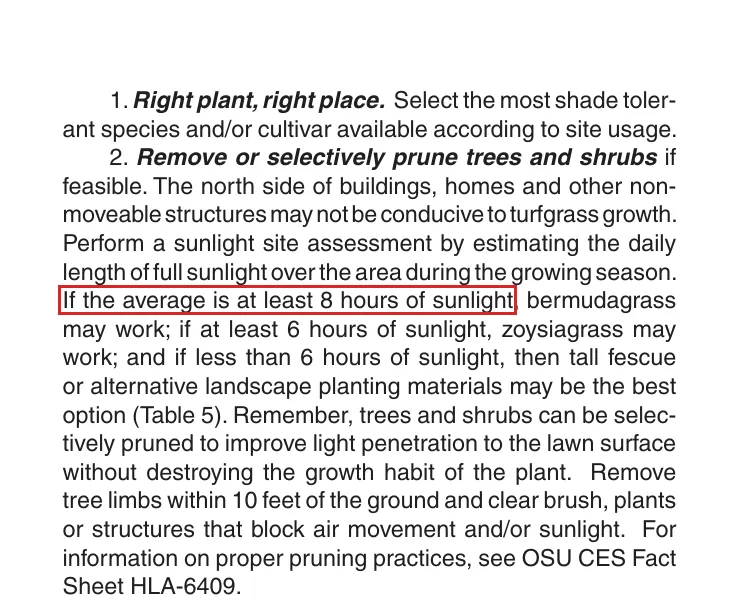
Count the hours, do not guess them. Oklahoma State tells readers to estimate the daily length of full sun over the area through the growing season; checking the spot every hour from 8 a.m. to 6 p.m. on a clear June day does that. A yard can split the difference: UT’s PB1935 suggests cool-season grass in shaded areas and warm-season grass in full sun on the same property. Expect a border war, though. Virginia Tech’s bermudagrass control guide says tall fescue mowed at 4 inches can completely kill bermudagrass without herbicide, while fescue kept at the low end of its height range lets bermuda hold on.
Then the job the lawn has to do
Once sun and climate leave both grasses standing, the job the lawn does separates them. NC State rates each on a 1 (very poor) to 6 (excellent) scale in Table 9-1, and the gaps are narrower than most comparisons suggest: one point on wear, one on drought, one on heat. The bigger differences are in recovery and in what the lawn looks like from November to March.
| If the lawn has to | Pick | The number behind it | Source |
|---|---|---|---|
| Take dogs running laps, kids or a play area | Bermuda | Wear 6 vs 5; bermuda spreads by stolons and rhizomes and recovers rapidly, while tall fescue does not recover well from excessive wear and must be reseeded | NC State 9-1; NC State AG-431; AG-367 |
| Go through summer without a sprinkler | Bermuda | Drought 6 vs 5; NC State says some tall fescue may be lost if a drought runs past 3 weeks | NC State |
| Stay green from November to March | Tall fescue | Bermuda is straw-brown from the first killing frost in October to mid-April in Kentucky, about 6 months | UK AGR-52 |
| Grow under trees | Tall fescue | Shade 4 vs 1 | NC State 9-1 |
| Stay out of flower beds | Tall fescue | Fescue is a bunch grass; bermuda runners invade beds above and below ground | NC State AG-69; UK AGR-52 |
| Look like a golf fairway | Bermuda | Mowed 0.75 to 2 inches vs 2.5 to 3.5 for fescue; below 1 inch needs a reel mower and level ground | NC State 9-1; AG-431 |
| Survive a cold snap on an exposed slope | Tall fescue | Cold 5 vs 1 (common) or 2 (hybrid bermuda) | NC State 9-1 |
Water is where the two grasses trade places. Oklahoma State’s HLA-6419 recommends tall fescue for lightly shaded or irrigated sites and warns that fescue in full sun needs more frequent watering. UT’s PB1935 says most Tennessee lawns need no more than 1 inch a week in the hottest months, rain included, and many bermudagrass lawns do well on about 0.5 inch. If the lawn will not be watered in July and August, that 0.5-inch gap is the whole argument.
1Does the spot get less than 6 hours of direct sun on a June day?
YesTall fescue. Arkansas and Tennessee put bermuda at 6 hours minimum; Oklahoma State says 8.
NoGo to the next question
2Does your city average 5 or more nights a year at 10 F or colder (table above)?
YesTall fescue, or a cold-hardy sod cultivar such as Latitude 36 or Tahoma 31 only in full sun.
NoGo to the next question
3Must it stay green from November to March?
YesTall fescue. Bermuda is brown about 6 months in Kentucky.
NoGo to the next question
4Will dogs, kids or play wear paths into it every week?
YesBermuda: it regrows into wear from runners; fescue must be reseeded.
NoGo to the next question
5Will you skip watering in July and August?
YesBermuda. Some tall fescue is lost when drought passes 3 weeks.
NoEither grass fits. Pick tall fescue for a 3.5 inch lawn fed in fall, or bermuda for a 1 to 2 inch lawn mowed often in summer.
Source: OSU HLA-6608; U. of Arkansas FSA2112; UK AGR-52; NC State Table 9-1
What each grass asks of you over 5 years, per 1,000 sq ft
The yearly work moves to different months rather than disappearing. Fescue’s work is in fall: seeding, feeding and patching. Bermuda’s is in summer: mowing low and often from green-up to frost. The table below uses the Piedmont rates from NC State and the July to September 2026 farm price of sod from USDA AMS; the 5-year column is our arithmetic.
| Input | Tall fescue | Bermudagrass | 5-year arithmetic | Source |
|---|---|---|---|---|
| Planting window (Piedmont) | Sept. 1 to 15 | April to July | Fescue’s second-best window is mid-February to mid-March (AGR-52); late spring seedings seldom succeed | NC State Table 9-4; AGR-52 |
| Seed to plant | 6 lb | 1 to 2 lb (common types only; hybrids are sod or sprigs) | Fescue takes 3 to 6 times more seed by weight | NC State Table 9-4 |
| Sod, farm price, July to Sept. 2026 | 51.62¢ per sq ft national ($516) | 55.29¢ national ($553); 47.12¢ South ($471) | Add $50 to $120 delivery at the reported 5 to 12¢ per sq ft | USDA AMS |
| Nitrogen a year | 2 to 4 lb | 4 to 4.5 lb common; 3 to 6 lb hybrid | Fescue 10 to 20 lb; common bermuda 20 to 22.5 lb | NC State Table 9-1 |
| Patching thin areas | Reseed; it cannot spread. K-State: 3 to 5 lb for thin lawns, 6 to 8 lb for large dead areas | Fills gaps from runners | Fescue: 1 or 2 interseedings is 3 to 10 lb of seed (our assumption) | K-State MF736; UT PB1935 |
| Mowing height | 2.5 to 3.5 in; 3.5 in summer | 1 to 2.5 in for most lawns | Fescue never below 2.5 in; bermuda below 1 in needs a reel mower | AG-367; AG-431 |
| Peak mowing interval | Every 5 to 7 days, late spring | Twice a week in rapid growth | Peaks fall in different seasons | AG-367; FSA2112 |
| When to feed | 1 lb N in mid-September and again in November | First 0.5 to 1 lb N several weeks after full green-up, early April to May | Fescue is fed when bermuda is going dormant | AG-367; AG-431 |
Read the nitrogen row as a range, not a bill: at 2 to 4 lb a year, a 5,000 sq ft fescue lawn takes 50 to 100 lb of actual nitrogen over 5 years, and common bermuda 100 to 113 lb. The seed row cuts the other way. UT lists periodic interseeding among the limitations of cool-season lawns, because tall fescue thins from heat, drought or disease and cannot spread back. Our sod installation cost guide prices the labor side.
Switching a lawn from one grass to the other
Going from bermuda to fescue is the harder move: NC State says it takes several applications spaced 3 to 4 weeks apart to completely control bermudagrass. Virginia Tech’s glyphosate program sprays in late June or early July, sprays again 3 to 4 weeks later and seeds a week after that; its selective programs run 3 or more sprays and finish with fall seeding of tall fescue at the Sept. 1 to 15 Piedmont window. Product rates and waiting periods are in our guide to killing bermuda grass.
Going from fescue to bermuda means killing the fescue in spring and planting once the ground is warm, inside NC State’s April to July window; Kentucky’s AGR-52 narrows that to May and June. Our guides to killing grass before replanting and soil temperature for planting cover the timing.
This page is general information. Herbicide and fungicide rules vary by state and product; read and follow the label, which is the law for pesticide use.
How we compiled this
We downloaded NOAA NCEI 1991 to 2020 annual and monthly normals for 20 airport stations in November 2026 and read 16 extension publications from 9 universities in North Carolina, Virginia, Tennessee, Kentucky, Oklahoma, Kansas, Missouri, Arkansas and Mississippi, plus the USDA AMS sod report for July to September 2026. The heat and cold flags are our own screening rule built on NC State’s disease temperatures and Kentucky’s winterkill line; we did not grow or test either grass. Airport stations can run warmer or colder than a given neighborhood.
Frequently asked questions
Which is better, bermuda grass or fescue?
Neither across the board. Bermuda wins on wear, drought and heat (NC State rates it 6, 6 and 5 of 6); tall fescue wins on shade (4 vs 1), cold (5 vs 1) and winter color (NC State). In the city table, 4 of 20 cities lean bermuda in sun, 9 lean tall fescue and 7 depend on the spot.
What are the downsides of fescue grass?
Tall fescue is highly susceptible to brown patch above 85°F with humid nights over 68°F, does not recover well from wear, and must be reseeded because it does not spread (NC State AG-367). NC State adds that some stands are lost when a drought runs past 3 weeks. More detail is in our tall fescue guide.
What is the downside of bermuda grass?
It is brown for about 6 months, from the first killing frost in October to mid-April in Kentucky; it has very poor shade tolerance; it creeps into beds and neighboring lawns; and it can winterkill below 15°F without snow cover (UK AGR-52). Our bermuda grass guide scores 11 cultivars.
Will fescue choke out bermuda grass?
Only if it is mowed tall. Virginia Tech says research shows tall fescue mowed at 4 inches can completely kill bermudagrass without herbicides, and that fescue kept at the low end of its height range makes bermuda herbicides much less effective (Virginia Tech).
How do I tell if I have bermuda or fescue?
Look at the lawn in January. University of Missouri’s test: if it turned completely tan or brown over winter, it is a warm-season grass such as bermudagrass; if it stayed green, it is tall fescue or a fescue and bluegrass mix (MU IPM, 2014). Bermuda also has runners; tall fescue grows in clumps.
Sources
- NOAA National Centers for Environmental Information, U.S. Climate Normals 1991 to 2020, annual/seasonal and monthly station files (20 airport stations), 1991 to 2020 normals. Accessed November 2026.
- NOAA NCEI, Annual/Seasonal Normals documentation (field definitions), 2021. Accessed November 2026.
- NC State Extension, Extension Gardener Handbook, Chapter 9: Lawns (Tables 9-1 and 9-4), Feb. 1, 2022. Accessed November 2026.
- NC State Extension, AG-69, Carolina Lawns, July 2, 2021. Accessed November 2026.
- NC State Extension, AG-367, Tall Fescue Lawn Maintenance Calendar, July 8, 2021. Accessed November 2026.
- NC State Extension, AG-431, Bermudagrass Lawn Maintenance Calendar, July 30, 2021. Accessed November 2026.
- Virginia Cooperative Extension, SPES-748NP, Selecting Turfgrass for Virginia, 2025. Accessed November 2026.
- Virginia Tech, School of Plant and Environmental Sciences, Selective Bermudagrass Control for Lawns, current web page. Accessed November 2026.
- University of Tennessee Extension, PB1935, Turfgrass Selection for Tennessee Landscapes, March 2026. Accessed November 2026.
- University of Kentucky Cooperative Extension, AGR-52, Selecting the Right Grass for Your Kentucky Lawn, Issued Aug. 2019. Accessed November 2026.
- Oklahoma Cooperative Extension Service, HLA-6608, Managing Turfgrass in the Shade in Oklahoma, print code 0309. Accessed November 2026.
- Oklahoma Cooperative Extension Service, HLA-6418, Selecting a Lawn Grass for Oklahoma, PDF edition. Accessed November 2026.
- Oklahoma Cooperative Extension Service, HLA-6419, Establishing a Lawn in Oklahoma, PDF edition. Accessed November 2026.
- K-State Research and Extension, MF2032, Turfgrass Selection, Professional Series, July 2017. Accessed November 2026.
- K-State Research and Extension, MF736, Tall Fescue Lawns, April 2015. Accessed November 2026.
- University of Missouri IPM (L. Miller), Seeding and Fertilizing Missouri Lawns: One Size Does Not Fit All, May 8, 2014. Accessed November 2026.
- University of Arkansas Cooperative Extension Service, FSA2112, Choosing a Grass, Rev. May 2007. Accessed November 2026.
- Mississippi State University Extension, P2892, Selecting and Managing Turfgrass for Shade, POD-07-24. Accessed November 2026.
- USDA Agricultural Marketing Service, National Quarterly Sod Report, July 1 to Sept. 30, 2026, Released Oct. 21, 2026. Accessed November 2026.