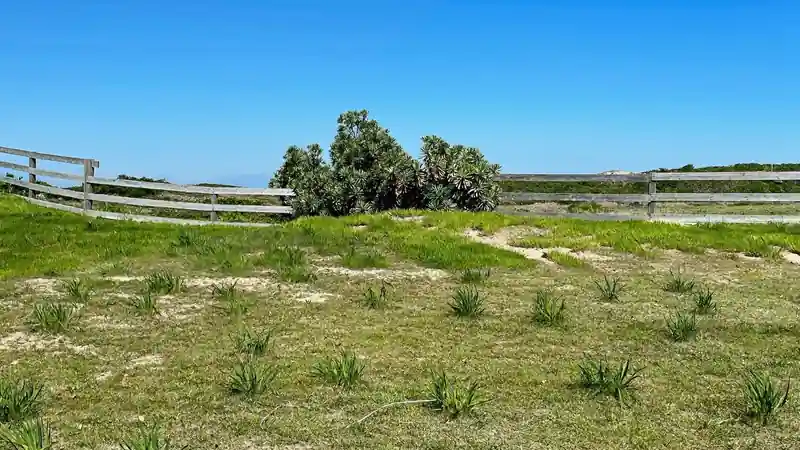
Can grass grow in sand? Yes. Bermudagrass, bahiagrass, St. Augustinegrass, zoysiagrass and centipedegrass all grow on sand, but sand holds only 0.20 to 1.00 inch of water per foot, so a summer sand lawn runs dry in 1 to 2 days.
Can grass grow in sand? Most of Florida’s lawns already do. UF/IFAS Extension says most native soils in Florida are sandy and that sandy soils typically hold no more than 0.75 inch of water per foot of depth. Its turf irrigation circular, CIR829, puts sands and fine sands at 0.20 to 1.00 inch per foot, against 1.50 for very fine sandy loams and 2.50 for clays and mucks. Grass roots fine in sand. What changes is the schedule: the water and nitrogen a sand lawn gets have to arrive in smaller doses, more often.
This page turns that water-holding figure into the number a sand lawn owner actually needs: how many days the root zone lasts between waterings. It uses the UF/IFAS days-of-water table, rescaled for your soil and root depth, then matches grasses, fertilizer limits and amendment depths to sand. The grass-by-grass thresholds sit in the table further down; the full compiled data set is a CSV.
How long does water last in sand?
UF/IFAS gives the method in CIR829, Turf Irrigation for the Home: water when the root zone has lost 1/2 to 2/3 of its stored water, and refill only the root zone. Most roots of a well-managed lawn sit in the top 12 inches. Its Figure 4 lists how many days stored water lasts in a soil holding 1 inch per foot with 12-inch roots: 2 days from May through July anywhere in Florida, up to 5 days in a south Florida January and 7 in a north Florida January. To adjust, multiply those days by your soil’s inches per foot and your root depth in feet.
| Soil (CIR829 Table 1) | Water held, in per ft | Usable before stress (50% of 12 in) | Water to apply, in (75% efficiency) | Days it lasts May to July, 12 in roots | Same, 6 in roots | Days, north Fla. January, 12 in roots |
|---|---|---|---|---|---|---|
| Sand or fine sand, low end | 0.20 | 0.10 | 0.13 | 0.4 | 0.2 | 1.4 |
| Sand or fine sand, UF/IFAS average | 0.75 | 0.38 | 0.50 | 1.5 | 0.8 | 5.2 |
| Sand or fine sand, high end | 1.00 | 0.50 | 0.67 | 2.0 | 1.0 | 7.0 |
| Moderately coarse sandy loams | 1.25 | 0.62 | 0.83 | 2.5 | 1.2 | 8.8 |
| Very fine sandy loams to silty clay loams | 1.50 | 0.75 | 1.00 | 3.0 | 1.5 | 10.5 |
| Silty clay to clay, peats and mucks | 2.50 | 1.25 | 1.67 | 5.0 | 2.5 | 17.5 |
Read the average sand row. A lawn on 0.75 inch per foot sand with roots 12 inches deep uses its spare water in about 1.5 days of early summer weather and needs about 0.5 inch to refill. That lines up with UF/IFAS ENH9, Watering Your Florida Lawn, which tells owners to apply 1/2 to 3/4 inch when the grass shows stress, and with NC State’s Carolina Lawns (AG-69), which says 0.5 inch every third day is usually enough on sandy soil. A zone that puts down 1 inch at a time on that sand delivers about 0.75 inch to the soil at 75 percent efficiency, and about half of that drains below 12 inches.
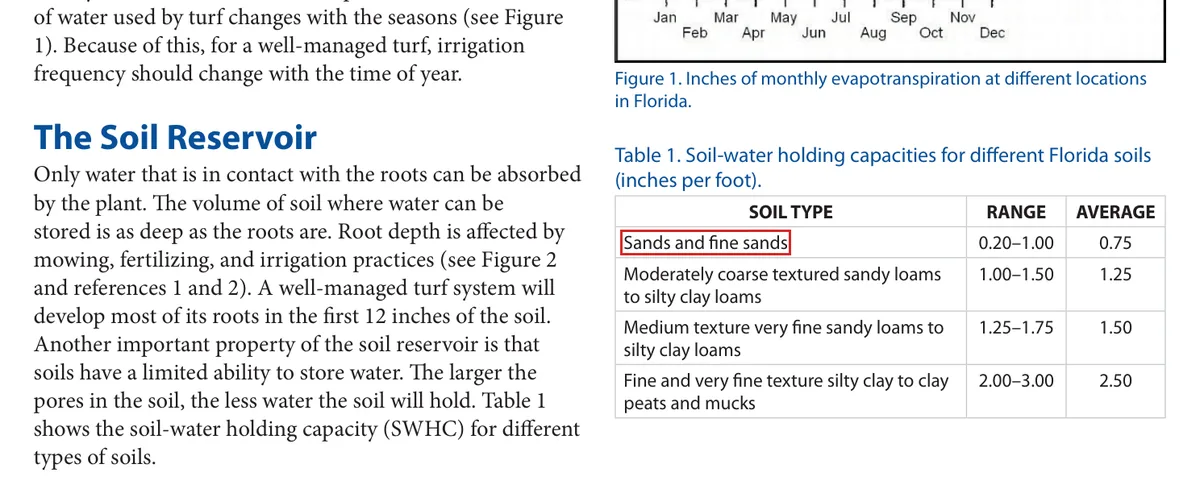
Root depth matters as much as texture. Halving roots from 12 to 6 inches halves the days: average sand with 6-inch roots holds 0.75 day of early-summer water, less than one missed watering. UF/IFAS SL384 says irrigation that exceeds the soil’s capacity carries nitrate below the roots, so the fix is shorter, more frequent runs sized to the table, plus watering only when leaf blades fold, turn blue-gray or hold footprints. Time of day and local restrictions are in our guide to the best time to water a lawn.
- Days until the lawn needs water or rain
- 1.5
Default: 12 in roots in average sand (0.75 in per ft) in May to July = 1.5 days. Method: UF/IFAS CIR829 Figure 4 days x water held x root depth in feet. Outside Florida, the 2-day line approximates a hot summer week.
Which grasses grow in sand?
Warm-season grasses with deep roots handle deep sand best. UF/IFAS writes, under the species table in ENH8, Centipedegrass for Florida Lawns, that St. Augustinegrass, bermudagrass and bahiagrass typically root deeper and should perform best on deep sands, while shallower-rooted centipedegrass and zoysiagrass do best on shallow soils. In the cool-season North, NC State warns that tall fescue will not perform well in full sun on sandy coastal plain soil, and Colorado State lists tolerance of rocky, sandy or clay soil among the fine fescues’ advantages.
| Grass | Sand fit | Drought | Salt | Nematodes | N, lb per 1,000 sq ft per year (N, C, S Florida) | Mowing height, in | Source |
|---|---|---|---|---|---|---|---|
| Bahiagrass | Deep sands (UF/IFAS) | Excellent | Poor | Excellent | 1 to 2 (all regions) | 3.0 to 4.0 | ENH8 Table 1; ENH6 Table 1 |
| Bermudagrass | Deep sands; NC State: well adapted to sandy soils | Excellent | Good | Poor | 3 to 5 N, 4 to 6 C, 5 to 7 S | 0.5 to 2.0 | ENH8; ENH19 Table 1; AG-69 |
| St. Augustinegrass | Deep sands (UF/IFAS) | Good | Good | Good | 2 to 4 N, 2 to 5 C, 4 to 6 S | 2.0 to 4.0 | ENH8; ENH5 Table 2 |
| Zoysiagrass (Z. japonica) | Shallow soils (UF/IFAS) | Excellent | Excellent | Good | 2 to 3 N, 2 to 4 C, 2.5 to 4.5 S | 2.5 or less | ENH8; ENH11 Table 2 |
| Centipedegrass | Shallow soils; acidic soils only (UF/IFAS) | Good | Poor | Poor | 0.4 to 2 N, 0.4 to 3 C and S | Under 2.0 | ENH8 Tables 1 and 2 |
| Fine fescues (cool-season) | Tolerates rocky, sandy or clay soil | Drought resistant, goes dormant | Moderate to very good (6 to 10 mmhos/cm) | Not rated | 1 to 2; 3 to 4 on sandy soil or heavy traffic | 1 to 3 | Colorado State GardenNotes #564 |
| Tall fescue (cool-season) | Not in full sun on sandy coastal plain soil (N.C.) | Good (NC State) | Not rated | Not rated | Use your state’s calendar | See our tall fescue guide | NC State AG-69 |
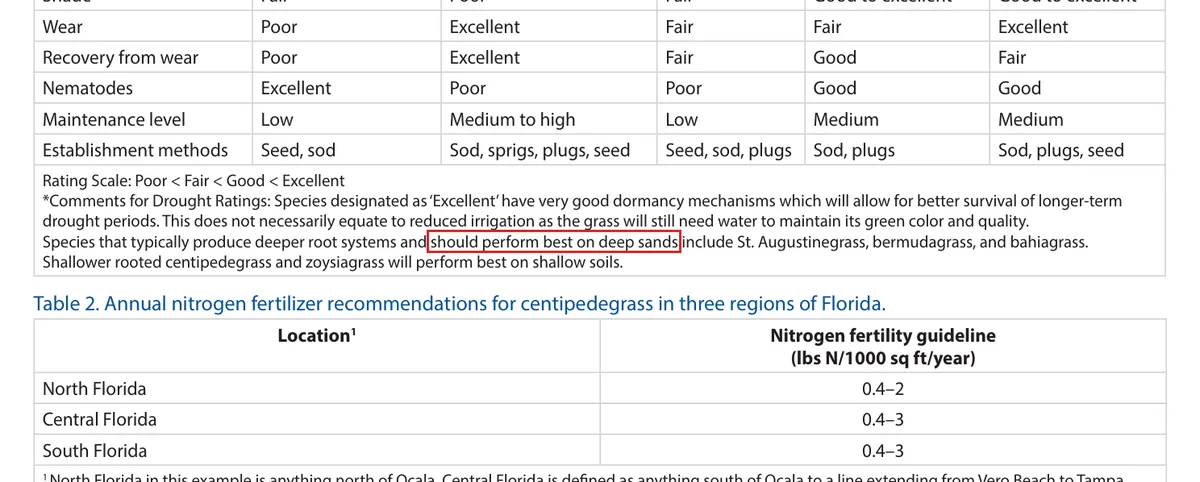
Two columns matter more on sand than the drought rating. UF/IFAS ENH04 describes nematodes as worms that live in moist sandy soil, and ENH8 rates bermudagrass and centipedegrass poor against them, bahiagrass excellent. Salt matters within sight of the beach: zoysiagrass rates excellent and bahiagrass and centipedegrass poor. For a sunny, sandy, unirrigated lot in Florida, that combination points to bahiagrass; for a shaded yard, St. Augustinegrass, which UF/IFAS rates good to excellent in shade.
UF/IFAS adds a caution to its drought column: an excellent rating means better survival through long dry spells by going dormant, not less irrigation to stay green. So a sand lawn of bermudagrass still needs water every 1 to 2 summer days, per the table above, to stay green.
How to feed grass on sand without washing it out
Sand leaches what it cannot hold, so the dose per feeding matters more than the yearly total. Florida’s Urban Turf Fertilizer Rule, summarized by UF/IFAS in ENH1089, caps any single application at 0.7 lb of soluble (quick-release) nitrogen per 1,000 sq ft. It allows up to 2 lb of nitrogen per 1,000 sq ft in spring or summer only when at least 65 percent of it is controlled-release; UF/IFAS SL21 adds a 1 lb per application limit in fall.
- Read the bag’s first number and divide it into 100: that is pounds of product per 1 lb of nitrogen per 1,000 sq ft. UF/IFAS SL21 works ammonium sulfate (21 percent N) to 3.3 lb of product for 0.7 lb of soluble nitrogen.
- On sand, pick a blend with slow-release nitrogen (polymer-coated or sulfur-coated urea, methylene urea, IBDU) so no more than 70 percent of each feeding is soluble, the SL21 split for a 1 lb application.
- Water it in with about 1/4 inch. UF/IFAS SL384 says that is enough to move granules into the soil, and that more increases leaching.
- Hold the yearly total inside your grass’s range in the table above, and split it. At planting outside Florida, NC State’s AG-69 raises starter fertilizer rates by 20 percent on coastal plain and sandhills sands.
- Get a soil test before adding potassium or phosphorus. SL21 notes potassium is highly mobile in Florida’s sandy soils, and the rule limits phosphate to 0.25 lb P2O5 per 1,000 sq ft per application.
The yearly nitrogen ceiling stays the same on sand; what shrinks is the safe single dose. Our guide to adding nitrogen to lawn soil covers sources and timing in more detail.
Should you amend sand or cap it with topsoil?
Amend by mixing, never by capping. NC State’s Carolina Lawns says to mix 1 to 2 cubic yards of peat moss or compost per 1,000 sq ft into the top 6 to 8 inches of very sandy soil before planting. Penn State Extension’s Lawn Establishment goes heavier: a 1 to 2 inch layer of compost or sphagnum peat worked 4 to 6 inches in, tilled in 2-inch passes if more is needed. Either way the amendment ends up spread through the root zone, not sitting on top of it.
| Rule | Per 1,000 sq ft | Layer depth | Mixed to | Amendment share of mixed zone |
|---|---|---|---|---|
| NC State AG-69, very sandy soil | 1 to 2 cu yd | 0.3 to 0.6 in | 6 to 8 in | 4 to 11% |
| Penn State, new lawn | 3.1 to 6.2 cu yd | 1 to 2 in | 4 to 6 in | 17 to 50% |
| Penn State, renovating via core aeration | 0.8 to 1.5 cu yd | 1/4 to 1/2 in | Aeration holes only | Not mixed through |
| Oregon State, imported sandy soil layer | 18.5 cu yd | 6 in minimum after compaction | Placed as a layer | Not applicable |
| USGA putting green root zone | 37 cu yd of blended mix | 12 in | Peat blended throughout 12 in before placement | Set by lab tests, not a fixed share |
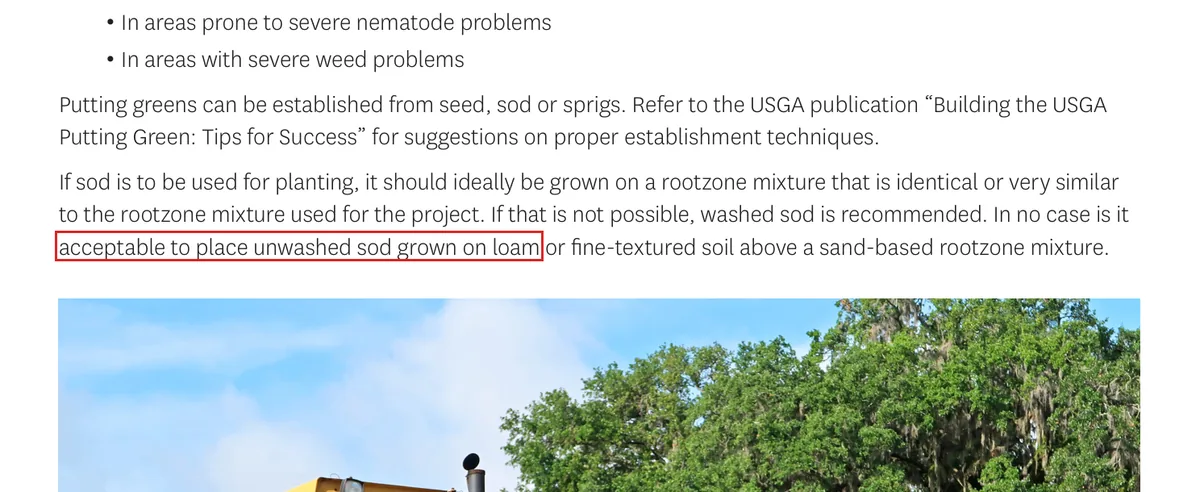
Capping sand with 1 or 2 inches of topsoil fails for a physical reason: a sharp change in texture stops water. R.W. Sheard’s 1992 turf management series explains that gravity drainage only happens once soil is wetter than field capacity, that capillary water in sand travels only centimetres, and that golf builders use the effect on purpose, laying 30 cm of sand over gravel to hold a perched zone of saturation at the base. By the same physics, a thin fine layer over sand stays wet while the sand below stays dry, and roots tend to stay in it. The USGA’s 2018 putting green recommendations state that in no case is unwashed sod grown on loam or fine-textured soil acceptable above a sand-based root zone.
Oregon State’s EC 1550 gives the depth logic for imported soil: a layer of sandy soil should be at least 6 inches deep after compaction to provide an adequate root zone. Anything thinner should be tilled into what lies below. That rule, and the topsoil price per yard in our topsoil cost guide, decide most fill questions. Sand mixed into clay is a different problem, covered in our guide to improving clay soil.
1Is the sand your native soil, 12 inches deep or more (Florida, coastal plain, sandhills)?
YesKeep it. Mix 1 to 2 cu yd of compost per 1,000 sq ft into the top 6 to 8 in (NC State AG-69), plant a deep-rooted warm-season grass, and water by the days table.
NoGo to the next question
2Is it a sand layer under 6 inches thick over other soil (pool base, fill, old sandbox)?
YesRake most of it off or till it into the soil below so no layer remains (Oregon State EC 1550: a sandy layer needs 6 in after compaction).
NoGo to the next question
3Were you planning to cap the sand with 1 or 2 inches of topsoil?
YesDo not. Mix the topsoil and compost into the top 6 in, or bring in at least 6 in. Fine soil over sand traps water at the interface (USGA 2018).
NoGo to the next question
4Are you north of the warm-season belt?
YesPlant fine fescues, which tolerate sandy soil (Colorado State GardenNotes #564); avoid tall fescue in full sun on sand (NC State).
NoPlant bahiagrass, bermudagrass or St. Augustinegrass for deep sand, or zoysiagrass where salt spray reaches the lawn (UF/IFAS ENH8).
Source: NC State AG-69; Oregon State EC 1550; USGA 2018; Colorado State; UF/IFAS ENH8
Golf greens are grass on almost pure sand
The best evidence that turf grows in sand is a putting green. The USGA’s 2018 Recommendations for a Method of Putting Green Construction specify a 12-inch root zone in which at least 60 percent of particles are 0.25 to 1.0 mm (medium and coarse sand), with no more than 10 percent very fine sand, silt and clay combined. Any peat must be at least 85 percent organic matter and blended through the full 12 inches.
| USGA root zone property | Recommended range | What it means for a home lawn |
|---|---|---|
| Total porosity | 35 to 55% | Sand is mostly pore space; the question is how much of it holds water |
| Air-filled porosity | 15 to 30% | Drains fast after rain, so roots get air |
| Capillary (water-holding) porosity | 15 to 25% | About 1.8 to 3.0 in of water held in 12 in after drainage, not all of it usable |
| Saturated hydraulic conductivity | 6 in per hour or more | Below 6 in per hour, USGA says drainage problems are a high risk |
| Organic amendment | Peat at 85% organic matter or more; compost aged 1 year | Organic matter is mixed through the root zone, never laid on top |
The same document notes that coarse sands retain little water and often must be amended, and that rootzones are tested by an accredited lab against ASTM F1815. A lawn does not need that precision, but it borrows the two rules that matter: amendment is mixed through 12 inches, and nothing finer sits on top.
Planting seed or sod on bare sand
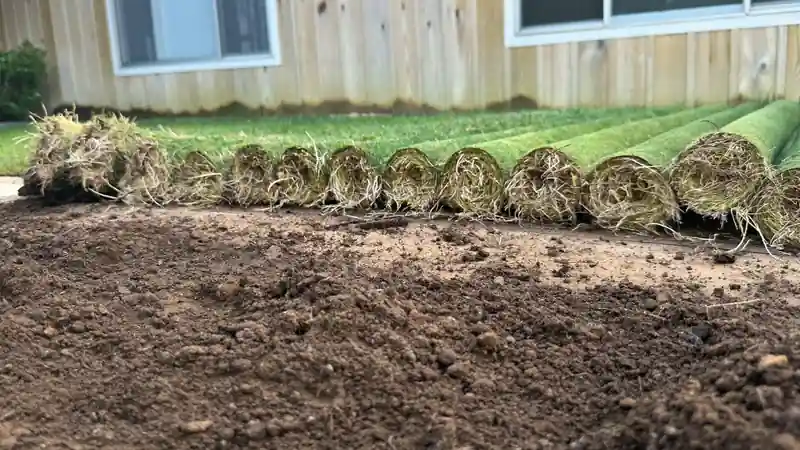
Sod skips the germination weeks, the stage most exposed on fast-drying sand. UF/IFAS ENH-03, Establishing Your Florida Lawn schedules new sod for several short irrigations of 5 to 10 minutes a day for 7 to 10 days, then 1/4 to 1/2 inch once a day for 7 to 10 days, then 1/4 to 1/2 inch two to three times a week; the grass should be established 3 to 4 weeks after laying. For greens the USGA wants sod grown on a matching root zone or washed; on a deep-sand lawn, the same logic argues against sod carrying a thick clay layer.
Seed works on sand if the top 1/4 inch never dries out until the grass covers. UF/IFAS ENH11 says zoysiagrass seed may take 2 to 3 weeks to germinate and another 6 to 8 weeks to establish, with frequent, light irrigation the whole time. ENH-03 suggests topdressing seed with 1/4 to 1/2 inch of soil where practical, and mixing tiny bermudagrass or centipedegrass seed with dry sand to spread it evenly. For zoysiagrass, plugs or sod avoid the long germination window. If an above-ground pool left a 2 to 3 inch pad of sand, rake most of it off or till it 6 inches into the soil below so no layer remains.
How we compiled this
We compiled 17 primary documents: 12 UF/IFAS Extension publications (irrigation, species, fertilization and establishment), NC State AG-69, Colorado State GardenNotes #564, Oregon State EC 1550, Penn State’s Lawn Establishment page and the USGA’s 2018 putting green recommendations, plus one 1992 trade article for the capillary explanation. Days of water, refill depths, compost volumes and the water held in a USGA root zone are our arithmetic from those documents, shown in each table. We did not test any soil or grass. Accessed November 2026.
Frequently asked questions
What grass grows best in sand?
In the South, bahiagrass, bermudagrass and St. Augustinegrass, which UF/IFAS says root deepest and perform best on deep sands. Zoysiagrass handles salt best. In the North, fine fescues tolerate sandy soil; NC State says tall fescue struggles in full sun on sandy coastal plain soil.
Can you lay grass on top of sand?
Yes; most Florida sod is laid on sand. Water it 5 to 10 minutes several times a day for the first 7 to 10 days (UF/IFAS ENH-03). Avoid sod carrying a thick layer of clay or loam: the USGA rejects unwashed fine-soil sod over sand.
Will grass grow through sand?
Through a thin topdressing, yes: UF/IFAS ENH-03 covers broadcast sprigs with 1/2 inch of soil and topdresses seed with 1/4 to 1/2 inch. Thicker sand fill is a layer problem; till it into the soil below or make it at least 6 inches deep (Oregon State EC 1550).
How much topsoil over sand for grass?
None as a thin cap. Mix 1 to 2 cubic yards of compost per 1,000 sq ft into the top 6 to 8 inches (NC State AG-69), or bring in a full root zone at least 6 inches deep after settling, not 1 to 2 inches.
Can you put grass seed on top of sand?
Yes, if you keep the surface moist until the grass covers. Zoysiagrass seed can take 2 to 3 weeks to germinate and 6 to 8 more to establish (UF/IFAS ENH11), which is many light waterings on fast-drying sand.
How often should you water grass growing in sand?
On average sand (0.75 inch per foot) with 12-inch roots, about every 1.5 days in May to July and every 5 days in a north Florida January, applying about 1/2 inch each time (UF/IFAS CIR829 arithmetic).
Sources
- UF/IFAS Extension (Zazueta, Brockway, Landrum, McCarty), CIR829, Turf Irrigation for the Home, Revised Feb. 2014, reviewed 2020. Accessed November 2026.
- UF/IFAS Extension (Hochmuth et al.), SL384, Managing Landscape Irrigation to Avoid Soil and Nutrient Losses, Revised Dec. 2024. Accessed November 2026.
- UF/IFAS Extension (Trenholm, Unruh, Cisar), ENH9, Watering Your Florida Lawn, Current EDIS edition. Accessed November 2026.
- UF/IFAS Extension (Lindsey et al.), ENH04, Selecting a Turfgrass for Florida Lawns, 2025. Accessed November 2026.
- UF/IFAS Extension (Unruh, Lindsey, Schiavon), ENH8, Centipedegrass for Florida Lawns (Tables 1 and 2), 2024. Accessed November 2026.
- UF/IFAS Extension (Schiavon, Unruh et al.), ENH6, Bahiagrass for Florida Lawns, 2022. Accessed November 2026.
- UF/IFAS Extension (Trenholm et al.), ENH19, Bermudagrass for Florida Lawns, Current EDIS edition. Accessed November 2026.
- UF/IFAS Extension (Trenholm et al.), ENH5, St. Augustinegrass for Florida Lawns, 2021. Accessed November 2026.
- UF/IFAS Extension (Unruh, Schiavon et al.), ENH11, Zoysiagrass for Florida Lawns, 2022. Accessed November 2026.
- UF/IFAS Extension (Lindsey, Schiavon et al.), ENH-03, Establishing Your Florida Lawn, 2025. Accessed November 2026.
- UF/IFAS Extension (T.W. Shaddox), SL21, General Recommendations for Fertilization of Turfgrasses on Florida Soils, Revised Jan. 2023. Accessed November 2026.
- UF/IFAS Extension (Trenholm et al.), ENH1089, Urban Turf Fertilizer Rule for Home Lawn Fertilization, 2013 edition. Accessed November 2026.
- NC State Extension, AG-69, Carolina Lawns, July 2, 2021. Accessed November 2026.
- Colorado State University Extension, GardenNotes #564, Fine Fescues for Lawns, Current online edition. Accessed November 2026.
- Oregon State University Extension, EC 1550, Practical Lawn Establishment and Renovation, Current online edition. Accessed November 2026.
- Penn State Extension, Lawn Establishment, Current online edition. Accessed November 2026.
- United States Golf Association, Recommendations for a Method of Putting Green Construction, 2018 Revision (MSU Turfgrass Information Center copy), 2018. Accessed November 2026.
- R.W. Sheard, Sports Turf Newsletter (MSU Turfgrass Information Center), Understanding Turf Management: Movement of Water in Soil, July 1992. Accessed November 2026.