How to clean artificial grass: blow or rake off debris, hose it weekly, wash spots with 1 teaspoon of mild detergent per pint of warm water, brush against the grain, and use an enzyme cleaner where dogs go. Skip bleach and spray above 300 psi.
We built this from the documents that decide a warranty claim: 14 care manuals, warranties and spec guides from 11 turf makers and sellers, plus 7 household cleaners’ safety data sheets. Turf manuals set a cleaner window of pH 5 to 9, and 3 common home remedies, bleach, ammonia and vinegar, fall outside it. The documents also contradict each other, sometimes within one brand, so every schedule line names its source.
The artificial grass cleaning schedule, from the makers’ own documents
Rain does part of the work. SYNLawn’s care manual (May 2023) says rainfall goes a long way but still recommends routine washing, and ForeverLawn’s landscape maintenance sheet (Rev. 08/24) calls an occasional rinse not required but helpful. The table uses the most frequent interval any maker document gives, so treat it as the ceiling for a busy yard with dogs and trees, and stretch it for a decorative patch nobody walks on.
| Task | How often | How | Source |
|---|---|---|---|
| Blow, rake or sweep off leaves and debris | Weekly, more in leaf drop | Plastic rake, stiff push broom or blower; hold a blower at least 2 ft off the surface at 45 degrees | ForeverLawn M0945; FieldTurf FAQ |
| Rinse with a garden hose | Weekly | Gentle spray; it also evens out shifted infill | TigerTurf; Simple Green |
| Pick up dog waste and flush the spot | As it happens | Let solids dry, pick up, then hose the area | SYNLawn manual; TigerTurf |
| Enzyme or bacterial odor treatment in pet areas | Weekly | Hose-end bottle at low pressure, kept wet 10 minutes, at dawn or dusk | Simple Green Outdoor Odor Eliminator directions |
| Brush against the grain, high-traffic areas | Weekly | Synthetic bristles only, never metal or wire | Turf Distributors care guide |
| Brush against the grain, low-traffic areas | Monthly | Same brush | Turf Distributors care guide |
| Spot-clean spills | Same day | 1 tsp mild detergent per pint of warm water, then a cold-water rinse | SYNLawn manual, p. 3 to 4 |
| Feel for low infill | Periodically and after any deep clean | Run a stiff brush over the surface; refill low spots at the maker’s rate | Turf Distributors care guide |
| Moss or algae treatment in damp shade | Up to every 3 months, only if needed | Product approved by the turf maker, at its label rate | TigerTurf |
| Professional deep clean, infill and seam check | Once a year | Power brush, infill level check, seam inspection; required for SYNLawn and Fusion Turf warranty coverage | SYNLawn warranty 3.3; Fusion Turf 3.5 |
| No heavy cleaning or adjustments | First 2 weeks after install | SYNLawn’s minimum stabilization period | SYNLawn manual, p. 2 |
How to wash artificial grass, step by step
- Clear solids, leaves and dust first with a plastic leaf rake, a stiff push broom or a blower. FieldTurf’s maintenance guidelines hold a blower at least 2 ft from the surface at a 45 degree angle so it does not blow infill out. Never use metal tines or wire bristles (SYNLawn, Turf Distributors).
- Wet the whole area with a garden hose. Simple Green‘s turf directions hose the area down before any cleaner goes on.
- Mix the cleaner. SYNLawn’s manual calls for about 1 teaspoon of granular household detergent, or a low-sudsing detergent for fine fabrics, per pint of warm water: about 8 teaspoons per gallon. If you use Simple Green All-Purpose Cleaner, its maker’s turf mix is 1.5 cups per gallon.
- Scrub one section at a time with a long-handled deck brush or a stiff nylon brush, the tool ForeverLawn names for spills.
- Rinse with clean cold water until no foam is left. SYNLawn says to rinse away every trace of soap or ammonia, then blot up standing liquid.
- Let it dry, then brush against the grain to stand the blades back up. SYNLawn calls this cross brushing; a Grandi Groomer rake is the tool it names.
Which cleaners are safe on artificial grass? Check the pH
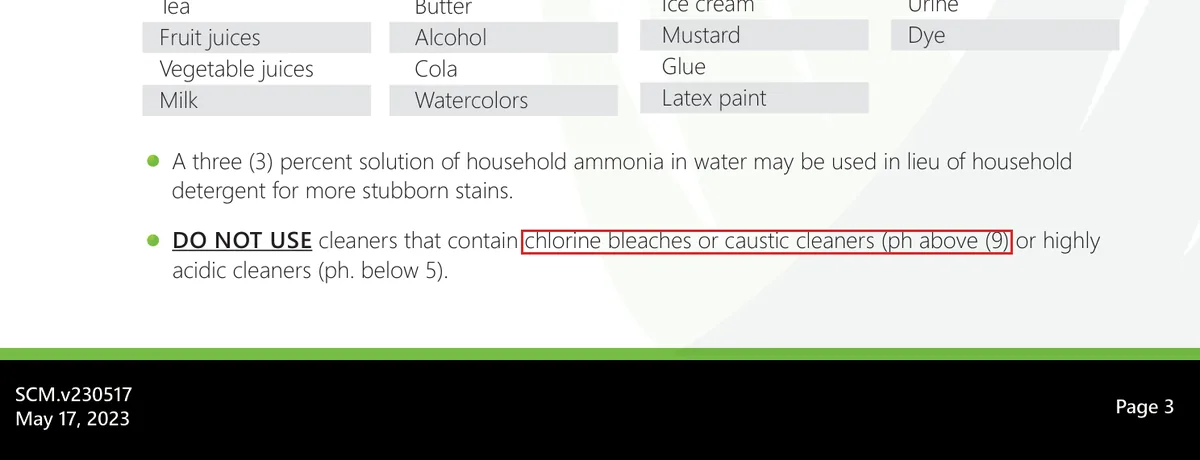
SYNLawn’s manual draws the line on page 3: no chlorine bleach, no caustic cleaners above pH 9 and no highly acidic cleaners below pH 5. Turf Distributors’ Eco 48 Silver care packet repeats the same rule word for word. We checked each common cleaner’s own safety data sheet (SDS) against that window.
| Cleaner | pH on its SDS | Inside pH 5 to 9? | What turf documents say | pH source |
|---|---|---|---|---|
| Clorox Regular Bleach | About 12 | No | SYNLawn bans chlorine bleach; FieldTurf bars oxidizing agents; SYNLawn and Fusion Turf warranties exclude chlorine and other halogens | Clorox SDS, June 2015 |
| Household ammonia (Parsons All-Purpose) | 11 to 12, undiluted | No | SYNLawn suggests a 3 percent solution for stubborn stains; Sprinturf says ammonia voids its warranty | Parsons SDS, April 2019 |
| Simple Green All-Purpose Cleaner | 8.0 to 10.0, concentrate | Concentrate can exceed 9 | SYNLawn lists Simple Green as safe for liberal use, at the maker’s directions | Simple Green SDS, Oct. 2025 |
| Dawn dishwashing liquid | 9 at a 10 percent solution | At the limit | Manuals ask for mild detergent at about 1 tsp per pint, roughly a 1 percent mix | P&G MSDS, Jan. 2014 |
| Baking soda (Arm & Hammer) | 8.2 at 1 percent | Yes | Motz suggests sprinkling it on odor spots for 20 minutes, then sweeping | Arm & Hammer SDS, April 2015 |
| Simple Green Outdoor Odor Eliminator | 6.0 to 8.0 | Yes | Simple Green’s bacterial product for urine odor on turf | Simple Green SDS, March 2026 |
| Distilled white vinegar, 5 percent | 2.6 | No | SYNLawn and TigerTurf both suggest a 1:1 vinegar and water mix for odor or mineral deposits | Woeber distilled white vinegar SDS |
Dilution moves pH less than people expect. Vinegar is a weak acid, so halving it with water raises its pH only about 0.15, to roughly 2.8 by our arithmetic. SYNLawn’s 3 percent ammonia mix, about half a cup per gallon, still works out near pH 10 to 11. The same manual sets the 5 to 9 window, so ask your dealer which rule applies before using either.
For oil, tar, gum or crayon, SYNLawn allows mineral spirits or perchloroethylene dry-cleaning fluid on a cloth only, never poured, since both can harm the backing and are flammable. Gum and sap can be frozen with dry ice and scraped. For mold, the manual names 1 percent hydrogen peroxide, flushed afterward, though FieldTurf’s field guidelines bar oxidizing agents.
How to clean artificial grass with dogs: urine and odor
Water alone often does not clear the smell. Simple Green says urine collects between the turf backing and the weed barrier underneath, and Motz, which makes Envirofill infill, says uric acid is not water-soluble. Both point to enzyme or live-bacteria cleaners, which break the residue down instead of masking it.
- Pick up solids. SYNLawn’s manual says to let waste dry, then dispose of it.
- Flush the spot with a hose (TigerTurf).
- Apply an enzyme or bacterial cleaner at dawn or dusk with the hose-end sprayer at low to moderate pressure, with pets kept off. Simple Green’s directions keep the area wet for 10 minutes and mist it again in heat or wind.
- Let it dry and repeat weekly in the main potty area, the interval Simple Green recommends.
- If the smell survives repeated treatments, look at the infill. Motz says raw sand traps urine, and that Envirofill needs at least 2 to 3 lb per sq ft to control odor; it also says new infill spread over old, smelly infill will not fix the problem.
1Is there solid waste or a wet patch you can see?
YesPick it up, flush the spot with a hose, and check again the next day.
NoGo to the next question
2Does the smell come back within a day or two of a rinse?
YesApply an enzyme or bacterial cleaner at dawn or dusk, keep it wet 10 minutes, and repeat weekly.
NoGo to the next question
3Does it still smell after several weekly enzyme treatments?
YesThe infill is likely holding urine. Ask your installer about removing it and refilling with an odor-control infill at the maker's rate (Envirofill: at least 2 to 3 lb per sq ft).
NoNo visible source and no lingering smell: a weekly hose rinse is enough.
Source: Simple Green Outdoor Odor Eliminator directions; Motz Group; SYNLawn and TigerTurf care pages
Vinegar is the maker-listed fallback: TigerTurf suggests equal parts white vinegar and lukewarm water poured over a smelly patch, and SYNLawn suggests the same 1:1 mix. At about pH 2.8 it sits below the manuals’ floor of pH 5, so keep it for spot fixes. Pet turf carries shorter coverage too: US Turf gives its PET Collection 3 years against 15 for most products (US Turf warranty page), and the Always Green warranty excludes pet damage outright.
Can you pressure wash artificial grass?
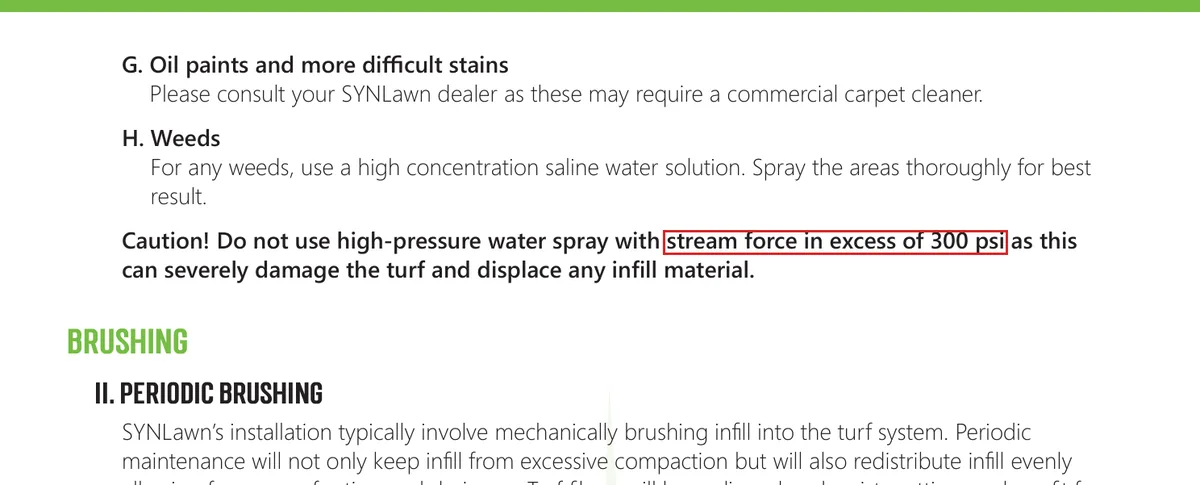
Only gently, and only if your maker allows it. SYNLawn’s manual warns against spray with stream force above 300 psi because it can severely damage the turf and displace infill. Sprinturf says pressure washers displace infill and can damage the turf system. FieldTurf, removing paint from sports fields, holds the nozzle at least 2 ft away and at no less than a 45 degree angle. Every residential care sheet we read uses a garden hose for routine rinsing.
Blowers, rakes and vacuums are where the documents split. ForeverLawn tells owners to use a blower, brush or sweeper and to pull a plastic rake against the lay of the turf. The US Turf warranty excludes damage from raking, vacuuming or aggressive blowing, and ForeverLawn disclaims damage from vacuum sweepers and snow blowers. Use the tools your own warranty names.
Brushing and infill: how much to add back
Brush against the grain with synthetic bristles: weekly where people and dogs walk, monthly elsewhere (Turf Distributors). Matting is on you: the SYNLawn and Fusion Turf warranties call wear and matting in heavy foot traffic normal and exclude it. Fusion Turf guarantees against pile-height loss over 50 percent only with properly maintained infill levels, and US Turf words its 50 percent pile-height cover the same way, so infill is a warranty item, not just a looks item.
No residential document we found gives a yearly top-up rate. What makers publish is the install rate, the level to restore after a deep clean or wherever brushing exposes the backing. Turf Distributors’ TrafficMaster spec sheets, sold through Home Depot, list these rates; ForeverLawn says to use only its approved infill and only at a dealer’s direction.
| Product | Pile height (in.) | Infill (lb per sq ft) |
|---|---|---|
| TrafficMaster 48 | 1.5 | 1.0 |
| TrafficMaster 56 | 1.5 | 1.0 |
| TrafficMaster 72 | 1.5 | 1.0 to 1.5 |
| TrafficMaster 82 | 2.0 | 1.5 to 2.0 |
| TrafficMaster 94 | 2.0 | 1.5 to 2.0 |
| TrafficMaster 108 | 1.77 | 1.5 to 2.0 |
| TrafficMaster Flow 75 Forest | 1.5 | 1.0 |
| TrafficMaster Flow 98 Olive | 2 | 1.0 |
| TrafficMaster Putt (putting turf) | 9/16 | 2.5 to 3.0 |
| Any turf with Envirofill for pet odor | Not applicable | 2 to 3, minimum (Motz) |
To size a refill, measure only the low area and multiply by your product’s rate: 40 sq ft of TrafficMaster 82 at 1.75 lb per sq ft takes 70 lb, or 1.4 bags of 50 lb. The calculator does the same sum for any area. Brush the infill in dry, in thin passes, so it settles between the blades instead of sitting on top.
- Infill (lb)
- 70
- 50 lb bags
- 1.4
Install rates from Turf Distributors TrafficMaster spec sheets and Motz; no maker we found publishes a yearly top-up rate. Use your own product's spec sheet if it differs.
Heat: when to rinse, and what melts turf
A rinse cools turf only briefly. Penn State’s surface temperature summary cites a Utah study (Williams and Pulley, 2002) in which 30 minutes of watering dropped a synthetic surface from 174°F to 85°F; it was back to 120°F 5 minutes later and 164°F after 20 minutes. Clean in the morning, and do not count on the hose to make afternoon turf safe for bare feet or paws. Our artificial turf vs real grass comparison covers the surface heat studies in more depth.
Source: Williams and Pulley 2002, as summarized by Penn State Center for Sports Surface Research Sports-field turf on a hot day; minutes counted from the end of watering.
Show the numbers
| Surface temperature, F | |
|---|---|
| Before watering | 174 |
| End of 30 min watering | 85 |
| 5 min later | 120 |
| 20 min later | 164 |
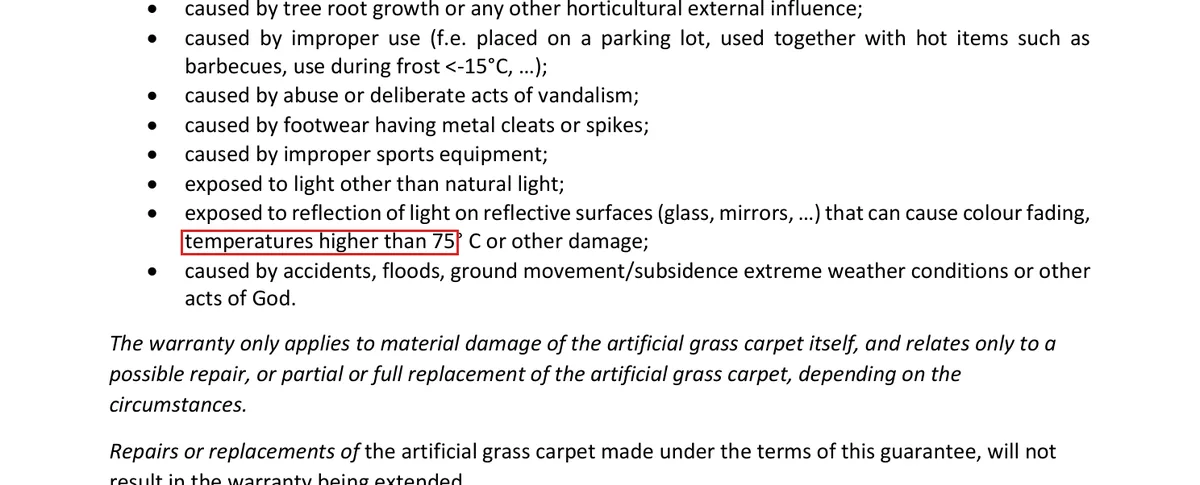
Concentrated reflected sunlight is the bigger risk to the turf itself. The Always Green warranty excludes damage from light reflected off glass or mirrors that can push turf above 75°C (167°F). ForeverLawn names low-E windows, reflective siding, glass tables and clear plastic toys, and the SYNLawn, Fusion Turf and US Turf warranties all exclude reflective-light melting. Turf Distributors adds fireworks, cigarettes, hot objects and idling vehicles to the keep-off list.
What voids an artificial grass warranty
SYNLawn’s manual says customers must demonstrably comply with its installation and care guidelines to qualify for warranty claims. Here is what each document excludes.
| Document | Cleaning and care exclusions | Care requirement | Coverage term |
|---|---|---|---|
| SYNLawn residential warranty, eff. Oct. 1, 2019 | Improper cleaning agents; chlorine and other halogens; herbicides, pesticides; topical applications with a pH greater than 5 | Annual maintenance program by a certified installer required (3.3); self-install nullifies (3.4) | Prorated: 100% years 1 to 3, falling to 15% in years 8 to 10 |
| Fusion Turf residential warranty | Same wording as SYNLawn, including the pH greater than 5 clause | Same annual program (3.5); self-install nullifies (3.6) | 100% years 1 to 8, 50% years 9 to 11, 25% years 12 to 14 |
| US Turf, Las Vegas | Improper maintenance; raking, vacuuming, aggressive blowing; reflective heat; burns | Occasional rinsing | 15 years most products; 3 years PET Collection; 2 years labor |
| Always Green Lawn (Home Depot listing) | Solvents, herbicides, pesticides; pets and wild animals; hot items such as barbecues; reflected light above 75°C | Follow the FUNGRASS maintenance guide | 6 months against manufacturing defects |
| Artificial Grass Recyclers, Eco 72 Silver | Cleaning chemicals, herbicides, pesticides; improper cleaning methods | Maintained to the recommended procedure at all times | 8 years maker plus up to 8 years seller, prorated |
| ForeverLawn Landscape sheet | Harsh chemicals or solvents may limit the claim; personal vacuum sweepers, heaters, snow blowers | ForeverLawn-approved infill only, dealer-directed | Not stated on the sheet |
| Sprinturf (sports fields) | Harsh chemicals, ammonia and bleach void the warranty; pressure washers displace infill | Sprinturf field program | Not stated in the manual |
| FieldTurf (sports fields) | No oxidizing agents such as bleach | Signed maintenance acceptance form | Not stated in the guide |
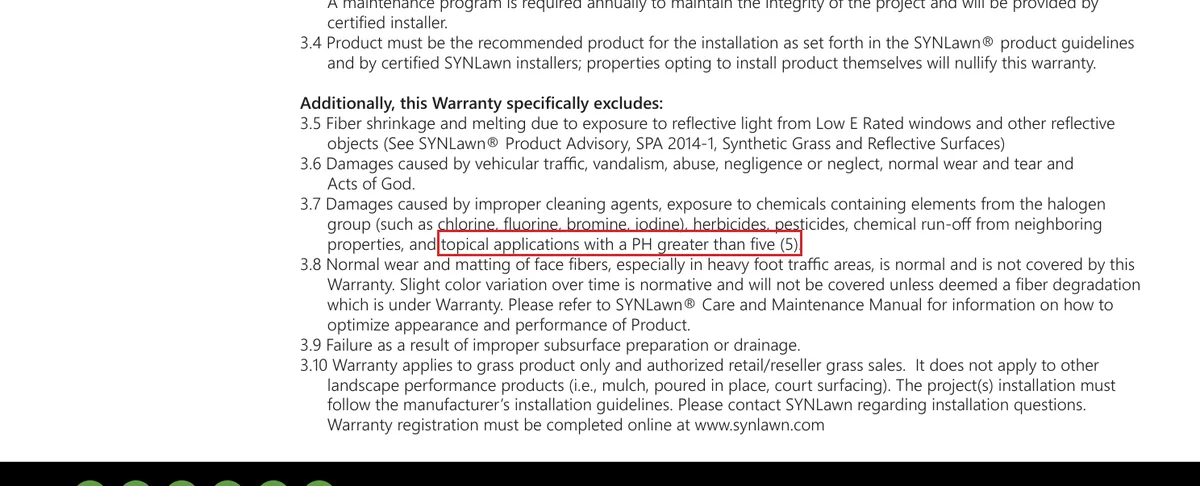
The pH clause is the one to ask about. SYNLawn’s 2019 residential warranty and Fusion Turf’s warranty both exclude topical applications with a pH greater than 5, while SYNLawn’s 2023 manual allows cleaners up to pH 9 and suggests a 3 percent ammonia mix near pH 10 to 11. Read literally, the warranty clause would exclude plain detergent, baking soda at pH 8.2 and the pH 6 to 8 enzyme product above. It may be a drafting error, but claims are judged on the written warranty: get your dealer’s cleaner list in writing.
Weed killer splits the documents too. ForeverLawn’s sheet says weed killer and insect repellent will not harm its surface, while the SYNLawn, Fusion Turf, Artificial Grass Recyclers and Always Green warranties exclude damage from herbicides or pesticides. For weeds at the seams, Turf Distributors suggests hand-pulling or a spot product labeled safe for artificial turf, and SYNLawn suggests a strong salt-water spray. With any herbicide, the label is the law. Our salt weed guide covers what salt does to edge soil, and our bleach review explains why bleach is a poor weed fix near turf.
Cleaning is a small budget line: our artificial turf cost guide puts do-it-yourself upkeep at about $30 a year against $5.40 to $9.80 per sq ft to install, and our putting green cost guide prices the denser putting build. More guides are in Turf and Trees.
How we compiled this
In November 2026 we read 14 care manuals, warranties and spec guides from 11 turf makers and sellers (SYNLawn, ForeverLawn, Turf Distributors, US Turf, Always Green, Fusion Turf, Artificial Grass Recyclers, FieldTurf, Sprinturf, TigerTurf and Motz), AstroTurf’s field service page, Simple Green’s 2 turf cleaning pages, 7 cleaner safety data sheets and Penn State’s surface temperature summary. We cleaned no turf and tested no products. The pH after dilution is our arithmetic for weak acids and bases, not a measurement. FieldTurf and Sprinturf cover sports fields and are cited only where no residential document addresses the point.
Frequently asked questions
What is the best thing to clean fake grass with?
Water for routine dust, a mild detergent at about 1 teaspoon per pint of warm water for spills, and an enzyme or bacterial cleaner where pets go. Keep any cleaner between pH 5 and 9, the window in SYNLawn‘s manual, and rinse with cold water afterward.
Can you use Dawn dish soap on artificial turf?
Dawn is a mild detergent, the category turf manuals allow, though none we read names it. Its safety data sheet lists pH 9 at a 10 percent solution, the top of the window, so dilute it to about 1 teaspoon per pint and rinse until no suds remain.
What should you not put on artificial grass?
Chlorine bleach, undiluted ammonia, poured solvents, metal rakes or wire brushes, fertilizer, and anything hot: grills, fire pits, cigarettes, fireworks and idling vehicles. Keep pressure-washer spray under SYNLawn’s 300 psi limit, and watch for sunlight reflected off low-E windows.
How often should you clean artificial grass?
Rinse weekly, treat dog areas with an enzyme cleaner weekly, brush busy areas weekly and the rest monthly, and book a professional deep clean once a year, which the SYNLawn and Fusion Turf warranties require.
How do professionals clean artificial turf?
With machines. AstroTurf‘s field packages list infill vacuuming, de-compaction, power grooming, a magnet sweep for metal debris and an approved disinfectant. For a yard, the SYNLawn and Fusion Turf warranties require an annual maintenance visit by a certified installer.
Sources
- SYNLawn, Care and Maintenance Manual, SCM.v230517, May 17, 2023. Accessed November 2026.
- SYNLawn (Lowe’s product document), Residential Statement of Warranty Terms and Conditions, effective Oct. 1, 2019. Accessed November 2026.
- ForeverLawn, Landscape Maintenance Guidelines, M0945, Rev. 08/24. Accessed November 2026.
- Turf Distributors, Care and Maintenance, undated web page. Accessed November 2026.
- Turf Distributors, Artificial Turf Guide (TrafficMaster spec sheets and warranties), Feb. 2021 upload. Accessed November 2026.
- Turf Distributors (Home Depot product document), Eco 48 Silver warranty and care packet, undated. Accessed November 2026.
- US Turf Las Vegas, Warranty and Coverage, web page. Accessed November 2026.
- Steel and Pipes Inc. (Home Depot product document), Always Green Lawn Artificial Turf Warranty, undated. Accessed November 2026.
- Fusion Turf, Residential Statement of Warranty Terms and Conditions, undated. Accessed November 2026.
- Artificial Grass Recyclers, Eco 72 Silver 16 Year Product Warranty, Sept. 2019 upload. Accessed November 2026.
- FieldTurf, Maintenance Guidelines, April 2021. Accessed November 2026.
- Sprinturf, Maintenance Manual, March 2017 upload. Accessed November 2026.
- TigerTurf, Maintaining Your Synthetic Grass Lawn, web page. Accessed November 2026.
- The Motz Group, My Artificial Turf Smells Like Dog Pee: What Should I Do?, web page. Accessed November 2026.
- AstroTurf, Maintenance, web page. Accessed November 2026.
- Simple Green, How to Clean Artificial Grass, web page. Accessed November 2026.
- Simple Green, How to Clean Artificial Grass (Dog Urine), web page. Accessed November 2026.
- Simple Green, Safety Data Sheet, All-Purpose Cleaner, issued Oct. 1, 2025. Accessed November 2026.
- Simple Green, Safety Data Sheet, Outdoor Odor Eliminator, issued March 1, 2026. Accessed November 2026.
- The Clorox Company, Safety Data Sheet, Clorox Regular-Bleach1, revised June 12, 2015. Accessed November 2026.
- Brillo (Home Depot product document), Safety Data Sheet, Parsons All-Purpose Ammonia Cleaner, printed April 26, 2019. Accessed November 2026.
- Procter & Gamble (Purdue University copy), MSDS, Dawn Hand Dishwashing Liquids, Jan. 29, 2014. Accessed November 2026.
- Woeber Mustard Mfg. Co., Safety Data Sheet, Distilled White Vinegar (5% acidity), undated. Accessed November 2026.
- Church & Dwight, Safety Data Sheet, Arm & Hammer Sodium Bicarbonate Grade 1, April 30, 2015. Accessed November 2026.
- Penn State Center for Sports Surface Research, Surface Temperature of Synthetic Turf, undated presentation. Accessed November 2026.