Zoysia grass vs bermuda: on 5,000 sq ft, zoysia sod costs $1,517 more at 2026 USDA farm prices and saves about $125 a year in feed and dethatching. It wins within 5 years only if it cuts 4 hired mowings a year.
The zoysia grass vs bermuda question usually gets answered with a verdict on feel and shade. This page prices it instead: a 5-year ledger for one lawn, the payback year under each sod price, mowing intervals worked from measured leaf growth, and NTEP ratings for both grasses on the same dates at Raleigh, N.C. Two common claims look weaker against that data: that zoysia cuts mowing by more than half, and that it is always last to green up.
The 5-year bill on a 5,000 sq ft lawn
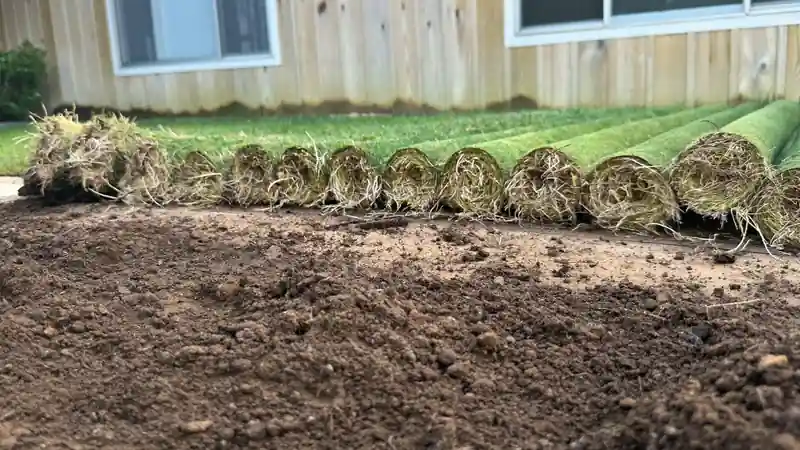
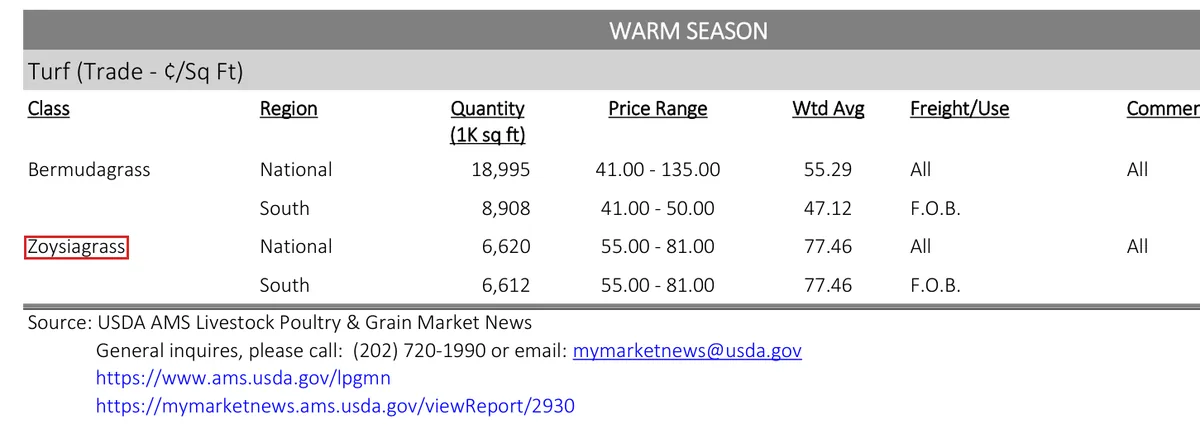
Zoysia is the more expensive lawn in year 0 and the cheaper one to feed afterward. USDA reported southern farm prices of 77.46 cents a sq ft for zoysiagrass and 47.12 cents for bermudagrass in the third quarter of 2026, a $1,517 gap on this lawn. Delivery ($0.05 to $0.12 a sq ft in the same report), laying and soil prep cost the same for either, so they stay out; our sod installation guide prices them.
| Line, 5 seasons | Zoysia | Hybrid bermuda | Who saves | Input and source |
|---|---|---|---|---|
| Sod, farm price | $3,873 | $2,356 | Bermuda, $1,517 | USDA AMS, South, F.O.B., Q3 2026 |
| Nitrogen | $158 to $390 | $317 to $781 | Zoysia, $158 to $390 | 2 lb vs 4 lb N per 1,000 sq ft a year (Texas A&M; NC State) at $3.17 to $7.81 per lb N for synthetic lawn foods; organics run higher (our fertilizer price table) |
| Dethatching, hired | $175 | $525 | Zoysia, $350 | 1 vs 3 jobs (our assumption, see below) at the $175 median in our dethatching price lists |
| You mow | $4,206 to $4,438 | $3,198 to $3,662 | Bermuda, $776 to $1,008 | Sum of the rows above; fuel and blades left out |
| Hired mowing, 135 visits | $6,412 to $7,425 | $6,412 to $7,425 | Tie | 27 weeks a year (Atlanta, table below) at $47.50 to $55 a visit (our 23 price lists) |
| Hired, same visits | $10,619 to $11,864 | $9,610 to $11,087 | Bermuda | Weekly service on both |
| Hired, zoysia at 95 visits | $8,719 to $9,664 | $9,610 to $11,087 | Zoysia | Zoysia every 10 days, bermuda weekly: one seller’s claim (see below), not a measured schedule |
- Bermuda, hired weekly
- Zoysia, hired weekly
- Zoysia, hired every 10 days
- Zoysia, you mow
- Bermuda, you mow
Source: Green Industry Report estimate: USDA AMS Q3 2026 sod prices, $5.49 per lb N, $175 dethatching spread evenly, $51.25 a visit Midpoints of the ranges in the ledger table.
Show the numbers
| Bermuda, hired weekly | Zoysia, hired weekly | Zoysia, hired every 10 days | Zoysia, you mow | Bermuda, you mow | |
|---|---|---|---|---|---|
| Year 0 | 2,356 | 3,873 | 3,873 | 3,873 | 2,356 |
| 1 | 3,955 | 5,347 | 4,937 | 3,963 | 2,571 |
| 2 | 5,553 | 6,820 | 6,000 | 4,053 | 2,786 |
| 3 | 7,152 | 8,294 | 7,064 | 4,143 | 3,000 |
| 4 | 8,750 | 9,768 | 8,128 | 4,233 | 3,215 |
| 5 | 10,349 | 11,241 | 9,191 | 4,322 | 3,430 |
Payback hangs on two numbers: the sod premium and how many hired visits zoysia removes. The premium moved a lot inside 2026. USDA’s second-quarter national averages (52.32 and 38.04 cents, recorded on our zoysia page) put it at $714, and NC State‘s 2026 on-farm averages ($0.59 and $0.41) at $900. Get a quote for both grasses before using any of these.
| Sod premium on 5,000 sq ft | No visits saved | 4 visits a year saved | 8 visits a year saved |
|---|---|---|---|
| $1,517 (USDA South, Q3 2026) | 12.1 years | 4.6 years | 2.8 years |
| $900 (NC State, 2026) | 7.2 years | 2.7 years | 1.7 years |
| $714 (USDA national, Q2 2026) | 5.7 years | 2.2 years | 1.3 years |
If you mow your own lawn, read the left column: 12.1 years at third-quarter prices. Those visits saved are hours back, not dollars. The 5-year break-even at those prices is 3.5 fewer hired visits a year.
Default: 5,000 sq ft of zoysia, you mow: about $4,206 to $4,438, matching the table. Tick a mowing pair to add service at 27 weeks a year. Sod at farm price; delivery, laying and prep are extra and equal for both grasses.
How much less do you really mow zoysia?
Less, say the extension services, but none we read prints a 10-day schedule. NC State rates mowing frequency low to medium for zoysia and high for hybrid bermuda in the piedmont. UF/IFAS still says to mow medium and coarse zoysias weekly. The 10-day figure on a sod seller‘s page cites no study.
| Source | Zoysia | Bermuda |
|---|---|---|
| The Lawn Farm (seller) | Every 10 days in summer | 2 times a week |
| UF/IFAS LH011; LH007 | Weekly, or at 3 to 4 in, cut to 1.75 to 2.5 in | 1 to 2 times a week at 1 to 2 in |
| Texas A&M guide; ESC-042 | Less often than other species; no count given | Weekly at 1 to 2 in, or as needed to prevent scalping |
| NC State Table 9-1 | Low to medium (piedmont) | Medium to high (common); high (hybrid) |
Measured growth tells a narrower story. Kim and Beard (1988) grew both at 1.5 inches on the same sand, feed and water in College Station, Texas, and recorded vertical leaf growth of 1.8 mm a day for Tifway bermuda against 2.2 for Emerald zoysia and 2.7 for Meyer. Those differences were not statistically significant. Arizona Common bermuda ran 3.2.
Height, then, drives the visits. The one-third rule (Texas A&M) means you mow after growth equal to half your cut height, so the interval is that distance divided by the growth rate. Tifway at 1 inch comes due every 7 days and Meyer at 2 inches every 9; at the same height, Tifway waits longer. Bermuda on 4 lb of nitrogen will grow faster than this same-feed test shows, so part of the real gap is the fertilizer.
| Grass (leaf growth) | Cut at 1 in | Cut at 1.5 in | Cut at 2 in | Cut at 2.5 in |
|---|---|---|---|---|
| Tifway bermuda (1.8 mm a day) | 7 days | 11 days | 14 days | 18 days |
| Arizona Common bermuda (3.2 mm a day) | 4 days | 6 days | 8 days | 10 days |
| Emerald zoysia (2.2 mm a day) | 6 days | 9 days | 12 days | 14 days |
| Meyer zoysia (2.7 mm a day) | 5 days | 7 days | 9 days | 12 days |
So the mowing saving is something you buy with height and feed, and our mowing frequency guide covers the schedule itself. Below 1 inch, NC State and Texas A&M both point to a reel mower. Zoysia also takes its own toll on rotary blades: UF/IFAS says its leaves hold more lignin and silica than other lawn grasses, and K-State says to inspect and sharpen often.
Time to full cover: where the cheap routes split apart
Skip solid sod and the two grasses stop being close. NC State rates zoysia establishment very slow, hybrid bermuda moderate and common bermuda fast. UF/IFAS says bermuda plugs on 12-inch centers close in 3 to 6 months in Florida; NC State says zoysia plugs typically take 2 to 4 years.
| Route | Material, 5,000 sq ft | Time to cover | Source |
|---|---|---|---|
| Zoysia sod | $3,873 | Roots hold in about 2 to 3 weeks | UF/IFAS |
| Bermuda sod | $2,356 | First mow at 14 to 21 days; established at 3 to 4 weeks | UF/IFAS |
| Zoysia plugs, 12 in centers | $108 | 2 to 4 years typical; at least 1 full season | NC State; UF/IFAS |
| Bermuda plugs, 12 in centers | $65 | 3 to 6 months (6 to 9 at 24 in) | UF/IFAS |
| Coated zoysia seed (Compadre) | $250 to $500 | 2 to 3 weeks to germinate, 6 to 8 more to establish | UF/IFAS; our seed price |
| Common bermuda seed, hulled | $20 to $140 | Rated fast; hybrids cannot be seeded | NC State; our seed prices |
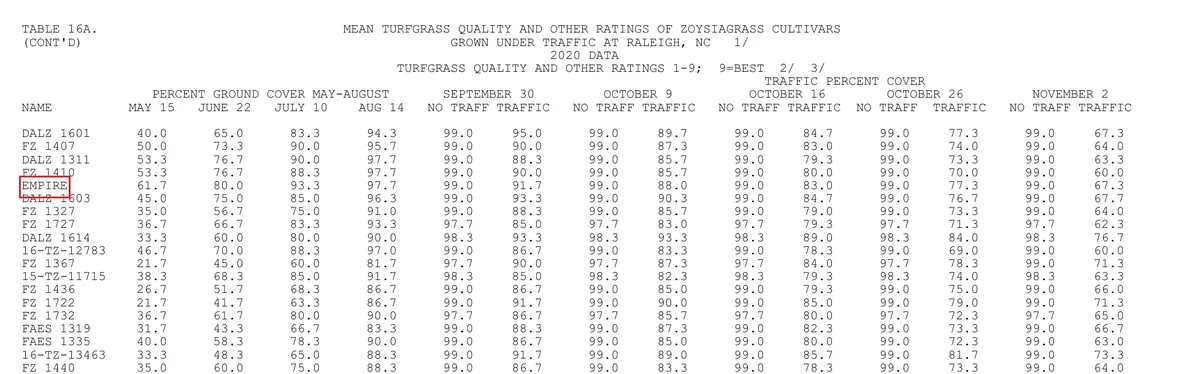
The national trials show the same gap at one site. At Raleigh, in the 2019 tests, four named bermudas rated 90.7 to 95.3 percent cover in spring 2020 (NTEP 24-11, Table 16A). On May 15, 2020, four zoysias rated 15.7 to 61.7 percent, and Meyer still sat at 63.3 percent on Aug. 14 (NTEP 24-12, Table 16A). Both reports’ Table A list the same pH, nitrogen and 2.1 to 2.5 inch cut-height bands for the Raleigh traffic site, with loam for bermuda and sandy loam for zoysia. The tables print no planting dates and the tests were analyzed separately, so read the size of the gap, not an exact week count.
Nitrogen, thatch and water: the smaller lines
Bermuda’s nitrogen bands sit above zoysia’s wherever one source prints both. North Carolina‘s piedmont row gives 3 to 6 lb per 1,000 sq ft a year for hybrid bermuda and 1 to 3 for zoysia; north Florida gives 3 to 5 against 2 to 3 (LH007; LH011). Georgia lists 2 to 5 for bermuda. Our nitrogen guide covers products and rates.
Going over the zoysia band costs more than the fertilizer. UF/IFAS ties thatch to excess nitrogen, and NC State says removal may be needed every 3 to 5 years with slow recovery. UF/IFAS writes “every year or two” for Florida; at 2 zoysia jobs instead of 1, the yearly saving drops by $35. UC IPM says bermuda may need dethatching yearly, so our 3 jobs in 5 years is an assumption on the low side. NC State and Texas A&M draw the line at 1/2 inch, measured as in our dethatching guide.
Water rarely decides it. NC State asks 0.5 to 1 inch a week for zoysia and about 1 inch for bermuda. Kim and Beard measured 5.2 mm a day for Tifway, 5.5 for Meyer and 6.0 for Emerald with soil kept moist, which at full replacement over 27 weeks on this lawn is about 7,000 and 18,500 extra gallons a year; that is a ceiling, not a bill. In a 3-year Texas A&M study, Celebration and Palisades did not differ statistically at any irrigation frequency, though Palisades fell below acceptable at once a month or none in years 2 and 3.
What foot traffic does to each grass
Bermuda keeps more ground cover under wear, and the gap is measured. NTEP ran traffic plots of both species at Raleigh from 2020 to 2023; the 2020 zoysia footnote gives 7 weeks, 3 days a week, 2 passes a day. At the last rating each fall, the four named bermudas averaged 78.2, 57.5, 45.4 and 53.4 percent cover against 64.3, 27.9, 17.9 and 41.7 for four zoysias, on the same dates.
| Cover on traffic plots | 2020 (Nov. 2) | 2021 (Nov. 11) | 2022 (Nov. 3) | 2023 (Nov. 17) | Back next September |
|---|---|---|---|---|---|
| 4 bermudas, mean | 78.2% | 57.5% | 45.4% | 53.4% | 97.8%, 96.5%, 96.5% |
| 4 zoysias, mean | 64.3% | 27.9% | 17.9% | 41.7% | 92.2%, 95.8%, 96.0% |
The scar is seasonal, though. Both grasses were back at 92 percent or better by the next September, so a zoysia lawn that thins from fall play can refill over a summer. What you lose is the fall: at 17.9 percent cover in November 2022, the zoysia plots were mostly bare going into winter. NC State scores wear 6 of 6 for bermuda and 4 of 6 for zoysia, and that matches.
Brown weeks and mowing weeks, by city
Season length sets the mowing bill and the brown stretch. We built the table from NOAA’s 1991 to 2020 normals: mowing weeks run from the day normal mean air temperature reaches 65°F (the soil figure Georgia uses before first feeding) until it last holds 60°F, and brown weeks from the median first 32°F night to that 65°F day. Missouri Botanical Garden puts St. Louis dormancy at mid-October to mid or late May, or 30 to 32 weeks; our 26 is a floor.
Swipe the table sideways to see every column.
| City | First freeze | Mean hits 65°F | Last 60°F mean | Mowing weeks | Brown weeks | Hired mowing a year |
|---|---|---|---|---|---|---|
| Phoenix, AZ | Jan. 3 | March 11 | Nov. 27 | 37 | 10 | $1,896 |
| Houston, TX | Dec. 9 | March 22 | Nov. 22 | 35 | 15 | $1,794 |
| San Antonio, TX | Nov. 28 | March 26 | Nov. 17 | 34 | 17 | $1,742 |
| Las Vegas, NV | Dec. 15 | April 4 | Nov. 9 | 31 | 16 | $1,589 |
| Dallas-Fort Worth, TX | Nov. 24 | April 13 | Nov. 5 | 29 | 20 | $1,486 |
| Atlanta, GA | Nov. 20 | April 23 | Oct. 28 | 27 | 22 | $1,384 |
| Birmingham, AL | Nov. 11 | April 22 | Oct. 28 | 27 | 23 | $1,384 |
| Columbia, SC | Nov. 7 | April 19 | Oct. 27 | 27 | 23 | $1,384 |
| Memphis, TN | Nov. 16 | April 22 | Oct. 27 | 27 | 22 | $1,384 |
| Charlotte, NC | Nov. 3 | April 30 | Oct. 20 | 25 | 25 | $1,281 |
| Raleigh-Durham, NC | Nov. 4 | May 1 | Oct. 20 | 25 | 25 | $1,281 |
| Nashville, TN | Nov. 3 | April 30 | Oct. 20 | 25 | 25 | $1,281 |
| Little Rock, AR | Nov. 10 | April 29 | Oct. 22 | 25 | 24 | $1,281 |
| Tulsa, OK | Nov. 4 | May 2 | Oct. 22 | 25 | 26 | $1,281 |
| Oklahoma City, OK | Nov. 2 | May 7 | Oct. 18 | 23 | 27 | $1,179 |
| Richmond, VA | Nov. 4 | May 9 | Oct. 15 | 23 | 27 | $1,179 |
| Louisville, KY | Nov. 7 | May 5 | Oct. 16 | 23 | 26 | $1,179 |
| St. Louis, MO | Nov. 4 | May 8 | Oct. 14 | 23 | 26 | $1,179 |
| Wichita, KS | Oct. 29 | May 12 | Oct. 13 | 22 | 28 | $1,128 |
| Kansas City, MO | Oct. 24 | May 17 | Oct. 7 | 20 | 29 | $1,025 |
The species gap inside those weeks is smaller than its reputation. UF/IFAS calls zoysia the first to go off color and the last to green up. Averaged across the 7 cities both NTEP tests rated for spring green-up (Auburn, Fayetteville, West Lafayette, College Park, Raleigh, Stillwater and Knoxville), Meyer scored 5.7 and Emerald 5.8 of 9, ahead of Tifway at 4.7 and Celebration at 4.3; Latitude 36 (5.4) matched Zeon (5.5). Cultivar moves your spring more than species does. Plots, cut heights and rating dates differ between tests, so read this as no evidence of a clean species split, not as proof zoysia is earlier.
Which cultivar changes the math
Pick the cultivar before the species if your lawn is shaded or trafficked. In College Station shade plots, Celebration (5.4) and Empire (5.1) out-scored Meyer (3.5) and Tifway (3.8), so bermuda is not automatically out in light shade, though NC State rates the species 1 of 6 for shade against 4 of 6 for zoysia. Within each test the significance margin is 1.9 points for zoysia and 1.4 for bermuda, so Celebration beats Tifway but Empire does not clearly beat Meyer.
| Cultivar | NTEP quality, 2020 to 2023 | Raleigh cover, spring 2020 | Spring green-up, 7 shared cities | Traffic cover, 4-year mean | Shade quality, College Station | Budget note |
|---|---|---|---|---|---|---|
| Meyer | 5.1 | 15.7% | 5.7 | 36.2% | 3.5 | Lowest quality of the 8. K-State sets 2 lb N a season as the ceiling |
| Zeon | 6.2 | 35.0% | 5.5 | 36.9% | 5.0 | Fine leaf; Texas A&M says fine types may need dethatching more often. Below 1 in, a reel mower |
| Emerald | 6.3 | 26.7% | 5.8 | 41.1% | 4.8 | Fine leaf, same dethatching flag; most traffic cover of these 4 zoysias |
| Empire | 6.0 | 61.7% | 5.1 | 37.6% | 5.1 | Coarse, weekly mowing at 1.75 to 2.5 in per UF/IFAS; fastest cover of the 4 zoysias |
| Tifway | 5.9 | 90.7% | 4.7 | 55.4% | 3.8 | UF/IFAS flags more feed, spray and mowing; may suit a pro-managed lawn |
| TifTuf | 6.4 | 94.7% | 5.2 | 56.0% | 5.0 | Held the most November color at Raleigh in 2020 (8.0 of 9) |
| Latitude 36 | 6.3 | 95.3% | 5.4 | 59.8% | 4.4 | UF/IFAS says it suits colder climates but is prone to nematodes in Florida |
| Celebration | 6.0 | 92.0% | 4.3 | 63.3% | 5.4 | Best bermuda in shade; UF/IFAS says 1 to 2 in with a rotary mower; slowest green-up |
For care details on each, see our zoysia grass guide and our bermuda grass guide. The bermuda vs St. Augustine comparison covers the shadier southern alternative.
How to tell zoysia from bermuda in the yard
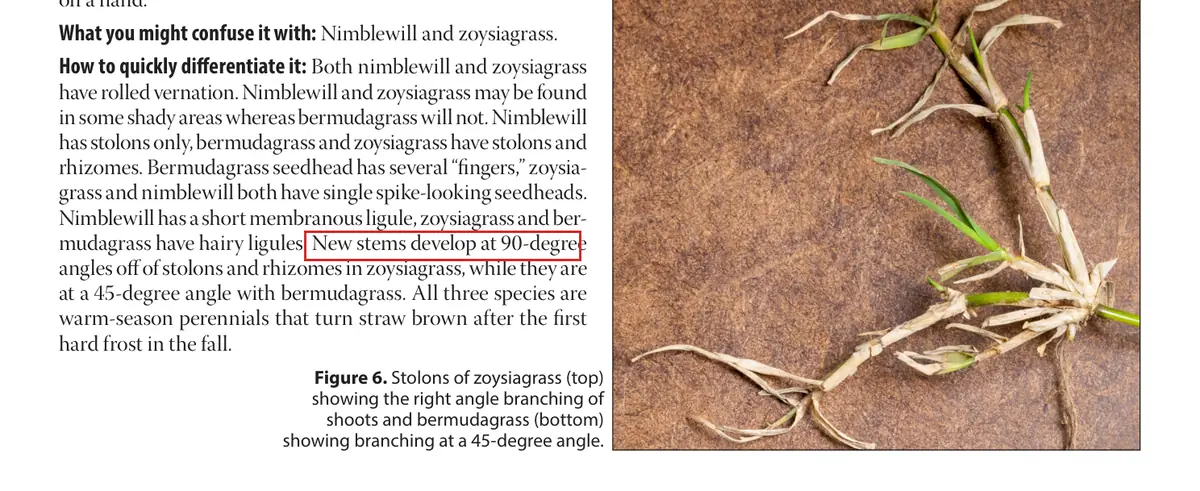
Leaf width will fool you, because fine zoysia and bermuda look alike. Kim and Beard measured Tifway at 0.8 mm and Emerald at 1.9 mm, but Meyer at 2.9 mm. Use the bud and the stem angle, which University of Kentucky AGR-251 gives as the quick tests.
| Check | Zoysia | Bermuda | Source |
|---|---|---|---|
| New leaf in the bud | Rolled | Folded, somewhat hard to see | AGR-251 |
| Shoots off a runner | About 90 degrees | About 45 degrees | AGR-251 |
| Seedhead | Single spike | Several fingers | AGR-251 |
| Ligule | Hairy | Hairy, so it does not separate them | AGR-251 |
| Shade | May persist in shady spots | Will not | AGR-251 |
| Mower feel | Tough, needs a sharp blade | Easier to cut | NC State AG-432 |
Choose by answering these in order
1Is the soil alkaline, as in western Kansas, or wet and poorly drained?
YesAvoid zoysia: K-State says it yellows on alkaline soil and does not tolerate poor drainage. NC State says bermuda also grows poorly where drainage is poor, so fix drainage first.
NoGo to the next question
2Is the area shaded for much of the day?
YesZoysia. NC State rates it 4 of 6 for shade against 1 of 6 for bermuda. If you want bermuda anyway, Celebration scored best in NTEP shade plots.
NoGo to the next question
3Will kids, dogs or sport wear the same paths every week?
YesBermuda. It held about 20 points more cover on Raleigh traffic plots.
NoGo to the next question
4Do you need cover this season on a small budget?
YesBermuda seed, sprigs or plugs. Zoysia plugs typically take 2 to 4 years.
NoGo to the next question
5Do you pay for mowing, and will you keep zoysia at 2 inches or taller on low nitrogen?
YesZoysia. Dropping 4 or more visits a year repays the sod premium inside 5 years at Q3 2026 prices.
NoBermuda. In full sun with your own mower, zoysia's sod premium takes 6 to 12 years to return in cash.
How we compiled this
We ran no field tests and have no job data. Prices are USDA and NC State sod reports plus company price lists compiled on our own cost pages in October 2026. Trial numbers are copied from NTEP final reports 24-11 and 24-12 and one peer-reviewed lysimeter study; 7 extension services and the Missouri Botanical Garden supplied rates, frequencies and dormancy dates. The ledger, payback years, mowing intervals, city weeks and cross-test averages are our estimates, and the arithmetic is shown. NTEP ran these as separate tests, so differences between species are not statistically tested. We checked 20 NOAA station files on Nov. 5, 2026.
Frequently asked questions
Which is cheaper, bermuda or zoysia?
Bermuda, at the start. On 5,000 sq ft the sod premium for zoysia ran $714 to $1,517 on 2026 farm prices. Zoysia saves about $125 a year on feed and dethatching, so if you mow yourself, bermuda stays cheaper for 5.7 to 12.1 years.
What are the drawbacks of zoysia grass?
Slow repair and slow establishment: plugs typically take 2 to 4 years, per NC State, and traffic plots at Raleigh averaged 38.0 percent cover in late fall against 58.6 for bermuda. Its leaves dull mower blades, and thatch over 1/2 inch needs careful removal.
Will zoysia overtake bermuda grass?
Do not count on it. University of Georgia’s B1393 says zoysiagrass lawns are often unable to compete with bermudagrass during summer. We found no trial measuring zoysia displacing bermuda. Selective control is riskier on fine zoysias; see how to kill bermuda grass.
What is better, bermuda or zoysia?
Bermuda for full sun, heavy use, fast cover and a do-it-yourself budget. Zoysia for light shade, or where you pay for mowing and will keep it at 2 inches or taller on low nitrogen. NC State rates shade 4 of 6 for zoysia and 1 of 6 for bermuda, and wear 4 against 6.
Does zoysia grass turn brown in winter?
Yes, and so does bermuda, usually at the first hard frost per University of Kentucky. Expect about 15 brown weeks in Houston, 22 in Atlanta and 26 or more in St. Louis, by our NOAA-based estimate.
Sources
- USDA Agricultural Marketing Service, National Quarterly Sod Report, July 1 to Sept. 30, 2026 (published Oct. 21, 2026), Q3 2026. Accessed November 2026.
- NC State Extension, Sod Producers Report for North Carolina, 2026. Accessed November 2026.
- National Turfgrass Evaluation Program (NTEP), 2019 National Zoysiagrass Test, final report 24-12, 2019 to 2023 data. Accessed November 2026.
- National Turfgrass Evaluation Program (NTEP), 2019 National Bermudagrass Test, final report 24-11, 2019 to 2023 data. Accessed November 2026.
- Kim and Beard, Crop Science 28:328-331, Comparative Turfgrass Evapotranspiration Rates and Associated Plant Morphological Characteristics, 1988. Accessed November 2026.
- Hejl, Wherley and Fontanier, HortScience 56(10), Long-term Performance of Warm-season Turfgrass Species under Municipal Irrigation Frequency Restrictions, 2021. Accessed November 2026.
- UF/IFAS, LH007, Bermudagrass for Florida Lawns, current edition. Accessed November 2026.
- UF/IFAS, LH011, Zoysiagrass for Florida Lawns, current edition. Accessed November 2026.
- NC State Extension, AG-431, Bermudagrass Lawn Maintenance Calendar, current edition. Accessed November 2026.
- NC State Extension, AG-432, Zoysiagrass Lawn Maintenance Calendar, current edition. Accessed November 2026.
- NC State Extension, Extension Gardener Handbook, Chapter 9: Lawns, Tables 9-1 and 9-4, current edition. Accessed November 2026.
- Texas A&M AgriLife Extension, ESC-042, Bermudagrass Lawn Management Calendar, 2023. Accessed November 2026.
- Texas A&M AgriLife Extension, SCSC-PU-279, Zoysiagrass Lawn Management Guide, current edition. Accessed November 2026.
- K-State Research and Extension, MF683, Zoysiagrass in Kansas, current edition. Accessed November 2026.
- University of Georgia Extension, 2024 Bermudagrass Lawn Calendar, 2024. Accessed November 2026.
- University of Georgia Extension, B1393, Bermudagrass Control in Southern Lawns, current edition. Accessed November 2026.
- UC IPM, Dethatching: when and how often, current edition. Accessed November 2026.
- University of Kentucky, AGR-251, Turfgrass identification guide, current edition. Accessed November 2026.
- Missouri Botanical Garden, Lawn Problems: Zoysia, current page. Accessed November 2026.
- NOAA NCEI, U.S. Climate Normals 1991 to 2020, daily and annual/seasonal station files, 1991 to 2020. Accessed November 2026.
- The Lawn Farm, Zoysia vs. Bermudagrass Lawns (seller’s article), March 26, 2024. Accessed November 2026.