
Lawn mower oil type depends on the engine and air temperature: most 4-stroke mowers take SAE 30 above 40°F or 10W-30 when temperatures swing, as a detergent oil rated API SJ or later; Kawasaki FR-series riders call for 10W-40.
Key takeaways
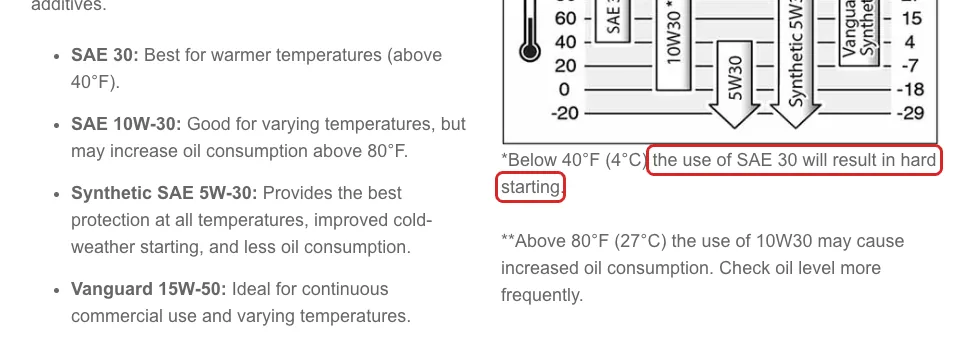
- Briggs & Stratton lists SAE 30 above 40°F, 10W-30 for varying temperatures (with more oil use above 80°F) and synthetic 5W-30 for all temperatures.
- Honda’s GCV170 and GCV200 engines hold 13.5 oz (0.40 L) of SAE 10W-30 rated API SJ or later, and the Honda engine manual says to use 4-stroke automotive detergent oil.
- The walk-behind engines in our table hold 13.5 to 20 oz; riding engines hold 1.5 quarts (John Deere S100) to 2.2 quarts with a new filter (Kawasaki FR691V).
- Change the oil after the first 5 hours, then every 50 hours or once a year on Briggs & Stratton walk-behind engines (Briggs maintenance schedule); Kawasaki FR and Kohler 7000 riding engines run 100 hours between changes.
- A 2-cycle engine mixed at 50:1 needs 2.6 oz of 2-cycle oil per gallon of gasoline, and 4.0 oz at 32:1 (Briggs 2-cycle chart).
- API lists SF, SG and SH as obsolete; SQ, introduced in March 2025, is the newest gasoline category (API Motor Oil Guide, 2025).
40°F below this, SAE 30 causes hard starting (Briggs & Stratton)
13.5 to 20 oz oil capacity of the walk-behind engines checked (maker manuals, Oct. 2026)
50 hours between walk-behind oil changes (Briggs & Stratton, Honda, Kohler XT manuals)
What kind of oil does a lawn mower take?
A 4-stroke lawn mower takes detergent motor oil in the viscosity grade its engine maker lists for your mowing temperatures. Briggs & Stratton names SAE 30 for warm weather above 40°F, 10W-30 for varying temperatures and synthetic 5W-30 for all temperatures; Honda names 10W-30 for general use. A 2-stroke mower has no crankcase oil: its 2-cycle oil is mixed into the gasoline.
The grades below are the ones the five engine makers in this guide print in their manuals and oil charts. Anything outside these lists, such as a 0W-20 car oil, appears on none of the charts we checked, so buying a listed grade is the simplest way to stay inside the manual.
| Oil grade | When engine makers list it | Watch for | Source |
|---|---|---|---|
| SAE 30 | Warm weather: above 40°F on the Briggs & Stratton chart; from 50°F up on Kohler’s XT and 7000 charts | Below 40°F (4°C), SAE 30 “will result in hard starting” | Briggs & Stratton FAQ; Kohler XT manual |
| 10W-30 | Varying temperatures; Honda’s grade for general use; Kohler charts run it from 0°F up; Toro lists it beside SAE 30 | Above 80°F (27°C) it may increase oil consumption, so check the level more often | Briggs & Stratton; Honda HRN216 manual |
| 5W-30 (conventional) | Cold weather: 40°F and below on the Briggs chart; 32°F and below on Kohler’s charts | Not charted for summer mowing by Briggs or Kohler | Briggs & Stratton; Kohler 7000 manual |
| Synthetic 5W-30 | All temperatures, with better cold starting and less oil consumption (Briggs) | Does not change Briggs’s 50-hour oil change interval | Briggs & Stratton |
| Synthetic 15W-50 (Vanguard) | Continuous commercial use and varying temperatures; charted from about 20°F up | Briggs names its own Vanguard product for this grade | Briggs & Stratton |
| 10W-40 | Kawasaki engines, including the FR series: recommended for most conditions | Kawasaki says 5W-20, 10W-30 and 10W-40 multigrades increase oil consumption | Kawasaki FR manual; Kawasaki FAQ |
| 20W-50 | Kawasaki engines in higher ambient temperatures | Kawasaki says it may reduce oil consumption in heat | Kawasaki FAQ |
| Kohler PRO 10W-50 synthetic | All seasons on Kohler 7000 engines | The 300-hour interval applies only with the Kohler PRO filter | Kohler 7000 manual |
Where the SAE 30 line sits depends on the maker. Briggs & Stratton’s footnote says SAE 30 below 40°F (4°C) will result in hard starting, Kohler’s XT and 7000 charts start SAE 30 at 50°F, and Briggs flags 10W-30 above 80°F (27°C) for higher oil consumption. If the mower starts on cold spring or fall mornings, 10W-30 avoids the SAE 30 limit on both makers’ charts.
What oil does your mower’s engine call for?
The oil spec belongs to the engine, so read the engine maker’s name and model on the engine itself, not only the brand on the deck. Toro’s own 21-inch Recycler manuals show why: model 20349 holds 18.6 fl oz while models 21332 and 21352 hold 15 fl oz. The table below sets grade, API rating, capacity and oil change interval side by side for 10 engines and mowers.
| Engine or mower | Type | Oil capacity | Grade the maker lists | API minimum | Oil change | Source |
|---|---|---|---|---|---|---|
| Honda GCV170 and GCV200 (HRN216 mower) | Walk-behind | 13.5 oz (0.40 L); refill 12.0 to 13.5 oz | SAE 10W-30 for general use; SAE 30 in warm weather per chart | SJ or later | Every 6 months or 50 hours; 25 hours under heavy load or high heat | Honda HRN216VKA owner’s manual |
| Briggs & Stratton EXi625 (150 cc) | Walk-behind | 15 oz | SAE 30 above 40°F; 10W-30; synthetic 5W-30 | SF, SG, SH, SJ or higher | No oil change: Just Check & Add, top up as needed | Briggs & Stratton EXi Series specifications |
| Briggs & Stratton EXi725 (163 cc) | Walk-behind | 15 oz | SAE 30 above 40°F; 10W-30; synthetic 5W-30 | SF, SG, SH, SJ or higher | No oil change: Just Check & Add, top up as needed | Briggs & Stratton EXi Series specifications |
| Briggs & Stratton EXi875 (190 cc) | Walk-behind | 18 oz | SAE 30 above 40°F; 10W-30; synthetic 5W-30 | SF, SG, SH, SJ or higher | No oil change: Just Check & Add, top up as needed | Briggs & Stratton EXi Series specifications |
| Toro 21in Recycler model 20349 | Walk-behind | 18.6 fl oz (0.55 L) | SAE 30 or SAE 10W-30 detergent oil | SJ or higher | Yearly | Toro 20349 operator’s manual |
| Toro 21in Recycler models 21332 and 21352 | Walk-behind | 15 fl oz (0.44 L) | SAE 30 or SAE 10W-30 detergent oil | SJ or higher | Manual says changing the oil is not required; check level before each use | Toro 21332/21352 operator’s manual |
| Kohler XT-6, XT6.5, XT6.75, XT-7, XT775, XT8 | Walk-behind | 20 oz (0.6 L) refill | 10W-30 from 0°F up; SAE 30 from 50°F up; 5W-30 at 32°F and below | SJ or higher | Every 50 hours or annually | Kohler XT service manual 14 690 01 Rev. G |
| John Deere S100 lawn tractor, 42-inch deck | Riding | 1.5 qt (1.41 L) | Turf-Gard 10W-30 | Not stated on sheet | Oil and filter every 50 hours | John Deere S100 maintenance reminder sheet |
| Kohler 7000 Series KT715 to KT745 | Riding | 2.0 qt (1.9 L) refill | 10W-30 from 0°F up; SAE 30 from 50°F up; 5W-30 at 32°F and below; Kohler PRO 10W-50 all seasons | SJ or higher | Oil and filter every 100 hours; 300 hours only with Kohler PRO 10W-50 and PRO filter | Kohler 7000 Series service manual 32 690 03 Rev. M |
| Kawasaki FR651V, FR691V, FR730V | Riding / zero-turn | 1.9 qt (1.8 L); 2.2 qt (2.1 L) with new filter | 10W-40 for most conditions; 20W-50 in high heat | SF, SG, SH, SJ or SL | Every 100 hours or 1 year; filter every 200 hours | Kawasaki FR owner’s manual; FR691V spec page |
Two engine families in the table have no scheduled oil change. Briggs & Stratton says its EXi engines’ Just Check & Add design keeps the oil clean, eliminating the need for an oil change, and Toro’s manual for Recycler models 21332 and 21352 says changing the engine oil is not required. Both still call for a dipstick check before each use and a top-up with SAE 30 or 10W-30.
Those Recycler engines also start with no primer and no choke, and our model-by-model Toro starting guide shows which older Toros still need 3 to 5 primer pushes.
For Craftsman, Troy-Bilt, Cub Cadet or any other deck brand, the rule is the same: find the engine maker and model number on the engine, then use that maker’s chart. Briggs & Stratton’s manual finder pulls up the operator’s manual, with its oil table, from the model, type and code numbers stamped on the engine.
How much oil does a lawn mower take?
Most walk-behind lawn mowers take 13.5 to 20 oz of oil, and riding mowers take 1.5 to 2.2 quarts, across the 10 engines in our table. Honda’s GCV170 holds 13.5 oz (0.40 L), Kohler’s XT series 20 oz (0.6 L), John Deere’s S100 tractor 1.5 quarts (1.41 L) and Kawasaki’s FR691V 2.2 quarts when the filter is changed. Pour less than the full figure first, because some old oil stays in the engine.
| Engine | Maker’s figure | Arithmetic | What to pour first | Source |
|---|---|---|---|---|
| Honda GCV170 (HRN216) | Capacity 13.5 oz; refill 12.0 to 13.5 oz | 13.5 oz capacity minus up to 1.5 oz left in the engine | 12 oz, then check the dipstick | Honda HRN216 manual |
| Toro Recycler 20349 | 0.55 L (18.6 fl oz); pour about 3/4 of capacity first | 18.6 × 0.75 = 13.95 oz | About 14 oz, wait 3 minutes, check | Toro 20349 manual |
| Toro Recycler 21332, 21352 | 0.44 L (15 fl oz); pour about 3/4 first | 15 × 0.75 = 11.25 oz | About 11 oz, wait 3 minutes, check | Toro 21332 manual |
| John Deere S100 | 1.41 L (1.5 qt) Turf-Gard 10W-30 | 1.5 qt × 32 oz = 48 oz | One 32 oz quart, then top up | John Deere S100 sheet |
| Kohler 7000 KT715 to KT745 | 1.9 L (2.0 qt) refill | 2.0 qt × 32 oz = 64 oz | Most of two quarts, then check | Kohler 7000 manual |
| Kawasaki FR691V | 1.9 qt without filter change; 2.2 qt with new filter | 1.9 × 32 = 60.8 oz; 2.2 × 32 = 70.4 oz | Fill to FULL, run briefly, recheck | Kawasaki FR manual; FR691V specs |
Overfilling is the more common mistake than running low. Honda warns that excess oil may be pushed into the air cleaner housing and air filter, and Briggs & Stratton lists an overfilled crankcase as a cause of white or blue exhaust smoke. Briggs’s oil FAQ says to add a few ounces at a time until the level sits between the dipstick’s full and add marks.
Nearly every posted shop tune-up includes this oil change along with a plug, filter and blade service. If you would rather pay for it, our lawn mower repair cost guide lists what 26 shops charge.
Can you use car oil in a lawn mower?
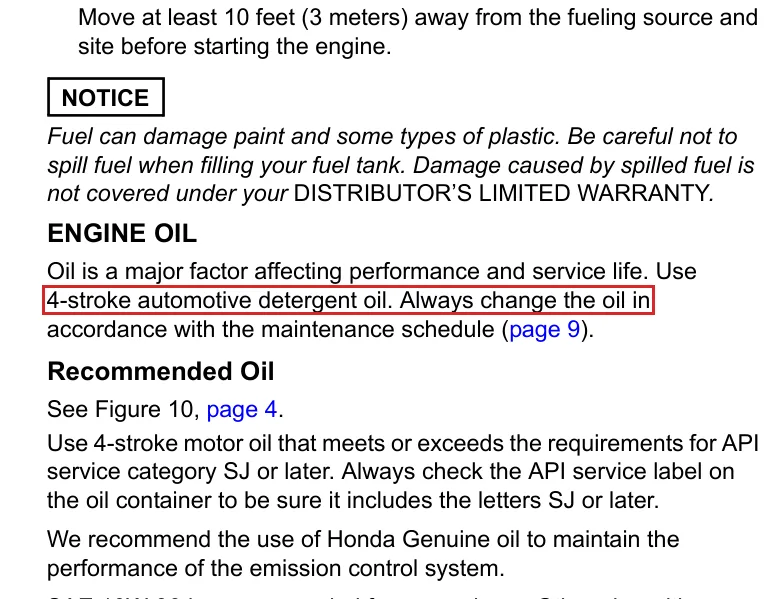
Yes, if it matches the grade and rating your engine maker lists. Honda’s GCV170 and GCV200 manual says to use 4-stroke automotive detergent oil rated API SJ or later, and Briggs & Stratton accepts detergent oils classified SF, SG, SH, SJ or higher. What to avoid is non-detergent oil, 2-stroke oil and any grade your engine’s chart does not list.
| Oil you already have | Use it in a 4-stroke mower? | Why (source) |
|---|---|---|
| 10W-30 passenger car oil, API SP or SQ | Yes for Briggs & Stratton, Honda, Kohler and Toro engines | All four list 10W-30, and API says the latest gasoline category covers earlier ones (API) |
| Conventional 5W-30 | Only for cold-weather use on Briggs and Kohler engines | Briggs charts it at 40°F and below; Kohler at 32°F and below (Briggs) |
| Full synthetic 5W-30 | Yes, at all temperatures on Briggs engines | Briggs lists synthetic 5W-30 for all temperature ranges (Briggs) |
| 10W-40 | Yes on Kawasaki engines; not charted by Briggs, Honda, Kohler or Toro | Kawasaki recommends 10W-40 for most conditions (Kawasaki) |
| 0W-20 or 0W-16 car oil | No listed use | None of the five makers’ charts checked includes a 0W grade |
| 15W-40 diesel oil (API C category only) | Not on any mower chart checked | API says C-category oils are formulated primarily for diesel engines (API guide) |
| Non-detergent SAE 30 | No | Honda says non-detergent oil can shorten engine life (Honda HRN216 manual) |
| 2-stroke oil | No, not in a 4-stroke crankcase | Honda says 2-stroke oil can damage the engine |
Older guides sometimes say mower engines need single-grade oil. The current manuals do not: Honda recommends multigrade 10W-30 for general use, Kohler charts 10W-30 from 0°F upward, and Kawasaki recommends 10W-40. The one maker-specific limit is Briggs & Stratton’s note that 10W-30 can burn faster above 80°F.
What do the API letters on the oil bottle mean?
The API service symbol, called the donut in the API Motor Oil Guide, shows the service category in its top half and the SAE viscosity grade in the center. Gasoline categories start with S. Honda, Kohler and Toro ask for SJ or later, and API says each newer gasoline category includes the performance of the earlier ones, so a bottle marked SP or SQ meets an SJ requirement.
| API category | Status | Written for | Meets an “SJ or later” spec? | Source |
|---|---|---|---|---|
| SQ | Current | Introduced March 2025; newest gasoline category | Yes | API Motor Oil Guide, 2025 |
| SP | Current | 2025 and older automotive engines (introduced May 2020) | Yes | API oil categories |
| SN | Current | 2020 and older automotive engines | Yes | API |
| SM | Current | 2010 and older automotive engines | Yes | API |
| SL | Current | 2004 and older automotive engines | Yes | API |
| SJ | Current | 2001 and older automotive engines | Yes (the minimum) | API |
| SH | Obsolete | Not suitable for most automotive engines built after 1996 | No | API |
| SG | Obsolete | Not suitable for most automotive engines built after 1993 | No | API |
| SF | Obsolete | Not suitable for most automotive engines built after 1988 | No | API |
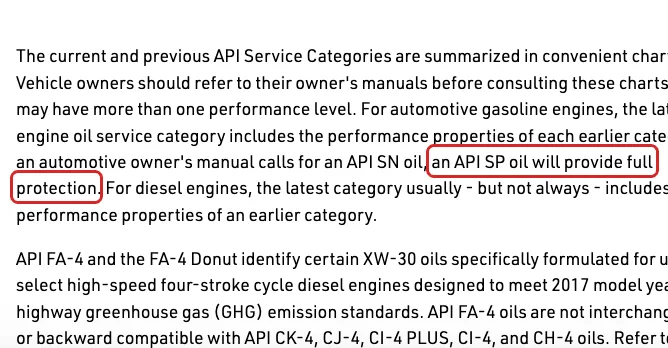
Two mower makers still print the old letters. Briggs & Stratton accepts oils classified SF, SG, SH, SJ or higher, and Kawasaki’s FR manual lists SF, SG, SH, SJ or SL. API now lists SF, SG and SH as obsolete, so in practice any bottle labeled SJ through SQ satisfies all five engine makers in this guide.
How often should you change lawn mower oil?
Change lawn mower oil after the first 5 hours on a new engine, then every 50 hours or once a season on most walk-behind engines. Briggs & Stratton and Kohler’s XT series use 50 hours or annually, Honda 50 hours or 6 months, dropping to 25 hours under heavy load or high heat. Kawasaki FR and Kohler 7000 riding engines go 100 hours.
| Engine | First change | Then | Change sooner when | Source |
|---|---|---|---|---|
| Briggs & Stratton walk-behind | After the first 5 hours | Every 50 hours or annually | Wet grass, heavy dust, high heat, rough or hilly ground | Briggs schedule; Briggs oil FAQ |
| Briggs & Stratton EXi | Not required | Check and add only | Level drops below the add mark | Briggs EXi page |
| Honda GCV170, GCV200 | First month or 5 hours | Every 6 months or 50 hours | Heavy load or high outside temperature: every 25 hours | Honda HRN216 manual |
| Kohler XT series | After 3 to 5 hours | Every 50 hours or annually | Not stated for oil | Kohler XT manual |
| Toro Recycler 20349 | After the first 5 hours | Yearly | Not stated | Toro 20349 manual |
| John Deere S100 | Not stated on the sheet | Oil and filter every 50 hours | Not stated | John Deere S100 sheet |
| Kohler 7000 KT715 to KT745 | Not listed | Oil and filter every 100 hours (300 hours with Kohler PRO 10W-50 and PRO filter) | Severe, dusty or dirty conditions | Kohler 7000 manual |
| Kawasaki FR651V, FR691V, FR730V | After 5 to 8 hours | Every 100 hours or 1 year; filter every 200 hours | Commercial or dusty use | Kawasaki FR manual; Kawasaki guide |
The break-in change matters most. Briggs & Stratton says the first change removes metal particles worn from bearings and the cylinder wall during break-in, and that standard oil is fine for it. For a typical home lawn, University of Illinois Extension notes oil is usually changed once a year; heavy users should follow the maker’s hour count.
How many oil changes does a season take?
Multiply your mowing hours by the maker’s interval and round down; the annual rule catches anything left over. The inputs below are illustrations, not survey data: 1 hour a week for a homeowner and 30 hours a week for a commercial zero-turn, over a 30-week season. Put in your own hour meter reading.
| Scenario (illustration inputs) | Hours per season | Maker interval | Oil changes | Oil used |
|---|---|---|---|---|
| Homeowner, Briggs & Stratton walk-behind, 18 oz engine | 1 × 30 = 30 | 50 hours or annually | 30 ÷ 50 = 0.6, so the annual rule: 1 | About 18 oz |
| Homeowner, Honda GCV170, mowing in summer heat | 1 × 30 = 30 | 25 hours (heavy load or high heat) | 30 ÷ 25 = 1.2, so 1 in season plus the next at 50 hours | 12.0 to 13.5 oz per change |
| Commercial, Kawasaki FR691V zero-turn | 30 × 30 = 900 | 100 hours; filter every 200 | 900 ÷ 100 = 9 (4 with a new filter) | 4 × 2.2 qt + 5 × 1.9 qt = 18.3 qt |
| Commercial, Kohler 7000 KT725, standard oil | 30 × 30 = 900 | 100 hours with filter | 900 ÷ 100 = 9 | 9 × 2.0 qt = 18 qt |
| Commercial, Kohler 7000 KT725, Kohler PRO 10W-50 and PRO filter | 30 × 30 = 900 | 300 hours with filter | 900 ÷ 300 = 3 | 3 × 2.0 qt = 6 qt |
For an operator, the 18.3 quarts a season in the Kawasaki example is one line in the per-hour equipment cost behind our lawn mowing cost figures. The same oil and filter count belongs in the equipment budget for anyone starting a lawn care business.
How do you change the oil in a lawn mower?
Warm the engine, stop it and disconnect the spark plug wire, then drain the old oil through the filler neck, a drain plug or an extractor, and refill in steps to the dipstick’s full mark. Tilt only the way your maker says: Briggs & Stratton says air filter or spark plug side up, and Honda says tilt the HRN216 on its right side.
- Warm the oil. Briggs & Stratton says to run the engine for 15 minutes (Briggs oil change FAQ); Honda says warm oil drains quickly and completely.
- Stop the engine and disconnect the spark plug wire so it cannot start. On a Honda HRN216, also turn the fuel valve off.
- Keep fuel out of the way. Briggs suggests draining the gas or sealing the tank with a plastic sandwich bag under the cap; Toro says to run the tank dry or use a hand pump before tipping.
- Clean around the oil fill cap and drain plug so dirt does not fall into the crankcase, then remove the dipstick.
- Drain the oil: tip the mower with the filler neck down over a pan, remove the drain plug with a 3/8-inch drive socket wrench and extension (Briggs), or pump it out through the dipstick tube with an extractor. On Kohler XT engines with a crankcase plug, reinstall it with thread sealant at 120 in-lb (13.6 N·m).
- Replace the filter on riding engines that have one. Briggs says to oil the new gasket, turn the filter by hand until the gasket touches, then tighten 1/2 to 3/4 turn more.
- Refill in steps: about 3/4 of capacity first on Toro Recyclers (14 oz on model 20349), wait 3 minutes, then check. Honda’s refill is 12.0 to 13.5 oz. On Honda and Kawasaki engines, rest the dipstick in the tube without screwing it in when you read it; Toro varies by model (the 20349 rests it in the tube, the 21332 and 21352 manuals say screw it in, then remove and read).
- Run the engine briefly, stop it and recheck the level, as Kawasaki’s guide says, then reconnect the plug wire.
- Recycle the old oil. The EPA says used oil from one oil change can contaminate one million gallons of fresh water; Honda says not to put it in the trash, on the ground or down a drain.
Which side faces up when you tip the mower matters. Tipping the wrong way can let oil escape the crankcase, which Briggs & Stratton lists as a cause of white or blue smoke on the next start; it says to keep the spark plug up or the muffler side down.
Each engine’s drain route, tip side, first pour and dipstick rule are set side by side in our guide on how to change oil in a lawn mower.
| Engine or mower | Tip it with | Drain route | Source |
|---|---|---|---|
| Briggs & Stratton walk-behind | Air filter or spark plug side up (or muffler side down) | Drain plug, dipstick tube extractor or filler neck | Briggs how-to; Briggs smoke FAQ |
| Honda HRN216 (GCV170) | Mower on its right side, over cardboard | Filler neck | Honda HRN216 manual |
| Toro 21in Recycler | Air filter up, dipstick down | Oil-fill tube | Toro 20349 manual |
| Kohler XT series | Air cleaner facing up | Dipstick tube, or crankcase plug | Kohler XT manual |
| Kawasaki FR riding engines | Engine level (no tipping) | Drain plug, then new filter | Kawasaki guide |
The blade comes off with the mower tipped the same way, air filter side up on a Briggs & Stratton or Toro walk-behind, so both jobs fit one session. Our guide to sharpening a lawn mower blade covers the bolt torque and the balance check.
What oil goes in a 2-stroke lawn mower?
A 2-stroke (2-cycle) engine burns its oil with the fuel, so you mix 2-cycle oil into the gasoline at the ratio in the operator’s manual instead of filling a crankcase. Briggs & Stratton says a single fill port for oil and gas marks a 2-cycle engine, while two ports, often with a yellow oil cap, mark a 4-cycle engine. Never add oil to a 4-cycle engine’s fuel.
The gasoline in that mix has its own limits, including an 89-octane floor on some trimmers, which our guide to what kind of gas a lawn mower takes lists by maker.
The arithmetic is one line: ounces of oil = gallons of gasoline × 128 ÷ the ratio, since a US gallon is 128 fl oz. At 50:1 that is 128 ÷ 50 = 2.56 oz per gallon, which Briggs rounds to 2.6 oz. Briggs also says to mix only in an approved fuel can, never in the engine’s tank.
| Gasoline | 50:1 ratio | 40:1 ratio | 32:1 ratio |
|---|---|---|---|
| 1 gallon | 2.6 oz | 3.2 oz | 4.0 oz |
| 2 gallons | 5.1 oz | 6.4 oz | 8.0 oz |
| 3 gallons | 7.7 oz | 9.6 oz | 12.0 oz |
| 4 gallons | 10.2 oz | 12.8 oz | 16.0 oz |
| 5 gallons | 12.8 oz | 16.0 oz | 20.0 oz |
What do common lawn mower oil guides get wrong?
Several high-ranking oil guides repeat claims the engine makers’ own documents do not support, from calling conventional 5W-30 an all-purpose grade to naming SN as the newest oil category. The table sets six common claims against the primary source that addresses each one; two of them come from inconsistencies between Briggs & Stratton’s own pages.
| Common guide advice | What the primary source says | Source |
|---|---|---|
| SAE 5W-30 is an all-purpose mower oil | Briggs charts conventional 5W-30 for 40°F and below; only synthetic 5W-30 is listed for all temperatures | Briggs & Stratton oil chart |
| Synthetic 5W-30 is for very cold weather | Briggs says synthetic 5W-30 gives the best protection at all temperatures | Briggs & Stratton |
| API SN is the highest oil quality | SQ is current since March 2025 and SP since May 2020 | API Motor Oil Guide |
| Car oil is not recommended for lawn mowers | Honda’s GCV170 and GCV200 manual says to use 4-stroke automotive detergent oil, API SJ or later | Honda GCV170/GCV200 manual |
| Riding mowers need an oil change every 100 hours | True for Kawasaki FR and Kohler 7000 engines; John Deere’s S100 sheet lists oil and filter every 50 hours | John Deere S100 sheet; Kohler 7000 manual |
| Briggs walk-behind oil: every 25 hours | Briggs’s tune-up guide says 25 hours, but its maintenance schedule and oil FAQ say 50 hours or annually; the engine’s operator’s manual settles it | Briggs tune-up guide; Briggs schedule |
Which oil should you buy for your mower?
Buy the grade on your engine maker’s chart for the coldest temperature you mow in, with an API rating of SJ or later. For most Briggs & Stratton, Kohler and Toro walk-behinds that is SAE 30 in summer or 10W-30 year-round; Honda wants 10W-30, Kawasaki riders 10W-40. The decision table and the flowchart below carry the same logic.
| If your situation is | Do this | Why (source) |
|---|---|---|
| Single fill port; fuel cap shows 2-cycle or a ratio | Mix 2-cycle oil into the gas: 2.6 oz per gallon at 50:1, 4.0 oz at 32:1 | 2-cycle identification and mix chart (Briggs & Stratton) |
| Briggs EXi engine (Just Check & Add) or Toro 21332/21352 | No scheduled change; check before each use and top up with SAE 30 or 10W-30 | No oil change needed (Briggs EXi; Toro manual) |
| Honda GCV170 or GCV200 engine | SAE 10W-30, API SJ or later, 12.0 to 13.5 oz | Honda’s general-use grade (Honda HRN216 manual) |
| Kawasaki FR-series riding engine | 10W-40; 20W-50 in high heat; 2.2 qt with a new filter | Kawasaki’s recommended grade (Kawasaki FAQ; FR691V specs) |
| Briggs & Stratton engine above 40°F, or Kohler engine above 50°F | SAE 30 detergent oil | Where each maker charts SAE 30 (Briggs; Kohler XT) |
| Same engines, mowing or starting below those temperatures | 10W-30 (Briggs or Kohler) or synthetic 5W-30 (Briggs) | SAE 30 below 40°F causes hard starting (Briggs); Kohler charts 10W-30 from 0°F |
| 10W-30 in an engine run above 80°F | Keep 10W-30 but check the level more often, or switch to SAE 30 | 10W-30 may raise oil use above 80°F (Briggs) |
| Commercial rider on a Kohler 7000 engine | Kohler PRO 10W-50 with the PRO filter for 300-hour changes, or any SJ+ grade at 100 hours | Extended interval only with both PRO parts (Kohler 7000 manual) |
| Only 10W-40 or a 0W car oil on the shelf, non-Kawasaki engine | Buy a listed grade instead | Neither appears on the Briggs, Honda, Kohler or Toro charts |
1Does the engine have one fill port for gas and oil, or a ratio on the fuel cap?
Yes2-cycle: mix 2-cycle oil into the gas at the manual's ratio, 2.6 oz per gallon at 50:1 (Briggs & Stratton).
NoGo to the next question
2Is it a Briggs EXi (Just Check & Add) engine or a Toro Recycler 21332 or 21352?
YesNo scheduled change: check before each use and top up with SAE 30 or 10W-30.
NoGo to the next question
3Is it a Honda GCV170 or GCV200 engine?
YesSAE 10W-30, API SJ or later, 12.0 to 13.5 oz (Honda).
NoGo to the next question
4Is it a Kawasaki FR-series riding engine?
Yes10W-40, or 20W-50 in high heat; 2.2 qt with a new filter (Kawasaki).
NoGo to the next question
5Will you mow or start the engine below 40°F (50°F on a Kohler engine)?
Yes10W-30, or synthetic 5W-30 on a Briggs & Stratton engine (Briggs & Stratton; Kohler charts).
NoSAE 30 or 10W-30 detergent oil rated API SJ or later, in the amount on the engine's oil table.
This page compiles manufacturers’ published specifications. Your engine’s operator’s manual and warranty terms govern; if they differ from this page, follow the manual for your model and serial number.
The once-a-year oil change that Illinois Extension describes for most home mowers can be booked with the other seasonal jobs in our lawn care schedule. More lawn and equipment guides are in our Turf and Trees section.
How we compiled this
We compiled oil grades, capacities and change intervals from 24 primary sources accessed in October 2026: operator’s manuals, service manuals, spec pages and service FAQs from Briggs & Stratton, Honda, Kohler, Kawasaki, Toro and John Deere, plus API’s oil category publications, the EPA’s used-oil page and University of Illinois Extension. Ounce conversions, the 40:1 column and the oil-changes-per-season figures are our own arithmetic from those numbers. We did not test any oils or engines, and retailer listings, forums and other guides were used only to find the questions people ask.
Frequently asked questions
Can I use regular 10w30 in my lawn mower?
Yes, for Briggs & Stratton, Honda, Kohler and Toro engines, which all list 10W-30. Use a detergent oil rated API SJ or later; current car oils carry SP or SQ, which API says cover SJ. Briggs notes 10W-30 may burn faster above 80°F, so check the dipstick more often in hot weather.
Can I use 5W-30 instead of SAE 30 in my lawn mower?
Use full synthetic 5W-30 at any temperature; Briggs & Stratton lists it for all ranges. Conventional 5W-30 is charted only for cold weather: 40°F and below on the Briggs chart and 32°F and below on Kohler’s. For summer mowing in a Briggs, Kohler or Toro engine, SAE 30 or 10W-30 matches the charts.
Can I use 10W-40 in my lawn mower?
Only if your engine maker lists it. Kawasaki recommends 10W-40 for most conditions, including on its FR-series riding engines. The Briggs & Stratton, Honda, Kohler and Toro charts checked in October 2026 do not include 10W-40, so for those engines buy SAE 30 or 10W-30 instead.
Is synthetic oil better for a lawn mower?
Briggs & Stratton says synthetic 5W-30 gives the best protection at all temperatures, easier cold starts and lower oil consumption. It does not stretch Briggs’s 50-hour change interval. Kohler is the exception: its PRO 10W-50 synthetic with a PRO filter extends 7000-series changes from 100 to 300 hours.
Is it bad to run a lawn mower with too much oil?
Yes. Honda warns that excess oil can be pushed into the air cleaner housing and air filter, and Briggs & Stratton lists an overfilled crankcase as a cause of white or blue smoke. Drain or extract oil until the level sits between the dipstick marks, then refill a few ounces at a time.
How do I know if my lawn mower is 2 or 4-stroke?
Count the fill ports. Briggs & Stratton says one port for both fuel and oil, often with a ratio such as 50:1 on the cap, means a 2-cycle engine. Two ports, one for gas and a separate one for oil (usually a yellow cap and dipstick), mean a 4-cycle engine that takes crankcase oil.
Can I just add oil to my mower?
On Briggs & Stratton EXi engines and Toro Recycler models 21332 and 21352, yes: the makers say no oil change is needed, only checking and topping up. Other engines still need full changes, usually after 5 hours and then every 50 hours or once a year, because topping up does not remove dirty oil.
How many ounces of oil do I put in my lawn mower?
Walk-behind engines in our table hold 13.5 to 20 oz: 13.5 oz for a Honda GCV170, 15 to 18 oz for Briggs EXi engines, 18.6 oz for Toro model 20349 and 20 oz for Kohler XT. Pour about three quarters first, wait 3 minutes, then top up to the full mark.
What kind of oil does a riding lawn mower take?
It depends on the engine. John Deere’s S100 takes 1.5 quarts of Turf-Gard 10W-30, Kohler 7000 engines take 2.0 quarts of 10W-30, SAE 30 or Kohler PRO 10W-50, and Kawasaki FR engines take 10W-40, 2.2 quarts with a new filter. Riding engines with filters also need the filter changed.
Sources
- Briggs & Stratton, What type and how much oil for my lawn mower? (oil types, temperature chart), updated September 30, 2026. Accessed October 2026.
- Briggs & Stratton, Engine maintenance schedule FAQ, current page. Accessed October 2026.
- Briggs & Stratton, How to change small engine oil, current page. Accessed October 2026.
- Briggs & Stratton, How do I check and change lawn mower oil?, current page. Accessed October 2026.
- Briggs & Stratton, Lawn mower tune-up how-to, current page. Accessed October 2026.
- Briggs & Stratton, Why is white or blue smoke coming from the engine?, current page. Accessed October 2026.
- Briggs & Stratton, How to identify a 2-cycle engine and determine the best oil to gas ratio, current page. Accessed October 2026.
- Briggs & Stratton, EXi Series engines: specifications (EXi625, EXi725, EXi875), current page. Accessed October 2026.
- Briggs & Stratton, Find manual and parts list, current page. Accessed October 2026.
- American Honda Motor Co., HRN216VKA lawn mower owner’s manual, 2022 edition. Accessed October 2026.
- American Honda Motor Co., GCV170 and GCV200 engine owner’s manual, 2021 edition. Accessed October 2026.
- Kohler Engines, XT-6, XT-7, XT775, XT8 service manual, 14 690 01 Rev. G, 2015. Accessed October 2026.
- Kohler Engines, 7000 Series KT610 to KT745 service manual, 32 690 03 Rev. M, 2022. Accessed October 2026.
- Kawasaki Engines USA, FR691V engine specifications, current page. Accessed October 2026.
- Kawasaki Engines, FR651V, FR691V, FR730V owner’s manual, 2022. Accessed October 2026.
- Kawasaki Engines USA, How to change the oil in a lawn mower engine, current page. Accessed October 2026.
- Kawasaki Engines USA, Support FAQs (engine oil), current page. Accessed October 2026.
- The Toro Company, 21in Recycler lawn mower, model 20349, operator’s manual, current web edition. Accessed October 2026.
- The Toro Company, 21in Recycler/Rear Bagging lawn mower, models 21332 and 21352, operator’s manual, current web edition. Accessed October 2026.
- John Deere, S100 with 42-inch deck maintenance reminder sheet, December 2020. Accessed October 2026.
- American Petroleum Institute, API’s Motor Oil Guide (EOLCS), April 21, 2025. Accessed October 2026.
- American Petroleum Institute, Oil categories and classifications, current page. Accessed October 2026.
- U.S. Environmental Protection Agency, Managing, Reusing, and Recycling Used Oil, current page. Accessed October 2026.
- University of Illinois Extension, Mower maintenance, current page. Accessed October 2026.