
What kind of gas for lawn mower engines? Regular unleaded: 87 octane (86 for Honda) with no more than 10 percent ethanol, under 30 days old. Premium adds nothing, E15 is federally prohibited, and only 2-cycle mowers take oil in the gas.
What each maker’s manual says about gas
Six of the 8 gas-engine makers below set the floor at 87 pump octane, Honda accepts 86, and Cub Cadet’s manual prints no number. None asks for premium. All 6 that print an ethanol limit stop at 10 percent. The table sets their printed limits side by side, which we did not find on any page in the top results for this question.
| Engine or mower | Minimum pump octane (AKI) | Most ethanol allowed | Most MTBE allowed | Methanol | Source |
|---|---|---|---|---|---|
| Briggs & Stratton 4-cycle engines | 87 (85 above 5,000 ft, with a high-altitude adjustment) | 10%; E15 and E85 not approved | 15% | Not stated | Fuel FAQ, updated Apr. 6, 2026 |
| Honda GCV170, GCV200 engines | 86 | 10% | Not stated | 5%, only with cosolvents and corrosion inhibitors | Manual, p. 9 |
| Honda HRN216 mower | 86 | 10% | Not stated | 5%, only with cosolvents and corrosion inhibitors | Manual, p. 6 |
| Kohler XT-6 to XT8 engines | 87 | 10%; E15, E20, E85 not approved | 15% | Not stated | Service manual, p. 4 |
| Kohler 7000 Series engines | 87 | 10%; E15, E20, E85 not approved | 15% | Not stated | Service manual, p. 4 |
| Kawasaki FR, FS, FX engines | 87 | 10% | 15% | 5%, only with cosolvents and corrosion inhibitors | Manual, p. 15 |
| Toro 21in Recycler 21321 | 87 | 10% | Under 15% | None | Form 3456-222, p. 11 |
| Toro TimeCutter zero-turn | 87 | 10%; never E15, E20, E85 | 15% | Do not use | Form 3399-367, p. 17 |
| John Deere S100 to S180 tractors | 87 | 10% | 15% | Do not use | OMUC22642, p. 42 |
| Cub Cadet XT1, XT2 tractors | No number: “unleaded” | Not stated | Not stated | Not stated | Form 769-10184D, pp. 6, 13 |
| Husqvarna LC221RH mower | 87 | No percent; warns alcohol blends attract moisture | Not stated | Warned against in storage | Manual, p. 13 |
| EGO LM2130SP, LM2150SP | None: 56-volt battery mower | None | None | None | Manual, cover |
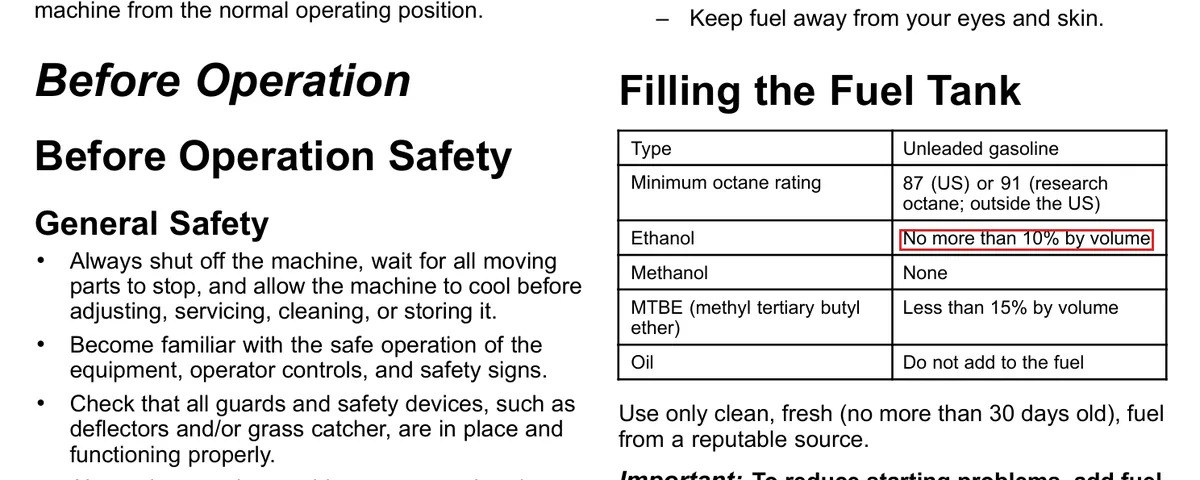
Methanol is where makers truly split. Honda and Kawasaki accept up to 5 percent with cosolvents and corrosion inhibitors; Toro and John Deere say none. MTBE is a different chemical from ethanol, and Toro says so outright: “Ethanol and MTBE are not the same.” A 15 percent MTBE allowance is no permission to use E15.
None of this gas gets oil added on a 4-cycle engine: Kohler says “do not add oil to gasoline,” and Briggs & Stratton says the same. Warranty follows the fuel. Honda excludes damage from blends over its limits, and Toro excludes from its starting guarantee fuel over 1 month old or above 10 percent ethanol.
Crankcase oil on a 4-cycle engine goes in through the fill tube instead, and our guide on how to change oil in a lawn mower lists the drain route and first pour for 10 engines.
If a Toro still fails to start on fresh E10, our Toro troubleshooting guide by model number lists the primer, toggle, battery and fuse steps each manual adds.
Should you use 87, 89 or 93 in a lawn mower?
Use 87. FuelEconomy.gov defines octane as resistance to knock, and these makers’ floors sit at the grade Kawasaki calls regular. A higher grade is allowed if it stays at or under 10 percent ethanol, but no document in the table above asks for it. For a Honda GCV170 mowing 1 hour a week for 30 weeks, about 9.5 gallons, the cost of grade looks like this:
| Grade | U.S. average, week of Nov. 2, 2026 | 9.5 gallons | Extra over regular |
|---|---|---|---|
| Regular | $4.153 | $39.45 | None |
| Midgrade | $4.757 | $45.19 | $5.74 |
| Premium | $5.158 | $49.00 | $9.55 |
Three cases change the grade. If the engine knocks or pings, Kawasaki says to try another brand or a higher octane. Above 5,000 feet, Briggs & Stratton accepts 85 with a high-altitude adjustment. And handheld 2-cycle tools set their own floor, up to 89, in the table further down.
Why E15 is off limits, and how to spot it
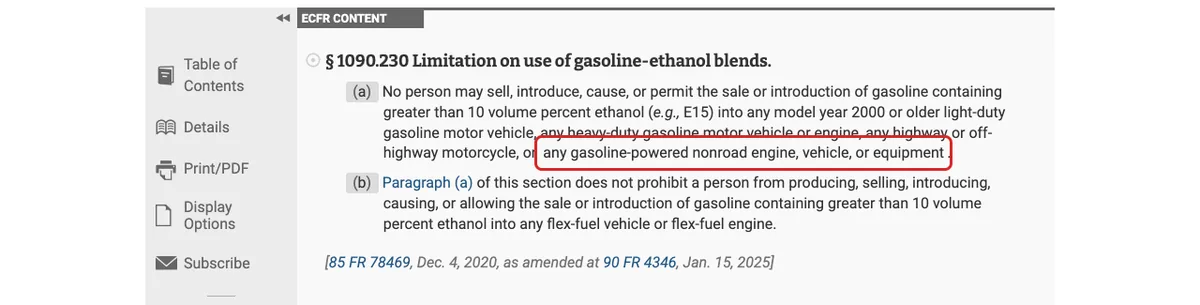
E15 in a mower breaks a federal rule, not only a warranty. 40 CFR 1090.230(a) says no person may “sell, introduce, cause, or permit” gasoline over 10 volume percent ethanol into “any gasoline-powered nonroad engine, vehicle, or equipment.” Section 1090.80 defines E15 as more than 10 and up to 15 percent. Only flex-fuel vehicles and engines are excepted from the rule, and mowers are neither.
Look for the label before you lift the nozzle. 40 CFR 1090.1510 requires it on any E15 dispenser: “Attention, E15, up to 15% ethanol,” then “Don’t use in other vehicles, boats or gasoline-powered equipment. It may cause damage and is prohibited by Federal law.” The button may not say E15: the Nebraska Corn Board says E15 is also sold as Unleaded 88, at 88 octane against 87. That makes 88 the one number on the pump that looks like an upgrade and is not one for a mower.
You will see it more often. DOE counts E15 at just over 3,000 stations in 31 states and lists “gasoline lawn mowers” as prohibited. EPA issued its first nationwide 2026 summer waiver on March 25, and its April 13 letter (p. 5) still ties E15 to model year 2001 and newer light-duty vehicles. The waivers lift a volatility limit; they add no mowers to the approved list.
The engineering reason is heat. Small engines are typically open loop and cannot correct for added oxygen, so more ethanol runs them leaner and hotter. Oak Ridge and NREL tested 28 small engines and measured exhaust temperatures 10 to 50 °C higher on E15 than on E0, and 5 to 10 °C higher from E10 to E15 on 6 pilot engines. Three handheld trimmers idled fast enough to engage the clutch. Kansas State Extension says one wrong fill will not cause immediate harm, though running hot can shorten engine life.
If you already filled up with E15, we found no maker instruction written for that mistake. The closest is Briggs & Stratton‘s step for untreated fuel: drain it into an approved container and run the engine until it stops, then refill with E10 or less.
The shared-hose trap for gas cans
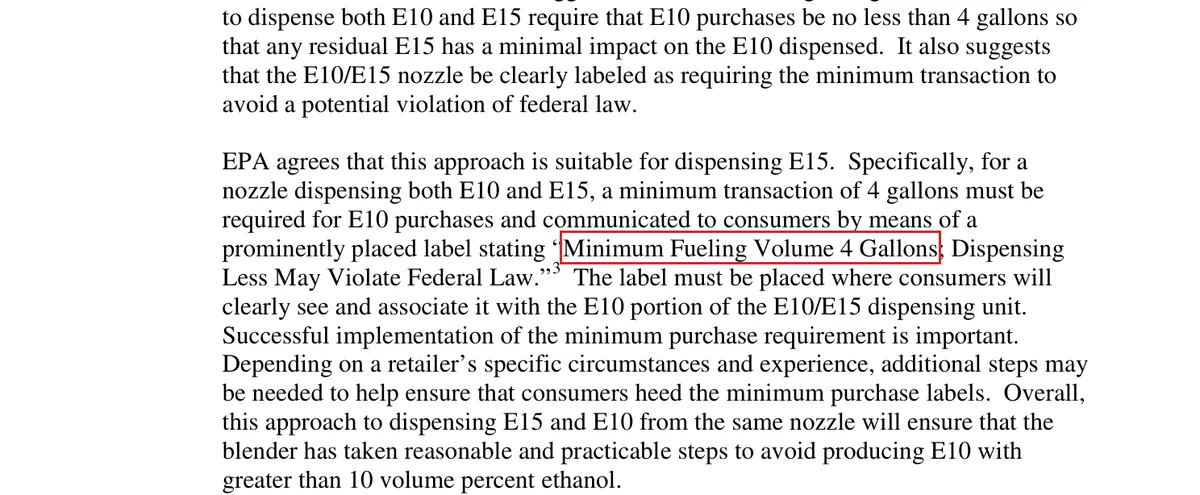
Some stations pump E10 and E15 through one hose, and the last customer’s E15 stays in it. EPA accepted that setup in a sample Model Plan approval letter, tied to its 2012 plan, only with a 4-gallon minimum on E10, marked “Minimum Fueling Volume 4 Gallons; Dispensing Less May Violate Federal Law.” A mower owner’s 30-day supply is about 1.4 gallons, so fill the can at another hose. We did not find how many stations use this setup.
This page is general information, not legal advice. Fuel rules and waivers change; the eCFR sections linked here show the current text.
What the pump says, and what to do
| The pump says | In a 4-cycle mower | Why |
|---|---|---|
| 87, regular, up to 10% ethanol | Yes: the default | Meets every printed limit in the table above |
| 85 | Only above 5,000 ft, where the maker allows it | Briggs allows it with a high-altitude adjustment; FuelEconomy.gov says 85 is sold in some high-elevation areas |
| 89 midgrade, up to 10% ethanol | Allowed, no gain | No mower maker above asks for it |
| 91 to 93 premium, up to 10% ethanol | Allowed, no gain | Cost $1.01 a gallon over regular on Nov. 2, 2026 |
| Ethanol-free, E0, rec fuel | Yes, if the octane meets the floor | Helps when fuel sits; see the ethanol-free section |
| E15, Unleaded 88, orange “Attention” label | No | 40 CFR 1090.230 prohibits it in nonroad engines |
| E85, flex fuel | No | Over 10 percent ethanol: the same rule applies; only flex-fuel vehicles are excepted |
| “Minimum Fueling Volume 4 Gallons” | Not for a small can | That hose also carries E15 (EPA letter) |
| Diesel | No | Kawasaki says “unleaded regular grade gasoline only” (p. 7); a diesel mower is a different machine |
1Does it run on a battery, with no fuel cap?
YesNo gas at all. EGO's LM2130SP, for one, is a 56-volt mower.
NoGo to the next question
2Is there one fill port for fuel and oil, or a ratio on the cap?
Yes2-cycle: premix in a can at the printed ratio, such as 50:1 or 32:1.
NoGo to the next question
3Does the pump button or label say E15, Unleaded 88, E85 or flex fuel?
YesDo not use it. 40 CFR 1090.230 prohibits it in nonroad engines. Pick another pump.
NoGo to the next question
4Does the hose carry a 4-gallon minimum label and you are filling a small can?
YesUse a different hose: this one can hold E15 from the last sale.
NoGo to the next question
5Will this fuel sit unused for over 30 days?
YesAdd stabilizer the day you buy it, or choose E0 and buy less. Check your manual's storage limit.
NoGo to the next question
6Are you above 5,000 feet with only 85 on offer?
YesAllowed by Briggs & Stratton with a high-altitude adjustment. Check your own engine's manual.
NoBuy regular 87 with 10 percent ethanol or less. Honda also accepts 86. Do not add oil.
Source: Maker manuals and 40 CFR 1090.230, as linked in the table above
Is ethanol-free gas better for a lawn mower?
Better for fuel that sits; optional for fuel you burn inside 30 days. Honda says ethanol attracts and holds water in the fuel system, and Toro says E0 greatly reduces that absorption. On durability the DOE data is calmer than most brand pages: Oak Ridge and NREL aged residential Class I engines to full life on blends up to E20 and saw no sensitivity to ethanol (p. xix). That was a 2009 run time study, not a storage test, and it does not cover a carburetor sitting all winter.
Money is rarely the obstacle. EIA publishes no E0 price, so use the arithmetic: each $1 a gallon over regular adds $9.50 to a 9.5-gallon season, against $40 to $105 for the carburetor cleaning on our lawn mower repair cost page. E0 still ages, so the limits in the next section apply. Briggs & Stratton also accepts canned ethanol-free fuel with stabilizer.
Finding the right grade is the harder part. Pure-gas.org is a free, crowd-sourced map of stations that sell ethanol-free gasoline, with the octane each one lists; its counter showed 18,011 U.S. and Canadian stations on Nov. 5, 2026. Check the grade before you drive, because an E0 pump can be 91 or higher, and read the station comments and call ahead, as the site itself asks, because listings vary. If nothing is close, plan on stabilizer rather than a long search.
How long gas lasts in a mower, maker by maker
Thirty days is the number that repeats across these documents, and stabilizer is where they part ways. Briggs & Stratton’s pages run to 24 months and 3 years, while Toro’s TimeCutter manual stops at 90 days and Honda says to empty the tank after 3 months idle. Follow the manual for your machine.
| Maker | Fresh-fuel limit | With stabilizer or in storage | Source |
|---|---|---|---|
| Briggs & Stratton | Buy a 30-day supply; fuel “can begin to deteriorate in as little as 30 days” | Up to 24 months on the FAQ; “up to 3 years” on its stabilizer article | FAQ; article |
| Honda | Buy 30 to 60 days’ worth | Over 60 days, add stabilizer; empty the tank past 3 months idle | HRN216, p. 19; GCV, p. 15 |
| Kohler | “Do not use gasoline older than 30 days” | Out of service 2 months or more: add fuel treatment, run 2 to 3 minutes | XT, p. 4 |
| Kawasaki | Not stated | Idle over 30 days: add stabilizer, run 5 minutes, then drain the tank anyway | p. 34 |
| Toro 21in Recycler | Do not store unstabilized over 30 days | As long as the stabilizer’s maker says | p. 22 |
| Toro TimeCutter | Less than 30 days old | Not over 90 days, even with stabilizer | pp. 17, 50 |
| John Deere S100 series | Buy what you will use in about 30 days | Add stabilizer at every purchase; the manual then allows storage in the machine all year | p. 42 |
| Cub Cadet XT1, XT2 | No more than 30 days old | 30 to 90 days: stabilizer. Over 90 days: run it empty | pp. 13, 25 |
| Husqvarna LC221RH | Buy what you will use in 30 days | Before 30 days or more of storage: empty the system, or add stabilizer and run 10 minutes | p. 13 |
Stabilizer only slows aging. Honda says it “will not reconstitute stale fuel,” Toro says it works best in fresh gas and rules out ethanol- or methanol-based products, and John Deere says to add it before you fill the can. Past that point, start with our lawn mower not starting checklist.
Buy less than feels sensible. Honda’s GCV170 holds 0.24 gallon and burns about 0.32 gallon an hour at 3,000 rpm, so a tank lasts roughly 45 minutes, and 1 hour a week uses about 1.4 gallons in 30 days. A 2-gallon can fits that owner; a 5-gallon can does not, unless it feeds something like the 3-gallon tank on a Cub Cadet XT1. A sharp blade helps too: Cornell’s figure of up to 20 percent more fuel with dull blades is on our blade sharpening guide.
2-cycle mowers and trimmers take a different fuel
Most walk-behind and riding mowers are 4-cycle. Briggs & Stratton‘s test: one fill port for fuel and oil, often with a ratio on the cap, means 2-cycle; two ports mean 4-cycle. A 2-cycle machine needs its oil premixed in a can, not in its tank, at the ratio on the cap or in its manual.
| Machine | Minimum octane | Most ethanol | Gas to oil | Oil per gallon | Source |
|---|---|---|---|---|---|
| STIHL FS 56 trimmer | 89 | 10% | 50:1 | 2.56 oz | Manual, p. 28 (retailer copy) |
| ECHO SRM-225 trimmer | 89 | 10%; not E15 or E85 | 50:1 | 2.56 oz | Manual, pp. 18, 33 |
| Husqvarna 128CD, 128LD trimmers | 87 | Under 10% | 50:1 | 2.6 oz as printed | Manual, p. 9 |
| Briggs & Stratton 2-stroke engines | 87 | 10% | 50:1 | 2.56 oz | Fuel FAQ |
| Lawn-Boy SilverPro 10247, 10252, 10323, 10324 mowers | “Unleaded regular”, no number | Not checked in this manual | 32:1 | 4 oz | Form 3321-749, pp. 5 to 6 |
The 89 floor on some trimmers is real: STIHL says lower octane may raise engine temperature and the risk of piston seizure. One can of 89 at 10 percent ethanol or less can fill a 4-cycle mower and supply a trimmer mix, but premix itself never goes in a 4-cycle engine. Label cans, and do not make more than Husqvarna‘s 30-day quantity. The oil math and 2-cycle oil grades live in our lawn mower oil guide.
How we compiled this
In November 2026 we read 15 operator, owner’s and service manuals from 11 brands, 4 Briggs & Stratton and Toro fuel pages, Toro’s warranty, 3 sections of 40 CFR Part 1090, EPA’s 2011 misfueling rule, its Model Plan approval letter and its April 13, 2026 waiver letter, the Oak Ridge and NREL engine report, and 6 other public pages. We ran no engines and bought no fuel. We found no retailer price for canned fuel that we could open, so none appears here.
Frequently asked questions
Can you put regular gas in lawn mowers?
Yes. Regular unleaded at 87 octane with no more than 10 percent ethanol meets every printed limit from Briggs & Stratton, Honda, Kohler, Kawasaki, Toro and John Deere. It must be fresh: Toro says not to store it unstabilized over 30 days.
Is lawn mower gas the same as car gas?
Usually it comes from the same pump, and Briggs & Stratton calls 87 octane “the same gasoline you put in your car.” The split is E15: it is approved for 2001 and newer cars but prohibited in mowers under 40 CFR 1090.230.
Do I have to mix gas for my lawn mower?
Only if it is 2-cycle. Kawasaki says “do not mix oil with gasoline,” and Honda says never to use an oil and gasoline mixture. Briggs & Stratton says one fill port for fuel and oil marks a 2-cycle engine; two ports mark a 4-cycle.
Should I use 87 or 89 gas for a lawn mower?
Use 87. No mower maker in our table asks for more, and at EIA prices for Nov. 2, 2026 midgrade cost $0.604 a gallon more. Handheld 2-cycle tools are the exception: STIHL’s FS 56 and ECHO’s SRM-225 manuals set an 89 floor.
Is ethanol-free gas better for your lawn mower?
It is better for fuel that sits, and optional for fuel burned within 30 days. Toro says E0 greatly reduces moisture absorption. No maker in our table requires it, and it still ages, so the 30-day and stabilizer limits apply.
Do lawn mowers take regular gas or diesel?
A gas mower takes gasoline only: Kawasaki prints “unleaded regular grade gasoline only” on page 7 of its FR, FS and FX manual. Diesel goes only in a mower built with a diesel engine, and its own manual sets that fuel.
Sources
- Briggs & Stratton, What is the best fuel type for lawn mowers and small engines?, updated Apr. 6, 2026. Accessed November 2026.
- Briggs & Stratton, The Importance of Fuel Stabilizer, updated Jan. 13, 2026. Accessed November 2026.
- Briggs & Stratton, How to identify a 2-cycle engine and determine the best oil to gas ratio, page current Nov. 2026. Accessed November 2026.
- American Honda, GCV170 and GCV200 engine owner’s manual (00X37Z9V0002), pp. 9, 13, 15. Accessed November 2026.
- American Honda, HRN216 owner’s manual (00X31VR8B103), pp. 6, 18, 19. Accessed November 2026.
- Kohler Engines, XT-6 to XT8 service manual, 14 690 01 Rev. G, p. 4. Accessed November 2026.
- Kohler Engines, 7000 Series service manual, 32 690 03 Rev. M, p. 4. Accessed November 2026.
- Kawasaki Motors, FR, FS and FX series engine owner’s manual, pp. 7, 15, 34. Accessed November 2026.
- The Toro Company, 21in Recycler 21321 Operator’s Manual, Form 3456-222 Rev B, pp. 11, 22. Accessed November 2026.
- The Toro Company, TimeCutter Operator’s Manual, Form 3399-367 Rev B, pp. 17, 50. Accessed November 2026.
- The Toro Company, The Toro Warranty: Consumer Mowers, current statement. Accessed November 2026.
- The Toro Company, Fuel Facts, page current Nov. 2026. Accessed November 2026.
- John Deere, 100 Series Lawn Tractors Operator’s Manual, OMUC22642 (retailer copy), p. 42. Accessed November 2026.
- Cub Cadet (MTD), XT1 and XT2 Enduro Series Operator’s Manual, Form 769-10184D, pp. 6, 13, 25. Accessed November 2026.
- Husqvarna, LC221RH operator’s manual, p. 13. Accessed November 2026.
- Husqvarna, 128CD, 128LD operator’s manual (retailer copy), p. 9. Accessed November 2026.
- EGO Power+, LM2130SP, LM2150SP 56-volt mower operator’s manual, cover. Accessed November 2026.
- STIHL, FS 56 instruction manual (retailer copy), p. 28. Accessed November 2026.
- ECHO, SRM-225 operator’s manual, pp. 18, 33. Accessed November 2026.
- Lawn-Boy (Toro), SilverPro Series Operator’s Manual, Form 3321-749 Rev B, pp. 5, 6. Accessed November 2026.
- eCFR, 40 CFR 1090.230, Limitation on use of gasoline-ethanol blends, current to Nov. 3, 2026. Accessed November 2026.
- eCFR, 40 CFR 1090.80, Definitions, current to Nov. 3, 2026. Accessed November 2026.
- eCFR, 40 CFR 1090.1510, E15 labeling provisions, current to Nov. 3, 2026. Accessed November 2026.
- U.S. EPA, Regulation To Mitigate the Misfueling of Vehicles and Engines, 76 FR 44406, July 25, 2011. Accessed November 2026.
- U.S. EPA, Sample approval letter for the E15 Model Misfueling Mitigation Plan, undated; Model Plan dated March 2, 2012. Accessed November 2026.
- U.S. EPA, National emergency fuel waiver letter to governors, Apr. 13, 2026. Accessed November 2026.
- Congressional Research Service, Year-Round Sale of E15 (IN10979), updated June 5, 2026. Accessed November 2026.
- U.S. DOE, Alternative Fuels Data Center, E15, page current Nov. 2026. Accessed November 2026.
- U.S. DOE and EPA, Selecting the Right Octane Fuel, FuelEconomy.gov, page current Nov. 2026. Accessed November 2026.
- Oak Ridge National Laboratory and NREL, Effects of Intermediate Ethanol Blends on Legacy Vehicles and Small Non-Road Engines, Report 1, Updated, Feb. 2009, pp. xix, 3-14. Accessed November 2026.
- Kansas State University Extension, Ethanol and Small Nonroad Engines, MF3068, pp. 3, 4. Accessed November 2026.
- U.S. Energy Information Administration, Weekly Retail Gasoline and Diesel Prices, week of Nov. 2, 2026. Accessed November 2026.
- Nebraska Corn Board, Unleaded 88 E15 gas guide, page current Nov. 2026. Accessed November 2026.
- Pure-gas.org, Stations that sell ethanol-free gasoline, crowd-sourced map, viewed Nov. 5, 2026. Accessed November 2026.