Does burning weeds kill them? Broadleaf seedlings under about 3 inches, yes: one pass at about 10 gallons of propane per acre killed 90 percent in Nebraska trials. Grasses regrow within 2 weeks, and perennials such as dandelion regrow from roots.
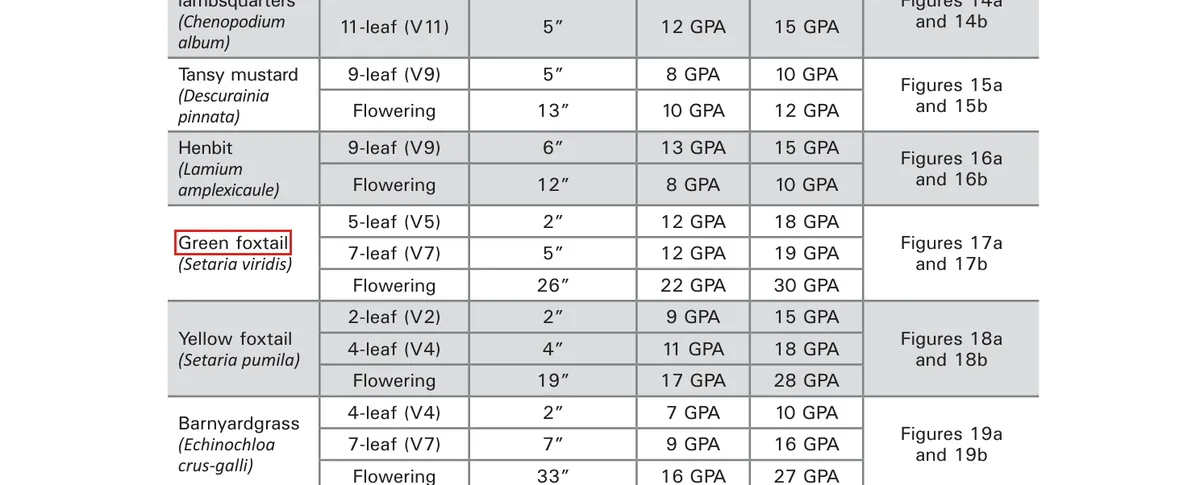
Does burning weeds kill them for good? It depends on what you burn, and the University of Nebraska flame-weeding manual (Knezevic and others, 2014) measured it: the propane dose that gave 80 and 90 percent control for 14 weeds at 39 growth stages. We converted every row into pounds of propane per 1,000 sq ft and minutes of a 100,000 BTU homeowner torch, which none of the top results do. The dose for 90 percent control runs from 4 gallons per acre on a 4-leaf ragweed to 30 on a flowering green foxtail.
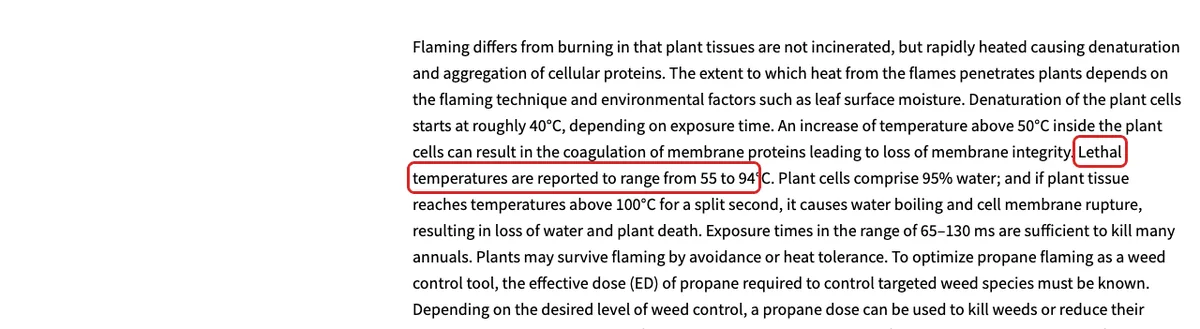
You also do not need to set anything alight. Flaming works by heat, not ash: University of Maryland Extension puts lethal leaf temperatures at 55 to 94°C (131 to 201°F) and says 65 to 130 milliseconds of exposure kills many annuals. If your weeds are mostly in a lawn, a torch scorches the turf too, and the selective options in our lawn weed killer guide or our list of common lawn weeds by type are the better start.
How heat kills a weed in under a second
Above about 50°C (122°F) the proteins in leaf cell membranes coagulate, and at 100°C (212°F) the sap boils and bursts the cell walls, per UMD and Stevan Knezevic at UNL. The plant then dries out. Iowa State Extension says flamed weeds turn a dull green right away and die over the next several hours to days; ATTRA (Diver, 2002) puts it at 1 to 3 days.
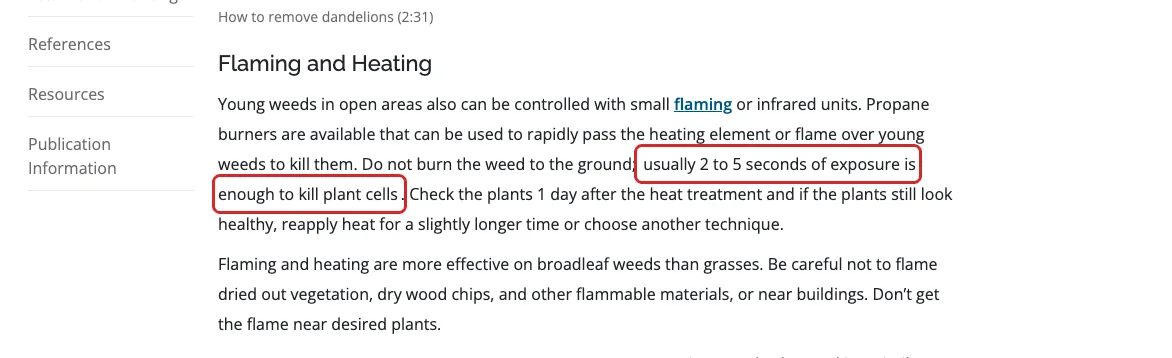
The test in the field is your thumb. ATTRA says foliage that keeps a thumbprint when pressed between thumb and finger has been flamed enough. UC IPM gives a time: 2 to 5 seconds of exposure is usually enough, and if the plant still looks healthy the next day, flame it again a little longer. Charring it to the soil only burns propane and raises the fire risk.
Which weeds burning kills, by type and stage
Read your weed’s row before you buy propane. Annual broadleaf seedlings are the one group that a single pass reliably kills, roots and all, because the growing point sits above ground in the flame. Grasses keep theirs below the soil surface, and perennials keep food in roots the flame never reaches, per the UNL manual (sections 5.2.1 to 5.2.3).
| Weed type and stage | Control measured | Passes needed | What happens after | Source |
|---|---|---|---|---|
| Annual broadleaf seedling, 1 to 3 in, 1 to 6 leaves (pigweed, lambsquarters, ragweed) | 90% at about 10 gal propane/acre | 1 | Leaves dry within a few days; no regrowth | UNL 2014, s. 5.2 and 5.2.1 |
| Annual broadleaf at 14 leaves or taller | 90% at about 15 gal/acre; velvetleaf at 39 in needed 21 | 1, at a slower pass | Dies if dosed; tolerance rises with size | UNL 2014, Table 2 |
| Broadleaf at the seed-leaf (cotyledon) stage, e.g. wild sunflower, cocklebur | Can survive | Wait until 2 to 4 true leaves | Survivors regrow | UNL 2014, s. 5.2.1 |
| White mustard, 0 to 2 leaves vs 2 to 4 leaves | 95% at 42 vs 74 kg propane/ha (about 9 vs 16 gal/acre) | 1 | Dose nearly doubles with 2 more leaves | UMD Extension, 2022 |
| Annual grass, 2 to 7 leaves (foxtails, barnyardgrass) | About 80% short-term suppression at 10 gal/acre; 90% took 10 to 19 | 2, 7 to 10 days apart | Leaves turn white, new leaves in 1 to 2 weeks | UNL 2014, s. 5.2.2 |
| Perennial broadleaf (Canada thistle, dandelion, field bindweed) | Top growth blackened in 24 hours at 3 gal/acre (thistle) | Every 2 to 3 weeks, over more than 1 season | Regrew a few weeks later | UNL 2014, s. 5.2.3; Iowa State; Cal-IPC |
| Rhizome, stolon or prostrate weeds (e.g. bermudagrass, nutsedge) | Not effective | Use another method | Regrows from rhizomes | Cal-IPC, Moore |
| Mixed weeds on paved traffic islands | Weed cover held under 2% | 5 a year on average | Seedlings keep emerging | Rask and others, 2013 |
Two rows surprise most people. A tiny seedling still showing only its seed leaves can be harder to kill than one with 3 true leaves, so UNL waits for 2 to 4 leaves on wild sunflower and cocklebur. And common ragweed is the easiest weed in the table: 4 gallons per acre at 4 leaves, against 18 for green foxtail at 5 leaves. Grassy weeds like foxtail and crabgrass are where a torch disappoints.
The propane dose for 14 weeds at 39 growth stages
UNL flamed each weed with non-hooded torches across the whole row and recorded the dose for 80 and 90 percent control. We added two columns: the 90 percent dose as pounds of propane per 1,000 sq ft (at NIST‘s 4.23 lb per gallon) and as minutes of a Weed Dragon VT2-23C at its 18 psi setting, which Flame Engineering lists at 2.25 lb an hour. The tractor rigs were not handheld wands, so treat the minutes as a floor.
Swipe the table sideways to see every column.
| Weed | Type | Stage, height | Gal/acre for 80% | Gal/acre for 90% | Lb propane per 1,000 sq ft (90%) | Torch minutes per 1,000 sq ft (90%) |
|---|---|---|---|---|---|---|
| Common waterhemp (Amaranthus rudis) | Annual broadleaf | 3-leaf, 2 in | 6 | 8 | 0.78 | 21 |
| Common waterhemp (Amaranthus rudis) | Annual broadleaf | 5-leaf, 4 in | 7 | 10 | 0.97 | 26 |
| Common waterhemp (Amaranthus rudis) | Annual broadleaf | Flowering, 15 in | 7 | 10 | 0.97 | 26 |
| Redroot pigweed (Amaranthus retroflexus) | Annual broadleaf | 3-leaf, 2 in | 10 | 15 | 1.46 | 39 |
| Redroot pigweed (Amaranthus retroflexus) | Annual broadleaf | 5-leaf, 4 in | 10 | 14 | 1.36 | 36 |
| Redroot pigweed (Amaranthus retroflexus) | Annual broadleaf | Flowering, 18 in | 12 | 18 | 1.75 | 47 |
| Field bindweed (Convolvulus arvensis) | Perennial broadleaf | 8-leaf, 2 in | 6 | 8 | 0.78 | 21 |
| Field bindweed (Convolvulus arvensis) | Perennial broadleaf | 10-leaf, 4 in | 5 | 7 | 0.68 | 18 |
| Field bindweed (Convolvulus arvensis) | Perennial broadleaf | 40-leaf, 13 in | 7 | 12 | 1.17 | 31 |
| Kochia (Kochia scoparia) | Annual broadleaf | 6-leaf, 1 in | 8 | 10 | 0.97 | 26 |
| Kochia (Kochia scoparia) | Annual broadleaf | 10-leaf, 3 in | 6 | 8 | 0.78 | 21 |
| Kochia (Kochia scoparia) | Annual broadleaf | Flowering, 18 in | 10 | 15 | 1.46 | 39 |
| Ivyleaf morningglory (Ipomoea hederacea) | Annual broadleaf | 10-leaf, 3 in | 8 | 12 | 1.17 | 31 |
| Ivyleaf morningglory (Ipomoea hederacea) | Annual broadleaf | 14-leaf, 4 in | 10 | 13 | 1.26 | 34 |
| Ivyleaf morningglory (Ipomoea hederacea) | Annual broadleaf | Flowering, 16 in | 10 | 14 | 1.36 | 36 |
| Velvetleaf (Abutilon theophrasti) | Annual broadleaf | 5-leaf, 2 in | 6 | 9 | 0.87 | 23 |
| Velvetleaf (Abutilon theophrasti) | Annual broadleaf | 7-leaf, 7 in | 8 | 12 | 1.17 | 31 |
| Velvetleaf (Abutilon theophrasti) | Annual broadleaf | 16-leaf, 39 in | 12 | 21 | 2.04 | 54 |
| Venice mallow (Hibiscus trionum) | Annual broadleaf | 3-leaf, 2 in | 7 | 11 | 1.07 | 28 |
| Venice mallow (Hibiscus trionum) | Annual broadleaf | 5-leaf, 4 in | 7 | 11 | 1.07 | 28 |
| Venice mallow (Hibiscus trionum) | Annual broadleaf | Flowering, 20 in | 8 | 15 | 1.46 | 39 |
| Common ragweed (Ambrosia artemisiifolia) | Annual broadleaf | 4-leaf, 1 in | 3 | 4 | 0.39 | 10 |
| Common ragweed (Ambrosia artemisiifolia) | Annual broadleaf | 14-leaf, 8 in | 5 | 6 | 0.58 | 16 |
| Common ragweed (Ambrosia artemisiifolia) | Annual broadleaf | 26-leaf, 31 in | 10 | 14 | 1.36 | 36 |
| Common lambsquarters (Chenopodium album) | Annual broadleaf | 5-leaf, 2 in | 8 | 10 | 0.97 | 26 |
| Common lambsquarters (Chenopodium album) | Annual broadleaf | 11-leaf, 5 in | 12 | 15 | 1.46 | 39 |
| Tansy mustard (Descurainia pinnata) | Annual broadleaf | 9-leaf, 5 in | 8 | 10 | 0.97 | 26 |
| Tansy mustard (Descurainia pinnata) | Annual broadleaf | Flowering, 13 in | 10 | 12 | 1.17 | 31 |
| Henbit (Lamium amplexicaule) | Annual broadleaf | 9-leaf, 6 in | 13 | 15 | 1.46 | 39 |
| Henbit (Lamium amplexicaule) | Annual broadleaf | Flowering, 12 in | 8 | 10 | 0.97 | 26 |
| Green foxtail (Setaria viridis) | Annual grass | 5-leaf, 2 in | 12 | 18 | 1.75 | 47 |
| Green foxtail (Setaria viridis) | Annual grass | 7-leaf, 5 in | 12 | 19 | 1.85 | 49 |
| Green foxtail (Setaria viridis) | Annual grass | Flowering, 26 in | 22 | 30 | 2.91 | 78 |
| Yellow foxtail (Setaria pumila) | Annual grass | 2-leaf, 2 in | 9 | 15 | 1.46 | 39 |
| Yellow foxtail (Setaria pumila) | Annual grass | 4-leaf, 4 in | 11 | 18 | 1.75 | 47 |
| Yellow foxtail (Setaria pumila) | Annual grass | Flowering, 19 in | 17 | 28 | 2.72 | 73 |
| Barnyardgrass (Echinochloa crus-galli) | Annual grass | 4-leaf, 2 in | 7 | 10 | 0.97 | 26 |
| Barnyardgrass (Echinochloa crus-galli) | Annual grass | 7-leaf, 7 in | 9 | 16 | 1.55 | 41 |
| Barnyardgrass (Echinochloa crus-galli) | Annual grass | Flowering, 33 in | 16 | 27 | 2.62 | 70 |
Size raises the dose: 13 of the 14 weeds needed more propane at their largest stage than at their smallest. Velvetleaf goes from 9 gallons per acre at 2 inches to 21 at 39 inches, and the three grasses need 27 to 30 gallons once they flower. Henbit is the exception (15 at 9 leaves, 10 at flowering), and the manual does not say why. The chart puts the earliest and latest stage side by side.
Why grasses come back after you burn them
A grass seedling keeps its growing point below the soil surface, wrapped in a leaf sheath, so the flame cooks the blades and misses the bud. ATTRA says grasses form that protective sheath by the time they are about 1 inch tall. At 10 gallons per acre, UNL got about 80 percent control of grasses, and only as short-term suppression: the leaves turned white, and within 1 to 2 weeks new leaves grew.
UNL’s fix is a second flaming 7 to 10 days after the first, or burying the scorched grass with soil within a few hours. Lawn grass has the same buried growing point, so a torch run across turf browns it rather than clearing it. To remove a grass weed from a lawn, the selective sprays in our guide to the crabgrass killer that will not kill grass work where flame cannot.
Does burning weeds kill the roots?
Only on young seedlings. A weed 1 to 2 inches tall has a fragile root that dies with the top, per a Cal-IPC training deck quoting McGill University. A perennial is different. In UNL’s trial, 3 gallons of propane per acre turned Canada thistle leaves completely black within 24 hours, yet the plants regrew a few weeks later because the heat cannot reach deep roots.
The only way flame kills a perennial is starvation by repetition. Iowa State says to flame regrowth about every 2 weeks; Cal-IPC says new shoots appear within about a week and treatments 2 to 3 weeks apart eventually exhaust the root. UNL says it can take several years. A dandelion taproot runs 6 to 18 inches deep, which is why our guide to killing dandelions without killing grass digs or sprays instead, and why our thistle control guide relies on herbicides that move to the root.
Several popular pages say otherwise. The table sets each claim against what the trial measured.
| Claim in the search results | Where it appears | What the research measured |
|---|---|---|
| “YES, flame weeding will kill the roots too!” | Flame Engineering, Flame Weeding 101 | True for annual seedlings. Canada thistle and dandelion regrew a few weeks after a full top kill (UNL 2014, s. 5.2.3). |
| Weeds 1 to 4 inches: “nearly 100% effective” | Flame Engineering, Flame Weeding 101 | UNL designed its doses for 90 percent control; at 10 gal/acre grasses reached only about 80 percent, as short-term suppression. |
| “Just a split second of heat should kill unwanted weeds and grasses completely” | Flame Engineering, Flame Weeding 101 | Broadleaves, often. Grass leaves turn white and regrow within 1 to 2 weeks (UNL, s. 5.2.2). |
| Burn the top fully so the heat damages shallow roots | Instructables, 2020 | UC IPM: do not burn the weed to the ground; 2 to 5 seconds is enough. UNL: flaming cannot penetrate deep into soil. |
| Torching gives temporary relief and does not kill roots | Facebook gardening group in the results | Half right: annual broadleaf seedlings at 10 gal/acre dry out with no regrowth (UNL, s. 5.2.1). |
How long burning weeds lasts, compared with spraying
Flame leaves nothing behind, so the next flush of seedlings is untouched; UMD lists the lack of residual control first among its drawbacks. On Danish traffic islands, Rask and others (2013) counted the treatments needed to keep weed cover under 2 percent over a season: flaming averaged 5 a year, glyphosate 2.5, hot water 3, and steam and hot air with flame 5.5 each.
On efficacy per pass, a 2024 Indian field trial in Heliyon found a hand-pulled flame weeder at 40 psi gave 91.1 percent weed control efficiency, against 98.06 for hand weeding and 78.26 for mechanical weeding, while using 13.24 labor-hours per hectare to hand weeding’s 255.75. The two heat-and-acid alternatives work the same contact-only way; their numbers are on our own pages.
| Method | What one treatment kills | Treatments a year to keep cover under 2% (Rask 2013) | Our page |
|---|---|---|---|
| Propane flame | Annual broadleaf seedlings; grass tops for 1 to 2 weeks | 5 | This page |
| Boiling water | Seedlings at about 3 fl oz per sq ft; perennials regrow | 3 (hot water) | Does boiling water kill weeds? |
| Vinegar (20% acetic acid) | Young broadleaves it fully wets; grasses and roots regrow | Not tested | Vinegar weed killer |
| Glyphosate | Moves to roots, kills perennials and grass, non-selective | 2.5 | Does Roundup kill grass? |
How much propane burning weeds takes
A gallon of propane holds 91,452 BTU (EIA) and weighs 4.23 lb, so UNL’s 10 gallons per acre works out to 0.97 lb per 1,000 sq ft. The Weed Dragon burns 2.25 lb an hour at 18 psi and 4.6 lb at full flame, per Flame Engineering, so the broadleaf dose is about 26 minutes of torch time per 1,000 sq ft. A 20-lb grill cylinder covers about 20,600 sq ft at that rate. Enter your area and weed below.
- Propane (lb)
- 0.97
- Propane (gallons)
- 0.23
- Weed Dragon minutes at 18 psi
- 26
- 20-lb cylinders
- 0.05
Default: 1,000 sq ft of broadleaf seedlings, 1 pass = 0.97 lb (0.23 gal), about 26 minutes of a Weed Dragon at 18 psi (2.25 lb/hr), 0.05 of a 20-lb cylinder. Gal/acre x 4.23 lb / 43,560 sq ft. UNL measured these doses with tractor-mounted torches; a handheld wand loses more heat, so treat results as a minimum.
| Area flamed | Weeds and dose (UNL) | Propane, lb | Weed Dragon minutes at 18 psi | Share of a 20-lb cylinder |
|---|---|---|---|---|
| 200 sq ft | Broadleaf seedlings, 10 gal/acre | 0.19 | 5 | 1% |
| 200 sq ft | Green foxtail at 5 leaves, 18 gal/acre | 0.35 | 9 | 2% |
| 500 sq ft | Broadleaf seedlings, 10 gal/acre | 0.49 | 13 | 2% |
| 500 sq ft | Green foxtail at 5 leaves, 18 gal/acre | 0.87 | 23 | 4% |
| 1,500 sq ft | Broadleaf seedlings, 10 gal/acre | 1.46 | 39 | 7% |
| 1,500 sq ft | Green foxtail at 5 leaves, 18 gal/acre | 2.62 | 70 | 13% |
Moisture changes the math. UNL says dew or rain on the leaves soaks up heat that would otherwise burst the cells, and recommends waiting at least 1 hour after rain or heavy dew. UMD adds that in one comparison, flaming at noon and 4 p.m. controlled weeds better than at 8 a.m. or 8 p.m. Wet ground, though, is safer, which is the trade-off in the next section.
When you should not burn weeds: fire rules and risk
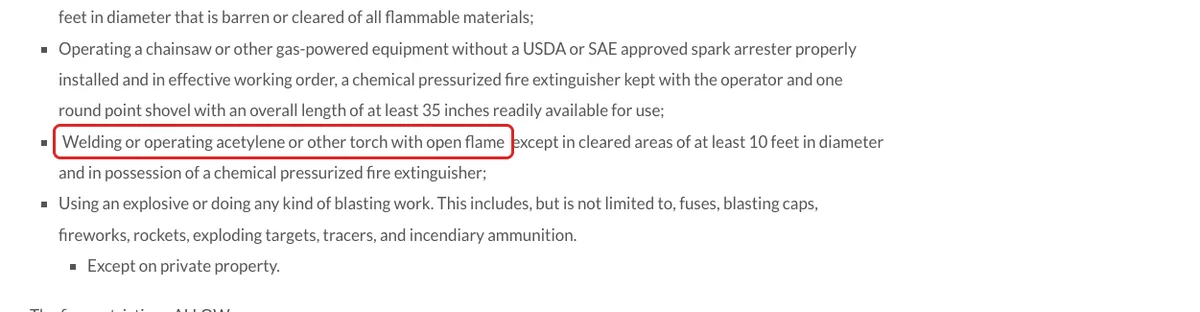
A flame weeder is an open-flame torch, and fire restrictions name torches. In unincorporated Boulder County, Colorado, the Stage 1 restrictions of March 30, 2026 ban operating any torch with an open flame except in a cleared area at least 10 feet in diameter with a chemical pressurized fire extinguisher, on pain of a $500 fine. Check your county or fire district before you light up during a dry spell.
California’s Public Resources Code 4427 applies whenever burning permits are required: equipment from which a spark, fire or flame may originate, including cutting torches, cannot run on or near grass, brush or forest land without clearing 10 feet around it and keeping a 46-inch round point shovel and a backpack pump extinguisher at hand. A weed torch is not named, so ask your CAL FIRE unit.
Mulch is the usual accident. In a University of Nevada burn of 8 mulches, shredded cedar spread fire at 47.9 feet a minute; our page on cedar mulch fire risk compares it with other mulches. UVM Extension says to avoid buildings, plastic, mulch and dry plants, skip dry, windy weather and keep a bucket of water within reach.
Never burn poison ivy, poison oak or poison sumac. The CDC National Institute for Occupational Safety and Health warns that burning them releases urushiol in the smoke, which can irritate the lungs, and that an amount smaller than a grain of salt causes a rash in 80 to 90 percent of adults.
The flowchart puts the fire checks and the weed checks in the order to ask them.
1Could any of it be poison ivy, poison oak or poison sumac?
YesDo not burn it. CDC NIOSH warns the smoke carries urushiol and can irritate the lungs. Dig or spray it instead.
NoGo to the next question
2Is a fire restriction or burn ban in effect, or is the weather dry and windy?
YesWait. Stage 1 orders such as Boulder County's (2026) allow torches only in a cleared 10-foot area with an extinguisher; UVM says skip dry, windy days.
NoGo to the next question
3Is there mulch, dry grass, a conifer, fence or siding within a few feet?
YesUse another method here. Shredded cedar mulch spread fire at 47.9 ft a minute in a University of Nevada burn.
NoGo to the next question
4Is it a grass, or a weed that spreads by rhizomes or runners?
YesExpect regrowth in 1 to 2 weeks. Flame twice, 7 to 10 days apart (UNL), or use a grass-selective spray or digging.
NoGo to the next question
5Is it a perennial with a taproot or creeping roots (dandelion, thistle, bindweed)?
YesFlame only if you will repeat every 2 to 3 weeks for a season or more (Iowa State, Cal-IPC); digging or a systemic herbicide is faster.
NoGo to the next question
6Is the broadleaf weed taller than about 4 inches or past 6 leaves?
YesSlow the pass: UNL's doses rose to about 15 gal/acre at 14 leaves and 21 for 39-inch velvetleaf.
NoBurn it: one slow pass at about 10 gal propane/acre (about 1 lb per 1,000 sq ft) kills 90 percent of annual broadleaf seedlings. Stop when a pressed leaf keeps a thumbprint.
Source: UNL 2014; CDC NIOSH; Boulder County 2026; UVM; Iowa State; Cal-IPC; University of Nevada SP-11-04
How we compiled this
On Nov. 12, 2026 we read the 2014 UNL and PERC flame-weeding manual in full and transcribed its Table 2 (39 rows), then added 5 extension publications (UMD, UC IPM, Iowa State, UVM, ATTRA), a Cal-IPC training deck, 2 peer-reviewed trials (Rask 2013 from its published abstract, the 2024 Heliyon paper in full), the Weed Dragon spec page, EIA and NIST propane figures, Boulder County’s 2026 order, California PRC 4427 and the CDC NIOSH page. We did not flame any weeds; pounds, minutes and cylinder shares are our arithmetic.
This page is general information, not safety or legal advice. Fire restrictions change with the weather and differ by county; confirm with your local fire authority before using an open flame outdoors.
Frequently asked questions
Will weeds come back if you burn them?
Annual broadleaf seedlings usually do not: at 10 gallons of propane per acre they dry out with no regrowth (UNL). Grasses send up new leaves within 1 to 2 weeks, perennials such as Canada thistle regrew a few weeks after a full top kill, and new seedlings keep emerging from seed in the soil.
How long will burning weeds last?
Weeks, not a season. On Danish traffic islands, flaming took an average of 5 treatments a year to hold weed cover under 2 percent, against 2.5 for glyphosate (Rask 2013). Iowa State says to reflame perennial regrowth about every 2 weeks.
Is burning weeds better than spraying them?
It leaves no residue and, as Cal-IPC notes, needs no pesticide license, but it needs about twice as many treatments as glyphosate (5 vs 2.5 a year) and does not kill perennial roots. Spraying a selective herbicide is the better tool in lawns, where flame scorches the turf.
What weeds should you not burn?
Poison ivy, poison oak and poison sumac: CDC NIOSH warns that burning them puts urushiol into the smoke and can irritate the lungs. Do not flame weeds growing in mulch, dry grass, conifers or against a fence or siding.
Is burning weeds illegal?
Not in general, but fire restrictions often limit open-flame torches. Boulder County’s 2026 Stage 1 order allows them only in a cleared 10-foot area with a pressurized extinguisher, with a $500 fine for violations. Check with your fire district before you flame in dry weather.
Sources
- University of Nebraska-Lincoln and Propane Education and Research Council, Propane-Fueled Flame Weeding in Corn, Soybean, and Sunflower (Knezevic, Datta, Bruening and Gogos), March 2014. Accessed November 2026.
- UNL CropWatch, Flame Weeding Offers Alternative Weed Control Method, Aug. 9, 2012. Accessed November 2026.
- University of Maryland Extension, Flaming as a Weed Management Tool (Hooks and Joseph), June 2022. Accessed November 2026.
- UC Statewide IPM Program, Weed Management in Landscapes, Pest Notes, accessed Nov. 2026. Accessed November 2026.
- Iowa State University Extension, How to Utilize Flame Weeding for Weed Control, accessed Nov. 2026. Accessed November 2026.
- University of Vermont Extension, Flame Weeding (Kirn Donahue), accessed Nov. 2026. Accessed November 2026.
- ATTRA, National Center for Appropriate Technology, Flame Weeding for Vegetable Crops (Diver), June 2002. Accessed November 2026.
- California Invasive Plant Council, Flaming: A New Tool for Wildland Weed Control (Moore), 2017 upload. Accessed November 2026.
- Weed Research 53(4):249 to 258, Rask, Larsen, Andreasen and Kristoffersen, Determining treatment frequency for controlling weeds on traffic islands, 2013. Accessed November 2026.
- Heliyon 10(12):e32776, Non-chemical weed management: Harnessing flame weeding for effective weed control, June 2024. Accessed November 2026.
- Flame Engineering, Weed Dragon VT2-23C Vapor Torch Kit specifications, accessed Nov. 12, 2026. Accessed November 2026.
- Flame Engineering, Flame Weeding 101, accessed Nov. 12, 2026. Accessed November 2026.
- U.S. Energy Information Administration, British thermal units (Btu): propane heat content, accessed Nov. 2026. Accessed November 2026.
- NIST Chemistry WebBook, Thermophysical Properties of Fluid Systems (propane density), accessed Nov. 2026. Accessed November 2026.
- Boulder County, Colorado, All of unincorporated Boulder County will now be under Stage 1 fire restrictions, March 30, 2026. Accessed November 2026.
- California Public Resources Code (text via california.public.law), Section 4427, equipment use where burning permits are required, accessed Nov. 2026. Accessed November 2026.
- CDC NIOSH, Poisonous Plants and Work, accessed Nov. 2026. Accessed November 2026.
- University of Nevada Cooperative Extension, SP-11-04, Combustibility of Landscape Mulches (Quarles and Smith), 2011. Accessed November 2026.
- Instructables, How to Flame Weed: the Beginner’s Guide, July 17, 2020. Accessed November 2026.