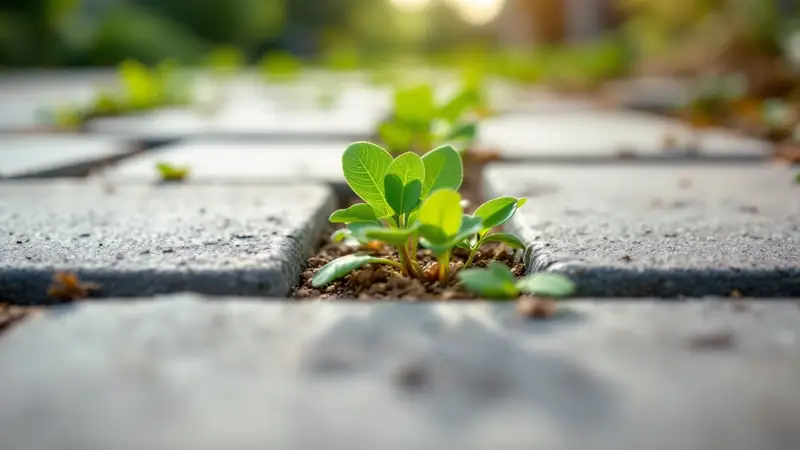
Crabgrass is a summer annual weed grass that sprouts after soil holds about 55°F for several days and dies at the first frost: prevent it with a preemergent applied before germination, and spot-kill young escapes before they tiller.
Key takeaways
- Two species do the damage: smooth crabgrass (Digitaria ischaemum) and large or hairy crabgrass (D. sanguinalis). One large crabgrass plant can set more than 100,000 seeds, and the seed stays viable in soil for at least 3 years (UC IPM Pest Note 7456).
- Every extension guide we read keys germination to about 55°F soil, but they measure it differently: a 24-hour mean for 3 or 4 days (NC State TurfFiles), 55 to 58°F at daybreak in the top inch for 4 to 5 days (Penn State), or 55 to 60°F for 7 to 10 days (Illinois Extension).
- Michigan State’s Crabgrass PRE timer opens at 250 and closes at 500 growing degree days (base 32°F, counted from Feb. 15) (MSU GDD Tracker). On 1991 to 2020 NOAA normals that is April 3 to April 19 in Chicago and March 18 to April 4 in Philadelphia, by our calculation.
- Prodiamine, pendimethalin and dithiopyr are the three preemergent actives UW-Madison calls the most widely used; under normal conditions preemergents give 90 to 95 percent control (UW-Madison Extension). Among preventers, mesotrione is the one labeled for use at seeding (Tenacity label); siduron’s Tupersan registration has been inactive since 2020 (EPA PPLS).
- Once crabgrass is up, quinclorac, fenoxaprop, mesotrione and topramezone are the selective options, and all work best before the plant has 4 tillers (Penn State). Topramezone (Pylex) causes severe injury on bermudagrass and zoysiagrass.
- Mowing at about 3 inches cuts crabgrass pressure (UW-Madison), and nitrogen applied from mid-June to mid-August feeds crabgrass more than cool-season turf (Rutgers FS1308).
What is crabgrass, and why is it a problem?
Crabgrass is a warm-season (C4) summer annual grass in the genus Digitaria. It grows from seed each spring, spreads low across thin turf through summer, sets seed from July through September and dies at the first fall frost. Smooth and large crabgrass are the two species in U.S. lawns, and Penn State calls them the most common grass weeds of turf in Pennsylvania (Penn State Extension).
The problem is seed, not the plant. A single large crabgrass plant can exceed 100,000 seeds (UC IPM); UMass puts one plant at 150 to 700 tillers and 150,000 seeds (UMass Extension). Smooth crabgrass still sets seed when mowed to 1/2 inch, so mowing alone never stops the seed rain.
| Fact | Figure | Source |
|---|---|---|
| Species in U.S. lawns | Smooth (Digitaria ischaemum) and large or hairy (D. sanguinalis) | UC IPM |
| Life cycle | Summer annual; dies at first frost | Penn State |
| Germination trigger | Soil about 55°F for several consecutive days, with moisture | UC IPM |
| Seed set | July through September | Penn State |
| Seeds per plant | More than 100,000 (large crabgrass); 150,000 (UMass) | UC IPM; UMass |
| Seed survival in soil | At least 3 years | UC IPM |
| Lowest mowing height that still sets seed | 1/2 inch (smooth); 1/4 inch (Penn State) | UC IPM; Penn State |
| Preemergent control in a normal year | 90 to 95 percent | UW-Madison |
| MSU preemergent window | 250 to 500 GDD, base 32°F, from Feb. 15 | MSU GDD Tracker |
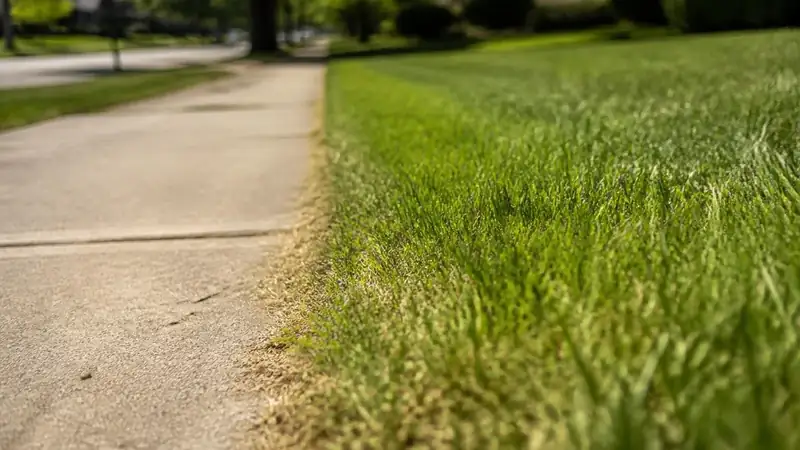
Crabgrass is not a disease and not a sign of a dead lawn. UW-Madison notes that crabgrass invades thin stands in full sun, especially south- and west-facing slopes and strips along sidewalks and driveways, where soil warms first (UW-Madison Extension). A lawn with no crabgrass history does not need a preemergent at all, by the same publication’s advice. Profiles of the lawn grasses crabgrass competes with are collected on our turf and trees hub.
What does crabgrass look like?
Crabgrass looks like coarse, light green or lime green grass growing in flat, spreading clumps, with stems that radiate from one crown like a star. From July the plants push up seedheads of 3 to 11 thin, finger-like spikes. Leaves are wider and paler than bluegrass or fescue, the ligule is a short membrane and there are no auricles (Penn State).
| Feature | Smooth crabgrass | Large (hairy) crabgrass | Source |
|---|---|---|---|
| Leaf hairs | Smooth; a few hairs at the leaf base | Long, sparse hairs on both leaf surfaces and the sheath | Penn State |
| Leaf blade | 1/4 to 1/3 inch wide, up to 5 inches long | About 3 inches long in turf; 1 1/4 to 8 inches unmowed | UC IPM; UC IPM gallery |
| Stem base | Hairless, purple at the base | Densely hairy sheaths; stems often purplish | Rutgers; UC IPM gallery |
| Ligule | Membranous, 1 to 1.5 mm, not jagged | Membranous, 1 to 1.5 mm, jagged tip | Penn State |
| Seedhead spikes | 5 to 7, each 1/2 to 2 1/2 inches | 3 to 11, each 2 to 5 inches | UC IPM |
| Height unmowed | About 6 inches | Up to 2 feet | UC IPM |
| Where it dominates | Lawns (more common in the Northeast and mid-Atlantic) | Gardens, orchards, vacant lots; less tolerant of close mowing | Rutgers; UC IPM |
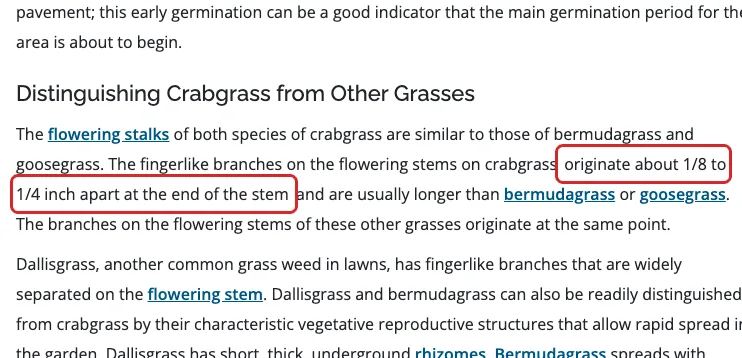
Control is identical for both species, so the split matters only for identification (UW-Madison). The test that separates crabgrass from its look-alikes is the seedhead: crabgrass spikes leave the stem about 1/8 to 1/4 inch apart, while bermudagrass and goosegrass spikes all start from the same point (UC IPM).
Is it crabgrass, bermudagrass or another look-alike?
The fastest test is the calendar. Crabgrass is an annual, so it is never green and established when the lawn greens up in April; a coarse clump visible in early spring is a perennial such as tall fescue or quackgrass (UW-Madison). After that, check the seedhead, the ligule and whether the plant has runners. Crabgrass has no rhizomes or stolons (UC IPM).
| Grass | Life cycle | Tell-tale feature | Spreads by | Crabgrass preventer stops it? | Source |
|---|---|---|---|---|---|
| Crabgrass | Summer annual | Spikes leave the stem 1/8 to 1/4 inch apart; membranous ligule | Seed; roots at stem nodes | Yes, if applied before germination | UC IPM |
| Goosegrass | Summer annual | Flat, silvery-white stem base; zipper-like seed rows; spikes from one point | Seed | Partly; germinates 3 to 4 weeks later, often needs a second application | Penn State |
| Bermudagrass | Perennial | Spikes from one point; ligule is a fringe of hairs | Rhizomes and stolons | No effect on established runners | UC IPM; Penn State |
| Dallisgrass | Perennial | Seedhead branches widely spaced along the stem | Short, thick rhizomes | No | UC IPM |
| Quackgrass | Perennial | Long, claw-like auricles; white, sharp-tipped rhizomes | Rhizomes | No | UW-Madison |
| Tall fescue (pasture type) | Perennial | Stiff, dull, ribbed wide leaves in clumps, green in early spring | Clumps (bunch type) | No | UW-Madison |
| Nimblewill | Perennial | Short gray-green leaves, 0.75 to 2 inches; tan dormant patches in spring | Stolons | No | Penn State |
Getting this wrong wastes a season. A preemergent applied for crabgrass does nothing to established bermudagrass, quackgrass, tall fescue or nimblewill, because those perennials regrow from crowns, rhizomes or stolons rather than from seed. For bermudagrass identification and control, our bermuda grass guide covers the perennial side, and the tall fescue profile explains why pasture clumps of Kentucky 31 stand out in finer lawns.
When does crabgrass germinate?
Crabgrass germinates in spring once the top inch or two of soil warms to about 55°F for several days and stays moist, and it keeps emerging into July. In Pennsylvania emergence tapers off in mid-June (Penn State); in Wisconsin it usually does not start until May or June (UW-Madison); NC State has found crabgrass germinating in Raleigh in February in 4 of 5 recent years (NC State TurfFiles).
The 55°F figure is repeated everywhere, but the guides behind it do not measure the same thing. Depth, the time of day of the reading and the number of days all change when a lawn crosses the line:
| Source | Soil temperature | Depth or statistic | How long | When to apply |
|---|---|---|---|---|
| NC State TurfFiles (2024) | About 55°F | 24-hour mean soil temperature | 3 or 4 consecutive days | By end of Feb. in central NC; mid-Feb. east of Raleigh |
| Penn State (2025) | 55 to 58°F | Upper inch of soil at daybreak | 4 to 5 days | 10 to 14 days before earliest germination |
| UMass (2011) | 55°F | Soil surface | 4 or 5 consecutive days | At or before forsythia full bloom; late April or early May in Mass. |
| University of Maryland (2023) | Above 55°F; 53 to 55°F in its tips | Not stated | At least 3 days; 5 days in its tips | Before seed germination |
| University of Minnesota | 55°F | Upper 1 to 2 inches | Several days | Before soil reaches it |
| Illinois Extension | Over 55 to 60°F | Not stated | 7 to 10 consecutive days | Late April to early May (northern Ill.) |
| Purdue AY-10 (2006) | About 60°F | 1/4 inch depth | 3 to 5 days | At least 2 weeks before predicted germination |
| MSU GDD Tracker | 50 to 55°F (model target) | 0 to 2 inch depth, estimated from air temperature | 250 to 500 GDD base 32°F | Inside the 250 to 500 window |
| Scotts Halts bag directions | Not used | Air temperature and mowing count | Before air regularly reaches the 80s | Early spring, before the 3rd or 4th mowing |
The practical reading: a 24-hour mean of 55°F arrives earlier than a daybreak (daily low) reading of 55°F, so the NC State trigger is the earlier, safer one. If you only have a soil thermometer, read it at 1 inch in the morning and treat 50°F and climbing as the signal to apply, which is the band the MSU model is built to anticipate (MSU GDD Tracker). Forsythia bloom is a rough cue that Penn State calls unreliable in abnormal years (Penn State).
When should you apply crabgrass preventer in your city?
Apply crabgrass preventer inside the 250 to 500 growing degree day window that Michigan State’s Crabgrass PRE timer uses, counted from Feb. 15 with a 32°F base. On 1991 to 2020 NOAA normals that window runs from Feb. 28 to March 11 in Atlanta, March 18 to April 4 in Philadelphia, April 3 to April 19 in Chicago and April 15 to April 29 in Minneapolis.
A growing degree day (GDD32) is the day’s mean air temperature minus 32°F, with negative days counted as zero. MSU’s model starts counting on Feb. 15 and is published for Michigan, Illinois, Indiana and Ohio; 80 percent of crabgrass germination happens when 0 to 2 inch soil is consistently 60 to 70°F, and the 250 to 500 band is meant to land the herbicide while that soil is still 50 to 55°F (MSU GDD Tracker). Here is the arithmetic on Chicago’s normal year:
| Date (normal year) | Normal mean air temp | GDD32 that day | Running total since Feb. 15 | What it means |
|---|---|---|---|---|
| Feb. 15 | 28.6°F | 0 | 0 | Counting starts; below base |
| March 1 | 33.7°F | 1.7 | 6 | Too early |
| March 15 | 38.7°F | 6.7 | 68 | Too early |
| April 1 | 44.4°F | 12.4 | 234 | Get product and spreader ready |
| April 3 | 45.1°F | 13.1 | 260 | Window opens (passes 250) |
| April 15 | 49.4°F | 17.4 | 445 | Still inside window |
| April 19 | 50.9°F | 18.9 | 518 | Window closed (passed 500) |
| May 20 | 61.9°F | 29.9 | 1,285 | MSU germination timer reaches 200 GDD base 50°F |
Swipe the table sideways to see every column.
| City (NOAA station) | Window opens (250 GDD32) | Window closes (500 GDD32) | Germination timer starts (200 GDD50) | Local extension calendar |
|---|---|---|---|---|
| Dallas, TX (USW00003927) | Feb. 27 | March 9 | March 24 | Not compiled |
| Atlanta, GA (USW00013874) | Feb. 28 | March 11 | April 2 | Not compiled |
| Raleigh, NC (USW00013722) | March 3 | March 17 | April 16 | By end of Feb. (NC State) |
| Nashville, TN (USW00013897) | March 4 | March 18 | April 17 | Not compiled |
| Louisville, KY (USW00093821) | March 9 | March 24 | April 23 | Not compiled |
| Washington, DC (USW00013743) | March 9 | March 25 | April 26 | Not compiled |
| St. Louis, MO (USW00013994) | March 13 | March 29 | April 28 | Not compiled |
| Salt Lake City, UT (USW00024127) | March 13 | March 30 | May 16 | Not compiled |
| Philadelphia, PA (USW00013739) | March 18 | April 4 | May 6 | March 15 to April 15, southeastern Pa. (Penn State) |
| Kansas City, MO (USW00003947) | March 19 | April 3 | May 7 | Not compiled |
| New York, NY (USW00094728) | March 19 | April 6 | May 9 | Not compiled |
| Indianapolis, IN (USW00093819) | March 24 | April 8 | May 9 | Not compiled |
| Columbus, OH (USW00014821) | March 26 | April 10 | May 10 | Not compiled |
| Denver, CO (USW00003017) | March 26 | April 13 | May 29 | Not compiled |
| Pittsburgh, PA (USW00094823) | March 31 | April 15 | May 15 | April 1 to May 1, most of Pa. (Penn State) |
| Des Moines, IA (USW00014933) | April 2 | April 17 | May 15 | Not compiled |
| Chicago, IL (USW00094846) | April 3 | April 19 | May 20 | Late April to early May, northern Ill. (Illinois Extension) |
| Boston, MA (USW00014739) | April 4 | April 20 | May 24 | Late April or early May (UMass) |
| Detroit, MI (USW00094847) | April 8 | April 23 | May 21 | Not compiled |
| Milwaukee, WI (USW00014839) | April 11 | April 27 | May 29 | After forsythia passes full bloom (UW-Madison) |
| Minneapolis, MN (USW00014922) | April 15 | April 29 | May 23 | Watch soil at 1 to 2 in. (UMN) |
Two cautions. First, normals smooth out real weather: a warm March can open the window 2 to 3 weeks early, so in a given year the live map at the GDD Tracker or a soil thermometer beats any table. Second, the model starts on Feb. 15, which is too late for the Southeast: NC State’s own advice for Raleigh (by the end of February) lands before our normal-year window of March 3 to March 17, and UC IPM records southern coastal California germination from mid-January (UC IPM). In the South and the Pacific Coast, follow the extension calendar. Month-by-month timing for the rest of the lawn calendar sits in our lawn care schedule by grass type.
Which crabgrass preventer active ingredient should you use?
For an established lawn you will not seed this spring, use prodiamine, pendimethalin or dithiopyr at the full label rate; all three have shown long-term preemergent control in Penn State’s work (Penn State). Pick dithiopyr if you might be late, because it also kills crabgrass seedlings. Pick mesotrione if you are seeding. The real difference is how long each one blocks new grass seed:
| Active ingredient | Example product (EPA Reg. No.) | Label crabgrass rate | Wait before reseeding | Label notes | Source |
|---|---|---|---|---|---|
| Prodiamine 40.7% | Barricade 4FL (100-1139) | Yearly max 21 to 48 fl oz/acre (0.5 to 1.1 fl oz per 1,000 sq ft) on tall fescue and warm-season grasses; 10 to 30 on bluegrass and ryegrass | 4 months at 16 fl oz/acre, 6 months at 24 (North), up to 12 months at 48 (South) | Preemergent only; needs 0.5 in. of rain or irrigation within 14 days | Barricade 4FL label |
| Dithiopyr 24% | Dimension 2EW (62719-542) | 1 to 2 pints/acre per application; 6 pints/acre per year | 3 months after one application; 4 months after a sequential program over 2 pints | Kills crabgrass through 3 to 5 tillers in southern and transition regions, before tillering in cool regions | Dimension 2EW label |
| Dithiopyr 0.13% granular | Preen Lawn Crabgrass Preventer (961-392) | 2.2 to 3.1 lb per 1,000 sq ft (North); 3.4 to 4.5 (South) | 8 weeks after a spring application; 12 weeks after a fall one | Early post on small crabgrass, no later than 4 weeks after germination | Preen / Greenview label |
| Pendimethalin 38.7% | Pendulum AquaCap (241-416) | 1.1 to 1.6 fl oz per 1,000 sq ft (3.1 to 4.2 pints/acre); repeat 2.2 to 3.1 pints after 5 to 8 weeks | At least 3 months; 5 months before sprigging | Will not control emerged crabgrass; activate with 0.5 in. of water | Pendulum label |
| Pendimethalin (granular with 30-0-4 fertilizer) | Scotts Turf Builder Halts Crabgrass Preventer with Lawn Food | One bag per 5,000 sq ft; up to twice a year | 4 months (no seeding or sod) | No raking or aerating for 4 months; water 1/4 to 1/2 in. within 2 to 3 days | Scotts product page |
| Mesotrione 40% | Tenacity (100-1267) | 4 to 8 fl oz/acre; 16 fl oz/acre per year | None: labeled before or at seeding, except fine fescue | Bermudagrass, zoysiagrass and bentgrass are sensitive | Tenacity label |
| Siduron 50% | Tupersan (10163-213) | 4 to 12 lb/acre at seeding | None: applied at seeding | EPA lists the registration as inactive since Dec. 31, 2020 | Tupersan label (EPA PPLS) |
Two corrections to what several guides repeat. Siduron (Tupersan) is still named as the seeding-safe preventer in older publications, but EPA’s label database shows the Tupersan registration inactive since Dec. 31, 2020 (EPA PPLS), which leaves mesotrione as the labeled at-seeding choice. Purdue’s AY-10 still lists MSMA and DSMA as crabgrass killers (Purdue AY-10, rev. 2006); EPA cancelled DSMA in 2009 and MSMA use on residential lawns the same year, and MSMA remains only on sod farms, golf courses and highway rights-of-way (EPA).
Rutgers and UW-Madison both put the repair seeding of crabgrass-thinned turf in late summer or early fall (Rutgers; UW-Madison), which a spring preventer with a 3 to 4 month label wait still allows. Seed rates, slit-seeder settings and watering for that job are in our guide on how to overseed a lawn, and germination days by grass are in grass seed germination time.
How do you apply crabgrass preventer?
Spread the full label rate evenly over the whole lawn before the window closes, then water it in with about 1/2 inch. Rutgers says thin coverage is the most common reason preventers fail: a bag rated for 5,000 sq ft spread over 7,500 sq ft will not give good control (Rutgers FS1308).
- Check the next 4 to 12 months. If you plan to seed, choose mesotrione; prodiamine at 24 fl oz/acre blocks seeding for 6 months in the North (Barricade 4FL label).
- Measure the lawn. Multiply length by width for each section and add them up; buy product for the total at the label rate, with no stretching.
- Time it. Apply when your area reaches 250 GDD32 or 1-inch soil climbs through 50°F, and no later than 500 GDD32 (MSU GDD Tracker). Penn State targets 10 to 14 days before the first germination (Penn State).
- Set the spreader. Use the setting printed on the bag; for Scotts Halts that is 3 on Scotts broadcast spreaders and 6 on Scotts drop spreaders, applied to a dry lawn with passes overlapping slightly (Scotts).
- Sweep the hardscape. Blow or sweep granules off sidewalks and driveways back onto the turf to prevent runoff (Rutgers).
- Water it in. Give 1/2 inch of rain or irrigation: within 14 days for Barricade 4FL (label), within 2 to 3 days for Scotts Halts (Scotts); Pendulum control turns erratic if it is not activated within 30 days (Pendulum label).
- Leave the soil alone. No aerating or raking for 4 months after Scotts Halts (Scotts); UW-Madison says to hold dethatching until late August (UW-Madison).
- Split it if pressure is high. On severe-history or sandy sites, a second application 6 to 8 weeks after the first extends control, with both rates kept under the label’s yearly maximum (Penn State; Rutgers).
- Scout in mid-June. Look along sidewalks and south-facing edges and treat escapes while they are small (Rutgers).
Here is what the label rates mean for an 8,000 sq ft lawn, our arithmetic at one application:
| Product | Label rate used | Amount for 8,000 sq ft | Cost or note | Source |
|---|---|---|---|---|
| Scotts Turf Builder Halts | 1 bag per 5,000 sq ft | 1.6 bags, so buy 2 | $82.98 at $41.49 a bag ($8.30 per 1,000 sq ft), Oct. 19, 2026 | Scotts |
| Pendulum AquaCap | 1.6 fl oz per 1,000 sq ft (top residential rate) | 12.8 fl oz | Reseed no sooner than 3 months | Pendulum label |
| Barricade 4FL | 16 fl oz/acre = 0.37 fl oz per 1,000 sq ft | 2.9 fl oz | Reseed no sooner than 4 months | Barricade label |
| Preen Lawn Crabgrass Preventer | 2.2 lb per 1,000 sq ft (North) | 17.6 lb | Reseed after 8 weeks (spring) | Preen label |
| Drive XLR8 (post) | 1.45 fl oz + 0.55 fl oz methylated seed oil per 1,000 sq ft | 11.6 fl oz + 4.4 fl oz oil | Broadcast rate; spot spray uses the same ratio | Drive XLR8 label |
| Contract application (municipal) | $75 to $165 per acre bid | $13.77 to $30.30 | Three bids for city fields; product and labor included | Middletown, Conn., Bid 2025-019 |
The contract figure is a municipal bid for multi-acre fields, so it shows the scale economics of a licensed crew rather than a homeowner quote. For hiring a lawn service, applicators who spray for hire need a state pesticide license; our pesticide applicator license guide lists the state rules.
How do you kill crabgrass that is already growing?
Kill emerged crabgrass with a selective post-emergent while plants are small: quinclorac, fenoxaprop, mesotrione or topramezone, each before about 4 tillers (Penn State). Check your lawn grass against the label first, because the wrong product kills the lawn. A few plants are faster to pull: remove the crown and they do not regrow (Rutgers).
| Active ingredient | Product (EPA Reg. No.) | Crabgrass stage on label | Rate | Do not use on | Seeding rule | Source |
|---|---|---|---|---|---|---|
| Quinclorac 18.92% | Drive XLR8 (7969-272) | Newly germinated, 1 tiller, or 5+ tillers; 2 to 4 tillers may need a repeat | 64 fl oz/acre (1.45 fl oz per 1,000 sq ft) plus seed oil; 128 fl oz/acre a year | St. Augustinegrass, centipedegrass, bahiagrass, carpetgrass, colonial bentgrass, dichondra | Bluegrass, fine fescue, creeping bentgrass: not until 28 days after seedling emergence | Drive XLR8 label |
| Fenoxaprop-p-ethyl 6.59% | Acclaim Extra (432-950) | 1 leaf to 4 to 5 tillers | 13 fl oz/acre untillered up to 39 fl oz/acre at 4 to 5 tillers; 120 fl oz/acre a year | Unlisted turf; suppresses common bermudagrass; not within 21 days after or 5 days before 2,4-D or MCPP | Fescues and ryegrass overseeded at once; other species after 21 days | Acclaim Extra label |
| Mesotrione 40% | Tenacity (100-1267) | Under 4 tillers | 4 to 8 fl oz/acre with surfactant, repeat in 2 to 3 weeks; 16 fl oz/acre a year | Bermudagrass, zoysiagrass, bentgrass, kikuyugrass, seashore paspalum (sensitive) | New turf: after 2 mowings or 4 weeks | Tenacity label |
| Topramezone 29.7% | Pylex (7969-327) | Before the 4th tiller | 1.0 to 1.5 fl oz/acre; 4.0 fl oz/acre a year | St. Augustinegrass, zoysiagrass, bahiagrass, buffalograss, carpetgrass; bermudagrass only marginally tolerant | Not in the 28 days after seeding | Pylex label |
| Dithiopyr 24% | Dimension 2EW (62719-542) | Through 3 to 5 tillers (South, transition); before tillering (cool regions) | 2 pints/acre | Colonial bentgrass, Tifgreen 328 bermudagrass, some fine fescue varieties | 3 months after a single application | Dimension 2EW label |
| Quinclorac 0.121% + 2,4-D, dicamba, sulfentrazone | Spectracide Weed Stop For Lawns Plus Crabgrass Killer RTU (9688-337-8845) | Emergence to 6 leaves (2 tillers) | Spray to cover; 2 applications a year | Bentgrass, St. Augustinegrass, bahiagrass, centipedegrass, carpetgrass; not above 90°F | Reseed after 3 to 4 weeks | Spectracide label |
| Quinclorac 2.13% + 2,4-D, dicamba | Ortho Weed B Gon Plus Crabgrass Control Concentrate (2217-896-239) | Emergence until 3 to 4 inches tall | 6.4 fl oz per 1,000 sq ft; 2 applications 21 days apart | St. Augustinegrass, centipedegrass, bahiagrass, bentgrass; below 90°F (85°F on bermudagrass) | Seed after 4 weeks | EH-1437 master label |
Timing decides whether a post-emergent is worth it. Rutgers notes crabgrass tillers fast from mid- to late June, and from early July to mid-August control often takes repeat sprays 2 to 3 weeks apart (Rutgers). Purdue advises against herbicides after mid-July and suggests tolerating the plants until frost (Purdue AY-10). UW-Madison adds an 85°F ceiling for application and notes that plants with seedheads are near the end of their life anyway (UW-Madison). Quinclorac resistance has been reported in some crabgrass populations, so a failed quinclorac spray should not simply be repeated (UC IPM; Drive XLR8 label).
Which of these products your lawn grass tolerates is laid out grass by grass, from 11 EPA labels, in our guide to the best crabgrass killer that won’t kill grass.
How do you stop crabgrass without herbicide?
Thick, tall turf is the long-term fix, because crabgrass seed needs light and warm bare soil to germinate. Mow at about 3 inches, feed cool-season lawns in fall rather than midsummer, water deeply once or twice a week, and fill bare spots by seeding in late summer, when frost will kill any crabgrass that sprouts with the new grass (Rutgers FS1308; UW-Madison).
| Practice | Threshold or setting | Why it works | Source |
|---|---|---|---|
| Mowing height | About 3 in. for most lawns; 3 to 4 in. (Maryland); over 3 in. (Illinois) | Shades soil so seedlings get less light | UW-Madison; UMD; Illinois |
| Mowing frequency | Remove no more than one-third of the blade per cut | Avoids thin, scalped turf | UC IPM |
| Nitrogen timing (cool-season) | Early fall and, if needed, spring; skip mid-June to mid-August | Summer N favors crabgrass over turf | Rutgers |
| Irrigation | Deep and infrequent, once or twice a week; wet 6 to 8 in. of soil | Daily light watering keeps the surface moist for seedlings | Rutgers; UC IPM |
| Seeding and dethatching | Late summer, not late spring | Spring disturbance opens bare soil at peak germination | UW-Madison |
| Hand removal | Pull while small, before seed; remove the crown | Plants do not regrow once the crown is out | Rutgers |
| Corn gluten meal | 12 to 20 lb per 1,000 sq ft (adds 1 to 2 lb N) | Weak preemergent; results improve over several seasons | UW-Madison |
Rutgers puts corn gluten meal in perspective: it rarely gives acceptable control of severe infestations, and the researchers saw no crabgrass control from soybean-oil or horticultural-oil products in their trials (Rutgers FS1308). For watering schedules by grass and soil, see our guide to the best time to water a lawn. If compaction is what thins the turf, core aeration timing is in when to aerate your lawn.
Which crabgrass control fits your lawn?
Match the method to two facts: whether crabgrass is already up, and whether you plan to seed this spring. Before germination, a full-rate preemergent does the most work for the least money. If you are seeding, mesotrione is the one preventer labeled at seeding. Once it is past mid-July, Purdue’s advice is to tolerate the plants until frost (Purdue AY-10).
| If your situation is | Do this | Why (source) |
|---|---|---|
| No crabgrass last summer and dense turf | Skip the preventer; mow at about 3 inches | No need for a preemergent where crabgrass has not been a problem (UW-Madison) |
| Crabgrass last year, no seeding planned, before 500 GDD32 | Prodiamine, pendimethalin or dithiopyr at full label rate, watered in with 1/2 inch | Long-term preemergent control (Penn State); 90 to 95 percent in normal years (UW-Madison) |
| Severe history or sandy soil | Second application 6 to 8 weeks later, under the yearly maximum | Germination runs into July (Penn State; Rutgers) |
| Seeding this spring (not fine fescue) | Mesotrione at seeding; no prodiamine (4 to 12 months wait) | Tenacity label; Barricade 4FL label |
| Missed the window; seedlings up less than 4 weeks | Dithiopyr (Dimension or granular dithiopyr) | Early post plus residual (Preen label; Dimension 2EW label) |
| Cool-season lawn, crabgrass under 4 tillers | Quinclorac, fenoxaprop, mesotrione or topramezone | Penn State |
| Bermudagrass or zoysiagrass lawn | Quinclorac; not topramezone or mesotrione | Pylex excludes zoysiagrass; Tenacity lists both as sensitive (Pylex label; Tenacity label) |
| St. Augustinegrass or centipedegrass lawn | Preemergent plus hand-pulling; no quinclorac or topramezone | Both are excluded on those labels (Drive XLR8 label; Pylex label) |
| Air temperature above 90°F (85°F on bermudagrass for Ortho) | Wait for a cooler day | Spectracide label; EH-1437 label |
| After mid-July, plants with seedheads | Pull or tolerate until frost; seed bare spots in late summer | Purdue AY-10; Rutgers |
1Did crabgrass show up in this lawn last summer?
Yes
NoSkip the preventer. Mow at about 3 inches and pull the odd plant before it seeds (UW-Madison).
2Will you seed or overseed in the next 4 months?
YesUse mesotrione (Tenacity) at seeding; avoid prodiamine, pendimethalin and dithiopyr until their label waits pass.
NoGo to the next question
3Is your area still below 500 GDD32, with no crabgrass seedlings visible?
YesApply prodiamine, pendimethalin or dithiopyr at the full label rate and water in 1/2 inch.
NoGo to the next question
4Are the plants within 4 weeks of germination or under 1 tiller?
YesUse dithiopyr, which kills young seedlings and adds residual control.
NoGo to the next question
5Are the plants under 4 tillers and is it before mid-July?
YesSpot-spray a post-emergent labeled for your grass: quinclorac on bermudagrass or zoysiagrass; quinclorac, fenoxaprop, mesotrione or topramezone on cool-season lawns.
NoPull plants before they seed or tolerate them until frost, then seed bare spots in late summer.
Source: Penn State, Rutgers, Purdue, UW-Madison extension; EPA product labels
How we compiled this
We read 32 primary documents in October 2026: crabgrass publications from 10 land-grant extension programs, Michigan State’s GDD Tracker notes, NOAA climate normals, 11 EPA-stamped product labels, two EPA pages, one Scotts product page and one municipal bid. The 21-city windows are our arithmetic on NOAA 1991 to 2020 normals. No product or lawn was tested; label rates are quoted, not recommended.
This page is general information, not pesticide-use advice. Herbicide registrations and labels change and some products are restricted to licensed applicators in some states; the product label is the law, so read and follow it before you apply.
Frequently asked questions
What will kill crabgrass but not the lawn?
Selective post-emergents: quinclorac, fenoxaprop, mesotrione and topramezone kill crabgrass in tolerant turf when applied before about 4 tillers (Penn State). Tolerance depends on the grass: Drive XLR8 (quinclorac) is not for St. Augustinegrass or centipedegrass (label), and Pylex (topramezone) is not for zoysiagrass (label).
How do you get rid of crabgrass permanently?
Stop the seed supply for several years. Crabgrass seed lives at least 3 years in soil (UC IPM), so a preemergent each spring plus thick turf mowed at about 3 inches runs the seed bank down. Penn State says control cannot be completed in one growing season for this reason (Penn State).
Is July too late to kill crabgrass?
Not with the right product, but it gets harder. From early July to mid-August Rutgers expects repeat sprays 2 to 3 weeks apart (Rutgers); Purdue advises tolerating crabgrass after mid-July (Purdue AY-10). Quinclorac is labeled on plants with 5 or more tillers (Drive XLR8 label).
Can I kill crabgrass in September?
You can, but the plant dies at the first frost anyway. UW-Madison calls herbicide use on older plants with seedheads debatable (UW-Madison). September is better spent seeding bare spots; if you sprayed a quinclorac mix, the Ortho master label says to wait 4 weeks before seeding (EH-1437 label).
Should you pull out crabgrass?
Yes, while plants are small and before they seed. Pull the whole crown, which stops regrowth (Rutgers), ideally when the soil is moist (University of Maryland). Fill the gap with seed in late summer so new seedlings do not take the space.
Can crabgrass be spread by mowing?
Yes. Seed travels on mowers, shoes and soil (Penn State), and UC IPM advises cleaning the mower after cutting infested turf (UC IPM). Crabgrass also roots at stem nodes that touch the soil, so mowing alone does not stop it spreading.
Can I apply pre-emergent too early?
Somewhat. Purdue found applications as early as March 1 still worked all season in Indiana and Illinois (Purdue AY-10), but heavy early-summer rain breaks products down faster (UW-Madison). If you go early, plan a second application 6 to 8 weeks later within the label maximum.
What month do you apply Scotts crabgrass preventer?
Scotts says early spring, before the 3rd or 4th mowing and before air temperatures regularly reach the 80s (Scotts). On normal-year temperatures that falls from late February in Atlanta to mid-April in Minneapolis by the MSU timer (MSU GDD Tracker).
Why is crabgrass bad for a lawn?
It is coarse and pale against turf, and over time it can dominate a stand and thin it (Penn State). Because it dies at the first frost, every patch becomes a bare spot each fall that next year’s crabgrass seed can fill.
Sources
- UC Statewide IPM Program, Pest Notes: Crabgrass (UC ANR Publication 7456), Current Pest Note. Accessed October 2026.
- UC Statewide IPM Program, Weed Gallery: Large crabgrass, Current page. Accessed October 2026.
- Penn State Extension, Lawn and Turfgrass Weeds: Smooth Crabgrass and Large Crabgrass, Updated Sept. 10, 2025. Accessed October 2026.
- Penn State Extension, Postemergence Control of Crabgrass and Other Summer Annual Grasses in Lawns, Updated Oct. 14, 2025. Accessed October 2026.
- Penn State Extension, Lawn and Turfgrass Weeds: Goosegrass, Current page. Accessed October 2026.
- Penn State Extension, Lawn and Turfgrass Weeds: Nimblewill, Current page. Accessed October 2026.
- Penn State Extension, Control of Summer Annual Grass Weeds in Turfgrasses, Updated Sept. 30, 2024. Accessed October 2026.
- UW-Madison Extension, Crabgrass Management in Lawns, Published April 2026. Accessed October 2026.
- UW-Madison Extension, Perennial Grass Weeds in Lawns, Current page. Accessed October 2026.
- Rutgers NJAES Cooperative Extension, FS1308, Crabgrass Control in Lawns for Homeowners in the Northern US, August 2019. Accessed October 2026.
- UMass Extension Turf Program, Biology and Management of Crabgrass, Revised May 2011. Accessed October 2026.
- NC State TurfFiles, When to Apply Preemergent Herbicides for Turfgrasses (Fred Yelverton), Feb. 8, 2024. Accessed October 2026.
- University of Maryland Extension, Crabgrass, Updated March 13, 2023. Accessed October 2026.
- Illinois Extension, Managing Crabgrass in Lawns, Current page. Accessed October 2026.
- Purdue University and University of Illinois, AY-10-W, Control of Crabgrass in Home Lawns, Rev. May 2006. Accessed October 2026.
- Michigan State University, GDD Tracker, About: Crabgrass Preemergence Timer (GDD32) and Crabgrass Germination Timer (GDD50), 2026 season page. Accessed October 2026.
- University of Minnesota Turfgrass Science, Spring Preemergent Applications for Crabgrass, Current page. Accessed October 2026.
- NOAA National Centers for Environmental Information, U.S. Climate Normals 1991 to 2020, daily normals (DLY-TAVG-NORMAL), 1991 to 2020 normals. Accessed October 2026.
- ScottsMiracle-Gro, Scotts Turf Builder Halts Crabgrass Preventer with Lawn Food (product page, SKU 32367), Price and directions as of Oct. 19, 2026. Accessed October 2026.
- Syngenta, EPA Reg. No. 100-1139, Barricade 4FL herbicide label (prodiamine 40.7%), EPA PPLS, EPA-accepted Feb. 21, 2024. Accessed October 2026.
- Corteva Agriscience, EPA Reg. No. 62719-542, Dimension 2EW herbicide label (dithiopyr 24%), EPA PPLS, EPA-accepted July 2, 2021. Accessed October 2026.
- BASF, EPA Reg. No. 241-416, Pendulum AquaCap (Pendulum CS) herbicide label (pendimethalin 38.7%), EPA PPLS, EPA-stamped July 2, 2020. Accessed October 2026.
- Syngenta, EPA Reg. No. 100-1267, Tenacity herbicide label (mesotrione 40%), EPA PPLS, EPA-accepted Sept. 28, 2022. Accessed October 2026.
- BASF, EPA Reg. No. 7969-272, Drive XLR8 herbicide label (quinclorac 18.92%), EPA PPLS, EPA-stamped Nov. 1, 2019. Accessed October 2026.
- Bayer Environmental Science (Envu), EPA Reg. No. 432-950, Acclaim Extra herbicide label (fenoxaprop-p-ethyl 6.59%), EPA PPLS, PPLS label dated Aug. 24, 2016. Accessed October 2026.
- BASF, EPA Reg. No. 7969-327, Pylex herbicide label (topramezone 29.7%), EPA PPLS, EPA-stamped Sept. 12, 2018. Accessed October 2026.
- Gowan Company, EPA Reg. No. 10163-213, Tupersan herbicide label (siduron 50%), EPA PPLS; registration inactive since Dec. 31, 2020, Label Aug. 2, 2012. Accessed October 2026.
- Chemsico / Spectrum Brands, EPA Reg. No. 9688-337-8845, Spectracide Weed Stop For Lawns Plus Crabgrass Killer (RTU) label, EPA PPLS, EPA notification accepted March 4, 2024. Accessed October 2026.
- PBI-Gordon master label for Ortho Weed B Gon Plus Crabgrass Control Concentrate, EPA Reg. No. 2217-896, EH-1437 Herbicide label (2,4-D, quinclorac, dicamba), EPA PPLS, EPA notification Jan. 21, 2026. Accessed October 2026.
- Lebanon Seaboard Corp., EPA Reg. No. 961-392, Greenview / Preen Lawn Crabgrass Preventer label (dithiopyr 0.13%), EPA PPLS, PPLS label Dec. 10, 2025. Accessed October 2026.
- U.S. Environmental Protection Agency, Monosodium Methanearsonate (MSMA), an Organic Arsenical, Current page. Accessed October 2026.
- City of Middletown, Conn., Bid 2025-019 Turf Care Services, bid tabulation (item 38, pre-emergent crabgrass per acre), 2025 bid. Accessed October 2026.