The best crabgrass killer that won’t kill grass is the one whose label lists your lawn species: quinclorac for bluegrass, fescue, ryegrass, bermuda and zoysia; mesotrione or topramezone for centipede. For St. Augustine and bahia, only dithiopyr is labeled, on young crabgrass.
No single best crabgrass killer that won’t kill grass exists for every lawn, because each herbicide label names the turf it spares. We lined up 12 lawn grasses against 11 current EPA labels, from Drive XLR8 to Ortho, Spectracide and Roundup For Lawns bottles. Quinclorac, the active the top-ranked review pages pick, is barred by its own label on St. Augustine, centipede, bahia and carpetgrass.
Two numbers tell you if a spray is still worth it: the crabgrass stage and the air temperature. Most of these labels want plants under 4 tillers, and the consumer mixes stop at 85 to 90°F. Spring prevention and the germination dates for 21 cities are in our crabgrass prevention and timing guide; if you are not sure the weed is crabgrass at all, check it against our crabgrass vs bermuda grass identification key first, because none of these products touches established bermuda runners in the same way.
Which crabgrass killer is safe on your grass? 12 lawn grasses vs 9 labels
Find your grass in the left column and read across. “Yes” means the label names it as tolerant; “Yes, with limit” means a lower rate, a heat ceiling or a variety exception; a “No (not listed)” cell is not a safety claim, it means the label gives no permission. Dimension 2EW is the only label that lists all 12 grasses, and Crabgrass Destroyer lists 4.
| Lawn grass | Drive XLR8 (7969-272) | Quinclorac lawn mixes (2217-896, 2217-917, 9688-337) | Tenacity (100-1267) | Pylex (7969-327) | Roundup For Lawns Crabgrass Destroyer (71995-70) | Acclaim Extra (432-950) | Fusilade II T&O (100-1084) | Dimension 2EW (62719-542) | MSMA 6 Plus (19713-42) |
|---|---|---|---|---|---|---|---|---|---|
| Kentucky bluegrass | Yes: Highly tolerant | Yes | Yes: 5 to 8 fl oz/A | Yes | Yes | Yes, with limit: Max 28 fl oz/A | No (not listed): Not listed | Yes | No for lawns: Golf and sod only |
| Perennial ryegrass | Yes: Highly tolerant | Yes | Yes, with limit: 5 fl oz/A max | Yes | Yes | Yes | No (not listed): Not listed | Yes | No (not listed): Not listed |
| Tall fescue | Yes: Highly tolerant | Yes | Yes: 5 to 8 fl oz/A | Yes | Yes | Yes | Yes, with limit: 5 to 6 fl oz/A; not in summer | Yes | No: Injury may result |
| Fine fescue | Yes, with limit: Moderate; blends only | Yes, with limit: In mixtures (2217-896) | Yes, with limit: 5 fl oz/A; not new seedings | Yes | Yes | Yes | Yes, with limit: 8 to 16 fl oz/A | Yes, with limit: Some varieties excluded | No: Injury may result |
| Creeping bentgrass | Yes, with limit: Moderate; split rates | No: Do not apply | No: Sensitive | Yes, with limit: Marginal; 0.25 fl oz/A | No: Do not apply | Yes, with limit: Special directions, 3.5 fl oz/A | No (not listed): Not listed | Yes, with limit: Some varieties excluded | No: Injury may result |
| Bermudagrass | Yes: Common highly, hybrid moderately tolerant | Yes, with limit: May yellow; not above 85 or 90°F | No: Sensitive; dormant only | Yes, with limit: Marginal; injury expected | No: Do not apply | No (not listed): Not listed for lawns; suppresses it | No: Label controls it | Yes, with limit: Not on Tifgreen | No for lawns: Golf and sod only |
| Zoysiagrass | Yes: Highly tolerant | Yes | No: Sensitive | No: Do not apply | No: Do not apply | Yes, with limit: Max 28 fl oz/A | Yes, with limit: 3 to 4 fl oz/A | Yes | No for lawns: Golf and sod only |
| St. Augustinegrass | No: Susceptible | No: Do not apply | No for lawns: Sod farms only, 4 fl oz/A | No: Do not apply | No: Do not apply, incl. Floratam | No (not listed): Not listed | No (not listed): Not listed | Yes | No for lawns: Sod farms only |
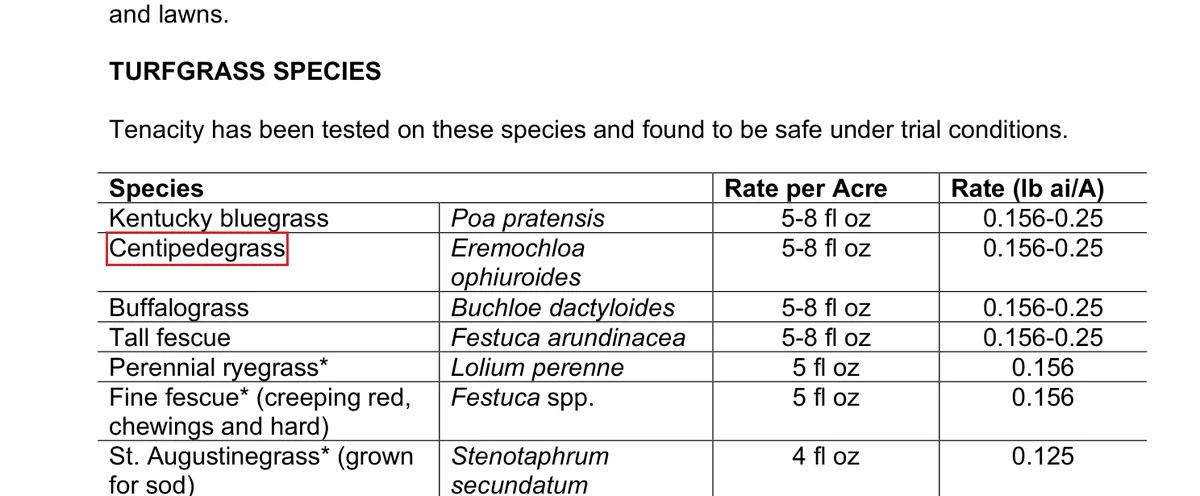
| Centipedegrass | No: Susceptible | No: Do not apply | Yes: 5 to 8 fl oz/A | Yes | No (not listed): Not listed | No (not listed): Not listed | No (not listed): Not listed | Yes | No: Do not apply |
| Bahiagrass | No: Susceptible | No: Do not apply | No (not listed): Not listed | No: Do not apply | No: Do not apply | No (not listed): Not listed | No (not listed): Not listed | Yes | No: Listed as a weed it controls |
| Buffalograss | Yes: Highly tolerant | Yes | Yes: 5 to 8 fl oz/A | No: Do not apply | No: Do not apply | No (not listed): Not listed | No (not listed): Not listed | Yes | No (not listed): Not listed |
| Seashore paspalum | Yes, with limit: Moderate | No: Do not apply | No: Sensitive | Yes, with limit: Marginal | No: Do not apply | No (not listed): Not listed | No (not listed): Not listed | Yes | No (not listed): Not listed |
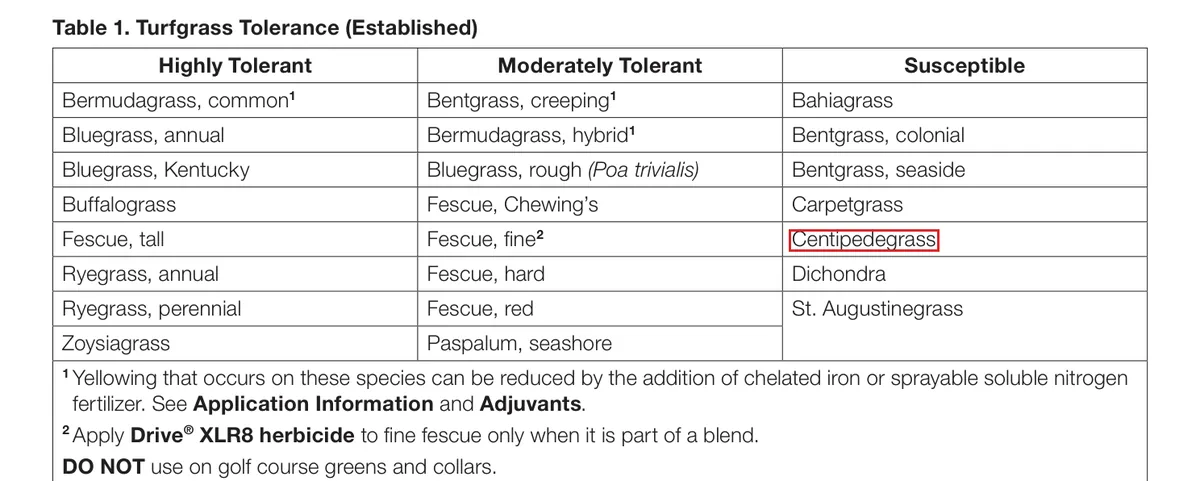
Three cells catch most homeowners. Centipede is barred by every quinclorac label yet listed at 5 to 8 fl oz per acre on Tenacity and as tolerant on Pylex. Zoysia is the reverse: quinclorac is fine, both topramezone labels bar it and Tenacity lists it as sensitive. Bermuda tolerates quinclorac, while Roundup For Lawns Crabgrass Destroyer, sold under a lawn-safe name, says do not apply to bermudagrass at all.
The chart counts the 12 grasses each label allows. Breadth is not strength: Dimension 2EW covers every grass because it is mainly a preemergent, and its label claims emerged crabgrass only before tillering in cool regions, or through 3 to 5 tillers in the South. The Ortho and Spectracide mixes also carry 2,4-D for broadleaf weeds; our page on whether 2,4-D kills grass covers that ingredient.
The 9 labels side by side: stage, rate, heat and seeding
Rates on professional labels are per acre, so a 5,000 sq ft lawn takes very little product. Pylex at 1.5 fl oz per acre works out to 0.034 fl oz, about 1 mL, per 1,000 sq ft. Crabgrass Destroyer delivers almost the same topramezone dose already diluted: 0.00079 lb per 1,000 sq ft, or 0.034 lb per acre, against 0.033 lb in 1.5 fl oz of Pylex.
| Product (EPA Reg. No.) | Active | Crabgrass stage on label | Lawn rate | Per 1,000 sq ft | Heat limit | Seeding rule |
|---|---|---|---|---|---|---|
| Drive XLR8 (7969-272) | Quinclorac | Newly germinated, 1 tiller, or 5+ tillers; 2 to 4 tillers may need a second spray | 64 fl oz/A plus methylated seed oil; 128 fl oz/A a year | 1.45 fl oz + 0.55 fl oz oil | None in °F; no drought-stressed turf | Seed 7+ days after; bluegrass and fine fescue seedlings wait 28 days |
| Ortho Weed B Gon MAX Plus Crabgrass Control concentrate (2217-896) | Quinclorac 2.13%, 2,4-D, dicamba | Emergence to 3 to 4 in. tall; 2 sprays 21 days apart | 6.4 fl oz per 1,000 sq ft | 6.4 fl oz | Below 90°F; bermuda below 85°F | Seed 4 weeks after |
| Roundup For Lawns1, Northern (2217-917) | Quinclorac 0.118%, MCPA, dicamba, sulfentrazone | Emergence to 6 leaves (2 tillers); 2 sprays 21 days apart | Ready to spray | Spray to cover | Bermuda below 85°F; rainproof 3 hours | Seed 4 weeks after |
| Chemsico Lawn Weed Killer Plus Crabgrass RTU, Spectracide brand (9688-337) | Quinclorac 0.121%, 2,4-D, dicamba, sulfentrazone | Emergence to 6 leaves (2 tillers); 2 sprays | Ready to use | Spray to cover | 45 to 90°F | Reseed 3 to 4 weeks after |
| Tenacity (100-1267) | Mesotrione | Under 4 tillers; repeat at 2 to 3 weeks | 4 to 8 fl oz/A with nonionic surfactant; 16 fl oz/A a year | 0.09 to 0.18 fl oz | None in °F | Spray at seeding (not fine fescue); new grass after 2 mowings or 4 weeks |
| Pylex (7969-327) | Topramezone | Before the 4th tiller | 1.0 fl oz/A to 2 tillers, 1.5 at 2 to 4 tillers, with oil adjuvant; 4.0 fl oz/A a year | 0.023 to 0.034 fl oz | None in °F | Any time before seeding; not in the 28 days after |
| Roundup For Lawns Crabgrass Destroyer (71995-70) | Topramezone 0.0092% | Early growth stages; some weeds need a 2nd spray at 3 to 4 weeks | Ready to use, max 1 gal per 1,000 sq ft | Up to 128 fl oz of spray | 45 to 90°F; no irrigation for 24 hours | May go down before seeding, same day included; not in the 28 days after |
| Acclaim Extra (432-950) | Fenoxaprop-p-ethyl | 1 leaf to 5 tillers, rate rises with stage | 13 fl oz/A untillered to 39 fl oz/A at 4 to 5 tillers (28 max on bluegrass, zoysia) | 0.30 to 0.90 fl oz | Not under drought stress | Fescue and ryegrass at once; other grasses after 21 days |
| Dimension 2EW (62719-542) | Dithiopyr | Before tillering (under 5 leaves) in cool regions; through 3 to 5 tillers in southern regions | 2 pints/A | 0.73 fl oz | None in °F | Wait 3 months (4 after over 2 pints/A) |
| Fusilade II T&O (100-1084) | Fluazifop-P-butyl | Actively growing grass weeds; repeat every 28 days | 3 to 6 fl oz/A (zoysia, tall fescue); 8 to 16 (fine fescue) | 0.07 to 0.37 fl oz | Skip July and August | 30 days after the renovation rate |
| MSMA 6 Plus (19713-42) | MSMA | Not staged on label | 1 to 2 fl oz in 1 to 2.5 gal per 1,000 sq ft | 1 to 2 fl oz | Apply at 80 to 90°F | Reseed 2 weeks after; golf courses and sod farms only |
- Product (fl oz)
- 1.45
- Product (mL)
- 42.9
- Product (teaspoons)
- 8.7
Default: 1,000 sq ft of Drive XLR8 = 1.45 fl oz (42.9 mL), plus 0.55 fl oz methylated seed oil. Per-acre rates divided by 43.56. 1 fl oz = 29.57 mL = 6 teaspoons. Mix in the spray volume the label sets (Drive XLR8: at least 0.5 gal per 1,000 sq ft).
Two label rules decide the timing. Drive XLR8 says 2 to 4 tiller crabgrass may need a second spray, and it controls newly germinated, 1-tiller and 5+ tiller plants most consistently (Drive XLR8 label, Table 3). Acclaim Extra waits 21 days after a 2,4-D or MCPP spray and 5 days before one, so it cannot share a week with a broadleaf mix (Acclaim Extra label).
Mowing and watering rules travel with the products. Drive XLR8, Pylex and Crabgrass Destroyer each say no mowing for 2 days before or after the spray and no irrigation for 24 hours. Leave the first three mowings of clippings on the lawn after Drive XLR8, and keep treated clippings out of compost or vegetable beds: the label bars tomatoes or carrots on treated ground for 24 months.
Which one kills crabgrass best?
The only side-by-side efficacy ratings we found from a land-grant university are in UGA Extension Bulletin 1462. Topramezone (Pylex) rates good to excellent, 80 to 100 percent control, in centipede, Kentucky bluegrass and tall fescue; quinclorac, mesotrione and MSMA rate good, 80 to 89 percent; dithiopyr rates fair to good. Most ratings assume 2 sprays for tillered summer crabgrass; Pylex needs 1 or 2 and dithiopyr 1.
| Active (product) | Lawn grasses in UGA’s table | Sprays needed | Interval | UGA efficacy rating | Control range |
|---|---|---|---|---|---|
| Topramezone (Pylex) | Centipede; Kentucky bluegrass and tall fescue | 1 or 2 | 3 weeks | Good to excellent | 80 to 100% |
| Mesotrione (Tenacity) | Centipede; Kentucky bluegrass and tall fescue | 2 | 3 weeks | Good | 80 to 89% |
| Quinclorac (Drive, others) | Kentucky bluegrass, tall fescue, zoysia | 2 | 2 to 3 weeks | Good | 80 to 89% |
| MSMA (Target 6, others) | Kentucky bluegrass, tall fescue, zoysia (golf and sod only) | 2 | 2 to 3 weeks | Good | 80 to 89% |
| Dithiopyr (Dimension 2EW) | Centipede; bluegrass and tall fescue; zoysia | 1 | None | Fair to good | 70 to 89% |
UGA adds a fix for the white leaves that mesotrione leaves behind. Tank-mixing triclopyr ester at 1 to 2 pints per acre with Tenacity raised smooth crabgrass control from about 65 percent with Tenacity alone to more than 90 percent and almost removed the bleaching, in a 2016 study by Yu and McCullough (UGA B1462). Pylex’s label offers a similar pairing: 0.75 fl oz per acre with 32 fl oz of Drive XLR8 for more consistent crabgrass control (Pylex label).
Resistance limits repeat sprays. Drive XLR8 says California crabgrass biotypes have shown varied response and that a failed quinclorac spray should not be repeated; switch to a different mode of action. In Georgia, UGA has confirmed southern crabgrass resistant to sethoxydim that is cross-resistant to fenoxaprop and fluazifop, so Acclaim Extra and Fusilade II share that weakness (UGA B1462).
Two picks on popular product round-ups do not fit this question. Fusilade II is sometimes listed as a crabgrass killer that spares turf, but its label allows over-the-top turf use only on zoysia, tall fescue and fine fescue, and its turf section is written to control bermudagrass. Prodiamine (Barricade) is preemergent only: it stops seed from sprouting and does not kill crabgrass you can see, as our crabgrass preventer comparison shows label by label.
St. Augustine, centipede and bahia: what is left?
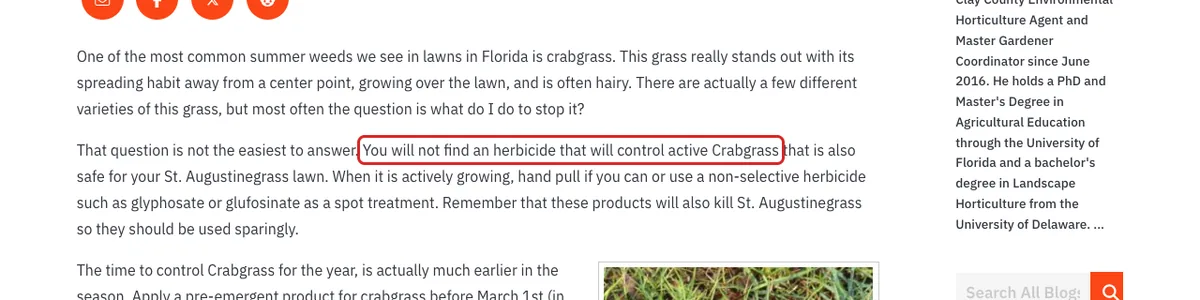
St. Augustine has the fewest options. UF/IFAS Extension in Clay County puts it bluntly: no herbicide controls actively growing crabgrass and is also safe on St. Augustinegrass, so pull it by hand or spot-spray glyphosate and patch. The labels nearly agree: Tenacity allows St. Augustine only on sod farms at 4 fl oz per acre, and MSMA only on sod farms.
The one label exception is dithiopyr. Dimension 2EW lists St. Augustine, bahia and centipede among its tolerant warm-season grasses and claims crabgrass control through the 3 to 5 tiller stage at 2 pints per acre in southern and transition regions. UGA rates it only fair to good and only to 1 tiller in early spring, so treat it as a spring tool. Our St. Augustine grass guide lists the preemergent dates for Florida, Feb. 1 to March 1.
Centipede owners have more room than most guides suggest. Tenacity lists centipedegrass at 5 to 8 fl oz per acre, and UGA recommends 2 Tenacity sprays 3 weeks apart or Pylex at 1 to 1.5 fl oz per acre for crabgrass in centipede (UGA B1462). Our centipede grass lawn guide covers the sethoxydim option and the 90°F spray ceiling.
What do professionals and golf courses use?
Professionals use the per-acre products in the table: Drive XLR8 or generic quinclorac, Tenacity, Pylex and Acclaim Extra, measured in fractions of a fluid ounce per 1,000 sq ft. At least 49 of the 51 jurisdictions (50 states and DC) require a commercial applicator license to spray even general-use weed killers for pay, as our pesticide applicator license guide shows state by state. Golf courses add MSMA: EPA cancelled its residential lawn uses in 2009 and still allows it on golf courses, sod farms and highway rights-of-way.
Even on a golf course, MSMA is capped. The current MSMA 6 Plus label allows one broadcast spray on a newly built course, then only 100 sq ft spot treatments on no more than 25 percent of the course each year, applied at 80 to 90°F. It cannot be sold for home lawns, so a homeowner shopping the same active will not find a legal one.
Pick by grass: a 6-question check
1Is your lawn St. Augustine or bahia?
YesOnly dithiopyr (Dimension 2EW, 62719-542) lists both, and only on young crabgrass. Past that stage, UF/IFAS says hand-pull or spot-spray glyphosate and patch.
NoGo to the next question
2Is it centipede?
YesTenacity (mesotrione) at 5 to 8 fl oz/A, 2 sprays 3 weeks apart, or Pylex (topramezone) at 1 to 1.5 fl oz/A. Every quinclorac label bars centipede.
NoGo to the next question
3Is it zoysia?
YesQuinclorac (Drive XLR8 or a quinclorac lawn mix) or Acclaim Extra at no more than 28 fl oz/A. Not Tenacity, Pylex or Crabgrass Destroyer.
NoGo to the next question
4Is it bermuda or buffalograss?
YesQuinclorac. Consumer mixes stop at 85 or 90°F on bermuda. Avoid Tenacity and Crabgrass Destroyer; Pylex bars buffalograss.
NoGo to the next question
5Did you seed in the last 4 weeks?
YesTenacity can go down at seeding (not on fine fescue); wait 2 mowings or 4 weeks before a post spray. Drive XLR8 waits 28 days on bluegrass and fine fescue seedlings.
NoGo to the next question
6Has the crabgrass got 4 or more tillers?
YesQuinclorac (labeled at 5+ tillers) or Acclaim Extra at 39 fl oz/A on fescue and ryegrass; expect a second spray.
NoCool-season lawn with small crabgrass: quinclorac, mesotrione, topramezone or fenoxaprop all list bluegrass, ryegrass and tall fescue; UGA rates topramezone highest.
Source: EPA master labels linked in the matrix; UGA Extension Bulletin 1462; UF/IFAS Clay County
The same logic as a rule of thumb: bluegrass, ryegrass and tall fescue lawns can use any of the 9 labels except MSMA and Fusilade II; bermuda and zoysia lawns start with quinclorac; centipede starts with mesotrione or topramezone. Broadleaf weeds in the same lawn are a separate choice, compared by active in our lawn weed killer guide.
How we compiled this
On Nov. 12, 2026 we downloaded the newest EPA-accepted master label for 11 registrations from EPA’s Pesticide Product Label System and read each turf-tolerance list, do-not-apply list, crabgrass stage, rate, temperature and seeding rule. Efficacy figures come from UGA Extension Bulletin 1462 (reviewed Oct. 28, 2024); we did not spray or test any product, and “best” here means labeled for your grass plus UGA’s rating, not a field trial of our own.
This page is general information, not pesticide advice. The label is the law: master labels carry bracketed options, so read the container you bought, and follow the most restrictive label in any tank mix.
Frequently asked questions
What kills crabgrass but doesn’t kill regular grass?
Selective grass herbicides: quinclorac, mesotrione, topramezone, fenoxaprop and, on young plants, dithiopyr. Each label names the lawn grasses it spares. Quinclorac (Drive XLR8, 7969-272) spares bluegrass, ryegrass, tall fescue, bermuda, zoysia and buffalograss but bars St. Augustine, centipede and bahia.
What do golf courses use to kill crabgrass?
Mostly quinclorac, topramezone, mesotrione and fenoxaprop, the same actives sold to lawn pros. MSMA is still labeled for golf courses, but only as 100 sq ft spot treatments on no more than 25 percent of the course a year (MSMA 6 Plus, 19713-42); residential lawns lost MSMA uses.
What do professionals use to kill crabgrass?
The per-acre products: Drive XLR8 or generic quinclorac at 64 fl oz per acre with seed oil, Tenacity at 4 to 8 fl oz per acre, Pylex at 1 to 1.5 fl oz per acre, or Acclaim Extra. UGA Bulletin 1462 lists the same actives for crabgrass in tolerant turf.
What is the highest-rated crabgrass killer?
In UGA Extension Bulletin 1462, topramezone (Pylex) is the only crabgrass option rated good to excellent, 80 to 100 percent control, in centipede, bluegrass and tall fescue. Quinclorac, mesotrione and MSMA rate good (80 to 89 percent). Topramezone cannot go on zoysia, St. Augustine, bahia or buffalograss.
Will vinegar kill crabgrass permanently?
No. Vinegar is a contact burn that does not move to roots and browns lawn grass it wets. The best crabgrass result in the trials our vinegar weed killer page compiles was 44 to 63 percent control, with 20 percent acetic acid on crabgrass at 1 or 2 leaves.
Sources
- U.S. EPA PPLS, Drive XLR8 Herbicide, EPA Reg. No. 7969-272, master label, Nov. 1, 2019. Accessed November 2026.
- U.S. EPA PPLS, EH-1437 Herbicide (Ortho Weed B Gon MAX Plus Crabgrass Control; Gordon’s Trimec Crabgrass Plus), EPA Reg. No. 2217-896, master label, Jan. 21, 2026. Accessed November 2026.
- U.S. EPA PPLS, EH-1462 Herbicide (Roundup For Lawns1), EPA Reg. No. 2217-917, master label, Sept. 10, 2025. Accessed November 2026.
- U.S. EPA PPLS, Chemsico Lawn Weed Killer Plus Crabgrass RTU (anticipated brand Spectracide), EPA Reg. No. 9688-337, master label, Oct. 30, 2026. Accessed November 2026.
- U.S. EPA PPLS, Tenacity Herbicide, EPA Reg. No. 100-1267, master label, Sept. 28, 2022. Accessed November 2026.
- U.S. EPA PPLS, Pylex Herbicide, EPA Reg. No. 7969-327, master label, Sept. 12, 2018. Accessed November 2026.
- U.S. EPA PPLS, Roundup For Lawns Crabgrass Destroyer Ready-To-Use, EPA Reg. No. 71995-70, master label, June 5, 2025. Accessed November 2026.
- U.S. EPA PPLS, Acclaim Extra Herbicide, EPA Reg. No. 432-950, master label, Aug. 24, 2016. Accessed November 2026.
- U.S. EPA PPLS, Fusilade II Turf and Ornamental Herbicide, EPA Reg. No. 100-1084, master label, July 15, 2026. Accessed November 2026.
- U.S. EPA PPLS, Dimension 2EW, EPA Reg. No. 62719-542, master label, July 2, 2021. Accessed November 2026.
- U.S. EPA PPLS, MSMA 6 Plus, EPA Reg. No. 19713-42, master label, June 1, 2015. Accessed November 2026.
- University of Georgia Extension, Bulletin 1462, Controlling Crabgrass and Goosegrass with Resistance to Sethoxydim and other ACCase-Inhibitors in Georgia Turf, Reviewed Oct. 28, 2024. Accessed November 2026.
- Penn State Extension, Postemergence Control of Crabgrass and Other Summer Annual Grasses in Lawns, Updated Oct. 14, 2025. Accessed November 2026.
- UF/IFAS Extension Clay County, Crabgrass in St. Augustinegrass Lawns, June 1, 2021, updated Jan. 14, 2022. Accessed November 2026.
- U.S. EPA, Monosodium Methanearsonate (MSMA), an Organic Arsenical. Accessed November 2026.