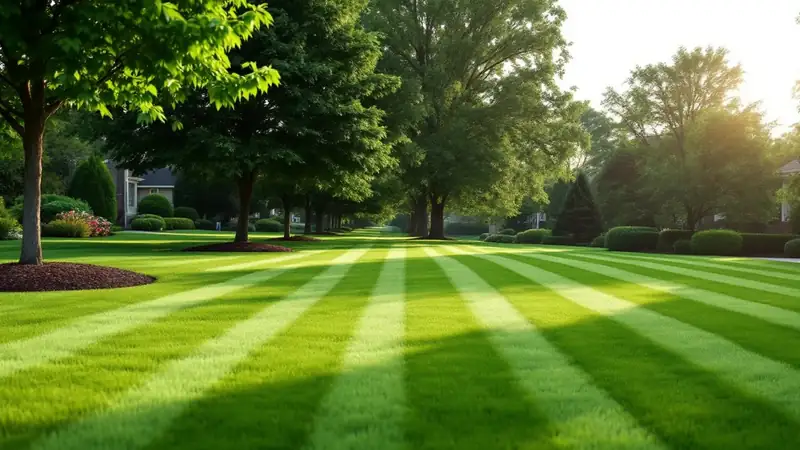
Centipede grass is a slow-growing warm-season lawn grass for acidic Southern soils: mow at 1 to 2 inches, keep soil pH near 5.0 to 6.0 and feed only 1 to 2 lb of nitrogen per 1,000 sq ft yearly.
Key takeaways
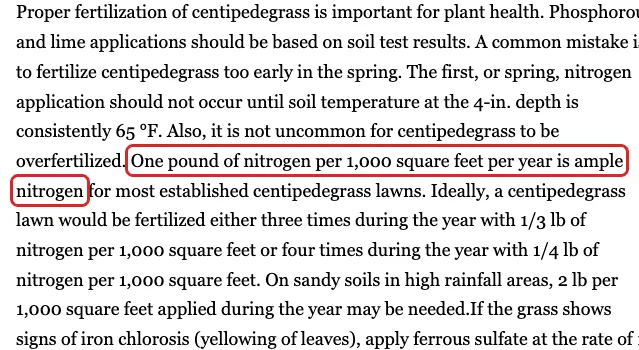
- Feed centipede grass 1 to 2 lb of nitrogen per 1,000 sq ft a year, starting no earlier than mid-May in North Carolina; UGA calls 1 lb ample for most established lawns, and overfeeding is linked to centipedegrass decline (Clemson HGIC 1215; NC State AG-381; UGA C1003).
- Centipede grass wants soil pH 5.0 to 6.0; above about 6.5 it turns yellow from iron chlorosis, which a spray of 2 oz ferrous sulfate in 3 to 5 gallons of water per 1,000 sq ft masks for weeks (UGA C1003; UF/IFAS LH009).
- It is the cheapest warm-season sod in the USDA’s national report: 28.27 cents per sq ft at the farm in April to June 2026, against 38.04 for bermudagrass and 54.25 for St. Augustinegrass (USDA AMS).
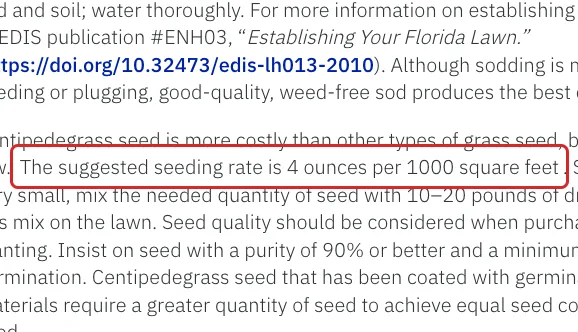
- Seed at 1/4 to 1/2 lb per 1,000 sq ft between April and July; it takes about 28 days to germinate and up to three years to form a full lawn (NC State AG-381; UF/IFAS LH009).
- Centipede grass is sensitive to 2,4-D, should get no herbicide above 90°F, and is excluded from oxadiazon (Ronstar) preemergent use (Clemson HGIC 1215; UGA Bulletin 1462).
| Key number | Value | Source |
|---|---|---|
| Mowing height | 1 to 2 in; never let it pass 2.5 in | NC State AG-381 |
| Nitrogen per year | 1 to 2 lb per 1,000 sq ft | Clemson HGIC 1215 |
| Preferred soil pH | 5.0 to 6.0 | UGA C1003 |
| Full sun needed | At least 6 hours a day | Clemson HGIC 1215 |
| Seeding rate (raw seed) | 1/4 to 1/2 lb per 1,000 sq ft | NC State AG-381 |
| Germination | About 28 days (N.C.); 2 to 3 weeks (Fla.) | NC State AG-381; UF/IFAS LH009 |
| Water, growing season | About 1 in a week, rain plus irrigation | UGA C1003 |
| Sod, national farm price | 28.27¢ per sq ft (Q2 2026) | USDA AMS |
| Hardiness range | USDA zones 7a to 10b | NC State Plant Toolbox |
What is centipede grass, and where does it grow?
Centipede grass (Eremochloa ophiuroides) is a light green warm-season turfgrass from southern China and Southeast Asia that spreads by above-ground stolons and was introduced to the United States in 1916 (UF/IFAS LH009). UF/IFAS rates it low maintenance, with about 50 percent less nitrogen than other Florida lawn grasses, and calls it the most common home lawn grass in the Florida Panhandle.
Its range is the acidic, sandy Southeast. UGA places good centipede lawns from North Carolina south through Georgia and north Florida, then west along the Gulf into Arkansas and Texas (UGA Georgia Turf). NC State lists USDA hardiness zones 7a to 10b and says the grass is grown mostly east of Interstate 95 in North Carolina (NC State Plant Toolbox; NC State AG-381).
The species name comes from its stolons: UT Extension says the plants spread slowly by short, thick, centipede-like runners (UT Extension W159-C). The same source says limited cold hardiness of Common centipedegrass has restricted its use in Tennessee and the northern transition zone, which is why cultivar choice matters in the transition zone. Profiles of the other warm- and cool-season grasses are in our Turf & Trees section.
Sod farms show where it is planted. In North Carolina, 14 of 21 surveyed producers (67 percent) grow centipedegrass, the third most common species (NC State sod report, 2026). In Florida, only three producers, all in north Florida, had it in production in 2024, on 155 acres against 14,157 acres of St. Augustinegrass (UF/IFAS EP658).
| Trait | Centipedegrass | Bahiagrass | Bermudagrass | St. Augustinegrass | Zoysiagrass (Z. japonica) |
|---|---|---|---|---|---|
| Mowing height (in) | Under 2.0 | 3.0 to 4.0 | 0.5 to 2.0 | 2.0 to 4.0 | 2.5 or less |
| Leaf texture | Medium | Medium to coarse | Fine to medium | Medium to coarse | Medium |
| Drought | Good | Excellent | Excellent | Good | Excellent |
| Salt | Poor | Poor | Good | Good | Excellent |
| Shade | Fair | Fair | Poor | Good to excellent | Good to excellent |
| Wear | Fair | Poor | Excellent | Fair | Excellent |
| Nematode tolerance | Poor | Excellent | Poor | Good | Good |
| Maintenance level | Low | Low | Medium to high | Medium | Medium |
| Establishment | Seed, sod, plugs | Seed, sod | Sod, sprigs, plugs, seed | Sod, plugs | Sod, plugs, seed |
What does centipede grass look like?
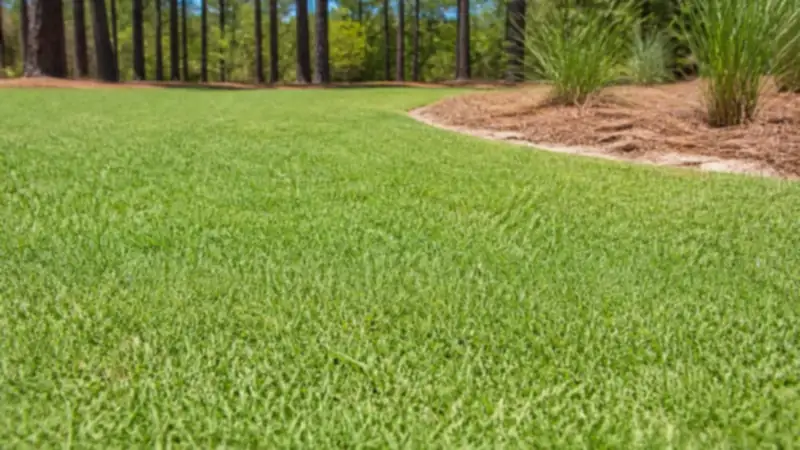
Centipede grass looks like a low, apple-green mat of medium-textured blades 3 to 5 millimeters wide, smooth, with hairs on the margins toward the base, growing on stolons that root at each node (UF/IFAS LH009). Clemson describes the blades as strongly creased, folded and narrowing to a point, with leaves alternately arranged along the stolon (Clemson HGIC).
The seedhead settles most identification questions. NC State describes a purple, spike-like raceme 3 to 5 inches long, a white midvein and short hairs on the ligule (NC State Plant Toolbox). LSU AgCenter adds that centipedegrass has one slender spike per seedhead, while carpetgrass, its closest look-alike, has several (LSU AgCenter).
| Feature | Centipedegrass | St. Augustinegrass | Carpetgrass | Source |
|---|---|---|---|---|
| Leaf tip | Narrow, pointed, folded blade | Wide, flat, rounded or blunt tip | Not described | Clemson HGIC |
| Leaf arrangement on stolon | Alternate | Opposite | Not described | Clemson HGIC |
| Leaf width | 3 to 5 mm; under 1/4 in | Wider than most other lawn grasses | Not described | UF/IFAS LH009; UGA |
| Seedhead | Single slender spike-like raceme, 3 to 5 in, purple | Chunky spike with spikelets embedded in its sides | Multiple spikes per seedhead | NC State; LSU AgCenter |
| Color | Light, apple green; yellows easily | Green to blue-green | Not described | Clemson HGIC 1215 |
What are the negatives of centipede grass?
The negatives of centipede grass are poor salt, wear and freeze tolerance, damage from nematodes and ground pearls, natural yellowing from iron chlorosis, and a decline disease that overfeeding makes worse, all listed by UF/IFAS (UF/IFAS LH009). Clemson adds that it needs at least 6 hours of full sun and tolerates neither compaction, high phosphorus, high pH, low potassium nor heavy shade (Clemson HGIC 1215).
- Cold: Alabama Extension calls winter kill erratic, with one lawn lost while a neighbor’s survives; it ties the risk to fertilization, shade, soil type, elevation, mowing height and herbicide use (Alabama Extension).
- Recovery: it does not recover from injury as quickly as other grasses and is less wear tolerant than bermudagrass or zoysiagrass (Alabama Extension).
- Pests with no fix: UF/IFAS says there are no effective control products for ground pearls (UF/IFAS LH009).
- Herbicides: NC State warns it is sensitive to 2,4-D and says to wait three weeks after green-up for postemergence sprays (NC State AG-381).
- Thatch: its stolons are high in lignin, resist decay and build a heavy thatch layer under high nitrogen rates (UF/IFAS LH009).
Which centipede grass varieties can you buy?
Few centipede grass varieties exist because the grass is used in a small region: UF/IFAS lists Common, Covington, Santee and TifBlair as available in Florida (UF/IFAS LH009). Clemson names Centennial, Oaklawn, Covington, Santee, TennTurf and TifBlair as improved cultivars and says only TifBlair is available as seed among them (Clemson HGIC 1209). Common seed is also sold.
| Cultivar | Released by, year | Sold as | Distinguishing trait | Source |
|---|---|---|---|---|
| Common | Unimproved population; no single release | Seed, sod, plugs | Slow, prostrate growth; most widely planted | UF/IFAS LH009; UGA C1003 |
| Chinese Red Stem (PI 72260) | First commercial strain in the U.S. | Seed (in Common mixes) | Red-stemmed strains usually more cold tolerant | UT W159-C |
| Oklawn (Clemson spells it Oaklawn) | Oklahoma State AES, 1965 | Plugs, sprigs, sod | Bluish-green; heat, drought, insect and disease tolerant | UT W159-C |
| AU Centennial | Auburn University, 1983 | Vegetative only | Dwarf; better color, density, cold and alkaline-soil tolerance | UT W159-C; Clemson |
| TennTurf (formerly Tennessee Hardy) | University of Tennessee, 1997 | Stolons, plugs, sod | Very cold hardy; suits pH 4.5 to 5.5 and 1 lb N a year | UT W159-C |
| TifBlair | USDA-ARS and UGA, Tifton, Ga., 1997 | Seed and sod (certified) | Better cold tolerance, low-pH tolerance and growth rate than Common | USDA-ARS; UT W159-C |
| Santee | Sod Solutions, proprietary | Sod | Clemson: for the lower third of South Carolina | Clemson HGIC 1209; UF/IFAS |
| Covington | Sod Solutions, proprietary | Sod | Emerald green; stays green several weeks longer in fall (UF) | UF/IFAS LH009; Clemson |
Is TifBlair better than common centipede grass?
TifBlair is the better pick where winters are cold: USDA-ARS says it improves on Common in cold tolerance, tolerance of low soil pH and growth rate (USDA-ARS Tifton). UGA calls it the only certified centipedegrass cultivar, and Alabama Extension says its cold tolerance may make it perform better in the transition zone of northern Alabama (UGA C1003; Alabama Extension).
It was bred by irradiating Common seed with 10,000 rads of cobalt-60 gamma radiation for four cycles, planting it at Blairsville, Ga., and harvesting seed from plants that survived the 1980 to 1984 winters (USDA-ARS). Registration dates to 1997, but ARS expected seed in early 2000 and sod in 2001. Its licensee, The Turfgrass Group, markets it for USDA zone 7 and recommends 1 to 2 lb of nitrogen a year (The Turfgrass Group).
The trade-off is price. In October 2026, a 1 lb bag of TifBlair seed cost $59.99 to $67.70, against $45.00 a pound for Common raw seed in a 2 lb bag (Hancock Seed; Seed Barn; Hancock Seed, raw). Per pound, TifBlair runs about 33 to 50 percent more.
Should you plant centipede grass from seed, sod or plugs?
Plant centipede grass from sod for an instant lawn, or from seed if you can wait: seeding is cheap but slow, with germination in about 28 days and up to three years to a uniform lawn (NC State AG-381). UF/IFAS says sod establishes faster and resists stress better, while plugs and sprigs leave bare soil that weeds take over (UF/IFAS LH009).
| Method | Rate | When | Time to cover | Source |
|---|---|---|---|---|
| Seed | 1/4 to 1/2 lb per 1,000 sq ft (Clemson, NC State, Alabama); 4 oz (UF) | April to July; fall seeding undesirable | Germinates in 2 to 3 weeks (UF) or 28 days (NC); up to 3 years to a dense lawn | NC State AG-381; UF/IFAS LH009 |
| Sod | Pieces fitted tightly, rolled, watered | May for repairs (Clemson) | Mow after 2 to 3 weeks, once it resists a tug | UF/IFAS LH009; Clemson |
| Plugs | About 1 ft apart | After all risk of hard freeze (seller) | Slow; weeds fill gaps first | LSU AgCenter; Hancock; UF/IFAS |
| Sprigs | 5 bushels per 1,000 sq ft (Clemson) or 3/4 bushel (NC State) | May | Slow | Clemson HGIC 1215; NC State AG-381 |
Whether sod is worth the premium on your lot, given that centipede seed needs about 28 days just to germinate, is the subject of our sod vs seed comparison.
How do you plant centipede grass seed?
Plant centipede grass seed in a soil-tested, tilled seedbed between April and July, at 1/4 to 1/2 lb of raw seed per 1,000 sq ft mixed with sand, then keep the surface moist for about 28 days (NC State AG-381; Alabama Extension). UF/IFAS asks for seed of 90 percent purity or better and at least 85 percent germination (UF/IFAS LH009).
- Test the soil. If pH is above 6.5, UF/IFAS says wettable sulfur at 10 lb per 1,000 sq ft lowers some Florida soils by about 1 pH unit; never exceed 10 lb per application, wait 60 days between, and water in with 1 inch (UF/IFAS LH009).
- Clear debris and till to a crumbly seedbed. Seed Barn’s TifBlair directions work in 10 lb of 5-10-15 per 1,000 sq ft at this step (Seed Barn).
- Weigh the seed: 1/4 to 1/2 lb of raw seed per 1,000 sq ft. Mix 1 lb of seed with 20 lb of dry sand, per Alabama Extension, or with 2 gallons of fine sand per 1,000 sq ft, per NC State (Alabama Extension; NC State AG-381).
- Spread half the mix in one direction and half at right angles (Alabama Extension). Rake it 1/8 to 1/4 inch deep (Hancock Seed).
- Mulch lightly with weed-free straw so 50 to 75 percent of bare ground is covered (UF/IFAS LH009).
- Water lightly several times a day for 28 days (NC State AG-381). After germination, water less often but more deeply (UF/IFAS LH009).
- Expect the stand to need 6 to 8 weeks after germination to establish in Florida (UF/IFAS LH009), and up to three years to become dense in North Carolina.
Why do seed bags say 1 to 2 lb when extension says 1/4 lb?
Seed bags often list 1 to 2 lb per 1,000 sq ft because many are coated: Hancock says its coated centipede seed is about 50 percent coating by weight, and UF/IFAS warns coated seed needs more product for the same seed count (Hancock Seed; UF/IFAS LH009). Hancock lists the same 1 to 2 lb rate for its raw seed, which is two to eight times the 1/4 to 1/2 lb extension rate.
| Source | Seed type | Stated rate per 1,000 sq ft | Highest rate (lb) |
|---|---|---|---|
| UF/IFAS LH009 | Not specified | 4 oz | 0.25 |
| Super-Sod | TifBlair | 1 lb covers up to 4,000 sq ft | 0.25 |
| Clemson HGIC 1215 | Not specified | 1/4 to 1/2 lb | 0.5 |
| NC State AG-381 | Not specified | 1/4 to 1/2 lb | 0.5 |
| Alabama Extension | Not specified | 1/4 to 1/2 lb | 0.5 |
| Hancock Seed | TifBlair, coated | 1 lb per 2,000 sq ft | 0.5 |
| Seed Barn | TifBlair, certified | 1/2 lb; up to 1 lb for faster grow-in | 1.0 |
| Outsidepride | Common | 1/2 to 1 lb | 1.0 |
| Hancock Seed | Common, coated (about 50% coating) | 1 to 2 lb | 2.0 |
| Hancock Seed | Common, raw | 1 to 2 lb | 2.0 |
| Pennington | TifBlair Penkoted seed and mulch | 2.5 lb of product | 2.5 |
In practice, weigh pure live seed, not bag weight. Half a pound of coated seed that is 50 percent coating holds about 1/4 lb of seed, the bottom of the extension range, so the Hancock coated rate of 1 to 2 lb equals roughly 1/2 to 1 lb of raw seed. That is still up to twice the 1/2 lb ceiling that Clemson, NC State and Alabama Extension publish.
How much does centipede grass cost?
Centipede grass sod averaged 28.27 cents per sq ft at the farm nationally in April to June 2026, in a range of 27 to 35 cents, before delivery (USDA AMS). North Carolina farms averaged 38 cents on the farm and 43 cents delivered in 2026 (NC State sod report). Raw seed ran $30.00 to $45.00 a pound and TifBlair $45.67 to $67.70 in October 2026.
Swipe the table sideways to see every column.
| Item | Price | Unit price | Source, date |
|---|---|---|---|
| Centipede sod, U.S. farm (trade) | 27¢ to 35¢ per sq ft | 28.27¢ weighted average | USDA AMS, Q2 2026 |
| Bermudagrass sod, U.S. farm (trade) | 23¢ to 72¢ | 38.04¢ | USDA AMS, Q2 2026 |
| Zoysiagrass sod, U.S. farm (trade) | 51¢ to 78¢ | 52.32¢ | USDA AMS, Q2 2026 |
| St. Augustinegrass sod, U.S. farm (trade) | 52¢ to 85¢ | 54.25¢ | USDA AMS, Q2 2026 |
| Centipede sod, N.C. on farm | 25¢ to 62¢ | 38¢ average | NC State, 2026 |
| Centipede sod, N.C. delivered | 30¢ to 67¢ | 43¢ average | NC State, 2026 |
| Centipede sod, north Florida farm | n/a | 32¢ | UF/IFAS EP658, 2024 |
| Centipede sod, pallet (about 450 sq ft) | $215 | About 48¢ | Panhandle Palm & Rock, Oct. 19, 2026 |
| TifBlair sod, retail store price | $1.00 to $1.18 per sq ft | Varies by store | Super-Sod, Oct. 19, 2026 |
| Common seed, coated | $58.99 (2 lb) to $834.99 (50 lb) | $29.50 to $16.70 per lb | Hancock Seed, Oct. 19, 2026 |
| Common seed, raw | $89.99 (2 lb) to $1,499.99 (50 lb) | $45.00 to $30.00 per lb | Hancock Seed, Oct. 19, 2026 |
| TifBlair seed | $59.99 (1 lb) to $1,499.99 (30 lb) | $59.99 to $50.00 per lb | Hancock Seed, Oct. 19, 2026 |
| TifBlair seed, certified | $67.70 (1 lb) to $1,370.00 (30 lb) | $67.70 to $45.67 per lb | Seed Barn, Oct. 19, 2026 |
| TifBlair seed | $66.95 (1 lb); $324.95 (5 lb) | $66.95 to $64.99 per lb | Super-Sod, Oct. 19, 2026 |
| Centipede plugs | $44.99 (16) to $109.99 (64) | $2.81 to $1.72 per plug | Hancock Seed, Oct. 19, 2026 |
Those are material prices only; the USDA figure is a trade price before delivery charges of 5 to 12 cents per sq ft. Installed sod adds site prep, delivery and labor, which our sod installation cost guide prices per square foot from the same USDA report. Per-pound prices for every lawn species are compiled in our grass seed cost guide.
What does it cost to plant a 5,000 sq ft centipede lawn?
Planting a 5,000 sq ft centipede lawn costs about $90 to $325 in seed or about $1,400 to $5,900 in sod at October 2026 prices, before labor; plugs on 12-inch centers cost more than either at about $8,700. The table shows each input: rate, quantity, the bag or pallet you would actually buy and the dated price behind it.
| Method | Rate or unit (source) | Quantity for 5,000 sq ft | Buy | Material cost |
|---|---|---|---|---|
| Common raw seed | 1/4 to 1/2 lb per 1,000 sq ft (NC State) | 1.25 to 2.5 lb | One 2 lb bag ($89.99) or one 5 lb bag ($196.99) | $89.99 to $196.99 |
| Common coated seed | 1 to 2 lb per 1,000 sq ft (Hancock label) | 5 to 10 lb | 5 lb ($129.99) or 10 lb ($204.99) | $129.99 to $204.99 |
| TifBlair seed | 1/2 lb per 1,000 sq ft (Seed Barn, Hancock) | 2.5 lb | Three 1 lb bags at $59.99, or a 5 lb bag ($247.77 to $324.95) | $179.97 to $324.95 |
| Sod at USDA farm price | 28.27¢ per sq ft (USDA AMS) | 5,000 sq ft | Trade price before delivery | $1,413.50 |
| Sod delivered, N.C. average | 43¢ per sq ft (NC State) | 5,000 sq ft | Delivered within about 100 miles | $2,150.00 |
| Sod by the pallet, Florida | $215 per pallet of about 450 sq ft | 11.1 pallets | 12 pallets | $2,580.00 |
| TifBlair sod, retail | $1.00 to $1.18 per sq ft (Super-Sod) | 5,000 sq ft | Store pickup | $5,000 to $5,900 |
| Plugs on 12 in centers | 1 plug per sq ft (LSU spacing) | 5,000 plugs | 79 packs of 64 at $109.99 | $8,689.21 |
Seed wins on material cost by a factor of about 7 to 65, which is why UF/IFAS calls seeding’s up-front cost low (UF/IFAS LH009). What seed costs instead is time: a season or more of weeding and daily watering before the lawn closes, against a sodded lawn you can mow after 2 to 3 weeks.
How high should you mow centipede grass?
Mow centipede grass at 1 to 2 inches and never let it pass 2.5 inches, the range in NC State’s and Clemson’s calendars (NC State AG-381; Clemson HGIC 1215). UGA and Alabama Extension go lower, at 1 to 1.5 inches, and Clemson suggests 2 inches in partial shade. Remove no more than a third of the blade at once (UGA C1003).
| Source | Recommended height | Added rule |
|---|---|---|
| NC State AG-381 | 1 to 2 in | Never taller than 2.5 in; never burn off debris |
| Clemson HGIC 1215 | 1 to 2 in | 2 in in partial shade; about 1 in just before spring green-up; 2 in once nights fall below 70°F |
| Clemson HGIC 1209 | 1.5 to 2 in | Older Clemson fact sheet, revised 2016 |
| UGA C1003 | 1.0 to 1.5 in | Raise 1/4 to 1/2 in during heat or before winter |
| Alabama Extension | 1 to 1.5 in | Repeated mowing below 1 in thins the lawn |
| LSU AgCenter | 1 to 2 in | At 1 in, mow before it passes 1.5 in |
| UF/IFAS LH009 | 1.5 to 2.5 in (text); under 2.0 in (Table 1) | Mow every 7 to 14 days in active growth |
| NC Extension, Pender County | About 1 in, no higher than 2 in | High-mown lawns are more prone to cold damage |
| Scotts; Pennington | 1.5 to 2 in | Retail guides |
Why lower is safer: mowing too high and too seldom lets thatch build up, and thatch-raised stolons are more exposed to cold and drought, according to Alabama Extension and UGA (Alabama Extension; UGA C1003). During heat or drought stress, Clemson says to raise the deck 1/2 to 1 inch until the stress passes (Clemson HGIC 1215).
Should you dethatch or aerate centipede grass?
Dethatch centipede grass only when thatch passes 1/4 inch (Clemson HGIC 1215) or 1/2 inch (NC State AG-381 and Clemson HGIC 1209), using 2 to 3 inch blade spacing set 1/4 inch deep; a 1 inch spacing can severely injure it (Clemson HGIC 1215; NC State AG-381). UGA warns centipede tolerates vertical mowing less than other warm-season grasses (UGA C1003).
Timing is late May in North Carolina, after full green-up, and core aeration can be combined with it once frost risk has passed (NC State AG-381; Clemson HGIC 1215). If a preemergent went down in late February to mid-March, Clemson says to postpone soil disturbance until just before the next preemergent. Machine rental and contractor prices for the job are in our dethatching cost guide.
How much fertilizer does centipede grass need?
Centipede grass needs 1 to 2 lb of nitrogen per 1,000 sq ft a year, the higher rate on sandy soil and the lower on clay, and more than 2 lb builds thatch and invites disease (Clemson HGIC 1215). UGA says 1 lb is ample for most established lawns, split into three 1/3 lb or four 1/4 lb feedings (UGA C1003). Skip phosphorus unless a soil test calls for it.
| Source | Nitrogen, lb per 1,000 sq ft a year | Low | High | Timing rule |
|---|---|---|---|---|
| Clemson HGIC 1215 | 1 to 2 | 1 | 2 | Early May after full green-up; last before Aug. 15 (Upstate) or Sept. 1 (coast) |
| UGA C1003 | 1; up to 2 on sandy soil in high rainfall | 1 | 2 | Not until soil at 4 in is consistently 65°F |
| NC State AG-381 | 1 in mid-May; optional 1 in mid-August | 1 | 2 | No nitrogen before mid-May |
| UF/IFAS LH009 | 0.4 to 2 (north Fla.); 0.4 to 3 (central and south Fla.) | 0.4 | 3 | Not before April 15 in north Florida; last by mid-September |
| LSU AgCenter | Up to 1 | 0 | 1 | Midspring to midsummer; 1 lb per application at most |
| Clemson HGIC 1209 | 0 to 2 | 0 | 2 | Older Clemson fact sheet |
| The Turfgrass Group (TifBlair) | 1 to 2 | 1 | 2 | During the growing season |
Timing matters as much as the rate. Fertilizing early pushes growth that a late frost can burn back, and Clemson notes centipede often greens up and is frosted back several times in spring (Clemson HGIC 1215). For a single feeding, LSU AgCenter suggests 1 lb of nitrogen from a slow-release product in April (LSU AgCenter).
What is the best fertilizer for centipede grass?
The best fertilizer for centipede grass has little or no phosphorus and plenty of potassium, such as the 15-0-15 Clemson names for the late-summer feeding (Clemson HGIC 1215). NC State suggests 5-5-15 or 8-8-24, or a phosphorus-free 15-0-14 or 8-0-24 where soil tests show moderate to high phosphorus (NC State AG-381). Rate matters more than brand.
To find pounds of product, Clemson and NC State divide 50 by the first number on the bag for 1/2 lb of nitrogen per 1,000 sq ft, or 100 for 1 lb (Clemson HGIC 1215; NC State AG-381). The table runs that arithmetic for bags centipede owners are told to buy.
| Product (N-P-K) | Who names it | Product per 1,000 sq ft | Nitrogen delivered | Also delivers |
|---|---|---|---|---|
| 15-0-15 | Clemson HGIC 1215 | 3.3 lb (50 / 15) | 0.5 lb | 0.5 lb potash |
| 5-0-15 | Pender County Extension | 10 lb | 0.5 lb | 1.5 lb potash |
| 5-5-15 | NC State AG-381 | 10 lb (50 / 5) | 0.5 lb | 0.5 lb phosphate, 1.5 lb potash |
| 16-0-8, slow release | LSU AgCenter | 6.3 lb (100 / 16) | 1 lb | 0.5 lb potash |
| 33-0-0 | LSU AgCenter | 1.5 lb | 0.5 lb | Nothing else |
| 32-0-5 | Pennington guide | 1.6 lb (50 / 32) | 0.5 lb | 0.08 lb potash |
| 10-10-10 | Asked in search results | 5 lb (50 / 10) | 0.5 lb | 0.5 lb phosphate, which Clemson says to skip without a soil test |
| 15-0-4 centipede weed and feed | Hancock Seed label rate | 6.4 lb (32 lb per 5,000 sq ft) | 0.96 lb | 0.26 lb potash plus herbicide |
| 0-0-60 muriate of potash | Clemson HGIC 1215 | 1.6 lb | None | About 1 lb potash, 4 to 6 weeks before first frost |
The weed-and-feed line shows the trap: one bag at the label rate puts down 0.96 lb of nitrogen per 1,000 sq ft, nearly the 1 lb a year that UGA calls ample, in a single pass (Hancock Seed; UGA C1003). LSU AgCenter also warns that repeated use of 8-8-8 or 13-13-13 builds up phosphorus that harms centipede lawns (LSU AgCenter).
Why is my centipede grass turning yellow?
Yellow centipede grass usually means iron chlorosis, caused by soil pH above 6.0 to 6.5, excess phosphorus, or cool spring nights that slow root uptake while warm days push leaves (UF/IFAS LH009; UGA C1003). Spraying 2 oz of ferrous sulfate in 3 to 5 gallons of water per 1,000 sq ft restores color; NC State says within 24 hours (Clemson HGIC 1215; NC State AG-381).
Iron is a cosmetic fix, not a cure. UGA says applications darken the grass only temporarily and may be needed every two to four weeks, and UF/IFAS says iron is no substitute for nitrogen (UGA C1003; UF/IFAS LH009). For high pH, Clemson allows no more than 5 lb of pelletized sulfur per 1,000 sq ft per application, only below 80°F, and 10 lb a year at most (Clemson HGIC 1215).
| Soil pH reading | What it means for centipede | Action | Source |
|---|---|---|---|
| Below 5.0 | Below the preferred range; rare | Lime only if the soil test says so | LSU AgCenter |
| 5.0 to 6.0 | Preferred range | No change | UGA C1003; LSU |
| 6.0 to 6.5 | Iron availability starts to fall | Watch spring color; iron spray as needed | UGA C1003; Alabama |
| Above 6.5 | Iron chlorosis likely | Sulfur at no more than 5 lb (pelletized) per 1,000 sq ft per application | Clemson HGIC 1215; UF/IFAS |
| 6.5 to 7.0 and up | Severe chlorosis possible | Consider another grass | UF/IFAS LH009 |
How much water does centipede grass need?
Established centipede grass needs about 1 inch of water a week from rain plus irrigation, applied to wet the soil 5 to 7 inches deep, ideally before sunrise (UGA C1003). On sandy soil, NC State suggests 1/2 inch every third day when rain falls short (NC State AG-381). Water when the lawn turns bluish or footprints stay flat (Clemson HGIC 1215).
UF/IFAS rates its drought tolerance good: it goes dormant and brown without water and usually recovers soon after rain (UF/IFAS LH009). Clemson lists drought among the stresses it does not tolerate, and Pennington notes its roots are shallow (Clemson HGIC 1215; Pennington). In dry winters, Clemson says to water if no measurable rain falls for 3 to 4 weeks, especially before lows in the low 20s °F.
New sod and plugs need a stepped schedule, which UF/IFAS spells out (UF/IFAS LH009):
- Days 1 to 10: 2 to 3 brief waterings a day, 5 to 10 minutes each.
- Next 7 to 10 days: once a day, 1/4 inch.
- Following week: every other day, 1/4 to 1/2 inch.
- From about day 30: a normal maintenance schedule of 1/2 to 3/4 inch per watering, as needed.
Clock times and run lengths for each zone type are in our guide to the best time to water your lawn.
What causes centipede grass decline, and can you fix it?
Centipede grass decline is a spring die-back of yellow or dead patches in lawns a few years old, tied to the fungus Gaeumannomyces graminis var. graminis and made worse by high nitrogen, pH above 6.5, thatch, scalping and stressed roots (UF/IFAS LH009). No fungicide controls it, says Alabama Extension; management prevents it (Alabama Extension).
| What you see (UGA diagnostic question) | Likely cause | What to do | Source |
|---|---|---|---|
| Yellowing as it greens up in spring or goes dormant in fall | High pH or phosphorus; iron deficiency | Soil test; sulfur if pH is high; iron spray for color | UGA C1003 |
| Lawn stayed dark green most of last season | Too much nitrogen | Cut to 1 lb N a year | UGA C1003 |
| Turf lifts easily when you pull a stolon | Poor roots: thatch, compaction, drought or nematodes | Dethatch, core aerate, test for nematodes | UGA C1003 |
| Hard to push a screwdriver into the soil | Compaction | Core aerate after green-up | UGA C1003 |
| Blades dull green and curled in dry weather | Drought stress | Deep watering to 1 in a week | UGA C1003 |
| Rings or semicircles of dying grass in summer | Fairy ring fungi | Have a sample diagnosed | UGA C1003 |
| Circular patches in spring or fall | Large patch (brown patch) | Fall fungicide; fix drainage and thatch | UGA C1003; Pender |
| Soft, fluffy turf full of tunnels | Moles or mole crickets | Identify the pest before treating | UGA C1003 |
To prevent or correct decline, UGA lists the same short program: prepare soil from a soil test, hold nitrogen to about 1 lb a year, mow at 1 to 1.5 inches, control thatch, and irrigate during drought, particularly in fall (UGA C1003). UF/IFAS adds a soil pH check and nematode and disease sampling through the county Extension office (UF/IFAS LH009).
Which pests and diseases hit centipede grass hardest?
Ground pearls and nematodes hit centipede grass hardest, because neither has a dependable chemical fix and centipede’s low vigor makes it the most severely damaged warm-season grass (Pender County Extension). Large patch is the most common disease in the growing season, Clemson says, while mole crickets, white grubs and spittlebugs cause summer insect damage (Clemson HGIC 1215).
| Problem | Sign | Threshold or timing | Control | Source |
|---|---|---|---|---|
| Ground pearls (scale insect) | Yellow then dead patches growing about 1 ft in diameter a year; tan pearls in the soil at the edge | Any confirmed | None effective; replant with shrubs or trees, or zoysiagrass | Pender County; UF/IFAS |
| Nematodes (ring, sting) | Severe wilt even when watered | Lab assay of soil from the patch margin | Less nitrogen, deep and infrequent watering, adequate potassium | UF/IFAS LH009; Alabama |
| Large patch | Circles 2 to 3 ft across in spring that can pass 10 ft in weeks | Preventive spray when soil falls to 70°F or below, late Sept. to early Oct. | Fungicides with azoxystrobin or triadimefon, per label | Pender County; Clemson |
| White grubs | Turf peels back like carpet | More than 6 grubs per square foot | Labeled grub insecticide; preventive in June | Clemson HGIC 1215; NC State |
| Mole crickets | Tunnels, soft turf | Nymphs hatch midsummer | Insecticide in mid-July aimed at small nymphs | Clemson HGIC 1215 |
| Two-lined spittlebug, sod webworms, caterpillars | Browning, chewed blades | Scout in summer | Identify, then a labeled insecticide | Clemson; UF/IFAS |
| Dollar spot | Small straw-colored spots | Sporadic | Balanced nutrition; fungicide if needed | UF/IFAS LH009 |
This page is general information, not pesticide advice. The label is the law: confirm that any herbicide, insecticide or fungicide lists centipedegrass, follow its rate, temperature and reentry rules, and check your state’s rules before you apply.
Which weed killers are safe on centipede grass?
Weed killers labeled for centipede grass include sethoxydim for crabgrass, goosegrass and sandspurs, imazaquin for sedges, and atrazine or simazine in November or December for annual bluegrass and winter broadleaf weeds (Clemson HGIC 1215; NC State AG-381). Use 2,4-D mixes with caution and at reduced rates, and spray nothing above 90°F.
Which straight 2,4-D labels warn on centipede, St. Augustine and carpetgrass is set out grass by grass in our answer to does 2,4-D kill grass.
For crabgrass that is already up, Tenacity and Pylex both list centipedegrass while every quinclorac label bars it; our comparison of crabgrass killers that won’t kill grass sets 9 labels side by side.
| Active ingredient (example brand) | Targets in centipede | When | Limit or caution | Source |
|---|---|---|---|---|
| Preemergents labeled for centipede | Crabgrass, goosegrass, foxtail, sandspurs | Mid-Feb. (coast) to mid-March (piedmont); by March 1 in N.C.; repeat in 8 to 10 weeks | Do not use on dead or declining areas | Clemson; NC State; Pender |
| Sethoxydim (Segment) | Crabgrass, goosegrass, sandspurs, bahiagrass | Summer, active growth | Resistant crabgrass and goosegrass confirmed in Georgia | Clemson; UGA B1462; UGA Tattnall |
| Topramezone (Pylex) | Sethoxydim-resistant crabgrass and goosegrass | 1 or 2 applications, 2 to 3 weeks apart | Foliar bleaching; crop oil adjuvant | UGA B1462 |
| Mesotrione (Tenacity) | Crabgrass; seedling goosegrass only | 2 applications, 3 weeks apart | Does not control mature goosegrass | UGA B1462 |
| Metsulfuron methyl (Manor, Blade) | Bahiagrass, lespedeza | 0.25 to 0.5 oz product per acre | Calibrated sprayer; nonionic surfactant | UGA Tattnall |
| Imazaquin | Sedges (nutgrass) | Summer | Label rate | Clemson HGIC 1215 |
| Atrazine or simazine | Annual bluegrass, winter broadleaf weeds | November or December | Label rate | NC State AG-381 |
| 2,4-D + dicamba + mecoprop (three-way) | Spurge, lespedeza, chickweed, henbit | 3 weeks after green-up; repeat in 10 to 14 days if needed | Centipede is sensitive; reduced rates | Clemson; NC State |
| Oxadiazon (Ronstar) | None: not for centipede | n/a | Labeled for most warm- and cool-season turf except centipedegrass | UGA B1462 |
Clemson adds three handling rules: apply only when grass and weeds are actively growing and not drought stressed, do not mow 3 days before or 2 days after a spray, and wait until spring green-up is complete before any postemergent (Clemson HGIC 1215). Common invaders listed by UF/IFAS are crabgrass, goosegrass, dallisgrass, annual bluegrass and torpedograss, plus dandelion, clover, pennywort, betony, oxalis and henbit (UF/IFAS LH009).
A thick centipede stand is itself the cheapest weed control: Alabama Extension says an established lawn crowds out many weeds, while new and thin stands are easily invaded (Alabama Extension).
Should you use weed and feed on centipede grass?
Most extension sources say no. Pender County Extension tells centipede owners to avoid weed and feed because the herbicides can damage the grass and the timing for weed control is the wrong time to fertilize (Pender County Extension). Hancock’s own seeding directions say not to use a weed-and-feed product on new seedings (Hancock Seed).
Retail guides disagree: Pennington and Scotts recommend a weed and feed labeled for centipede after green-up, with Scotts saying to wait until the third or fourth mowing (Pennington; Scotts). If you use one, check the nitrogen math first. At the label rate, Hancock’s 15-0-4 product delivers 0.96 lb of nitrogen per 1,000 sq ft in one pass (Hancock Seed).
When should you do each job on a centipede lawn?
A centipede grass year runs on soil temperature, not the calendar: preemergent by March 1, mowing low before green-up, the only main feeding in mid-May, an optional one in mid-August, potash 4 to 6 weeks before frost, and nothing but weed control and occasional water in winter (NC State AG-381; Clemson HGIC 1215). Shift dates two to four weeks earlier on the Gulf.
| Month | Mowing | Feeding | Weeds and pests | Source |
|---|---|---|---|---|
| January to February | 1 to 2 in to clear debris; never burn | None; soil test now | Preemergent mid-February on the coast | Clemson HGIC 1215 |
| March to April | Lower to about 1 in just before green-up (late April to early May) | No nitrogen | Preemergent by March 1 (N.C.), mid-March (piedmont) | NC State AG-381; Clemson |
| May | 1 to 2 in; dethatch late May if over 1/2 in | 1 lb N in mid-May; 1/2 to 1 lb (Clemson) | Postemergent 3 weeks after green-up; replant bare spots | NC State AG-381 |
| June to July | 1 to 2 in; raise in heat or drought | Iron for color only | Grub preventive in June; mole cricket and grub nymphs mid-July | NC State; Clemson |
| August | 1 to 2 in | Optional 1/2 to 1 lb N with high potassium, before Aug. 15 (Upstate S.C.) or Sept. 1 (coast) | Spot-treat broadleaf weeds | Clemson HGIC 1215; NC State |
| September to October | Raise to about 2 in once nights fall below 70°F | 1 lb potash 4 to 6 weeks before first frost; no nitrogen | Winter preemergent in September; large patch fungicide when soil drops to 70°F | Clemson HGIC 1215 |
| November to December | Mow to remove leaves | None | Atrazine or simazine for annual bluegrass | NC State AG-381 |
A month-by-month plan for every lawn type is in our lawn care schedule. Centipede’s simplest rule from both calendars: no nitrogen before mid-May, no nitrogen after early September.
What do popular centipede grass guides get wrong?
Popular centipede grass guides most often get four things wrong against land-grant sources: mowing height, the date of the first feeding, seeding rate and weed-and-feed advice. The table sets each retail claim next to the primary source, with links to both, as published in October 2026. Retail figures are shown exactly as published on each page.
| Topic | What several guides say | What the primary source says | Primary source |
|---|---|---|---|
| Mowing height | 1 1/2 to 2 in (Pennington; Scotts; Super-Sod) | 1 to 1.5 in (UGA, Alabama); 1 to 2 in (NC State, Clemson); higher mowing raises cold injury risk (Pender) | UGA C1003; NC State AG-381 |
| First feeding | Feed in early spring with a crabgrass preventer, before soil reaches 55°F (Pennington) | No nitrogen before mid-May (N.C.) or until soil at 4 in holds 65°F (Ga.); early feeding raises frost damage | NC State AG-381; UGA C1003 |
| Seeding rate | 1 to 2 lb per 1,000 sq ft, raw or coated (Hancock); 2.5 lb seed and mulch (Pennington) | 1/4 to 1/2 lb per 1,000 sq ft; 4 oz in Florida | NC State AG-381; UF/IFAS LH009 |
| Weed and feed | Use one approved for centipede (Pennington; Scotts) | Avoid: herbicide injury and wrong fertilizer timing | Pender County Extension |
| Sunlight | Tolerates moderate shade with 4 hours of full sun (Outsidepride) | Needs at least 6 hours of full sun | Clemson HGIC 1215; Alabama |
| Drought | Shallow rooted with poor drought tolerance (Wikipedia) | Good drought tolerance by going dormant (UF); does not tolerate drought (Clemson). The sources split | UF/IFAS LH009; Clemson HGIC 1215 |
| Fertilizer product | 32-0-5 full-season feed (Pennington) | Low or no phosphorus with high potassium, such as 15-0-15; 1 to 2 lb N a year in total | Clemson HGIC 1215 |
Is centipede grass better than St. Augustine, bermuda or zoysia?
Centipede grass beats St. Augustine, bermuda and zoysia on cost and upkeep: NC State says it has the lowest nitrogen needs of the common turfgrasses and needs infrequent mowing, and its sod is cheapest at 28.27 cents a sq ft (NC State AG-381; USDA AMS). It loses on wear, salt, shade and cold. UF/IFAS rates its wear tolerance fair against excellent for bermudagrass and zoysiagrass (UF/IFAS LH009).
| Criterion | Centipedegrass | St. Augustinegrass | Bermudagrass | Zoysiagrass | Bahiagrass | Source |
|---|---|---|---|---|---|---|
| Sod, U.S. farm price, Q2 2026 | 28.27¢ | 54.25¢ | 38.04¢ | 52.32¢ | Not reported | USDA AMS |
| Sod, N.C. farm price, 2026 | 38¢ | 60¢ | 41¢ | 59¢ | Not reported | NC State |
| Mowing height (in) | Under 2.0 | 2.0 to 4.0 | 0.5 to 2.0 | 2.5 or less | 3.0 to 4.0 | UF/IFAS LH009 |
| Shade | Fair | Good to excellent | Poor | Good to excellent | Fair | UF/IFAS LH009 |
| Wear / recovery | Fair / fair | Fair / good | Excellent / excellent | Excellent / fair | Poor / poor | UF/IFAS LH009 |
| Salt | Poor | Good | Good | Excellent | Poor | UF/IFAS LH009 |
| Maintenance | Low | Medium | Medium to high | Medium | Low | UF/IFAS LH009 |
| Grown from seed | Yes | No | Yes (common types) | Some Z. japonica | Yes | UF/IFAS LH009 |
Full profiles of the alternatives: St. Augustine grass for shade and coastal salt, bermuda grass for sun and traffic, and zoysia grass for wear with less mowing than bermuda. Bahiagrass, rated low maintenance like centipede, tolerates nematodes far better on Florida’s deep sands, per UF/IFAS Table 1.
Can you mix centipede with bermuda or St. Augustine?
Mixing centipede grass with bermuda or St. Augustine rarely works, because the grasses need different mowing heights and feeding: bermudagrass mows at 0.5 to 2.0 inches and St. Augustinegrass at 2.0 to 4.0, against under 2.0 for centipede (UF/IFAS LH009). UF/IFAS rates bermudagrass medium to high maintenance against low for centipede, so one feeding program overfeeds one grass or starves the other.
Overseeding with ryegrass for winter color is also discouraged. Pennington says the competition can weaken centipede’s roots and cause the grass to fail, and Scotts says most centipede lawns are better left dormant (Pennington; Scotts). To fill thin spots instead, NC State says to replant bare areas in May with seed or sprigs, and UF/IFAS warns that reseeding patches in an established lawn usually needs hand watering.
Should you plant centipede grass? A decision table
Plant centipede grass if your soil is acidic, the lawn gets 6 or more hours of sun, traffic is light and you want to feed it once or twice a year. Choose another grass if soil pH sits above 6.5, the yard is shaded, salty or heavily used, or winters regularly kill Common centipede (Clemson HGIC 1215; UF/IFAS LH009).
| If your situation is | Do this | Why (source) |
|---|---|---|
| Soil pH above 6.5 and cannot be lowered | Plant a different grass | Severe iron chlorosis above pH 6.5 to 7.0; UF/IFAS says centipede may not be appropriate (UF/IFAS LH009) |
| Soil pH 6.0 to 6.5 | Plant, but test yearly and apply sulfur at 5 lb or less per 1,000 sq ft per pass | Iron availability falls above 6.0 (UGA C1003; Clemson) |
| Under 6 hours of direct sun | Choose St. Augustinegrass or zoysiagrass | Centipede needs at least 6 hours (Clemson HGIC 1215) |
| Daily play or dog traffic | Choose bermudagrass or zoysiagrass | Centipede wear tolerance rated fair; bermuda and zoysia excellent (UF/IFAS LH009) |
| Oceanfront or salt spray | Choose zoysiagrass or St. Augustinegrass | Centipede salt tolerance rated poor (UF/IFAS LH009) |
| Zone 7, upper South or high elevation | Plant TifBlair or TennTurf, not Common | Improved cold tolerance (USDA-ARS; UT W159-C) |
| Ground pearls confirmed in the soil | Do not replant centipede; use shrubs, trees or zoysiagrass | No effective control (Pender County Extension) |
| Deep sand in south Florida | Pick bahiagrass or St. Augustinegrass | Nematodes historically limited centipede there (UF/IFAS LH009) |
| Big lawn, tight budget, April to July | Seed at 1/4 to 1/2 lb per 1,000 sq ft | About $90 to $325 of seed for 5,000 sq ft vs $1,400 or more of sod (our arithmetic, prices Oct. 19, 2026) |
| It is mid-August to October | Wait until April to seed | Fall seedlings may not survive winter (UF/IFAS LH009; Seed Barn) |
| You want a dark green lawn | Use iron, not more nitrogen, or choose another grass | Dark green from nitrogen is a primary cause of decline (UGA C1003) |
1Is soil pH above 6.5 and hard to lower?
YesPlant a different grass; centipede yellows from iron chlorosis (UF/IFAS).
NoGo to the next question
2Does the lawn get under 6 hours of direct sun?
YesChoose St. Augustinegrass or zoysiagrass (Clemson).
NoGo to the next question
3Does it take daily play, dog or vehicle traffic?
YesChoose bermudagrass or zoysiagrass; centipede wear is rated fair (UF/IFAS).
NoGo to the next question
4Is it exposed to salt spray?
YesChoose zoysiagrass or St. Augustinegrass; centipede salt tolerance is poor (UF/IFAS).
NoGo to the next question
5Are ground pearls confirmed in the soil?
YesDo not replant centipede; use shrubs, trees or zoysiagrass (NC Extension).
NoGo to the next question
6Are you in USDA zone 7 or the upper South?
YesPlant TifBlair or TennTurf rather than Common (USDA-ARS, UT Extension).
NoGo to the next question
7Is it mid-August to October?
YesWait and seed in April to July, or lay sod (UF/IFAS).
NoPlant centipede grass: seed at 1/4 to 1/2 lb per 1,000 sq ft from April to July, or lay sod; then mow at 1 to 2 inches and feed 1 to 2 lb of nitrogen a year from mid-May.
How we compiled this
We compiled this page in October 2026 from 17 land-grant and federal documents (Clemson, UGA, NC State, UF/IFAS, LSU AgCenter, Alabama Extension, UT Extension, USDA-ARS, USDA AMS), two state sod price surveys, price or rate pages from six seed and sod sellers checked Oct. 19, 2026, and four retail or reference guides used only in the corrections table. We did no field testing; where sources disagree, both figures appear.
Frequently asked questions
Will centipede grass choke out weeds?
Once established, yes, to a point: Alabama Extension says centipede grass crowds out many weeds, but its slow growth lets weeds invade new or thin stands (Alabama Extension). UGA calls it aggressive enough to form a dense, weed-free turf (UGA C1003). A preemergent by March 1 and mowing at 1 to 2 inches do most of the remaining work.
Which is better, bermuda or centipede grass?
Bermuda grass is better for full sun and heavy traffic, with wear tolerance UF/IFAS rates excellent; centipede grass is better for low upkeep, with lower nitrogen needs and sod at 28.27 cents a sq ft against 38.04 cents for bermuda in mid-2026 (UF/IFAS LH009; USDA AMS). Bermuda is poor in shade; centipede is fair.
Is centipede grass good in Florida?
In north and central Florida, yes: UF/IFAS calls centipedegrass the most common home lawn grass in the Panhandle and rates it adapted statewide on acidic soils (UF/IFAS LH009). In south Florida’s sandy soils, nematodes historically limited it, and its salt tolerance is poor. Florida growers had only 155 acres of it in production in 2024 (UF/IFAS EP658).
When should you put centipede grass seed down?
Sow centipede grass seed from April to July, so seedlings get a full growing season before winter; UF/IFAS calls fall seeding undesirable (UF/IFAS LH009). NC State says May or whenever days stay above 60°F (NC State AG-381). Seed Barn advises against planting TifBlair from Aug. 15 to Nov. 1 (Seed Barn).
Is 10-10-10 fertilizer good for centipede grass?
Not as a routine feed. At 5 lb per 1,000 sq ft, 10-10-10 delivers 0.5 lb of nitrogen but also 0.5 lb of phosphate, and Clemson says established centipede should get no phosphorus unless a soil test shows a deficiency (Clemson HGIC 1215). LSU AgCenter warns repeated balanced fertilizers build phosphorus that harms centipede (LSU AgCenter).
How do I tell if I have centipede grass?
Look at a runner. Centipede grass has narrow, creased blades with pointed tips set alternately along the stolon, while St. Augustinegrass has wide, blunt blades in opposite pairs (Clemson HGIC). Centipede seedheads are single slender spikes 3 to 5 inches tall, often purple (NC State Plant Toolbox). Its apple-green color is lighter than most lawn grasses.
Should I dethatch centipede grass?
Only if thatch is thicker than 1/4 to 1/2 inch, measured on a cut plug (Clemson HGIC 1215; NC State AG-381). Use a dethatcher with 2 to 3 inch blade spacing set 1/4 inch deep in late May. NC State says a 1 inch spacing can severely damage the lawn, and UGA says centipede tolerates vertical mowing less than other warm-season grasses.
How do you make centipede grass spread faster?
Keep soil pH at 5.0 to 6.0, feed the 1 lb of nitrogen in mid-May once the soil is warm, water 1 inch a week in drought, and keep the mower at 1 to 2 inches (UGA C1003; NC State AG-381). Extra nitrogen does not help; UF/IFAS links overfeeding to thatch and decline. TifBlair grows somewhat faster than Common (UF/IFAS LH009).
What is the best fungicide for centipede grass?
For large patch, the most common centipede disease, Pender County Extension says fungicides containing triadimefon or azoxystrobin work best, with the best results from fall applications even before symptoms show (Pender County Extension). Clemson times preventive sprays for when soil cools to 70°F, typically late September to early October (Clemson HGIC 1215). No fungicide controls centipedegrass decline.
Does centipede grass have anything to do with centipedes?
Only the name. UT Extension says the grass is named for its short, thick, centipede-like stolons (UT Extension W159-C). It does not attract soil centipedes, and the lawn pests that matter in centipede grass are ground pearls, nematodes, mole crickets, white grubs and spittlebugs, according to UF/IFAS and Clemson (UF/IFAS LH009; Clemson HGIC 1215).
Sources
- Clemson Cooperative Extension, Home & Garden Information Center, HGIC 1215, Centipedegrass Yearly Maintenance Program, Updated Aug. 15, 2024. Accessed October 2026.
- NC State Extension, AG-381, Centipedegrass Lawn Maintenance Calendar, Aug. 4, 2021. Accessed October 2026.
- University of Georgia Cooperative Extension, Circular 1003, Centipedegrass Decline, Full review June 21, 2022. Accessed October 2026.
- UF/IFAS Extension, ENH8/LH009, Centipedegrass for Florida Lawns, Current EDIS edition. Accessed October 2026.
- USDA Agricultural Marketing Service, National Quarterly Sod Report (April 1 to June 30, 2026), Q2 2026, released July 17, 2026. Accessed October 2026.
- University of Georgia Cooperative Extension, Bulletin 1462, Controlling Crabgrass and Goosegrass with Resistance to Sethoxydim and Other ACCase-Inhibitors in Georgia Turf, Reviewed October 2024. Accessed October 2026.
- NC State Extension Gardener Plant Toolbox, Eremochloa ophiuroides (Centipedegrass), Current page. Accessed October 2026.
- University of Georgia CAES, Georgia Turf, Centipedegrass (species identification), Current page. Accessed October 2026.
- University of Tennessee Extension, W159-C, Turfgrass Selection: Centipedegrass, 2007. Accessed October 2026.
- NC State Extension, Sod Producers’ Report for North Carolina, 2026, Survey March 2026, published May 1, 2026. Accessed October 2026.
- UF/IFAS Extension, ENH1394/EP658, Florida Sod Inventory and Pricing Report, 2025, 2024 prices, survey January 2025. Accessed October 2026.
- Clemson Cooperative Extension, Home & Garden Information Center, Distinguishing the Difference Between Centipedegrass and St. Augustinegrass, Current page. Accessed October 2026.
- LSU AgCenter, Centipedegrass (warm-season turfgrass identification), Current page. Accessed October 2026.
- Alabama Cooperative Extension System, Home Lawns: Centipedegrass, Current page. Accessed October 2026.
- Clemson Cooperative Extension, Home & Garden Information Center, HGIC 1209, Centipedegrass, Revised Jan. 27, 2016. Accessed October 2026.
- USDA Agricultural Research Service, Tifton, Ga., Centipedegrass for Turf (TifBlair release), Last modified Aug. 13, 2016. Accessed October 2026.
- The Turfgrass Group (TifBlair licensee), TifBlair Centipede, Current page. Accessed October 2026.
- Hancock Seed, TifBlair Centipede Grass Seed, Price checked Oct. 19, 2026. Accessed October 2026.
- Seed Barn, Tifblair Centipede Grass Seed (Certified), Price checked Oct. 19, 2026. Accessed October 2026.
- Hancock Seed, Hancock’s Centipede Grass Seed, Raw, Price checked Oct. 19, 2026. Accessed October 2026.
- Hancock Seed, Centipede Lawn Plugs, Price checked Oct. 19, 2026. Accessed October 2026.
- Hancock Seed, Hancock’s Centipede Grass Seed, Coated, Price checked Oct. 19, 2026. Accessed October 2026.
- Super-Sod (Patten Seed Co.), TifBlair Centipede Grass Seed, Price checked Oct. 19, 2026. Accessed October 2026.
- Outsidepride, Centipede Grass Seed, Page as of October 2026. Accessed October 2026.
- Pennington, Centipede TifBlair Penkoted Grass Seed & Mulch, Page as of October 2026. Accessed October 2026.
- Panhandle Palm & Rock (Navarre, Fla.), Centipede Sod (pallet and piece prices), Price checked Oct. 19, 2026. Accessed October 2026.
- Super-Sod (Patten Seed Co.), TifBlair Centipede Sod, Store prices checked Oct. 19, 2026. Accessed October 2026.
- LSU AgCenter, Taking Care of Centipedegrass Lawns (Mary Helen Ferguson), Page dated Feb. 28, 2026. Accessed October 2026.
- N.C. Cooperative Extension, Pender County Center, Centipede Lawn Problems, Current page. Accessed October 2026.
- ScottsMiracle-Gro, How to Plant and Care for a Centipede Grass Lawn, Page as of October 2026. Accessed October 2026.
- Pennington, All You Need to Know About Centipede Grass, Page as of October 2026. Accessed October 2026.
- Hancock Seed, 15-0-04 Centipede Weed & Feed Fertilizer, Label rate checked Oct. 19, 2026. Accessed October 2026.
- UGA Cooperative Extension, Tattnall County, Controlling Bahiagrass in Centipede Lawns, July 2015. Accessed October 2026.
- Wikipedia, Eremochloa ophiuroides, Page as of October 2026. Accessed October 2026.