Does 2 4 D kill grass? Not established bluegrass, fescue, ryegrass, bermuda, zoysia or bahia at the label rate, about 1.5 lb acid equivalent per acre. Its labels warn it can injure or kill St. Augustine, bentgrass, carpetgrass and seedlings short of the five-leaf stage.
2,4-D is a synthetic auxin that makes the water- and food-carrying cells of broadleaf plants divide without stopping, and the National Pesticide Information Center sums up the result in one line: it “kills broadleaf weeds but not most grasses.” The word that matters is “most.” We read the lawn sections of 6 current EPA labels for straight 2,4-D and two university tolerance tables to find the exceptions.
What none of the top results show is the grass-by-grass list below, with the EPA registration number behind each warning. Four of the 6 labels name St. Augustine, 5 warn about bentgrass, and 2 print a lawn rate above their own per-application cap. If you are choosing between products rather than checking one, our lawn weed killer guide compares 13 store-bought mixes by active ingredient and grass type.
Which grasses can 2,4-D kill? 12 lawns checked against 5 labels and 2 extension tables
Find your grass in the left column. The straight-2,4-D columns quote the label; the University of Georgia and UF/IFAS columns rate the 2,4-D mixes sold to homeowners, since most lawn products pair 2,4-D with MCPP and dicamba. St. Augustine draws the most warnings: 4 of the 6 labels and both extension tables flag it, from “injury may result” on Amine 4 D to “do not use” on Weedar 64 and Weedone LV4.
| Lawn grass | Straight 2,4-D amine labels: Amine 4 D (48273-4), Clean Amine (34704-120), Weedar 64 (71368-1), Weedestroy AM-40 (228-145) | Weedone LV4 ester (71368-14) | UGA B-978 tolerance, p. 10 | UF/IFAS EP141 Table 1, 12 lawn products with 2,4-D | Does 2,4-D kill it? |
|---|---|---|---|---|---|
| Kentucky bluegrass | No warning on any of the 4 | No warning; label: cool-season grasses tolerate higher rates | T (2,4-D + MCPP); T (three-way) | Not rated | Tolerant at label rate |
| Perennial ryegrass | No warning | No warning | Not rated | T on 12 of 12 | Tolerant |
| Tall fescue | No warning | No warning | T; T | Not rated | Tolerant |
| Bermudagrass | No warning | No warning | T; T (avoid spring green-up) | T on 12 of 12 | Tolerant; skip spring green-up |
| Zoysiagrass | No warning | No warning | T; T | T on 11, R on 1 | Tolerant |
| Bahiagrass | No warning | No warning | T; T | T on 9, R on 2, no data 1 | Tolerant |
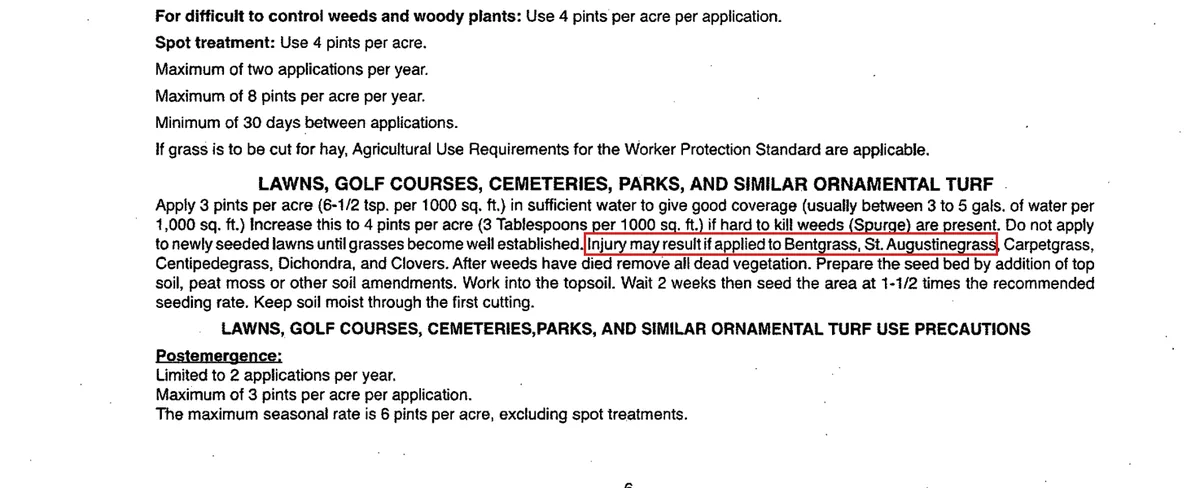
| Centipedegrass | Amine 4 D: injury may result; other 3 silent | No warning | I; I (temporary yellowing) | T on 11, R on 1 | Usually survives; low rate, may yellow |
| St. Augustinegrass | Amine 4 D: injury may result; Weedar 64 and Weedestroy: do not use | Do not use | S-I (not recommended); I | R on 9, D on 1, T on 2 | Can be killed: skip straight 2,4-D |
| Carpetgrass | Amine 4 D: injury may result | No warning | Not in table; text: temporary yellowing | D on 10, no data 2 | Can be killed: avoid |
| Seashore paspalum | Not named | Not named | Not rated | D on 3, no data 7, T on 2 | Unlisted: avoid unless your label names it |
| Creeping bentgrass | Amine 4 D: injury may result; Weedar 64, Weedestroy, Clean Amine (non-crop): may be injured | Spot treatment only | Not rated | Not rated | Injury likely: amine only, 0.75 lb ae/A max (UC IPM) |
| New seedlings, any grass | All 4: not until well established; Weedar 64: five-leaf stage, 2/3 pint/A max | Five-leaf stage, 1 pint/A max | Half rate after 3 to 4 mowings | Not rated | Can be killed: wait |
Three rows trip up most owners. Centipede usually survives but may yellow: UGA rates it intermediate and the 2008 Amine 4 D label warns of injury, so our centipede grass care guide sticks to reduced rates below 90°F. Floratam, which UF/IFAS calls the most widely produced and used St. Augustinegrass in Florida, is barred by name even on some three-way mixes, such as Gordon’s Trimec Lawn Weed Killer (2217-539); cultivar notes are in our St. Augustine grass cultivar guide.
Bentgrass is the third. UC IPM calls it “the most sensitive of the turfgrasses” and allows only the water-soluble amine at 0.75 lb acid equivalent per acre, half the lawn cap. Weedone LV4 allows bentgrass only as a spot treatment, so a creeping bentgrass lawn or putting green is the wrong place for a broadcast ester.
1Is the lawn St. Augustine (any cultivar) or carpetgrass?
YesSkip straight 2,4-D. Weedar 64, Weedestroy AM-40 and Weedone LV4 say do not use on St. Augustine, and UF/IFAS rates most 2,4-D mixes potentially damaging on carpetgrass. Use only a product whose label lists your grass, at its low rate.
NoGo to the next question
2Is it creeping bentgrass?
YesSpot-treat only (Weedone LV4), or use an amine at no more than 0.75 lb acid equivalent per acre (UC IPM), about half a normal lawn rate.
NoGo to the next question
3Was it seeded this season and mowed fewer than 3 times?
YesWait. Labels allow 2/3 to 1 pint per acre only from the five-leaf stage; UGA uses half rate after 3 to 4 mowings; NC State often waits until spring.
NoGo to the next question
4Will the air pass 85°F within 24 hours, or is the lawn drought-stressed?
YesWait for a cooler, watered week. UGA says tolerance drops above 90°F; Weedone LV4 bars spraying its ester in high heat and low humidity.
NoGo to the next question
5Is it centipede?
YesExpect possible yellowing. Use the low end of the label rate; UGA rates centipede intermediate and Amine 4 D warns of injury.
NoBluegrass, ryegrass, tall fescue, bermuda, zoysia and bahia tolerate 2,4-D at the label rate: up to 3 pints of a 3.8 lb/gal amine per acre, about 1.1 fl oz per 1,000 sq ft.
Source: EPA labels 48273-4, 71368-1, 228-145, 71368-14; UGA B-978; UF/IFAS EP141; UC IPM; NC State TurfFiles
Why does 2,4-D spare most grass, and when does it hurt it?
Grasses tolerate 2,4-D; they are not immune to it. The NPIC technical fact sheet says it “has little effect on grasses,” and Penn State Extension adds the catch: 2,4-D “can injure non-target species (including grasses) if used incorrectly.” Four conditions move a lawn from tolerant to damaged, and three of them carry a number on a label or in an extension bulletin.
- Growth stage. Wheat, barley and oats are grasses, and the Weedar 64 label allows spraying them only “after crop is fully tillered (usually 4 to 8 inches tall)” and never from early boot through milk stage. Seedling lawn grass gets the same treatment: five-leaf stage first, then no more than 2/3 pint per acre.
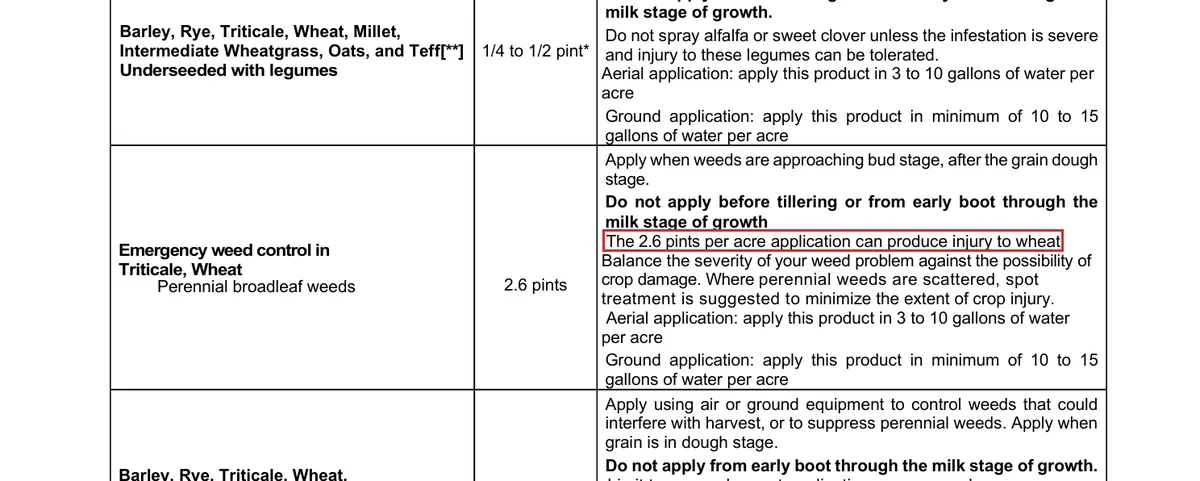
- Dose. The same label warns that 2.6 pints per acre, 1.24 lb acid equivalent, “can produce injury to wheat.” On a lawn the 3-pint cap is 6 1/2 teaspoons of a 3.8 lb/gal product per 1,000 sq ft (Amine 4 D), so a second pass over the same strip puts down 2.85 lb, nearly twice the cap.
- Heat and drought. UGA B-978 says turfgrass tolerance drops above 90°F or under drought stress, and to skip 2,4-D + MCPP if the air will pass 85°F within 24 hours.
- Formulation. Penn State says some esters are “hot” and can injure grasses in warm weather, and UC IPM calls the amine “generally more selective on turfgrass.”
The chart puts those ceilings side by side in pounds of 2,4-D acid equivalent per acre. The gap between a seedling ceiling of 0.32 and the established-lawn cap of 1.5 is almost five times, which is why labels hold new seedlings to a fraction of the lawn rate.
Amine, ester or choline: which 2,4-D is in the jug?
Every product here carries 3.74 to 3.8 lb of 2,4-D acid equivalent per gallon; the salt or ester attached to it changes how it behaves. Esters soak through the waxy leaf surface faster but have higher vapor pressure, so Penn State suggests esters in cool March to May weather and amines once it warms. Choline salt is the low-volatility form in Enlist One, and its label covers Enlist corn, soybeans and cotton, with no lawn use at all.
| Product (EPA Reg. No.) | Form of 2,4-D | Lawn rate per acre (per 1,000 sq ft) | Per-application cap | Grasses barred or warned | Seedlings and reseeding | Heat or volatility line |
|---|---|---|---|---|---|---|
| Amine 4 D, sold as Southern Ag 2,4-D Amine (48273-4) | Dimethylamine salt, 3.8 lb ae/gal | 3 pints (6 1/2 tsp) | 3 pints, 1.43 lb ae; 6 pints a season | Injury may result: bentgrass, St. Augustine, carpetgrass, centipede; also dichondra, clovers | Not on newly seeded lawns until established; after a kill, wait 2 weeks, then seed at 1 1/2 times the rate | None for turf |
| Clean Amine (34704-120) | Dimethylamine salt, 3.74 lb ae/gal | 2 to 4 pints in the rate table (0.73 to 1.47 fl oz) | 3.2 pints, 1.5 lb ae; 6.4 pints a season | None named in the turf section | Not on newly seeded areas until well established | Non-crop: not in extremely high temperatures |
| Weedar 64 (71368-1) | Dimethylamine salt, 3.8 lb ae/gal | 2 to 3 pints (0.73 to 1.10 fl oz) | 3 pints, 1.5 lb ae; 6 pints a year | Do not use on St. Augustine; bentgrass, clover, dichondra may be injured | Five-leaf stage or later, then 2/3 pint/A max | None for turf |
| Weedestroy AM-40 (228-145) | Dimethylamine salt, 3.8 lb ae/gal | 2 to 3 pints (0.73 to 1.10 fl oz) | 3 pints, 1.5 lb ae; 6 pints a year | Do not use on St. Augustine; bentgrass, clover, dichondra may be injured | Not on newly seeded areas until well established | None for turf |
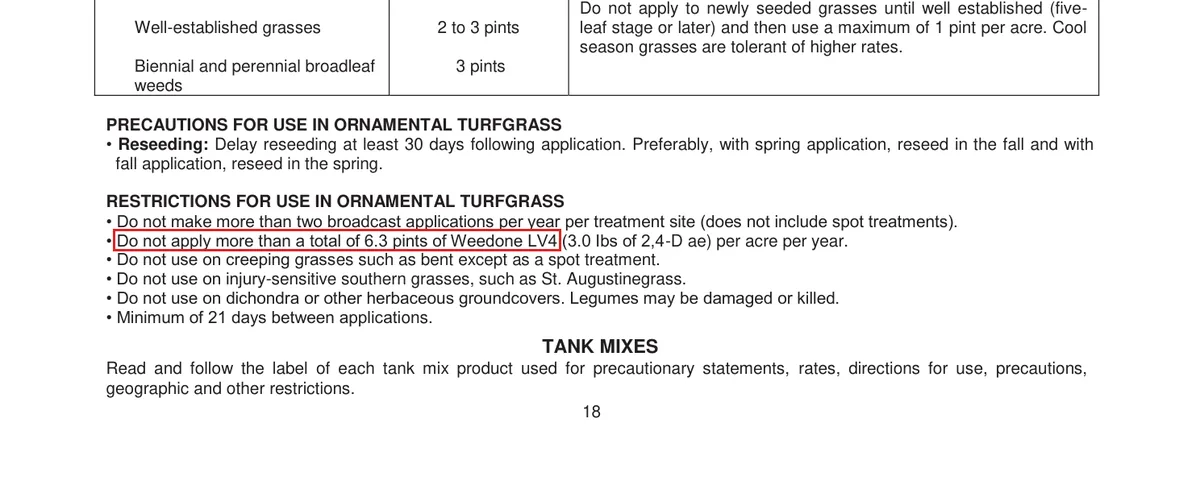
| Weedone LV4 (71368-14) | 2-ethylhexyl ester, 3.8 lb ae/gal | 2 to 3 pints (0.73 to 1.10 fl oz) | 3 pints by rate table; 6.3 pints, 3.0 lb ae a year; 21 days apart | Do not use on St. Augustine; bentgrass spot treatment only | Five-leaf stage, 1 pint/A max; delay reseeding at least 30 days | Esters may volatilize in low humidity and high heat: do not apply then |
| Enlist One (62719-695) | Choline salt, 3.8 lb ae/gal | No lawn directions | Not for lawns | Label covers Enlist corn, soybeans and cotton | Not applicable | Not applicable |
Two labels disagree with themselves. Clean Amine lists 2.0 to 4.0 pints per acre for lawns, then caps one application at 3.2 pints; Amine 4 D says to raise its rate to 4 pints (3 tablespoons per 1,000 sq ft) for spurge, then caps it at 3 pints. The restriction is the enforceable line, so use the cap.
- Product (fl oz)
- 1.10
- Product (mL)
- 32.6
- Product (teaspoons)
- 6.6
Default: 1,000 sq ft at 3 pints per acre = 1.10 fl oz (32.6 mL, 6.6 teaspoons); Amine 4 D prints 6 1/2 tsp. Per-acre rates divided by 43.56. 1 fl oz = 29.57 mL = 6 teaspoons. Mix in 3 to 5 gal of water per 1,000 sq ft (Amine 4 D label).
The calculator converts the per-acre label rate into fluid ounces, milliliters and teaspoons for your lawn area. Mix it into the spray volume Amine 4 D names, 3 to 5 gallons of water per 1,000 sq ft, and spray each strip once.
What will 2,4-D not kill?
2,4-D does nothing to weeds that are grasses or sedges, and it is less than fully effective on most broadleaf weeds. In the PNW Weed Management Handbook table of 35 lawn broadleaf weeds, 2,4-D alone rates susceptible on only 9, partial on 13 and resistant or intermediate-to-resistant on 13, while three-way mixes without triclopyr rate susceptible on 24.
| Weed | Type | 2,4-D alone | What the sources say |
|---|---|---|---|
| Dandelion, broadleaf and buckhorn plantain | Broadleaf | S (controlled) | PNW Handbook rates all three susceptible to 2,4-D |
| Lambsquarters, wild mustard, chicory, shepherd’s purse, prostrate pigweed | Broadleaf | S | Same PNW table; 9 of 35 broadleaf weeds are S |
| White clover, purslane, prostrate spurge, yarrow | Broadleaf | I (several sprays) | PNW: intermediate means repeat applications may be needed |
| Common chickweed, English daisy, speedwells, yellow woodsorrel | Broadleaf | R (not controlled) | PNW: resistant to 2,4-D alone; three-way mixes rate S on chickweed |
| Ground ivy, henbit, wild violet, prostrate knotweed | Broadleaf | I-R | PNW; triclopyr mixes are the column that rates violet S |
| Crabgrass, goosegrass, quackgrass, dallisgrass | Grass | No control | UGA B-978: 2,4-D mixes “will not control weedy grasses” |
| Sandbur (grass burrs) | Grass | No control | A grass; UGA B-978 names imazaquin for sandbur |
| Yellow and purple nutsedge | Sedge | No control | Not on any of the 5 lawn labels’ weed lists; needs a sedge product |
For the grassy weeds use a grass herbicide, matched to your lawn in our crabgrass killer by lawn type table; nutsedge needs halosulfuron or sulfentrazone, covered in our nutsedge control guide. Dandelion is the weed 2,4-D handles best, and fall versus spring timing for it is in our guide to killing dandelions without hurting grass.
How long after 2,4-D can you seed grass?
Labels for straight 2,4-D put the wait between 2 weeks and 30 days, and seeding first then spraying is the riskier order. NC State TurfFiles says broadleaf herbicides “can temporarily affect grass seed germination,” so it waits 3 to 4 weeks after a spray and, on a lawn seeded first, 2 to 3 mowings or until spring.
| Situation | Wait | Source |
|---|---|---|
| Seeding bare spots after Amine 4 D killed the weeds | 2 weeks, then seed at 1 1/2 times the normal rate | EPA 48273-4, turf section |
| Reseeding after Weedone LV4 (ester) | At least 30 days; spring spray, fall seeding is the label’s preference | EPA 71368-14, turf precautions |
| Overseeding after any broadleaf herbicide | 3 to 4 weeks | NC State TurfFiles |
| Spraying a lawn seeded this season | After 2 to 3 mowings, or wait until spring | NC State TurfFiles |
| Spraying new seedlings with straight 2,4-D | Five-leaf stage, at 2/3 to 1 pint per acre | Weedar 64; Weedone LV4 |
| Spraying newly seeded turf, general rule | Half the label rate after 3 to 4 mowings, repeat in 7 to 10 days | UGA B-978, newly established lawns |
For a fall overseeding, that 3 to 4 week gap means spraying broadleaf weeds in late August to seed in mid to late September, or seed first and hold 2,4-D until spring. Seed rates, timing by region and soil contact are in our lawn overseeding guide.
Pets, drift and the 2,4-D label
The Amine 4 D and Clean Amine labels say not to let people or pets enter the treated area “until sprays have dried” (EPA 48273-4; EPA 34704-120). NPIC adds that dogs may be more sensitive to 2,4-D than other animals and can be exposed by eating treated grass, so keep dogs off until the leaves are dry.
Drift is the larger lawn-edge risk. UF/IFAS EP141 warns that vapor from 2,4-D esters and spray drift from amines can damage ornamentals, trees, vegetables and fruit, and says not to reuse a 2,4-D sprayer for insecticides or fungicides because the herbicide is hard to rinse out. NC State‘s diagnostic note on 2,4-D-injured strawberries describes the symptom: injury evident soon after exposure, then rapid growth with twisted foliage before death.
If you want to kill a lawn on purpose, 2,4-D is the wrong tool; glyphosate is, as our page on whether Roundup kills grass explains.
How we compiled this
On Nov. 12, 2026 we downloaded the newest EPA-accepted master label for 6 registrations that contain 2,4-D as the only active (48273-4, 34704-120, 71368-1, 228-145, 71368-14, 62719-695) from EPA’s Pesticide Product Label System and read every turf, lawn and precaution section. We added the turfgrass tolerance tables in UGA Bulletin 978 and UF/IFAS EP141, the PNW Weed Management Handbook weed table, UC IPM, NPIC, Penn State and NC State. We did not test any product; ratings and rates are quoted, and per-1,000 sq ft figures are our arithmetic.
This page is general information, not pesticide advice. The label is the law: read the container you bought, which may carry a distributor number and wording that differ from the master label, and check your state’s rules before you spray.
Frequently asked questions
Will 2,4-D kill grass or just weeds?
Just broadleaf weeds on most established lawns. NPIC says it kills broadleaf weeds but not most grasses. The exceptions on its labels are St. Augustine, bentgrass, carpetgrass, new seedlings before the five-leaf stage, and any lawn sprayed above about 3 pints of a 3.8 lb/gal product per acre.
How long does 2,4-D stay on grass?
The Amine 4 D and Clean Amine labels keep people and pets off only until the spray has dried. In soil, NPIC reports that half of most 2,4-D forms is gone in 1 to 14 days, and its technical sheet gives a 6.2-day half-life in aerobic mineral soil.
How long does it take 2,4-D to start killing weeds?
Twisted growth shows soon after exposure, per NC State, and susceptible weeds then die over the following weeks. Weedone LV4 sets at least 21 days between broadcast sprays, so judge the result at 3 weeks before spraying again; intermediate weeds such as clover often need that second pass.
Can I spray 2,4-D on St. Augustine grass?
Not a straight 2,4-D product. Weedar 64, Weedestroy AM-40 and Weedone LV4 say not to use it on St. Augustine, and UGA rates 2,4-D + MCPP sensitive to intermediate. Use only a mix whose label lists St. Augustine, at its low rate and below 90°F, and check for a Floratam exclusion.
Will 2,4-D kill grass seed?
It can slow germination. Amine 4 D waits 2 weeks before seeding a sprayed area, Weedone LV4 at least 30 days, and NC State 3 to 4 weeks. Seedlings themselves should not be sprayed before the five-leaf stage, and then only at 2/3 to 1 pint per acre.
Sources
- U.S. EPA PPLS, Amine 4 D (Southern Ag 2,4-D Amine), EPA Reg. No. 48273-4, master label, Sept. 29, 2008. Accessed November 2026.
- U.S. EPA PPLS, Amine 4 2,4-D Weed Killer (Clean Amine), EPA Reg. No. 34704-120, master label, Sept. 15, 2025. Accessed November 2026.
- U.S. EPA PPLS, Weedar 64 Broadleaf Herbicide, EPA Reg. No. 71368-1, master label, Jan. 26, 2021. Accessed November 2026.
- U.S. EPA PPLS, Weedestroy AM-40 Amine Salt, EPA Reg. No. 228-145, master label, Nov. 29, 2024. Accessed November 2026.
- U.S. EPA PPLS, Weedone LV4 Broadleaf Herbicide, EPA Reg. No. 71368-14, master label, March 2, 2017. Accessed November 2026.
- U.S. EPA PPLS, Enlist One (GF-3335, 2,4-D choline), EPA Reg. No. 62719-695, master label, Jan. 25, 2024. Accessed November 2026.
- U.S. EPA PPLS, Gordon’s Trimec Lawn Weed Killer (BL 8000), EPA Reg. No. 2217-539, master label, Aug. 6, 2021. Accessed November 2026.
- National Pesticide Information Center, 2,4-D General Fact Sheet, 2008. Accessed November 2026.
- National Pesticide Information Center, 2,4-D Technical Fact Sheet (archive), Reviewed November 2008. Accessed November 2026.
- University of Georgia Extension, McCullough and Waltz, Bulletin 978, Weed Control in Home Lawns (Turfgrass Tolerance to Herbicides, p. 10), posted August 2025. Accessed November 2026.
- UF/IFAS Extension, Unruh and others, ENH884/EP141, Weed Management Guide for Florida Lawns, Table 1, revised December 2024. Accessed November 2026.
- Penn State Extension, Amines or Esters; Which Should You Use?, undated. Accessed November 2026.
- UF/IFAS Extension, ENH5/LH010, St. Augustinegrass for Florida Lawns, reviewed October 2025. Accessed November 2026.
- PNW Weed Management Handbook (University of Idaho), Susceptibility of Broadleaf Weeds in Turf to Common Herbicides, current edition. Accessed November 2026.
- UC Statewide IPM Program, Turfgrass Herbicide Treatment Table, current edition. Accessed November 2026.
- NC State Extension TurfFiles, Fred Yelverton, Fall Weed Control Options for Home Lawns, 2012. Accessed November 2026.
- NC State Extension, 2,4-D Injury, May 18, 2014. Accessed November 2026.