Does Roundup kill grass? Yes, if the bottle says Weed & Grass Killer: its glyphosate or fluazifop formulas kill lawn grass in 1 to 2 weeks. Roundup For Lawns does not harm most turf, though its Northern versions bar St. Augustine, centipede and bahia.
So does Roundup kill grass in your case? Check the EPA Reg. No. on the back panel, not the brand name. We sorted 13 lawn grasses against 13 current Roundup-brand labels, and the split is sharp: every Weed & Grass Killer label says it is not for spot weed control in lawns because it kills lawn grasses, while the 6 Roundup For Lawns registrations list grasses they leave alone. Weed & Grass Killer4 carries no glyphosate at all, part of a 2024 switch that University of Tennessee Extension (W 1237) flagged as a source of confusion.
The newer formula still kills grass because of dose. Fluazifop, its grass killer, is the same active that Fusilade II sprays over tall fescue and zoysia to thin out bermuda, at 0.05 to 0.09 lb per acre. Mixed and sprayed the way the Roundup label directs, it delivers about 1.16 lb per acre, roughly 12 times the tall fescue rate.
Which Roundup kills grass? 8 product lines compared
| Roundup product (EPA Reg. No.) | Active ingredients | Kills lawn grass? | First symptoms | Complete kill | Rainproof | Plant lawn seed after |
|---|---|---|---|---|---|---|
| Weed & Grass Killer Super Concentrate (71995-25) | Glyphosate 50.2% | Yes: label says it “kills lawn grasses” | 2 to 4 days | 1 to 2 weeks | 30 min | 3 days |
| Weed & Grass Killer Concentrate Plus (71995-29) | Glyphosate 18%, diquat 0.73% | Yes | 9 to 12 hours | 1 to 2 weeks; perennials 4+ weeks | 10 or 30 min | 3 days |
| Weed & Grass Killer4, ready-to-use and concentrate (71995-65, 71995-64) | Triclopyr, fluazifop-P-butyl, diquat; no glyphosate | Yes: label says it kills lawn grasses | 3 to 6 hours | 1 to 2 weeks; perennials 4+ weeks | 10 or 30 min | 7 days |
| Super Concentrate Weed & Grass Killer2 (71995-72) | Triclopyr 5.0%, fluazifop-P-butyl 3.6%, diquat 1.5%; no glyphosate | Yes | 6 hours | 1 to 2 weeks; perennials 3 to 4+ weeks | 30 min | 7 days |
| Max Control 365, concentrate (71995-49) and ready-to-use (71995-51) | Glyphosate, imazapic, diquat | Yes, and imazapic blocks regrowth and new seed | 12 hours | 1 to 2 weeks; perennials 4+ weeks | 30 min | 1 year; label bars lawns |
| For Lawns1 and For Lawns3, Northern (2217-917-71995, 2217-918-71995) | MCPA, quinclorac, dicamba, sulfentrazone | No on bluegrass, ryegrass, fescues, bermuda, buffalo, zoysia; bars St. Augustine, bahia, centipede, bentgrass, carpetgrass | Hours (label claim) | Up to 3 weeks for some weeds | 3 hours | 4 weeks |
| For Lawns4 and For Lawns6, Southern (2217-1009-71995, 2217-1010-71995) | 2,4-D, dicamba, penoxsulam, sulfentrazone | No on 11 listed grasses incl. Floratam St. Augustine; bars bentgrass, carpetgrass | A few days | 14 to 28 days | 4 hours | No seeding section; optional claim says 1 week |
| For Lawns Crabgrass Destroyer2 (71995-70, 71995-71) | Topramezone | No on bluegrass, fescues, perennial ryegrass; bars bermuda, zoysia, St. Augustine, bahia and 4 more | Weeds turn white in 4 to 7 days | Some weeds need a 2nd spray at 3 to 4 weeks | 3, 6 or 24 hours | 1 day (71995-70) or 28 days (71995-71) |
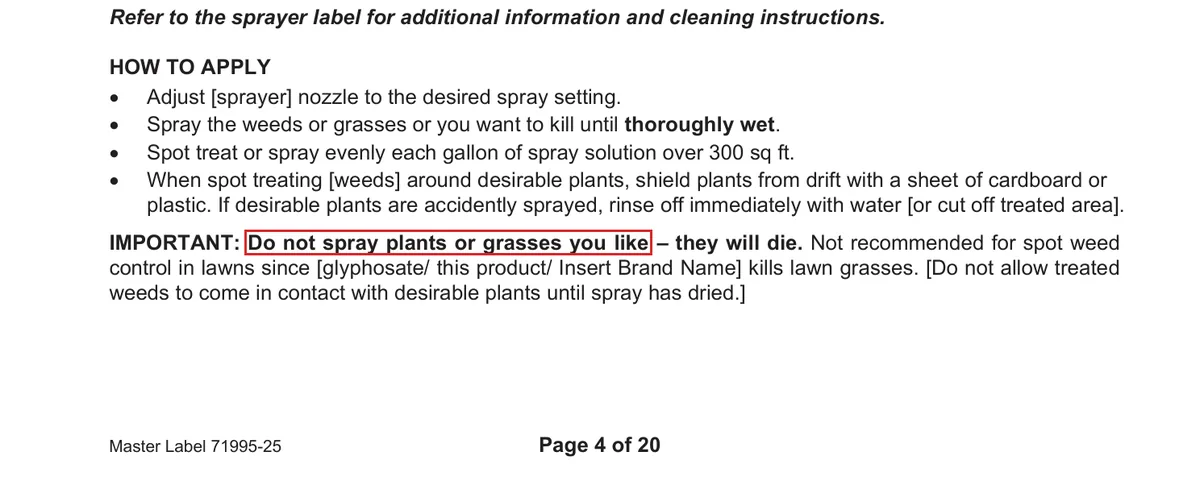
"Kills lawn grass" is a label statement, not our rating. Rainproof times run from 10 minutes (71995-29) to 4 hours (Southern For Lawns) and up to 24 hours on some Crabgrass Destroyer bottles, so a shower 1 hour after a For Lawns spray can wash out the treatment. The planting column only matters if you mean to reseed; our page on how long Roundup stays in soil carries the half-lives behind those waits.
Grass by grass: which Roundup label names your lawn?
Find your grass, then read across. Two cells to watch: the Northern For Lawns label (2217-917) says do not use on St. Augustine, bahia or centipede, and Crabgrass Destroyer (71995-70) bars 8 grasses including bermuda and zoysia. A Southern For Lawns bottle is the only Roundup that lists Floratam St. Augustine as tolerant, and only between 50 and 85°F.
Swipe the table sideways to see every column.
| Lawn grass | Glyphosate W&G Killer (71995-25) | Fluazifop W&G Killer4 / Killer2 (71995-65, 71995-72) | For Lawns Northern (2217-917) | For Lawns Southern (2217-1010) | Crabgrass Destroyer (71995-70) |
|---|---|---|---|---|---|
| Kentucky bluegrass | Kills: named target | Kills: named on both | Labeled safe | Labeled safe | Labeled safe |
| Perennial ryegrass | Kills: named target | Kills: named on 71995-65, not on 71995-72 | Labeled safe | Labeled safe | Labeled safe |
| Tall fescue | Kills: named target (fescue species) | Kills: named on both | Labeled safe | Labeled safe | Labeled safe |
| Fine fescue (red, Chewings, hard) | Kills: named target (fescue species) | Kills: named on 71995-65 (fescue species), not on 71995-72 | Labeled safe | Labeled safe | Labeled safe |
| Bermudagrass | Kills: named target; may need a repeat | Kills: named on both; may need a repeat | Labeled safe; may yellow; no spray above 85°F | Labeled safe; hybrids may yellow | Do not use |
| Zoysiagrass | Kills: named target | Kills: named on 71995-65, not on 71995-72 | Labeled safe | Labeled safe; dormant zoysia allowed | Do not use |
| St. Augustinegrass | Kills: named target | Kills: named on both | Do not use | Labeled safe incl. Floratam; 50 to 85°F only | Do not use |
| Centipedegrass | Not named | Kills: named on 71995-72, not on 71995-65 | Do not use | Labeled safe; may yellow; 85°F limit | Not named |
| Bahiagrass | Kills: named target | Kills: named on both | Do not use | Labeled safe | Do not use |
| Buffalograss | Not named | Not named | Labeled safe | Labeled safe | Do not use |
| Seashore paspalum | Not named | Not named | Not named | Labeled safe | Do not use |
| Creeping bentgrass | Kills: named target | Kills: named on 71995-65, not on 71995-72 | Do not use | Do not use | Do not use |
| Carpetgrass | Not named | Not named | Do not use | Do not use | Do not use |
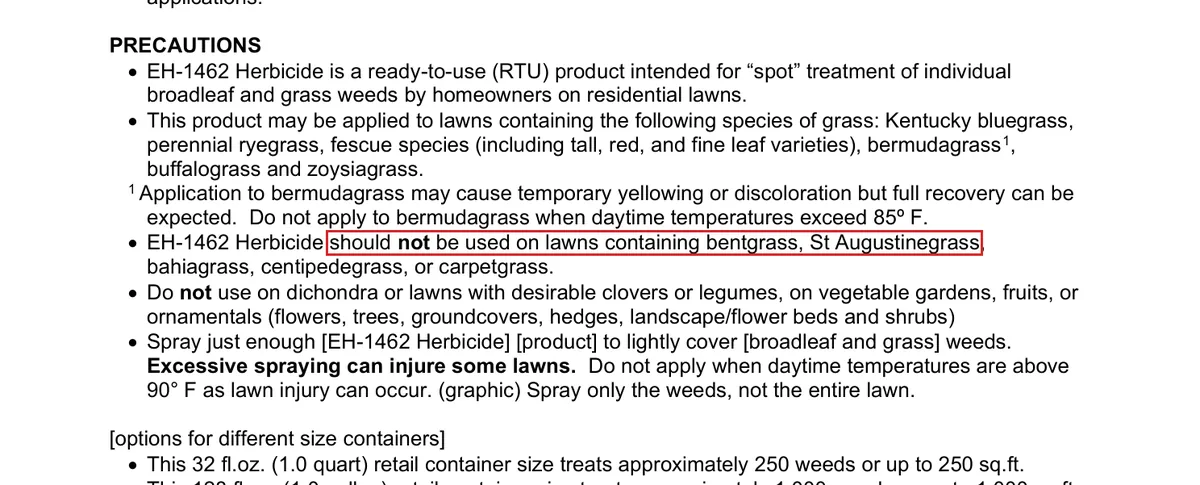
The fluazifop labels disagree with each other. The 2023 Weed & Grass Killer4 master label (71995-65) names zoysia, perennial ryegrass, fine fescue and creeping bentgrass among targets; the June 2026 Super Concentrate2 label (71995-72) names none of them but adds centipedegrass. Fusilade II calls zoysia and fine fescue tolerant only at 3 to 16 fl oz per acre, so at Roundup’s spray-to-wet rate treat every lawn grass as a target. Picking a lawn-safe weed killer by grass type is covered in our lawn weed killer guide.
How long does Roundup take to kill grass?
Glyphosate is the slow one on the surface: 71995-25 promises yellowing in 2 to 4 days and complete kill in 1 to 2 weeks, faster above 60°F in sun. The diquat in Concentrate Plus and the fluazifop formulas browns leaves in 3 to 12 hours, but the roots still take 1 to 2 weeks, and the labels allow 4 or more weeks for perennials.
Bermudagrass, zoysia and quackgrass come back from rhizomes the spray never reached. The 71995-25 lawn-replacement directions say to reapply if green patches remain after 7 days; the fluazifop labels (71995-64, 71995-72) require 28 days before a repeat. For a full bermuda removal plan, see how to kill bermuda grass.
How much Roundup per gallon kills grass?
Every Roundup concentrate sprays 1 gallon of mix over 300 sq ft. Super Concentrate uses 2.5 fl oz (5 tablespoons) per gallon for lawn grass and perennials, Concentrate Plus and Weed & Grass Killer4 Concentrate 6 fl oz, and Super Concentrate2 3 fl oz.
- Concentrate to measure (fl oz)
- 8.3
- Same amount in tablespoons
- 17
Each label sprays 1 gallon of mix over 300 sq ft, so 1,000 sq ft takes about 3.3 gallons of mix. Default: 1,000 sq ft at 2.5 fl oz per gal = 8.3 fl oz (17 tablespoons). 1 fl oz = 2 tablespoons. Fluazifop labels require 28 days between sprays.
| Product and use | Label rate | Active per gallon of product | Arithmetic (145.2 = 43,560 / 300 sq ft) | Active per acre |
|---|---|---|---|---|
| Roundup Super Concentrate, lawn replacement (71995-25) | 2.5 fl oz per gal, 1 gal per 300 sq ft | 3.7 lb glyphosate per gal | 2.5 / 128 x 3.7 x 145.2 | 10.5 lb glyphosate per acre |
| Roundup Concentrate Plus (71995-29) | 6 fl oz per gal, 1 gal per 300 sq ft | 1.2 lb glyphosate per gal | 6 / 128 x 1.2 x 145.2 | 8.2 lb glyphosate per acre |
| Roundup Pro Concentrate, perennial weeds, broadcast (524-529) | 1.6 to 4 quarts per acre | 3.7 lb glyphosate per gal | 0.4 to 1 gal x 3.7 | 1.5 to 3.7 lb glyphosate per acre |
| Virginia Tech, low rate over dormant bermuda (Askew) | 20 fl oz Roundup Pro Concentrate per acre | 3.7 lb glyphosate per gal | 20 / 128 x 3.7 | 0.58 lb glyphosate per acre |
| Roundup Weed & Grass Killer4 Concentrate (71995-64) | 6 fl oz per gal, 1 gal per 300 sq ft | 0.17 lb fluazifop per gal | 6 / 128 x 0.17 x 145.2 | 1.16 lb fluazifop per acre |
| Roundup Super Concentrate2 (71995-72) | 3 fl oz per gal, 1 gal per 300 sq ft | 0.31 lb fluazifop per gal | 3 / 128 x 0.31 x 145.2 | 1.05 lb fluazifop per acre |
| Fusilade II, over tall fescue to suppress bermuda (100-1084) | 5 to 6 fl oz per acre | 2 lb fluazifop per gal | 5 to 6 / 128 x 2 | 0.08 to 0.09 lb fluazifop per acre |
| Fusilade II, over zoysia (100-1084) | 3 to 4 fl oz per acre | 2 lb fluazifop per gal | 3 to 4 / 128 x 2 | 0.05 to 0.06 lb fluazifop per acre |
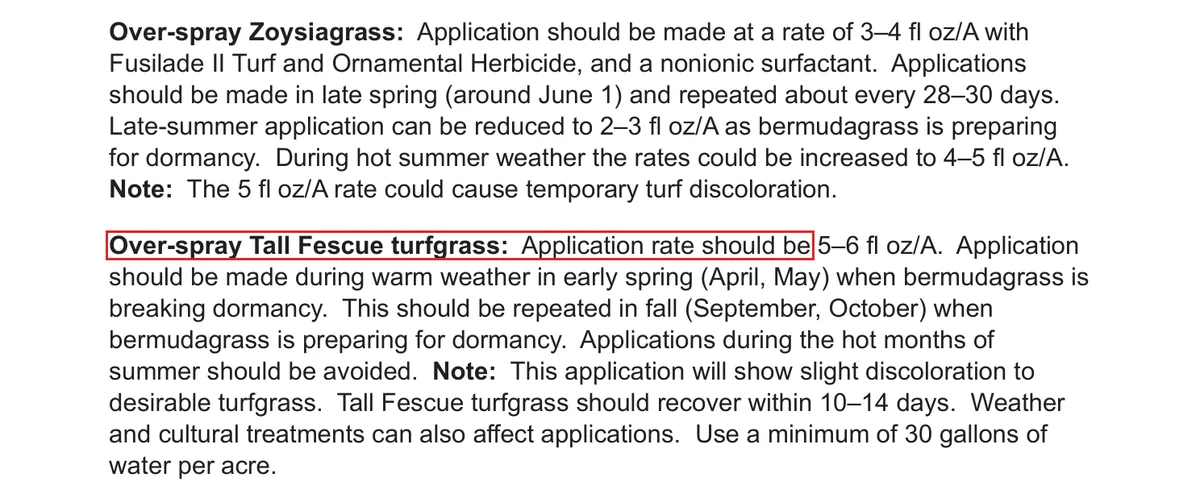
A homeowner gallon of Super Concentrate over 300 sq ft works out to 10.5 lb of glyphosate per acre, about 18 times the 0.58 lb Virginia Tech’s Shawn Askew sprays over dormant bermuda to kill winter weeds. He puts the green-up delay from 40 fl oz per acre at 6 weeks or more when the bermuda was not fully dormant. To kill a whole lawn and reseed, follow our guide to killing grass before replanting.
Why is Roundup not killing my grass?
- Check the active ingredient. A For Lawns bottle (2217-917, 2217-1009) is built to spare turf, and Weed & Grass Killer4 kills grass through fluazifop and triclopyr, with perennials taking 4 or more weeks (71995-65).
- Check the rain. Glyphosate needs 30 minutes dry on 71995-25; For Lawns needs 3 to 4 hours.
- Check the weather and the grass. 71995-25 works best above 60°F in sun and says results slow in cool or cloudy weather. Labels say to spray actively growing plants; Virginia Tech sprays low rates over dormant bermuda because brown, dormant grass takes up little.
- Check the rate. 1.5 fl oz per gallon is the annual-weed rate; lawn grass and perennials need 2.5 fl oz (71995-25). Virginia Tech also notes glyphosate is sensitive to hard water and suggests ammonium sulfate as a conditioner (Askew).
- Check for rhizomes. Bermuda and zoysia regrow from underground stems; respray green regrowth after 7 days on glyphosate or 28 days on fluazifop formulas.
Sprayed the wrong Roundup on your lawn?
1Does the front panel say Roundup For Lawns?
YesFind your grass in the matrix above. Northern bottles (2217-917, 2217-918) bar St. Augustine, bahia, centipede, bentgrass and carpetgrass; Southern bottles (2217-1009, 2217-1010) allow St. Augustine at 50 to 85°F. Listed grasses may yellow briefly.
NoGo to the next question
2Is it For Lawns Crabgrass Destroyer (topramezone)?
YesIt is labeled only for Kentucky bluegrass, tall and fine fescue and perennial ryegrass; bermuda, zoysia, St. Augustine, bahia, buffalograss, seashore paspalum, bentgrass and carpetgrass are on its do-not-apply list.
NoGo to the next question
3Is the spray still wet on the grass?
YesRinse the grass with a hose now, or cut off the treated blades: the 71995-25 and 71995-64 labels give that instruction for accidentally sprayed plants.
NoGo to the next question
4Does the bottle say Max Control 365, Extended Control or Dual Action?
YesExpect the grass to die and nothing to grow there for 4 to 12 months: imazapic stays in the soil. Do not reseed before the label's wait.
NoWeed & Grass Killer formulas kill treated grass in 1 to 2 weeks. Mark the patch, wait 3 days (glyphosate only) or 7 days (fluazifop formulas), then reseed or sod.
Act within minutes. Both 71995-25 and 71995-64 tell you to rinse accidentally sprayed plants with water immediately or cut off the treated area. A Northern For Lawns bottle on St. Augustine or centipede was used against its label’s do-not-use line, the mix-up Ohio State Extension warns about. Neither label gives a recovery timeline; judge after the kill window: 2 weeks for Weed & Grass Killer, up to 4 weeks for Southern For Lawns. Patches that stay brown need reseeding, sodding or revival steps after the label’s planting wait.
How we compiled this
In November 2026 we downloaded the newest EPA-accepted master label for 13 Roundup-brand registrations and 2 comparison products (Fusilade II, Roundup Pro Concentrate) from the Pesticide Product and Label System, and read each weed list, turf-tolerance section, rate table, rainproof claim and planting interval. The dose table is our arithmetic from each label’s pounds-per-gallon statement. We did not spray anything; no field trial compares these Roundup products on lawn grasses, so the grass matrix records what each label names, not measured kill.
This page is general information, not pesticide advice. The label is the law: read the container you bought, because master labels carry bracketed options and your bottle prints one of them.
Frequently asked questions
Will grass grow back after using Roundup?
Not from treated leaves and crowns: glyphosate and fluazifop move to the roots and kill them in 1 to 2 weeks. Grass regrows from rhizomes the spray missed (bermuda, zoysia, quackgrass) or from seed you sow after the label’s wait: 3 days on 71995-25, 7 days on Weed & Grass Killer4 and 1 year on Max Control 365.
Why is Roundup not killing my grass?
Usually the bottle, rain, cold or rate. For Lawns formulas are made to spare turf; glyphosate needs 30 minutes without rain, works best above 60°F on green, growing grass, and needs 2.5 fl oz per gallon for lawn grass. Rhizome grasses need a second spray.
How long does Roundup take to kill grass?
Labels say 1 to 2 weeks for complete kill. Glyphosate-only Super Concentrate shows yellowing in 2 to 4 days; diquat formulas brown leaves in 3 to 12 hours. Perennial grasses can take 4 weeks or more and a repeat spray.
When should you not apply Roundup?
Not within 30 minutes of rain for glyphosate (3 to 4 hours for For Lawns), not on windy days near plants you want, not on dormant or drought-stressed grass, and not on a lawn you plan to seed within 1 year if the bottle contains imazapic (71995-49). For Lawns labels add temperature caps of 85 or 90°F.
What is the difference between Roundup and Roundup For Lawns?
Roundup Weed & Grass Killer kills nearly everything green, lawn grass included. Roundup For Lawns uses selective actives (MCPA, quinclorac, dicamba and sulfentrazone in the Northern version; 2,4-D, dicamba, penoxsulam and sulfentrazone in the Southern) that control broadleaf weeds and nutsedge in listed turf (Ohio State Extension).
Is it true that Roundup no longer contains glyphosate?
For some bottles. Weed & Grass Killer4 (71995-64, 71995-65) and Super Concentrate2 (71995-72) use triclopyr, fluazifop and diquat instead, while Super Concentrate (71995-25) and Concentrate Plus (71995-29) still list glyphosate as of November 2026. UT Extension dates the switch to 2024.
Sources
- U.S. EPA PPLS, Roundup Weed & Grass Killer Super Concentrate, EPA Reg. No. 71995-25, master label, Jan. 28, 2021. Accessed November 2026.
- U.S. EPA PPLS, Roundup Weed & Grass Killer Concentrate Plus, EPA Reg. No. 71995-29, master label, Apr. 6, 2022. Accessed November 2026.
- U.S. EPA PPLS, Roundup Concentrate (Weed & Grass Killer4), EPA Reg. No. 71995-64, master label, June 5, 2023. Accessed November 2026.
- U.S. EPA PPLS, Roundup Ready-To-Use (Weed & Grass Killer4), EPA Reg. No. 71995-65, master label, Nov. 29, 2023. Accessed November 2026.
- U.S. EPA PPLS, Roundup Super Concentrate Weed & Grass Killer2, EPA Reg. No. 71995-72, master label, June 18, 2026. Accessed November 2026.
- U.S. EPA PPLS, Roundup Concentrate Max Control 365, EPA Reg. No. 71995-49, master label, Nov. 21, 2025. Accessed November 2026.
- U.S. EPA PPLS, EH-1462 Herbicide (Roundup For Lawns1, Northern), EPA Reg. No. 2217-917, Sept. 10, 2025. Accessed November 2026.
- U.S. EPA PPLS, EH-1464 Herbicide (Roundup For Lawns3, Northern), EPA Reg. No. 2217-918, July 26, 2022. Accessed November 2026.
- U.S. EPA PPLS, EH-1574 Herbicide (Roundup For Lawns4, Southern), EPA Reg. No. 2217-1009, Apr. 26, 2024. Accessed November 2026.
- U.S. EPA PPLS, EH-1573 Herbicide (Roundup For Lawns6, Southern), EPA Reg. No. 2217-1010, June 14, 2024. Accessed November 2026.
- U.S. EPA PPLS, Roundup For Lawns Crabgrass Destroyer Ready-To-Use, EPA Reg. No. 71995-70, June 5, 2025. Accessed November 2026.
- U.S. EPA PPLS, Roundup For Lawns Crabgrass Destroyer Ready-To-Spray, EPA Reg. No. 71995-71, Oct. 28, 2022. Accessed November 2026.
- U.S. EPA PPLS, Fusilade II Turf and Ornamental Herbicide, EPA Reg. No. 100-1084, July 15, 2026. Accessed November 2026.
- U.S. EPA PPLS, Roundup Pro Concentrate, EPA Reg. No. 524-529, July 22, 2025. Accessed November 2026.
- University of Tennessee Extension, W 1237, Update on Roundup-Branded Herbicides for Consumers, May 2023 (print code). Accessed November 2026.
- Virginia Tech Turfgrass (Shawn Askew), Is it Too Late to Treat my Bermudagrass with Roundup?, undated web article. Accessed November 2026.
- Ohio State University Extension, Buckeye Hills, Be Cautious if you plan to Roundup your lawn, Apr. 7, 2017. Accessed November 2026.
- Roundup (Scotts Miracle-Gro), How Do Roundup For Lawns Products Work?, web page. Accessed November 2026.