The best weed killer for lawns is a selective three-way mix of 2,4-D, MCPP and dicamba for most broadleaf weeds, triclopyr for violets, ground ivy and oxalis, and atrazine for St. Augustine or centipede: never glyphosate on living turf.
Key takeaways
- Three-way mixes of 2,4-D, MCPP (mecoprop) and dicamba control dandelion, plantain and most clover. Spectracide Weed Stop For Lawns Concentrate2 (EPA Reg. No. 9688-342-8845) is labeled at 4 fl oz per 1,000 sq ft on cool-season grass (EPA label), which works out to $0.94 per 1,000 sq ft at its $7.48 Menards price on Oct. 28, 2026.
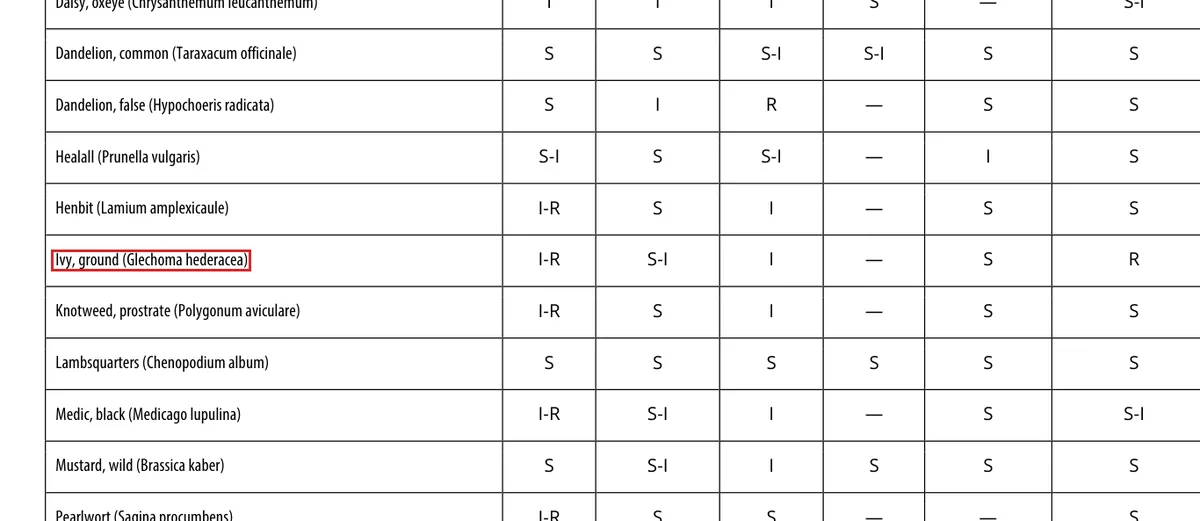
- Wild violet, ground ivy and yellow woodsorrel (oxalis) need triclopyr. In the PNW Weed Management Handbook table, mixes with triclopyr are the only option rated fully effective on all three; Iowa State plans two fall sprays a month apart for ground ivy (Iowa State).
- St. Augustine and centipede tolerate the fewest products. UGA rates St. Augustine sensitive to MCPP, quinclorac and sulfentrazone (UGA Bulletin 978), most three-way labels exclude Floratam and cut the rate to 1 to 2 fl oz per 1,000 sq ft, and atrazine labels cover only St. Augustine and centipede (EPA Reg. No. 19713-567).
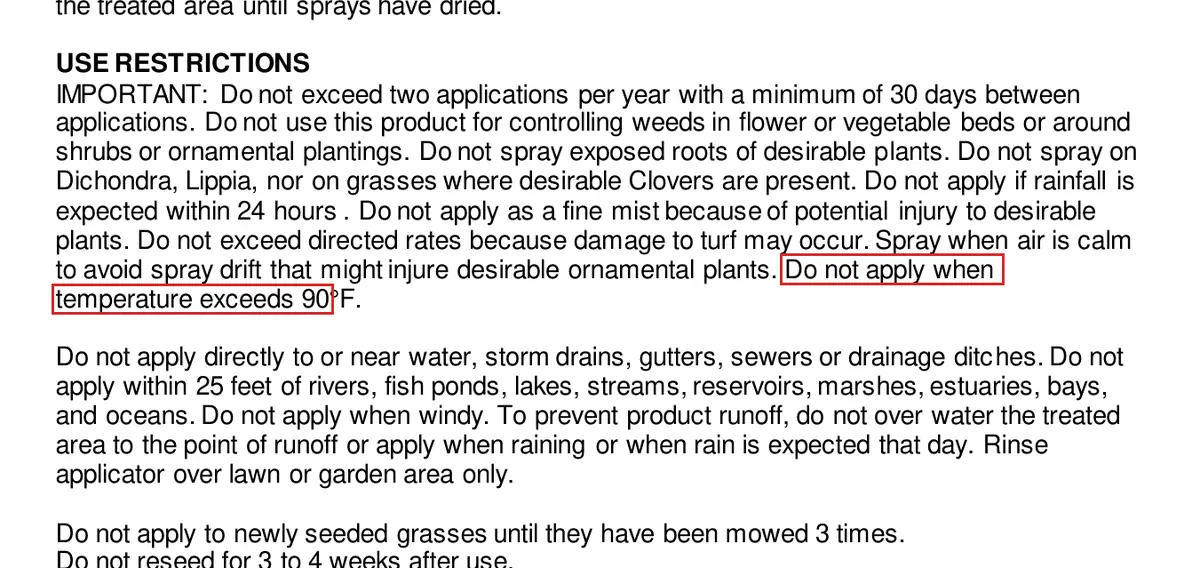
- Heat and rain limits come from the label: 90°F on most lawn labels here, 85°F on hybrid bermuda for Ortho WeedClear (EPA Reg. No. 239-2744) and for iron HEDTA products (Sunday Dandelion Doom label). Rain-free times run from 10 minutes (Spectracide) to 72 hours before watering (atrazine).
- Spray cool-season lawns from late September through October, when Purdue calls broadleaf weeds most susceptible (Purdue Turf). Most three-way labels allow 2 broadcast applications a year, 30 days apart, and a 3 to 4 week wait before reseeding (Gordon’s Trimec label).
Which weed killer kills weeds but not grass?
A selective postemergence herbicide kills weeds but not grass. For broadleaf weeds that means synthetic auxins (2,4-D, MCPP, MCPA, dicamba, triclopyr, fluroxypyr), usually sold as two-, three- or four-way mixes, sometimes with fast-acting carfentrazone or sulfentrazone. Rutgers says products containing glyphosate, glufosinate, fluazifop or diquat are not safe for lawn grasses (Rutgers FS385, April 2025).
Mixes exist because no single active covers the common lawn weeds. Rutgers lists white clover, chickweed, purslane and ground ivy as weeds 2,4-D does not control well, and dicamba as weak on plantains (Rutgers FS385). Purdue’s turf program advises a product with at least two, preferably three or more, active ingredients (Purdue Turf).
| Active ingredient | How it acts | Strong on | Weak on | Grass cautions | Source |
|---|---|---|---|---|---|
| 2,4-D | Systemic synthetic auxin | Dandelion, plantains, purslane | White clover, chickweed, ground ivy, violets, oxalis | St. Augustine sensitive to intermediate in mixes; buffalograss caution above 75°F (Texas A&M) | Rutgers; UGA; TAMU |
| MCPP (mecoprop) | Systemic synthetic auxin | Chickweed, clovers | Purslane, false dandelion | St. Augustine sensitive (UGA) | Rutgers; PNW |
| MCPA | Systemic synthetic auxin | Used in mixes only | Not broad-spectrum alone | Labeled in northern Roundup For Lawns | Rutgers |
| Dicamba | Systemic; also root-absorbed | Clover, chickweed, henbit, knotweed, spurge, purslane | Plantains (rated R) | Do not apply over shallow tree roots (TAMU) | PNW; TAMU |
| Triclopyr | Systemic pyridine | Violets, ground ivy, oxalis, clover, speedwell, lespedeza | Grasses on non-listed turf | Ortho triclopyr label excludes bahia, bermuda, centipede, kikuyu, St. Augustine | Rutgers; EPA 239-2491 |
| Quinclorac | Systemic | Crabgrass, white clover, speedwell | Woodsorrel (oxalis) | Not on St. Augustine, centipede, bahia, carpetgrass | Rutgers; EPA 7969-272 |
| Carfentrazone, sulfentrazone | Contact, fast burn-down | Speed visible kill; sulfentrazone also yellow nutsedge | Regrowth from roots if used alone | Sulfentrazone: St. Augustine sensitive (UGA) | Rutgers; UGA |
| Atrazine | Root and leaf uptake; pre and post | Winter annuals, young grassy weeds | Established perennials | Tolerated by St. Augustine, centipede, dormant bermuda; zoysia intermediate to tolerant; kills fescue and bluegrass | UGA; EPA 19713-567 |
| Penoxsulam | Systemic ALS inhibitor | Dollarweed, select broadleaves | Large weeds alone; 2 to 3 weeks to act | In southern Roundup For Lawns | TAMU; EPA 2217-1010 |
| Iron HEDTA | Contact, selective | White clover, young broadleaves | Dandelion regrows from taproot | Not on bentgrass; 85°F limit | Rutgers; EPA 67702-27 |
Non-selective products kill grass too, so they belong only on renovation jobs, edges and hardscape. Glyphosate (Ranger Pro, EPA Reg. No. 105211-85) needs 7 days before tillage or coring (label), and glufosinate (Finale, 7969-444) needs a 7-day wait before seeding turf (label). Contact sprays built on ammonium nonanoate, fatty-acid soap or acetic acid burn any green leaf they wet; our vinegar weed killer analysis covers the acetic acid option.
Which active ingredient controls which lawn weed?
Match the active ingredient to the weed: 2,4-D for dandelion and plantains, dicamba or MCPP for clover and chickweed, and a triclopyr mix for wild violet, ground ivy (creeping Charlie) and oxalis. In the PNW Weed Management Handbook table, triclopyr mixes are the only column rating violet and oxalis susceptible, and no column rates speedwells susceptible (PNW Handbook).
Swipe the table sideways to see every column.
| Weed | 2,4-D | Dicamba | MCPP | Mix with triclopyr | Mix without triclopyr | What the extension sources add |
|---|---|---|---|---|---|---|
| Dandelion | S | S | S-I | S | S | 2,4-D controls it easily; a taproot piece left after digging regrows (Rutgers; Purdue) |
| Broadleaf plantain | S | R | I | S | S | 2,4-D alone gives excellent control (Rutgers) |
| White clover | I | S | S-I | S | S | Triclopyr or quinclorac work best; other mixes may need 2 sprays 4 to 6 weeks apart (Rutgers) |
| Black medic | I-R | S-I | I | S | S-I | Only the triclopyr-mix column is rated S |
| Common chickweed | R | S | S-I | S | S | Treat in fall; mature spring plants are hard to kill (Rutgers) |
| Henbit | I-R | S | I | S | S | Winter annual: spray in fall; it dies by mid spring anyway (Rutgers) |
| Ground ivy (creeping Charlie) | I-R | S-I | I | S | R | Two fall sprays, late September to early October and a month later (Iowa State) |
| Wild violet | I-R | I-R | I-R | S | I-R | Triclopyr products are much more effective (Rutgers) |
| Yellow woodsorrel (oxalis) | R | I | I-R | S | I-R | Triclopyr; quinclorac does not control it (Rutgers) |
| Prostrate spurge | I | S-I | I | S | S-I | Summer annual; two or three of 2,4-D, dicamba and triclopyr, often 2 sprays (Rutgers) |
| Prostrate knotweed | I-R | S | I | S | S | Dicamba is the key active; compaction favors it (Rutgers) |
| Common purslane | I | S | R | S | S | Products with 2,4-D give excellent control (Rutgers) |
| Speedwells | R | R | R | R | R | Quinclorac in one application (PNW footnote); triclopyr is the best auxin option (Rutgers) |
| Thistle | S-I | S | I | S | S | Most columns rated S |
The chart counts how many of the five columns rate each weed fully susceptible. Dandelion scores 4 of 5, wild violet, ground ivy and oxalis score 1 (the triclopyr mix), and speedwells score 0; the handbook’s footnote points to quinclorac for speedwell (PNW Handbook). Photos and life cycles for 20 lawn weeds are in our common lawn weeds identification guide.
Which lawn weed killers are safe for St. Augustine, centipede and other grasses?
St. Augustine and centipede tolerate the fewest lawn herbicides. In UGA’s tolerance table, St. Augustine is sensitive to MCPP, quinclorac and sulfentrazone and only intermediate on 2,4-D mixes, while it tolerates atrazine; Kentucky bluegrass and tall fescue are the reverse, sensitive to atrazine (UGA Bulletin 978, p. 10). Bermuda, zoysia and tall fescue tolerate the standard three-way mix.
Swipe the table sideways to see every column.
| Active ingredient | Kentucky bluegrass | Bermuda | Bahia | Centipede | Tall fescue | St. Augustine | Zoysia |
|---|---|---|---|---|---|---|---|
| 2,4-D + MCPP | T | T | T | I | T | S-I | T |
| 2,4-D + MCPP + dicamba | T | T | T | I | T | I | T |
| Dicamba | T | T | T | I | T | I | T |
| MCPP | T | T | T | I | T | S | T |
| Carfentrazone | T | T | T | T | T | I | T |
| Fluroxypyr | T | T | T | T | T | T | T |
| Quinclorac | T | T | S | S | T | S | T |
| Sulfentrazone | T | T | T | T | I | S | T |
| Atrazine | S | T(D) | I | T | S | T | I-T |
| Halosulfuron | T | T | T | T | T | T | T |
| Imazaquin | S | T | S | T | S | T | T |
| Bentazon | T | T | T | T | T | T | T |
| Glyphosate | S | T(D) | S | S | S | S | S |
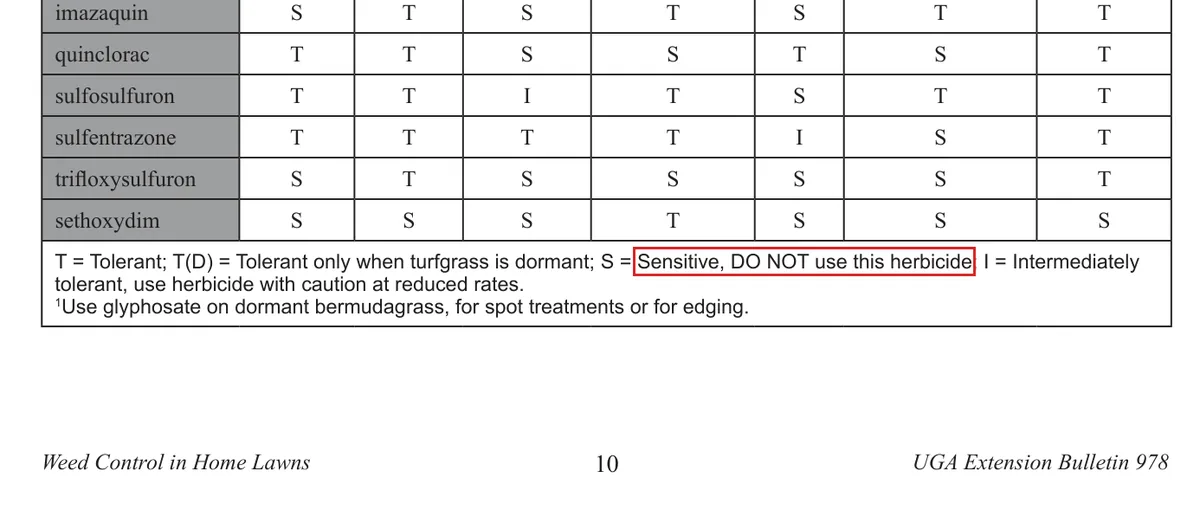
Labels go further than the extension table. Ortho WeedClear (239-2744) cuts its rate from 4 fl oz per 1,000 sq ft on cool-season grass to 1 fl oz on St. Augustine and centipede and excludes Floratam on most sublabels (EPA label); Spectracide Weed Stop Concentrate2 also excludes Bitterblue (EPA label). Roundup For Lawns Southern (2217-1010) lists Floratam but sets a 50 to 85°F window on St. Augustine (EPA label).
Atrazine is the split decision. Scotts Bonus S (538-18) lists St. Augustine “including Floratam” (EPA label), while Texas A&M says Floratam “is not tolerant to herbicides containing the active ingredient Atrazine and will be injured” (Texas A&M EHT-144) and UF/IFAS warns of damage above 85°F (UF/IFAS EP575). If your lawn is Floratam, test a small area first. Cultivar notes are in our St. Augustine grass guide.
What are the best weed killers for lawns, compared by EPA label?
The best lawn weed killers for most homeowners are concentrates of the 2,4-D, MCPP and dicamba three-way, with triclopyr for violet and ground ivy and atrazine for St. Augustine and centipede. The table compares 13 products sold in stores by their EPA label: active ingredients, the grasses each label forbids, its heat limit, its rain-free time and its reseeding wait.
Swipe the table sideways to see every column.
| Product (EPA Reg. No.) | Active ingredients | Do not use on (label) | Heat limit (label) | Rain-free time (label) | Reseed after (label) | Source |
|---|---|---|---|---|---|---|
| Ortho WeedClear Weed Killer for Lawns, also sold as Ortho Weed B Gon Lawn Weed Killer (239-2744) | 2,4-D 8.66%, MCPP-p 2.13%, dicamba 0.37% | Bentgrass, carpetgrass, dichondra, lippia, seashore paspalum; Floratam on most sublabels | 90°F; 85°F on hybrid bermuda | No rain for 24 h; 12 h before watering | 3 to 4 weeks | EPA label, Aug. 2023 |
| Spectracide Weed Stop For Lawns Concentrate2 (9688-342-8845) | 2,4-D 7.57%, MCPP-p 2.73%, dicamba 0.71%, sulfentrazone 0.18% | Floratam and Bitterblue St. Augustine, carpetgrass, dichondra | Apply at 45 to 90°F | 10 minutes (optional label claim) | 3 to 4 weeks | EPA label, June 2021 |
| Gordon’s Trimec Lawn Weed Killer (2217-539-33955) | 2,4-D 7.59%, MCPP-p 1.83%, dicamba 0.84% | Carpetgrass, Floratam, dichondra | Spray at 60 to 90°F | Do not water for 24 h | 3 to 4 weeks | EPA label, Aug. 2021 |
| BioAdvanced Southern Weed Killer for Lawns (92564-4) | Same three actives and percentages as Gordon’s Trimec | Carpetgrass, dichondra, Floratam | Most of the day below 90°F | 1 hour | 3 to 4 weeks | EPA label, June 2026 |
| Southern Ag 2,4-D Amine (48273-4-829) | 2,4-D amine 46.3% (signal word Danger) | Label warns of injury on bentgrass, St. Augustine, carpetgrass, centipede, dichondra, clovers | None stated for lawns | Not stated | 2 weeks, then seed at 1.5x rate | EPA label, Sept. 2008 |
| Ortho Weed B Gon Chickweed, Clover & Oxalis Killer for Lawns (239-2491) | Triclopyr 8% | Bahia, bermuda, centipede, kikuyu, St. Augustine | 90°F | 6 hours | 1 week | EPA label, Aug. 2024 |
| Roundup For Lawns1, Northern (2217-917-71995) | MCPA 0.257%, quinclorac 0.118%, dicamba 0.029%, sulfentrazone 0.015% (no glyphosate) | Bentgrass, St. Augustine, bahia, centipede, carpetgrass | 90°F; 85°F on bermuda | 3 hours | 4 weeks | EPA label, Sept. 2025 |
| Roundup For Lawns Southern concentrate (2217-1010-71995) | 2,4-D 1.46%, dicamba 0.41%, penoxsulam 0.14%, sulfentrazone 0.14% | Bentgrass, carpetgrass, dichondra (Floratam allowed) | St. Augustine 50 to 85°F; others 90°F | 4 hours | Not stated | EPA label, June 2024 |
| Preen Lawn Weed Control granules (961-418) | 2,4-D 1.37%, MCPP-p 0.31%, dicamba 0.13% | Carpetgrass, dichondra, St. Augustine | Not when consistently above 90°F | Keep on leaves 1 to 2 days | 3 weeks | EPA label, July 2020 |
| Scotts Turf Builder Weed & Feed5 (538-333) | 2,4-D 1.22%, dicamba 0.081%, plus 28-0-3 fertilizer | Creeping bentgrass, St. Augustine including Floratam, dichondra, carpetgrass, lippia | 60 to 90°F | No rain for 24 h; do not water for 24 h | 1 month | EPA label, Sept. 2026 |
| Scotts Turf Builder Bonus S (538-18) | Atrazine 1.29%, plus fertilizer | Bahia, bluegrass, fescues, bentgrass, ryegrass, dichondra (bermuda in the Florida version) | 90°F on bermuda | Water in immediately | Sod 1 month; seed 6 months | EPA label, March 2025 |
| Southern Ag or Hi-Yield Atrazine (19713-567) | Atrazine 4% | Every grass except St. Augustine and centipede | 90°F; summer spot treatment only | Rain within 2 to 3 days cuts control; 72 h before watering | No overseeding for 6 months | EPA label, Nov. 2021 |
| Sunday Dandelion Doom (67702-27-93737) | Iron HEDTA 1.5% | Bentgrass, dichondra | 85°F | 3 hours | 1 day | EPA label, Sept. 2026 |
Two pairs in the table are the same chemistry under different names. Ortho WeedClear Weed Killer for Lawns and Ortho Weed B Gon Lawn Weed Killer share registration 239-2744 (EPA label), and BioAdvanced Southern Weed Killer for Lawns carries the same 7.59 / 1.83 / 0.84 percent formula as Gordon’s Trimec (EPA 92564-4). Compare the EPA number and percentages on the back panel, not the brand on the front.
Which weed killer do professionals use on lawns?
Professionals mostly use the same actives at higher strength, plus a few products stores rarely stock: SpeedZone (2,4-D ester, MCPP-p, dicamba and carfentrazone), Q4 Plus (adds quinclorac and sulfentrazone for crabgrass and nutsedge), Celsius WG for warm-season lawns and SedgeHammer for nutsedge. Rates are per acre, so a homeowner measures fractions of a fluid ounce.
| Product (EPA Reg. No.) | Active ingredients | Label rate | Grass limits (label) | Source |
|---|---|---|---|---|
| SpeedZone EW (2217-1053) | 2,4-D ester 25.86%, MCPP-p 6.84%, dicamba 1.91%, carfentrazone 0.57% | 1.1 to 1.8 fl oz per 1,000 sq ft cool-season; 0.75 to 1.5 on bermuda, zoysia, buffalograss | Not St. Augustine, bahia, centipede, seashore paspalum, carpetgrass; reseed after 1 week | EPA label, June 2023 |
| SpeedZone Southern EW (2217-1031) | 2,4-D ester 9.02%, 2,4-DP-p 5.19%, dicamba 0.59%, carfentrazone 0.47% | 0.7 to 1.5 fl oz per 1,000 sq ft on warm-season grass | Not Floratam or Bitterblue St. Augustine; reseed after 1 week | EPA label, Aug. 2024 |
| Trimec Classic (2217-543) | 2,4-D 25.93%, MCPP-p 6.93%, dicamba 2.76% | 1.2 to 1.5 fl oz per 1,000 sq ft cool-season | Some injury expected on centipede and St. Augustine | EPA label, April 2014 |
| Trimec Southern (2217-655) | 2,4-D 18.74%, MCPP-p 17.37%, dicamba 3.85% | 0.37 to 0.55 fl oz per 1,000 sq ft on St. Augustine and centipede | Not Floratam; 50 to 90°F | EPA label, Feb. 2014 |
| Q4 Plus (2217-930) | 2,4-D 11.81%, quinclorac 8.43%, dicamba 1.49%, sulfentrazone 0.69% | 2.6 to 3.0 fl oz per 1,000 sq ft cool-season; 1.8 to 2.6 bermuda, zoysia | Not bahia, bentgrass, carpetgrass, centipede, dichondra, St. Augustine | EPA label, Nov. 2020 |
| Celsius WG (101563-141, formerly 432-1507) | Dicamba 57.4%, thiencarbazone 8.7%, iodosulfuron 1.9% | 0.057 to 0.113 oz per 1,000 sq ft | Warm-season only, Floratam included; not bahia or any cool-season grass | EPA label, Sept. 2021 |
| Tenacity (100-1267) | Mesotrione 40% | 5 to 8 fl oz per acre on Kentucky bluegrass | Bermuda, zoysia, bentgrass, seashore paspalum sensitive; can go down at seeding | EPA label, Sept. 2022 |
| Drive XLR8 (7969-272) | Quinclorac 18.92% | 1.45 fl oz per 1,000 sq ft | Not bahia, carpetgrass, centipede, dichondra, St. Augustine | EPA label, Nov. 2019 |
| Turflon Ester Ultra (62719-566) | Triclopyr ester 60.45% | 1/2 to 1 qt per acre; spot 3/8 to 3/4 fl oz per 1,000 sq ft | Bluegrass, ryegrass, zoysia, tall fescue only; reseed after 3 weeks | EPA label, March 2019 |
| SedgeHammer (81880-1) | Halosulfuron 75% | 0.9 g in 1 gal per 1,000 sq ft | Nutsedge only; up to 4 applications a year, 4 weeks apart | EPA label, Sept. 2026 |
Buying a pro concentrate does not need a license for use on your own lawn, but spraying anyone else’s lawn for pay does in at least 49 of 51 jurisdictions, as our pesticide applicator license guide shows. Pro labels also carry restricted-entry intervals for workers: 48 hours for SpeedZone EW and Q4 Plus (SpeedZone EW label; Q4 Plus label).
How much does lawn weed killer cost per 1,000 sq ft?
Lawn weed killer costs about $0.35 to $3.80 per 1,000 sq ft per application for liquid three-way concentrates at label rates (under $1.70 for Spectracide, Ortho WeedClear or a gallon of Trimec), $6.65 to $10.56 for weed and feed bags and about $98 for iron HEDTA, at prices posted Oct. 28, 2026. The rate your grass type allows moves the cost more than the brand.
Swipe the table sideways to see every column.
| Product and size | Price (seller, Oct. 28, 2026) | Label coverage | Cost per 1,000 sq ft |
|---|---|---|---|
| Spectracide Weed Stop For Lawns Concentrate2, 32 oz | $7.48, Menards | 4 fl oz per 1,000 sq ft cool-season, 2 fl oz other warm-season, 1.5 fl oz St. Augustine (8,000 to 21,333 sq ft) | $0.35 to $0.94 |
| Southern Ag 2,4-D Amine, 32 oz | $24.95, Seed Barn | 6 1/2 tsp (about 1.08 fl oz) per 1,000 sq ft, so about 29,500 sq ft | $0.84 |
| Gordon’s Trimec Lawn Weed Killer, 1 gal | $40.77, Seed Barn | 4 fl oz per 1,000 sq ft; 2 fl oz on St. Augustine and centipede (32,000 to 64,000 sq ft) | $0.64 to $1.27 |
| Gordon’s Trimec Lawn Weed Killer, 32 oz | $30.40, DoMyOwn | Same rates: 8,000 to 16,000 sq ft | $1.90 to $3.80 |
| Ortho WeedClear Weed Killer for Lawns Ready-To-Spray, 32 oz | $13.49, Scotts Miracle-Gro store | Label: 4 fl oz per 1,000 sq ft cool-season (8,000 sq ft), 2 fl oz bahia, bermuda, zoysia (16,000), 1 fl oz centipede and St. Augustine | $0.42 to $1.69 |
| Ortho Weed B Gon Chickweed, Clover & Oxalis Concentrate, 16 oz | $11.49, Menards | 1 fl oz per 200 sq ft (3,200 sq ft) | $3.59 |
| Roundup For Lawns3 Ready-To-Spray (Northern), 32 oz | $20.49, Roundup store | Up to 5,000 sq ft (seller) | $4.10 |
| Preen Lawn Weed Control granules, 10 lb | $20.70, MiniTack (sale price; listed sold out) | 2 lb per 1,000 sq ft maximum (5,000 sq ft) | $4.14 |
| Southern Ag Atrazine for St. Augustine, 1 gal | $41.00, DoMyOwn (sale price) | 8.6 fl oz per 1,000 sq ft (14,816 sq ft) | $2.77 |
| Scotts Turf Builder Bonus S, 10,000 sq ft bag | $66.49, Scotts Miracle-Gro store | 3.45 lb per 1,000 sq ft (10,000 sq ft) | $6.65 |
| Scotts Turf Builder Weed & Feed5, 12,000 sq ft bag | $86.49, Scotts Miracle-Gro store | 2.82 lb per 1,000 sq ft (12,000 sq ft) | $7.21 |
| Scotts Turf Builder Southern Triple Action, 8,000 sq ft bag | $84.49, Scotts Miracle-Gro store | 3.33 lb per 1,000 sq ft (8,000 sq ft); also an insecticide | $10.56 |
| Roundup For Lawns1 Ready-To-Use (Northern), 1 gal | $28.49, Roundup store | Label maximum 1 gal per 1,000 sq ft; spot treatment | $28.49 |
| Sunday Dandelion Doom concentrate refill, 5 oz | $22.00, Sunday | Up to 224 sq ft (seller) | $98.21 |
| Envu Celsius WG, 10 oz (pro) | $133.20, DoMyOwn | 0.057 to 0.113 oz per 1,000 sq ft (88,500 to 175,400 sq ft) | $0.76 to $1.51 |
| Corteva Turflon Ester Ultra, 1 gal (pro) | $170.98, DoMyOwn | 3/8 to 3/4 fl oz per 1,000 sq ft spot rate | $0.50 to $1.00 |
| PBI-Gordon SpeedZone, 1 gal (pro) | $112.79, DoMyOwn | 1.1 to 1.8 fl oz per 1,000 sq ft cool-season | $0.97 to $1.59 |
| Syngenta Tenacity, 8 oz (pro) | $66.64, DoMyOwn (regular price; $59.98 on sale) | 5 to 8 fl oz per acre on Kentucky bluegrass (43,560 to 69,700 sq ft) | $0.96 to $1.53 |
| Gowan SedgeHammer, 1.33 oz (pro) | $64.48, DoMyOwn | 0.9 g per 1,000 sq ft (about 42 treatments) | $1.54 |
| BASF Drive XLR8, 64 oz (pro) | $69.98, DoMyOwn | 1.45 fl oz per 1,000 sq ft (44,100 sq ft) | $1.59 |
| PBI-Gordon Q4 Plus, 1 gal (pro) | $218.66, DoMyOwn | 2.6 to 3.0 fl oz per 1,000 sq ft cool-season | $4.44 to $5.12 |
Two inputs move the bill most. First, grass type: on St. Augustine, Spectracide’s label rate falls to 1.5 fl oz per 1,000 sq ft, so the same $7.48 bottle covers 21,333 sq ft instead of 8,000 (EPA label). Second, format: on the same fescue lawn, Weed & Feed5 costs $7.21 per 1,000 sq ft against $0.94 for Spectracide Concentrate2, about 7.7 times as much, because you pay for 28 percent nitrogen and treat weed-free turf too. A spot spray of only the weedy 25 percent of a lawn cuts every figure by three quarters.
| Step | Input | Result |
|---|---|---|
| Lawn | 6,000 sq ft tall fescue; dandelions, plantain and white clover scattered | Cool-season label rates apply |
| Broadcast three-way | 6 x 4 fl oz Spectracide Concentrate2 = 24 fl oz of a 32 oz $7.48 bottle | $5.61 per application |
| Same job with Gordon’s Trimec gallon | 24 fl oz of 128 fl oz at $40.77 | $7.64 per application; 104 fl oz left for later years |
| Same job with Weed & Feed5 | 6,000 / 12,000 x $86.49 (16.9 lb at 2.82 lb per 1,000) | $43.25, fertilizer included |
| Clover patches left after 4 to 6 weeks | 1,500 sq ft (25%) x 5 fl oz per 1,000 of Ortho triclopyr concentrate = 7.5 fl oz of a 16 oz $11.49 bottle | $5.39 |
| Season total, spray route | $5.61 + $5.39 | $11.00; label allows 2 broadcast passes a year, 30 days apart |
Cost = area x share treated x cost per 1,000 sq ft from the cost table (prices Oct. 28, 2026). Default: 6,000 sq ft broadcast with Spectracide on cool-season grass = $5.64. Buy whole containers; leftover product keeps for later seasons if stored as the label directs.
When should you spray weeds in your lawn?
Spray cool-season lawns from late September through October and again in May if needed; Purdue calls fall the period when broadleaf weeds are most susceptible (Purdue Turf). In warm-season lawns, UGA times broadleaf sprays for April to July and atrazine for November to mid-February (UGA B-978). Always on a calm day below the label’s heat limit.
| Condition | Rule | Source |
|---|---|---|
| Best season, cool-season lawns | Late September through October; spring option in May | Purdue; Rutgers FS385 |
| Ground ivy (creeping Charlie) | Late September to early October, repeat a month later | Iowa State |
| Best season, warm-season lawns (Georgia) | Broadleaf sprays April to July; winter annuals November to March above 50°F; atrazine November to mid-February | UGA B-978, p. 11 |
| Upper heat limit | 90°F on most labels; 85°F for hybrid bermuda (Ortho, Roundup For Lawns1), St. Augustine (Roundup Southern) and iron HEDTA | EPA 239-2744; EPA 2217-1010; EPA 67702-27 |
| Extension heat rule | Do not apply 2,4-D + MCPP if air temperature will exceed 85°F within 24 hours | UGA B-978, p. 7 |
| Lower limit | 45°F (Spectracide), 50°F (St. Augustine on Roundup Southern), 60°F (Trimec, Weed & Feed5) | EPA 9688-342; EPA 2217-539 |
| Mowing | Mow 1 to 3 days before (Trimec, BioAdvanced); no mowing 2 days before or after (Ortho, Roundup, Q4 Plus) | EPA 2217-539; EPA 239-2744 |
| Newly seeded lawn | Wait for 2 mowings (Ortho triclopyr, SpeedZone EW), 3 (Ortho WeedClear) or 4 (Weed & Feed5) | EPA 239-2491; EPA 538-333 |
| Applications per year | 2 broadcast applications, 30 days apart, on most three-way labels | EPA 239-2744; EPA 2217-539 |
| Spring green-up of warm-season grass | Avoid applications during transition | UGA B-978 |
Fall wins on both counts in the sources: Purdue rates broadleaf weeds most susceptible from late September through October, and Rutgers says winter annuals such as henbit and chickweed are easy to kill in fall but hard at maturity in spring, when they die by mid spring anyway (Rutgers FS385). Month-by-month timing for fertilizer and preemergents sits in our lawn care schedule.
Is weed and feed or a spray better for lawn weeds?
A spray is usually better. Rutgers found weed and feed granules less effective than sprayable products, especially on clover, and notes that a spray lets you treat only the weedy spots (Rutgers FS385). UF/IFAS advises weed and feed only where weeds cover the whole lawn (UF/IFAS EP141). Weed and feed also costs $6.65 to $8.62 per 1,000 sq ft against under $2 for a concentrate.
If you use one, follow its activation rule, because the two types work in opposite ways. Weed & Feed5 (2,4-D and dicamba) goes on wet grass so granules stick to the leaves, with no rain or watering for 24 hours (EPA 538-333). Bonus S (atrazine) goes on dry grass and must be watered in immediately, since atrazine works through the soil (EPA 538-18).
How do you spray lawn weeds without killing the grass?
You spray lawn weeds without killing the grass by matching the label to your grass, measuring the label rate exactly, and spraying only when the label’s temperature and rain windows are met. Most turf injury comes from the wrong product on St. Augustine or centipede, double rates, or heat above 85 to 90°F.
- Identify the weed and the grass. Use the weed table above and our weed identification chart; check that your grass is on the label’s list of tolerant species.
- Check the forecast: highs below the label limit (90°F on most, 85°F on St. Augustine for Roundup Southern) for the next 24 hours, little wind and no rain inside the label’s rain-free time (EPA 2217-1010).
- Water a dry lawn 24 hours before spraying and mow 1 to 3 days before (Gordon’s Trimec label). Weeds must be actively growing, not drought-stressed.
- Measure. Trimec spot treatment is 1 fl oz (2 Tbsp) in 1 gal of water per 250 sq ft, or 0.5 fl oz on St. Augustine and centipede (EPA 2217-539); Ortho’s triclopyr concentrate is 1 fl oz per gal per 200 sq ft (EPA 239-2491); Southern Ag 2,4-D Amine is 6 1/2 tsp per 1,000 sq ft in 3 to 5 gal of water (EPA 48273-4).
- Spray to wet the leaves, not to runoff, using a coarse spray. Ortho’s label prohibits spraying as a fine mist because of drift onto ornamentals (EPA 239-2744).
- Keep people and pets off until the spray has dried, the standard re-entry statement on these labels (EPA 9688-342). NPIC notes pets can be exposed by touching or eating grass still wet with 2,4-D (NPIC).
- Do not water for 12 to 24 hours (Ortho, Trimec) and do not mow for 2 days. Look for twisting or browning within days; if tough weeds are alive after 30 days, Ortho’s label allows a repeat (EPA 239-2744).
- Reseed bare spots only after the label’s wait: 1 week for triclopyr, 3 to 4 weeks for most three-way mixes, 6 months after atrazine. Seeding rates and timing are in our overseeding guide.
- Rinse the sprayer over the lawn. UF/IFAS advises against using a sprayer that has held 2,4-D for insecticides, fungicides or other herbicides, because it is hard to remove (UF/IFAS EP141).
Dicamba is absorbed by roots as well as leaves, so Texas A&M advises against applying it near shallow-rooted trees (Texas A&M ESC-055), and Rutgers points to the label for spraying inside tree driplines (Rutgers FS385). In hot weather, choose amine formulations over esters: Penn State notes esters volatilize more as temperatures rise (Penn State Extension). Grass-by-grass care guides sit in our Turf and Trees section.
What do product roundups get wrong about lawn weed killers?
Several top-ranking product roundups for this keyword (Google, Oct. 28, 2026) recommend sprays that kill grass, misstate label rates or leave out an active ingredient. The table sets each claim against the EPA label or an extension publication. Check the EPA Reg. No. on the bottle and read its “Where to use” section before you buy.
| What some guides say | What the label or extension source says | Source |
|---|---|---|
| Contact sprays such as ammonium nonanoate, vinegar or fatty-acid soap are listed as top picks for lawn weeds | These are non-selective. Sunday describes its soap-based Weed Warrior as a product that “kills all plants on contact”; Rutgers says no selective organic herbicide currently exists for lawns | Sunday; Rutgers FS385 |
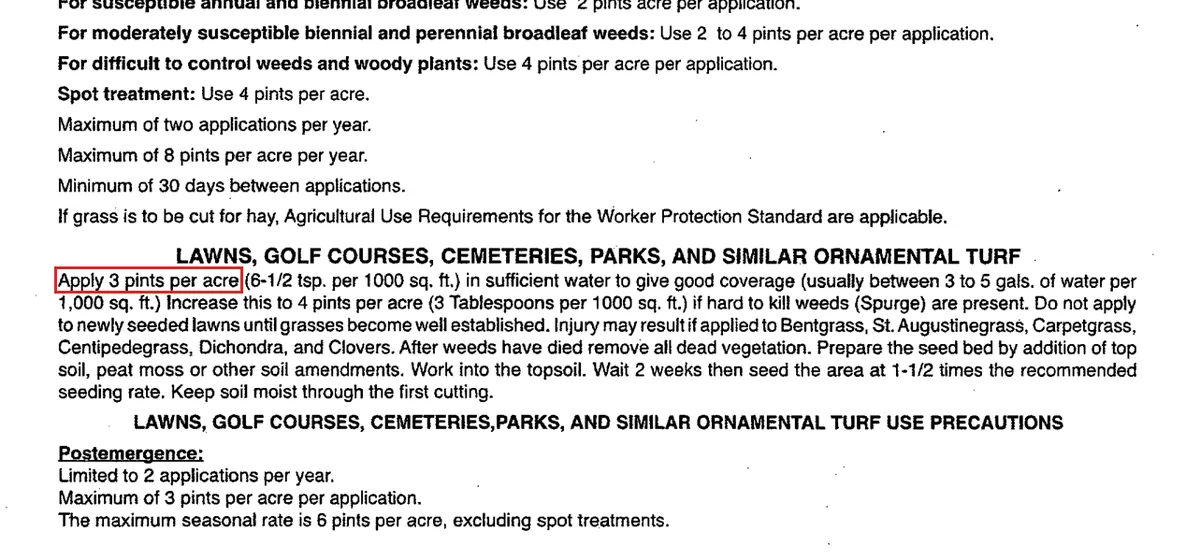
| 2,4-D amine: “2 to 3 teaspoons in 5 gallons” treats an acre, so 1 quart treats 32 acres | Label rate is 3 pints per acre (6 1/2 tsp per 1,000 sq ft), so 2 to 3 tsp is about 1 percent of an acre’s dose and 1 quart covers about 0.67 acre (29,000 sq ft) | EPA 48273-4, p. 14 |
| One 32 oz bottle of Ortho WeedClear treats up to 16,000 sq ft (seller page) | True only at the 2 fl oz rate for bahia, bermuda and zoysia; the cool-season rate is 4 fl oz per 1,000 sq ft, and the label’s own text says one quart covers up to 8,000 sq ft | EPA 239-2744, pp. 7 to 9 |
| Anything sold as Roundup contains glyphosate | Roundup For Lawns has no glyphosate: the northern formula is MCPA, quinclorac, dicamba and sulfentrazone; the southern is 2,4-D, dicamba, penoxsulam and sulfentrazone | EPA 2217-917; EPA 2217-1010 |
| SpeedZone’s four actives are 2,4-D, 2-ethylhexyl ester, dicamba and mecoprop-p | 2-ethylhexyl ester is the form of the 2,4-D; the fourth active is carfentrazone-ethyl (0.57%), the contact ingredient behind its fast visible burn | EPA 2217-1053 |
| Preen Lawn Weed Control prevents weeds like Preen garden granules | It is a post-emergent three-way (2,4-D, MCPP-p, dicamba) that must stay on wet weed leaves for 1 to 2 days | EPA 961-418 |
| Systemic weed killers work by stopping photosynthesis | 2,4-D, MCPP, dicamba and triclopyr are synthetic auxins; UF/IFAS says 2,4-D works by causing uncontrolled cell division | UF/IFAS EP575 |
| Never spray lawn weeds above 85°F | Rutgers says most labels suggest 85°F, but 10 of the 13 store labels above set 90°F as the general limit; 85°F applies to hybrid bermuda, St. Augustine on Roundup Southern, and iron HEDTA | Rutgers; labels in the product table |
Which lawn weed killer should you use?
Pick by weed first, then by grass. A three-way 2,4-D mix handles dandelion, plantain and most clover on cool-season, bermuda and zoysia lawns; triclopyr handles violets, ground ivy and oxalis on cool-season lawns; atrazine or a label that lists Floratam handles St. Augustine. If weeds cover more than about half the lawn, renovating beats spraying.
| If your situation is | Do this | Why (source) |
|---|---|---|
| Dandelion, plantain or clover in tall fescue, bluegrass, ryegrass, bermuda or zoysia | Broadcast a 2,4-D + MCPP + dicamba concentrate at 4 fl oz per 1,000 sq ft (2 on bermuda and zoysia), late September to October | PNW rates dandelion and plantain S for 2,4-D (PNW); EPA 9688-342 |
| Wild violet, ground ivy or oxalis in a cool-season or zoysia lawn | Triclopyr (Ortho 239-2491 at 1 fl oz per gal per 200 sq ft); two sprays a month apart in fall | Only triclopyr mixes rated S (PNW); Iowa State |
| St. Augustine, not Floratam, with broadleaf weeds | Three-way at the reduced St. Augustine rate (1 to 2 fl oz per 1,000 sq ft), below 85 to 90°F | EPA 239-2744; UGA |
| Floratam St. Augustine | A label that lists Floratam (Roundup For Lawns Southern, 50 to 85°F); test atrazine on a small area first | EPA 2217-1010; Texas A&M |
| St. Augustine or centipede with henbit, chickweed or annual bluegrass in winter | Atrazine 4% at 8.6 fl oz per 1,000 sq ft, November to mid-February; no overseeding for 6 months | UGA; EPA 19713-567 |
| Yellow nutsedge | Halosulfuron (SedgeHammer, 0.9 g per gal per 1,000 sq ft) at the 3 to 8 leaf stage; repeat after 6 to 10 weeks | UGA; EPA 81880-1 |
| Speedwell or crabgrass plus clover | Quinclorac product; not on St. Augustine, centipede or bahia | PNW; EPA 7969-272 |
| Seeding within the next 4 weeks | Iron HEDTA (seed after 1 day), triclopyr or SpeedZone EW (1 week), or Tenacity at seeding; avoid atrazine (6 months) | EPA 67702-27; EPA 239-2491; EPA 100-1267 |
| You want to keep clover or microclover | Skip broadleaf herbicides and hand-weed; most kill or injure clover | Rutgers; see our clover lawn guide |
| Forecast above 90°F or the lawn is drought-stressed | Wait; UGA says turf tolerance drops above 90°F and weed control is poorer on stressed weeds | UGA B-978 |
| Weeds cover more than about half the lawn | Renovate: glyphosate, wait 7 days before tillage or coring, then seed | EPA 524-517; our grass seed planting guide |
1Do weeds cover more than about half the lawn?
YesRenovate: glyphosate, 7 days, then seed.
NoGo to the next question
2Is the forecast high above 90°F, or the lawn drought-stressed?
YesWait for cooler weather and moist soil.
NoGo to the next question
3Will you seed within 4 weeks?
YesUse iron HEDTA, triclopyr or SpeedZone EW (1 day to 1 week wait), or Tenacity at seeding.
NoGo to the next question
4Is the lawn St. Augustine or centipede?
YesReduced-rate three-way (not Floratam), a Floratam-listed label, or atrazine in winter.
NoGo to the next question
5Are the weeds violets, ground ivy or oxalis?
YesTriclopyr, two sprays a month apart in fall.
NoGo to the next question
6Is it yellow nutsedge?
YesHalosulfuron at the 3 to 8 leaf stage.
NoBroadcast or spot-spray a 2,4-D, MCPP and dicamba three-way at the label rate, late September to October.
Source: EPA labels and UGA, PNW, Rutgers and Iowa State extension publications
This page is general information, not legal or pesticide-use advice. The label is the law: read and follow the label on the package you buy, which may differ from the master labels cited here. Some products and rates are restricted in certain states; confirm with your state department of agriculture before you apply, and hold a pesticide license before you apply any herbicide for pay.
How we compiled this
We compiled 27 EPA-stamped product labels from the EPA Pesticide Product Label System (each quote checked on its PDF page), 5 distributor or brand labels, 12 land-grant extension publications (Rutgers, UGA, PNW Handbook, UF/IFAS, Texas A&M, NC State, Purdue, Iowa State, Penn State) and 47 retail price listings captured from seller product pages on Oct. 28, 2026. Cost per 1,000 sq ft is our arithmetic: price divided by the area the label rate covers. No products were applied or field-tested, and products are named for identification, not endorsement. We excluded restricted-use products and claims we could find only on blogs.
| Item | Figure | Source |
|---|---|---|
| Three-way label rate, cool-season | 4 fl oz per 1,000 sq ft | EPA 9688-342 |
| Three-way label rate, St. Augustine | 1 to 2 fl oz per 1,000 sq ft (not Floratam on most labels) | EPA 239-2744 |
| Cheapest broadcast cost found | $0.35 to $0.94 per 1,000 sq ft (Spectracide Concentrate2) | Menards, Oct. 28, 2026 |
| Weed and feed cost | $6.65 to $8.62 per 1,000 sq ft | Scotts, Oct. 28, 2026 |
| Heat limit on most labels | 90°F (85°F hybrid bermuda, iron HEDTA) | Labels above |
| Rain-free time | 10 minutes to 72 hours | Labels above |
| Reseeding wait | 1 day (iron HEDTA) to 6 months (atrazine) | Labels above |
| Best timing, cool-season | Late September through October | Purdue |
Frequently asked questions
What is the best weed killer that will not kill grass?
A selective broadleaf herbicide labeled for your grass type. For fescue, bluegrass, bermuda and zoysia that is usually a 2,4-D, MCPP and dicamba three-way such as Spectracide Weed Stop Concentrate2 or Gordon’s Trimec; for St. Augustine, a reduced-rate three-way or atrazine. Even selective products injure grass above 90°F or at double rates (EPA 9688-342).
How long after spraying weed killer can you mow or water the lawn?
Usually 2 days to mow and 12 to 24 hours to water. Ortho WeedClear says wait 12 hours before watering and 2 days before mowing (EPA 239-2744); Gordon’s Trimec says do not water within 24 hours (EPA 2217-539). Atrazine is the exception: wait 72 hours before watering treated weeds (EPA 19713-567).
Is lawn weed killer safe for pets once it dries?
Labels here say keep people and pets off until the spray has dried, or until granule dust settles (EPA 9688-342; EPA 538-333). NPIC notes dogs may be more sensitive to 2,4-D than other animals and can be exposed by eating treated grass (NPIC).
How much Trimec per gallon of water?
For spot spraying, 1 fl oz (2 Tbsp) of Gordon’s Trimec Lawn Weed Killer in 1 gal of water treats 250 sq ft, or 0.5 fl oz on St. Augustine and centipede. Through a hose-end sprayer, apply 4 fl oz per 1,000 sq ft, or 2 fl oz on those grasses (EPA 2217-539).
How long does it take for lawn weed killer to work?
Symptoms show in hours to days; kill takes 1 to 4 weeks. Roundup For Lawns Southern claims complete kill in 14 to 28 days (EPA 2217-1010), SpeedZone Southern puts plant death at 7 to 14 days (EPA 2217-1031), and Ortho allows a repeat after 30 days.
Can you put down weed killer and grass seed at the same time?
Only with a few products. Tenacity (mesotrione) can go down at seeding for tolerant grasses except fine fescue (EPA 100-1267), and iron HEDTA allows seeding 1 day after spraying (EPA 67702-27). Three-way mixes need 3 to 4 weeks, and atrazine needs 6 months before seeding.
Is there a homemade weed killer that won’t kill grass?
No. Vinegar, salt and dish-soap mixes are non-selective and burn grass leaves as readily as weeds, and Rutgers says no selective organic lawn herbicide currently exists (Rutgers FS385). Iron HEDTA is the closest low-synthetic option. Evidence on vinegar is in our vinegar weed killer guide.
Sources
- Rutgers Cooperative Extension, Matthew Elmore, FS385, Broadleaf Weed Control in Cool Season Lawns, April 2025. Accessed October 2026.
- University of Georgia Extension, Patrick McCullough and Clint Waltz, Bulletin 978, Weed Control in Home Lawns (Turfgrass Tolerance to Herbicides, p. 10), Reviewed July 2024. Accessed October 2026.
- PNW Weed Management Handbook (University of Idaho), Susceptibility of Broadleaf Weeds in Turf to Common Herbicides, Current edition. Accessed October 2026.
- PNW Weed Management Handbook, Chemical Control of Broadleaf Weeds in Turf, Current edition. Accessed October 2026.
- UF/IFAS Extension, ENH884/EP141, Weed Management Guide for Florida Lawns (ask.ifas.ufl.edu/publication/EP141), Current edition. Accessed October 2026.
- UF/IFAS Extension, ENH1311/EP575, Florida Homeowner Herbicide Guide (ask.ifas.ufl.edu/publication/EP575), Current edition. Accessed October 2026.
- Texas A&M AgriLife Extension, Becky Grubbs-Bowling, ESC-055, A Homeowner’s Guide to Herbicide Selection for Warm-Season Turfgrass Lawns (copy hosted by Denton County Master Gardeners), July 2019. Accessed October 2026.
- Texas A&M AgriLife Extension, EHT-144, St. Augustinegrass Lawn Management, July 2020. Accessed October 2026.
- NC State Extension, Fred Yelverton, Fall Weed Control Options for Home Lawns (TurfFiles), Updated Oct. 27, 2025. Accessed October 2026.
- Purdue University Turfgrass Science, Zac Reicher, Open Season on Dandelions, Clover, and Other Broadleaf Weeds, Sept. 27, 2006. Accessed October 2026.
- Iowa State University Extension, Control of Ground Ivy (Creeping Charlie) in Lawns and Gardens, Current page. Accessed October 2026.
- Penn State Extension, Amines or Esters; Which Should You Use?, Updated Sept. 18, 2025. Accessed October 2026.
- National Pesticide Information Center, 2,4-D General Fact Sheet, Reviewed March 2009. Accessed October 2026.
- The Scotts Company, EPA Reg. No. 239-2744, WBG 553 Concentrate label (Ortho WeedClear / Weed B Gon Lawn Weed Killer), EPA PPLS, Aug. 23, 2023. Accessed October 2026.
- The Scotts Company, EPA Reg. No. 239-2491, Ortho Brush-B-Gon / Weed B Gon Chickweed, Clover & Oxalis label (triclopyr 8%), EPA PPLS, Aug. 6, 2024. Accessed October 2026.
- Chemsico / Spectrum, EPA Reg. No. 9688-342-8845, Spectracide Weed Stop For Lawns Concentrate2 label, EPA PPLS, June 29, 2021. Accessed October 2026.
- PBI-Gordon, EPA Reg. No. 2217-917, EH-1462 Herbicide (Roundup For Lawns1) label, EPA PPLS, Sept. 10, 2025. Accessed October 2026.
- PBI-Gordon, EPA Reg. No. 2217-1010, EH-1573 Herbicide (Roundup For Lawns Southern) label, EPA PPLS, June 14, 2024. Accessed October 2026.
- The Scotts Company, EPA Reg. No. 538-333, Turf Builder Weed & Feed 211 (Weed & Feed5) label, EPA PPLS, Sept. 17, 2026. Accessed October 2026.
- The Scotts Company, EPA Reg. No. 538-307, Southern Fertilizer with Weed and Insect Control (Southern Triple Action) label, EPA PPLS, Nov. 10, 2021. Accessed October 2026.
- The Scotts Company, EPA Reg. No. 538-18, Scotts Bonus S label, EPA PPLS, March 24, 2025. Accessed October 2026.
- PBI-Gordon, EPA Reg. No. 2217-539, Gordon’s BL 8000 Lawn Weed Killer (Trimec Lawn Weed Killer) label, EPA PPLS, Aug. 6, 2021. Accessed October 2026.
- Marman USA / Southern Ag, EPA Reg. No. 48273-4, Amine 4 D label (2,4-D amine 46.3%), EPA PPLS, Sept. 29, 2008. Accessed October 2026.
- SBM Life Science (BioAdvanced), EPA Reg. No. 92564-4, Lawn Herbicide JD Concentrate (Southern Weed Killer for Lawns) label, EPA PPLS, June 25, 2026. Accessed October 2026.
- W. Neudorff GmbH KG, EPA Reg. No. 67702-27, NEU1173H RTU (Sunday Dandelion Doom) label, EPA PPLS, Sept. 4, 2026. Accessed October 2026.
- W. Neudorff GmbH KG, EPA Reg. No. 67702-26, NEU1173H Concentrate (Fiesta) label, EPA PPLS, April 10, 2025. Accessed October 2026.
- Drexel Chemical, EPA Reg. No. 19713-567, Drexel Auguzine (Southern Ag and Hi-Yield Atrazine 4%) label, EPA PPLS, Nov. 10, 2021. Accessed October 2026.
- Lebanon Seaboard, EPA Reg. No. 961-418, Turf Broadleaf Weed Control (Preen Lawn Weed Control) label, EPA PPLS, July 28, 2020. Accessed October 2026.
- PBI-Gordon, EPA Reg. No. 2217-1053, SpeedZone EW (EH-1681) label, EPA PPLS, June 29, 2023. Accessed October 2026.
- PBI-Gordon, EPA Reg. No. 2217-1031, SpeedZone Southern EW (EH-1620) label, EPA PPLS, Aug. 9, 2024. Accessed October 2026.
- PBI-Gordon, EPA Reg. No. 2217-543, Trimec Classic label, EPA PPLS, April 2, 2014. Accessed October 2026.
- PBI-Gordon, EPA Reg. No. 2217-655, Trimec Southern label, EPA PPLS, Feb. 18, 2014. Accessed October 2026.
- PBI-Gordon, EPA Reg. No. 2217-930, Q4 Plus (EH-1471) label, EPA PPLS, Nov. 20, 2020. Accessed October 2026.
- Envu (formerly Bayer), EPA Reg. No. 101563-141 / 432-1507, Celsius WG label, EPA PPLS, Sept. 1, 2021. Accessed October 2026.
- Gowan / Canyon Group, EPA Reg. No. 81880-1, SedgeHammer label, EPA PPLS, Sept. 1, 2026. Accessed October 2026.
- Corteva Agriscience, EPA Reg. No. 62719-566, Turflon Ester Ultra label, EPA PPLS, March 21, 2019. Accessed October 2026.
- Syngenta, EPA Reg. No. 100-1267, Tenacity label, EPA PPLS, Sept. 28, 2022. Accessed October 2026.
- BASF, EPA Reg. No. 7969-272, Drive XLR8 label, EPA PPLS, Nov. 1, 2019. Accessed October 2026.
- Ruveon (formerly Monsanto), EPA Reg. No. 105211-85 / 524-517, Ranger Pro / Accord XL glyphosate label, EPA PPLS, May 18, 2010. Accessed October 2026.
- BASF, EPA Reg. No. 7969-444, Finale herbicide label (glufosinate), EPA PPLS, March 17, 2021. Accessed October 2026.
- Sunday (This Land Inc.), Weed Warrior Weed & Grass Killer product page, Oct. 28, 2026. Accessed October 2026.
- Menards, Spectracide Weed Stop For Lawns Concentrate2, 32 oz, product page and price, Oct. 28, 2026. Accessed October 2026.
- Seed Barn, Southern Ag 2,4-D Amine, 32 oz, product page and price, Oct. 28, 2026. Accessed October 2026.
- Seed Barn, Gordon’s Trimec Lawn Weed Killer, 1 gal, product page and price, Oct. 28, 2026. Accessed October 2026.
- DoMyOwn, Gordon’s Trimec Lawn Weed Killer, 32 oz, product page and price, Oct. 28, 2026. Accessed October 2026.
- Scotts Miracle-Gro store, Ortho WeedClear Weed Killer for Lawns Ready-To-Spray, 32 oz, product page and price, Oct. 28, 2026. Accessed October 2026.
- Menards, Ortho Weed B Gon Chickweed, Clover & Oxalis Concentrate, 16 oz, product page and price, Oct. 28, 2026. Accessed October 2026.
- Roundup store, Roundup For Lawns3 Ready-To-Spray (Northern), 32 oz, product page and price, Oct. 28, 2026. Accessed October 2026.
- MiniTack, Preen Lawn Weed Control granules, 10 lb, product page and price, Oct. 28, 2026. Accessed October 2026.
- DoMyOwn, Southern Ag Atrazine for St. Augustine, 1 gal, product page and price, Oct. 28, 2026. Accessed October 2026.
- Scotts Miracle-Gro store, Scotts Turf Builder Bonus S, 10,000 sq ft bag, product page and price, Oct. 28, 2026. Accessed October 2026.
- Scotts Miracle-Gro store, Scotts Turf Builder Weed & Feed5, 12,000 sq ft bag, product page and price, Oct. 28, 2026. Accessed October 2026.
- Scotts Miracle-Gro store, Scotts Turf Builder Southern Triple Action, 8,000 sq ft bag, product page and price, Oct. 28, 2026. Accessed October 2026.
- Roundup store, Roundup For Lawns1 Ready-To-Use (Northern), 1 gal, product page and price, Oct. 28, 2026. Accessed October 2026.
- Sunday, Sunday Dandelion Doom concentrate refill, 5 oz, product page and price, Oct. 28, 2026. Accessed October 2026.
- DoMyOwn, Envu Celsius WG, 10 oz, product page and price, Oct. 28, 2026. Accessed October 2026.
- DoMyOwn, Corteva Turflon Ester Ultra, 1 gal, product page and price, Oct. 28, 2026. Accessed October 2026.
- DoMyOwn, PBI-Gordon SpeedZone, 1 gal, product page and price, Oct. 28, 2026. Accessed October 2026.
- DoMyOwn, Syngenta Tenacity, 8 oz, product page and price, Oct. 28, 2026. Accessed October 2026.
- DoMyOwn, Gowan SedgeHammer, 1.33 oz, product page and price, Oct. 28, 2026. Accessed October 2026.
- DoMyOwn, BASF Drive XLR8, 64 oz, product page and price, Oct. 28, 2026. Accessed October 2026.
- DoMyOwn, PBI-Gordon Q4 Plus, 1 gal, product page and price, Oct. 28, 2026. Accessed October 2026.