Vinegar weed killer works only as a contact burn: 5% household vinegar kills weeds in their first 2 weeks, 20% acetic acid controls most young broadleaf weeds, and grasses and perennial roots such as dandelion usually regrow.
Key takeaways
- Age beats strength: 5 and 10 percent vinegar killed weeds during their first 2 weeks of life in USDA ARS trials; older weeds needed higher concentrations, which reached 85 to 100 percent kill (USDA ARS, 2002).
- Broadleaves die, grasses survive: averaged over spray volumes, 20 percent acetic acid gave 94 percent broadleaf control but 28 percent grass control 4 days after spraying; 5 percent gave 67 and 9 percent (Webber et al., 2018, Table 2).
- Roots are untouched: in University of Florida research, 8-week-old spurge, large crabgrass and oxalis sprayed with acetic acid at label rates fully recovered within 4 weeks (UF/IFAS EP580).
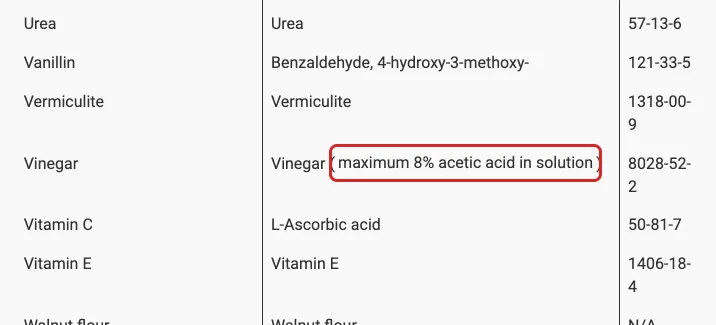
- Herbicide-strength vinegar is a registered pesticide: EPA allows vinegar in minimum-risk products only as an inert at 8 percent acetic acid or less, and registered acetic acid herbicides carry the DANGER signal word (40 CFR 152.25(f); NPIC).
- Price per gallon runs from $3.94 for 5 percent grocery vinegar to $29.97 for a registered 20 percent herbicide at Walmart.com on Oct. 28, 2026; the 20 percent label rate of 44 to 88 fl oz per 1,000 sq ft puts that at $10 to $21 per 1,000 sq ft (Vinagreen label).
2 weeks weed age up to which 5 percent household vinegar killed weeds (USDA ARS, 2002)
94% vs 28% broadleaf vs grass control with 20 percent acetic acid (Webber et al., 2018)
8% most acetic acid vinegar may hold as a 25(b) inert (40 CFR 152.25(f))
50 to 75°F best spray temperature on the Vinagreen label (EPA Reg. No. 85208-1)
Does vinegar kill weeds?
Vinegar kills weeds it fully wets, but only the leaves and stems it touches. The National Pesticide Information Center (NPIC) classes acetic acid as a non-selective contact herbicide: it breaks open cell walls, the tissue dries out, and nothing moves to the roots. Seedlings die outright; established perennials lose their tops and resprout, which is why results look better on day 1 than on day 30 (NPIC, Apr. 2024).
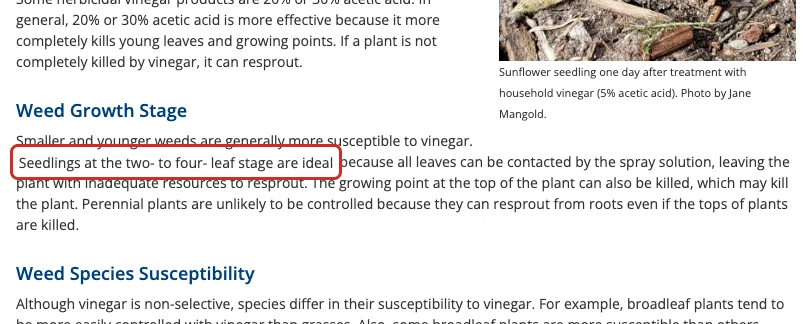
How much dies depends on three numbers: acetic acid strength, weed age and spray volume. Montana State University Extension names seedlings at the two- to four-leaf stage as the ideal target, because spray reaches every leaf and the growing point (MSU Extension, June 2021). The Vinagreen label (EPA Reg. No. 85208-1) sets its own window at the 3 to 5 leaf stage (Vinagreen label, 2024).
Spray volume matters as much as strength. In Cornell greenhouse trials, 15 percent vinegar at 636 liters per hectare (about 68 gallons per acre) controlled redroot pigweed and velvetleaf as well as 30 percent at half that volume (Evans, Bellinder and Goffinet, Weed Technology, 2009). University of Maryland Extension gives the same rule for spraying: 10 percent at 70 gallons per acre beat 20 percent at 35 gallons (UMD Extension, Nov. 2024).
What did the vinegar trials actually measure?
Seven field and greenhouse studies with stated concentrations, volumes and weed stages are compiled below. Read the weed stage column first: almost every high kill rate came on weeds with 1 to 6 leaves. The one perennial tested at ARS, Canada thistle, lost 100 percent of its top growth to 5 percent vinegar, a result about shoots, not roots (USDA ARS, May 15, 2002).
| Study | Acetic acid and volume | Weeds and stage | Result | Source |
|---|---|---|---|---|
| USDA ARS Beltsville, 2002 | 5 to 20%, hand-sprayed to uniform wetting | Lambsquarters, giant foxtail, velvetleaf, smooth pigweed, Canada thistle | 5% and 10% killed weeds in their first 2 weeks; higher strengths 85 to 100% at all stages | ARS news release |
| Webber et al., Oklahoma, 2018 | 5% and 20% at 20 and 100 gal/acre | Large crabgrass at 1 to 2 leaves; carpetweed at 4 to 5 leaves | 20%: 94% broadleaf, 28% grass (averaged); best grass control 44 to 63% at 100 gal/acre | J. Agric. Sci. 10(8) |
| Evans et al., Cornell, 2009 | 15 to 30% at about 34 and 68 gal/acre | Redroot pigweed and velvetleaf, cotyledon to 4 leaves | 20% at 68 gal/acre: 100% control of 2-leaf pigweed, 73% control and 18% mortality of velvetleaf | Weed Technol. 23(2) |
| Evans et al., Cornell, 2011 | 20% at about 75 gal/acre | In-row weeds, cotyledon to 6 leaves | 100% in pepper and over 96% in broccoli 1 day after spraying | Weed Technol. 25(3) |
| Brainard et al., 7 states, 2013 | 5 to 20% at about 11 gal/acre | Brown mustard at 3 to 4 leaves | At least 15% needed for adequate control; annual grasses poorly controlled | Weed Technol. 27(1) |
| Abouziena et al., Florida, 2009 | 5% and 30% | 6 broadleaf and 6 grass or sedge species, 2 to 6 leaves | Only 30% acetic acid applied early controlled grass weeds; 4 to 6 leaf weeds were harder to kill | Weed Technol. 23(3) |
| UF/IFAS landscape trial | Labeled rates | Spurge, large crabgrass, oxalis at 8 weeks old | All 3 fully recovered after 4 weeks | UF/IFAS EP580 |
| Acetic acid | Total weed control | Grass control | Broadleaf control |
|---|---|---|---|
| 0% (water) | 0% | 3% | 0% |
| 5% | 36% | 9% | 67% |
| 20% | 57% | 28% | 94% |
What strength of vinegar kills weeds?
For anything past the seedling stage, 20 percent acetic acid is the working strength. Grocery vinegar runs 4 to 6 percent, and NPIC defines horticultural vinegar as 20 percent or more (NPIC). UConn Extension says vinegar must reach at least 10 percent to work on anything bigger than tiny seedlings (UConn Extension). Above 20 percent, the extra acid adds burn risk to skin and eyes faster than it adds kill.
| Acetic acid | Where you find it | Status as a weed killer | Hazard (GHS cutoff on SDS) | Source |
|---|---|---|---|---|
| 4 to 6% | Distilled white and cider vinegar for food | Not labeled as an herbicide | Below the 10% irritant cutoff | NPIC |
| 8% or less | Inert ingredient in minimum-risk products | Allowed only as an inert under FIFRA 25(b); acetic acid is not on the 25(b) active list | Below the 10% cutoff | 40 CFR 152.25(f) |
| 10% and up | Cleaning and horticultural vinegars | Above 8%, EPA says vinegar may not be an active ingredient in an unregistered product | Skin Irrit. 2 and Eye Irrit. 2 from 10% | EPA, Feb. 2026; SDS |
| 20% | Registered herbicides: Vinagreen (EPA Reg. No. 85208-1) and store brands sold under it; Harris Vinegar Grass & Weed Killer II (3-24) | Registered; label signal word DANGER | Label: corrosive, irreversible eye damage | Vinagreen label; Harris 3-24 label |
| 25% and up | 30% and 45% cleaning vinegars | Sold as cleaners, with no herbicide directions | Skin Corr. 1B (burns) from 25% | Green Gobbler SDS |
Do you dilute vinegar to kill weeds?
Do not dilute 5 percent vinegar or a registered 20 percent herbicide. Water only weakens household vinegar, and the Vinagreen label says that because dilution reduces effectiveness, do not dilute; its one exception is liverworts, at 1 gallon of product to 2 gallons of water (Vinagreen label, p. 5). Diluting a 30 or 45 percent cleaning vinegar is arithmetic, shown below, not a labeled use.
| Start with | Target | Mix (by volume) | Gallons of spray per gallon bought | Arithmetic |
|---|---|---|---|---|
| 30% cleaning vinegar | 20% | 2 parts vinegar, 1 part water | 1.5 | 30 × 1 ÷ 20 = 1.5 gal |
| 30% cleaning vinegar | 10% | 1 part vinegar, 2 parts water | 3.0 | 30 × 1 ÷ 10 = 3.0 gal |
| 45% vinegar | 20% | 4 parts vinegar, 5 parts water | 2.25 | 45 × 1 ÷ 20 = 2.25 gal |
| 20% registered herbicide | 20% | Use as sold (label) | 1.0 | No dilution |
| 5% grocery vinegar | 5% | Use as sold | 1.0 | Adding water drops it below 5% |
Which weeds does vinegar kill, and which grow back?
Vinegar reliably kills small annual broadleaf weeds and fails on grasses, sedges and anything with a perennial root. Webber, Shrefler and Brandenberger rank carpetweed as very sensitive even at low strength and yellow nutsedge as tolerant of high strength and volume (Webber et al., Organic Weed Control, 2012). University of Maryland Extension says larger and perennial weeds may begin to regrow about a week after spraying (UMD Extension).
A propane torch splits the same way: Nebraska trials killed 90 percent of broadleaf seedlings at 10 gallons of propane per acre while grasses regrew, as our answer to whether burning weeds kills them sets out by weed and stage.
| Weed | Life cycle | What vinegar does | Source |
|---|---|---|---|
| Carpetweed | Annual broadleaf | Very sensitive at low strength and volume | Webber et al., 2012 |
| Redroot pigweed | Annual broadleaf | 100% control at the 2-leaf stage with 20% | Evans et al., 2009 |
| Velvetleaf | Annual broadleaf | 73% control, 18% mortality at 2 leaves; leaf angle sheds spray | Evans et al., 2009 |
| Brown mustard | Annual broadleaf | Needs at least 15% for adequate control | Brainard et al., 2013 |
| Large crabgrass | Annual grass | 28 to 63% control with 20%; 8-week-old plants recovered | Webber 2018; UF/IFAS |
| Yellow nutsedge | Perennial sedge | Tolerates high strength and volume | Webber et al., 2012 |
| Dandelion | Perennial broadleaf | Top kill only unless very young; 5% vinegar plants recovered within weeks | UMD; WSU Yakima, 2025 |
| Canada thistle | Perennial broadleaf | 100% top growth kill at 5%; repeated trim-and-spray cycles needed | ARS; WSU FS161E |
| Blackberry (mature) | Woody perennial | 10% burned back 5% of leaves | WSU FS161E, 2015 |
| Bermudagrass | Perennial grass | Suppression only; rhizomes and stolons regrow | UC IPM Pest Notes |
The 20 or so weeds people most often spray in lawns and paths, from crabgrass to clover, are profiled with their control windows in our common lawn weeds identification guide. For crabgrass specifically, a preemergence timed to soil temperature does what vinegar cannot, as our crabgrass control guide explains. Bermudagrass, which vinegar only suppresses, has its own removal plan in our bermuda grass guide, and the rest of our lawn coverage sits in the turf and trees section.
Will vinegar kill grass?
Vinegar burns lawn grass blades on contact, and the Vinagreen label warns that spraying weeds in turf will kill the surrounding turf (Vinagreen label, p. 6). Established grass usually grows back, because its growing point sits at or below the soil surface where spray does not reach. University of Illinois Extension gives that as the reason broadleaf weeds are more susceptible than grasses (Illinois Extension, July 2021).
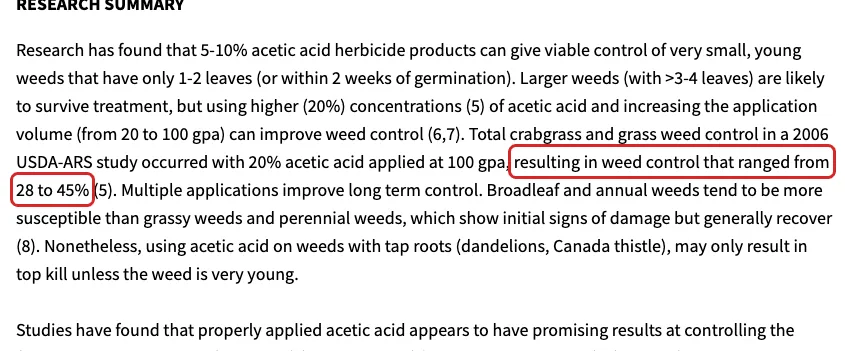
The trial numbers show how little grass vinegar kills. Webber’s best grass and crabgrass result was 44 to 63 percent control, with 20 percent acetic acid at 935 liters per hectare (100 gallons per acre), and that was on crabgrass with 1 or 2 leaves (Webber et al., 2018). Maryland Extension cites an earlier USDA ARS run at the same strength and volume at 28 to 45 percent.
Will grass grow back after vinegar?
Established lawn grass usually does: Maryland Extension says acetic acid burns grasses back temporarily, and Oregon State Extension notes that sprays leave the root system alone (UMD; Oregon State Extension). Seedling grass under 2 weeks old can die. If you want to keep a lawn and remove broadleaf weeds from it, a selective herbicide is the tool; our lawn weed killer guide compares the active ingredients by weed and grass type.
Is vinegar weed killer a registered pesticide?
Yes, when it is sold to kill weeds at herbicide strength. Registered products carry an EPA registration number and signal word; NPIC says every registered acetic acid herbicide carries DANGER because of eye and skin risk (NPIC). Vinagreen (EPA Reg. No. 85208-1) is 20.0 percent acetic acid; EPA’s label system lists more than 10 distributor registrations under it, including Green Gobbler 20% (85208-1-93489) and Nature’s Wisdom 20% (85208-1-90394) (EPA PPLS).
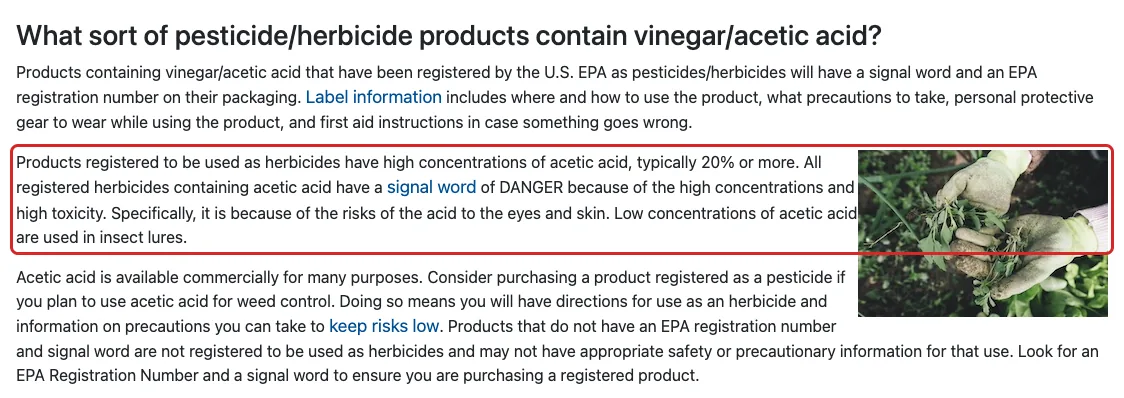
The minimum-risk exemption under FIFRA section 25(b) does not cover herbicide-strength vinegar. The permitted active ingredients at 40 CFR 152.25(f)(1) include sodium chloride but not acetic acid; vinegar appears only in the inert table, capped at 8 percent acetic acid (40 CFR 152.25(f)(2)). EPA states that vinegar may not be used as an active ingredient in unregistered, minimum-risk pesticides because acetic acid is a potent herbicide that can cause severe burns and eye damage (EPA, updated Feb. 26, 2026). Maryland adds its own rule: a product must be registered with the state chemist before it is used as a pesticide there (UMD Extension).
For paid work the rules tighten. UF/IFAS says it is illegal for commercial applicators to apply homemade herbicides as part of a landscape contract, and most states require a pesticide license for any weed control done for hire (UF/IFAS EP580). Our state-by-state pesticide applicator license guide lists the turf and ornamental category for each state.
Is vinegar weed killer organic?
Only when the acetic acid comes from fermentation. USDA’s Agricultural Marketing Service says herbicides containing only natural substances, such as vinegar and clove oils, are allowed in certified organic production; synthetic acetic acid made from methanol is not acceptable, per Washington State University FS161E (USDA AMS; WSU FS161E). Vinagreen’s label reads For Organic Production, and its alternate names include Non-Synthetic Vinegar Weed Control.
What do vinegar guides get wrong?
Seven claims repeated across vinegar guides do not match the primary documents. The table pairs each with what the label, regulation or trial actually says. The most consequential is the product status: WeedPharm and AllDown, the two vinegar products extension pages name most often, lost their EPA registrations in January 2025 (Federal Register, Jan. 13, 2025).
| Common claim | What the primary source says | Source |
|---|---|---|
| Vinegar of 8% or less is exempt from EPA registration | Vinegar of 8% or less is a permitted inert; a 25(b) product still needs an active ingredient from the 25(b) active list, which does not include acetic acid | 40 CFR 152.25(f) |
| Spray on the hottest, sunniest day (above 85°F) | Vinagreen and Harris 3-24 labels: best on dry leaves at 50 to 75°F; above 75°F with low humidity may reduce efficacy. The cancelled WeedPharm label said full sun above 65°F. A 20-trial study found humidity helped and cloud cover had no effect | Vinagreen label; Weed Works label; Brainard 2013 |
| Add orange oil or oil to make vinegar stick | Neither orange oil nor canola oil improved control; canola oil cut broadleaf control from 59 to 48% | Webber 2018, Table 4 |
| Vinegar kills weeds to the root | Acetic acid does not travel through the plant; roots are not killed | NPIC; UMD |
| WeedPharm and AllDown are the vinegar herbicides to buy | EPA cancelled Weed Works 81936-1 (sold as WeedPharm, 20%), SummerSet AllDown 84069-1 and 84069-2, and Local 20 Weed Terminator 93740-2 on Jan. 13, 2025, for non-payment of the 2024 maintenance fee; existing stocks may be sold until exhausted | Federal Register 2025-00461 |
| Green Gobbler weed killer is 20% vinegar | Its 20% product (85208-1-93489) is still an active supplemental registration, but the maker’s weed killer page now lists only Total Control, which its SDS calls a 25(b) minimum-risk pesticide with 3 to 5% acetic acid | SDS, Nov. 2022; Green Gobbler; SDS, Oct. 2023 |
| 30% cleaning vinegar is just stronger horticultural vinegar | Selling it with a weed claim makes it an unregistered pesticide: EPA Region 10 found a 20% vinegar listed under Herbicides on a price list to be one | EPA, FIFRA-10-2018-0204 |
How do you kill weeds with vinegar?
Spray young weeds on a dry, mild day until every leaf is wet, wearing goggles and waterproof gloves, then check for regrowth after 1 to 2 weeks. The steps below carry the label and extension numbers for each stage, using the Vinagreen label (EPA Reg. No. 85208-1) as the reference registered product (Vinagreen label, accepted Aug. 22, 2024).
- Check the weed’s age. Target seedlings at 2 to 4 leaves (Montana State) or the label’s 3 to 5 leaf stage; 5 percent vinegar works only within 2 weeks of emergence (USDA ARS).
- Choose the product. For herbicide use, NPIC recommends a product with an EPA registration number and signal word, so you get directions and precautions (NPIC). On an established stand, the Harris 3-24 label says to mow to 4 to 6 inches and remove clippings first (Harris 3-24 label).
- Put on the label PPE: goggles or a face shield, a particulate mask such as N95, a long-sleeved shirt and long pants, waterproof gloves, and shoes plus socks (Vinagreen label, p. 3).
- Pick the weather. Spray dry leaves at 50 to 75°F with no wind toward plants you want to keep, and wait 24 to 48 hours after rain (UMD Extension).
| Label direction | Vinagreen (85208-1) | Harris II (3-24) | WeedPharm (81936-1, cancelled 2025) |
|---|---|---|---|
| Acetic acid | 20% | 20% | 20% |
| Weed stage | 3 to 5 leaves | 3 to 5 leaves | 3 to 5 leaves |
| Temperature | 50 to 75°F, dry leaves | 50 to 75°F, dry leaves | Full sun, above 65°F |
| Rate | 44 to 88 fl oz per 1,000 sq ft | 44 to 88 fl oz per 1,000 sq ft | 15 to 30 gal per acre (0.34 to 0.69 gal per 1,000 sq ft) |
| Dilute? | No (liverworts 1:2 only) | No | No (liverworts 1:2 only) |
| Signal word | DANGER | DANGER | DANGER |
- Use a sprayer with plastic or 316 stainless steel nozzles, which the Harris 3-24 label requires, and a coarse droplet setting. Keep acid off aluminum, tin and iron, rinse any metal that gets wet, and avoid repeat applications on concrete, which acid can etch (Vinagreen label, p. 4).
- Spray each weed to the point of wetness. The Vinagreen label rate is 44 to 88 fl oz per 1,000 sq ft, so 1 gallon treats about 1,450 to 2,900 sq ft; UMD Extension’s research coverage of 70 gallons per acre is heavier, about 1.6 gallons per 1,000 sq ft.
- Keep people and pets out until the spray has dried; the label’s restricted-entry interval for workers is 48 hours.
- Check after 24 hours, when over 90 percent of treated plants should be dead, and again at 1 to 2 weeks. The Vinagreen label says to repeat if new leaves appear; UMD Extension and the cancelled AllDown label set 2 weeks as the shortest interval (UMD Extension).
Should you add salt, Epsom salt or dish soap to vinegar?
Skip the salt and Epsom salt, and treat dish soap as optional at best. Table salt kills plants but moves through soil: University of Illinois Extension says it is highly mobile and spreads to beds you want to keep (Illinois Extension, May 2020). A University of Georgia Extension agent told UGA Today that Epsom salt does not do anything to kill weeds (UGA Today, Feb. 2026).
| Additive | Claimed effect | What the source says | Source |
|---|---|---|---|
| Table salt (sodium chloride) | Dehydrates weeds | Mobile in soil, builds up with repeat sprays and harms nearby plants; leach with repeated soakings | Illinois Extension; UConn |
| Epsom salt (magnesium sulfate) | Draws out moisture | Does nothing to kill weeds; too much magnesium interferes with phosphorus uptake | UGA; UConn |
| Dish soap | Helps spray stick | No vinegar trial has tested dish soap as a treatment; the label lists any adjuvant to use | Webber 2018; UC IPM |
| Orange or canola oil | Penetrates leaf wax | No improvement; canola oil reduced broadleaf control | Webber 2018 |
| Boiling water or more vinegar | Faster kill | Volume to full wetness improves control; higher strength adds burn risk | Evans 2009; UMD |
NPIC’s caution on home remedies applies to all three: a mixed recipe has no label telling you how much to use, how often, or what protective gear to wear (NPIC, Pesticide home remedies). If a registered vinegar herbicide is in the sprayer, adding anything the label does not list makes the mix a use inconsistent with labeling, which the Vinagreen label calls a violation of federal law.
How much does vinegar weed killer cost?
Vinegar costs $3.94 to $29.97 a gallon at Walmart.com on Oct. 28, 2026, depending on strength and registration. Per area treated, cost follows spray volume: the Vinagreen label rate tops out at 88 fl oz (0.69 gallon) per 1,000 sq ft, while UMD Extension’s coverage target of 70 gallons per acre is 1.61 gallons (Vinagreen label; UMD Extension). The table converts each price to a 20 percent equivalent where the math allows.
| Product (size) | Acetic acid | EPA herbicide registration | Price | Per gallon at 20% | Per 1,000 sq ft at 88 fl oz | Source |
|---|---|---|---|---|---|---|
| Great Value Distilled White Vinegar (1 gal) | 5% | No | $3.94 | n/a (5%) | $2.71 at 5% | Walmart.com |
| 45% Pure Vinegar, Belle Chemical (1 gal) | 45% | No | $19.99 | $8.88 | $6.11 | Walmart.com |
| Harris 30% Concentrated Vinegar (1 gal) | 30% | No (cleaner) | $15.97 | $10.65 | $7.32 | Walmart.com |
| Expert Gardener 30% Vinegar Concentrate (1 gal) | 30% | None found (described as a cleaner) | $16.97 | $11.31 | $7.78 | Walmart.com |
| Green Gobbler 30% Concentrated Vinegar (1 gal) | 30% | No (cleaner) | $19.88 | $13.25 | $9.11 | Walmart.com |
| Nature’s Wisdom 20% Vinegar Weed & Grass Killer (1 gal) | 20% | Yes, 85208-1-90394 (Vinagreen label) | $29.97 | $29.97 | $20.60 | Walmart.com |
- Gallons of spray per pass
- 0.69
Gallons = area × spray volume; cost = gallons × price per gallon of spray. Label rate from the Vinagreen label (EPA Reg. No. 85208-1); diluted cleaning vinegars carry no herbicide directions. Results round to the nearest $5.
What does a typical driveway job cost with vinegar?
A worked example: weeds in the cracks and gravel edges of a 12 by 40 ft driveway, about 480 sq ft of sprayable area. At the top label rate of 88 fl oz per 1,000 sq ft, one pass takes 0.33 gallon, and a second pass 2 weeks later catches the next seedling flush. Every input is in the table, so you can swap in your own area and product.
| Input | Value | Arithmetic |
|---|---|---|
| Area sprayed | 480 sq ft | 12 ft × 40 ft |
| Spray rate | 88 fl oz per 1,000 sq ft (0.6875 gal) | Top of the Vinagreen label rate |
| Spray per pass | 0.33 gal | 480 × 0.6875 ÷ 1,000 |
| Passes | 2 | Second pass 2 weeks later (UMD minimum interval) |
| 20% registered herbicide at $29.97/gal | $19.78 | 0.33 × 2 × 29.97 |
| 30% cleaner diluted to 20% at $10.65/gal | $7.03 | 0.33 × 2 × 10.65; no herbicide label |
| 5% grocery vinegar at $3.94/gal | $2.60 | 0.33 × 2 × 3.94; seedlings only |
| Same job at UMD’s 70 gal/acre, 20% registered | $46.24 | 480 × 1.607 ÷ 1,000 × 2 × 29.97 |
Against conventional herbicides, vinegar loses on cost per season. In a UMass study for the Massachusetts Highway Department, three citric-acetic acid applications cost $270 to $570 per highway mile per year against $20 for one glyphosate application, and the acid plots showed no suppression after 6 weeks (Barker and Prostak, HortTechnology, 2009). A California roadside study put natural products at more than 10 times the cost of glyphosate (Young, Weed Technology, 2004).
If the weeds are in a gravel driveway or rock bed, the cheaper long-term fix is often below the surface: our gravel driveway cost guide prices the fabric and base layers, and the river rock cost guide covers the 3-inch depth Colorado State recommends for weed control.
Is vinegar weed killer safe for people, pets and soil?
Herbicide-strength vinegar is the most hazardous product in many garden sheds for eyes. The Vinagreen label states that the 20 percent product is corrosive and causes irreversible eye damage, and NPIC warns that acetic acid can permanently damage the corneas (Vinagreen label, p. 3; NPIC). Vapor also rises faster in warm weather and can irritate the nose, throat and lungs.
| Hazard | Number or rule | Source |
|---|---|---|
| Eye irritant classification | From 10% acetic acid (Eye Irrit. 2, H319) | Green Gobbler SDS, 2023 |
| Skin burns classification | From 25% acetic acid (Skin Corr. 1B, H314) | Green Gobbler SDS, 2023 |
| Skin burns and eye injury reported | 11% acetic acid or greater | Webber et al., 2018 |
| Air exposure limit | 10 ppm over 8 hours, 15 ppm short-term | NIOSH Pocket Guide |
| Re-entry | Keep people out until spray dries; 48-hour REI for workers | Vinagreen label, p. 4 |
| Wildlife | Toxic to birds, fish and aquatic invertebrates; do not apply to water | Vinagreen label, p. 4 |
| Soil breakdown | 75% degraded in 14 days with a garden-soil inoculum | NLM PubChem, CID 176 |
In soil, acetic acid does not last. EPA’s 2008 registration review summary says acetic acid and its salts break down to carbon dioxide and water in days to weeks and are not persistent (EPA, Acetic Acid and Salts Summary Document, 2008). Washington State University Extension notes a slight, temporary drop in pH and a small rise in acetate salts that rain leaches out (WSU Extension Yakima, June 2025).
Pets are covered by the same rule as people: the Vinagreen label says to keep unprotected persons out of treated areas until the spray has dried (48 hours for workers), and NPIC says never to leave any pesticide unattended around children or pets. Store concentrates in the original container, never a drink bottle.
Should you use vinegar on your weeds?
Use vinegar when the weeds are annual broadleaves under 5 leaves on hard surfaces or bare ground; use something else for lawns, grasses and perennials. The table and the flowchart below hold the same thresholds, drawn from the trials, label and extension sources above.
| If your situation is | Do this | Why (source) |
|---|---|---|
| Weeds inside a lawn you want to keep | Do not spray vinegar; use a selective lawn herbicide or hand-pull | Spraying weeds in turf kills surrounding turf (Vinagreen label) |
| Seedlings under 2 weeks old on a patio, path or bare soil | 5% household vinegar, soaked to wetness | 5% killed weeds in their first 2 weeks (USDA ARS) |
| Annual broadleaf weeds at 2 to 5 leaves | Registered 20% product at full wetness | 94% broadleaf control with 20% (Webber 2018) |
| Crabgrass or other grass weeds | Pull, or prevent with a preemergence; do not rely on vinegar | 28% average grass control with 20% (Webber 2018) |
| Dandelion, Canada thistle, bermudagrass or nutsedge | Dig, smother or plan repeated trim-and-spray cycles | Roots regrow (WSU FS161E; UC IPM) |
| Weeds next to aluminum, iron or concrete you care about | Hand-pull or shield the surface; rinse any overspray | Acid stains metal and can etch concrete (Vinagreen label) |
| Spraying for paying customers | Use only a registered product under your pesticide license | Homemade herbicides are illegal in landscape contracts (UF/IFAS) |
1Is the weed growing inside a lawn you want to keep?
YesDo not spray vinegar: label says it kills surrounding turf. Use a selective lawn herbicide or pull it.
NoGo to the next question
2Is it a perennial with a root system, such as dandelion, Canada thistle, bermudagrass or nutsedge?
YesExpect top kill only. Dig it, smother it, or plan repeated trim-and-spray cycles.
NoGo to the next question
3Is it a grass weed such as crabgrass?
YesExpect 28 to 63 percent control at best with 20 percent acetic acid. Pull it or prevent it.
NoGo to the next question
4Is the weed 2 weeks old or younger?
Yes5 percent household vinegar can kill it if every leaf is soaked.
NoGo to the next question
5Is it past the 5-leaf stage?
YesPull it, or accept partial control; label timing is the 3 to 5 leaf stage.
NoSpray a registered 20 percent acetic acid product to wetness on dry leaves at 50 to 75°F, with goggles and waterproof gloves.
Source: Vinagreen label (EPA Reg. No. 85208-1); USDA ARS 2002; Webber et al. 2018; WSU FS161E
How we compiled this
We compiled 7 peer-reviewed papers, 1 book chapter, the 2002 USDA ARS release, more than 20 extension, NPIC, EPA and USDA documents, 3 EPA-accepted labels, 2 safety data sheets and 6 Walmart.com prices checked Oct. 28, 2026, all read in October 2026. We did not test any product; every percentage here is a published figure or arithmetic shown beside it.
| Number to remember | What it means | Source |
|---|---|---|
| 2 weeks | Oldest weed 5% vinegar reliably killed | USDA ARS |
| 20% | Strength of registered acetic acid herbicides | NPIC |
| 1.6 gal per 1,000 sq ft | Spray volume at 70 gal/acre | UMD Extension |
| 50 to 75°F | Label temperature range for best results | Vinagreen label |
| Every 2 weeks | Shortest re-spray interval | UMD Extension |
Frequently asked questions
Is vinegar as good as Roundup?
No. Glyphosate moves to the roots; vinegar burns only what it touches. In a UMass roadside study, glyphosate scored 10 out of 10 at 6 weeks and a citric and acetic acid product 2.0, at $20 versus $270 to $570 per mile (Barker and Prostak, 2009). Vinegar’s edge is speed on seedlings.
How long does it take for 30% vinegar to kill weeds?
Leaves brown within hours. Illinois Extension reports damage as early as 4 hours after spraying, and ARS saw 20 percent vinegar kill Canada thistle top growth in about 2 hours (Illinois Extension; USDA ARS). Judge the result at 1 to 2 weeks: Maryland Extension says perennials may start regrowing about a week later.
Does vinegar kill weeds permanently?
Only seedlings and small annuals that lose every leaf and growing point. Dandelion and Canada thistle regrow from roots, and UF/IFAS found 8-week-old spurge, crabgrass and oxalis fully recovered in 4 weeks (UF/IFAS EP580). With no residual activity, new seedlings keep emerging.
What is the ratio of vinegar to water to kill weeds?
None for 5 percent vinegar or a registered 20 percent product: use both full strength, and the Vinagreen label says not to dilute. To bring a 30 percent cleaning vinegar to 20 percent, the arithmetic is 2 parts vinegar to 1 part water; 45 percent needs 4 parts vinegar to 5 parts water. Cleaning vinegars carry no herbicide directions.
Is 30% vinegar safe to use?
Treat it as a corrosive. Acetic acid at 25 percent or more is classed Skin Corr. 1B, able to burn skin, and NPIC warns horticultural vinegar can blind you (Green Gobbler SDS; NPIC). Wear goggles or a face shield and waterproof gloves, and keep children and pets away until it dries.
Is it okay to mix vinegar with weed killer?
Not unless the herbicide’s label lists vinegar as a tank-mix partner. The Vinagreen label states that using a product in a manner inconsistent with its labeling violates federal law, a rule that applies to every registered product (Vinagreen label, p. 4). Mixing also changes the hazards the label was written for.
Does vinegar, salt and Dawn really kill weeds?
The vinegar does the burning; salt and soap add risk more than kill. Illinois Extension says salt spreads through soil to plants you want to keep, and an Oregon State Extension specialist saw Canada thistle return as strong as ever the next year after a 5 percent vinegar, Epsom salt and dish soap spray (Illinois Extension; Oregon State).
Is bleach or vinegar better for killing weeds?
Neither household product carries herbicide directions, and UF/IFAS notes that online recipes using salt, vinegar, soaps and bleach mostly have not been tested (UF/IFAS EP580). Of the two, only acetic acid has registered herbicide labels and field trials behind it, such as 94 percent broadleaf control at 20 percent in Webber’s 2018 study.
This page is general information, not pesticide or legal advice. Read and follow the label of any product you use; the label is the law, and state rules on pesticide registration and licensing differ.
Sources
- National Pesticide Information Center (Oregon State University and U.S. EPA), Can I use vinegar to control weeds?, updated Apr. 18, 2024. Accessed October 2026.
- National Pesticide Information Center, Pesticide home remedies, current page. Accessed October 2026.
- USDA Agricultural Research Service (D. Comis), Spray Weeds With Vinegar?, May 15, 2002. Accessed October 2026.
- Webber, White, Shrefler and Spaunhorst, Journal of Agricultural Science 10(8), Impact of Acetic Acid Concentration, Application Volume, and Adjuvants on Weed Control Efficacy, July 15, 2018. Accessed October 2026.
- Evans, Bellinder and Goffinet, Weed Technology 23(2), Herbicidal Effects of Vinegar and a Clove Oil Product on Redroot Pigweed and Velvetleaf, June 2009. Accessed October 2026.
- Evans, Bellinder and Hahn, Weed Technology 25(3), Integration of Vinegar for In-Row Weed Control in Transplanted Bell Pepper and Broccoli, Sept. 2011. Accessed October 2026.
- Brainard et al., Weed Technology 27(1), Temperature and Relative Humidity Affect Weed Response to Vinegar and Clove Oil, March 2013. Accessed October 2026.
- Abouziena, Omar, Sharma and Singh, Weed Technology 23(3), Efficacy Comparison of Some New Natural-Product Herbicides for Weed Control at Two Growth Stages, Sept. 2009. Accessed October 2026.
- Young, Weed Technology 18(3), Natural Product Herbicides for Control of Annual Vegetation Along Roadsides, Sept. 2004. Accessed October 2026.
- Barker and Prostak, HortTechnology 19(2), Alternative Management of Roadside Vegetation, April to June 2009. Accessed October 2026.
- Webber, Shrefler and Brandenberger (InTech), Organic Weed Control, in Herbicides: Environmental Impact Studies and Management Approaches, 2012. Accessed October 2026.
- U.S. EPA, Vinagreen label, EPA Reg. No. 85208-1 (notification accepted Aug. 22, 2024), Aug. 22, 2024. Accessed October 2026.
- U.S. EPA, Pesticide Product Label System (PPLS), records for 85208-1 and its supplemental registrations, searched Oct. 28, 2026. Accessed October 2026.
- Federal Register 2025-00461 (U.S. EPA), Pesticide Registration Maintenance Fee; Cancellation Order for Certain Pesticide Registrations, Jan. 13, 2025. Accessed October 2026.
- U.S. EPA, Weed Works Weed & Grass Killer label, EPA Reg. No. 81936-1, accepted Jan. 27, 2020. Accessed October 2026.
- U.S. EPA, Harris Vinegar Grass & Weed Killer II label, EPA Reg. No. 3-24, Sept. 14, 2022. Accessed October 2026.
- U.S. EPA, Minimum Risk Pesticides: Inert Ingredient and Active Ingredient Eligibility under 40 CFR 152.25(f), updated Feb. 26, 2026. Accessed October 2026.
- U.S. EPA Region 10, Consent Agreement, In the Matter of Concentrates, Inc., FIFRA-10-2018-0204, 2018. Accessed October 2026.
- USDA Agricultural Marketing Service, Allowed and prohibited substances, methods and ingredients in organic production, current page. Accessed October 2026.
- CDC NIOSH, Pocket Guide to Chemical Hazards: Acetic acid, reviewed Oct. 30, 2019. Accessed October 2026.
- eCFR, 40 CFR 152.25, Exemptions for pesticides of a character not requiring FIFRA regulation, current as of Oct. 2026. Accessed October 2026.
- U.S. EPA (docket EPA-HQ-OPP-2008-0016), Acetic Acid and Salts Summary Document, Registration Review, March 2008. Accessed October 2026.
- National Library of Medicine, PubChem, Acetic acid (CID 176), environmental fate, current record. Accessed October 2026.
- Green Gobbler, Safety Data Sheet, 20% Vinegar Weed Killer (EPA Reg. No. 85208-1-93489), rev. Nov. 10, 2022. Accessed October 2026.
- Green Gobbler, Safety Data Sheet, Total Control Weed & Grass Killer (25(b)), Oct. 12, 2023. Accessed October 2026.
- University of Maryland Extension (D. Smith-Fiola, S. Gill), Vinegar: An Alternative to Glyphosate?, updated Nov. 1, 2024. Accessed October 2026.
- Montana State University Extension (N. Orloff), Monthly Weed Post: Does Vinegar Kill Weeds?, June 2021. Accessed October 2026.
- Oregon State University Extension, Ask Extension: Does vinegar help in controlling weeds?, current page. Accessed October 2026.
- UF/IFAS Extension (C. Marble, J. Neal, A. Senesac), EP580, Use of Glyphosate and Herbicide Alternatives for Weed Control in Florida Landscape Planting Beds, Jan. 22, 2020. Accessed October 2026.
- Washington State University Extension (C. Daniels, T. Miller), FS161E, Pesticide Ingredient: Acetic Acid/Vinegar, Jan. 2015. Accessed October 2026.
- Washington State University Extension, Yakima County, Salt and Vinegar, June 21, 2025. Accessed October 2026.
- University of Illinois Extension, Home, Yard and Garden Newsletter: vinegar as an herbicide, July 16, 2021. Accessed October 2026.
- University of Illinois Extension, Good Growing: Home horticultural remedies, May 22, 2020. Accessed October 2026.
- UConn Extension, Homemade weed killer recipes, current page. Accessed October 2026.
- UGA Today, University of Georgia, Extension agent weighs in on whether Epsom salt kills weeds, Feb. 1, 2026. Accessed October 2026.
- UC Statewide IPM Program, Pest Notes: Weed Management in Landscapes, updated Sept. 2018. Accessed October 2026.
- UC Statewide IPM Program, Pest Notes: Bermudagrass, current page. Accessed October 2026.
- Walmart.com, Product pages for Great Value 5%, Harris 30%, Expert Gardener 30%, Green Gobbler 30%, Belle Chemical 45% and Nature’s Wisdom 20% vinegars, prices checked Oct. 28, 2026. Accessed October 2026.