
How to winterize irrigation system lines: shut off the water, set the controller to off, and drain or blow out each zone at 50 psi or less, 2 minutes at a time, before the first 28°F freeze. Drain the backflow last, valves half open.
How to winterize irrigation system lines depends on how the system was built to drain: manual drain valves, automatic drain valves or a port for compressed air. Every method starts with the supply valve closed and the controller off before the first hard freeze, 28°F or lower for an extended period per the National Weather Service; early dates for 36 cities are in our guide to when to stop watering your lawn.
The blowout numbers are where guides split. In the 13 maker, extension and utility documents we compared, Rain Bird, Toro and K-Rain cap air at 50 psi, while Hunter and Colorado State allow 80 psi on rigid PVC. Air volume runs from 10 CFM in Rain Bird’s homeowner PDF to 185 CFM on its blog. To hire it out instead, see our sprinkler blowout price survey: $50 to $160 for 8 zones.
Which winterizing method fits your system?
Look in the valve box and along the mainline. A ball valve, stop-and-waste valve or threaded cap at the mainline’s low point is a manual drain. Spring valves in the low points of the laterals, such as Rain Bird’s 16A-FDV, are automatic drains. A hose bib, quick coupler or plugged tee just downstream of the backflow device is a blowout port. Hunter‘s rule if you cannot tell: blow it out.
| Method | How the water leaves | Air pressure | Use it when | What it leaves behind | Source |
|---|---|---|---|---|---|
| Manual drain | Gravity, through valves at every low point and end of the pipe | None | The system was designed with drains at each low point | Water in valve bodies, check-valve heads and any dip in the pipe | Hunter; Rain Bird |
| Automatic drain | Spring valves on the laterals open when pressure drops after each cycle | None | Laterals have drains at low points; the mainline still needs a manual drain | Water above valve diaphragms; a stuck drain puddles all season | Rain Bird |
| Compressed-air blowout | Regulated air pushes water out through the heads, zone by zone | 50 psi max (Rain Bird, Toro, K-Rain); up to 80 on rigid PVC (Hunter, CSU) | Electric valves, unknown layout, or frost that reaches pipe depth | Little, if each zone gets 2 short rounds; heat damage if dry zones keep running | CSU; Toro |
| Above-ground drain only | Drain the backflow and exposed pipe; buried pipe stays full | None | Light freezes where the ground does not freeze to pipe depth, as in most of Texas | Buried pipe, by design | Texas A&M |
Colorado State University Extension distrusts drain valves, because buried pipe shifts and leaves low spots, and says systems with electric valves must be blown out since nothing else empties the water on top of each diaphragm. Texas A&M says most Texas systems are not built for a blowout at all. The design was settled at install, as our sprinkler system installation cost guide explains.
1Do winters bring only light freezes that do not reach buried pipe, as in most of Texas?
YesShut off the supply, drain the backflow and any above-ground pipe, and insulate exposed PVC (Texas A&M).
NoGo to the next question
2Do you not know how the system was built to drain?
YesBlow it out with air regulated to 50 psi, 2 minutes per zone (Hunter, Rain Bird).
NoGo to the next question
3Are there manual drain valves at every low point and end of the pipe?
YesRelieve pressure through one zone valve, open every drain, then close them when the water stops (Hunter, Rain Bird).
NoGo to the next question
4Are there automatic drain valves on the lateral lines?
YesDrain the mainline by hand, then blow out or take apart the zone valves, which gravity does not empty (Rain Bird).
NoBlow it out with compressed air, adding a blowout port downstream of the backflow device if there is none (CSU).
What pressure, air volume and time per zone do the guides set?
Three numbers decide whether a blowout clears the pipe or damages it. Each document’s figures, quoted as printed:
Swipe the table sideways to see every column.
| Source | Max air pressure | Air volume | Time per zone | Backflow preventer |
|---|---|---|---|---|
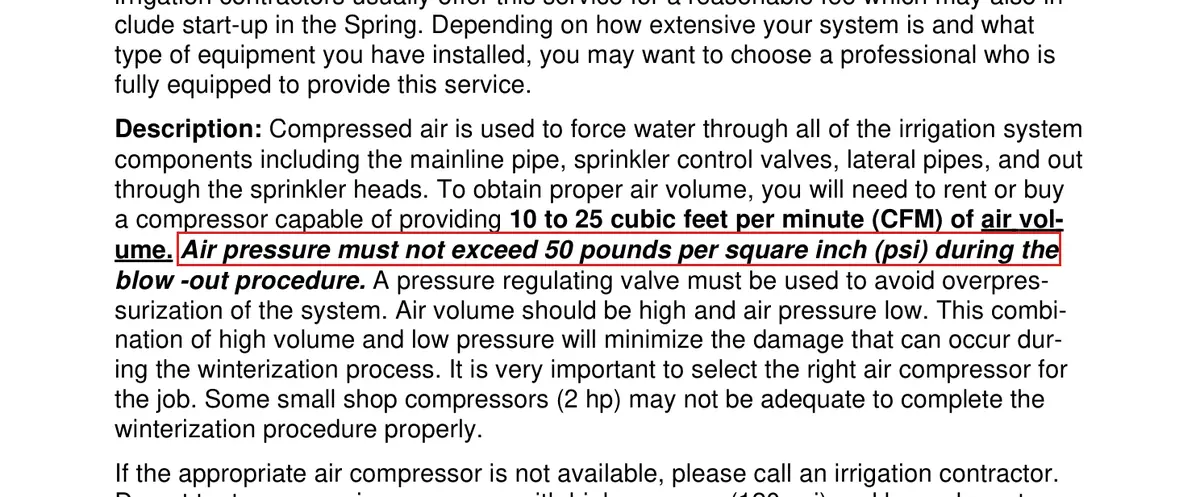
| Rain Bird, Homeowner’s Guide to Winterization (PDF) | 50 psi | 10 to 25 CFM | 2 min max, 2 or more rounds until a fine mist | Check the maker’s steps; leave ball valves at 45° |
| Rain Bird, Fall is Blow-Out Season (blog) | 50 psi at the regulator (same page: compressor regulated to 75 to 85 psi) | 185 CFM or more, 50 to 70 gal tank | 2 min max, 2 or more rounds | Insulate; do not block air vents or drain outlets |
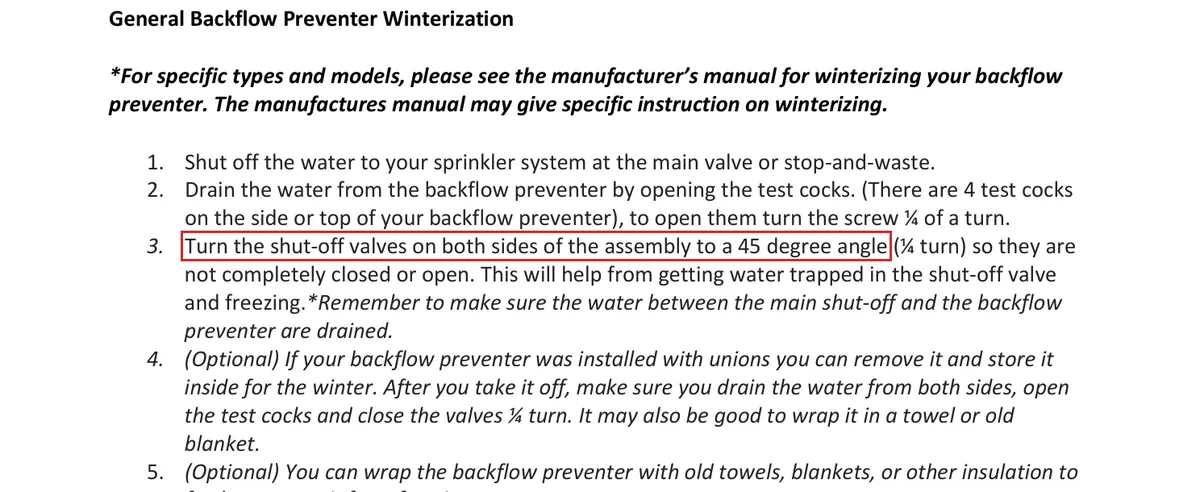
| Hunter Industries, Winterizing Your Irrigation System | 50 psi poly pipe, 80 psi PVC, and below the lowest-rated part in the zone | Largest zone GPM divided by 7.5 | About 2 min or more; 2 or 3 short cycles | Never blow air through it; drain after; valves at 45°, test cocks open |
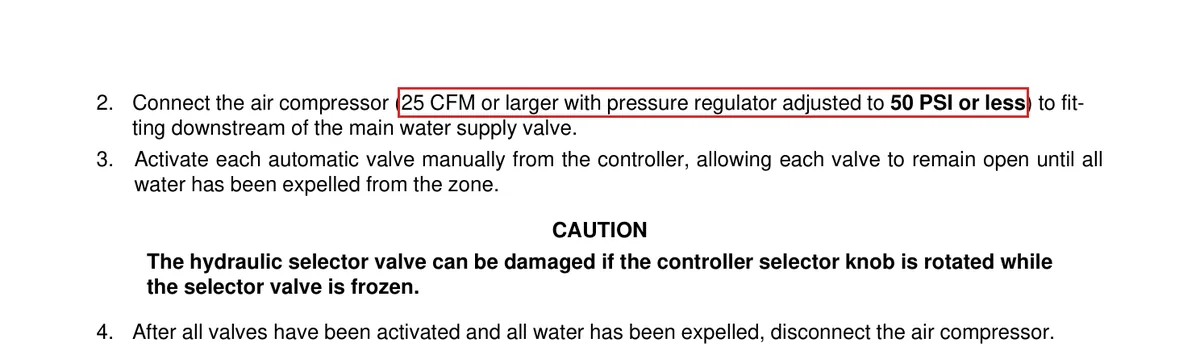
| Toro, residential start-up and winterization instructions | 50 psi, any system | 25 CFM or larger | Until the zone stops expelling water | Not covered |
| Toro, document 373-0849 (golf and large commercial, 2014) | Start at 40 psi, raise in 2 psi steps, 50 psi max in the field | 375 to 900 CFM | Not stated | Not covered |
| K-Rain, Winterize Your Sprinkler System | 50 psi | 20 to 25 CFM | 1 min max, 2 or more rounds | Not covered |
| Colorado State University Extension | 40 to 80 psi: 80 max rigid PVC, 50 max poly pipe | Zone GPM divided by 7.5 | Each zone twice, short cycles | PVB and RP: never blow air through; valves half open |
| Sullair (compressor maker), winterizing FAQ | Home pipe often cannot take more than 40 to 60 psi; regulate a 100 psi unit | 185 Series is the usual residential unit | 2 to 3 min; 5 zones in about 20 to 25 min with setup | Contractor removes it |
| Woodlands Water Agency, Texas | 50 psi PVC, 80 psi metal pipe | Not stated | One zone at a time | Drain and insulate |
| Salt Lake City Public Utilities (PDF) | Not stated | Not stated | Not stated | Connect downstream of it with its ball valves shut; then test cocks open, valves at 45° |
| Watts, 800M4 PVB installation sheet (PDF) | Not stated | Not stated | Not stated | Open drain, test cocks and ball valves; purge; handles at 45° |
| Texas A&M School of Irrigation | Most Texas systems are not built for a blowout | Not stated | Not stated | Drain above-ground assemblies; insulate exposed PVC |
| Oregon City, Oregon, utility page | Hire a professional for a blowout | Not stated | Not stated | Drain it; pack boxes with foam or wood chips; test each spring |
Read 185 CFM as a contractor number: Rain Bird‘s blog pairs it with a 50 to 70 gallon compressor regulated to 75 to 85 psi, then tells homeowners to set the regulator to 50 psi. Where sources disagree, 50 psi sits inside every limit in the table, and Toro’s golf sheet starts at 40 and climbs in 2 psi steps.
How big a compressor do you need?
Hunter and CSU divide the largest zone’s gallons per minute by 7.5 (a cubic foot holds 7.48 gallons); CSU’s example is a 20 GPM zone needing 2.66 CFM at 30 psi. That is air at line pressure, while compressors are rated in free air. At 50 psi air fills 1/4.4 of its free volume (14.7 ÷ 64.7 absolute psi), so a zone needs about 4.4 times the rule’s figure in free air, and 6.4 times at 80 psi.
- Hunter and CSU rule: GPM divided by 7.5 (CFM at line pressure)
- 1.6
- Same air as free air if the line holds 50 psi (CFM)
- 7.0
- Same air as free air if the line holds 80 psi (CFM)
- 10.3
Free air = GPM / 7.5 x (psi + 14.7) / 14.7, an upper bound. Rain Bird asks for 10 to 25 CFM, K-Rain 20 to 25 and Toro 25 or more; use the larger of their figure and this one.
| Largest zone flow | GPM ÷ 7.5 (Hunter, CSU) | Free air if the line holds 50 psi | Free air if the line holds 80 psi |
|---|---|---|---|
| 6 GPM | 0.8 CFM | 3.5 CFM | 5.2 CFM |
| 12 GPM | 1.6 CFM | 7.0 CFM | 10.3 CFM |
| 18 GPM | 2.4 CFM | 10.6 CFM | 15.5 CFM |
| 24 GPM | 3.2 CFM | 14.1 CFM | 20.6 CFM |
Even 24 GPM stays under the 20 to 25 CFM that K-Rain and Toro name, so treat their figure as the target and the conversion as a floor. CSU’s field check: if heads stay up while air flows, the compressor is big enough. For your zone’s GPM, read the irrigation plan or run that zone alone for 1 minute and read the gallons on the water meter.
A small tank cannot fake volume. Rain Bird, K-Rain and Hunter all forbid charging the tank and a closed mainline to 120 psi and dumping it through a zone, and Rain Bird says some 2 hp shop compressors are not adequate. Pipe rated for 120 psi of water is not rated for 120 psi of air.
How to blow out a sprinkler system, step by step
- Wear ANSI-approved eye protection and never stand over heads, valves or pipe while air is on (Hunter).
- Close the supply valve or stop-and-waste valve; CSU says it can be 5 feet down, needing a long key. Remove any flow sensor and cap the pipe (Hunter).
- Close the ball valve on the downstream side of the backflow device so compressor air never passes through it (CSU; Salt Lake City).
- From the controller, open the zone farthest from the air connection and highest in elevation, to relieve mainline pressure.
- Attach the hose with the compressor valve closed and set the regulator to 50 psi (80 only on rigid PVC, per Hunter and CSU).
- Open the air slowly until the heads pop up. Run each zone 2 minutes at most (Rain Bird; K-Rain says 1), and never with every zone valve shut.
- Work zone by zone toward the compressor, then repeat: 2 or more rounds until only a fine mist comes out. Stop once a zone is dry; Rain Bird warns the heat can melt gear-drive rotor seals.
- With one zone still open, shut the compressor off, let the air bleed out and unhook the hose.
- Leave blown-out valves in the manual-open position so they cannot repressurize (Rain Bird), and close any manual drain valves (Hunter).
Sullair, which calls its 185 Series the usual residential unit, puts each zone at 2 to 3 minutes and a 5-zone job at 20 to 25 minutes with setup.
How do you drain a manual or automatic drain system?
- Close the irrigation supply valve.
- Open one zone valve to relieve mainline pressure first; Rain Bird warns drain caps are pressurized.
- Slowly open every manual drain, then the stop-and-waste drain cap or boiler drain before the backflow device (Hunter).
- Open the test cocks on the backflow device.
- Pull up on any heads with built-in check valves so their bodies drain (Hunter).
- When the water stops, close all manual drain valves (Hunter).
On automatic-drain systems the laterals empty after every cycle, so only the mainline and backflow need draining (Oregon City). Rain Bird says gravity does not empty the valves: diaphragm valves such as its DAS-100 need the bonnet and diaphragm removed and the water sponged out unless the system is blown out.
How do you winterize the backflow preventer?
The backflow assembly usually sits above ground, and Hunter says freezing water can crack its brass body. Do the zones first, then the device:
| Device | Where it sits | Winter steps | Source |
|---|---|---|---|
| Pressure vacuum breaker (PVB), e.g. Watts 800M4 | At least 12 in above the highest downstream pipe | No compressor air through it. Close the supply, open the upstream drain and test cocks, work both ball valves back and forth several times, leave handles at 45° | CSU; Watts; SLC |
| Reduced pressure assembly (RP or RPZ) | At least 12 in above ground | Close the supply slowly; open test cocks 2 and 3 to drain the first check; drain upstream; remove the second check cap, spring and disc holder to drain the body, then refit; ball valves at about 45° | CSU; SLC |
| Atmospheric vacuum breaker (AVB) | One per zone, 6 in above the highest head | Cleared when its zone is blown out | CSU; SLC |
| Double check valve | Older systems only | Drain through the test cocks; Salt Lake City no longer allows new ones on lawn systems | SLC |
| Any assembly on unions | Removable | Take it indoors, drain both sides, test cocks open, ball valves a quarter turn | SLC |
One conflict: Watts’ 800M4 sheet lists purging the PVB with pressurized air, while CSU says PVB and RP devices must never be blown out because heat can melt their rubber seals, and Hunter keeps compressed air out of every backflow device. Follow your model’s sheet; for a blowout, connect downstream with its ball valves closed. Removing an RPZ for winter costs $55 extra at one company in our repair price list.
Insulate what stays outside: Rain Bird wraps the main shutoff and exposed pipe in foam tape and a plastic bag without covering the backflow’s vents, and Oregon City packs valve boxes with foam or wood chips. In spring, CSU closes test cocks and ball valves first and opens the ball valves slowly; Toro refills at 50 psi or less.
What should the controller, pump and sensors be set to?
| Part | Winter setting | Source |
|---|---|---|
| Controller, no pump | Leave it powered with the dial or mode on OFF or RAIN; transformer heat keeps condensation out and the program stays | Hunter; Rain Bird |
| Controller, CSU variant | Keep it powered and run a minimum cycle once a week so solenoid plungers do not stick | CSU |
| Indoor controller that starts a pump | Unplug it and remove the backup battery; reprogram in spring | Rain Bird |
| Outdoor controller that starts a pump | Breaker off, then disconnect the common wire(s) so a power surge cannot start a dry pump | Rain Bird |
| Pump | Drain it, remove and store indoors, or drain and insulate in place | CSU |
| Rain sensor with a cup | Empty the cup and cover it with a plastic bag | Hunter |
| Flow sensor | Remove before any blowout and seal the pipe | Hunter |
| Hose-bib timer | Disconnect and store in a garage or basement | Oregon City |
When should you winterize, and what does skipping it cost?
Finish before the first 28°F night. Sullair says blowout season runs from August to early December by region, done before temperatures consistently drop below 32°F. In our freeze-date table for 36 cities, Denver’s median 28°F date is Oct. 18 and 1 year in 10 sees it by Oct. 5.
CSU says water grows by one-eleventh as it freezes, enough to split pipe, valves and pumps. Oregon City says most of its water shut-off emergency calls come in winter from homes with irrigation not winterized properly, and buried leaks can run for months. A backflow assembly costs $650 to $1,600 to replace in our repair price survey, against an $87 median blowout.
Drip zones get drained the same way, per our drip irrigation setup guide. For a dry fall after shutdown, hand-water as in our lawn watering timing guide; contractors can compare blowout route tools in our irrigation contractor software comparison.
How we compiled this
In November 2026 we read 13 primary documents: 6 from irrigation makers (2 Rain Bird, Hunter, 2 Toro, K-Rain), Sullair, Watts, Colorado State, Texas A&M and 3 utilities, plus the National Weather Service glossary. Table values are quoted as printed. We ran no tests; the free-air figures are our arithmetic.
Frequently asked questions
Can you winterize your own irrigation system?
Yes. A drain system needs only a valve key; a blowout needs a 10 to 25 CFM compressor regulated to 50 psi. Rain Bird and Hunter recommend a professional for the injury risk; the median 8-zone price is $87 (our survey).
Can you winterize a sprinkler system without a blowout?
Yes, if it has drains at every low point (Hunter). CSU warns gravity leaves water in low spots and on electric valve diaphragms. In most of Texas, Texas A&M drains only above-ground parts.
Will sprinklers freeze at 29 degrees?
Exposed parts can. The National Weather Service hard freeze is 28°F or lower for an extended period. Soil shields buried pipe, not the backflow, so before a night near 29°F shut the supply, drain the backflow and insulate exposed PVC (Texas A&M).
What psi should I use to blow out sprinklers?
50 psi. Rain Bird, Toro and K-Rain cap every system there; Hunter and CSU allow 80 on rigid PVC but 50 on poly pipe.
What is the 30/30 rule for irrigation?
A drip rule: UC ANR limits 1/4 inch tubing to 30 feet per run and 30 gallons per hour.
How much does it cost to winterize an irrigation system?
An 8-zone blowout costs $50 to $160 across 8 companies, median $87, per our sprinkler repair cost guide.
Sources
- Rain Bird, Homeowner’s Guide to Winterization (PDF), undated. Accessed November 2026.
- Rain Bird, Fall is Blow-Out Season: Tips for Winterizing Your Sprinkler System, undated. Accessed November 2026.
- Rain Bird, How Do I Winterize My Irrigation System?, undated. Accessed November 2026.
- Rain Bird, Sprinkler System Filtered Drain Valve (16A-FDV), product page. Accessed November 2026.
- Hunter Industries, Winterizing Your Irrigation System, undated. Accessed November 2026.
- The Toro Company, Irrigation System Start-Up and Winterization Procedures (service instructions, hosted by Midwest Turf), undated. Accessed November 2026.
- The Toro Company, Irrigation System Winterization and Pressurization Procedures, document 373-0849 Rev. A, 2014. Accessed November 2026.
- K-Rain, Winterize Your Sprinkler System, undated. Accessed November 2026.
- Colorado State University Extension, Home Sprinkler Systems: Preparing Your Sprinkler System for Winter (from Fact Sheet 4.719), undated. Accessed November 2026.
- Texas A&M AgriLife, School of Irrigation, Winterization, undated. Accessed November 2026.
- Sullair, 6 Frequently Asked Questions When Winterizing Irrigation Systems, undated. Accessed November 2026.
- Salt Lake City Department of Public Utilities, Winterizing Your Lawn Sprinkler System and Backflow Preventer (PDF), undated. Accessed November 2026.
- Woodlands Water Agency, It’s time to winterize your irrigation system, undated. Accessed November 2026.
- Watts, Series 800M4 Pressure Vacuum Breaker installation, service and maintenance instructions, IS-800M4 (PDF), 2024. Accessed November 2026.
- City of Oregon City, Oregon, Winterize Your Irrigation System to Prevent Freeze Damage, undated. Accessed November 2026.
- National Weather Service, Glossary: freeze and hard freeze, current. Accessed November 2026.
- UC Agriculture and Natural Resources, Backyard Gardener, Flow Focus: Irrigation Friction Loss, undated. Accessed November 2026.