When to stop watering lawn grass: cool-season lawns when daytime highs stay below 50°F, warm-season lawns at the first frost, when they go dormant. Blow out sprinklers before the first 28°F freeze, then hand-water dry winter spells above 40°F.
Knowing when to stop watering lawn grass means watching two clocks, not a calendar. The grass clock: Iowa State Extension says cool-season foliage stops growing once daytime highs stay below 50°F, which in Iowa is late October or early November, and until then turf uses about 1 inch of water a week. The pipe clock: a buried sprinkler system has to be drained before the first hard freeze, which the National Weather Service defines as 28°F or lower for an extended period.
The grass clock has an earlier stage too: growth falls under 10% of its peak once the normal daily mean drops below about 46°F, on Nov. 4 in Chicago, as the city tables on when grass stops growing show.
Those clocks rarely agree. We lined both up for 36 U.S. cities using NOAA’s 1991 to 2020 climate normals. In 19 of the 23 cities where normal highs ever drop below 50°F, the median hard freeze comes first, by 3 days in Minneapolis and Milwaukee to 36 days in Denver and 42 in Nashville. In those places the sprinkler season ends before the grass does, and any dry week in between is a hose job.
When to stop watering your lawn: 36-city calendar
Find your city or the nearest one with a similar climate. Read column 2 if you grow Kentucky bluegrass, tall fescue or perennial ryegrass, and column 3 if you grow bermudagrass, zoysiagrass, St. Augustinegrass or centipedegrass; our guide to types of lawn grass sorts the two groups. The early freeze date in column 4 is the day by which 1 year in 10 has already seen 28°F, which is the safer blowout deadline than the median.
Once you have the date, the shutdown itself, from the 2-minute limit per zone to leaving backflow valves at 45 degrees, is in our guide to how to winterize your irrigation system.
Swipe the table sideways to see every column.
| City (NOAA station) | Normal high drops below 50°F: cool-season growth stops | Median first 32°F frost: warm-season dormancy | 28°F hard freeze, early (1 in 10 years) / median | October normal rain, in (share of 1 in a week) | What it means |
|---|---|---|---|---|---|
| Fargo, ND | Oct. 26 | Sept. 30 | Sept. 26 / Oct. 10 | 2.17 (49%) | Blow out by Sept. 26; hose-water dry weeks until Oct. 26. |
| Minneapolis, MN | Nov. 1 | Oct. 18 | Oct. 15 / Oct. 29 | 2.58 (58%) | Blow out by Oct. 15; hose-water dry weeks until Nov. 1. |
| Milwaukee, WI | Nov. 11 | Oct. 29 | Oct. 27 / Nov. 8 | 2.78 (63%) | Blow out by Oct. 27; hose-water dry weeks until Nov. 11. |
| Chicago, IL | Nov. 13 | Oct. 28 | Oct. 27 / Nov. 7 | 3.43 (77%) | Blow out by Oct. 27; hose-water dry weeks until Nov. 13. |
| Detroit, MI | Nov. 13 | Oct. 27 | Oct. 27 / Nov. 7 | 2.53 (57%) | Blow out by Oct. 27; hose-water dry weeks until Nov. 13. |
| Des Moines, IA | Nov. 12 | Oct. 20 | Oct. 16 / Oct. 30 | 2.78 (63%) | Blow out by Oct. 16; hose-water dry weeks until Nov. 12. |
| Omaha, NE | Nov. 17 | Oct. 21 | Oct. 17 / Oct. 30 | 2.32 (52%) | Blow out by Oct. 17; hose-water dry weeks until Nov. 17. |
| Boston, MA | Nov. 21 | Nov. 9 | Nov. 8 / Nov. 21 | 4.03 (91%) | Growth stops about when the freeze arrives; stop and blow out by Nov. 8. |
| New York, NY | Nov. 28 | Nov. 20 | Nov. 15 / Dec. 1 | 4.38 (99%) | Growth stops about when the freeze arrives; stop and blow out by Nov. 15. |
| Philadelphia, PA | Dec. 3 | Nov. 10 | Nov. 7 / Nov. 23 | 3.47 (78%) | Blow out by Nov. 7; hose-water dry weeks until Dec. 3. |
| Columbus, OH | Nov. 21 | Oct. 27 | Oct. 26 / Nov. 6 | 2.9 (65%) | Blow out by Oct. 26; hose-water dry weeks until Nov. 21. |
| Washington, DC | Dec. 11 | Nov. 18 | Nov. 14 / Dec. 3 | 3.66 (83%) | Blow out by Nov. 14; hose-water dry weeks until Dec. 11. |
| Kansas City, MO | Nov. 24 | Oct. 24 | Oct. 19 / Nov. 1 | 3.25 (73%) | Blow out by Oct. 19; hose-water dry weeks until Nov. 24. |
| St. Louis, MO | Nov. 29 | Nov. 4 | Nov. 2 / Nov. 13 | 3.15 (71%) | Blow out by Nov. 2; hose-water dry weeks until Nov. 29. |
| Denver, CO | Nov. 23 | Oct. 9 | Oct. 5 / Oct. 18 | 0.99 (22%) | Blow out by Oct. 5; grass grows to Nov. 23 with 0.99 in of October rain. In 2026 Denver Water bans all lawn watering from Oct. 1. |
| Salt Lake City, UT | Nov. 17 | Oct. 31 | Oct. 27 / Nov. 10 | 1.26 (28%) | Blow out by Oct. 27; hose-water dry weeks until Nov. 17. |
| Boise, ID | Nov. 13 | Oct. 21 | Oct. 17 / Oct. 31 | 0.81 (18%) | Blow out by Oct. 17; hose-water dry weeks until Nov. 13. |
| Spokane, WA | Oct. 30 | Oct. 12 | Oct. 7 / Oct. 23 | 1.37 (31%) | Blow out by Oct. 7; hose-water dry weeks until Oct. 30. |
| Seattle, WA | Nov. 26 | Nov. 23 | Nov. 17 / Dec. 10 | 3.91 (88%) | Autumn rain takes over: November averages 6.31 in. Blow out by Nov. 17. |
| Portland, OR | Nov. 29 | Nov. 19 | Nov. 12 / Dec. 5 | 3.42 (77%) | Autumn rain takes over: November averages 5.45 in. Blow out by Nov. 12. |
| Albuquerque, NM | Dec. 3 | Nov. 3 | Oct. 31 / Nov. 15 | 0.87 (20%) | Blow out by Oct. 31; hose-water dry weeks until Dec. 3. |
| Las Vegas, NV | Never (lowest normal high 56°F) | Dec. 15 | Dec. 6 / Dec. 26 | 0.32 (7%) | Highs stay above 50°F: cool-season grass keeps growing; warm-season grass goes dormant near Dec. 15. |
| Phoenix, AZ | Never (lowest normal high 65°F) | Jan. 3 | None in a typical year / None in a typical year | 0.56 (13%) | Highs stay above 50°F: cool-season grass keeps growing; warm-season grass goes dormant near Jan. 3. |
| Sacramento, CA | Never (lowest normal high 55°F) | Dec. 2 | Nov. 30 / Dec. 16 | 0.85 (19%) | Highs stay above 50°F: cool-season grass keeps growing; warm-season grass goes dormant near Dec. 2. |
| Los Angeles, CA | Never (lowest normal high 65°F) | None in a typical year | None in a typical year / None in a typical year | 0.49 (11%) | No normal frost: no end date. Switch the controller to its winter schedule. |
| Oklahoma City, OK | Dec. 16 | Nov. 2 | Oct. 29 / Nov. 11 | 3.32 (75%) | Blow out by Oct. 29; hose-water dry weeks until Dec. 16. |
| Dallas-Fort Worth, TX | Never (lowest normal high 56°F) | Nov. 24 | Nov. 15 / Dec. 7 | 4.37 (99%) | Highs stay above 50°F: cool-season grass keeps growing; warm-season grass goes dormant near Nov. 24. |
| Austin, TX | Never (lowest normal high 62°F) | Dec. 3 | Nov. 27 / Dec. 27 | 3.91 (88%) | Highs stay above 50°F: cool-season grass keeps growing; warm-season grass goes dormant near Dec. 3. |
| Houston, TX | Never (lowest normal high 63°F) | Dec. 9 | Dec. 2 / Jan. 2 | 5.46 (123%) | Highs stay above 50°F: cool-season grass keeps growing; warm-season grass goes dormant near Dec. 9. |
| Nashville, TN | Dec. 27 | Nov. 3 | Nov. 2 / Nov. 15 | 3.36 (76%) | Blow out by Nov. 2; hose-water dry weeks until Dec. 27. |
| Charlotte, NC | Never (lowest normal high 52°F) | Nov. 3 | Nov. 1 / Nov. 14 | 3.16 (71%) | Highs stay above 50°F: cool-season grass keeps growing; warm-season grass goes dormant near Nov. 3. |
| Raleigh, NC | Never (lowest normal high 52°F) | Nov. 4 | Nov. 2 / Nov. 16 | 3.37 (76%) | Highs stay above 50°F: cool-season grass keeps growing; warm-season grass goes dormant near Nov. 4. |
| Atlanta, GA | Never (lowest normal high 54°F) | Nov. 20 | Nov. 14 / Dec. 5 | 3.28 (74%) | Highs stay above 50°F: cool-season grass keeps growing; warm-season grass goes dormant near Nov. 20. |
| Jacksonville, FL | Never (lowest normal high 65°F) | Dec. 7 | Nov. 29 / Jan. 2 | 4.03 (91%) | Highs stay above 50°F: cool-season grass keeps growing; warm-season grass goes dormant near Dec. 7. |
| Orlando, FL | Never (lowest normal high 71°F) | Jan. 10 | Dec. 24 / Jan. 13 | 3.46 (78%) | Highs stay above 50°F: cool-season grass keeps growing; warm-season grass goes dormant near Jan. 10. |
| Miami, FL | Never (lowest normal high 76°F) | None in a typical year | None in a typical year / None in a typical year | 7.65 (173%) | No normal frost: no end date. Switch the controller to its winter schedule. |
The widest gaps sit in the dry interior and the transition zone. Denver’s median hard freeze is Oct. 18, but its normal high does not fall below 50°F until Nov. 23, and October brings only 0.99 inches of rain. Oklahoma City runs 35 days and Kansas City 23. In Seattle the order flips: highs drop below 50°F on Nov. 26, 14 days before the median hard freeze, and November averages 6.31 inches of rain, so the irrigation season ends by itself.
Which trigger applies to your grass?
Every date in the calendar comes from one of the thresholds below. Air temperature is the practical signal because it is in every forecast; soil temperature explains why. Our soil temperature guide shows where to read live 4-inch soil readings if you want to check the ground directly.
| Threshold | What happens | What to do with the water | Source |
|---|---|---|---|
| Daytime highs consistently below 50°F | Cool-season foliage (Kentucky bluegrass and similar) stops growing; Iowa reaches it in late October or early November | Stop routine watering; the mower goes away at the same point | Iowa State Extension |
| Soil 40 to 65°F | Cool-season roots still grow after shoots slow; shoots favor temperatures above 55°F, and some root growth continues while soil is unfrozen | Keep a dry fall lawn moist until the soil freezes | Michigan State turfgrass archive, 1988 |
| Soil below 40°F | Plant growth slows and turf can no longer use fertilizer well | Last useful deep watering on a dry fall | Purdue Extension, 2022 |
| Winter soil below 50 to 55°F | All bermudagrasses go dormant, for up to 5 months | Drop to an occasional dry-spell watering | UC Cooperative Extension, Harivandi |
| Air below 50°F, first killing frost | Bermudagrass and bahiagrass stop shoot growth and lose chlorophyll; in Mississippi dormancy runs from early to mid-November to early to mid-April | Same: dormancy schedule | Mississippi State Extension, Dec. 2015 |
| Air 28°F or lower for an extended period | Hard freeze; water left in pipes, valves and the backflow assembly can freeze | Blow out the sprinkler system before this date | National Weather Service glossary |
| Air above 40°F, no snow cover, soil not frozen | Safe window for winter watering in the dry West | Midday hose watering once or twice a month | Colorado State Extension 7.211 |
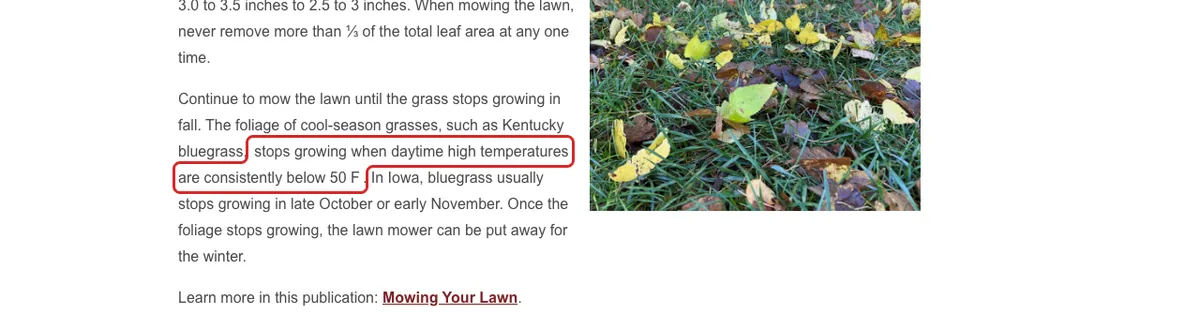
The 1 inch a week figure from Iowa State is the yardstick for the rain column. Over a 31-day October that is about 4.4 inches, and none of the 36 stations reaches it on its normal rainfall except Miami (7.65 in) and Houston (5.46 in). Las Vegas averages 0.32 inches, Boise 0.81 and Denver 0.99. That is why the West, not the Midwest, is where fall watering matters most.
What to do in the freeze gap
If your city shows a positive gap, the sprinkler system has to stop before the lawn does. Shut it down by the early freeze date in the calendar, then cover the remaining dry weeks by hose until highs drop below 50°F. Count rain first: if 1 inch fell that week, skip it, the same skip rule our guide to the best time to water your lawn applies in summer.
- Pick the shutdown date: the early (1 in 10) 28°F date for your city, Oct. 15 in Minneapolis, Oct. 27 in Chicago, Oct. 5 in Denver.
- Close the main irrigation shutoff valve and run one zone from the controller to bleed water pressure off the mainline, starting with the zone farthest from the air connection.
- Set the compressor regulator to 50 psi and attach it through a blowout adapter. Rain Bird says air pressure should not exceed 50 psi and that no zone should be blown for more than 2 minutes at a time, because heat from the compressed air can damage pipes.
- Wear eye protection and do not stand over any irrigation component. Raise airflow gradually until the heads pop up, then advance the controller to the next zone (Rain Bird).
- Protect the backflow assembly. SNWA tells Las Vegas owners to drape a towel over the device and cover it with a bucket or other cover that reaches the ground. The assembly is one of the costliest parts to replace after a freeze, $650 to $1,600 on one published list in our sprinkler repair cost data, against a median published price of $87 for an 8-zone blowout.
- Until highs fall below 50°F, give the lawn about 1 inch a week from a hose-end sprinkler in any week without that much rain (Iowa State). Water on a day above 40°F and early enough to soak in before night (Denver Water with CSU Extension, Feb. 2026), then disconnect and drain the hose.
The calculator turns your lawn size into hose gallons and run time. The run time assumes a hose that delivers 5 gallons a minute; time how long yours takes to fill a 5-gallon bucket and adjust.
- Gallons per watering
- 312
- Minutes with a 5 gal/min hose
- 62
- Gallons a month at 2 waterings (CSU's upper winter rate)
- 623
1 inch over 1 sq ft is 0.623 gallon. Default: 1,000 sq ft at 1/2 inch is about 312 gallons, roughly 62 minutes at 5 gallons a minute.
| Lawn area | 1/4 inch | 1/2 inch | 1 inch |
|---|---|---|---|
| 1,000 sq ft | 156 gal | 312 gal | 623 gal |
| 2,500 sq ft | 390 gal | 779 gal | 1,558 gal |
| 5,000 sq ft | 779 gal | 1,558 gal | 3,117 gal |
| 10,000 sq ft | 1,558 gal | 3,117 gal | 6,234 gal |
Does a dormant lawn need water in winter?
Stopping routine watering is not the same as never watering. Where winters are dry and the ground thaws, dormant grass can dry out at the crown. Colorado State Extension says there is often little or no snow cover from October through March and that lawns with south or west exposures, and newly seeded or sodded lawns, are most susceptible. Oklahoma State warned in November 2024 that drought-stressed bermudagrass and zoysiagrass face winterkill from desiccation and recommended irrigating before and during dormancy.
| Region and grass | Winter rule | Source |
|---|---|---|
| Colorado Front Range and dry West, cool-season | Water during dry spells without snow cover, about once or twice a month, only when air and soil are above 40°F, at midday | CSU Extension 7.211 |
| Denver metro | Water after 3 to 4 weeks without measurable moisture, by hose only; do not turn on the in-ground system in winter | Denver Water with CSU Extension, Feb. 14, 2026 |
| Low-elevation Arizona desert, dormant bermudagrass not overseeded | Generally no irrigation; if winter rain is lacking, run the system once a month, December to February | University of Arizona, Umeda, 2020 |
| Las Vegas Valley | Sprinklers limited to 1 assigned day a week through Feb. 28; never on Sunday | SNWA |
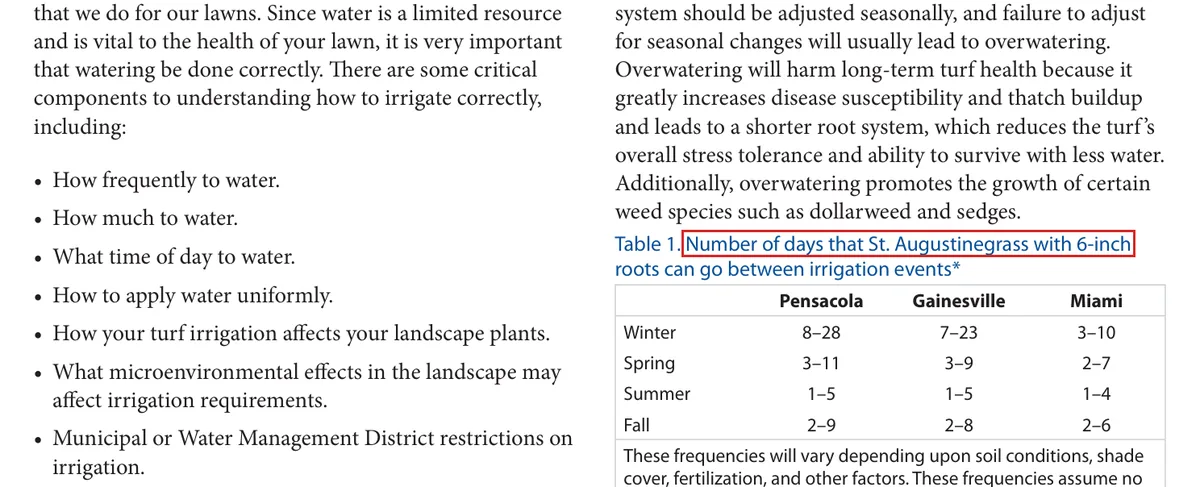
| Florida St. Augustinegrass with 6-inch roots | Winter gap between waterings: 8 to 28 days in Pensacola, 7 to 23 in Gainesville, 3 to 10 in Miami | UF/IFAS LH025, Table 1 |
| Oklahoma bermudagrass and zoysiagrass in drought | Irrigate before dormancy, then a less frequent winter schedule | Oklahoma State Extension, Nov. 2024 |
Brown is not a signal to water. A dormant lawn should look tan; the point of a winter soak is to keep crowns and roots from drying, not to green the leaves. If a lawn comes out of winter brown in patches, our guide on reviving dead or dormant grass has the crown test, and its working schedule for drought-dormant turf is 1/2 inch every 2 weeks.
Water rules that set the end date for you
In some places the utility decides. These three examples were in force as of November 2026, and each changes what a homeowner may legally run.
| Utility | Rule | Dates | Source |
|---|---|---|---|
| Denver Water (Stage 1 drought, amended) | Lawn watering and all spray irrigation prohibited; trees, shrubs and perennials by hand-held hose or drip only; hand-watering grass not permitted; repeat violations draw charges up to $2,000 | From Oct. 1, 2026, until further Board action; Stage 1 runs March 25, 2026, to April 30, 2027 | Denver Water drought page; Board resolution |
| St. Johns River Water Management District, Florida (normal rule) | 1 day a week during Eastern Standard Time (odd addresses Saturday, even Sunday); 2 days during daylight saving time; never 10 a.m. to 4 p.m.; up to 3/4 inch and 1 hour per zone | Winter schedule from the first Sunday in November to the second Sunday in March | SJRWMD |
| SJRWMD Phase III Extreme Water Shortage areas | 1 day a week year-round, never 8 a.m. to 6 p.m.; new sod watered every day for the first 15 days, up to 3 days a week for the next 30, 2 days a week for the final 15 | In effect for parts of 11 counties as of November 2026 | SJRWMD |
| Southern Nevada Water Authority | 1 assigned day a week for sprinklers and drip; Sunday never allowed; SNWA advises 3 cycles of no more than 4 minutes, 1 to 2 hours apart | Winter schedule through Feb. 28 | SNWA |
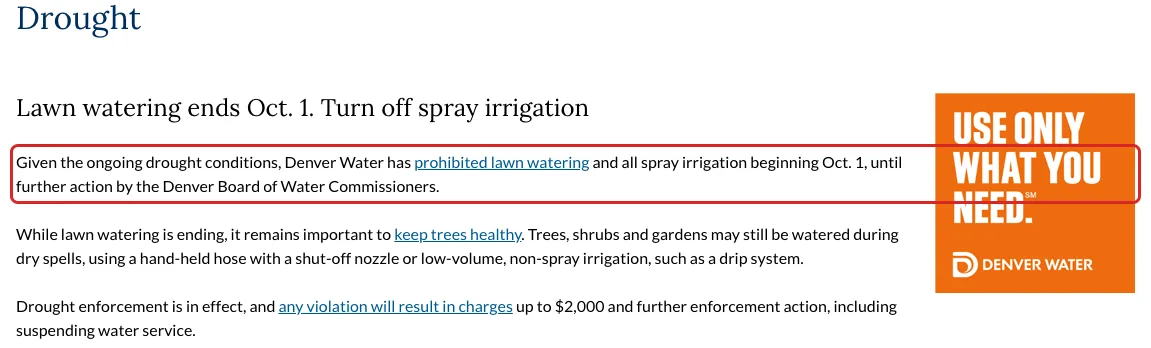
Denver is the extreme case: the calendar says its grass can use water until Nov. 23, but under the 2026 drought order no grass may be watered at all after Sept. 30, by sprinkler or by hand, unless Denver Water issues a watering establishment permit (Denver Water). In Las Vegas the rule caps watering but never ends it, because the city has no normal date when highs fall below 50°F.
Seed or sod planted this fall: keep watering
Everything above is for established lawns. New grass follows its own schedule until it roots. Iowa State says to keep the upper 1 inch of soil moist after seeding, expect germination in 2 to 3 weeks, and water less often but more deeply once seedlings reach 1 to 2 inches. CSU lists newly seeded and sodded lawns as the most susceptible to winter drying (CSU 7.211). Our page on when to mow new grass covers the first cut, and how to plant grass seed covers late-season seeding dates.
Should you still be watering this week?
1Was the lawn seeded or sodded in the last 2 months?
YesKeep the new-grass schedule: top inch moist until germination, then deeper and less often (Iowa State). Check local new-sod allowances.
NoGo to the next question
2Does your utility ban lawn watering now (for example Denver Water from Oct. 1, 2026)?
YesStop. Hand-water trees and shrubs only if the rule allows it.
NoGo to the next question
3Is the ground frozen, snow-covered, or is the air below 40°F today?
YesDo not water. Wait for a day above 40°F with thawed soil (CSU 7.211).
NoGo to the next question
4Has 1 inch of rain fallen this week?
YesSkip this week.
NoGo to the next question
5Are daytime highs still above 50°F (cool-season) or has the first frost not yet arrived (warm-season)?
YesWater about 1 inch this week. If the 28°F early freeze date has passed, use a hose, not the in-ground system.
NoThe lawn is dormant: stop routine watering. In a dry, snowless winter water once or twice a month at midday (CSU), or once a month December to February for dormant desert bermudagrass (University of Arizona).
Source: Iowa State Extension; CSU Extension 7.211; Denver Water; University of Arizona
How we compiled this
We downloaded NOAA NCEI 1991 to 2020 daily, monthly and annual/seasonal climate normals for 36 airport and city weather stations in November 2026. For each we took the first fall day the normal daily high is below 50°F, the 50 percent and 10 percent first-fall dates for 32°F and 28°F, and October and November normal precipitation, then compared them with thresholds from 9 extension publications, 4 utility pages and the NWS glossary. The verdicts are our reading of those numbers. Normals describe a typical year at one station: elevation, a cold valley or a south-facing lawn can move your dates by weeks. We did not measure any lawns.
Frequently asked questions
What month should you stop watering your lawn?
It depends on the city, not the month. On NOAA normals, cool-season growth stops in late October in Fargo and Spokane, mid-November in Chicago, Detroit and Des Moines and early to mid-December in Philadelphia and Washington. Atlanta, Charlotte, Raleigh, Dallas-Fort Worth, Las Vegas, Sacramento and every station farther south never reach the 50°F high trigger, so watering drops to a winter schedule instead of ending.
How late in the fall should I water my lawn?
Until the grass stops growing, with about 1 inch a week counting rain (Iowa State), or until the soil freezes on a dry fall. Sprinkler systems in freezing climates must be blown out earlier, by the first 28°F freeze, so late-fall water comes from a hose.
Should you give your lawn one last deep watering before winter?
On a dry fall, yes, while the ground is still unfrozen and air is above 40°F, at midday so it soaks in before night (CSU Extension; Denver Water). Skip it if 1 inch of rain fell that week or the soil is frozen, and check local rules: Denver Water bans all grass watering from Oct. 1, 2026.
At what point can you stop watering new grass?
Not on the established-lawn schedule. Keep the top inch of seeded soil moist until germination (2 to 3 weeks), then water deeper and less often once seedlings are 1 to 2 inches tall (Iowa State). New sod in Florida Phase III areas may be watered daily for 15 days, then up to 3 days a week for 30 days and 2 days a week for 15 (SJRWMD).
When should sprinklers be turned off in Colorado?
Before the first hard freeze: on 1991 to 2020 normals, Denver’s median 28°F date is Oct. 18 and 1 year in 10 sees it by Oct. 5. In 2026 Denver Water customers had to stop all lawn spray irrigation by Sept. 30. After that, CSU says to hand-water once or twice a month in dry spells when it is above 40°F.
Sources
- NOAA National Centers for Environmental Information, U.S. Climate Normals 1991 to 2020 (daily, monthly and annual/seasonal station files), 1991 to 2020 normals. Accessed November 2026.
- Iowa State University Extension and Outreach, Late Summer and Fall Lawn Care, Current online edition. Accessed November 2026.
- Purdue University Extension, Plant and Pest Diagnostic Laboratory, Fall fertilization of home lawns, November 2022. Accessed November 2026.
- Michigan State University Turfgrass Information Center archive, Turf newsletter article on late-season nitrogen and root growth of cool-season turfgrass, August 1988. Accessed November 2026.
- University of California Cooperative Extension, California Turfgrass Culture (hosted by UC Riverside), Hybrid Bermudagrass Winter Overseeding (M. Ali Harivandi), Vol. 36, Vol. 36, Nos. 1 to 4. Accessed November 2026.
- Mississippi State University Extension, Forage News, Vol. 8, Issue 12: cold temperatures on warm-season perennial grasses, December 2015. Accessed November 2026.
- NOAA National Weather Service, Glossary: Hard Freeze, Current. Accessed November 2026.
- Colorado State University Extension, Fact Sheet 7.211, Fall and Winter Watering of Plants and Trees, Reviewed August 2025. Accessed November 2026.
- Denver Water, Drought: Lawn watering ends Oct. 1, 2026. Accessed November 2026.
- Denver Water, Board Resolution #002-2026, Stage 1 Drought Declaration, March 2026. Accessed November 2026.
- Denver Water TAP, Do you need to water your trees and plants in the winter?, Feb. 14, 2026. Accessed November 2026.
- University of Arizona Cooperative Extension, A Turfgrass Maintenance Guide for Residential and Commercial Lawns in the Low Elevation Arizona Desert (Umeda), March 2020. Accessed November 2026.
- University of Florida IFAS Extension, ENH9/LH025, Watering Your Florida Lawn, Current PDF. Accessed November 2026.
- Oklahoma State University Extension, Horticulture Tips, November 2024: Preventing winterkill in warm-season grasses, November 2024. Accessed November 2026.
- Southern Nevada Water Authority, How and when to water, Current. Accessed November 2026.
- Southern Nevada Water Authority, Find your watering group, 2026 winter season. Accessed November 2026.
- St. Johns River Water Management District, Watering restrictions, Current, Phase III in effect. Accessed November 2026.
- Rain Bird Corporation, Fall is Blow-Out Season: Tips for Winterizing Your Sprinkler System, Oct. 20, 2025. Accessed November 2026.