When does grass stop growing? Cool-season grass stops once daytime highs stay below 50°F, from late October in Fargo to late December in Nashville. Warm-season grass slows below a 62°F daily mean and browns at the first 32°F frost, November to January.
Search “when does grass stop growing” and the top results give single numbers that disagree by up to 18°F for the same grass. The research gives a sequence instead: growth halves, slows to under 10% of its peak, then stops. We converted each step into dates for 36 cities from NOAA 1991 to 2020 climate normals and checked them against 4-inch soil readings from 35 NOAA reference stations in fall 2025 and fall 2026.
The temperature that stops each grass
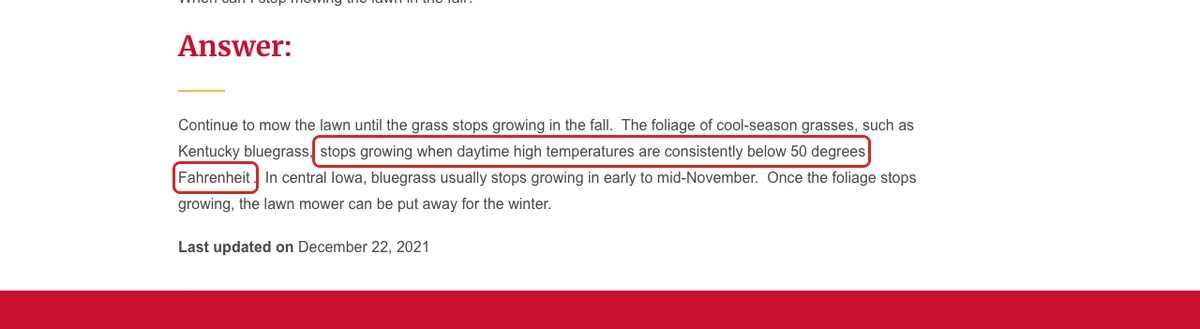
Iowa State Extension gives the clearest cool-season rule: Kentucky bluegrass foliage stops growing when daytime highs are consistently below 50°F, which in central Iowa is early to mid-November. Roots carry on longer. Penn State Extension puts the best root growth at 50 to 65°F soil and says roots still grow below 50°F, slowing sharply as soil nears 32°F.
Warm-season grasses quit earlier and more visibly. Mississippi State Extension says bermudagrass and bahiagrass stop shoot growth and lose chlorophyll once temperatures drop below 50°F and days shorten, and UC Riverside says all bermudagrasses go dormant where winter soil falls below 50 to 55°F, for up to 5 months. Mississippi State dates the dormant season from the first killing frost, the point when the lawn turns straw-colored.
| Grass | What stops it | When that usually happens | Source |
|---|---|---|---|
| Kentucky bluegrass | Leaves stop growing once daytime highs stay below 50°F | Oct. 26 (Fargo) to Nov. 13 (Chicago, Detroit) in the Upper Midwest; Nov. 21 (Boston) to Dec. 3 (Philadelphia) in the Northeast; early to mid-Nov. in central Iowa | Iowa State Extension |
| Tall fescue, perennial ryegrass, fine fescue | Leaf growth is fastest at 60 to 75°F; growth potential falls under 10% once the daily mean air temperature is 46°F | Mean reaches 46°F on Nov. 23 (Oklahoma City) to Dec. 21 (Atlanta) in the transition zone; never in a normal Los Angeles year | Penn State Extension; GCSAA growth potential table |
| Bermudagrass | Shoots stop below 50°F air; dormant once soil drops below 50 to 55°F, for up to 5 months | Median first 32°F frost: Nov. 3 (Nashville, Charlotte) to Dec. 9 (Houston); Jan. 3 in Phoenix and Jan. 10 in Orlando | UC Riverside, Harivandi; Mississippi State |
| Bahiagrass | Same 50°F shoot cutoff as bermudagrass; dormant from the first killing frost | Early to mid-Nov. to early to mid-April in Mississippi | Mississippi State |
| Zoysiagrass | No temperature given; Clemson raises the mower once nights fall below 70°F so the turf acclimates before the first frost | Frost dates in South Carolina vary by several weeks to a month from the coast to the Upstate | Clemson HGIC |
| St. Augustinegrass | Grows best at 80 to 95°F; brown or off-color during winter dormancy; southern Texas lawns may not go fully dormant | Median first frost Dec. 9 (Houston), Jan. 10 (Orlando); none in a normal Miami year | Texas A&M AgriLife |
| Buffalograss | Turns brown and dormant with the first hard frost; unirrigated lawns also go dormant most summers | Median 28°F hard freeze Oct. 18 in Denver | Colorado State Extension |
Two of the top results for this question, LawnStarter and Lawn Love, publish species tables that disagree by 5 to 18°F for the same grass. Neither says whether the figure is air or soil. The extension numbers are air temperatures except UC Riverside’s 50 to 55°F, which is soil, and for perennial ryegrass, zoysiagrass and St. Augustinegrass we found no published single cutoff at all.
| Grass | LawnStarter: stops below | Lawn Love: stops below | What the extension source says |
|---|---|---|---|
| Kentucky bluegrass | 50°F | 32°F | Highs consistently below 50°F (Iowa State); air, not soil |
| Perennial ryegrass | 40°F | 32°F | No species cutoff found; the cool-season curve is under 10% at a 46°F daily mean (GCSAA) |
| Bermudagrass | 50°F | 41°F | Air below 50°F (Mississippi State); soil below 50 to 55°F (UC Riverside) |
| Bahiagrass | 50°F | 58°F | Air below 50°F (Mississippi State) |
| Zoysiagrass | 55°F | 50°F | No published number found; acclimate before the first frost (Clemson) |
| St. Augustinegrass | 55°F | 50°F | No published number found; brown in winter dormancy (Texas A&M) |
Why growth fades for weeks before it stops
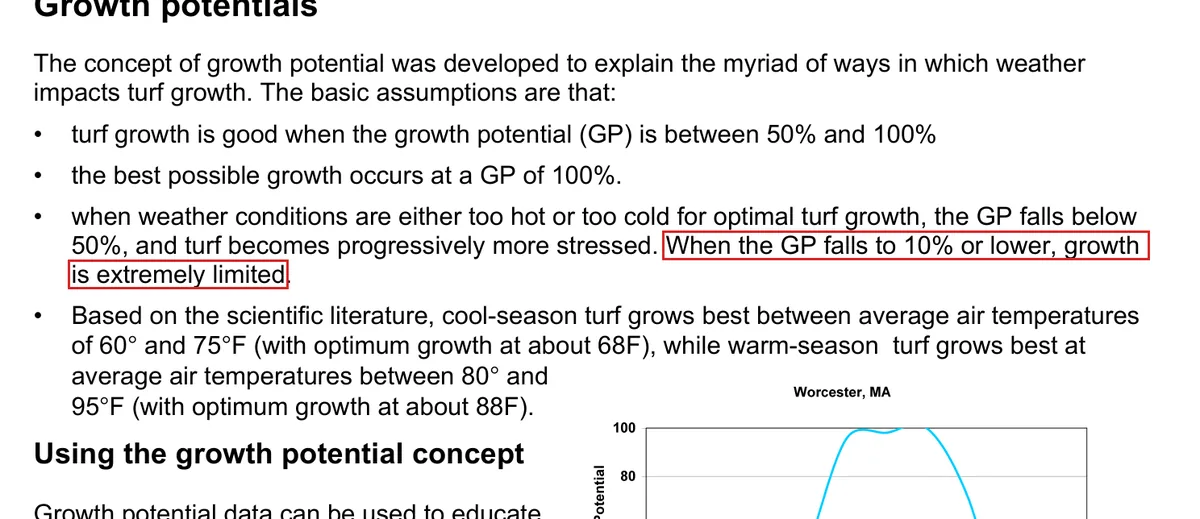
Turf scientists model this with growth potential, a bell curve of growth against daily mean air temperature from Gelernter and Stowell (2005). The GCSAA reference sheet built on it puts cool-season optimum growth at about 68°F and warm-season at about 88°F, rates 50 to 100% as good growth, and says growth is “extremely limited” at 10% or lower.
Read off that table, cool-season growth potential falls to 46% at a 55°F daily mean and to 10% at 46°F. Warm-season grass drops faster: 48% at 73°F and 10% at 62°F. A 62°F mean is a pleasant fall day of about 72°F highs and 52°F lows, which is why bermudagrass looks finished in October while bluegrass next door still needs cutting.
- Minneapolis, cool-season
- Atlanta, cool-season
- Atlanta, warm-season
- Dallas-Fort Worth, warm-season
Source: GCSAA/PACE Turf growth potential table applied to NOAA NCEI 1991 to 2020 monthly normals Above 50% is good growth; 10% or less is extremely limited.
Show the numbers
| Minneapolis, cool-season | Atlanta, cool-season | Atlanta, warm-season | Dallas-Fort Worth, warm-season | |
|---|---|---|---|---|
| Jan | 0% | 8% | 0% | 0% |
| Feb | 0% | 15% | 0% | 1% |
| Mar | 0% | 52% | 3% | 5% |
| Apr | 12% | 90% | 12% | 20% |
| May | 75% | 94% | 39% | 53% |
| Jun | 97% | 58% | 73% | 90% |
| Jul | 81% | 40% | 86% | 99% |
| Aug | 90% | 46% | 82% | 99% |
| Sep | 94% | 75% | 58% | 73% |
| Oct | 22% | 97% | 17% | 27% |
| Nov | 0% | 40% | 2% | 3% |
| Dec | 0% | 12% | 0% | 0% |
| City and grass | Jan | Feb | Mar | Apr | May | Jun | Jul | Aug | Sep | Oct | Nov | Dec |
|---|---|---|---|---|---|---|---|---|---|---|---|---|
| Minneapolis, cool-season | 0% | 0% | 0% | 12% | 75% | 97% | 81% | 90% | 94% | 22% | 0% | 0% |
| Atlanta, cool-season | 8% | 15% | 52% | 90% | 94% | 58% | 40% | 46% | 75% | 97% | 40% | 12% |
| Atlanta, warm-season | 0% | 0% | 3% | 12% | 39% | 73% | 86% | 82% | 58% | 17% | 2% | 0% |
| Dallas-Fort Worth, warm-season | 0% | 1% | 5% | 20% | 53% | 90% | 99% | 99% | 73% | 27% | 3% | 0% |
The curves answer “does grass slow down in September?” both ways. Atlanta warm-season growth potential falls from 86% in July to 58% in September and 17% in October, while Atlanta cool-season grass climbs from 40% in July to 97% in October. Minneapolis cool-season grass drops from 94% in September to 22% in October and 0% in November.
When grass stops growing in 36 cities
Each date below is the first fall day a threshold is crossed in the NOAA daily normals for the city’s main weather station, so it describes a typical year. Cool-season lawns pass through three dates: growth under half, growth near zero, then the 50°F-high stop that Iowa State uses for putting the mower away.
Swipe the table sideways to see every column.
| City | Growth under half (daily mean below 55.5°F) | Growth near zero (mean below 46.5°F) | Stops: normal high below 50°F |
|---|---|---|---|
| Fargo, ND | Sept. 27 | Oct. 15 | Oct. 26 |
| Minneapolis, MN | Oct. 4 | Oct. 23 | Nov. 1 |
| Milwaukee, WI | Oct. 10 | Nov. 2 | Nov. 11 |
| Chicago, IL | Oct. 13 | Nov. 4 | Nov. 13 |
| Detroit, MI | Oct. 10 | Nov. 2 | Nov. 13 |
| Des Moines, IA | Oct. 12 | Oct. 31 | Nov. 12 |
| Omaha, NE | Oct. 14 | Nov. 2 | Nov. 17 |
| Boston, MA | Oct. 14 | Nov. 11 | Nov. 21 |
| New York, NY | Oct. 23 | Nov. 21 | Nov. 28 |
| Philadelphia, PA | Oct. 24 | Nov. 19 | Dec. 3 |
| Columbus, OH | Oct. 16 | Nov. 8 | Nov. 21 |
| Washington, DC | Oct. 31 | Nov. 27 | Dec. 11 |
| Kansas City, MO | Oct. 19 | Nov. 9 | Nov. 24 |
| St. Louis, MO | Oct. 26 | Nov. 16 | Nov. 29 |
| Denver, CO | Oct. 7 | Oct. 28 | Nov. 23 |
| Salt Lake City, UT | Oct. 14 | Nov. 5 | Nov. 17 |
| Boise, ID | Oct. 12 | Oct. 31 | Nov. 13 |
| Spokane, WA | Oct. 1 | Oct. 19 | Oct. 30 |
| Seattle, WA | Oct. 10 | Nov. 16 | Nov. 26 |
| Portland, OR | Oct. 16 | Nov. 18 | Nov. 29 |
| Albuquerque, NM | Oct. 23 | Nov. 14 | Dec. 3 |
| Las Vegas, NV | Nov. 20 | Never in a normal year | Highs stay above 50°F |
| Sacramento, CA | Nov. 11 | Never in a normal year | Highs stay above 50°F |
| Los Angeles, CA | Never in a normal year | Never in a normal year | Highs stay above 50°F |
| Oklahoma City, OK | Oct. 31 | Nov. 23 | Dec. 16 |
| Dallas-Fort Worth, TX | Nov. 18 | Dec. 25 | Highs stay above 50°F |
| Nashville, TN | Nov. 1 | Nov. 28 | Dec. 27 |
| Charlotte, NC | Nov. 2 | Dec. 6 | Highs stay above 50°F |
| Raleigh, NC | Nov. 3 | Dec. 6 | Highs stay above 50°F |
| Atlanta, GA | Nov. 11 | Dec. 21 | Highs stay above 50°F |
Measured mowing lines up with the table. In Purdue plots at West Lafayette, Ind., tall fescue and Kentucky bluegrass mown by the one-third rule needed their last cut by Oct. 30 in 2012 and Nov. 8 in 2013; the nearest city here, Chicago, reaches near-zero growth on Nov. 4 and the 50°F high on Nov. 13. The slow-down lasts 4 weeks in Minneapolis (Oct. 4 to Nov. 1) but 7 weeks in Seattle and Denver and 8 in Nashville (Nov. 1 to Dec. 27), so lawns with long, mild falls need occasional cuts for weeks longer. In Los Angeles cool-season grass never stops in a normal year.
Warm-season lawns slow about a month before the frost that browns them. Atlanta passes a 62°F mean on Oct. 22 and its median first frost is Nov. 20; in Dallas-Fort Worth the gap is Oct. 30 to Nov. 24. Miami has neither date in a normal year, so its lawns slow in winter without going dormant.
Swipe the table sideways to see every column.
| City | Growth under half (mean below 73.5°F) | Growth near zero (mean below 62.5°F) | Browns: median first 32°F frost | Median first 28°F hard freeze |
|---|---|---|---|---|
| Washington, DC | Sept. 14 | Oct. 12 | Nov. 18 | Dec. 3 |
| Kansas City, MO | Sept. 1 | Oct. 2 | Oct. 24 | Nov. 1 |
| St. Louis, MO | Sept. 9 | Oct. 8 | Nov. 4 | Nov. 13 |
| Oklahoma City, OK | Sept. 14 | Oct. 13 | Nov. 2 | Nov. 11 |
| Nashville, TN | Sept. 16 | Oct. 15 | Nov. 3 | Nov. 15 |
| Charlotte, NC | Sept. 14 | Oct. 15 | Nov. 3 | Nov. 14 |
| Raleigh, NC | Sept. 14 | Oct. 14 | Nov. 4 | Nov. 16 |
| Atlanta, GA | Sept. 22 | Oct. 22 | Nov. 20 | Dec. 5 |
| Dallas-Fort Worth, TX | Oct. 1 | Oct. 30 | Nov. 24 | Dec. 7 |
| Austin, TX | Oct. 12 | Nov. 11 | Dec. 3 | Dec. 27 |
| Houston, TX | Oct. 12 | Nov. 14 | Dec. 9 | Jan. 2 |
| Jacksonville, FL | Oct. 10 | Nov. 14 | Dec. 7 | Jan. 2 |
| Orlando, FL | Oct. 24 | Dec. 22 | Jan. 10 | Jan. 13 |
| Miami, FL | Nov. 26 | Never in a normal year | None in a normal year | None in a normal year |
| Phoenix, AZ | Oct. 26 | Nov. 22 | Jan. 3 | None in a normal year |
| Las Vegas, NV | Oct. 9 | Nov. 4 | Dec. 15 | Dec. 26 |
| Los Angeles, CA | Never reaches 50% | Nov. 16 | None in a normal year | None in a normal year |
| Sacramento, CA | Sept. 11 | Oct. 23 | Dec. 2 | Dec. 16 |
| Albuquerque, NM | Sept. 6 | Oct. 7 | Nov. 3 | Nov. 15 |
What 4-inch soil did in fall 2025 and 2026
Normals are averages, so we pulled daily soil temperature at 10 cm (about 4 inches) from 35 U.S. Climate Reference Network stations. In fall 2025, soil fell below 50°F for 3 days running as early as Oct. 6 at Lewistown, Mont., and Oct. 12 at Arco, Idaho, versus Dec. 7 at Watkinsville, Ga., and Dec. 15 at Blackville, S.C. Three stations, Tucson, Fallbrook and Lafayette, never dropped below 50°F all winter.
Swipe the table sideways to see every column.
| NOAA USCRN station | Latitude | Fall 2025: 4-inch soil below 55°F | Below 50°F | Below 40°F | Fall 2026: below 55°F (data to Nov. 9) |
|---|---|---|---|---|---|
| Spokane 17 SSW, WA | 47.4°N | Oct. 5 | Oct. 14 | Nov. 29 | Sept. 27 |
| Lewistown 42 WSW, MT | 46.9°N | Oct. 4 | Oct. 6 | Nov. 25 | Oct. 1 |
| Jamestown 38 WSW, ND | 46.8°N | Oct. 13 | Oct. 21 | Nov. 9 | Oct. 2 |
| Sandstone 6 W, MN | 46.1°N | Oct. 8 | Oct. 20 | Nov. 9 | Oct. 15 |
| Old Town 2 W, ME | 44.9°N | Oct. 2 | Oct. 27 | Nov. 16 | Oct. 6 |
| Gaylord 9 SSW, MI | 44.9°N | Oct. 9 | Oct. 22 | Nov. 9 | Oct. 8 |
| Corvallis 10 SSW, OR | 44.4°N | Oct. 25 | Nov. 19 | Jan. 18, 2026 | Oct. 23 |
| Necedah 5 WNW, WI | 44.1°N | Oct. 20 | Oct. 24 | Nov. 27 | Oct. 17 |
| Sioux Falls 14 NNE, SD | 43.7°N | Oct. 19 | Oct. 22 | Nov. 26 | Oct. 16 |
| Arco 17 SW, ID | 43.5°N | Oct. 5 | Oct. 12 | Oct. 27 | Oct. 11 |
| Durham 2 N, NH | 43.2°N | Oct. 16 | Oct. 27 | Nov. 23 | Oct. 10 |
| Ithaca 13 E, NY | 42.4°N | Oct. 15 | Oct. 24 | Nov. 17 | Oct. 9 |
| Millbrook 3 W, NY | 41.8°N | Oct. 24 | Nov. 2 | Nov. 29 | Oct. 18 |
| Brigham City 28 WNW, UT | 41.6°N | Oct. 5 | Oct. 17 | Nov. 23 | Oct. 12 |
| Des Moines 17 E, IA | 41.6°N | Oct. 24 | Nov. 9 | Dec. 5 | Nov. 7 |
| Kingston 1 W, RI | 41.5°N | Oct. 16 | Oct. 25 | Nov. 19 | Oct. 9 |
| Nunn 7 NNE, CO | 40.8°N | Oct. 17 | Oct. 28 | Nov. 26 | Oct. 15 |
| Wooster 3 SSE, OH | 40.8°N | Oct. 27 | Nov. 11 | Jan. 17, 2026 | Nov. 7 |
| Lincoln 11 SW, NE | 40.7°N | Oct. 22 | Nov. 1 | Nov. 30 | Nov. 5 |
| Avondale 2 N, PA | 39.9°N | Oct. 24 | Nov. 11 | Dec. 4 | Not yet |
| Manhattan 6 SSW, KS | 39.1°N | Oct. 30 | Nov. 26 | Dec. 14 | Not yet |
| Bedford 5 WNW, IN | 38.9°N | Oct. 24 | Nov. 10 | Nov. 29 | Nov. 7 |
| Versailles 3 NNW, KY | 38.1°N | Oct. 30 | Nov. 10 | Dec. 14 | No data since Aug. 10 |
| Charlottesville 2 SSE, VA | 38.0°N | Nov. 19 | Dec. 3 | Jan. 31, 2026 | Not yet |
| Salem 10 W, MO | 37.6°N | Oct. 31 | Nov. 10 | Jan. 17, 2026 | Not yet |
| Durham 11 W, NC | 36.0°N | Nov. 11 | Nov. 28 | Jan. 25, 2026 | Not yet |
| Los Alamos 13 W, NM | 35.9°N | Sept. 15 | Oct. 17 | Nov. 18 | Sept. 23 |
| Batesville 8 WNW, AR | 35.8°N | Nov. 10 | Dec. 1 | Jan. 31, 2026 | Not yet |
| Watkinsville 5 SSE, GA | 33.8°N | Nov. 28 | Dec. 7 | Never | Not yet |
| Fallbrook 5 NE, CA | 33.4°N | Feb. 19, 2026 | Never | Never | Not yet |
| Blackville 3 W, SC | 33.4°N | Dec. 2 | Dec. 15 | Never | Not yet |
| Tucson 11 W, AZ | 32.2°N | Jan. 7, 2026 | Never | Never | Not yet |
| Palestine 6 WNW, TX | 31.8°N | Jan. 15, 2026 | Jan. 25, 2026 | Never | Not yet |
| Austin 33 NW, TX | 30.6°N | Jan. 17, 2026 | Jan. 24, 2026 | Never | Not yet |
| Lafayette 13 SE, LA | 30.1°N | Jan. 26, 2026 | Never | Never | Not yet |
Fall 2026 is running late in the middle of the country. By Nov. 9, 2025, 25 of the 35 stations had soil below 55°F; by Nov. 9, 2026, 21 of 34 reporting stations had. Des Moines, Lincoln and Bedford, Ind., crossed 55°F 14 days later than in 2025, while Jamestown, N.D., crossed 11 days earlier. If your soil thermometer still reads above 55°F this week, a warm-season lawn is not yet dormant by UC Riverside’s 50 to 55°F rule.
Does grass stop growing in summer?
Cool-season grass can stall in heat as well as cold. On the GCSAA table its growth potential drops below 50% once the daily mean passes 79°F, and July normals put it at 2% in Phoenix, 4% in Las Vegas, 18% in Dallas-Fort Worth and 40% in Atlanta, against 100% in Seattle. Penn State adds that Kentucky bluegrass root growth is greatly reduced once the top inch of soil reaches 90°F.
Warm-season grass keeps its growth potential through summer heat (99% in a Dallas July) and stops for lack of water instead. Texas A&M calls summer dormancy a normal response to heat and drought, and Colorado State says unirrigated buffalograss goes dormant most summers. Texas A&M says irrigation relieves that drought stress; a lawn browned by cold waits for spring.
Is it time for the last mow?
1Is it a warm-season lawn (bermuda, zoysia, St. Augustine, centipede, bahia, buffalo)?
YesGo to the warm-season questions below.
NoGo to the cool-season questions below.
2Warm-season: has the lawn turned tan after a frost, or is 4-inch soil below 55°F?
YesIt is dormant (UC Riverside: soil below 50 to 55°F). Stop mowing; it greens up in spring.
NoGo to the next question
3Warm-season: is the daily mean below 62°F (highs near 72°F, lows near 52°F)?
YesGrowth is under 10% of peak (GCSAA). Mow only if it reaches its trigger height.
NoGo to the next question
4Cool-season: have daytime highs stayed below 50°F for a week or more?
YesGrowth has stopped (Iowa State). Make this the last mow at your normal height.
NoGo to the next question
5Cool-season: is the daily mean below 46°F?
YesGrowth is under 10% of peak. Mow every 2 to 3 weeks at most, and shred leaves when you do.
NoThe lawn is still growing: keep your usual mowing schedule and height.
Source: Iowa State Extension; UC Riverside; GCSAA growth potential table
Keep cutting at your normal height until the lawn stops reaching it. Purdue AY-8 says not to vary mowing height during the year, and Iowa State says to put the mower away once the foliage stops growing. Heights by grass are in our guide to mowing a lawn, and fall intervals are in how often to mow by month and city.
Use the last mows to shred leaves. A University of Wisconsin trial found a 2-inch layer of shredded leaves reasonable to leave on a lawn over winter, while 4 inches of leaves were highly likely to cause winter damage. Collection prices, if you would rather haul them, are in our leaf removal cost breakdown.
Two jobs keep going after the mower stops. Roots keep working until soil drops below 40°F, when Purdue says plant growth slows and turf will likely not use fertilizer nutrients effectively; the late-fall feeding dates in when to fertilize your lawn fall about a week after the last cut. Watering ends on its own schedule in our 36-city watering calendar.
How we compiled this
We read 11 extension and research documents (Iowa State, Penn State, Purdue, UC Riverside, Mississippi State, Colorado State, Clemson, Texas A&M, Wisconsin, the GCSAA growth potential sheet and Gelernter and Stowell 2005) in November 2026. City dates are our arithmetic on NOAA NCEI 1991 to 2020 daily and annual/seasonal normals for 36 main stations. Soil dates come from NOAA USCRN daily files for 35 stations, fall 2025 and fall 2026 to Nov. 9. We did not measure any lawns; a city lawn on sandy or south-facing ground runs warmer than a rural reference site.
Frequently asked questions
What month does grass stop growing?
October to December for cool-season grass: the normal daytime high falls below 50°F on Oct. 26 in Fargo, Nov. 13 in Chicago, Nov. 28 in New York and Dec. 11 in Washington (NOAA normals, Iowa State rule). Warm-season grass browns at the first frost: early November in Charlotte and Nashville, late November in Atlanta and Dallas, December to January along the Gulf and in Phoenix.
When should the last grass cut of the season be?
When the lawn no longer grows enough to reach its normal mowing height, which Iowa State ties to daytime highs staying below 50°F. Purdue AY-8 says not to vary mowing height during the year, so the last cut goes at your usual height. Use that mow to shred leaves: Wisconsin found 4 inches of leaves over winter likely to damage turf.
Does grass slow down in September?
Warm-season grass does: Atlanta growth potential for bermuda-type grass falls from 86% in July to 58% in September (GCSAA table on NOAA normals). Cool-season grass speeds up instead, from 40% to 75% in Atlanta, because September means fall back toward its 68°F optimum.
Does grass stop growing in October?
In the far north and the mountains, yes: normal highs drop below 50°F on Oct. 26 in Fargo and Oct. 30 in Spokane, and Lewistown, Mont., had 4-inch soil below 50°F by Oct. 6, 2025. In most other cities cool-season grass keeps growing into November, and in October warm-season lawns are slowing toward frost.
What temperature does grass stop growing in summer?
Cool-season grass slows below half its growth potential once the daily mean air temperature passes 79°F and nearly stops near 89°F (GCSAA table). Penn State says bluegrass root growth is greatly reduced at 90°F in the top inch of soil. Warm-season grass keeps growing in heat and goes summer-dormant mainly from drought (Texas A&M).
Will grass grow in 40 degree weather?
Barely. A 40°F daily mean gives cool-season grass 2% of its growth potential and warm-season grass 0% (GCSAA table). Purdue says plant growth slows when soil drops below 40°F, and Penn State says cool-season roots slow sharply as soil nears 32°F.
Sources
- Iowa State University Extension and Outreach, When can I stop mowing the lawn in the fall?, Dec. 22, 2021. Accessed November 2026.
- Penn State Extension, The Cool-Season Turfgrasses: Basic Structures, Growth and Development, web page. Accessed November 2026.
- Purdue University Plant and Pest Diagnostic Laboratory, Fall Fertilization of Home Lawns: Is it too late?, November 2022. Accessed November 2026.
- Purdue University and University of Illinois, AY-8-W, Mowing, Dethatching, Aerifying and Rolling Turf, undated PDF. Accessed November 2026.
- Law, Bigelow and Patton, Crop Science 56, Selecting Turfgrasses and Mowing Practices that Reduce Mowing Requirements, 2016. Accessed November 2026.
- University of California Cooperative Extension (Harivandi), California Turfgrass Culture Vol. 36, Hybrid Bermudagrass Winter Overseeding, trials 1981 to 1984. Accessed November 2026.
- Mississippi State University Extension (Lemus), Impact of Cold Temperatures on Warm-season Perennial Grasses, Forage News Vol. 8 No. 12, December 2015. Accessed November 2026.
- Colorado State University Extension, Buffalograss Lawns, web page. Accessed November 2026.
- Clemson Cooperative Extension HGIC, Zoysiagrass Maintenance Calendar, web page. Accessed November 2026.
- Texas A&M AgriLife Extension, St. Augustinegrass Lawn Management, July 2026. Accessed November 2026.
- GCSAA, Growth Potential Reference (weather reference sheet), undated PDF. Accessed November 2026.
- PACE Turf, Turfgrass Growth Potential, web page. Accessed November 2026.
- Gelernter and Stowell, Golf Course Management, Improved overseeding programs 1. The role of weather, March 2005. Accessed November 2026.
- University of Wisconsin-Madison Division of Extension, Winter Leaf Coverage on Lawns, web page. Accessed November 2026.
- NOAA National Centers for Environmental Information, U.S. Climate Normals 1991 to 2020: daily, monthly and annual/seasonal station files, 1991 to 2020. Accessed November 2026.
- NOAA National Centers for Environmental Information, U.S. Climate Reference Network daily01 files, 2025 and 2026 daily data. Accessed November 2026.