When to fertilize lawn grass depends on its type. Feed cool-season lawns mostly from late August to about a week after the last fall mowing. Feed warm-season lawns after green-up, once 4-inch soil holds 65°F, and stop 6 weeks before first frost.
Knowing when to fertilize lawn grass comes down to two measurable triggers, not a date on a bag. Cool-season grasses (Kentucky bluegrass, ryegrass, the fescues) do best when most of the year’s nitrogen goes on from late summer through autumn, Purdue Extension says, with less in the spring flush. Warm-season grasses (bermudagrass, zoysiagrass, St. Augustinegrass, centipedegrass) get none until soil at 4 inches is “constantly 65° F and rising,” in the University of Georgia’s words, and none in the last 6 weeks before frost (Texas A&M).
We turned those triggers into dates. The 36-city table below gives the last cool-season and warm-season feeding for each city from NOAA’s 1991 to 2020 climate normals, and a second table shows when 4-inch soil actually reached 65°F at 15 NOAA reference stations in spring 2026. Of the top-ranking pages we could read in November 2026 (Scotts, ExperiGreen, Weed Man and Illinois Extension), none gave a feeding date for a named city, and none gave a soil depth or a number for its soil-temperature rule.
When to fertilize each grass type
Find your grass in the first column; our guide to types of lawn grass sorts the two groups if you are unsure. Rates are pounds of actual nitrogen per 1,000 sq ft, not pounds of product: 1 lb of N is about 3 lb of a 32-0-4 bag. The rows come from extension calendars in Indiana, Illinois, North Carolina, Georgia, Texas and Florida, so the months shift with latitude, but the triggers do not.
| Grass | First feeding of the year | Main feeding window | Last feeding | Source |
|---|---|---|---|---|
| Kentucky bluegrass, perennial ryegrass, fine and tall fescue (North) | 0 to 0.75 lb N mid-March to April is optional; the spring feeding goes May to mid-June (early to mid-May in central Illinois) | Late Aug. to Sept.: up to 1 lb N a month. Purdue puts 50 to 60% of the year’s N between Labor Day and Halloween | About 1 week after the last mowing (Illinois); Purdue’s window closes in early Dec. or when the ground freezes | Purdue AY-22; Purdue, 2022; Illinois Extension |
| Tall fescue, transition zone (North Carolina) | 1 lb N in Feb.; 1/5 to 1/2 lb in spring only if needed | 1 lb N in mid-Sept. | 1 lb N in Nov., when the grass is green but not actively growing | NC State AG-367 |
| Bermudagrass | Not until 4-inch soil is constantly 65°F and rising (UGA); 0.5 to 1 lb N several weeks after full green-up, early April to May (NC) | 1 lb N every 4 to 6 weeks; UGA marks May to Aug. as best | No more than 0.5 lb N in Sept., or 4 weeks before the first expected frost | UGA; NC State AG-431 |
| Zoysiagrass | 0.5 lb N about 3 weeks after green-up, once soil holds 65°F | 0.5 to 1 lb N in late June or early July; repeat mid-Aug. | Mid-Aug.; no N in Sept., potash only | NC State AG-432; UGA |
| St. Augustinegrass | 0.5 lb N in May or 2 weeks after green-up, whichever is later | 0.5 lb N in June and Aug., 1 lb in July | 0.5 lb or less in Sept.; nothing after mid-Sept. | NC State AG-540 |
| Centipedegrass | Not before mid-May: 1 lb N | Optional 1 lb N in mid-Aug. | Mid-Aug.; potash only 4 to 6 weeks before frost | NC State AG-381; UGA |
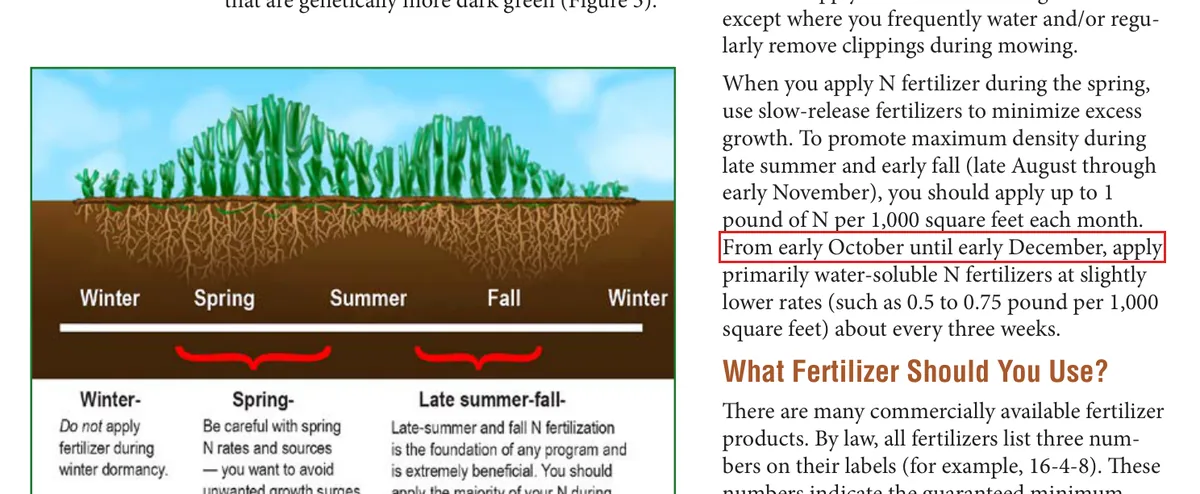
| Texas warm-season lawns | After the 2nd or 3rd mowing: after April 1 in Houston, April 15 in Austin, May 1 in Dallas | Extra summer feedings at least 45 to 60 days apart | Oct. 15 in Austin and Houston, Oct. 1 in Dallas; never later than 6 weeks before frost | Texas A&M SCS-2005-15 |
| Florida lawns, basic program | Feb. in south Florida, March in central, April in north Florida (bermuda, zoysia, St. Augustine) | Slow-release N or iron in June and July | Sept. in north Florida; Sept. to Nov. farther south, by grass | UF/IFAS SL21, Table 5 |
Two patterns hold across all 8 rows. Cool-season programs are back-loaded: in Purdue’s Table 2 a typical unirrigated lawn gets 1.5 to 3 lb of its 2 to 4 lb year between late August and early December and zero from mid-June through August. Warm-season programs are front-loaded into summer and stop early: NC State lists no nitrogen at all on zoysiagrass in September and none on St. Augustinegrass after mid-September.
That second rule is where retail calendars and extension calendars part ways. ScottsMiracle-Gro’s schedule tells southern St. Augustine, centipede and zoysia owners to make a fall feeding between August and November. Against the NC State calendars, only the August end of that window fits; a late-October feeding on centipedegrass would land after NC State’s last listed nitrogen in mid-August.
When to fertilize lawn grass in fall: dates for 36 cities
The cool-season column uses two extension rules in sequence. Iowa State Extension says cool-season foliage stops growing when daytime highs stay below 50°F, which is when the mower goes away, and Illinois Extension times the late-season feeding about 1 week after the final mowing. The warm-season column subtracts 6 weeks from the median first 32°F frost, the latest cut-off Texas A&M allows. Both dates come from NOAA NCEI climate normals.
Swipe the table sideways to see every column.
| City | Normal high drops below 50°F (cool-season growth stops) | Last cool-season feeding: about 1 week later | Median first 32°F frost | Last warm-season feeding: 6 weeks before frost | Law that ends it sooner |
|---|---|---|---|---|---|
| Fargo, ND | Oct. 26 | Nov. 2 | Sept. 30 | Cool-season region | |
| Minneapolis, MN | Nov. 1 | Nov. 8 | Oct. 18 | Cool-season region | |
| Milwaukee, WI | Nov. 11 | Nov. 18 | Oct. 29 | Cool-season region | |
| Chicago, IL | Nov. 13 | Nov. 20 | Oct. 28 | Cool-season region | |
| Detroit, MI | Nov. 13 | Nov. 20 | Oct. 27 | Cool-season region | |
| Des Moines, IA | Nov. 12 | Nov. 19 | Oct. 20 | Cool-season region | |
| Omaha, NE | Nov. 17 | Nov. 24 | Oct. 21 | Cool-season region | |
| Boston, MA | Nov. 21 | Nov. 28 | Nov. 9 | Cool-season region | |
| New York, NY | Nov. 28 | Dec. 5 | Nov. 20 | Cool-season region | NJ suburbs: homeowners stop Nov. 15 by law |
| Philadelphia, PA | Dec. 3 | Dec. 10 | Nov. 10 | Cool-season region | PA: over 0.5 lb N banned Dec. 15 to March 1; NJ suburbs stop Nov. 15 |
| Columbus, OH | Nov. 21 | Nov. 28 | Oct. 27 | Cool-season region | |
| Washington, DC | Dec. 11 | Early Dec. at the latest (Purdue window) | Nov. 18 | Oct. 7 | Maryland suburbs: stop Nov. 15 by law |
| Kansas City, MO | Nov. 24 | Dec. 1 | Oct. 24 | Sept. 12 | |
| St. Louis, MO | Nov. 29 | Dec. 6 | Nov. 4 | Sept. 23 | |
| Denver, CO | Nov. 23 | Nov. 30 | Oct. 9 | Cool-season region | |
| Salt Lake City, UT | Nov. 17 | Nov. 24 | Oct. 31 | Cool-season region | |
| Boise, ID | Nov. 13 | Nov. 20 | Oct. 21 | Cool-season region | |
| Spokane, WA | Oct. 30 | Nov. 6 | Oct. 12 | Cool-season region | |
| Seattle, WA | Nov. 26 | Dec. 3 | Nov. 23 | Cool-season region | |
| Portland, OR | Nov. 29 | Dec. 6 | Nov. 19 | Cool-season region | |
| Albuquerque, NM | Dec. 3 | Dec. 10 | Nov. 3 | Sept. 22 | |
| Las Vegas, NV | Stays above 50°F | n/a | Dec. 15 | Nov. 3 | |
| Phoenix, AZ | Stays above 50°F | n/a | Jan. 3 | Nov. 22 | |
| Sacramento, CA | Stays above 50°F | n/a | Dec. 2 | Oct. 21 | |
| Los Angeles, CA | Stays above 50°F | n/a | None in a typical year | No frost: UC and local programs | |
| Oklahoma City, OK | Dec. 16 | Early Dec. at the latest (Purdue window) | Nov. 2 | Sept. 21 | |
| Dallas-Fort Worth, TX | Stays above 50°F | n/a | Nov. 24 | Oct. 13 (Texas A&M publishes Oct. 1) | |
| Austin, TX | Stays above 50°F | n/a | Dec. 3 | Oct. 22 (Texas A&M publishes Oct. 15) | |
| Houston, TX | Stays above 50°F | n/a | Dec. 9 | Oct. 28 (Texas A&M publishes Oct. 15) | |
| Nashville, TN | Dec. 27 | Early Dec. at the latest (Purdue window) | Nov. 3 | Sept. 22 | |
| Charlotte, NC | Stays above 50°F | n/a | Nov. 3 | Sept. 22 | |
| Raleigh, NC | Stays above 50°F | n/a | Nov. 4 | Sept. 23 | |
| Atlanta, GA | Stays above 50°F | n/a | Nov. 20 | Oct. 9 | |
| Jacksonville, FL | Stays above 50°F | n/a | Dec. 7 | Oct. 26 | |
| Orlando, FL | Stays above 50°F | n/a | Jan. 10 | Nov. 29 (UF/IFAS basic program: last feeding Sept.) | |
| Miami, FL | Stays above 50°F | n/a | None in a typical year | No frost: feed by UF/IFAS or local program |
The same grass ends its year more than 5 weeks apart: a Fargo bluegrass lawn gets its last feeding around Nov. 2, a Portland or St. Louis lawn around Dec. 6 and a Philadelphia lawn around Dec. 10. Warm-season cut-offs run from Sept. 12 in Kansas City to Nov. 22 in Phoenix, and in Kansas City, St. Louis, Oklahoma City, Albuquerque, Nashville, Charlotte and Raleigh the warm-season cut-off falls in September, before most people think about fall feeding at all.
Law beats the normals in three metro areas. New Jersey homeowners must stop by Nov. 15, 3 to 4 weeks before the Dec. 5 and Dec. 10 dates for New York and Philadelphia, and grass around Washington keeps growing until about Dec. 11 while Maryland suburbs must stop on Nov. 15. Texas A&M’s published cut-offs run 7 to 13 days earlier than our NOAA arithmetic for Dallas, Austin and Houston, because they use regional frost averages; when the two disagree, the earlier date is the safer one.
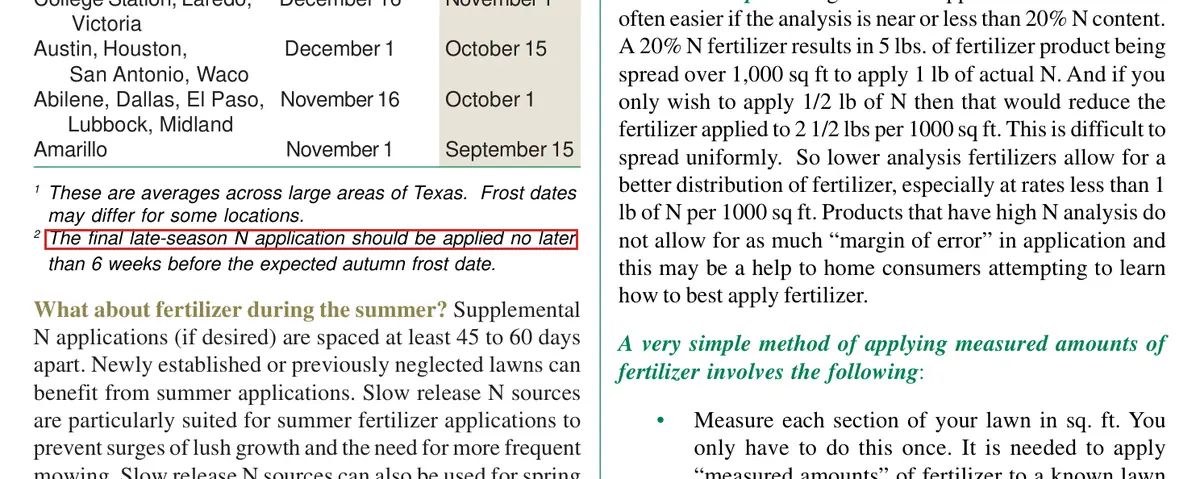
Purdue gives two answers on lateness. Its 2013 bulletin runs feedings of 0.5 to 0.75 lb of water-soluble N about every 3 weeks from early October to early December. Its 2022 plant diagnostic lab note says that if Halloween has come and gone, put the spreader away, and that November nitrogen should go on at a reduced rate because it can cause excess growth the next spring. Our table’s dates sit between the two; at a northern site past Nov. 1, use the lower 0.5 lb rate.
The reason late feeding works is roots. A 1988 turf article archived by Michigan State’s Turfgrass Information Center notes that cool-season roots grow well at soil temperatures between 40 and 65°F, after shoot growth has slowed, and that some root growth continues as long as the soil stays unfrozen. The same article reports higher stored carbohydrates going into summer for late-season-fertilized turf than for spring-fertilized turf.
When to fertilize lawn grass in spring
Cool-season lawns: lightly, and later than the bag says
Purdue tells owners to apply less nitrogen during the spring growth flush and to use slow-release sources when they do, to avoid surge growth; its typical program allows 0 to 0.75 lb from mid-March through April and 0.5 to 0.75 lb from May to mid-June. Illinois Extension puts the spring feeding in early to mid-May in central Illinois, earlier in the south of the state and later in the north. Scotts’ first step runs February to April.
If crabgrass is the reason for an early spring bag, time it to the herbicide, not the fertilizer. Illinois calls spring weed-and-feed a product of convenience that compromises the ideal timing of either the fertilizer or the herbicide; crabgrass preventer goes down before soil reaches about 55°F, which our crabgrass guide dates by region.
Warm-season lawns: 65°F soil is the floor, green-up is the signal
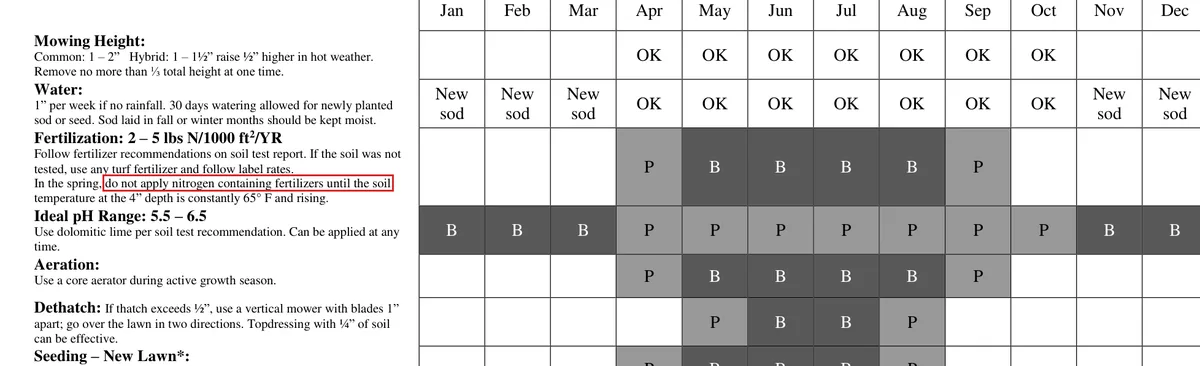
All three UGA calendars, for bermudagrass, zoysiagrass and centipedegrass, carry the same line: no nitrogen in spring until soil at the 4-inch depth is constantly 65°F and rising. Texas A&M adds a visual check: wait until the lawn has greened up and been mowed 2 or 3 times, and “mowing weeds doesn’t count.” Our soil temperature guide lists live 4-inch soil maps by state.
Swipe the table sideways to see every column.
| NOAA USCRN station | Latitude | 4-inch soil held 65°F from (2026) | Days after Jan. 1 | Nearest extension first-feeding guidance |
|---|---|---|---|---|
| Lafayette 13 SE, LA | 30.09°N | March 21 | 79 | |
| Austin 33 NW, TX | 30.62°N | March 20 | 78 | Texas A&M: first N after April 15 in Austin |
| Palestine 6 WNW, TX | 31.78°N | March 21 | 79 | Texas A&M: after April 1 (Houston) to May 1 (Dallas) |
| Tucson 11 W, AZ | 32.24°N | Feb. 23 | 53 | |
| Blackville 3 W, SC | 33.36°N | April 11 | 100 | |
| Fallbrook 5 NE, CA | 33.44°N | Feb. 26 | 56 | |
| Watkinsville 5 SSE, GA | 33.78°N | April 12 | 101 | UGA: April possible, May to Aug. best (bermuda) |
| Batesville 8 WNW, AR | 35.82°N | May 11 | 130 | |
| Durham 11 W, NC | 35.97°N | May 14 | 133 | NC State: early April to May (bermuda); not before mid-May (centipede) |
| Stillwater 2 W, OK | 36.12°N | April 9 | 98 | |
| Salem 10 W, MO | 37.63°N | May 17 | 136 | |
| Charlottesville 2 SSE, VA | 38.00°N | June 1 | 151 | |
| Versailles 3 NNW, KY | 38.09°N | May 17 | 136 | |
| Bedford 5 WNW, IN | 38.89°N | May 17 | 136 | |
| Manhattan 6 SSW, KS | 39.10°N | May 12 | 131 |
Treat 65°F as the earliest date, not the feeding date. At the Austin reference station 4-inch soil held 65°F from March 20, 2026, while Texas A&M’s table holds Austin’s first nitrogen until after April 15, 26 days later, to let the lawn green up fully. Going north the gap closes: at Durham, N.C., soil reached 65°F only on May 14, right at NC State’s early-April-to-May window for bermudagrass, and at Charlottesville not until June 1.
How often should you fertilize your lawn?
Most lawns need 2 to 4 feedings a year, and the count follows from 2 numbers: the grass’s yearly nitrogen budget and the most you can put down at once. Purdue caps a feeding at 1.0 lb of quick-release N per 1,000 sq ft, or about 2 lb when more than half the N is slow-release, and puts most programs at 2 to 6 applications. Illinois Extension suggests about 3 lb a year for most sunny lawns, split into 2 or 3 feedings of about 1 lb.
| Grass | Nitrogen a year, lb per 1,000 sq ft | Per feeding, lb N | Feedings a year | Spacing | Source |
|---|---|---|---|---|---|
| Kentucky bluegrass, ryegrass, fescues (North) | 1 to 5 (2 to 4 for a typical unirrigated lawn) | 0.5 to 1; 0.5 to 0.75 from Oct. to early Dec. | 2 to 6 | Up to 1 lb a month late Aug. to early Nov.; about every 3 weeks Oct. to early Dec. | Purdue AY-22, Table 2 |
| Tall fescue (North Carolina) | 3 (basic program) | 1 | 3 | Mid-Sept., Nov., Feb. | NC State AG-367 |
| Bermudagrass | 2 to 5 | 0.5 to 1 | 3 to 5 | Every 4 to 6 weeks in summer | UGA; AG-431 |
| Zoysiagrass | 2 to 3 | 0.5 to 1 | 3 | Green-up plus 3 weeks, late June, mid-Aug. | UGA; AG-432 |
| St. Augustinegrass | 3 in NC State’s calendar; never over 4 | 0.5 to 1 | 5 | Monthly, May to mid-Sept. | AG-540 |
| Centipedegrass | 1 to 2 | 1 | 1 to 2 | Mid-May; optional mid-Aug. | UGA; AG-381 |
| Any quick-release product | n/a | Under 1.0 (2.0 if more than 50% slow-release) | n/a | Greening response lasts about 4 to 6 weeks | Purdue AY-22, Table 1; Texas A&M |
Spacing follows release speed. Quick-release nitrogen such as urea or ammonium sulfate gives a greening response of about 4 to 6 weeks, per Texas A&M, which is why bermudagrass calendars repeat every 4 to 6 weeks and why extra summer feedings in Texas sit at least 45 to 60 days apart. Purdue’s every-3-weeks late-fall schedule works only because each dose is small, 0.5 to 0.75 lb.
Some laws set the yearly ceiling for you. New Jersey caps homeowners at 3.2 lb of total N per 1,000 sq ft a year and 0.9 lb per feeding, with no more than 0.7 lb water-soluble; Pinellas County, Fla., caps lawns at 4 lb a year. If you bag clippings, Purdue says to raise the yearly total 25 to 50 percent; leaving them, as our page on grass clippings shows, returns part of it.
The calculator turns a feeding rate into pounds of product for your lawn. Pick the bag’s first number, which is percent nitrogen; product choice and price per pound of N are in our lawn fertilizer guide, and straight sources such as urea are in our page on adding nitrogen to soil.
- Pounds of product per feeding
- 15.6
Pounds of product = N wanted ÷ (bag % N ÷ 100) × area ÷ 1,000 (Illinois Extension). Default: 5,000 sq ft at 1 lb N from a 32 percent product is 15.6 lb.
| Nitrogen per 1,000 sq ft | 32-0-x | 24-0-x | 16-x-x | 6-x-x (biosolids) |
|---|---|---|---|---|
| 1.0 lb N (most single feedings) | 15.6 lb | 20.8 lb | 31.2 lb | 83.3 lb |
| 0.75 lb N (late-fall feeding) | 11.7 lb | 15.6 lb | 23.4 lb | 62.5 lb |
| 0.5 lb N (zoysia, St. Augustine) | 7.8 lb | 10.4 lb | 15.6 lb | 41.7 lb |
When not to fertilize: blackout dates and bad days
Six rules we read at the source put dates or rates on the calendar. In these places a feeding that an extension calendar recommends can be illegal: a November 20 feeding in a Maryland or New Jersey yard is past the Nov. 15 homeowner cut-off, and a late-October winterizer in Vermont misses the Oct. 15 limit.
| Jurisdiction | When fertilizing is barred | Applies to | Source |
|---|---|---|---|
| Vermont | No fertilizer on turf before April 1 or after Oct. 15, or on frozen ground | Everyone | 10 V.S.A. §1266b(d)(2) |
| New Jersey | No nitrogen or phosphorus on turf before March 1 or after Nov. 15 (professionals: after Dec. 1), or on frozen ground; homeowners capped at 3.2 lb N a year | Everyone | P.L.2010, c.112, §§2 to 3 |
| Maryland | No nitrogen or phosphorus on turf before March 1 or after Nov. 15, or on frozen ground | Everyone | Md. Code, Agric. §8-803.5(c) |
| Pennsylvania | Over 0.5 lb total N per 1,000 sq ft banned after Dec. 15 and before March 1; none on ground frozen 2 inches deep or snow-covered | Everyone | 3 Pa.C.S. §6813(b) |
| Connecticut | No phosphate-containing fertilizer, soil amendment or compost on lawns Dec. 1 to March 15 | Everyone | Conn. Gen. Stat. §22-111yy(d) |
| Pinellas County, Fla. | No nitrogen or phosphorus June 1 to Sept. 30, or during NWS storm or flood watches or when 2 inches of rain is forecast in 24 hours; 4 lb N a year at most | Everyone | Pinellas County fertilizer ordinance |
Weather closes it the rest of the time. Purdue says never to fertilize dormant, severely drought-stressed or frozen turf; New Jersey bars fertilizing turf when heavy rain is occurring or predicted, and Texas A&M says not to fertilize before rain to avoid runoff. Spread on a dry lawn and water the granules in with a normal irrigation cycle soon after, which Texas A&M says avoids burn from ammonium sulfate and urea.
If a feeding still scorches the grass, Maryland Extension’s repair is 1 inch of water repeated 2 or 3 times; the limits per pass and the full repair are in our guide to whether you can over-fertilize your lawn.
New grass has its own clock. Pinellas County bars nitrogen on new turf and new plantings for 30 days, and starter fertilizer with phosphorus is the legal exception in Vermont, Maryland and New Jersey; seeding-day rates are in our overseeding guide.
This page is general information, not legal advice. Fertilizer laws and local ordinances change and can be stricter than state law; read the product label and confirm with your state agriculture department or county before you apply.
Can you fertilize your lawn this week?
1Is the ground frozen, or the grass dormant from cold or drought?
YesNo. Wait until the grass is actively growing (Purdue AY-22).
NoGo to the next question
2Does a law or ordinance ban it today (for example after Nov. 15 in New Jersey or Maryland, after Oct. 15 in Vermont, June 1 to Sept. 30 in Pinellas County)?
YesNo. Wait for the legal window.
NoGo to the next question
3Is heavy rain forecast in the next day (Pinellas: 2 inches in 24 hours)?
YesWait. Fertilizing before rain causes runoff (Texas A&M).
NoGo to the next question
4Is it a warm-season lawn (bermuda, zoysia, St. Augustine, centipede)?
YesFeed only if 4-inch soil holds 65°F, the lawn has greened up and been mowed 2 or 3 times, and first frost is more than 6 weeks away.
NoGo to the next question.
5Is it late August to the week after your last mowing (cool-season lawn)?
YesYes: up to 1 lb N per 1,000 sq ft; from early October use 0.5 to 0.75 lb of mostly soluble N (Purdue).
NoGo to the next question
6Is it spring (mid-March to mid-June)?
YesOptional light feeding of 0.5 to 0.75 lb N, slow-release preferred (Purdue).
NoIt is summer on a cool-season lawn: skip nitrogen unless the lawn is irrigated (Purdue Table 2).
Source: Purdue AY-22; Texas A&M SCS-2005-15; UGA; state laws in the table above
Month by month, the same triggers sit inside a full year of mowing, watering and weed control in our lawn care schedule, and the matching end-of-season watering dates are in our guide to when to stop watering a lawn.
How we compiled this
We read 15 extension publications from Purdue, Illinois, Iowa State, Michigan State, NC State, UGA, Texas A&M and UF/IFAS, 5 state fertilizer laws and 1 county ordinance at the source in November 2026. City dates are our arithmetic on NOAA NCEI 1991 to 2020 Climate Normals for 36 main stations (first day the normal high falls below 50°F plus 7 days; median first 32°F frost minus 42 days), compiled for our watering calendar. Spring soil dates come from NOAA U.S. Climate Reference Network daily files for 15 stations south of 39.2°N. Normals describe a typical year at one station; we did not measure any lawns.
Frequently asked questions
What month should I put fertilizer on my lawn?
September for cool-season grass in most of the country: Aug. 15 to Sept. 15 in central Illinois and mid-September in North Carolina. For warm-season grass, May through August, starting after green-up once 4-inch soil holds 65°F (UGA). Florida starts in February to April depending on region (UF/IFAS SL21).
When should you not fertilize a lawn?
Not on frozen, dormant or drought-stressed grass (Purdue AY-22), not before heavy rain, and not inside a legal blackout: after Oct. 15 in Vermont, after Nov. 15 for New Jersey and Maryland homeowners, and June 1 to Sept. 30 in Pinellas County, Fla. Warm-season lawns get nothing in the 6 weeks before frost.
Is October too late to fertilize?
Not for cool-season lawns: Purdue schedules 0.5 to 0.75 lb of soluble N every 3 weeks from early October to early December, and our city table puts the last feeding between Nov. 2 in Fargo and Dec. 10 in Philadelphia. For warm-season lawns it is too late in 7 of our 19 warm-season cities, whose cut-offs fall in September; Houston (Oct. 28), Phoenix (Nov. 22) and Orlando (Nov. 29) still have time.
Should you fertilize before or after it rains?
After a light rain or before a light watering, never before a downpour. Texas A&M says not to fertilize before rain and to water granules in with a normal irrigation cycle; New Jersey law bars application when heavy rain is predicted, and Pinellas County bars it when 2 inches is forecast within 24 hours.
Do you put fertilizer on wet or dry grass?
Dry grass for plain fertilizer: Texas A&M says applying at reasonable rates when the lawn is dry avoids burn from urea and ammonium sulfate, then water it in. Weed-and-feed products follow their own label directions on leaf moisture, and the label is the law.
Can I fertilize my lawn every 3 weeks?
Only with small doses. Purdue’s late-fall program uses 0.5 to 0.75 lb of N every 3 weeks; at 1 lb every 3 weeks a lawn would pass Purdue’s 5 lb yearly ceiling in 15 weeks. Texas A&M spaces extra summer feedings at least 45 to 60 days apart.
Sources
- Purdue Extension (Bigelow, Camberato, Patton), Fertilizing Established Cool-season Lawns, AY-22-W, August 2013. Accessed November 2026.
- Purdue University Plant and Pest Diagnostic Laboratory, Fall Fertilization of Home Lawns: Is it too late?, November 2022. Accessed November 2026.
- University of Illinois Extension, Fertilizing Your Lawn, current online edition. Accessed November 2026.
- Iowa State University Extension and Outreach, Late Summer and Fall Lawn Care, current online edition. Accessed November 2026.
- Michigan State University Turfgrass Information Center archive, Turf newsletter article on late-season nitrogen and root growth, August 1988. Accessed November 2026.
- University of Georgia CAES Turfgrass, Bermudagrass Lawn Calendar, September 2023. Accessed November 2026.
- University of Georgia CAES Turfgrass, Zoysiagrass Lawn Calendar, September 2023. Accessed November 2026.
- University of Georgia CAES Turfgrass, Centipedegrass Lawn Calendar, September 2023. Accessed November 2026.
- NC State Extension, Tall Fescue Lawn Maintenance Calendar (AG-367), current online edition. Accessed November 2026.
- NC State Extension, Bermudagrass Lawn Maintenance Calendar (AG-431), current online edition. Accessed November 2026.
- NC State Extension, Zoysiagrass Lawn Maintenance Calendar (AG-432), current online edition. Accessed November 2026.
- NC State Extension, St. Augustinegrass Lawn Maintenance Calendar (AG-540), current online edition. Accessed November 2026.
- NC State Extension, Centipedegrass Lawn Maintenance Calendar (AG-381), current online edition. Accessed November 2026.
- Texas A&M AgriLife Extension (Chalmers, McAfee, Havlak), Lawn Fertilization for Texas Warm-Season Grasses: Frequently Asked Questions, SCS-2005-15, Tables 1, 3 and 4. Accessed November 2026.
- UF/IFAS Extension (Shaddox), General Recommendations for Fertilization of Turfgrasses on Florida Soils, SL21, Table 5, revised January 2023. Accessed November 2026.
- NOAA National Centers for Environmental Information, U.S. Climate Normals 1991 to 2020, 1991 to 2020 normals. Accessed November 2026.
- NOAA National Centers for Environmental Information, U.S. Climate Reference Network daily01 files, 2026 daily data. Accessed November 2026.
- Vermont General Assembly, 10 V.S.A. chapter 47, §1266b, current statute. Accessed November 2026.
- New Jersey State Library, P.L.2010, chapter 112 (fertilizer law), Laws of 2010. Accessed November 2026.
- Maryland General Assembly, Md. Code, Agriculture §8-803.5, current law. Accessed November 2026.
- Pennsylvania Department of Agriculture, Fertilizer law, 3 Pa.C.S. §6813 (unofficial copy), current law. Accessed November 2026.
- Connecticut General Assembly, General Statutes chapter 427b, §22-111yy, current law. Accessed November 2026.
- Pinellas County, Fla., Pinellas County Fertilizer Ordinance, current page. Accessed November 2026.
- ScottsMiracle-Gro, When to Fertilize for a Greener Lawn, current page. Accessed November 2026.