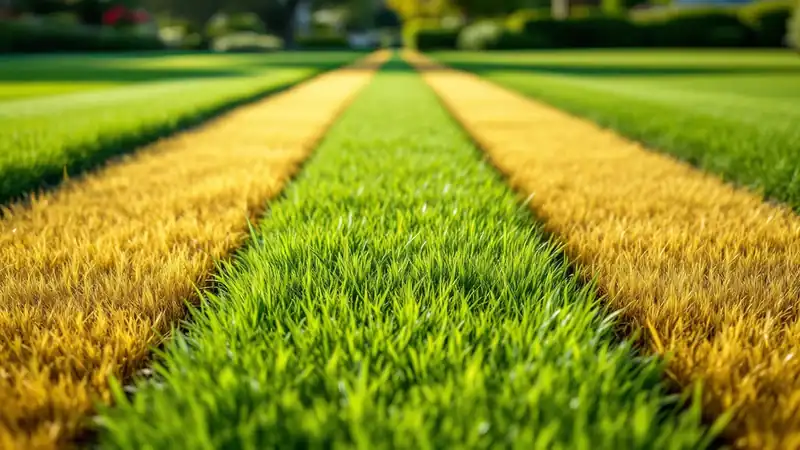
Yes, you can over-fertilize your lawn. More than 1 lb of quick-release nitrogen per 1,000 sq ft at once (0.7 lb under Florida’s rule) can scorch it in stripes or spots. Sweep up granules, then soak with 1 inch of water 2 or 3 times.
Can you over fertilize your lawn with an ordinary bag and spreader? Easily, and the arithmetic shows how. A 12.64 lb bag of Scotts Turf Builder 38-0-4 spread at its 4,000 sq ft rate puts down 1.20 lb of nitrogen per 1,000 sq ft. Walk that rate twice and it is 2.40 lb; spill 1 lb of it on 10 sq ft and that spot gets 38 lb. Purdue Extension AY-22 caps a single feeding at 1.0 lb of water-soluble nitrogen.
The usual explanation, a fertilizer’s salt index, did not predict which products burned in the newest field test. In a 2026 Crop Science trial by Shaddox, Boeri and Unruh, monoammonium and diammonium phosphate (salt index 30 and 34) burned about half the bermudagrass plot area at 8 lb of N per 1,000 sq ft, while ammonium sulfate, at 69, burned none. No source of the 12 burned at 1 lb watered in. Dose is the lever you control.
This page covers the dose that does damage and the repair. Choosing a bag is in our lawn fertilizer guide to grades and nitrogen sources, and the calendar in when to fertilize your lawn by grass type and soil temperature.
How much fertilizer is too much for a lawn?
Count pounds of actual nitrogen per 1,000 sq ft, not pounds of product: bag weight × the first number ÷ 100 ÷ the thousands of square feet it covered. The ceilings below come from 1 extension bulletin, 1 state label rule, 1 statute, 1 field trial and 1 maker’s own directions.
| Source | Per application (lb N per 1,000 sq ft) | Per year or timing | Applies to |
|---|---|---|---|
| Purdue AY-22 | 1.0 lb water-soluble N; up to 2.0 lb total only when over 50% is slow-release | 1 to 3 lb (lowest care) to 3 to 5 lb (clippings removed, irrigated) | Cool-season lawns: Kentucky bluegrass, ryegrass, fescues |
| Fla. Admin. Code 5E-1.003(2)(b) | 0.7 lb readily available N; 2 lb total in spring or summer, 1 lb in fall or winter | By species and region (next table) | Directions printed on lawn bags of 49 lb or less sold in Florida |
| Md. Code, Agric. §8-803.5(f) | 0.7 lb water-soluble N, or 0.9 lb total with at least 20% slow-release | No N or P before March 1, after Nov. 15 or on frozen ground (§8-803.5(c)) | Homeowners and anyone who is not a certified applicator |
| Shaddox, Boeri and Unruh, Crop Science, 2026 | No burn from any of 12 granular sources at 1.0 lb N watered in with 0.24 in; MAP and DAP burned at higher rates, tested up to 8.0 lb | Single application, August 2020 | Latitude 36 hybrid bermudagrass mown at 1 in, Jay, Fla., and Lexington, Ky. |
| Scotts Turf Builder Lawn Food 38-0-4, SKU 23500 | 1.20 lb at the Turf Builder rate (4,000 sq ft); 1.60 lb at the Max Greening rate (3,000 sq ft) | Turf Builder rate if feeding more than 2 times a year | No Max Greening rate on centipede or zoysia, or above 80°F |
Florida’s 0.7 lb limit binds the bag, not the homeowner: it sets what lawn products sold there may print as directions. Maryland’s caps bind the person spreading. Purdue’s 2.0 lb allowance exists because slow-release nitrogen, such as sulfur-coated urea or methylene urea, dissolves over weeks, so only the quick-release share hits the leaves at once. Release speed for each source, from urea to Milorganite, is compared in our guide to adding nitrogen to lawn soil.
How much nitrogen per year is too much?
Annual totals matter as much as single passes, because nitrogen beyond what the grass uses feeds thatch and disease or leaves the lawn in water. Florida’s rule prints a ceiling for each warm-season grass and region; UF/IFAS LH006 recommends only 1 to 2 lb a year for bahiagrass statewide, below the rule’s 2 to 4 lb top.
| Grass | North Florida | Central Florida | South Florida |
|---|---|---|---|
| Bahiagrass | 2 to 3 | 2 to 4 | 2 to 4 |
| Bermudagrass | 3 to 5 | 4 to 6 | 5 to 7 |
| Centipedegrass | 1 to 2 | 2 to 3 | 2 to 3 |
| St. Augustinegrass | 2 to 4 | 2 to 5 | 4 to 6 |
| Zoysiagrass | 2 to 3 | 2 to 4 | 2.5 to 4.5 |
| Cool-season (Purdue, any state) | 1 to 3 low care, 2 to 4 moderate, 3 to 5 highest care |
Frequent small feedings add up fast. Every 2 weeks from April through September is 13 feedings; at 0.5 lb of N each that is 6.5 lb a year, past Purdue’s 3 to 5 lb for the most intensively kept cool-season lawn and past every Florida ceiling except south Florida bermudagrass at 5 to 7 lb.
How common mistakes multiply the dose
The extra nitrogen usually comes from the spreading, not the plan: Maryland Extension names overlap between passes, wrong spreader settings and spills from spreaders or open bags. Each row is our arithmetic from label numbers, set against Purdue’s 1.0 lb and Florida’s 0.7 lb caps. Those caps cover the quick-release share, so for slow-release blends the multiples overstate the risk.
| Scenario | Math | lb N per 1,000 sq ft | × Purdue 1.0 lb | × Florida 0.7 lb |
|---|---|---|---|---|
| Scotts Turf Builder 38-0-4, 12.64 lb bag at its Turf Builder rate (4,000 sq ft) | 12.64 × 0.38 ÷ 4 | 1.20 | 1.2 | 1.7 |
| Same bag at its Max Greening rate (3,000 sq ft) | 12.64 × 0.38 ÷ 3 | 1.60 | 1.6 | 2.3 |
| Turf Builder rate spread twice: full rate in both directions | 1.20 × 2 | 2.40 | 2.4 | 3.4 |
| Max Greening rate where two passes overlap | 1.60 × 2 | 3.20 | 3.2 | 4.6 |
| Urea 46-0-0 at Purdue’s dose math for 1 lb N | 2.17 lb × 0.46 | 1.00 | 1.0 | 1.4 |
| A 50 lb bag of urea spread over 5,000 sq ft | 50 × 0.46 ÷ 5 | 4.60 | 4.6 | 6.6 |
| Highest rate in the 2026 field trial (392 kg per hectare) | 392 × 0.02048 | 8.03 | 8.0 | 11.5 |
| 1 lb of 38-0-4 spilled on 10 sq ft | 1 × 0.38 ÷ 0.01 | 38.0 | 38.0 | 54.3 |
| 1 lb of urea spilled on 10 sq ft | 1 × 0.46 ÷ 0.01 | 46.0 | 46.0 | 65.7 |
Spills are where the multiples jump. Washington State University Hortsense places dead patches where spreaders turn, start and stop, and stripes where passes overlap. A 1 lb spill of 38-0-4 on 10 sq ft carries 38 lb of N per 1,000 sq ft, nearly 5 times the 8 lb top rate that burned half the phosphate plots in the 2026 trial.
Check your own application below: enter the pounds of product you put down, the first number on the bag and the area it covered. The default is the 12.64 lb Scotts bag at its 4,000 sq ft rate, 1.20 lb of N. Penn State Extension advises a drop spreader or liquid application on small lawns boxed in by walks and drives, and shutting the spreader off when crossing pavement.
- Nitrogen (lb per 1,000 sq ft)
- 1.20
- Percent of Purdue's 1.0 lb cap
- 120
- Percent of Florida's 0.7 lb cap
- 172
Default: 12.64 lb of 38-0-4 over 4,000 sq ft = 1.20 lb N per 1,000 sq ft, 120% of Purdue's cap. The caps cover quick-release N; a bag with over 50% slow-release N may go to 2.0 lb under Purdue. Your bag's label overrides this tool.
Does salt index predict fertilizer burn?
Salt index compares how much a material raises the salt concentration of the soil solution against sodium nitrate, set at 100. Penn State lists urea at 75, ammonium nitrate at 105 and ammonium sulfate at 69. The 2025 North Carolina Agricultural Chemicals Manual, Table 4-11 puts potassium chloride at 116.3 and potassium sulfate at 46.1.
Swipe the table sideways to see every column.
| Material | Grade | Salt index (sodium nitrate = 100) | Salt index per unit of nutrient | lb of product for 1 lb N | 2026 field trial, bermudagrass |
|---|---|---|---|---|---|
| Potassium chloride (muriate of potash) | 0-0-60 to 0-0-63 | 116.3 (NC State) | 1.9 per unit K2O (our arithmetic, 116.3 ÷ 60) | no N | Not in the trial; highest salt index here |
| Ammonium nitrate | 33-0-0 | 105 (Penn State) | 3.2 (high) (UT W161-E) | 3.03 | Not reported in the abstract |
| Urea | 46-0-0 | 75 (Penn State) | 1.7 (moderate) (UT W161-E) | 2.17 | Not reported in the abstract |
| Potassium nitrate | 13-0-44 | 74 (Penn State) | 5.3 (high) (UT W161-E) | 7.69 | Not reported in the abstract |
| Ammonium sulfate | 21-0-0 | 69 (Penn State) | 3.3 (high) (UT W161-E) | 4.76 | No burn at any rate, up to 8 lb N |
| Calcium nitrate | 16-0-0 | 53 (Penn State) | 3.3 (high) (our arithmetic, 53 ÷ 16) | 6.25 | No burn at any rate, up to 8 lb N |
| Potassium sulfate (sulfate of potash) | 0-0-50 to 0-0-53 | 46.1 (NC State) | 0.9 per unit K2O (our arithmetic, 46.1 ÷ 50) | no N | Not in the trial |
| Diammonium phosphate (DAP) | 18-46-0 | 34 (Penn State) | 1.9 (moderate) (our arithmetic, 34 ÷ 18) | 5.56 | 48.4% of plot burned at 8 lb N, Jay, Fla. |
| Monoammonium phosphate (MAP) | 11-48-0 | 30 (Penn State) | 2.7 (high) (our arithmetic, 30 ÷ 11) | 9.09 | 51.6% of plot burned at 8 lb N, Jay, Fla. |
| Sulfur-coated urea (SCU) | 32-0-0 | not listed | 0.7 (low) (UT W161-E) | 3.13 | Not reported in the abstract |
| Polymer-coated urea | 38-0-0 | not listed | not rated; slow release (UT W161-E) | 2.63 | Not reported in the abstract |
| Ureaform or methylene urea | 38-0-0 | not listed | 0.3 (low) (UT W161-E) | 2.63 | Not reported in the abstract |
| IBDU | 31-0-0 | not listed | 0.2 (low) (UT W161-E) | 3.23 | Not reported in the abstract |
| Milorganite (biosolids) | 6-4-0 | not listed | 0.7 (low) (UT W161-E) | 16.67 | Not reported in the abstract |
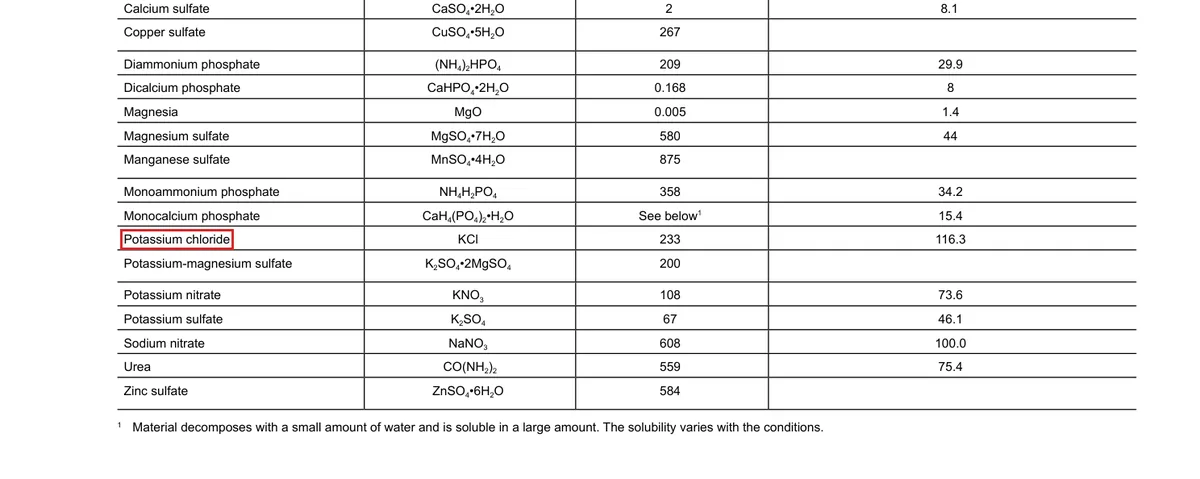
By either column, the 2026 result runs backward. Per unit of nitrogen, ammonium sulfate and calcium nitrate rate 3.3, high on UT’s scale, and burned nothing; diammonium phosphate rates 1.9 and burned 48.4 percent of the plot area at 8 lb. The authors conclude the salt index ‘may not be a valid predictor’ of nitrogen burn in turf. The NC State table in the screenshot lists the 2 phosphates the other way round, MAP 34.2 and DAP 29.9; Penn State and Hawaii’s CTAHR both give MAP 30 and DAP 34, the values used here.
Read the trial for what it tested: one August application on Latitude 36 bermudagrass mown at 1 in, irrigated with 0.24 in right after, scored for 22 days. In Lexington only the 2 phosphate sources burned at all. We have read the published abstract, not the full tables, so per-rate results for the other 8 sources are not on this page.
Potassium is the other salt in the bag. Penn State says most fertilizer potassium comes from muriate of potash (potassium chloride) or sulfate of potash, and at 116.3 the chloride carries the highest salt index of any material here. NC State’s manual, in its fertilizer placement section, suggests potassium sulfate over the chloride where salt injury is a risk. Hawaii’s CTAHR TM-13 gives the same nitrogen ranking: ammonium nitrate 105, urea 75, ammonium sulfate 69.
What does an over-fertilized lawn look like?
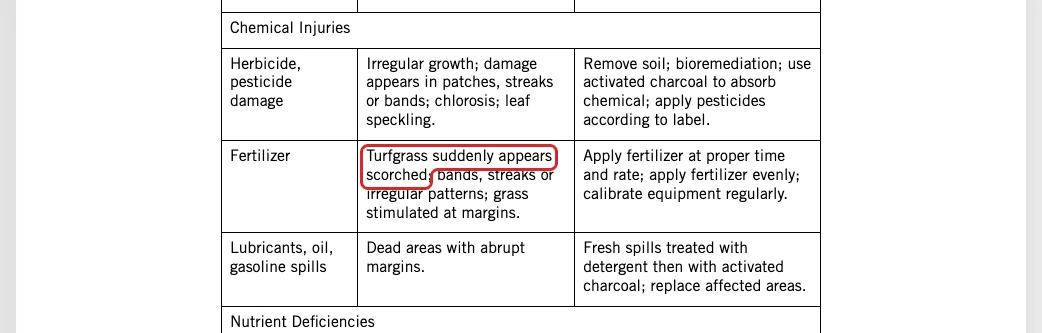
UGA Extension Bulletin 1258 describes fertilizer injury as turf that suddenly appears scorched, in bands, streaks or irregular patterns, with grass stimulated at the margins. The shape is the tell: straight lines and spill blots are man-made, while disease and insects rarely draw a spreader’s path.
- Straight brown or straw-colored stripes about one spreader-throw wide, parallel to your passes (WSU Hortsense).
- Dead patches at turns, starting and stopping points, or where the bag was filled (WSU Hortsense).
- Leaf tips and margins dying first, because salts collect in leaf tissue (WSU Hortsense).
- Grass that wilts like drought even when watered: University of Maryland Extension says burn usually resembles drought stress, since excess salts stop roots from taking up water.
- A darker green, faster-growing fringe around a dead spot, where a lower dose acted as feed (UGA B1258).
- Pale green stripes between passes are the opposite mistake: skips where spreader paths did not overlap (UGA B1258).
Weather points the same way. UGA ties burn from urea and other highly soluble nitrogen to wet turf or high temperatures, and WSU names quick-release products not watered in, or spread in hot weather, as a common cause. If the pattern is round spots, overall yellowing or a lawn brown everywhere, run the checks below and our yellow grass diagnosis by pattern.
1Do the brown areas run in straight stripes that match your spreader passes, or sit at turns, stops or where you filled the spreader?
YesFertilizer burn from overlap or a spill (WSU Hortsense, UGA B1258): pick up granules and start the 1-inch soaks.
NoGo to the next question
2Did the damage show up after you fed on a hot day or onto wet grass, without watering in?
YesLikely burn from soluble nitrogen on leaves (UGA B1258): soak 1 inch, 2 or 3 times.
NoGo to the next question
3Are the stripes pale green rather than brown, between darker bands?
YesSkips, not burn: the spreader paths did not overlap (UGA B1258). Fill in at half rate.
NoGo to the next question
4Is the whole lawn evenly pale yellow, older leaves first?
YesToo little nitrogen, the opposite problem: see our yellow grass diagnosis.
NoRound spots, rings or lawn-wide browning after heat point elsewhere: dog urine, disease or drought dormancy. Run your bag numbers in the calculator; above 1.0 lb N per 1,000 sq ft, treat it as burn.
Source: UGA Extension Bulletin 1258; WSU Hortsense, Fertilizer burn
How to fix an over-fertilized lawn
The repair is to remove what you can and wash the rest below the roots. Maryland Extension‘s sequence is short: collect spilled fertilizer, then dilute over-applications with water; replant what dies from root loss. The steps below add the measurements.
- Pick up loose granules the same day. Scoop or vacuum spill piles. Sweep or blow granules off drives and walks back onto turf, and never hose them into the street or a storm drain (Penn State Extension); Florida requires that sweep-back instruction on every retail bag (5E-1.003(2)(c)).
- Soak with 1 inch of water, then repeat it 2 or 3 times. That is Maryland Extension‘s figure: enough irrigation to fill a rain gauge to 1 inch, repeated to leach salts below the root zone. Time how long your sprinkler takes to fill a straight-sided can to 1 inch and run that length each round.
- Cancel the next feeding. A doubled pass at 2.4 lb of N already sits inside the 2 to 4 lb Purdue sets for a full year of moderate cool-season care. Do not feed drought-stressed or dormant turf at all (Purdue AY-22, Table 2 note b).
- Judge the damage after about 3 weeks. The 2026 trial scored burn for 22 days. Tug brown leaves: firm crowns and roots mean the plant can regrow, while leaves that lift out with no roots attached are dead; the full test is in our guide to telling dormant grass from dead.
- Reseed or patch only what died. UMD says to replant grass killed by root loss. Rake out dead material and seed after the soaks, following our overseeding rates by grass type.
- Test before the next season. UMD advises fertilizing only when a lab soil test shows the need, and Minnesota bans phosphorus on established turf without one (Minn. Stat. §18C.60).
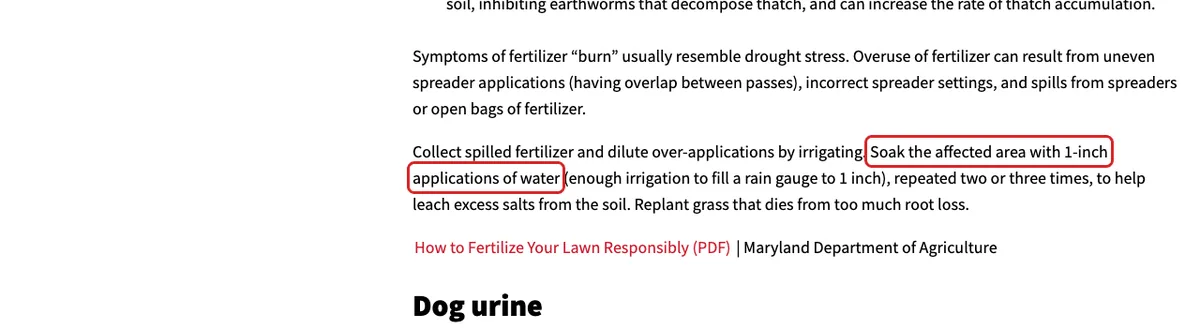
Skip the remedies meant for other spills. UGA B1258 lists activated charcoal for pesticide and fuel spills; its fertilizer row says only to apply at the proper time and rate, spread evenly and calibrate. Gypsum and lime appear in none of the burn repair steps from UGA, UMD or WSU.
What else does too much nitrogen do?
Excess nitrogen that does not burn still costs you. Maryland Extension says it fuels lush growth that grass-feeding insects, clover mites and fungi target, and that high rates of ammonium or urea acidify soil, slow the earthworms that break down thatch and speed thatch buildup. UGA B1258 adds that brown patch is more active under high nitrogen; symptoms and controls are in our lawn fungus disease guide.
The rest washes off. Maryland bars nitrogen or phosphorus on turf before March 1, after Nov. 15, on frozen ground and within 15 ft of surface water (§8-803.5(c) and (d)), and bars fertilizer on impervious surfaces. Minnesota allows phosphorus on turf only with a soil test from the last 3 years, a new lawn’s first season or a golf course. Blackout dates for other states are listed in our lawn fertilizing calendar and state blackout dates.
How we compiled this
In November 2026 we read 13 primary documents: extension publications from Purdue, Penn State, the University of Tennessee, NC State, UGA, UMD, WSU, UF/IFAS and the University of Hawaii, the Florida fertilizer labeling rule, the Maryland and Minnesota statutes, the Scotts SKU 23500 listing and the abstract of the 2026 Crop Science trial. Every dose in the tables is our arithmetic from those grades and rates. We ran no trials and spread no fertilizer.
This page is general information, not legal or agronomic advice. Fertilizer rules change and county ordinances can be stricter; read the bag you bought and your state’s rule before you spread. A weed-and-feed product is a pesticide, and its label is the law.
Frequently asked questions
Will grass recover from too much fertilizer?
Often, if the crowns survived. Leaves that burned stay brown, but plants with firm crowns push new leaves once the salts are flushed with 1 inch of water 2 or 3 times (Maryland Extension). Spots that pull up with no roots need seed or sod.
How much fertilizer is too much for a lawn?
More than 1.0 lb of water-soluble nitrogen per 1,000 sq ft in one feeding, per Purdue AY-22, or 2.0 lb when over half is slow-release. Florida bags must stay at 0.7 lb, and Maryland homeowners at 0.7 lb soluble or 0.9 lb total.
Can I fertilize my lawn every 2 weeks?
Not at normal rates. Every 2 weeks from April through September is 13 feedings; at 0.5 lb of nitrogen each that is 6.5 lb a year, above Purdue’s 3 to 5 lb for the most intensively kept cool-season lawn and above most Florida ceilings.
How do you fix over-fertilized grass?
Sweep or vacuum loose granules, water 1 inch and repeat 2 or 3 times to leach salts, skip the next feeding, then reseed only the spots that died after about 3 weeks. Do not add more fertilizer to green it up.
Does a low salt index fertilizer prevent burn?
Not reliably. In a 2026 Crop Science field trial, monoammonium and diammonium phosphate, salt index 30 and 34, burned about half the bermudagrass plot at 8 lb N per 1,000 sq ft, while ammonium sulfate at 69 burned none. Rate and watering in mattered more.
Sources
- Purdue Extension (Bigelow, Camberato, Patton), AY-22-W, Fertilizing Established Cool-season Lawns, p. 5 and Table 2, Current edition. Accessed November 2026.
- Shaddox, Boeri and Unruh, Crop Science, Granular nitrogen source and rate affect bermudagrass phytotoxicity (abstract), September 2026. Accessed November 2026.
- Penn State Extension (Landschoot), Turfgrass Fertilization: A Basic Guide for Professional Turfgrass Managers, Tables 3 and 6, Current web edition. Accessed November 2026.
- NC State Extension, 2025 North Carolina Agricultural Chemicals Manual, Chapter IV, Table 4-11, April 2, 2025. Accessed November 2026.
- University of Tennessee Extension, W161-E, Turfgrass Maintenance: Fertilizers, Current edition. Accessed November 2026.
- University of Hawaii CTAHR (Deputy), TM-13, Turf Fertilizers for Hawaii’s Landscapes, Table 2, October 2000. Accessed November 2026.
- Florida Department of Agriculture and Consumer Services, Fla. Admin. Code Rule 5E-1.003, Labeling Requirements for Urban Turf Fertilizers, Amended Jan. 27, 2026. Accessed November 2026.
- UF/IFAS Extension, LH006, Bahiagrass for Florida Lawns, Table 1, Current revision. Accessed November 2026.
- Maryland General Assembly, Md. Code, Agriculture §8-803.5, Current code. Accessed November 2026.
- Minnesota Revisor of Statutes, Minn. Stat. §18C.60, Phosphorus turf fertilizer use restrictions, Current code. Accessed November 2026.
- University of Maryland Extension, Lawn Problems Not Caused by Pests or Diseases, Current page. Accessed November 2026.
- UGA Extension (Martinez), Bulletin 1258, Abiotic Injuries and Disorders of Turfgrasses in Georgia, Current page. Accessed November 2026.
- Washington State University Hortsense, Common Cultural: Fertilizer burn, Reviewed March 26, 2026. Accessed November 2026.
- ScottsMiracle-Gro, Scotts Turf Builder Lawn Food 38-0-4, 12.64 lb, SKU 23500, product information, Listing read Nov. 12, 2026. Accessed November 2026.