Lawn fungus is not one problem: brown patch, dollar spot and 14 other diseases each start at a set temperature and dew length. Identify the disease, fix watering and nitrogen, and spray a labeled fungicide only if patches spread.
Key takeaways
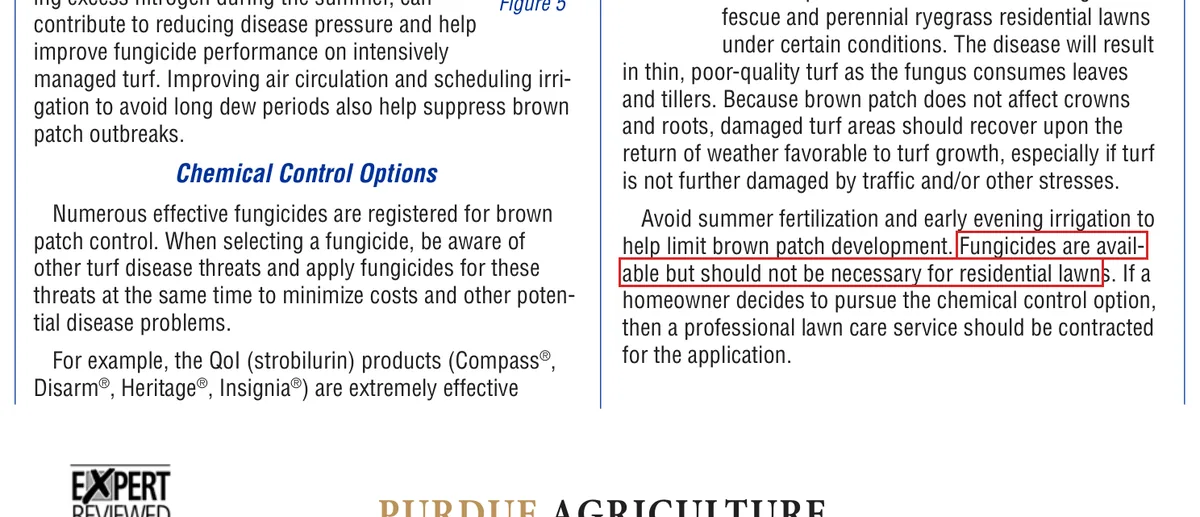
- Purdue Extension says brown patch fungicides “should not be necessary for residential lawns” because the fungus does not kill crowns or roots, so turf regrows when weather turns (Purdue BP-106).
- Weather sets the calendar: brown patch needs dew periods over 10 hours with nights above 65°F, Pythium blight over 14 hours with evenings averaging 68°F or more (Purdue BP-109).
- Nitrogen cuts both ways: dollar spot, red thread and rust are worse on hungry turf (Purdue fixes red thread with 0.2 lb N per 1,000 sq ft), while brown patch, Pythium and large patch flare with excess nitrogen (Purdue BP-104; Arkansas FSA7527).
- Every homeowner lawn fungicide in Arkansas’s 2026 products guide is FRAC group 11 (azoxystrobin), 3 (propiconazole, myclobutanil) or 1 (thiophanate-methyl), plus copper and potassium bicarbonate; Ohio State rates resistance concern high for groups 1, 3 and 11 (UADA MP154; Ohio State).
- Rule out look-alikes before buying anything: grubs matter above about 5 per square foot (Purdue E-271), and dog-urine spots smell of ammonia when the dead grass is sealed in a plastic bag (WSU HortSense).
10 to 12 hours of continuous leaf wetness before brown patch can infect (NC State TurfFiles)
68°F average evening temperature that signals Pythium blight weather (Purdue BP-109)
65°F soil at 3 inches for several days before summer patch fungicides work (Purdue BP-115)
3 FRAC groups cover the homeowner lawn fungicides in Arkansas’s 2026 guide (UADA MP154)
What does lawn fungus look like?
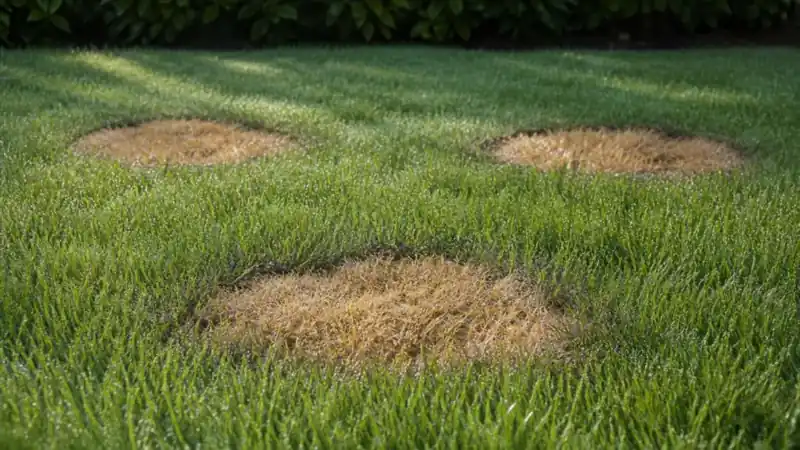
Lawn fungus shows up as a field pattern you see from 10 feet away and a sign you see up close. Purdue’s diagnostic guide sorts the patterns into circular patches, frogeyes or rings, linear streaks and diffuse thinning (Purdue BP-124). The close-up sign settles it: cottony mycelium at dawn, red threads, orange pustules, leaf lesions with dark borders, or black, rotted roots.
Read the patch edge, not the dead center, where the fungus has already moved on. The table below lists 16 diseases that extension pathologists profile for U.S. lawns, the grasses each attacks and the sign that separates it from its look-alikes. Grass names follow our Turf and Trees section; if you do not know your species, identify it first, because most diseases attack only a few grasses.
Swipe the table sideways to see every column.
| Disease | Grasses it attacks | What you see from 10 ft | Sign up close | Source |
|---|---|---|---|---|
| Brown patch | Tall fescue, perennial ryegrass; all cool-season grasses | Tan to brown circles 6 in to several ft across; leaves stay upright | Tan, irregular leaf lesions with a dark border; gray “smoke ring” at the edge on short turf | NC State; Purdue BP-106 |
| Large patch | Zoysiagrass; bermudagrass less often | Tan circles up to 20 ft across in fall and at spring green-up | Orange border on active patches; lower leaves die as sheaths are killed | Arkansas FSA7527 |
| Dollar spot | All warm- and cool-season lawn grasses | Sunken straw spots under 1/2 in to over 4 in, often merging | Straw lesions with a red-brown margin; white cobweb growth at dawn | UGA C1091; Purdue BP-105 |
| Pythium blight | Perennial ryegrass, rough bluegrass; tall fescue and Kentucky bluegrass rarely | Small greasy, water-soaked patches that merge in days, often in low spots | Cottony white mycelium in the morning; dead turf mats down | Purdue BP-109 |
| Summer patch | Kentucky bluegrass, annual bluegrass | Circular or oval orange-brown patches and frogeyes from late July | Sparse, dark, rotted roots | Purdue BP-115 |
| Necrotic ring spot | Kentucky bluegrass, annual bluegrass | Clustered gray-tan patches 6 to 8 in, later rings and frogeyes | Stunted, dark roots; tip die-back | Purdue BP-116 |
| Red thread | Kentucky bluegrass, perennial ryegrass, tall fescue | Tan or pink patches 4 to 8 in in spring and fall | Red, antler-like threads on leaf tips | Purdue BP-104 |
| Rust | Kentucky bluegrass, perennial ryegrass | Yellow-green cast, worst in shade and along foundations | Orange pustules; orange dust on shoes and mowers | Purdue BP-110 |
| Gray snow mold | All cool-season grasses | Circular patches 6 to 12 in at snowmelt | Gray mycelium; tiny black or red-brown sclerotia in dead leaves | Purdue BP-101 |
| Pink snow mold (Microdochium patch) | All cool-season grasses | Circular, matted patches, with or without snow | White to pink mycelium on leaves in cool, wet weather | Purdue BP-102 |
| Leaf spot and melting out | Kentucky bluegrass, perennial ryegrass, tall fescue | Diffuse thinning, off-color areas | Purple-brown leaf lesions; no mycelium on leaves | Purdue BP-103 |
| Gray leaf spot | Perennial ryegrass, tall fescue, St. Augustinegrass | Blue-gray, thin turf that looks like drought | Gray mold on leaves after an overnight bag test | Purdue BP-107; NC State |
| Fairy ring | All lawn grasses | Dark green bands or arcs under 1 ft to over 100 ft; mushrooms after rain | Ring persists in the same spot year after year | Purdue BP-113 |
| Slime mold | Any grass, mostly taller-mown | Yellow, orange, purple or gray crust on blades for 1 to 2 weeks | Spore masses that turn gray and powdery; grass underneath is unharmed | Purdue BP-112 |
| Spring dead spot | Bermudagrass | Sharp circular dead patches as the lawn greens up in spring | Black roots and stolons | Purdue BP-120 |
| Take-all root rot | All warm-season grasses, mostly St. Augustinegrass | Irregular yellow patches a few inches to a few feet that thin out | Short, black, rotted roots; black strands on stolons | UF/IFAS LH079 |
Mushrooms on their own are a fruiting body, not a disease of the grass; our guide to lawn mushrooms covers which ones are poisonous and why fungicides do not stop them. Fairy ring belongs in the table because Purdue notes it can kill grass in bands and leave soil that repels water (Purdue BP-113).
Is it fungus, grubs, dog urine or drought?
Four problems make brown patches in lawns, and only one of them responds to fungicide. A tug test, a one-square-foot dig, a sniff test and a look at the whole lawn separate them. UF/IFAS lists diagnosis among its reasons homeowners are discouraged from buying fungicides: each product is made for specific diseases, and treatments differ completely by cause (UF/IFAS PP154).
1Does the turf lift like carpet, with C-shaped white grubs in the top 2 to 3 inches of soil?
YesGrubs. Count per square foot; most turf tolerates up to 5 (Purdue E-271). See our grub guide.
NoGo to the next question
2Is it a round spot a few inches wide with a dark green ring, and does dead grass sealed in a bag smell of ammonia?
YesDog or animal urine (WSU). Water the spot heavily and reseed it; no fungicide.
NoGo to the next question
3Is the whole lawn blue-gray with folded blades, and do footprints stay visible?
YesDrought stress (UF/IFAS LH025). Water deeply before sunrise and recheck in a week.
NoGo to the next question
4Do leaves at the patch edge show lesions, red threads, orange pustules or cottony growth at dawn?
YesA leaf disease. Match the sign to the ID table, then fix water and nitrogen first.
NoGo to the next question
5Are the roots short, dark and rotted under a patch or ring that returns each year?
YesA root disease such as summer patch, necrotic ring spot, spring dead spot or take-all root rot. Get a lab diagnosis; sprays must go on before symptoms.
NoSend a sample to your state plant diagnostic lab before buying a fungicide (UF/IFAS PP154).
Source: Purdue E-271 and BP-124; WSU HortSense; UF/IFAS LH025, LH079 and PP154
| Test | Result | Points to | Source |
|---|---|---|---|
| Tug a handful of grass at the patch edge | Mat lifts like carpet, roots chewed off | White grubs | Purdue E-271 |
| Cut and lift 1 sq ft of sod, 2 to 3 in deep | More than 5 C-shaped grubs per sq ft | Possible grub damage; most turf tolerates up to 5 | Purdue E-271 |
| Seal dead grass in a plastic bag for a few hours, then smell | Ammonia odor; dark green ring around a spot a few inches wide | Dog or other animal urine | WSU HortSense |
| Look at the whole lawn, then walk on it | Folded blades, blue-gray tint, footprints stay visible | Drought stress | UF/IFAS LH025 |
| Check leaves at the patch edge at dawn | Lesions, red threads, orange pustules or cottony growth | Foliar fungus | Purdue BP-124 |
| Pull a plug and wash the roots | Short, dark, rotted roots under a patch that returns each year | Root disease (summer patch, necrotic ring spot, spring dead spot, take-all) | Purdue BP-115; UF/IFAS LH079 |
Grub thresholds by beetle species, and the dig method, are in our guide to grubs in lawns. For dog spots, Colorado State says pH-changing supplements and “female dogs only” claims do not hold up; the damage comes from nitrogen and salts, and heavier irrigation of the spot dilutes them (Colorado State Extension).
What weather triggers lawn fungus?
Lawn fungus is triggered by a measurable mix of temperature and hours of wet leaves, and each disease has its own window. Purdue’s seasonal profile puts gray snow mold at 31°F to 36°F under snow, dollar spot at 50°F to 70°F with long dew, and brown patch at dew periods of 12 hours or more averaging 65°F or warmer (Purdue BP-125).
Swipe the table sideways to see every column.
| Disease | Temperature | Moisture or other trigger | When it shows | Source |
|---|---|---|---|---|
| Gray snow mold | 31°F to 36°F under snow | Snow cover: mild after 40 to 60 days, moderate 60 to 90, severe over 90 | Late winter, at snowmelt | Purdue BP-101; BP-125 |
| Pink snow mold | 32°F to 50°F | Cool, wet weather; snow not required | Late fall to mid-spring | Purdue BP-125 |
| Red thread | 45°F to 60°F | Leaf wetness over 12 hours | Mid to late spring, some fall | Purdue BP-125 |
| Melting out | Cold, rainy weather | Rain; heavy spring nitrogen | April and May | Purdue BP-125 |
| Dollar spot | 50°F to 70°F (Purdue); 60°F to 75°F (UGA) | Dew over 8 hours | May to October; spring and fall in Georgia | Purdue BP-105; UGA C1091 |
| Large patch | 50°F to 70°F; patches appear as soil drops below 70°F | Long dew periods, wet or poorly drained soil | Fall and spring green-up | Purdue BP-125; FSA7527 |
| Rust | 50°F to 60°F | Evening dew over 10 hours on slow-growing turf | Late summer to mid-autumn | Purdue BP-110 |
| Spring dead spot | Moist soil at 50°F to 70°F (infection in fall) | Cold winter after fall infection | Shows at spring green-up | Purdue BP-120 |
| Necrotic ring spot | Soil 60°F to 75°F | Wet soil | Infects spring and fall; shows midsummer | Purdue BP-125 |
| Brown patch | Nights above 60°F to 65°F; severe above 70°F lows and 90°F highs | Leaves wet 10 to 12 hours | Summer | NC State; Purdue BP-106 |
| Summer patch | Soil at 3 in above 65°F for several days | Heat and drought later bring symptoms | Infects mid-May to June; shows from late July | Purdue BP-115 |
| Pythium blight | Evenings averaging 68°F or more; days 86°F to 95°F | Dew over 14 hours; humidity above 90% for 14 hours | Hottest, wettest weeks of summer | Purdue BP-109; UMD |
| Gray leaf spot | 70°F to 95°F | At least 14 hours of continuous leaf wetness | Mid to late summer, after tropical-storm rain | NC State; Purdue BP-107 |
| Take-all root rot | Summer and early fall | Prolonged rainfall plus any turf stress | Roots infected 2 to 3 weeks before leaves show it | UF/IFAS LH079 |
The chart sorts the diseases by the lowest temperature at which each pathogen becomes active. Read it as a calendar: the left side is a fall-to-spring problem in the North, the right side a July and August problem. Brown patch, Pythium blight and gray leaf spot share the same night-time weather, and Purdue rates perennial ryegrass susceptible to all three, so one hot, humid week can start them together (Purdue BP-125; BP-124).
Leaf wetness is the input you control. Every hour of irrigation that ends after sunset adds to the dew period, which is why NC State says watering after sunrise, in late afternoon or in the evening increases brown patch, and why UGA recommends knocking dew off with a hose for dollar spot (NC State; UGA C1091). Watering windows by grass are in our guide to the best time to water a lawn.
How do you treat lawn fungus?
You treat lawn fungus in eight steps: confirm the disease at the patch edge, rule out grubs and urine, change watering to before sunrise, move nitrogen in the direction that disease needs, raise the mower, bag clippings from active patches, spray only a product labeled for that disease and site, then reseed with a resistant grass. Purdue and UF/IFAS put cultural steps first (UF/IFAS PP154).
- Sample the edge at dawn. Look at leaves from the margin of a patch with a 10x hand lens while dew is on. For gray leaf spot, seal a plug in a plastic bag overnight; gray mold on the leaves the next morning confirms it (Purdue BP-107).
- Rule out grubs and urine. Dig 1 sq ft 2 to 3 inches deep and count; most turf tolerates up to 5 grubs per sq ft without visible damage (Purdue E-271). Do the plastic-bag ammonia test for urine (WSU).
- Send a sample if the sign is unclear. Send a plug that spans healthy and sick grass to your state’s plant diagnostic lab or extension office; UF/IFAS says visual diagnosis alone is difficult and treatments differ completely by disease (UF/IFAS PP154).
- Water before sunrise, deeply and less often. Skip late-afternoon and evening cycles; brown patch needs 10 to 12 hours of wet leaves and Pythium more than 14 (NC State; Purdue BP-109).
- Adjust nitrogen for the disease you have. Add 0.2 lb N per 1,000 sq ft for red thread; hold summer nitrogen to 0.5 lb N per 1,000 sq ft or less during brown patch weather (Purdue BP-104; NC State). Rates by disease are in the next section.
- Raise the mower and bag active patches. Purdue ties mowing below 2 inches to more leaf spot and melting out, and Arkansas says to bag clippings from large patch areas and avoid mowing wet turf (Purdue BP-103; FSA7527).
- Spray only if patches keep spreading. Choose an active ingredient listed for that disease on a label that allows residential lawns, apply at the label rate, and water granules or root-disease sprays in as the label directs (UF/IFAS LH079).
- Reseed with resistant grass. Purdue suggests Kentucky bluegrass to repair perennial ryegrass lost to gray leaf spot or Pythium blight, and names America, Majestic and Midnight among bluegrasses with moderate necrotic ring spot resistance (BP-107; BP-116).
Mowing during an outbreak spreads Pythium and large patch on wet blades, so mow those areas last and only when dry (Purdue BP-109; UMD); the evidence on dew and mowing for other diseases is in our article on mowing wet grass. Reseeding dates and rates are in our overseeding guide.
Does fertilizer make lawn fungus worse?
Fertilizer makes some lawn fungus worse and cures others, so the nitrogen move depends on the disease. Dollar spot, red thread and rust are worse on nitrogen-starved turf; brown patch, Pythium blight, large patch and spring dead spot are worse after heavy or badly timed nitrogen (UGA C1091; Purdue BP-120). Giving “no fertilizer” advice for all lawn fungus gets half the table wrong.
| Disease | Made worse by | Nitrogen move | Source |
|---|---|---|---|
| Dollar spot | Low nitrogen | Light, frequent nitrogen; dollar spot often follows the late-spring N slump | UGA C1091; Purdue BP-105 |
| Red thread | Low nitrogen | 0.2 lb N per 1,000 sq ft in mid to late spring; fixed over 2 to 3 years of adequate N | Purdue BP-104 |
| Rust | Low nitrogen, slow growth | 0.2 to 0.5 lb N per 1,000 sq ft on chronic spots | Purdue BP-110 |
| Fairy ring | Ring stimulates growth | Mask the dark band with 0.1 to 0.25 lb N per 1,000 sq ft around it | Purdue BP-113 |
| Brown patch | Excess summer nitrogen | No more than 0.5 lb N per 1,000 sq ft per feeding in disease weather; 1 lb max at any one time | NC State; Purdue BP-106 |
| Pythium blight | Lush growth, excess midsummer N | Avoid midsummer nitrogen near excessive levels | Purdue BP-109 |
| Leaf spot and melting out | Heavy spring nitrogen | Put most of the year’s nitrogen in fall | Purdue BP-103 |
| Large patch | Early-spring and late-season N | No N until May; max 2 lb N per 1,000 sq ft a season on zoysia, 4 lb on bermudagrass; stop after Aug. 15 | Arkansas FSA7527 |
| Spring dead spot | Late-summer nitrogen | Skip late-summer nitrogen on bermudagrass | Purdue BP-120 |
| Take-all root rot | Nitrate N and uncoated urea | Slow-release N matched 1 to 1 with potassium; no lime | UF/IFAS LH079 |
The arithmetic is simple once the rate is set. A 5,000 sq ft lawn at 0.2 lb N per 1,000 sq ft needs 1 lb of actual nitrogen, which is about 2.2 lb of 46-0-0 urea (1 / 0.46). How to read fertilizer analysis and pick a product is covered in our lawn fertilizer guide, and yearly timing by grass in our lawn care schedule.
What is the best fungicide for lawn fungus?
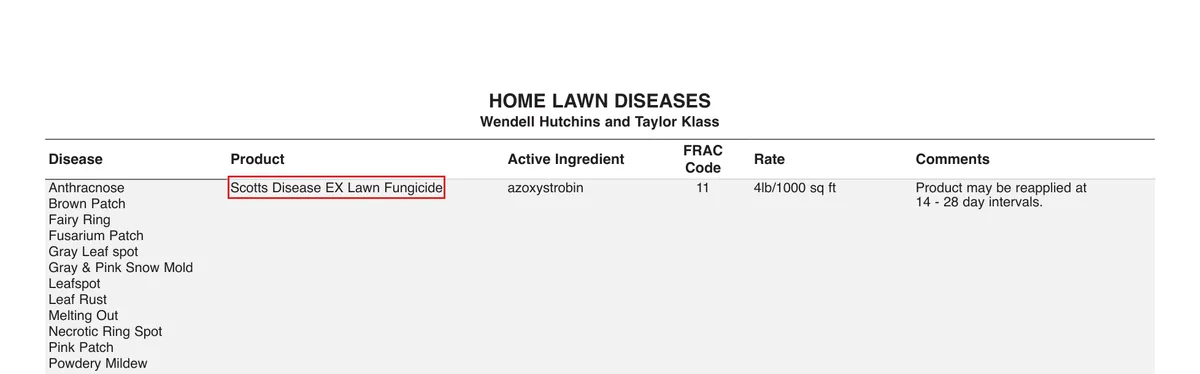
The best fungicide for lawn fungus is one whose label lists your disease and allows residential lawns, because no product covers everything. Azoxystrobin (FRAC 11) is very effective on brown patch and large patch but does almost nothing for dollar spot, Purdue says; propiconazole (FRAC 3) and thiophanate-methyl (FRAC 1) cover dollar spot (Purdue BP-106; BP-105).
Homeowner lawn fungicides by active ingredient
Arkansas’s 2026 Plant Disease Control Products Guide is the only extension table we found that lists retail lawn products with their FRAC codes and rates. We matched each entry to its EPA registration and current label in October 2026; where the label and the guide differ, the label column wins, because the label is the legal rate. Product names identify registrations, not endorsements (UADA MP154, 2026).
| Product as listed | Active ingredient | FRAC | Rate and limits | Lawn diseases listed (selected) | EPA registration |
|---|---|---|---|---|---|
| Scotts DiseaseEx Lawn Fungicide (granules) | azoxystrobin 0.31% | 11 | 2 to 4 lb per 1,000 sq ft (label); every 14 to 28 days; max 37 lb per 1,000 sq ft a year | Brown patch, large patch, summer patch, gray leaf spot, snow molds, red thread, rust, Pythium, take-all, spring dead spot | EPA Reg. No. 538-330 |
| BioAdvanced Fungus Control for Lawns (granules) | propiconazole 0.51% | 3 | 2 lb preventive, 3.5 lb curative per 1,000 sq ft (label); curative every 14 days | Brown patch, dollar spot, red thread, rust, summer patch, snow mold | EPA Reg. No. 92564-38 |
| Spectracide Immunox Fungus Plus Insect Control for Lawns (granules) | propiconazole 0.3% + lambda-cyhalothrin 0.02% | 3 | MP154: 4 lb per 1,000 sq ft. June 2026 label: not directly on residential lawns; spot treatments up to 2 sq ft | Brown patch, dollar spot, rust, leaf spot | EPA Reg. No. 9688-316 |
| Ferti-lome Liquid Systemic Fungicide II | propiconazole 1.55% | 3 | 5 fl oz in 1 gal water per 250 sq ft; brown patch every 14 days; max 8 applications a year (April 2026 label) | Brown patch, dollar spot, red thread, rust, take-all patch | EPA Reg. No. 53883-184-7401 |
| Ferti-lome F-Stop Lawn and Garden (liquid) | myclobutanil 1% | 3 | 5 1/3 fl oz in 1 gal water per 250 sq ft; 1 qt treats 1,500 sq ft; every 2 to 4 weeks | Brown patch, dollar spot, gray leaf spot, necrotic ring spot, red thread, rust, summer patch | EPA Reg. No. 7401-505 |
| Bonide Infuse Systemic Disease Control Lawn and Landscape (granules) | thiophanate-methyl 2.08% | 1 | MP154: 7.5 lb per 5,000 sq ft. Label: max 3 lb per 1,000 sq ft per application, 12 lb a season, 14 days apart | Brown patch, dollar spot, gray leaf spot, necrotic ring spot, summer patch, take-all patch | EPA Reg. No. 53883-183-4 |
| Scotts Lawn Fungus Control (granules) | thiophanate-methyl 2.3% | 1 | MP154: 6.75 lb per 2,400 sq ft | Large patch, gray leaf spot, snow molds, necrotic ring spot, red thread, take-all patch | EPA Reg. No. 538-88, listed inactive in EPA PPLS |
| Natural Guard Copper Soap Liquid Fungicide | copper octanoate 10% | M1 | 1.5 to 6 oz in 2.5 gal water per 1,000 sq ft | Dollar spot, rust, Ascochyta, Cercospora | EPA Reg. No. 67702-2-7401 |
| H&I Agritech GreenCure | potassium bicarbonate | Not classified | 1 to 2 tbsp per gal at first sign | Dollar spot, rust, powdery mildew, leaf spots | GreenCure registrations found in EPA PPLS are inactive |
Two rows changed after the guide went to print. The label EPA accepted on June 10, 2026 for registration 9688-316, sold as Spectracide Immunox Fungus Plus Insect Control for Lawns granules, says “Do not apply directly to residential lawns” and limits spot treatments to 2 square feet, a restriction tied to its lambda-cyhalothrin insecticide (EPA label 9688-316). EPA’s database lists Scotts Lawn Fungus Control’s thiophanate-methyl registration, 538-88, as inactive, and the “Lawn Fungus Control” name now appears as an alternate brand of the azoxystrobin registration 538-330.
Which active ingredient works on which disease?
Extension trials rank active ingredients differently for each disease, and two of the most common lawn diseases need opposite picks. Arkansas rates flutolanil, metconazole, tebuconazole, triticonazole and triadimefon excellent on large patch, azoxystrobin and propiconazole good, and myclobutanil only fair (Arkansas FSA7527). Pythium blight needs its own chemistry entirely.
| Disease | Active ingredients extension rates effective | FRAC | Timing or catch | Source |
|---|---|---|---|---|
| Brown patch | QoIs (azoxystrobin, pyraclostrobin) extremely effective; propiconazole and myclobutanil products also list it | 11, 3 | QoIs miss dollar spot: pair or rotate | Purdue BP-106; MP154 |
| Dollar spot | Propiconazole, myclobutanil, tebuconazole; thiophanate-methyl; boscalid, fluxapyroxad | 3, 1, 7 | QoIs do not control it; few homeowner options (UGA) | Purdue BP-105; UGA |
| Large patch | Excellent: flutolanil, tebuconazole, triticonazole; good: azoxystrobin, propiconazole | 7, 3, 11 | First fall spray when 5-day 0 to 4 in soil average drops below 70°F | Arkansas FSA7527 |
| Pythium blight | Mefenoxam, propamocarb, cyazofamid, fluopicolide; phosphonates preventive only | 4, 28, 21, 43, P07 | These do not control other diseases | Purdue BP-109 |
| Summer patch | Penetrant products only; homeowner listings include azoxystrobin, propiconazole, myclobutanil, thiophanate-methyl | 11, 3, 1 | Start only after 3 in soil averages 65°F; 28-day intervals | Purdue BP-115; MP154 |
| Necrotic ring spot | Thiophanate-methyl, propiconazole | 1, 3 | Spring sprays when 3 in soil averages 60°F to 70°F; water in | Purdue BP-116 |
| Red thread | QoIs, flutolanil | 11, 7 | Before red threads form; nitrogen usually enough | Purdue BP-104 |
| Rust | DMIs, QoIs | 3, 11 | Remedial only on established turf; first sign on new seedings | Purdue BP-110 |
| Gray leaf spot | QoIs; thiophanate-methyl | 11, 1 | Resistant strains found in the Midwest | Purdue BP-107 |
| Spring dead spot | DMI, QoI and SDHI combinations as soil drenches | 3, 11, 7 | 1 or 2 fall sprays as 2 in soil nears 70°F | Purdue BP-120 |
| Take-all root rot | Azoxystrobin, myclobutanil, propiconazole, pyraclostrobin, thiophanate-methyl | 11, 3, 1 | Start a month before usual symptoms, monthly, watered in | UF/IFAS LH079 |
| Slime mold | None needed | None | Hose off or rake; gone in 1 to 2 weeks | Purdue BP-112 |
Granules or liquid is a delivery question. Foliar diseases such as dollar spot and brown patch need product on the leaves, so professional sprays go out in 2 to 5 gallons of water per 1,000 sq ft (NC State). Root diseases need the opposite: UF/IFAS says take-all sprays should be lightly watered into the root zone right after application, and Purdue suggests 2 to 4 gallons or 0.25 inch of irrigation for spring dead spot (UF/IFAS LH079; Purdue BP-120).
How much product does a 5,000 sq ft lawn need?
Label rates are written per 1,000 sq ft, per 250 sq ft or per bag area, which makes products hard to compare. The table converts each label rate to a 5,000 sq ft lawn: area divided by the rate’s area, times the amount per rate (EPA label 538-330; 53883-184).
| Product | Label rate | Arithmetic for 5,000 sq ft | Amount for one application |
|---|---|---|---|
| Scotts DiseaseEx (538-330) | 2 to 4 lb per 1,000 sq ft | 5 x 2 lb to 5 x 4 lb | 10 to 20 lb |
| BioAdvanced Fungus Control granules (92564-38) | 2 lb preventive, 3.5 lb curative per 1,000 sq ft | 5 x 2 lb; 5 x 3.5 lb | 10 lb; 17.5 lb |
| Infuse Lawn and Landscape granules (53883-183-4) | Up to 3 lb per 1,000 sq ft per application | 5 x 3 lb | Up to 15 lb |
| Ferti-lome Liquid Systemic Fungicide II (53883-184-7401) | 5 fl oz in 1 gal per 250 sq ft | 20 x 5 fl oz, in 20 gal water | 100 fl oz |
| Ferti-lome F-Stop Lawn and Garden (7401-505) | 1 qt (32 fl oz) per 1,500 sq ft | 5,000 / 1,500 x 32 fl oz | 107 fl oz |
| Season cap check: DiseaseEx | Max 37 lb per 1,000 sq ft a year | 37 / 4 lb | 9 curative applications at most |
The 20 gallons of mix for a liquid product is what makes hose-end and pump-sprayer treatments of a whole lawn hard to do evenly, a point UF/IFAS makes when it lists measuring, diluting and applying as skills homeowners often lack (UF/IFAS PP154). Spot-treating only the patches and a 2 to 3 ft border cuts the amount sharply.
How do you rotate fungicides to prevent resistance?
You prevent fungicide resistance by never applying the same FRAC group twice in a row against the same disease and by mixing or alternating site-specific groups with a different group. Ohio State rates resistance concern high for thiophanate-methyl (FRAC 1), the DMIs (3), the strobilurins (11) and mefenoxam (4), and low for multi-site contacts such as chlorothalonil (M5) (Ohio State).
| FRAC code | Class | Lawn active ingredients | Resistance concern (Ohio State) | Homeowner products in MP154 |
|---|---|---|---|---|
| 1 | Benzimidazole | Thiophanate-methyl | High | Scotts Lawn Fungus Control; Bonide Infuse |
| 3 | DMI (sterol inhibitor) | Propiconazole, myclobutanil, tebuconazole, triticonazole, metconazole | High | BioAdvanced; Ferti-lome; Spectracide Immunox |
| 11 | QoI (strobilurin) | Azoxystrobin, pyraclostrobin, trifloxystrobin, fluoxastrobin | High | Scotts DiseaseEx |
| 7 | SDHI (carboxamide) | Flutolanil, boscalid, fluxapyroxad, penthiopyrad | Low to moderate | Professional only in MP154 |
| 4 | Phenylamide | Mefenoxam | High | Professional only in MP154 |
| 2 | Dicarboximide | Iprodione | Moderate to high | Professional only in MP154 |
| M5 | Chloronitrile | Chlorothalonil | Low | Professional turf; not for residential lawns (Purdue) |
| M1 | Inorganic copper | Copper octanoate | Not rated (M codes are multi-site) | Natural Guard Copper Soap |
A worked rotation for a tall fescue lawn with a brown patch history might run azoxystrobin (11) at the first nights above 65°F, then a propiconazole product (3) 14 to 28 days later, then back to 11 only if the weather holds. That alternation also covers dollar spot on the group 3 turn, which group 11 misses (Purdue BP-106). UGA gives the same rule for dollar spot: alternate fungicides from different chemical classes (UGA C1091).
Combination products already pair groups: Ohio State lists Headway as azoxystrobin plus propiconazole (11 + 3) and Concert as propiconazole plus chlorothalonil (3 + M5). A product containing 11 + 3 still counts as group 11 and group 3 for rotation, so the next application should be a different group, such as 1 (Ohio State).
When is a lawn fungicide not worth it?
A lawn fungicide is not worth it when the disease is cosmetic, the weather that drives it is ending, or the product cannot reach the target. Purdue calls red thread largely cosmetic, says slime molds need no treatment, and says summer patch sprays applied after symptoms appear have very limited effect (Purdue BP-104; BP-112; BP-115).
| If your situation is | Do this | Why (source) |
|---|---|---|
| Brown patch on tall fescue while nights stay above 65°F | Water before sunrise, hold N to 0.5 lb per 1,000 sq ft or less, let cooler nights stop it; spray a labeled product only if patches keep expanding | Does not kill crowns or roots; turf regrows (Purdue BP-106) |
| Dollar spot in late spring or early summer | Feed light nitrogen; remove dew; use a group 3 or 1 product if needed | Worse on low N; QoIs do not control it (Purdue BP-105) |
| Red thread or rust | Add 0.2 to 0.5 lb N per 1,000 sq ft and keep mowing | Largely cosmetic; nitrogen outgrows it (BP-104; BP-110) |
| Greasy, collapsing patches in a hot, humid low spot on ryegrass | Stop evening watering, mow there last; reseed with Kentucky bluegrass or tall fescue if it recurs | Pythium kills plants within days (Purdue BP-109) |
| Zoysia or bermudagrass with patches that return each fall | Preventive fall fungicide when 0 to 4 in soil drops below 70°F; no N until May | Sprays after patches show are much less effective (FSA7527) |
| Kentucky bluegrass with frogeye rings in July | Core aerate in fall, mow at 3 in, water deeply; plan spring sprays only if it recurs | Summer patch sprays after symptoms barely work (Purdue BP-115) |
| Colored crust on grass after rain | Hose it off or rake it | Slime mold is not infectious (Purdue BP-112) |
| Dark green rings or arcs | Mask with 0.1 to 0.25 lb N per 1,000 sq ft | Fungicides must reach the soil; masking is cheaper (Purdue BP-113) |
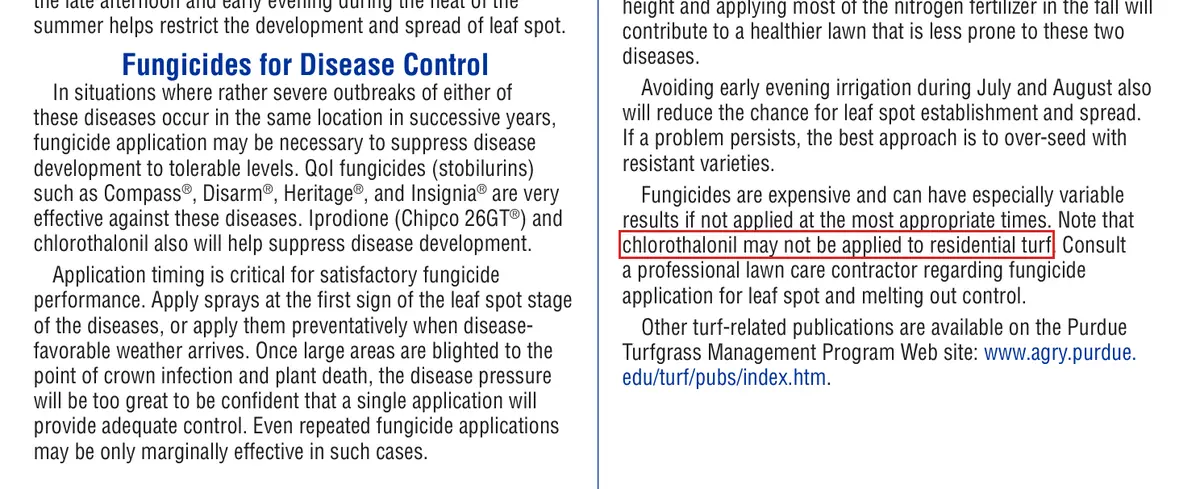
| Product label lists chlorothalonil | Do not use it on a home lawn | Daconil SDG label: “Do not use on home lawns” (EPA 100-1694; Purdue BP-103) |
| Granules that also contain lambda-cyhalothrin | Read the bag for the residential-lawn restriction before you spread | June 2026 label for 9688-316 bars direct application to residential lawns (EPA label) |
What several guides say vs what the extension source says
Several top-ranking lawn fungus pages give advice that the extension pathologists who study these diseases contradict. The most common error is treating “lawn fungus” as one problem with one fix. The table sets each claim beside the primary source, so you can see where a broad-spectrum spray or a blanket no-fertilizer rule would backfire (Purdue BP-106).
| Claim on consumer guides | What the primary source says | Source |
|---|---|---|
| A broad-spectrum lawn fungicide treats most fungus | QoI products are extremely effective on brown patch but not on dollar spot; Pythium products control no other disease | Purdue BP-106; BP-109 |
| Fertilizer feeds fungus, so stop fertilizing | Dollar spot, red thread and rust are worse on nitrogen-deficient turf | Purdue BP-105; BP-104 |
| Apply fungicide as soon as you see the disease | Summer patch, large patch and take-all sprays work only before symptoms | Purdue BP-115; UF/IFAS LH079 |
| Daconil (chlorothalonil) is a good lawn fungicide | The Daconil SDG label says do not use on home lawns, daycare or playground turf | EPA 100-1694; Purdue BP-103 |
| Lawn fungus will not go away on its own | Brown patch, red thread and gray snow mold damage usually recovers once the weather changes | Purdue BP-106; BP-101 |
This page is general information, not pesticide advice. The label is the law: use only products registered for your state, labeled for residential turf and the disease you have, at the label rate. Some states require a license to apply fungicides for hire; see our guide to the pesticide applicator license for lawn care.
How we compiled this
We read 37 primary documents in October 2026: 16 Purdue Turfgrass Disease Profiles (BP-101 to BP-125) plus Purdue E-271, the University of Arkansas 2026 Plant Disease Control Products Guide and FSA7527, UF/IFAS PP154, LH025 and LH079, UGA C1091, NC State brown patch and gray leaf spot pages, University of Maryland FS-2024-0707, the Ohio State fungicide family chart, WSU and Colorado State dog-injury fact sheets, and 8 EPA-accepted product labels, with registration status checked in EPA’s Pesticide Product and Label System on Oct. 30, 2026. No lawn, product or sample was tested; thresholds are as published, and regional figures are labeled by state.
| Question | Short answer | Best evidence |
|---|---|---|
| Main threat by grass? | Brown patch on tall fescue in summer; large patch on zoysia in fall and spring | Purdue BP-106; Arkansas FSA7527 |
| Fastest killer? | Pythium blight: large areas in days | Purdue BP-109 |
| Water when? | Before sunrise; never evening | NC State; UGA C1091 |
| Feed or starve? | Feed for dollar spot, red thread, rust; hold N for brown patch, Pythium, large patch | Purdue; UGA; Arkansas |
| Homeowner fungicide groups? | FRAC 11, 3 and 1; rotate | UADA MP154 (2026) |
Frequently asked questions
Will lawn fungus go away on its own?
Some will. Purdue says brown patch does not kill crowns or roots, so turf recovers when weather favors grass, and red thread usually recovers with no lasting effect. Pythium blight, take-all root rot and spring dead spot kill plants, and those patches need reseeding or resodding. Fairy rings and large patch tend to return in the same spots each year (Purdue BP-106).
Is lawn fungus harmful to pets or people?
The turf pathogens in this guide infect grass, not people or pets; Purdue says slime molds will not harm humans, pets or livestock, and rust spores only leave orange dust. The exposure that matters is the product: the DiseaseEx label lets people and pets back on after application, while the BioAdvanced label says wait until granules are watered in and dry (Purdue BP-112; EPA 538-330; 92564-38).
Should I water a lawn that has fungus?
Yes, but only before sunrise and less often. Brown patch needs 10 to 12 hours of continuous leaf wetness and Pythium more than 14, so evening watering extends the infection window. Drought makes dollar spot and summer patch worse, so do not stop watering altogether; water deeply when blades fold or footprints stay visible (NC State; UF/IFAS LH025).
Can I mow grass that has fungus?
Yes, when it is dry. Mow diseased areas last, bag clippings from large patch and Pythium spots, and keep the mower high: Purdue links cutting below 2 inches to more leaf spot and melting out. Arkansas advises against mowing wet zoysia and bermudagrass while large patch is active, because clippings carry the fungus (Arkansas FSA7527; Purdue BP-103).
Does baking soda or neem oil kill lawn fungus?
Arkansas’s 2026 guide lists potassium bicarbonate (GreenCure, 1 to 2 tbsp per gallon) for dollar spot, rust and leaf spots, but no neem product for lawns. Kitchen baking soda is sodium bicarbonate, not a registered lawn fungicide, and Colorado State warns, for urine spots, that baking soda is a salt that may compound the problem. Copper octanoate is the other low-risk listed option (UADA MP154).
Is granular or liquid fungicide better for lawns?
Granules are easier to spread evenly over a whole lawn; liquids put more product on leaves. For leaf diseases such as dollar spot, liquid coverage matters. For root diseases such as take-all root rot, summer patch and spring dead spot, either form must be watered in: UF/IFAS says lightly into the root zone right after application, and Purdue suggests 0.25 inch of irrigation (UF/IFAS LH079; Purdue BP-120).
When should I apply fungicide to my lawn?
Before the pathogen becomes active, which is a soil or night temperature, not a calendar date. Large patch: when 0 to 4 inch soil drops below 70°F in fall. Summer patch: when 3 inch soil averages 65°F for several days. Spring dead spot: as 2 inch soil nears 70°F in fall. Snow molds: after dormancy, before lasting snow (FSA7527; Purdue BP-115).
How long does a lawn take to recover from fungus?
Foliar diseases recover in weeks once weather turns: brown patch with cooler nights, large patch as zoysia outgrows it in late spring. Red thread may take 2 to 3 years of adequate nitrogen to stop recurring, Purdue says. Root diseases recover slowly or not at all; UF/IFAS warns take-all damage is very difficult to reverse once leaves show it (Purdue BP-104; UF/IFAS LH079).
Sources
- Purdue Extension (Richard Latin), BP-125-W, Seasonal Activity of Turfgrass Pathogens in the Midwest, March 2013. Accessed October 2026.
- Purdue Extension (Richard Latin), BP-124-W, Identifying Turf Diseases, 2013. Accessed October 2026.
- Purdue Extension (Richard Latin), BP-106-W, Brown Patch, April 2008. Accessed October 2026.
- Purdue Extension (Richard Latin), BP-105-W, Dollar Spot, undated PDF. Accessed October 2026.
- Purdue Extension (Richard Latin), BP-109-W, Pythium Blight, undated PDF. Accessed October 2026.
- Purdue Extension (Richard Latin), BP-115-W, Summer Patch, undated PDF. Accessed October 2026.
- Purdue Extension (Richard Latin), BP-116-W, Necrotic Ring Spot, undated PDF. Accessed October 2026.
- Purdue Extension (Philip Harmon, Richard Latin), BP-104-W, Red Thread, December 2009. Accessed October 2026.
- Purdue Extension (Richard Latin), BP-110-W, Rust Diseases, undated PDF. Accessed October 2026.
- Purdue Extension (Richard Latin), BP-101-W, Gray Snow Mold, undated PDF. Accessed October 2026.
- Purdue Extension (Richard Latin), BP-102-W, Pink Snow Mold and Microdochium Patch, undated PDF. Accessed October 2026.
- Purdue Extension (Richard Latin), BP-103-W, Leaf Spot/Melting Out, April 2008. Accessed October 2026.
- Purdue Extension (Richard Latin, Justin Stewart), BP-107-W, Gray Leaf Spot, undated PDF. Accessed October 2026.
- Purdue Extension (Richard Latin), BP-112-W, Slime Molds, February 2012. Accessed October 2026.
- Purdue Extension (Richard Latin), BP-113-W, Fairy Ring, undated PDF. Accessed October 2026.
- Purdue Extension (Richard Latin), BP-120-W, Spring Dead Spot, undated PDF. Accessed October 2026.
- Purdue Extension, E-271-W, Managing White Grubs in Turfgrass, June 2023. Accessed October 2026.
- University of Arkansas System Division of Agriculture, MP154, 2026 Arkansas Plant Disease Control Products Guide: Home Lawn Diseases, 2026 edition. Accessed October 2026.
- University of Arkansas System Division of Agriculture (Kreinberg, Hutchens), FSA7527, Large Patch of Zoysiagrass and Bermudagrass, May 2024. Accessed October 2026.
- UF/IFAS Extension (Harmon, Palmateer), PP154, Homeowner’s Guide to Fungicides for Lawn and Landscape Disease Management, current version. Accessed October 2026.
- UF/IFAS Extension (Elliott, Harmon), LH079, Take-all Root Rot, revised May 2026. Accessed October 2026.
- UF/IFAS Extension, LH025, Watering Your Florida Lawn, reviewed October 2025. Accessed October 2026.
- UGA Cooperative Extension, Circular 1091, Dollar Spot of Turfgrasses in Georgia, reviewed February 2026. Accessed October 2026.
- NC State Extension (Lee Butler, Jim Kerns), Brown Patch in Turf (TurfFiles), updated December 2019. Accessed October 2026.
- NC State Extension, Gray Leaf Spot in Turf, current page. Accessed October 2026.
- University of Maryland Extension, FS-2024-0707, Turfgrass Diseases: Pythium Blight, 2024. Accessed October 2026.
- The Ohio State University (Rimelspach, Hicks), Families of Fungicides for Turfgrass, July 2019. Accessed October 2026.
- Washington State University HortSense, Lawn and Turf: Dog Injury, reviewed June 2026. Accessed October 2026.
- Colorado State University Extension, Dog Urine Damage on Lawns: Causes, Cures and Prevention, current page. Accessed October 2026.
- The Scotts Company, Product label: Lawn Fungus Granular (DiseaseEx Lawn Fungicide), azoxystrobin 0.31%, EPA Reg. No. 538-330, label accepted Aug. 6, 2019. Accessed October 2026.
- SBM Life Science Corp., Product label: Propiconazole 0.51 Granular Fungicide (BioAdvanced Fungus Control for Lawns Granules II), EPA Reg. No. 92564-38, label accepted Dec. 1, 2017. Accessed October 2026.
- Chemsico, Product label: Chemsico Pesticide Granules PL II (Spectracide Immunox Fungus Plus Insect Control for Lawns Granules), propiconazole 0.3% + lambda-cyhalothrin 0.02%, EPA Reg. No. 9688-316, label accepted June 10, 2026. Accessed October 2026.
- Control Solutions, Inc., Product label: PPZ 1.55 Fungicide (Ferti-lome Liquid Systemic Fungicide II), propiconazole 1.55%, EPA Reg. No. 53883-184-7401, label accepted April 17, 2026. Accessed October 2026.
- Voluntary Purchasing Groups, Product label: VPG Myclobutanil Concentrate (Ferti-lome F-Stop Lawn and Garden Fungicide), myclobutanil 1%, EPA Reg. No. 7401-505, label accepted March 7, 2014. Accessed October 2026.
- Control Solutions, Inc., Product label: T-Methyl G-Pro Granular (Infuse Systemic Disease Control Lawn and Landscape), thiophanate-methyl 2.08%, EPA Reg. No. 53883-183-4, label accepted July 20, 2017. Accessed October 2026.
- W. Neudorff GmbH KG, Product label: NEU1140F Copper Soap (Natural Guard Copper Soap Liquid Fungicide), copper octanoate 10%, EPA Reg. No. 67702-2-7401, label accepted July 8, 2021. Accessed October 2026.
- Syngenta Crop Protection, Product label: Daconil SDG (alternate brand Daconil Ultrex Turf Care), chlorothalonil 82.5%, EPA Reg. No. 100-1694, label accepted Oct. 10, 2012. Accessed October 2026.