Mushrooms in lawn grass are the fruit of soil fungi feeding on buried wood, dead roots or thatch after rain. They rarely harm turf and fungicides will not stop them, but a few, led by the green-spored parasol, are poisonous.
Key takeaways
- University of Maryland Extension says there is no practical or permanent way to eliminate lawn mushrooms and that a fungicide will not get rid of them; they fade in dry weather and stop once their buried food has rotted (UMD Extension, 2025).
- The food is usually hidden: buried construction lumber, dead tree roots, or thatch thicker than 1/2 inch (UC IPM Pest Notes 74100; Purdue Plant and Pest Diagnostic Lab).
- The green-spored parasol (Chlorophyllum molybdites) is the most common mushroom cause of human poisonings in North America; it sickened 176 people in the North American Mycological Association (NAMA) case registry through 2005, none fatally (NAMA; Beug, Shaw and Cochran 2006).
- Amatoxin mushrooms (destroying angel, death cap, deadly galerina, Conocybe filaris) caused 16 of that registry’s 17 deaths, and their first symptoms wait 6 to 24 hours, so call Poison Help at 1-800-222-1222 as soon as anyone eats a lawn mushroom (CDC MMWR 2017; PoisonHelp.org).
- U.S. poison centers logged 133,700 mushroom exposures from 1999 to 2016, 62 percent of them in children under 6 (Brandenburg and Ward, Mycologia 2018).
7,428 a year mushroom exposures reported to U.S. poison centers, 1999 to 2016 (Mycologia 2018)
62% of those exposures were children under 6 (Mycologia 2018)
6 to 24 hours before the first amatoxin symptoms (CDC MMWR 2017)
1-800-222-1222 Poison Help, free, 24 hours a day (America’s Poison Centers)
Why do mushrooms grow in my lawn?
Mushrooms grow in a lawn when a soil fungus that has been digesting buried organic matter gets several days of wet weather. UC IPM names buried construction lumber, dead tree roots and thatch as the usual food, and overirrigation or poor drainage as the trigger. The fungus lives in the soil for years; the mushroom is its short-lived, spore-bearing fruit (UC IPM Pest Notes 74100).
The working part of the fungus is the mycelium, a mat of threads that spreads through the food source (UMD Extension). Fruit bodies are brief: the Missouri Department of Conservation (MDC) gives a shaggy mane about 24 hours from emerging to dissolving into ink (MDC), and Clemson says lawn mushrooms vanish once the weather turns dry or colder (Clemson HGIC 2355).
| Cause | What you see | Fix | Source |
|---|---|---|---|
| Buried wood: stump, old roots, construction lumber | Clusters in the same spot after each wet spell, sometimes in a line over a root | Dig out the wood, or wait: the fungi subside once the food is fully broken down | UMD; UC IPM |
| Tree root partners (mycorrhizal fungi) | Mushrooms under oaks, pines and other conifers | Leave them: many landscape trees grow poorly without these fungi | UC IPM |
| Mushrooms growing from a live trunk or surface roots | Honey-colored clusters at the tree base in fall, or shelf conks | Have an arborist check for Armillaria or Ganoderma wood decay | UMD; UC IPM |
| Thatch over 1/2 inch | Scattered mushrooms across a spongy lawn | Dethatch, then aerate | Purdue PPDL |
| Overirrigation or poor drainage | Mushrooms after every watering cycle; soggy low spots | Water less often and deeper; core aerate | UC IPM |
| New sod | Small cone-capped Panaeolus foenisecii and Conocybe in the first weeks | None: they stop once the sod knits and watering drops | UC IPM |
| Fairy ring fungi | Arcs or circles of mushrooms, often with a dark green band | Match the fix to the ring type (next section) | UMD; Purdue BP-113 |
Season narrows the suspects. In Missouri, MDC lists the fairy ring mushroom from May to September, the green-spored parasol from July to September and the destroying angel from June to November (MDC; MDC; MDC); in Florida the green-spored parasol runs April to November (UF/IFAS PP324).
UC IPM calls lawn fungi “mostly beneficial” decomposers and notes that the fungi behind lawn diseases do not typically produce mushrooms (UC IPM). Brown patch, dollar spot and 14 other turf diseases are covered in our lawn fungus identification guide.
Do mushrooms hurt your grass?
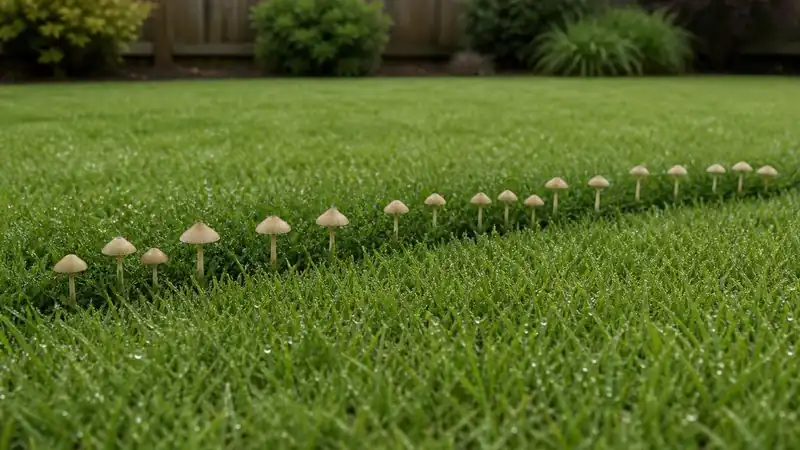
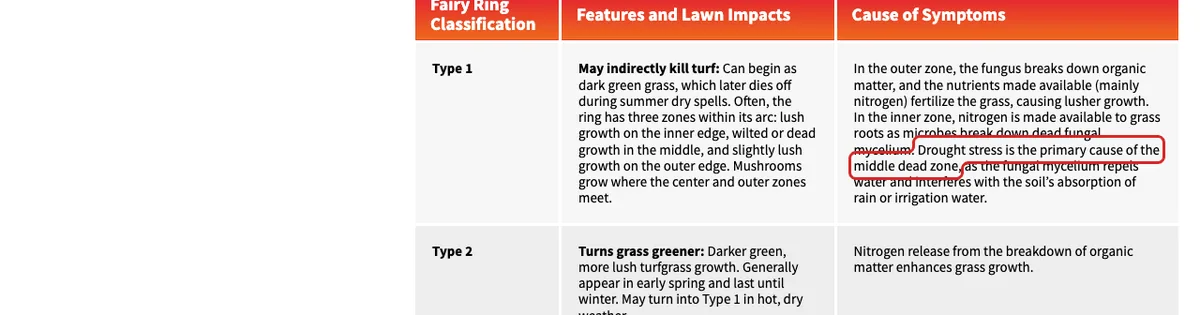
Most do not: UC IPM calls lawn mushrooms usually harmless to grasses. The exception is a Type 1 fairy ring, where fungal mycelium makes the soil repel water and kills a band of turf during summer dry spells (UMD). Rings usually measure 1 to 20 feet across, 200 feet in rare cases, and expand about 3 to 19 inches a year (UMD Extension).
About 50 fungus species form fairy rings in turf, most often Marasmius oreades, Agaricus campestris, Lycoperdon puffballs and Scleroderma earthballs (Missouri Botanical Garden). The green band is fertilizer: the fungus releases ammonium that soil microbes turn into nitrate (Purdue BP-113). Two rings that meet stop rather than cross (UMD).
| Fairy ring type | What you see | Why it happens | What to do | Source |
|---|---|---|---|---|
| Type 1: may kill turf | Three zones: lush inner edge, wilted or dead middle band, lush outer edge; mushrooms where the dead and outer zones meet | Mycelium repels water, so the middle band suffers drought stress | Core aerate the ring plus 2 ft on each side, apply a wetting agent, water the ring daily until the soil rewets | UMD; UF/IFAS LH046 |
| Type 2: greener grass | Band of darker green, faster-growing turf, spring to winter | Nitrogen released as the fungus decays organic matter | Mask it: spoon-feed 0.1 to 0.25 lb nitrogen per 1,000 sq ft around the ring | UMD; Purdue BP-113 |
| Type 3: mushrooms only | No grass symptom; mushrooms appear after rain, often in lawns mowed infrequently | Fungus fruits without changing the turf | Mow or pick the mushrooms; nothing else | UMD; UF/IFAS LH046 |
Fairy rings are slow to leave: UF/IFAS says they fade naturally but may take up to five years (UF/IFAS LH046). Purdue tells homeowners to aim for “peaceful coexistence”, masking rings with small nitrogen doses rather than excavation or fungicide (Purdue BP-113). Our lawn fertilizer guide shows how to turn a 0.25 lb nitrogen dose into pounds of product.
Which lawn mushrooms are poisonous?
The lawn mushrooms that send the most people to poison centers are the green-spored parasol, which causes violent vomiting but rarely kills, and the white amanitas and small brown Galerina and Conocybe species that carry amatoxins, the liver toxins behind 16 of 17 deaths in NAMA’s registry. Inocybe, Clitocybe and Scleroderma kill dogs more often than people (NAMA). None can be cleared by eye or from a photo.
A University of Georgia plant pathologist says specialists cannot positively identify a mushroom from a picture, and the one growing beside it may be a different species (UGA Extension). The 12 species below are those U.S. extension, conservation and veterinary sources place in lawns; field marks narrow the list but never prove a mushroom safe.
| Mushroom | Where it shows up | Field marks | Toxin and severity | Source |
|---|---|---|---|---|
| Green-spored parasol, Chlorophyllum molybdites | Lawns and pastures, often in fairy rings; most common in the Southeast | Cap 1.8 to 11.8 in, white with tan scales; free gills that turn green; thick ring; green spore print | Gastrointestinal irritant: vomiting and diarrhea 1 to 2 hours after eating; rarely fatal | UF/IFAS PP324; MDC |
| Eastern destroying angel, Amanita bisporigera | Grass near trees, June to November; eastern and midwestern U.S. | All white; cap 2 to 5 in; white gills and spore print; skirt ring; saclike cup at the base, often hidden underground | Amatoxin: deadly; symptoms start 6 to 24 hours after eating | MDC; Merck Vet Manual |
| Death cap, Amanita phalloides | West Coast from California to British Columbia; East Coast from Maryland to Maine | Smooth yellowish-green to yellowish-brown cap; white gills, ring, spores and basal cup | Amatoxin: one cap can hold a lethal dose for a person or a dog | Merck Vet Manual |
| Deadly galerina, Galerina marginata | On logs and buried wood, where it can look like it grows from soil; mostly September to November | Sticky brown cap 1 to 2.5 in; ring on the stalk; rusty spore print | Amatoxin: symptoms 10 or more hours after eating | MDC |
| Conocybe filaris (Pholiotina) | Grassy areas and woody debris, late fall to midwinter | Small brownish, tacky cap; yellowish gills turning rust; ring on the stalk; rust-brown spores | Amatoxin | Merck Vet Manual; NAMA |
| Sweating mushroom, Clitocybe dealbata | Lawns and fairy rings, among fairy ring mushrooms | Small white to gray-pink cap, often with a sunken center; gills run down the stalk; white spores | Muscarine: sweating, salivation and tears 15 to 30 minutes after eating | MDC; Merck Vet Manual |
| Fiber caps, Inocybe species | Lawns near conifers and oaks | Small brown conical cap with a knob; no ring; gray-brown to rust spore print | Muscarine: lethal to dogs | Merck Vet Manual; NAMA |
| Fly agaric and panther, Amanita muscaria and A. pantherina | Under conifers and hardwoods; most abundant in the Pacific Northwest | Red to orange cap with white or yellow warts (fly agaric); brown cap with white patches (panther); ring; bulb at base | Ibotenic acid and muscimol: confusion and deep sleep 30 to 120 minutes after eating; can kill dogs and cats | Merck Vet Manual; NAMA |
| Earthballs, Scleroderma species | Lawns, often in fairy rings | Hard-rind ball with a black spore mass inside when cut | Gastrointestinal; lethal to dogs and pigs, not recorded in people | UC IPM 74100 (2012); NAMA |
| Jack-o’-lantern, Omphalotus illudens | Tight clusters at tree bases, on stumps or buried wood, July to October | Bright orange caps 2 to 8 in; sharp gills running down the stalk | Gastrointestinal: mild to severe; not life-threatening to healthy adults | MDC; UMD |
| Leucoagaricus naucinus | Lawns in fall | Creamy white smooth cap; free gills; ring; no cup; white spore print | Mild to severe gastric upset | Ovrebo 2004 |
| Amanita thiersii | Lawns, often in fairy rings, summer and fall, alongside the green-spored parasol | White cap and stalk with a cottony coating that rain can wash off; white spore print | Toxicity little studied; its genus holds the deadliest species, so treat as poisonous | Ovrebo 2004 |
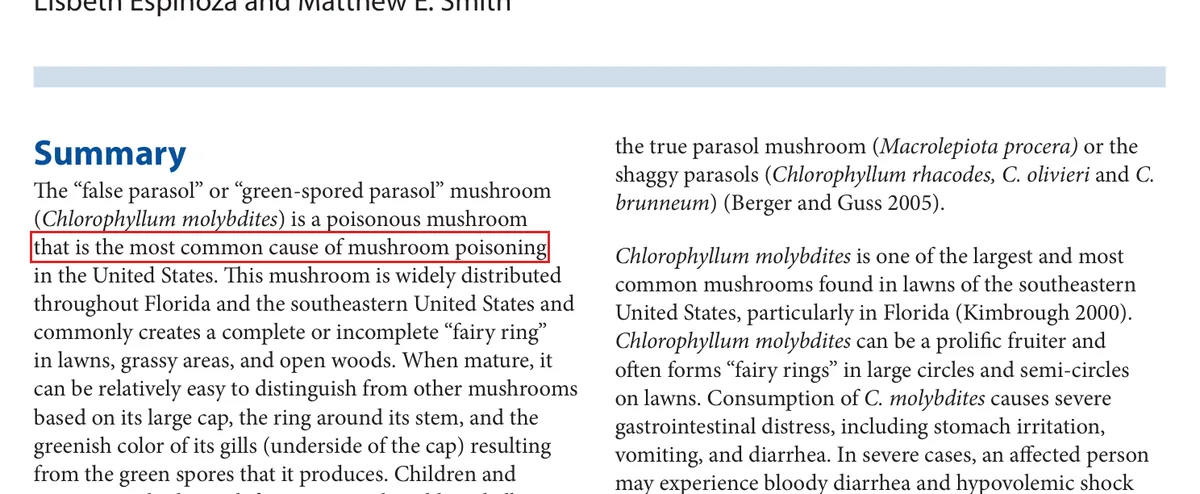
Size is no guide: the deadly list holds a 5-inch white amanita and two small brown species that MDC files with the “little brown mushrooms” it says never to eat (MDC). MDC’s 2018 guide adds that rain or handling can strip the ring and cup that mark an amanita, so beginners should avoid every parasol-shaped mushroom with white gills and a white spore print (MDC guide, 2018).
How do you tell the green-spored parasol from other white lawn mushrooms?
Take a spore print. The green-spored parasol is one of very few mushrooms with a green spore print, and UF/IFAS says that print, plus greenish gills, a cap up to 11.8 inches and a ring on the stalk, separates it from the parasols it resembles (UF/IFAS PP324). A print takes a few hours; it identifies a group, not a safe meal.
- Cut the stalk off a mature mushroom whose cap has opened flat (Ovrebo 2004).
- Set the cap gills-down on paper that is half white and half black, so both light and dark spores show (UGA Extension).
- Cover it with a bowl or dish and leave it for several hours or overnight (UF/IFAS PP324).
- Read the color: green means the green-spored parasol; blackish brown fits the meadow mushroom; rusty brown fits Galerina or Conocybe; white keeps the deadly amanitas on the list (UF/IFAS; MDC).
- Throw the cap and print in the trash and wash your hands.
Which edible-listed lawn mushrooms have poisonous twins?
Five mushrooms that field guides list as edible share lawns with a poisonous double, which is why MDC tells collectors to spore-print every specimen or show it to an expert (MDC meadow mushroom). The pairs below show why lawn mushrooms cannot be cleared by eye; this page gives no eating advice, and MDC warns lawn mushrooms may carry lawn chemicals.
| Listed as edible | Poisonous twin in the same lawn | Feature that separates them | Source |
|---|---|---|---|
| Meadow mushroom, Agaricus campestris | Destroying angel | Pink gills turning chocolate, blackish-brown spore print, no cup vs white gills, white print, saclike cup | MDC |
| Fairy ring mushroom, Marasmius oreades | Sweating mushroom; Inocybe | Widely spaced off-white gills, white print vs gills running down the stalk (Clitocybe) or gray-brown gills (Inocybe) | MDC |
| Shaggy mane, Coprinus comatus | Green-spored parasol | Tall cylindrical cap that turns to black ink, black print vs flatter cap, green print | MDC |
| Parasol and shaggy parasols, Macrolepiota procera, Chlorophyllum rhacodes | Green-spored parasol | White print vs green print | UF/IFAS PP324 |
| Giant puffball, Calvatia gigantea | Amanita button; earthball | Pure white, marshmallow-like inside with no cap or stem outline when sliced top to bottom vs the outline of a cap and gills (amanita) or a black interior (earthball) | MDC; UC IPM |
How fast do mushroom poisoning symptoms start?
Timing is the best early clue. The Merck Manual says mushrooms that cause symptoms within 2 hours are generally less dangerous than those that start after about 5 hours (Merck Manual Professional, April 2025). Muscarine acts in 15 to 30 minutes and the green-spored parasol in 1 to 2 hours, while amatoxins wait 6 to 24 hours and then attack the liver after a false recovery.
| Toxin group | Lawn examples | First symptoms | What follows | Source |
|---|---|---|---|---|
| Muscarine | Sweating mushroom, Inocybe | 15 to 30 minutes | Sweating, salivation, tears, slow pulse; usually mild and over within 12 hours in people | NAMA; Merck Manual |
| Ibotenic acid and muscimol | Fly agaric, panther | 30 minutes to 2 hours | Confusion and deep sleep; about 24 hours of signs in animals | NAMA; Merck Vet Manual |
| Gastrointestinal irritants | Green-spored parasol, jack-o’-lantern, earthballs | 20 minutes to 4 hours; green-spored parasol 1 to 2 hours | Vomiting and diarrhea for 4 hours to 7 days; most people recover within 24 hours; shock in severe cases | NAMA; UF/IFAS PP324 |
| Amatoxins | Destroying angels, death cap, deadly galerina, Conocybe filaris | 6 to 24 hours | Apparent recovery at 24 to 36 hours, then liver and multiorgan failure at 3 to 5 days | CDC MMWR 2017 |
A fast start does not clear a case: Merck’s veterinary chapter warns that a lethal and a mild species growing in the same spot may be eaten together, so early vomiting can hide a later amatoxin phase (Merck Veterinary Manual). Poison-center data show 86 percent of exposures cause no or only minor harm, and in both that data and NAMA’s registry amatoxins cause nearly every death (Mycologia 2018; Beug et al. 2006).
Swipe the table sideways to see every column.
| Measure | Figure | Period | Source |
|---|---|---|---|
| Mushroom exposures reported to U.S. poison centers | 133,700 (7,428 a year) | 1999 to 2016 | Brandenburg and Ward, Mycologia 2018 |
| Share in children under 6 | 62% | 1999 to 2016 | Mycologia 2018 |
| Exposures with no or only minor harm | 86% | 1999 to 2016 | Mycologia 2018 |
| Exposures with major harm | 704 (39 a year) | 1999 to 2016 | Mycologia 2018 |
| Deaths | 52 (2.9 a year); 68% to 89% from cyclopeptide (amatoxin) mushrooms | 1999 to 2016 | Mycologia 2018 |
| Unintentional exposures, children 5 and under | 50,323; 89.4% with no symptoms; 17 major outcomes; 2 liver transplants | 2009 to 2023 | Zmuda et al., Clinical Toxicology 2025 |
| Child cases where the mushroom type was unknown | 92.1% | 2009 to 2023 | Clinical Toxicology 2025 |
| Naturally occurring mushroom exposures, single substance | 7,090; 2,871 in children 5 and under; 74 major outcomes; 2 deaths (1,389 involved psilocybin mushrooms) | 2024 | NPDS 2024 Annual Report, Table 22A |
| NAMA registry: people sickened, all mushrooms | 1,641; 17 deaths | Early 1970s to Dec. 2005 | Beug, Shaw and Cochran 2006 |
| NAMA registry: isoxazole group (fly agaric, panther) | 218 sickened; 0 deaths | to Dec. 2005 | Beug et al. 2006 |
| NAMA registry: green-spored parasol | 176 sickened; 0 deaths | to Dec. 2005 | Beug et al. 2006 |
| NAMA registry: amatoxin group | 147 sickened; 16 deaths | to Dec. 2005 | Beug et al. 2006 |
| NAMA registry: psilocybin group | 108 sickened | to Dec. 2005 | Beug et al. 2006 |
| NAMA registry: jack-o’-lantern (Omphalotus) | 98 sickened | to Dec. 2005 | Beug et al. 2006 |
| Amatoxin death rate with prompt treatment | About 10% in the U.S. and Canada (about 50% without it) | Current | NAMA |
What should you do if a child or dog eats a lawn mushroom?
Call before symptoms appear. For a person, call Poison Help at 1-800-222-1222, which reaches one of the 53 accredited U.S. poison centers at no cost, 24 hours a day (America’s Poison Centers). For a pet, call your veterinarian or an animal poison line. Then save the rest of the mushroom, base included, because the specialist’s first question is what it was.
- Take any remaining pieces out of the mouth and note the time; hours to first symptom drive the prognosis (Merck Veterinary Manual).
- Call 1-800-222-1222 for a person. Call 911 instead if the person has collapsed, had a seizure, has trouble breathing or cannot be woken (PoisonHelp.org). For a pet, call your veterinarian, the ASPCA line or Pet Poison Helpline.
- Do not wait for symptoms. Amatoxin poisoning looks like nothing for 6 to 24 hours, and the false recovery that follows the first vomiting is not a cure (CDC MMWR 2017). In a 2024 poison-center case, a 69-year-old woman who ate mushrooms foraged from her yard fell ill about 10 hours later and died on day 4 of care (NPDS 2024, Case 298).
- Make the person or pet vomit only if the poison specialist or veterinarian tells you to.
- Dig up the same kind of mushroom whole, base included, because an amanita’s cup is often buried; keep any vomit; photograph cap, gills and base (MDC guide; UF/IFAS PP324).
- Take the specimens to the emergency room or veterinary clinic if you are sent there, so a mycologist can examine them (Merck Manual).
| Line | Number | Who answers | Cost | Source |
|---|---|---|---|---|
| Poison Help (people) | 1-800-222-1222 | Your regional poison center, 24 hours a day, 365 days a year | Free | America’s Poison Centers |
| ASPCA Animal Poison Control Center | (888) 426-4435 | Veterinary toxicology staff, 24 hours a day, 365 days a year | A consultation fee may apply (amount not posted) | ASPCA |
| Pet Poison Helpline | (855) 764-7661 | Veterinary toxicology staff, 24 hours a day | $99 per incident, follow-up calls included | Pet Poison Helpline |
| Emergency | 911 | Collapse, seizure, breathing trouble, cannot be woken | Free | PoisonHelp.org |
Dogs face a different list than people. In NAMA’s registry, 8 of 11 dogs that ate amatoxin mushrooms died or were euthanized, and dogs also died from Inocybe and Scleroderma, which have no recorded human deaths (Beug et al. 2006). At one Northern California hospital, only 13 of 59 dogs treated for amanitin poisoning from 2006 to 2019 survived, and 36 were under a year old (Kaae et al., JAVMA 2021).
This page is general information, not medical or veterinary advice. If a person or animal may have eaten a wild mushroom, call Poison Help at 1-800-222-1222 or your veterinarian now, even if there are no symptoms.
How do you get rid of mushrooms in your lawn?
You can remove the mushrooms in minutes but the fungus only over months or years. Pick or mow them and bag them before children or pets use the lawn, then take away what feeds the fungus: excess water, thatch over 1/2 inch and buried wood. UMD Extension says a fungicide “will not get rid of them” (UMD Extension).
Several consumer guides repeat fixes that UMD, UC IPM and Colorado State contradict; each claim sits beside the primary source below (UMD; UC IPM).
| Claim on consumer pages | What the primary source says | Source |
|---|---|---|
| Spray a lawn fungicide to kill the mushrooms | Using a fungicide will not get rid of mushrooms; Colorado State does not recommend fungicides for mushrooms or fairy ring in lawns | UMD; CSU 1546 |
| A vinegar or baking soda drench kills the fungus | Removing or damaging the mushroom does not kill the underground mycelium, which can form a mat 3 or more inches thick | UC IPM; UC IPM 2012 |
| Dish soap gets rid of fairy rings | Colorado State says a few ounces of dish soap per gallon, with spring and fall aeration, will sometimes make a ring less noticeable; it does not claim a cure | CSU 1506 |
| Pull them before they spread spores and they will stop | Spores blow in from neighboring areas, so picking only protects children, pets and appearance | UC IPM |
| Mushrooms mean the lawn has a disease | Fungi that cause lawn diseases do not typically produce mushrooms | UC IPM |
| Small brown lawn mushrooms are harmless | Galerina and Conocybe filaris carry amatoxins; Inocybe kills dogs | MDC; NAMA; NAMA dogs |
- Pick or rake up mushrooms and bag them for the trash every morning after rain if children or dogs use the lawn (UC IPM; Purdue PPDL). Elsewhere, mowing them is usually adequate (UF/IFAS LH046).
- Water less often: about 1 inch a week for most growing lawns, early in the morning (UC IPM). See our guide to the best time to water your lawn.
- Cut a 3-inch plug; if the brown thatch layer tops 1/2 inch, dethatch (Purdue PPDL). Prices are in our dethatching cost guide.
- Core aerate compacted or soggy areas (UC IPM); timing is in our guide on when to aerate your lawn.
- Dig out buried wood under a recurring cluster, or wait for it to rot (UMD). Stump grinding usually stops 4 to 12 inches below grade, so deeper roots keep feeding mushrooms; see our stump grinding cost guide.
- Optional: speed decay with 1 lb of soluble nitrogen per 1,000 sq ft, such as 5 lb of ammonium sulfate (21-0-0), inside your normal fertilizer program (UC IPM 74100, 2012).
For a Type 1 fairy ring, probe the fungal mat with a long screwdriver: under 3 inches thick, core aerating a few times a year may break it up; thicker mats need a soil probe or auger, starting 2 feet outside the ring (UC IPM 74100, 2012). UMD’s last resort is digging out soil 12 inches deep and 2 feet beyond the visible edge (UMD). The worked example sizes each route for a 10-foot ring.
| Step | Arithmetic | Result |
|---|---|---|
| Ring | Dead band 1 ft wide at a 10 ft outer diameter: inner radius 4 ft, outer radius 5 ft | Symptom band about 28 sq ft |
| Aeration zone (UMD: 2 ft on each side) | Radii 2 ft to 7 ft: 3.1416 × (7² minus 2²) = 3.1416 × 45 | 141 sq ft |
| Excavation volume (UMD: 12 in deep, 2 ft beyond the edge) | Same 141 sq ft × 1 ft deep = 141 cu ft ÷ 27 | 5.2 cu yd of soil out, fresh soil in |
| Masking with nitrogen (Purdue: 0.25 lb N per 1,000 sq ft) | 141 ÷ 1,000 × 0.25 lb N; with a 21-0-0 product, 0.035 ÷ 0.21 | 0.035 lb N, about 0.17 lb (2.7 oz) of ammonium sulfate per feeding |
| Labeled fungicide (EPA Reg. No. 538-330 fairy ring rate: 4 lb per 1,000 sq ft) | 141 ÷ 1,000 × 4 lb | 0.56 lb per application, repeat after 28 days if needed |
| Same product, yearly cap (37 lb per 1,000 sq ft) | 141 ÷ 1,000 × 37 lb | 5.2 lb per year on that zone |
Fungicides suppress fairy ring fungi at best. Scotts’ azoxystrobin granular, EPA Reg. No. 538-330 (sold as DiseaseEx), lists fairy ring, not mushrooms, at 4 lb per 1,000 sq ft every 28 days, and says symptoms may take 2 to 3 weeks to fade (EPA-accepted label, 2019). UF/IFAS notes fungicides do not remove the green or dead rings or cure dry soil (UF/IFAS LH046).
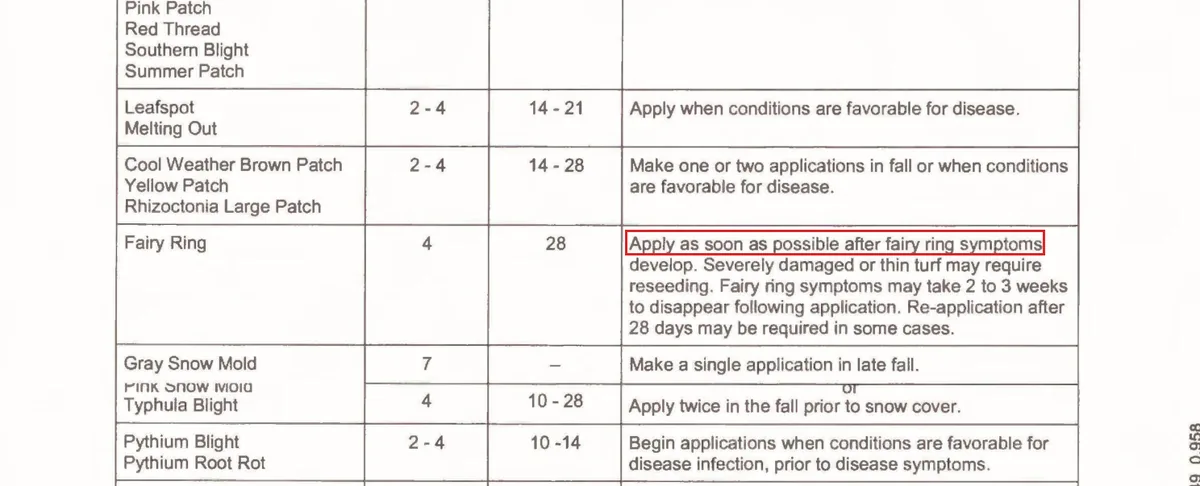
The label is the law: apply any fungicide only on a site the label allows, at the label rate, and check that it is registered in your state. Some states require a license to apply fungicides for hire; see our guide to the pesticide applicator license for lawn care.
Should you remove lawn mushrooms or leave them?
Leave them if nobody will eat them and the grass is fine; they help decompose organic matter and vanish in dry weather. Remove them daily if children under 6 or dogs use the lawn, since young children make up 62 percent of U.S. mushroom exposures (Mycologia 2018). Rings of dying grass, stumps and trunk mushrooms each need their own fix.
| If your situation is | Do this | Why (source) |
|---|---|---|
| Anyone may have eaten a lawn mushroom | Call 1-800-222-1222 (people) or your vet now; save the mushroom with its base | Amatoxin symptoms start 6 to 24 hours later (CDC MMWR) |
| Children under 6 or dogs use the lawn | Pick, bag and trash mushrooms every morning during wet spells | 62% of exposures are children under 6 (Mycologia 2018); dogs die from Inocybe and amanitas (NAMA) |
| Ring with a dead or straw-colored band and dry soil under it | Type 1 fairy ring: core aerate the ring plus 2 ft each side, wetting agent, water the ring daily | Mycelium repels water (UMD; UF/IFAS LH046) |
| Dark green ring, grass healthy | Mask with 0.1 to 0.25 lb N per 1,000 sq ft around the ring, or leave it | Nitrogen release is the cause (Purdue BP-113) |
| Clusters over a stump or root line | Dig out the wood or wait for it to rot | Fungi subside when the food is gone (UMD) |
| Mushrooms on a live tree’s trunk or surface roots | Have an arborist assess the tree | Armillaria and Ganoderma decay can kill trees (UMD) |
| New sod | Cut back watering once the sod knits; do nothing else | Establishment watering triggers them (UC IPM) |
| Thatch over 1/2 inch | Dethatch, then aerate | Thatch is the food source (Purdue PPDL) |
| No children or pets, grass healthy | Leave them or mow over them | They disappear when weather turns dry or cold (Clemson HGIC) |
1Did a person eat any part of a lawn mushroom?
YesCall Poison Help, 1-800-222-1222, now, even without symptoms. Save the mushroom with its base.
NoGo to the next question
2Did a dog or cat eat one?
YesCall your vet, the ASPCA line (888) 426-4435 or Pet Poison Helpline (855) 764-7661 now.
NoGo to the next question
3Is there a ring or arc of dead, straw-colored grass with dry soil under it?
YesType 1 fairy ring: core aerate the ring plus 2 ft each side, add a wetting agent, water the ring daily.
NoGo to the next question
4Are the mushrooms growing from a live tree's trunk or surface roots?
YesAsk an arborist to check for Armillaria or Ganoderma decay.
NoGo to the next question
5Do they cluster over a stump, an old root line or buried lumber?
YesDig out the wood or wait for it to rot; pick mushrooms meanwhile.
NoGo to the next question
6Is the lawn new sod, watered after every dry day, or carrying thatch over 1/2 inch?
YesCut back watering, dethatch over 1/2 inch, core aerate.
NoLeave them or mow them; pick and bag daily if children under 6 or dogs use the lawn. They fade in dry or cold weather.
Source: UMD Extension; UC IPM 74100; UF/IFAS LH046; Purdue PPDL; CDC MMWR 2017; America's Poison Centers
For anything fruiting from a living tree, UMD recommends a certified arborist or licensed tree expert; our explainer on what an arborist does covers the credentials. More turf problems are indexed in our Turf and Trees section.
How we compiled this
We read 40 primary documents in October 2026: 12 extension and botanical-garden publications, 10 Missouri Department of Conservation documents, a 2004 journal survey of lawn mushrooms, 4 Merck manual chapters, 3 NAMA documents including its registry summary, 4 poisoning studies and reports (abstracts where paywalled), CDC MMWR, the EPA Reg. No. 538-330 label and 4 poison-line pages. We did not collect, test or identify any mushroom, and this page gives no edibility advice.
| Question | Short answer | Best evidence |
|---|---|---|
| Do lawn mushrooms hurt grass? | No, except Type 1 fairy rings that dry the soil | UC IPM; UMD |
| Do fungicides stop them? | No; at best they suppress fairy ring fungi | UMD; UF/IFAS LH046 |
| Most common poisoner? | Green-spored parasol: 1 to 2 hour vomiting and diarrhea | NAMA; UF/IFAS PP324 |
| Deadliest? | Amatoxin species: destroying angel, death cap, Galerina, Conocybe filaris | CDC MMWR; Merck Vet Manual |
| Someone ate one? | Call 1-800-222-1222 or your vet before symptoms | America’s Poison Centers |
Frequently asked questions
Should I pull mushrooms out of my lawn?
Pull them if children or pets use the lawn, since children under 6 account for 62 percent of U.S. mushroom exposures; otherwise it is optional. UC IPM says removing mushrooms does not kill the fungus below, so more appear in the next wet spell. Bag them for the trash and pick again each morning after rain (UC IPM).
Is it safe to mow over mushrooms?
Mowing does the lawn no harm, and UF/IFAS says chopping fairy ring mushrooms with the mower is usually adequate. Where children or pets play, UF/IFAS says collecting the mushrooms and putting them in the garbage may be necessary instead (UF/IFAS LH046).
Do mushrooms in the lawn mean overwatering?
Often. UC IPM links lawn mushrooms to overirrigation, poor drainage and the frequent watering new sod needs. If mushrooms return after every irrigation cycle and not only after rain, cut watering frequency and check drainage; most growing lawns need about 1 inch of water a week (UC IPM).
Why do mushrooms come back in the same spot every year?
The fungus is still feeding there. Buried roots, a stump or lumber can feed it for years, and fairy rings return in place while expanding 3 to 19 inches a year. UMD says the fungi subside once the food is fully broken down; UF/IFAS says fairy rings can take up to five years to fade (UMD; UF/IFAS LH046).
Are white mushrooms in my yard poisonous?
Some of the deadliest are white. The eastern destroying angel is all white, with a 2 to 5 inch cap, white gills, a white spore print and a cup at the base that is often buried. MDC tells beginners to avoid every parasol-shaped mushroom with white gills and a white spore print (MDC).
What should I do if my dog ate a mushroom in the yard?
Call your veterinarian, the ASPCA line at (888) 426-4435 or Pet Poison Helpline at (855) 764-7661 right away, even if the dog seems fine. Amatoxin signs in dogs can wait 6 to 12 hours, and puppies can die within 24 hours. Bag a whole sample, base included, for identification (Merck Vet Manual).
Sources
- University of Maryland Extension (Miri Talabac; reviewed by David Clement), Mushrooms and Slime Molds in Lawns, 2025. Accessed October 2026.
- UC Statewide IPM Program, Pest Notes: Mushrooms in Lawns, Publication 74100 (web edition), current page. Accessed October 2026.
- UC Statewide IPM Program (Le Strange, Frate and others), Pest Notes: Mushrooms and Other Nuisance Fungi in Lawns, Publication 74100 (PDF), January 2012. Accessed October 2026.
- Purdue Plant and Pest Diagnostic Laboratory (Gail Ruhl), Mushrooms in Lawns, Picture of the Week, August 8, 2022. Accessed October 2026.
- Purdue Extension (Richard Latin), BP-113-W, Fairy Ring, January 2002. Accessed October 2026.
- Clemson Cooperative Extension HGIC, HGIC 2355, Mushrooms in Lawns, updated December 5, 2019. Accessed October 2026.
- Colorado State University Extension, PlantTalk Colorado, 1546, Mushrooms and Fairy Ring in the Home Lawn, current page. Accessed October 2026.
- Colorado State University Extension, PlantTalk Colorado, 1506, Mushrooms, Fairy Rings, current page. Accessed October 2026.
- Missouri Botanical Garden, Lawn Mushrooms (Fairy Rings), current page. Accessed October 2026.
- UF/IFAS Extension (Elliott and Harmon), SS-PLP-7 (LH046), Fairy Rings, revised August 2014. Accessed October 2026.
- UF/IFAS Extension (Espinoza and Smith), PP324, The Green-Spore Poison Parasol Mushroom, Chlorophyllum molybdites, reviewed April 2025. Accessed October 2026.
- UGA Cooperative Extension, Recent Rains Have Mushrooms Popping Up, current page. Accessed October 2026.
- Missouri Department of Conservation (Malissa Briggler), A Guide to Missouri’s Edible and Poisonous Mushrooms, 2018. Accessed October 2026.
- Missouri Department of Conservation, Field Guide: Destroying Angel, current page. Accessed October 2026.
- Missouri Department of Conservation, Field Guide: Green-Spored Lepiota, current page. Accessed October 2026.
- Missouri Department of Conservation, Field Guide: Fairy Ring Mushroom, current page. Accessed October 2026.
- Missouri Department of Conservation, Field Guide: Meadow Mushroom, current page. Accessed October 2026.
- Missouri Department of Conservation, Field Guide: Shaggy Mane, current page. Accessed October 2026.
- Missouri Department of Conservation, Field Guide: Giant Puffball, current page. Accessed October 2026.
- Missouri Department of Conservation, Field Guide: Deadly Galerina, current page. Accessed October 2026.
- Missouri Department of Conservation, Field Guide: Jack-o’-Lantern, current page. Accessed October 2026.
- Clark L. Ovrebo, Oklahoma Native Plant Record 4(1), Common Lawn and Garden Mushrooms of Central Oklahoma, December 2004. Accessed October 2026.
- Merck Veterinary Manual (Birgit Puschner), Toxin Latent Period Over 6 Hours After Ingestion of Mushrooms, April 2022. Accessed October 2026.
- Merck Veterinary Manual (Birgit Puschner), Toxin Latent Period of 3 Hours or Less After Ingestion of Mushrooms, April 2022. Accessed October 2026.
- Merck Veterinary Manual (Birgit Puschner), Overview of Mushrooms Toxic to Animals, April 2022. Accessed October 2026.
- Merck Manual Professional Edition (O’Malley and O’Malley), Mushroom Poisoning, April 2025. Accessed October 2026.
- North American Mycological Association, Mushroom Poisoning Syndromes, current page. Accessed October 2026.
- North American Mycological Association, Mushroom Poisonings in Dogs and Cats, current page. Accessed October 2026.
- Beug, Shaw and Cochran, McIlvainea 16(2), Thirty-Plus Years of Mushroom Poisoning: Summary of the Approximately 2,000 Reports in the NAMA Case Registry, Fall 2006. Accessed October 2026.
- Brandenburg and Ward, Mycologia 110(4), Mushroom Poisoning Epidemiology in the United States (abstract), 2018. Accessed October 2026.
- Zmuda, Farah, McDonald and Michienzi, Clinical Toxicology 63(8), Clinical Effects, Outcomes, and Disposition of Unintentional Pediatric Mushroom Exposures Reported to U.S. Poison Centers, 2009 Through 2023 (abstract), 2025. Accessed October 2026.
- Gummin, Mowry, Beuhler and others, Clinical Toxicology 63(12), 2024 Annual Report of the National Poison Data System (NPDS) from America’s Poison Centers, December 2025. Accessed October 2026.
- Kaae, Poppenga and Hill, JAVMA 258(5), Toxicosis from Alpha-Amanitin-Containing Mushrooms in Dogs: 59 Cases (2006 to 2019) (abstract), March 1, 2021. Accessed October 2026.
- CDC, MMWR 66(21) (Vo and others), Amanita phalloides Mushroom Poisonings, Northern California, December 2016, June 2, 2017. Accessed October 2026.
- America’s Poison Centers, Poison Help line, 1-800-222-1222, current page. Accessed October 2026.
- America’s Poison Centers, PoisonHelp.org, current page. Accessed October 2026.
- ASPCA, Animal Poison Control Center, current page. Accessed October 2026.
- Pet Poison Helpline, About Pet Poison Helpline, current page. Accessed October 2026.
- The Scotts Company, Product label: Lawn Fungus Granular (azoxystrobin 0.31%), EPA Reg. No. 538-330, label accepted August 6, 2019. Accessed October 2026.