Lawn fertilizer is bought for its nitrogen: the bag’s first number is percent N, most lawns need 0.5 to 1 lb per 1,000 sq ft per feeding, and phosphorus belongs only with a soil test or new seeding.
Key takeaways
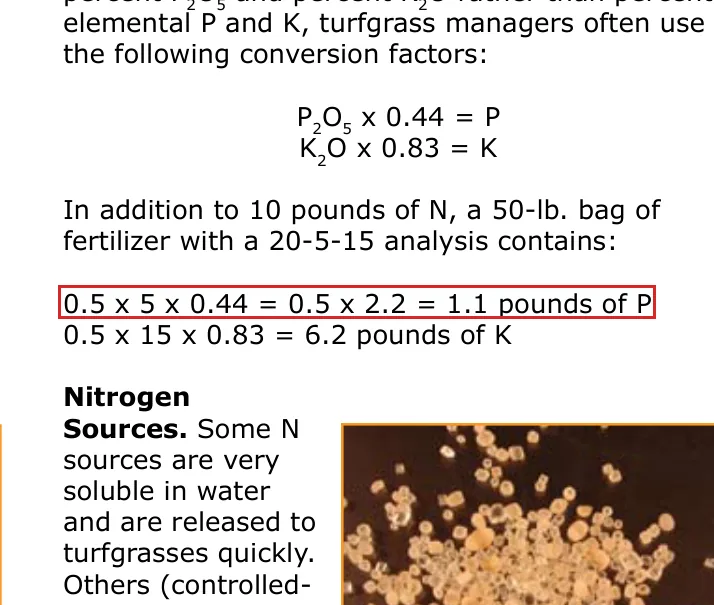
- The three numbers are a legal guarantee of total nitrogen, available phosphate (P2O5) and soluble potash (K2O), not elemental P and K; multiply the middle number by 0.44 and the last by 0.83 to get the elements (Penn State Extension; 3 Pa.C.S. §6801).
- Purdue caps a single feeding at 1.0 lb of water-soluble nitrogen per 1,000 sq ft, or 2.0 lb when more than half the nitrogen is slow-release, and suggests 25 to 50 percent slow-release nitrogen for established lawns (Purdue AY-22).
- Annual nitrogen runs from 0 to 2 lb per 1,000 sq ft for buffalograss (K-State MF658) to 2 to 6 lb for St. Augustinegrass in Florida (UF/IFAS LH010); cool-season lawns take 1 to 5 lb (Purdue AY-22, Table 2).
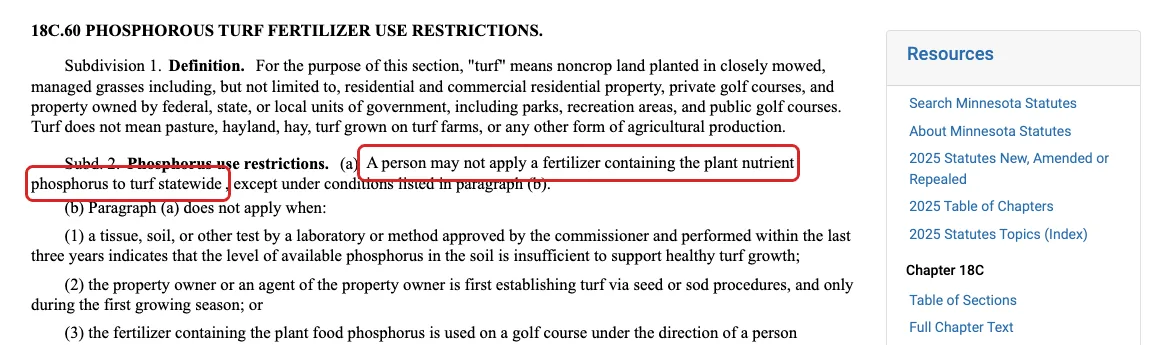
- Ten state laws we read restrict phosphorus lawn fertilizer or flag it at the shelf; Minnesota allows it only with a soil test from the last 3 years or on new turf in its first growing season (Minn. Stat. §18C.60).
- Price per pound of nitrogen, not price per bag, compares products: in our October 2026 check the spread ran from $3.17 (Scotts Turf Builder 38-0-4, 37.9 lb) to $17.84 (Espoma Turf-tone 9-0-1, 28 lb) per lb of N (single seller listings checked Oct. 28, 2026).
What do the three numbers on a lawn fertilizer bag mean?
The three numbers are the grade: the guaranteed minimum percent by weight of total nitrogen (N), available phosphate (P2O5) and soluble potash (K2O), in that order. Pennsylvania’s fertilizer law spells out that order and form, and other states use the same model wording (3 Pa.C.S. §6801, definition of guaranteed analysis). A 50 lb bag of 20-5-15 holds 10 lb of N, 2.5 lb of P2O5 and 7.5 lb of K2O.
That 50 lb example is the University of Tennessee’s (UT Extension W161-E). The middle and last numbers are oxides, a labeling convention: Penn State notes that P2O5 and K2O compounds do not exist in fertilizer, and converts them with two factors, % P2O5 × 0.44 = % P and % K2O × 0.83 = % K (Penn State Extension, updated Sept. 19, 2025).
Where do guides get the middle number wrong?
Some guides shorten the label to percent N, P and K, which overstates phosphorus about 2.3 times and potassium about 1.2 times. Purdue’s AY-22 says a 16-4-8 bag “contains 16 percent N, 4 percent P, and 8 percent K” (Purdue AY-22, p. 3), and Wisconsin’s DATCP fact sheet reads 10-8-15 as 10% N, 8% P and 15% K (DATCP P-DARM413). The statute and the conversion factors give the figures below.
| Grade on the bag | What some guides say | What the label guarantees | Elemental P and K (× 0.44, × 0.83) | Source |
|---|---|---|---|---|
| 16-4-8 | 16% N, 4% P, 8% K | 16% N, 4% P2O5, 8% K2O | 1.76% P, 6.64% K | Purdue AY-22; Penn State |
| 10-8-15 | 10% N, 8% P, 15% K | 10% N, 8% P2O5, 15% K2O | 3.52% P, 12.45% K | Wisconsin DATCP; Penn State |
| 20-5-15, 50 lb bag | n/a | 10 lb N, 2.5 lb P2O5, 7.5 lb K2O | 1.1 lb P, 6.2 lb K | UT W161-E |
The distinction matters for compliance as well as chemistry. Vermont and Maine define a phosphorus fertilizer by its phosphate content: more than 0.67 percent available phosphate by weight (10 V.S.A. §1266b(a)(6); 38 M.R.S. §419(1)(A-4)). Read the middle number as P2O5 when you check a bag against those rules.
What else does the label have to show?
Beyond the grade, Pennsylvania requires six items on every bag: brand and grade, the guaranteed analysis, what the material was derived from, directions for use, the guarantor’s name and address, and net weight (3 Pa.C.S. §6805(a)). The “derived from” line and the nitrogen breakdown tell you how fast the bag works, which the three numbers alone do not.
| Label line | What it tells you | How to use it |
|---|---|---|
| Grade, e.g. 32-0-4 | Percent N, P2O5, K2O | Divide your nitrogen target by the first number ÷ 100 to get pounds of product |
| Nitrogen breakdown (ammoniacal, urea, water-insoluble, slowly available) | How much N is quick-release | Purdue’s 1.0 lb cap applies to the water-soluble share; more than 50% slow-release allows up to 2.0 lb |
| Derived from | Urea, methylene urea, polymer-coated urea, sulfur-coated urea, biosolids | Coated and methylene urea sources release over weeks; urea and ammonium sulfate release in days |
| Directions for use and spreader settings | Coverage per bag at the maker’s rate | Back-calculate the nitrogen rate: bag lb × N% ÷ (coverage ÷ 1,000) |
| Turf warning statement (Pennsylvania) | No application near water or before heavy rain; sweep granules off pavement | Required on turf bags of 1 lb or more under §6805(g) |
Which nitrogen sources are in lawn fertilizer, and how fast do they release?
Quick-release sources such as urea, ammonium sulfate and potassium nitrate dissolve in water and green turf within a few days for nitrate forms or 7 to 10 days for ammonium forms; slow-release sources such as polymer-coated urea, sulfur-coated urea, methylene urea and biosolids feed for weeks and burn less (Purdue AY-22, Table 1). Most lawn bags blend both.
Salt index measures burn risk. The University of Tennessee rates each source per unit of nitrogen against sodium nitrate: urea 1.7 (moderate), ammonium sulfate 3.3 (high), sulfur-coated urea 0.7, Milorganite 0.7, ureaform or methylene urea 0.3 and IBDU 0.2 (low) (UT W161-E). The chart plots those values; the table holds them with each source’s release mechanism.
Salt index is a lab ranking, though: in a 2026 field trial on bermudagrass, monoammonium and diammonium phosphate burned the most at high rates while ammonium sulfate burned none, which is why our answer to can you over fertilize your lawn puts the dose ahead of the salt number.
| Nitrogen source | N content | Release | What controls release | Salt index per unit N | Source |
|---|---|---|---|---|---|
| Urea | 45 to 46% | Quick | Dissolves; urease converts it to ammonium within about 3 days | 1.7 (moderate) | UT W161-E; UF/IFAS, 1986 |
| Ammonium sulfate | 21% (24% sulfur) | Quick | Water-soluble; strongest acidifier listed | 3.3 (high) | UT W161-E |
| Ammonium nitrate | 33% | Quick | Water-soluble; nitrate can leach | 3.2 (high) | UT W161-E |
| Potassium nitrate | 13% N, 44% K2O | Quick | Water-soluble | 5.3 (high) | UT W161-E |
| Sulfur-coated urea (SCU) | 32% | Slow | Water moves through the sulfur coat; microbes and hydrolysis | 0.7 (low) | UT W161-E |
| Polymer-coated urea (PCU) | 38% | Slow | Diffusion through a plastic coat | not listed | UT W161-E |
| Ureaform or methylene urea | 38% | Slow | Soil microbes break the chains; longer chains release slower | 0.3 (low) | UT W161-E |
| IBDU | 31% | Slow | Hydrolysis, not microbes; faster when warm | 0.2 (low) | UT W161-E |
| Biosolids (Milorganite) | 6% N, 4% P2O5 | Slow | Soil microbes; little release in cold soil | 0.7 (low) | UT W161-E |
Temperature splits the slow sources. Natural organics and ureaform depend on soil microbes, so they release little in cold or waterlogged soil, while IBDU depends on water and speeds up as soil warms (UT W161-E). That is why Purdue prefers a product with nearly 100 percent water-soluble nitrogen for cool-season feedings from early October to early December (Purdue AY-22).
How much lawn fertilizer should you put down?
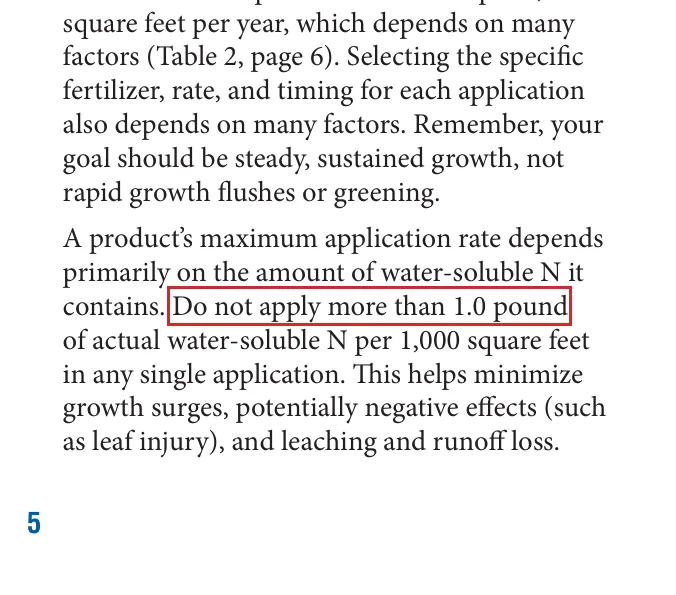
Plan in pounds of actual nitrogen per 1,000 sq ft, not pounds of product. Purdue’s normal target is 0.5 to 1.0 lb of N per feeding, never more than 1.0 lb of water-soluble N at once, and up to 2.0 lb only when more than half the nitrogen is slow-release (Purdue AY-22). The yearly total depends on the grass.
Three adjustments change the yearly total. Lawns where clippings are bagged need 25 to 50 percent more nitrogen, shaded lawns need up to 50 percent less and no more than 2.0 lb a year, and lawns fertilized regularly for more than 10 years can drop a feeding (Purdue AY-22). New lawns may need up to 50 percent more in their first 12 to 18 months.
| Grass | Annual N (lb per 1,000 sq ft) | Note | Source |
|---|---|---|---|
| Tall fescue, Kentucky bluegrass, perennial ryegrass (moderate care) | 2 to 4 | 1 to 5 across Purdue’s four care levels | Purdue AY-22, Table 2 |
| Tall fescue, North Carolina basic program | about 3 | 1 lb each in mid-September, November and February | NC State AG-367 |
| Shaded fine fescue | up to 2 | Half the sunny-lawn rate | Purdue AY-22 |
| Bermudagrass, Georgia | 2 to 5 | Starts when 4-inch soil holds 65°F | UGA bermudagrass calendar |
| Bermudagrass, south Florida | 5 to 7 | Year-round growth | UF/IFAS LH007 |
| Zoysiagrass, Texas | 1 to 3 | Established lawns | Texas A&M SCSC-PU-279 |
| St. Augustinegrass, Florida | 2 to 4 north, 2 to 5 central, 4 to 6 south | 2 to 6 feedings a year by region | UF/IFAS LH010, Table 2 |
| Centipedegrass | 1 to 2 | More than 2 lb builds thatch | Clemson HGIC 1215 |
| Bahiagrass, Florida | 1 to 2 | Same range in every Florida region | UF/IFAS LH006 |
| Buffalograss | 0 to 2 | June and July only | K-State MF658 |
When each feeding goes on, month by month and by state blackout date, is covered in our lawn care schedule by grass type. Grass-specific programs are on the bermuda grass and St. Augustine grass guides.
How do you turn pounds of nitrogen into pounds of product?
Divide the nitrogen you want by the first number on the bag, written as a decimal, then multiply by the lawn’s area in thousands of square feet. Purdue’s worked example: 0.5 lb of N on 5,500 sq ft from an 18-0-10 product is 0.5 ÷ 0.18 = 2.78 lb per 1,000 sq ft, times 5.5, or 15.29 lb (Purdue AY-22).
| Product (grade) | Product for 1 lb N per 1,000 sq ft | For 5,000 sq ft | Bags | N delivered at the bag’s own coverage |
|---|---|---|---|---|
| Scotts Turf Builder 38-0-4, 12.64 lb (38-0-4) | 1 ÷ 0.38 = 2.63 lb | 13.2 lb | 1.04 of a 12.64 lb bag | 12.64 × 0.38 ÷ 4 = 1.20 lb N |
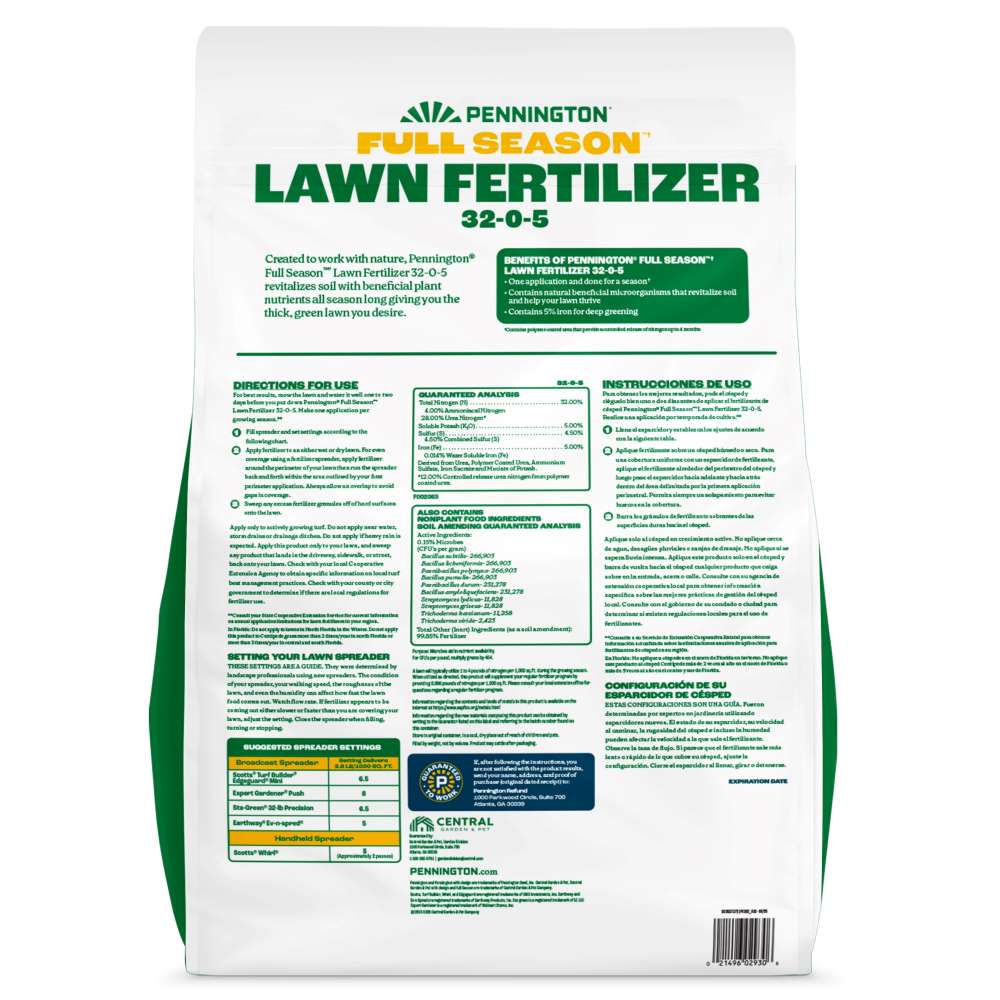
| Pennington Full Season 32-0-5, 11.2 lb (32-0-5) | 1 ÷ 0.32 = 3.12 lb | 15.6 lb | 1.40 of a 11.2 lb bag | 11.2 × 0.32 ÷ 4 = 0.90 lb N |
| Milorganite 6-4-0, 32 lb (6-4-0) | 1 ÷ 0.06 = 16.67 lb | 83.3 lb | 2.60 of a 32 lb bag | 32 × 0.06 ÷ 2.5 = 0.77 lb N |
The last column is the check most buyers skip. Spread at its printed 4,000 sq ft, a 12.64 lb bag of Scotts Turf Builder 38-0-4 puts down 1.20 lb of N per 1,000 sq ft, about 0.96 lb of it quick-release, because only 7.6 of its 38 percent is slowly available (Scotts label, SKU 23500). That sits just under Purdue’s 1.0 lb soluble cap but above the 0.9 lb total-N cap that Maryland and New Jersey set for homeowners (Md. Code, Agric. §8-803.5(f); N.J. P.L.2010, c.112); there, spread the bag over about 5,300 sq ft instead.
- Pounds of nitrogen to apply
- 5.00
- Pounds of a 32-0-4 product
- 15.6
- Pounds of a 38-0-4 product
- 13.2
- Pounds of a 6-4-0 organic product
- 83.3
Cost = area × nitrogen rate × the product's price per lb of N from our dated listings. Pounds of product: divide the nitrogen line by the bag's first number ÷ 100.
Which lawn fertilizers cost the least per pound of nitrogen?
Divide the bag price by the pounds of nitrogen in it: bag weight × first number ÷ 100. On that basis the products below ran from $3.17 to $17.84 per lb of N at the listings we checked in October 2026, and the cheapest per bag was not always the cheapest per pound of nitrogen.
| Product | Grade | Nitrogen derived from | Bag / labeled coverage | lb N per 1,000 sq ft at label rate | Price, seller, date | $ per lb N |
|---|---|---|---|---|---|---|
| Scotts Turf Builder Lawn Food (new formula, 12.64 lb) | 38-0-4 | Urea; polymer-coated sulfur-coated urea (7.6% slowly available N); 20% of N slow-release | 12.64 lb / 4,000 sq ft | 1.20 | $24.99, scottsmiraclegro.com, Oct. 28, 2026 | $5.20 |
| Scotts Turf Builder Lawn Food (new formula, 37.9 lb) | 38-0-4 | Same label as the 12.64 lb bag; 20% of N slow-release | 37.9 lb / 12,000 sq ft | 1.20 | $45.60, Walmart.com, Oct. 28, 2026 | $3.17 |
| Scotts Turf Builder Lawn Food (previous formula, SKU 22305) | 32-0-4 | Methylene ureas, urea, ammonium sulfate (9% slowly available N); 28% of N slow-release | 12.5 lb / 5,000 sq ft | 0.80 | $26.99, scottsmiraclegro.com, Oct. 28, 2026 | $6.75 |
| Scotts Turf Builder WinterGuard Fall Lawn Food | 32-0-10 | Urea, methylene ureas, ammonium sulfate (6.8% slowly available N); 21% of N slow-release | 10 lb / 4,000 sq ft | 0.80 | $23.98, Walmart.com, Oct. 28, 2026 | $7.49 |
| Scotts Turf Builder Starter Food for New Grass | 24-25-4 | Methyleneureas, urea, ammonium phosphate (6.2% slowly available N; 2015 label file); 26% of N slow-release | 15 lb / 5,000 sq ft | 0.72 | $37.49, scottsmiraclegro.com, Oct. 28, 2026 | $10.41 |
| Pennington Full Season Lawn Fertilizer (11.2 lb) | 32-0-5 | Urea, polymer-coated urea, ammonium sulfate (12% controlled-release N); 38% of N slow-release | 11.2 lb / 4,000 sq ft | 0.90 | $27.99, Walmart.com, Oct. 28, 2026 | $7.81 |
| Pennington Full Season Lawn Fertilizer (33.6 lb) | 32-0-5 | Same label as the 11.2 lb bag; 38% of N slow-release | 33.6 lb / 12,000 sq ft | 0.90 | $50.21, Walmart.com, Oct. 28, 2026 | $4.67 |
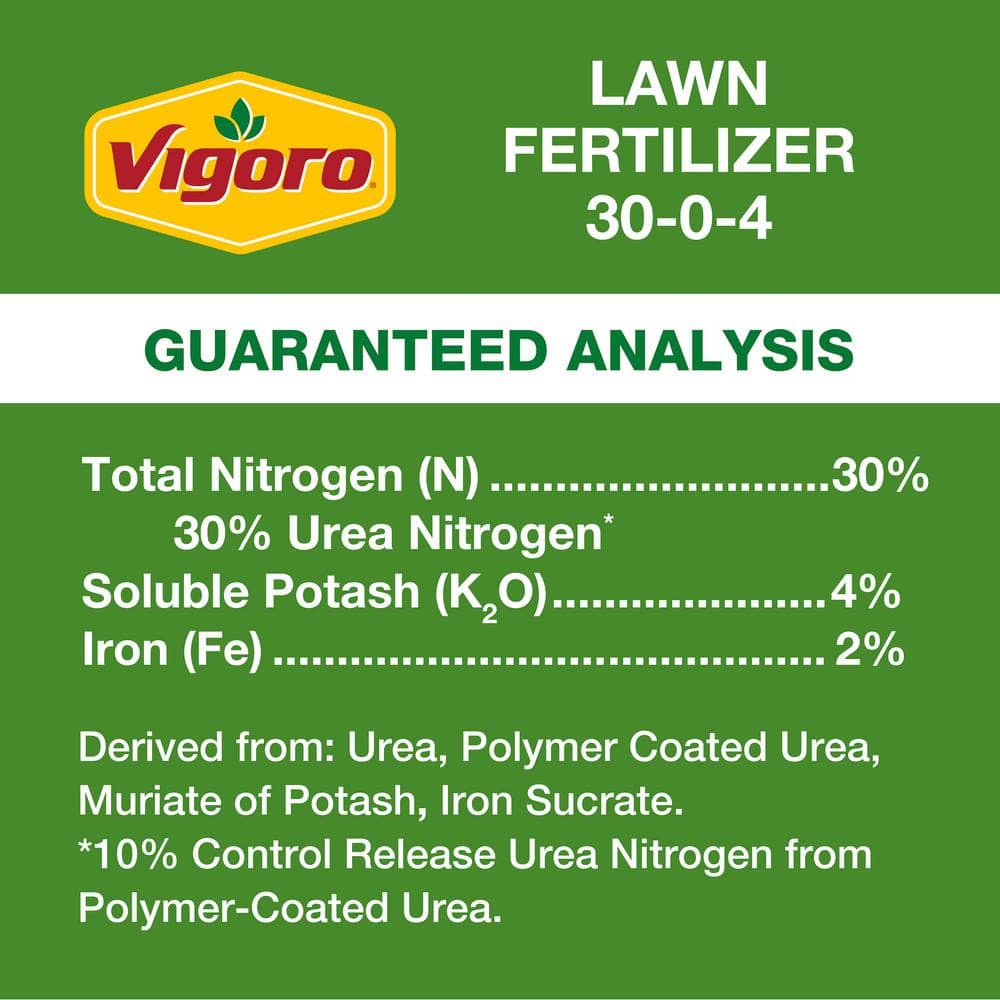
| Vigoro Lawn Fertilizer 30-0-4 (11.2 lb) | 30-0-4 | Urea, polymer-coated urea (10% controlled-release N); 33% of N slow-release | 11.2 lb / 4,000 sq ft | 0.84 | Not confirmed (search snippet only) | n/a |
| Milorganite 6-4-0 (32 lb) | 6-4-0 | Biosolids (4% water-insoluble, slowly available N); 67% of N slow-release | 32 lb / 2,500 sq ft | 0.77 | $19.97, Walmart.com, Oct. 28, 2026 | $10.40 |
| Espoma Lawn Food 15-0-5 (40 lb) | 15-0-5 | Poultry manure, methylene urea, ammonium sulfate, urea (7.7% slow-release N); 51% of N slow-release | 40 lb / 12,000 sq ft (computed) | 0.50 | $49.99, Bay Gardens, Oct. 28, 2026 | $8.33 |
| Espoma Organic Turf-tone All Season Lawn Food 9-0-1 (28 lb) | 9-0-1 | Feather, meat and blood meal, poultry manure (7.7% slow-release N); 86% of N slow-release | 28 lb / 5,000 sq ft | 0.50 | $44.95, Sod Solutions, Oct. 28, 2026 | $17.84 |
Big bags and high-analysis grades win on this measure. The 37.9 lb Scotts Turf Builder 38-0-4 at $45.60 works out to $3.17 per lb of N, against $5.20 for the 12.64 lb bag of the same product; Milorganite’s 32 lb bag at $19.97 holds only 1.92 lb of N, or $10.40 a pound. Scotts sells two Turf Builder Lawn Food formulas side by side as of October 2026: the new 38-0-4 (SKU 23500) and the previous 32-0-4 (SKU 22305), so read the grade, not the brand name, before you set the spreader (ScottsMiracle-Gro).
Is 10-10-10 or starter fertilizer good for an established lawn?
Usually not, unless a soil test shows low phosphorus or potassium. At 1 lb of N per 1,000 sq ft, 10-10-10 also drops 1 lb of P2O5 and 1 lb of K2O on the lawn every feeding. Purdue tells homeowners to avoid general-purpose garden grades such as 12-12-12 on established turf (Purdue AY-22), and Illinois suggests 3-0-2 or 4-0-2 ratios (Illinois Extension).
| Grade | Product for 1 lb N per 1,000 sq ft | P2O5 applied | Elemental P applied (× 0.44) | K2O applied |
|---|---|---|---|---|
| 32-0-4 | 3.1 lb | 0.00 lb | 0.00 lb | 0.12 lb |
| 24-25-4 (starter) | 4.2 lb | 1.04 lb | 0.46 lb | 0.17 lb |
| 16-4-8 | 6.2 lb | 0.25 lb | 0.11 lb | 0.50 lb |
| 10-10-10 | 10.0 lb | 1.00 lb | 0.44 lb | 1.00 lb |
| 6-4-0 (biosolids) | 16.7 lb | 0.67 lb | 0.29 lb | 0.00 lb |
Compare those numbers with the state caps. Pennsylvania lets organic-based products carry phosphorus only up to 0.25 lb of P per 1,000 sq ft per application and 0.5 lb a year (3 Pa.C.S. §6813(a)(3)); a 1 lb N feeding of a 6-4-0 organic product supplies about 0.29 lb of P, just over that line, so the rate has to drop to roughly 0.85 lb N to stay under it.
Starter fertilizer is the legal exception almost everywhere: Minnesota, Wisconsin, Washington, New York and Vermont all allow phosphorus on new seed or sod in its first growing season (Minn. Stat. §18C.60; 10 V.S.A. §1266b). Seeding steps are in how to plant grass seed, and our overseeding guide gives Purdue’s starter rates.
Which states restrict phosphorus in lawn fertilizer?
Of the state laws we read at the source in October 2026, nine limit applying or selling phosphorus lawn fertilizer and Maine requires a shelf warning sign. All ten carve out new seed or sod in some form, and nine exempt lawns whose soil test shows a need; the test must be no older than 18 months in Vermont and 3 years in Minnesota, Wisconsin, Washington, New Jersey, Maryland and Virginia.
| State | Law (source) | Type | What is restricted | Exemptions | Applies to |
|---|---|---|---|---|---|
| Minnesota | Minn. Stat. §18C.60, subd. 2 | use ban | Applying fertilizer containing phosphorus to turf | Soil or tissue test within 3 years shows P is insufficient; first growing season of new seed or sod; golf courses under trained staff | Everyone |
| Wisconsin | Wis. Stat. §94.643 (DATCP P-DARM413, April 2022) | use and display ban | Applying P-labeled turf fertilizer; retail display of it | Growing season the turf is established by seed or sod; lab soil test within 36 months shows a deficiency | Everyone |
| Washington | RCW 15.54.500 | use and sale ban | Applying or selling P-labeled turf fertilizer; applying it on frozen ground | Establishing or repairing grass by seed or sod in that growing season; soil test within 36 months shows a deficiency | Everyone |
| New York | N.Y. ECL §17-2103(1) | use ban | Applying phosphorus fertilizer to lawn or non-agricultural turf | Soil test shows more P is needed; newly established lawn in its first growing season | Everyone, including hired applicators |
| New Jersey | N.J. P.L.2010, c.112, §3(d) to (e) | use ban | Applying phosphorus fertilizer to turf | Soil test within 3 years; establishing vegetation for the first time; reestablishing or repairing turf; subsurface placement; manipulated manure at no more than 0.25 lb P per 1,000 sq ft | Everyone |
| Maryland | Md. Code, Agric. §8-803.5(e) | use ban | Applying phosphorus fertilizer to turf | Soil test within 3 years; establishing vegetation for the first time; reestablishing or repairing turf | Everyone |
| Pennsylvania | 3 Pa.C.S. §6804(a)(2) and §6813(a)(3) | product and rate rule | Distributing turf fertilizer with P to consumers; applying P to turf | Labeled for establishing or repairing turf; natural organic or organic-based products at no more than 0.25 lb P per 1,000 sq ft per application and 0.5 lb a year | Everyone |
| Virginia | Va. Code §3.2-3607(F) | sale ban | Registering, selling or using lawn maintenance fertilizer that contains phosphorus (since Dec. 31, 2013) | “Lawn fertilizer” for new seed or sod in its first season, repair or renovation, or a soil test within 3 years showing a deficiency (defined in §3.2-3600); manipulated manure, yard waste compost and sewage-sludge products | Everyone |
| Vermont | 10 V.S.A. §1266b(b) | use ban | Applying phosphorus fertilizer to turf | Soil test within 18 months shows a deficiency; starter fertilizer in the first growing season of new seed or sod | Everyone |
| Maine | 38 M.R.S. §419(1)(A-4) and (2)(B) | retail sign rule | Selling P fertilizer for lawns without a posted state-approved warning sign | Soil test shows P is needed; new lawn, reseeding or overseeding | Retailers |
Several of the same laws add rules that apply to every bag. Washington bars phosphorus turf fertilizer on frozen ground (RCW 15.54.500); Pennsylvania requires consumer turf fertilizer to carry at least 20 percent enhanced-efficiency nitrogen (3 Pa.C.S. §6804(a)(1)); Vermont bars applying any turf fertilizer whose nitrogen is less than 15 percent slow-release (10 V.S.A. §1266b(a)(5) and (c)). Dated blackout windows are on our lawn care schedule.
Lawn companies applying for hire can face different dates: New Jersey lets professional applicators fertilize turf until Dec. 1 rather than Nov. 15 (N.J. P.L.2010, c.112, §2(b)). Licensing is covered on our pesticide applicator license page.
This page is general information, not legal advice. Fertilizer laws change; confirm the current rule with your state department of agriculture before you buy or apply.
Are organic lawn fertilizers like Milorganite better?
Organic fertilizers burn less and feed slowly, but they carry little nitrogen and need warm, biologically active soil to release it. Milorganite is 6-4-0 with a salt index of 0.7 per unit of N against 1.7 for urea (UT W161-E), and it takes more than 5 times as much product as a 32-0-4 bag to deliver the same nitrogen.
| At 1 lb N per 1,000 sq ft on 5,000 sq ft | 6-4-0 biosolids | 32-0-4 synthetic | Source |
|---|---|---|---|
| Product needed | 83.3 lb | 15.6 lb | Arithmetic: 5 ÷ 0.06 and 5 ÷ 0.32 |
| P2O5 applied with it | 3.3 lb (1.47 lb P) | 0 | Arithmetic; Penn State factor 0.44 |
| Salt index of the nitrogen source | 0.7 (biosolids) | 1.7 if the N is urea | UT W161-E |
| Release in cold soil | Little: microbes inactive | Urea is water-soluble; coated shares vary | UT W161-E |
That bulk is the cost. At 1 lb of N per 1,000 sq ft, a 5,000 sq ft lawn needs 83 lb of 6-4-0 against 16 lb of 32-0-4, and the price per pound of nitrogen in our product table reflects it. Illinois lists alfalfa, cottonseed meal, seaweed, bone meal, blood meal and poultry, cow and horse manure as organic sources (Illinois Extension).
Do biosolids fertilizers contain PFAS?
Biosolids, the treated sewage sludge in products such as Milorganite, are under review for PFAS. On Jan. 14, 2025, the EPA released a draft risk assessment finding that human health risks may exceed its thresholds in some modeled farm scenarios when land-applied sludge contains 1 part per billion of PFOA or PFOS; the findings are preliminary and focus on people living on or near affected farms (EPA fact sheet, January 2025).
The same fact sheet notes that bagged biosolids are sold to the public and often used on lawns and home gardens (EPA). Maine has gone furthest: since 2022 its law bars selling or distributing fertilizer or compost made with municipal sludge in the state (38 M.R.S. §1306(7)). Milorganite’s maker reports that 2026 tests for PFOA and PFOS in its products averaged 5.4 parts per billion, against limits under 20 ppb in several states, and its FAQ says the product is not sold in Connecticut and Maine (Milorganite safety page; Milorganite FAQ).
Granular or liquid lawn fertilizer: which should you use?
Granular fertilizer suits most homeowners because it can carry slow-release nitrogen; most liquid lawn fertilizer is quick-release, because most slow-release sources cannot be mixed with water. Liquids green up fast but need smaller, more frequent feedings (Purdue AY-22, Table 1). Triazone, a clear liquid made from urea, formaldehyde and ammonia, is one slower liquid source (UT W161-E).
| Factor | Granular | Liquid | Source |
|---|---|---|---|
| Slow-release nitrogen possible | Yes: coated urea, methylene urea, biosolids | Mostly no | Purdue AY-22 |
| Ammonia loss from urea in a lab study | 1 to 55% of N applied | 2 to 26% of N applied | UF/IFAS (Augustin and Peacock), 1986 |
| Burn risk | Low for slow-release; water quick-release in | Leaf contact; follow label dilution | Purdue AY-22 |
| Equipment | Rotary or drop spreader, calibrated | Hose-end or tank sprayer | Penn State Extension |
| Pavement cleanup rule | Sweep granules back onto turf | Pennsylvania’s sweep-back label statement does not apply to liquids | 3 Pa.C.S. §6805(g)(4) |
Too much liquid fertilizer burns turf the same way granules do, because the nitrogen is all water-soluble. Purdue’s per-feeding cap of 1.0 lb of water-soluble N per 1,000 sq ft applies to liquids in full (Purdue AY-22), and Pinellas County, Fla., caps liquid feedings at 0.5 lb of nitrogen per 1,000 sq ft against 1 lb for granular products that are at least 50 percent slow-release (Pinellas County fertilizer ordinance).
How do you apply lawn fertilizer without burning the grass?
Burn comes from too much soluble salt on wet leaves, so the fixes are rate, spread and water. Keep quick-release nitrogen at or under 1.0 lb per 1,000 sq ft, split the dose into two passes at right angles, and water urea in: University of Florida turf specialists found 1/8 to 1/4 inch of water usually washes it into the thatch and soil (UF/IFAS, Florida Green, 1986).
- Measure the lawn in square feet and divide by 1,000. A 50 by 100 ft front yard is 5,000 sq ft, or 5 units.
- Pick a target of 0.5 to 1.0 lb of N per 1,000 sq ft and work out pounds of product: target ÷ (first number ÷ 100) × units (Purdue AY-22).
- Set the spreader to the bag’s half-rate setting. LSU warns that half the dial number is not half the rate, because spreader scales are never linear (LSU AgCenter).
- Spread the first half in parallel strips, then the second half at right angles; Penn State says the grid masks skips and overlaps that cause striping (Penn State Extension, April 2025).
- Sweep or blow granules off driveways and walks back onto the turf, which New Jersey and Pennsylvania require (N.J. P.L.2010, c.112, §2(a)(2); 3 Pa.C.S. §6813(b)(1)).
- Water in quick-release and urea products with 1/8 to 1/4 inch within a day; field tests on turf averaged 20 to 30 percent nitrogen loss as ammonia gas after urea, and about 95 percent of the loss came within 7 days (UF/IFAS, 1986).
- Skip dormant, drought-stressed or frozen turf (Purdue AY-22); Wisconsin counts ground as frozen when you cannot dig 6 to 8 inches (Wisconsin DATCP).
Calibrate once a season with a catch test: Penn State runs the spreader over a 50 to 100 ft strip with 5 to 10 lb of product in the hopper and weighs what is left (Penn State Extension). If the lawn needs weed control as well, a weed-and-feed product is a pesticide with its own EPA registration number, and its label, not the fertilizer math, sets the rate. Weed-specific choices are on our lawn weed killer guide.
Which lawn fertilizer should you buy?
Start from the soil test and the grass, then pick the grade, the slow-release share and the rate. The table turns the published thresholds into choices; the flowchart below it holds the same logic. If you have no recent soil test, our soil test guide explains how to get one before you buy anything with phosphorus or lime.
| If your situation is | Do this | Why (source) |
|---|---|---|
| Established lawn, no soil test, in MN, WI, WA, NY, NJ, MD, PA, VA or VT | Buy a lawn grade with a 0 middle number, such as 38-0-4, 32-0-5 or 30-0-4 | Phosphorus is restricted without a test (Minn. Stat. §18C.60) |
| Seeding or sodding a new lawn | Use a starter grade with phosphorus in the first growing season only | New-turf exemption (10 V.S.A. §1266b(b)(1)(B); RCW 15.54.500) |
| Soil test shows low phosphorus or potassium | Apply the P2O5 and K2O the lab recommends; a complete grade is fine | Soil-test exemption (Md. Code, Agric. §8-803.5(e); Purdue AY-22) |
| Want 1 lb of N or more in one pass | Choose a product with more than 50% slow-release N; cap at 2.0 lb | Purdue AY-22 |
| Quick-release product (mostly urea or ammonium sulfate) | Cap at 1.0 lb N per 1,000 sq ft and water in 1/8 to 1/4 inch | Purdue AY-22; UF/IFAS, 1986 |
| Homeowner in Maryland or New Jersey | No more than 0.7 lb water-soluble and 0.9 lb total N per feeding, 20% or more slow-release | Md. Code, Agric. §8-803.5(f) |
| Cool-season lawn, October to early December | Use nearly 100% water-soluble N at 0.5 to 0.75 lb about every 3 weeks | Cold soil slows microbial release (Purdue AY-22) |
| Shaded lawn | Halve the rate; 2.0 lb N a year at most | Purdue AY-22 |
| Clippings bagged every mowing | Add 25 to 50% to the yearly nitrogen | Purdue AY-22 |
| Want an organic product | Expect about 5 times the bag weight of a 32-0-4 for the same N, and feed only into warm soil | UT W161-E |
| Live in Maine | Biosolids-based fertilizer cannot be sold or distributed in the state | 38 M.R.S. §1306(7) |
1Are you seeding or sodding a new lawn this season?
YesUse a starter grade with phosphorus for the first growing season only (allowed under MN, WI, WA, NY and VT law).
NoGo to the next question
2Does a soil test from the last 3 years show low phosphorus or potassium?
YesApply the P2O5 and K2O the lab recommends; a complete grade is allowed under the soil-test exemptions.
NoGo to the next question
3Do you want to apply 1 lb of nitrogen or more per 1,000 sq ft in one pass?
YesChoose a bag with more than 50 percent slow-release nitrogen and stay at or under 2.0 lb (Purdue AY-22).
NoGo to the next question
4Is it a cool-season lawn between October and early December?
YesUse a mostly water-soluble grade at 0.5 to 0.75 lb N about every 3 weeks (Purdue AY-22).
NoGo to the next question
5Do you prefer an organic or biosolids product?
YesBudget for about 5 times the bag weight of a 32-0-4, apply into warm soil, and check state rules (Maine bars biosolids products).
NoBuy a lawn grade with a zero middle number and 25 to 50 percent slow-release nitrogen, apply 0.5 to 1 lb N per 1,000 sq ft, and compare brands by price per pound of nitrogen.
Source: Purdue AY-22; Minn. Stat. §18C.60; 10 V.S.A. §1266b; 38 M.R.S. §1306
How we compiled this
In October 2026 we read 10 state phosphorus statutes or agency fact sheets, 15 extension publications, an EPA fact sheet, a county ordinance and the label or product page of each fertilizer compared. Prices are single dated listings from the seller named in each row; all arithmetic is ours and shown in the tables. We did not test any product or lawn.
| Recap | Number | Source |
|---|---|---|
| Max water-soluble N per feeding | 1.0 lb per 1,000 sq ft | Purdue AY-22 |
| Max N per feeding, more than 50% slow-release | 2.0 lb per 1,000 sq ft | Purdue AY-22 |
| Phosphate to phosphorus | × 0.44 | Penn State |
| Potash to potassium | × 0.83 | Penn State |
| Water to move urea into soil | 1/8 to 1/4 inch | UF/IFAS, 1986 |
Frequently asked questions
What is the best fertilizer to put on a lawn?
For most established lawns, a grade with a high first number, a zero or low middle number and 25 to 50 percent slow-release nitrogen, applied at 0.5 to 1 lb of N per 1,000 sq ft (Purdue AY-22). Choose between brands by price per pound of nitrogen, and add phosphorus only when a soil test or new seeding calls for it.
When should you start putting fertilizer on your lawn?
It depends on the grass group. Cool-season lawns get most nitrogen from late August to early December and lighter feeding in spring; warm-season lawns wait until 4-inch soil holds 65°F and the lawn has greened up (Purdue AY-22; UGA). Month-by-month dates and state blackout periods are in our lawn care schedule.
Do you water grass immediately after fertilizing?
Water in quick-release and urea-based granules with 1/8 to 1/4 inch soon after spreading: Florida field tests measured 20 to 30 percent average nitrogen loss as ammonia from unwatered urea on turf (UF/IFAS, 1986). Where the bag’s directions differ, the label governs.
How can you tell if your grass needs fertilizer?
Purdue describes underfed turf as yellowing (chlorotic) leaves, thinning density and soil showing at the base of the canopy, followed by crabgrass and broadleaf weeds moving in (Purdue AY-22). Nitrogen fixes color and density; a soil test is the only reliable check for phosphorus, potassium and pH, since no soil test measures lawn nitrogen needs.
Can I fertilize my lawn every 4 weeks?
Yes, at low rates. Purdue suggests lighter, more frequent feedings, such as 0.5 lb of N per 1,000 sq ft every 21 days, give steadier color than heavy ones, as long as the yearly total stays inside the grass’s range (Purdue AY-22). Four-week feedings at 1 lb each would exceed most annual limits.
What is the disadvantage of using organic fertilizer?
Low analysis and slow, temperature-dependent release. Natural organics release nitrogen through soil microbes, so they do little in cold or waterlogged soil (UT W161-E), and a 6-4-0 product needs about 5 times the weight of a 32-0-4 bag for the same nitrogen. Most also carry phosphorus, which some states restrict on lawns.
Can you put too much liquid fertilizer on your lawn?
Yes. Liquid lawn fertilizer is mostly water-soluble nitrogen, so more than 1.0 lb of it per 1,000 sq ft in one feeding risks leaf burn, growth surges and leaching (Purdue AY-22). Pinellas County, Fla., caps liquid feedings at 0.5 lb of nitrogen (Pinellas County). Measure the area before you mix.
Sources
- Purdue Extension (Bigelow, Camberato, Patton), AY-22-W, Fertilizing Established Cool-season Lawns, August 2013. Accessed October 2026.
- University of Tennessee Extension (Samples, Sorochan, Savoy), W161-E, Turfgrass Maintenance: Fertilizers, Current PDF. Accessed October 2026.
- Penn State Extension (Landschoot), How Much Phosphorus and Potassium Are Really in Your Fertilizer?, Updated Sept. 19, 2025. Accessed October 2026.
- Penn State Extension, Calibrating Your Fertilizer Spreader, Updated April 30, 2025. Accessed October 2026.
- LSU AgCenter, Avoid Right-angle Patterns with Rotary Spreaders, Dec. 6, 2004. Accessed October 2026.
- University of Illinois Extension, Fertilizing Your Lawn, Current web page. Accessed October 2026.
- Pennsylvania Department of Agriculture, 3 Pa.C.S. Chapter 68, Fertilizer (unofficial copy), §§6801, 6804, 6805, 6813, Current law. Accessed October 2026.
- Minnesota Revisor of Statutes, Minn. Stat. §18C.60, Phosphorus turf fertilizer use restrictions, 2005 amendment. Accessed October 2026.
- Wisconsin DATCP, P-DARM413, Turf Fertilizer Phosphorus Restrictions (Wis. Stat. §94.643), April 2022. Accessed October 2026.
- Washington State Legislature, RCW 15.54.500, Turf fertilizer prohibitions, 2011 c 73. Accessed October 2026.
- New York State Senate, N.Y. Environmental Conservation Law §17-2103, Current law. Accessed October 2026.
- New Jersey State Library, P.L.2010, c.112 (fertilizer law), Chapter 112, Laws of 2010. Accessed October 2026.
- Maryland General Assembly, Md. Code, Agriculture §8-803.5, Current law. Accessed October 2026.
- Virginia General Assembly, Va. Code §3.2-3607, Current law. Accessed October 2026.
- Vermont General Assembly, 10 V.S.A. §1266b, Application of phosphorus fertilizer, Current law. Accessed October 2026.
- Maine Legislature, 38 M.R.S. §419, Lawn and turf fertilizer containing phosphate, Current through Jan. 1, 2025. Accessed October 2026.
- Maine Legislature, 38 M.R.S. §1306, subsection 7 (sludge and septage products), PL 2021, c. 641. Accessed October 2026.
- U.S. EPA, Draft Sewage Sludge Risk Assessment for PFOA and PFOS, fact sheet, January 2025. Accessed October 2026.
- UF/IFAS (Augustin and Peacock), via Florida Green, Gaseous Loss of Nitrogen from Turf, Winter 1986. Accessed October 2026.
- Pinellas County, Fla., Pinellas County fertilizer ordinance, Current web page. Accessed October 2026.
- NC State Extension, AG-367, Tall Fescue Lawn Maintenance Calendar, July 8, 2021. Accessed October 2026.
- University of Georgia CAES, Bermudagrass Lawn Calendar, September 2023 edition. Accessed October 2026.
- UF/IFAS Extension, LH007, Bermudagrass for Florida Lawns, Current EDIS edition. Accessed October 2026.
- Texas A&M AgriLife Extension, SCSC-PU-279, Zoysiagrass Lawn Management Guide, September 2025. Accessed October 2026.
- UF/IFAS Extension, LH010, St. Augustinegrass for Florida Lawns, Table 2, Current EDIS edition. Accessed October 2026.
- Clemson HGIC, HGIC 1215, Centipedegrass Yearly Maintenance Program, Updated Aug. 15, 2024. Accessed October 2026.
- UF/IFAS Extension, LH006, Bahiagrass for Florida Lawns, Revised May 2026. Accessed October 2026.
- K-State Research and Extension, MF658, Buffalograss Lawns, November 2014. Accessed October 2026.
- ScottsMiracle-Gro, Scotts Turf Builder Lawn Food (new formula, 12.64 lb) label or product page, Viewed Oct. 28, 2026. Accessed October 2026.
- scottsmiraclegro.com, Scotts Turf Builder Lawn Food (new formula, 12.64 lb) listing, Price as of Oct. 28, 2026. Accessed October 2026.
- Walmart.com, Scotts Turf Builder Lawn Food (new formula, 37.9 lb) listing, Price as of Oct. 28, 2026. Accessed October 2026.
- ScottsMiracle-Gro, Scotts Turf Builder Lawn Food (previous formula, SKU 22305) label or product page, Viewed Oct. 28, 2026. Accessed October 2026.
- scottsmiraclegro.com, Scotts Turf Builder Lawn Food (previous formula, SKU 22305) listing, Price as of Oct. 28, 2026. Accessed October 2026.
- ScottsMiracle-Gro, Scotts Turf Builder WinterGuard Fall Lawn Food label or product page, Viewed Oct. 28, 2026. Accessed October 2026.
- Walmart.com, Scotts Turf Builder WinterGuard Fall Lawn Food listing, Price as of Oct. 28, 2026. Accessed October 2026.
- ScottsMiracle-Gro, Scotts Turf Builder Starter Food for New Grass label or product page, Viewed Oct. 28, 2026. Accessed October 2026.
- scottsmiraclegro.com, Scotts Turf Builder Starter Food for New Grass listing, Price as of Oct. 28, 2026. Accessed October 2026.
- Pennington, Pennington Full Season Lawn Fertilizer (11.2 lb) label or product page, Viewed Oct. 28, 2026. Accessed October 2026.
- Walmart.com, Pennington Full Season Lawn Fertilizer (11.2 lb) listing, Price as of Oct. 28, 2026. Accessed October 2026.
- Walmart.com, Pennington Full Season Lawn Fertilizer (33.6 lb) listing, Price as of Oct. 28, 2026. Accessed October 2026.
- Vigoro (Home Depot brand), Vigoro Lawn Fertilizer 30-0-4 (11.2 lb) label or product page, Viewed Oct. 28, 2026. Accessed October 2026.
- Milwaukee Metropolitan Sewerage District (Milorganite), Milorganite 6-4-0 (32 lb) label or product page, Viewed Oct. 28, 2026. Accessed October 2026.
- Walmart.com, Milorganite 6-4-0 (32 lb) listing, Price as of Oct. 28, 2026. Accessed October 2026.
- Espoma, Espoma Lawn Food 15-0-5 (40 lb) label or product page, Viewed Oct. 28, 2026. Accessed October 2026.
- Bay Gardens, Espoma Lawn Food 15-0-5 (40 lb) listing, Price as of Oct. 28, 2026. Accessed October 2026.
- Espoma, Espoma Organic Turf-tone All Season Lawn Food 9-0-1 (28 lb) label or product page, Viewed Oct. 28, 2026. Accessed October 2026.
- Sod Solutions, Espoma Organic Turf-tone All Season Lawn Food 9-0-1 (28 lb) listing, Price as of Oct. 28, 2026. Accessed October 2026.
- Milwaukee Metropolitan Sewerage District (Milorganite), Milorganite safety and PFAS statement, 2026 test results. Accessed October 2026.
- Milwaukee Metropolitan Sewerage District (Milorganite), Milorganite FAQ, Current web page. Accessed October 2026.