Soil temperature decides planting: cool-season grass seed wants 50 to 70°F, bermudagrass 65°F, tomato seed 50°F minimum. Average three days of 4-inch readings: 21 of 37 federal stations crossed 50°F in 2026, then fell back.
Key takeaways
- Cool-season lawn seed germinates best at 50 to 70°F, measured about 1 inch deep (University of Maryland Extension); bermudagrass seeding waits for 65°F (NC State Extension) and zoysiagrass for 68°F (University of Arkansas MP476).
- Tomato seed sown into 50°F soil took 43 days to emerge in J. F. Harrington’s UC Davis trials, against 8 days at 68°F (Oregon State University Extension).
- In 2026, 4-inch soil settled at or above 50°F on Feb. 3 at Austin, Texas, March 30 at Champaign, Ill., and May 24 at Sandstone, Minn., the latest of 37 NOAA U.S. Climate Reference Network stations we analyzed; the wait from 50°F to 65°F ran 34 to 81 days (median 54).
- At 4 inches the daily swing averaged 3.7 to 8.0°F in late spring 2026, against 19.5 to 30.3°F in the air (USCRN hourly data, six stations).
- Fall planting has a floor: tree and shrub roots keep growing until soil dips below 40°F (UNH Extension), and dormant grass seeding starts once soil is 40°F or lower (Iowa State Extension).
What soil temperature do you need for planting?
Most planting jobs key off one of five soil temperatures: 40°F (dormant seeding, end of fall root growth), 50°F (cool-season seed and hardy vegetables), 55°F (crabgrass germination), 60°F (beans, cucumbers, peppers) and 65°F (warm-season grass seed). The table names the depth each source measures at, because a 1-inch and a 4-inch reading are not interchangeable.
Swipe the table sideways to see every column.
| Planting job | Soil temperature | Depth or statistic | Source |
|---|---|---|---|
| Cool-season grass seed (tall fescue, bluegrass, ryegrass) | 50 to 70°F optimum | About 1 inch | University of Maryland Extension |
| Cool-season grass roots | Best at 50 to 65°F; slows sharply toward 32°F | Soil, depth not stated | Penn State Extension |
| Crabgrass germination (preemergent deadline) | About 55°F | 24-hour mean, 3 or 4 days in a row | NC State TurfFiles, Feb. 2024 |
| Buffalograss seed | 60°F; no germination below it | Soil, depth not stated | Nebraska Extension |
| Bermudagrass seed | 65°F (usually after May 1 in North Carolina) | Soil, depth not stated | NC State Extension, Polk County, April 2023 |
| Zoysiagrass seed | 68°F (late May in Arkansas) | Soil | University of Arkansas MP476 |
| Lettuce, spinach, onion seed | 35°F minimum | Seed 1/2 inch deep | Harrington, via Oregon State Extension |
| Pea, carrot, beet, radish, cabbage seed | 40°F minimum | Seed 1/2 inch deep | Harrington, via OSU |
| Tomato and sweet corn seed | 50°F minimum | Seed 1/2 inch deep | Harrington, via OSU |
| Bean, cucumber, pepper, squash, melon seed | 60°F minimum | Seed 1/2 inch deep | Harrington, via OSU |
| Transplants | Use the crop’s threshold | Measure at 4 inches | Illinois Extension |
| Fall tree and shrub planting | Roots grow until soil dips below 40°F | Soil | UNH Extension, Aug. 2019 |
| Dormant seeding of cool-season grass | 40°F or lower | Soil, with air below 30 to 40°F | Iowa State Extension |
Two sources set most of these numbers. The vegetable minimums come from J. F. Harrington’s germination trials at UC Davis, which Oregon State University Extension republishes with a minimum, an optimum range and a maximum for 24 crops. The turf numbers come from state extension services; our grass seed germination guide has the day counts that follow once seed is in warm soil.
Where can you find a live soil temperature map?
A soil temperature map is only as good as its sensor depth and ground cover. The research-grade networks below measure at fixed depths, mostly 2 and 4 inches, and say whether the probe sits under sod or bare soil. A ZIP-code tool that covers every address is a modeled estimate, not a reading from your yard.
| Network or map | Coverage | Depths and cover | Update interval or archive | Source |
|---|---|---|---|---|
| Oklahoma Mesonet | Oklahoma | 2 in, 4 in under vegetation, 4 in bare, 10 in, 24 in | Map updated every 15 minutes; 1-day and 3-day averages | mesonet.org |
| ISU Soil Moisture Network (Iowa Environmental Mesonet) | Iowa | 4, 12, 24 and 50 in; daily county maps at 4 in | Network data since 1986 | Iowa State IEM |
| Illinois Climate Network (WARM) | Illinois, 19 stations | 2 in bare, 4 in bare, 4 in under sod, 8 in under sod | Hourly plus daily max and min | Illinois State Water Survey |
| Nebraska Mesonet (linked from CropWatch) | Nebraska | 4 in, bare soil | CropWatch states its own feed is currently unavailable | UNL CropWatch |
| Regional Mesonet Program maps | Midwest | 2 in and 4 in, bare and sod | Image maps, 2014 to present | Drought.gov |
| NC ECONet | North Carolina, 46 stations | Listed on each station page | Live station map | NC State Climate Office |
| U.S. Climate Reference Network | National | 5, 10, 20, 50 and 100 cm (2, 4, 8, 20, 39 in) | Hourly and daily files, free download | NOAA NCEI |
| GreenCast soil temperature map | National, by ZIP code | 2 to 5 cm layer (about 1 to 2 in) | Daily; includes forecast days and a 10-year average | Syngenta GreenCast |
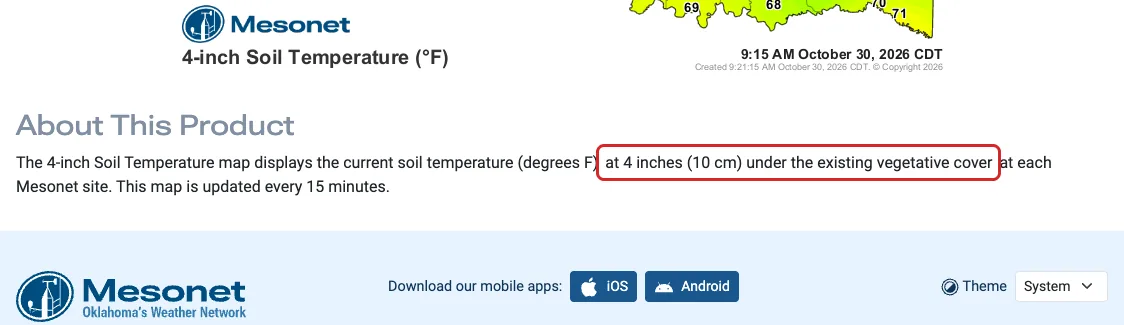
For lawns, match the map to what you plant into. The Oklahoma Mesonet 4-inch map reads under existing vegetation, which is the lawn case; bare-soil channels (Illinois, Nebraska) run warmer by day and suit a tilled garden bed. Drought.gov notes that 4 inches is the most common depth across Midwest mesonets, which is why most extension thresholds quote 4 inches.
GreenCast’s page does not name a station network. It returns a value for any location, shows a 2 to 5 cm layer, and labels its newest days as forecast, so treat it as an estimate for the top inch or two. If your state has no mesonet, the nearest USCRN station is the most consistent free benchmark, and its files back every 2026 date on this page.
When did soil reach planting temperatures in 2026?
In 2026, 4-inch soil settled at or above 50°F between Feb. 3 (Austin, Texas) and May 24 (Sandstone, Minn.) at 37 NOAA USCRN stations; three Gulf and Southwest stations never fell below it. Reaching 65°F took a further 34 to 81 days at the same stations, with a median of 54. The full table, built from NOAA’s daily files, is below and in our downloadable dataset.
We counted a threshold as reached on the day after the last run of 3 days in a row below it before July 15. That rule ignores a single cold night but resets on a real cold snap, the same 3-day logic NC State uses for crabgrass. The first column shows the first 3-day warm spell, which is when an impatient planter would have started.
Swipe the table sideways to see every column.
| USCRN station | First 3 days at 50°F or above | Stayed at 50°F or above from | Stayed at 55°F or above from | Stayed at 65°F or above from | Fall 2025: first 3 days below 50°F |
|---|---|---|---|---|---|
| Tucson 11 W, AZ | Already above on Jan. 1 | Never dropped below | Jan. 13 | Feb. 23 | Not reached in 2025 |
| Fallbrook 5 NE, CA | Already above on Jan. 1 | Never dropped below | Feb. 22 | Feb. 26 | Not reached in 2025 |
| Lafayette 13 SE, LA | Already above on Jan. 1 | Never dropped below | Feb. 4 | March 21 | Not reached in 2025 |
| Austin 33 NW, TX | Already above on Jan. 1 | Feb. 3 | Feb. 7 | March 20 | Not reached in 2025 |
| Palestine 6 WNW, TX | Already above on Jan. 1 | Feb. 3 | Feb. 9 | March 21 | Not reached in 2025 |
| Blackville 3 W, SC | Jan. 2 | Feb. 11 | Feb. 27 | April 11 | Dec. 15 |
| Stillwater 2 W, OK | Feb. 13 | Feb. 25 | Feb. 28 | April 9 | Data gap |
| Watkinsville 5 SSE, GA | Jan. 3 | Feb. 26 | March 20 | April 12 | Dec. 7 |
| Batesville 8 WNW, AR | Jan. 6 | Feb. 27 | March 20 | May 11 | Dec. 1 |
| Durham 11 W, NC | March 4 | March 4 | March 22 | May 14 | Nov. 28 |
| Corvallis 10 SSW, OR | March 12 | March 12 | April 4 | June 1 | Nov. 19 |
| Nunn 7 NNE, CO | March 19 | March 19 | May 10 | Not reached by July 15 | Oct. 28 |
| Manhattan 6 SSW, KS | March 9 | March 19 | March 21 | May 12 | Nov. 26 |
| Salem 10 W, MO | March 4 | March 19 | March 26 | May 17 | Nov. 10 |
| Bedford 5 WNW, IN | March 5 | March 20 | April 9 | May 17 | Nov. 10 |
| Versailles 3 NNW, KY | March 5 | March 21 | March 31 | May 17 | Nov. 10 |
| Charlottesville 2 SSE, VA | March 10 | March 22 | April 2 | June 1 | Dec. 3 |
| Champaign 9 SW, IL | March 30 | March 30 | April 15 | May 23 | Data gap |
| Avondale 2 N, PA | April 1 | April 1 | May 2 | June 3 | Nov. 11 |
| Lincoln 11 SW, NE | April 11 | April 11 | May 3 | May 26 | Nov. 1 |
| Millbrook 3 W, NY | April 11 | April 11 | April 24 | May 26 | Nov. 2 |
| Des Moines 17 E, IA | April 13 | April 13 | May 12 | May 31 | Nov. 9 |
| Wooster 3 SSE, OH | April 4 | April 13 | May 14 | June 9 | Nov. 11 |
| Necedah 5 WNW, WI | April 13 | April 13 | May 12 | May 26 | Oct. 24 |
| Sioux Falls 14 NNE, SD | April 13 | April 21 | May 8 | May 26 | Oct. 22 |
| Durham 2 N, NH | April 14 | April 26 | May 16 | June 29 | Oct. 27 |
| Kingston 1 W, RI | April 15 | April 29 | May 17 | June 11 | Oct. 25 |
| Brigham City 28 WNW, UT | March 22 | April 30 | May 4 | June 3 | Oct. 17 |
| Spokane 17 SSW, WA | April 30 | April 30 | May 21 | July 3 | Oct. 14 |
| Arco 17 SW, ID | May 2 | May 2 | May 4 | July 1 | Oct. 12 |
| Ithaca 13 E, NY | April 15 | May 4 | May 17 | June 28 | Oct. 24 |
| Los Alamos 13 W, NM | May 9 | May 9 | May 28 | Not reached by July 15 | Oct. 17 |
| Old Town 2 W, ME | May 15 | May 15 | June 4 | Not reached by July 15 | Oct. 27 |
| Gaylord 9 SSW, MI | April 14 | May 16 | May 25 | June 26 | Oct. 22 |
| Jamestown 38 WSW, ND | May 13 | May 21 | May 25 | July 4 | Oct. 21 |
| Lewistown 42 WSW, MT | May 8 | May 23 | June 4 | July 9 | Oct. 6 |
| Sandstone 6 W, MN | May 15 | May 24 | May 26 | June 29 | Oct. 20 |
Three patterns stand out. Southern stations had false starts: Watkinsville, Ga., logged three days above 50°F on Jan. 3 but did not hold that level until Feb. 26, and Blackville, S.C., went from Jan. 2 to Feb. 11. In all, 21 of 37 stations crossed 50°F and fell back before the level held.
The 50°F to 65°F gap is the window between cool-season and warm-season seeding. It ran 34 days at Brigham City, Utah, 35 at Sioux Falls, S.D., 54 at Champaign, Ill., 71 at Durham, N.C., and 81 at Corvallis, Ore., where 4-inch soil sat between 50 and 65°F for nearly 12 weeks. Durham reached 65°F on May 14, which matches NC State’s “usually after the first of May” rule for bermudagrass seed.
In fall 2025, soil fell below 50°F for three days running as early as Oct. 6 at Lewistown, Mont., and as late as Dec. 15 at Blackville, S.C.; Austin, Lafayette, Tucson and Fallbrook never got there. A cool-season lawn seeded within 4 to 6 weeks of that date is racing the cold.
Is soil temperature the same as air temperature?
No, but at 4 inches under grass the two run closer in spring than most guides suggest. Across the USCRN stations, the median 4-inch soil reading averaged 1.2°F cooler than air in March 2026, then 0.5°F warmer in April and 1.25°F warmer in May. The bigger gap comes in fall, when soil held 2.1 to 4.3°F above air.
| Month | Median: 4-in soil minus air (°F) | Range across stations (°F) | Stations |
|---|---|---|---|
| Sept. 2025 | +2.1 | -0.6 to +12.5 | 35 |
| Oct. 2025 | +4.0 | +1.1 to +8.1 | 35 |
| Nov. 2025 | +4.3 | -1.8 to +8.4 | 35 |
| March 2026 | -1.2 | -9.4 to +5.8 | 37 |
| April 2026 | +0.5 | -3.9 to +11.7 | 37 |
| May 2026 | +1.25 | -4.8 to +10.8 | 34 |
The spread matters more than the median. Desert stations ran far warmer underground (Fallbrook, Calif., +11.7°F in April), while Charlottesville, Va., Des Moines, Iowa, and Sandstone, Minn., ran 3.4 to 3.9°F cooler than air in April. A forecast high of 70°F says little about your soil; a 4-inch reading or a nearby mesonet value says a lot more.
- Air
- 2 in soil
- 4 in soil
Source: NOAA NCEI USCRN daily01 file for Sioux Falls 14 NNE; Green Industry Report weekly means, Oct. 2026 Weeks start on the date shown. The same numbers are in the table below.
Show the numbers
| Air | 2 in soil | 4 in soil | |
|---|---|---|---|
| Mar 23 | 42.60 | 41.80 | 41.50 |
| Mar 30 | 39.70 | 42.30 | 42.20 |
| Apr 6 | 39.40 | 43.60 | 43 |
| Apr 13 | 51.30 | 51.70 | 50.80 |
| Apr 20 | 55.50 | 54.10 | 53 |
| Apr 27 | 49 | 51.70 | 51.30 |
| May 4 | 50.80 | 54.90 | 54.10 |
| May 11 | 65.50 | 61.30 | 59.60 |
| May 18 | 54.60 | 58.60 | 57.80 |
| May 25 | 73.70 | 69 | 66.80 |
| Week starting | Air (°F) | 2 in soil (°F) | 4 in soil (°F) |
|---|---|---|---|
| Mar 23 | 42.6 | 41.8 | 41.5 |
| Mar 30 | 39.7 | 42.3 | 42.2 |
| Apr 6 | 39.4 | 43.6 | 43.0 |
| Apr 13 | 51.3 | 51.7 | 50.8 |
| Apr 20 | 55.5 | 54.1 | 53.0 |
| Apr 27 | 49.0 | 51.7 | 51.3 |
| May 4 | 50.8 | 54.9 | 54.1 |
| May 11 | 65.5 | 61.3 | 59.6 |
| May 18 | 54.6 | 58.6 | 57.8 |
| May 25 | 73.7 | 69.0 | 66.8 |
The Sioux Falls weeks show the damping at work. Air swung from 65.5°F to 54.6°F and back to 73.7°F in May, while 4-inch soil moved from 59.6°F to 57.8°F to 66.8°F. A one-week warm spell moved the soil less than half as much as the air.
How do you measure soil temperature?
Push a probe soil thermometer to the depth that matches the job (1 inch for grass seed, seed depth for vegetables, 4 inches for transplants), read it at the same morning hour for 3 or more days, and average the readings. Illinois Extension gives that method; USCRN hourly data show how much the hour and depth change the number.
- Pick the depth. Grass seed: about 1 inch (UMD). Vegetable seed: planting depth; transplants: 4 inches (Illinois Extension). To compare with a mesonet map, use 4 inches.
- Make a pilot hole in firm soil. Illinois Extension suggests a screwdriver to the right depth so the stem does not bend.
- Measure where you will plant. A bed against a south wall or a driveway edge is not the middle of the lawn; take the reading in the spot being seeded.
- Read at a fixed hour. In April to May 2026, the 4-inch low arrived around 7 to 10 a.m. daylight time and the high around 5 to 8 p.m. (USCRN hourly data, six stations).
- Repeat for at least 3 days and average. Illinois Extension advises averaging several days; NC State’s crabgrass trigger uses 3 or 4 consecutive days.
- Check the trend. Compare your average with the nearest network station; if it is falling, wait even when today is above the threshold.
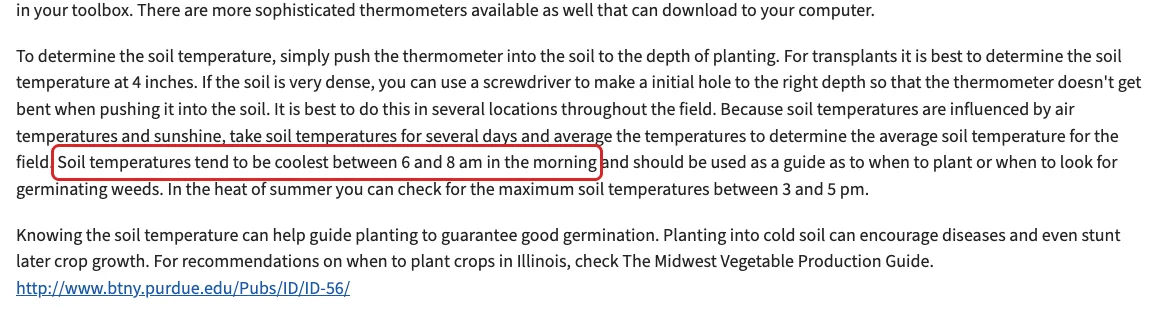
A morning reading is a conservative one. At 4 inches, the 8 a.m. standard-time reading (9 a.m. daylight time) averaged 1.4 to 3.5°F below the 24-hour mean at the six stations; at 2 inches it averaged 2.4 to 5.1°F below. If your morning number already clears the threshold, the daily mean clears it too.
| Station | Air swing (°F) | 2 in swing (°F) | 4 in swing (°F) | 8 in swing (°F) | 4 in: 8 a.m. LST minus daily mean (°F) | 4 in: median hour ending at low / high (LST) |
|---|---|---|---|---|---|---|
| Champaign, IL | 21.3 | 19.5 | 8.0 | 2.9 | -3.5 | 7:00 / 17:00 |
| Manhattan, KS | 24.0 | 8.4 | 4.8 | 2.3 | -2.1 | 8:00 / 18:00 |
| Durham, NC | 24.5 | 11.6 | 4.1 | 3.8 | -1.8 | 8:00 / 17:00 |
| Ithaca, NY | 19.5 | 6.1 | 3.7 | 2.5 | -1.4 | 9:00 / 18:00 |
| Sioux Falls, SD | 26.7 | 10.5 | 6.0 | 2.3 | -2.6 | 9:00 / 18:00 |
| Spokane, WA | 30.3 | 9.5 | 3.9 | 2.6 | -1.8 | 8:00 / 19:00 |
Depth explains most of the swing. Champaign’s 2-inch probe swung 19.5°F a day on average, its 4-inch probe 8.0°F and its 8-inch probe 2.9°F. At Champaign, a 2-inch reading at 4 p.m. standard time averaged 9.1°F above the daily mean, enough to make April soil look ready for bermudagrass seed when it is not.
What soil temperature do vegetable seeds need?
Vegetable seed sorts into three groups by minimum soil temperature: 35 to 40°F for lettuce, spinach, onion, peas and root crops; 50°F for tomato and sweet corn; and 60°F for beans, cucumbers, peppers, squash and melons. Harrington’s UC Davis data show emergence running two to five times faster at 68°F than at 50°F.
Swipe the table sideways to see every column.
| Crop | Minimum (°F) | Optimum range (°F) | Days to emerge at 50°F | Days to emerge at 68°F |
|---|---|---|---|---|
| Lettuce | 35 | 40 to 80 | 7 | 3 |
| Spinach | 35 | 45 to 75 | 12 | 6 |
| Onion | 35 | 50 to 95 | 13 | 5 |
| Pea | 40 | 40 to 75 | 13 | 7 |
| Carrot | 40 | 45 to 85 | 17 | 7 |
| Beet | 40 | 50 to 85 | 17 | 6 |
| Radish | 40 | 45 to 90 | 11 | 4 |
| Sweet corn | 50 | 60 to 95 | 22 | 7 |
| Tomato | 50 | 60 to 85 | 43 | 8 |
| Bean | 60 | 60 to 85 | Little or none | 11 |
| Cucumber | 60 | 60 to 95 | Little or none | 6 |
| Pepper | 60 | 65 to 95 | Little or none | 12 |
| Squash | 60 | 70 to 95 | Not listed | Not listed |
| Watermelon | 60 | 70 to 95 | Not tested | 12 |
The practical cost of planting cold is time and seed rot. Tomato seed needs 43 days to emerge at 50°F and 14 days at 59°F; pepper and bean seed barely germinate at 50°F. Seed that sits in cold, wet soil for six weeks is exposed to rot and damping-off the whole time, which is why sowing at the minimum is a gamble for warm-season crops. Our data set gives the full emergence table from 32°F to 104°F.
When is soil warm enough for grass seed and crabgrass preventer?
Cool-season grass seed germinates fastest at 50 to 70°F at 1 inch (University of Maryland), crabgrass starts at a 24-hour mean near 55°F for 3 or 4 days (NC State), and warm-season seed needs 65°F for bermudagrass and 68°F for zoysiagrass. In 2026 the 4-inch soil held 65°F from March 20 at Austin, Texas, to May 14 at Durham, N.C., and July 9 at Lewistown, Mont.
| Lawn job | Soil trigger | What 2026 USCRN data showed | Source for trigger |
|---|---|---|---|
| Spring seeding, cool-season | 50 to 70°F at about 1 in | Held 50°F at 4 in from Feb. 3 (Austin) to May 24 (Sandstone, Minn.); never fell below at Tucson, Fallbrook or Lafayette | UMD |
| Crabgrass preventer down | Before a 24-hour mean of about 55°F for 3 or 4 days | Held 55°F at 4 in from Jan. 13 (Tucson) to June 4 (Old Town, Maine, and Lewistown, Mont.) | NC State TurfFiles |
| Bermudagrass seed | 65°F | Held 65°F at 4 in from Feb. 23 (Tucson) and March 20 (Austin) to May 14 (Durham, N.C.) and July 9 (Lewistown) | NC State Extension |
| Zoysiagrass seed | 68°F | Arkansas expects it in late May | Arkansas MP476 |
| Fall seeding, cool-season | 50 to 70°F at about 1 in, falling | First 3 days below 50°F: Oct. 6 (Lewistown, Mont.) to Dec. 15 (Blackville, S.C.), 2025 | UMD |
| Dormant seeding | 40°F or lower | First 3 days below 40°F: Oct. 27 (Arco, Idaho) to Dec. 14 (Manhattan, Kan.), 2025 | Iowa State |
NC State’s Feb. 8, 2024 TurfFiles post shows why the 3-day rule matters: Raleigh soil passed 55°F for 3 days in late January that year, weeks before the real season. Depth and timing detail for preemergent herbicide, with dates for 21 cities, is in our crabgrass prevention guide, and fall timing for seed is in our overseeding guide.
Warm-season lawns are the case where soil beats the calendar. Clemson Extension targets May 1 to 14 in South Carolina and Arkansas warns against seeding zoysiagrass before May 15, because cooler soil slows germination (Arkansas) and raises seed rot (Clemson); the bermudagrass and zoysiagrass profiles carry regional dates.
When is soil too cold to plant trees and shrubs?
Tree and shrub roots keep growing in fall until the soil dips below 40°F, according to University of New Hampshire Extension, which advises giving new plants at least six weeks of mild weather before freezing and calls early October a good deadline in New Hampshire. Deciduous, fibrous-rooted plants handle fall planting better than evergreens.
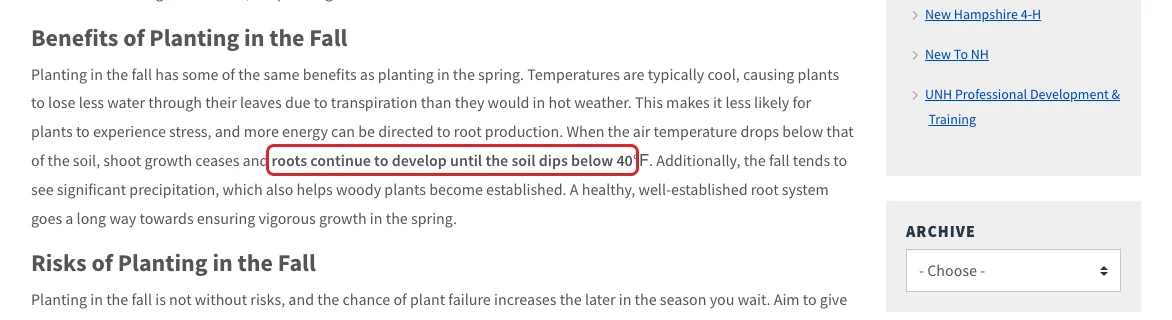
The USCRN fall data give that deadline a number by region. At Durham 2 N, N.H., 4-inch soil first fell below 40°F for three days on Nov. 23, 2025, so UNH’s early-October cutoff leaves about seven weeks. At Spokane the date was Nov. 29, at Des Moines Dec. 5, and Durham, N.C., never got there. Our tree planting cost guide prices the stock.
Which soil temperature rules of thumb hold up?
Four claims repeat across top-ranking soil temperature pages. The 2026 USCRN data support the morning-reading rule, contradict the idea that soil always lags air in spring, show that one warm week is a poor signal in the South, and put the 4-inch daily high later than the 3 to 5 p.m. window often quoted.
| Common claim | What the data or primary source says | Source |
|---|---|---|
| Soil always warms more slowly than air in spring | At 4 in under grass, the median station was 1.2°F cooler than air in March 2026 but 0.5 to 1.25°F warmer in April and May | NOAA USCRN 2026 |
| A few warm days means the soil is ready | 21 of 37 stations crossed 50°F for 3 days, then fell back; at Watkinsville, Ga., the gap was 54 days | NOAA USCRN 2026 |
| Check the daily maximum between 3 and 5 p.m. | True at 2 in (median high 2 to 5 p.m. standard time); at 4 in the high came at 5 to 7 p.m. standard time in April to May | USCRN hourly 2026; Illinois Extension |
| Measure in the morning for a safe number | Supported: at 4 in, 8 a.m. standard-time readings ran 1.4 to 3.5°F below the daily mean | USCRN hourly 2026 |
Should you plant today?
Plant when a 3-day average at the right depth clears the crop’s minimum and the trend is flat or rising. Below 50°F in spring, only lettuce, spinach, onion, peas and root crops go in; 65°F opens warm-season grass seed; in fall, 40°F ends tree planting and starts dormant seeding.
| If your situation is | Do this | Why (source) |
|---|---|---|
| Spring, 4-in soil under 40°F | Wait; prepare beds only | Even lettuce at 32 to 41°F takes 15 to 49 days to emerge (Harrington, OSU) |
| Spring, 3-day average 40 to 49°F | Sow peas, lettuce, spinach, onion, radish, carrots | Minimums are 35 to 40°F (Harrington, OSU) |
| Soil 50 to 55°F and rising, lawn has had crabgrass | Apply preemergent now | Crabgrass starts at a 24-hour mean near 55°F for 3 or 4 days (NC State) |
| Soil 50 to 70°F at 1 in, spring or fall | Seed tall fescue, bluegrass, ryegrass | Optimum germination range (UMD) |
| Soil 50 to 59°F, want tomatoes from seed | Start indoors or wait for 60°F | Emergence takes 43 days at 50°F, 14 at 59°F (Harrington, OSU) |
| Soil 60 to 64°F | Sow beans, cucumbers, squash | Minimums are 60°F (Harrington, OSU) |
| 4-in soil 65°F or more for 3+ days | Seed bermudagrass; zoysiagrass at 68°F | NC State Extension; Arkansas MP476 |
| Fall, at least 6 weeks before soil falls below 40°F | Plant deciduous trees and shrubs | Roots grow until 40°F (UNH Extension) |
| Fall, soil 40°F or lower, air below 30 to 40°F | Dormant-seed cool-season grass | Seed waits until spring (Iowa State) |
1Is it fall and is 4-inch soil at 40°F or lower?
YesToo cold for new trees to root (UNH). Dormant-seed cool-season grass now; the seed waits for spring (Iowa State).
NoGo to the next question
2Have you had fewer than 3 days in a row at your target temperature?
YesWait. One warm spell is not a trend: 21 of 37 USCRN stations crossed 50°F at 4 inches, then fell back, in 2026.
NoGo to the next question
3Is the 4-inch soil at 65°F or warmer and holding?
YesSeed bermudagrass (NC State) and, at 68°F, zoysiagrass (Arkansas); sow beans, cucumbers, squash and peppers.
NoGo to the next question
4Is it 60 to 64°F?
YesSow beans, cucumbers and squash (60°F minimums); hold warm-season grass seed a little longer.
NoGo to the next question
5Is it 50 to 59°F?
YesSeed cool-season grass (50 to 70°F, UMD); sow carrots, beets, corn and tomatoes, which emerge slowly at 50°F.
NoBelow 50°F in spring: sow only lettuce, spinach, onion (35°F minimums), peas, carrots, beets and radish (40°F), and wait on grass seed.
How we compiled this
We downloaded NOAA USCRN daily files for 42 stations (2025 and 2026) and hourly files for 6 on Oct. 30, 2026, dropped 5 stations with over 50 missing spring days (plus fall data for 2 more), and computed threshold dates, soil-minus-air differences and daily swings from 10 cm readings. Thresholds come from 10 extension publications and network pages read in October 2026. We took no field readings. The CSV holds 778 rows.
| Number | Value | Source |
|---|---|---|
| Cool-season grass seed | 50 to 70°F at about 1 in | UMD |
| Crabgrass trigger | About 55°F, 24-hour mean, 3 or 4 days | NC State TurfFiles |
| Bermudagrass / zoysiagrass seed | 65°F / 68°F | NC State; Arkansas MP476 |
| Tomato emergence at 50°F vs 68°F | 43 vs 8 days | Harrington via OSU |
| Tree roots stop | Below 40°F soil | UNH Extension |
| 2026 date 4-in soil held 50°F | Feb. 3 (Austin) to May 24 (Sandstone, Minn.); 3 stations never below | NOAA USCRN; our analysis |
| Daily swing at 4 in vs air | 3.7 to 8.0°F vs 19.5 to 30.3°F | NOAA USCRN hourly; our analysis |
Frequently asked questions
What is a good soil temperature for planting?
It depends on the crop group, not the calendar. Cool-season grass seed and hardy vegetables like peas and carrots start at 40 to 50°F, tomatoes and sweet corn need 50°F, and beans, cucumbers, peppers and bermudagrass need 60 to 65°F. University of Maryland puts the lawn-seed optimum at 50 to 70°F at about 1 inch; Harrington’s UC Davis table, published by Oregon State, lists minimums for 24 vegetables.
How deep should you measure soil temperature?
Match the job. Measure at about 1 inch for grass seed (University of Maryland), at seed depth for vegetable seed and at 4 inches for transplants (Illinois Extension). Use 4 inches when comparing with a mesonet map, because Drought.gov says 4 inches is the most common depth in Midwest networks. In 2026 data, a 2-inch probe swung up to 19.5°F a day, against 8.0°F at 4 inches.
What time of day should you check soil temperature?
Check in the morning at the same hour each day. Illinois Extension says soil is coolest between 6 and 8 am. In USCRN data for April to May 2026, the 4-inch low arrived later, around 7 to 10 a.m. daylight time, and an 8 a.m. standard-time reading ran 1.4 to 3.5°F below the daily mean, which makes it a safe, conservative number.
Is soil warmer or colder than air?
At 4 inches under grass, both. In March 2026 the median USCRN station read 1.2°F cooler than mean air, in April 0.5°F warmer and in May 1.25°F warmer. In fall 2025, soil ran 2.1 to 4.3°F warmer than air from September to November, which is why roots keep growing after leaves stop. Southwest sites ran up to 11.7°F warmer underground in April.
How do I find the soil temperature in my area?
Use the nearest research network: Oklahoma Mesonet, Iowa State’s soil network, the Illinois Climate Network, NC ECONet, Drought.gov’s Midwest maps, or NOAA’s national USCRN files. Syngenta’s free GreenCast map covers every ZIP code at a 2 to 5 cm layer, but it is an estimate with forecast days, so confirm with a probe thermometer at your planting spot.
What soil temperature is too cold for grass seed?
Below 50°F, cool-season seed germinates slowly; the University of Maryland optimum is 50 to 70°F at about 1 inch. Warm-season seed needs more: 60°F for buffalograss (Nebraska), 65°F for bermudagrass (NC State) and 68°F for zoysiagrass (Arkansas). At 40°F or lower, Iowa State treats seed as dormant: it sits until spring, which is the basis of dormant seeding.
What soil temperature do tomatoes need?
Tomato seed has a 50°F minimum and a 60 to 85°F optimum range in Harrington’s UC Davis data, published by Oregon State. Emergence took 43 days at 50°F, 14 days at 59°F and 8 days at 68°F. For transplants, Illinois Extension says to read soil at 4 inches, and the 60°F mark is a safer target than the 50°F germination floor.
When is the ground too cold to plant trees?
University of New Hampshire Extension says roots keep growing until soil dips below 40°F and advises at least six weeks of mild weather before freezing. In fall 2025, 4-inch soil first spent three days below 40°F on Nov. 9 at Gaylord, Mich., Nov. 23 at Durham, N.H., and Dec. 5 at Des Moines; count back six weeks for a planting deadline.
Sources
- NOAA National Centers for Environmental Information, U.S. Climate Reference Network daily01 files, 2025 and 2026 (10 cm soil temperature, air temperature), Downloaded Oct. 30, 2026. Accessed October 2026.
- NOAA National Centers for Environmental Information, U.S. Climate Reference Network hourly02 files, 2026, Downloaded Oct. 30, 2026. Accessed October 2026.
- NOAA NCEI, U.S. Climate Reference Network overview, Current page. Accessed October 2026.
- Oregon State University Extension, Soil temperature conditions for vegetable seed germination (J. F. Harrington, UC Davis), April 2013, reviewed 2024. Accessed October 2026.
- University of Maryland Extension, Starting a New Lawn, Current page. Accessed October 2026.
- Penn State Extension, The Cool-Season Turfgrasses: Basic Structures, Growth and Development, Sept. 19, 2025. Accessed October 2026.
- NC State Extension TurfFiles, When to Apply Preemergent Herbicides for Turfgrasses, Feb. 8, 2024. Accessed October 2026.
- NC State Extension, Polk County Center, Establishing Bermudagrass Pasture, April 2023. Accessed October 2026.
- University of Arkansas Division of Agriculture, MP476, Establishing Seeded Zoysiagrass on Lawns and Golf Courses, Current PDF. Accessed October 2026.
- Nebraska Extension, Establishing Buffalograss Turf in Nebraska, Current page. Accessed October 2026.
- Clemson Cooperative Extension, HGIC, Lawn Establishment, Current page. Accessed October 2026.
- Iowa State University Extension and Outreach, Seeding a New Lawn, Current page. Accessed October 2026.
- University of New Hampshire Extension, Is fall a good time to plant trees and shrubs?, Aug. 29, 2019. Accessed October 2026.
- University of Illinois Extension, Soil Thermometer: A Useful Toolbox Tool, March 31, 2014. Accessed October 2026.
- Oklahoma Mesonet, 4-inch Soil Temperature map, About This Product, Current page. Accessed October 2026.
- Oklahoma Mesonet, Soil Temperature maps, Current page. Accessed October 2026.
- Iowa State University, Iowa Environmental Mesonet, County 4 inch Soil Temperature Maps, Current page. Accessed October 2026.
- Iowa State University, Iowa Environmental Mesonet, ISU Soil Moisture Network, Current page. Accessed October 2026.
- Illinois State Water Survey, Illinois Climate Network soil data (WARM), Current page. Accessed October 2026.
- University of Nebraska-Lincoln CropWatch, Soil Temperature Maps and Data, Current page. Accessed October 2026.
- Drought.gov (NIDIS), Regional Mesonet Program (RMP) Soil Temperature Maps, Current page. Accessed October 2026.
- State Climate Office of North Carolina, NC ECONet, Current page. Accessed October 2026.
- Syngenta GreenCast, Soil Temperature map, Current page. Accessed October 2026.