
How to mow a lawn: set the deck to your grass (2.5 to 4 inches for tall fescue, 1 to 2 for bermuda), mow dry grass before it reaches 1.5 times that height, overlap each pass and change direction every mowing.
Learning how to mow a lawn well is mostly about one number: the height of cut. Purdue Extension says improper mowing causes more lawn problems than any other maintenance practice, and that many lawns are mowed too short, not often enough or with a dull blade. The other steps (direction, overlap, slope technique, when to skip a mow) matter less, and each one is below with the source that sets it.
One thing no top-ranking guide checks is whether your mower can reach the height your grass needs. We read the cutting-height specifications in 9 operator manuals and set them against extension heights for 11 grasses. A Greenworks 25022 tops out at 3.75 inches, below the 4 inches UF/IFAS gives standard St. Augustinegrass, and none of the 9 decks goes as low as the 0.5 inch Arkansas lists for hybrid bermudagrass. Three of the manuals also print a “1-1/2 to 2 inches in cool months” rule that sits below every cool-season range we found.
What height should you cut your grass? Ranges for 11 grasses
Set height by species, then mow when the grass reaches 1.5 times that setting so each cut removes no more than one-third of the leaf (Arkansas FSA6023). The example column picks one setting inside each range. Raise any setting 0.5 to 1 inch in shade, per Purdue AY-8-W.
| Grass | Height range, in | Extension source | Example setting | Mower type | Of the 9 manual decks below |
|---|---|---|---|---|---|
| Kentucky bluegrass | 2.5 to 3.5 | Arkansas 2.5 to 3.5; Purdue 2.0 to 3.5 | 3 in, mow at 4.5 in | Rotary | 8 of 9 reach 3.5 in; not Snow Joe MJ502M |
| Tall fescue | 2.5 to 4 | Arkansas and Purdue 2.5 to 4.0 | 3.5 in, mow at 5.25 in | Rotary | 7 of 9 reach 4 in; not Greenworks 25022 or Snow Joe MJ502M |
| Perennial ryegrass | 2 to 3.5 | Purdue 2.0 to 3.5 | 2.5 in, mow at 3.75 in | Rotary | 8 of 9 reach 3.5 in; not Snow Joe MJ502M |
| Fine fescue | 2 to 3.5 | Purdue 2.0 to 3.5 | 2.5 in, mow at 3.75 in | Rotary | 8 of 9 reach 3.5 in; not Snow Joe MJ502M |
| Common bermudagrass | 1.5 to 2.5 | Arkansas 1.5 to 2.5 | 2 in, mow at 3 in | Rotary or reel | All 9 |
| Hybrid bermudagrass | 0.5 to 1.5 | Arkansas 0.5 to 1.5; UF 0.5 to 1.5 | 1 in, mow at 1.5 in | Reel below 1 in (Purdue, Arkansas) | None reach 0.5 in; all reach 1.5 in |
| Zoysiagrass | 0.75 to 2.5 | Arkansas 0.75 to 2.5; Purdue 1.0 to 2.0; UF coarse types 2.0 to 2.5 | 1.5 in, mow at 2.25 in | Rotary at 1 to 2 in, reel at 0.5 to 1 in (Arkansas) | Only 1 of 9 reaches 0.75 in (Honda HRX217) |
| Centipedegrass | 1.5 to 2 | Arkansas and UF 1.5 to 2.0 | 1.5 in, mow at 2.25 in | Rotary (UF) | All 9 |
| St. Augustinegrass, standard (Floratam and others) | 3.5 to 4 | UF 3.5 to 4 (Arkansas lists 2.5 to 4.0 for the species) | 4 in, mow at 6 in | Rotary (UF) | 7 of 9 reach 4 in; not Greenworks 25022 or Snow Joe MJ502M |
| St. Augustinegrass, dwarf (Captiva, Delmar, Seville) | 2.5 | UF 2.5 | 2.5 in, mow at 3.75 in | Rotary (UF) | All 9 |
| Bahiagrass | 3 to 4 | UF 3.0 to 4.0 | 3.5 in, mow at 5.25 in | Rotary (UF) | 7 of 9 reach 4 in; not Greenworks 25022 or Snow Joe MJ502M |
Cool-season grasses sit highest: tall fescue at 2.5 to 4 inches, and Arkansas says it and St. Augustinegrass perform best at about 3 inches. Bermudagrass and zoysiagrass go lower, at 1 to 2 inches with a rotary mower or 0.5 to 1 inch with a reel. Not sure which grass you have? Our guide to lawn grass types separates 14 of them.
Can your mower reach that height?
| Mower | Type | Cutting height range | Steps | Source |
|---|---|---|---|---|
| Honda HRN216 (VKA) | Gas walk-behind, 21 in | 1 to 4 in | 7 positions, 1/2 in apart | Manual, p. 6 |
| Honda HRX217 (HYA, HZA) | Gas walk-behind, 21 in | 0.75 to 4 in | 7 positions | Manual, p. 20 |
| EGO LM2130SP / LM2150SP | Battery walk-behind, 21 in | 1 to 4 in | 8 positions | Manual, p. 13 |
| Ryobi RY401018 | Battery walk-behind, 20 in | 1.5 to 4 in | Lever, range only | Manual, p. 11 |
| Ryobi RY40HPLM01 | Battery walk-behind, 21 in | 1 to 4 in | Lever, range only | Manual, p. 11 |
| Greenworks 25022 | Corded electric, 20 in | 1.5 to 3.75 in | Lever, range only | Manual, p. 3 |
| Toro TimeCutter ZR4200T / ZS4200T | Zero-turn rider | 1.5 to 4.5 in | 1/2 in increments | Manual, p. 25 |
| Scag Cheetah II | Commercial zero-turn | 1.25 to 5 in | 1/4 in increments | Manual, p. 30 |
| Snow Joe MJ502M | Manual reel, 20 in | 1.34 to 2.52 in | 9 positions | Manual, p. 2 |
Read the two tables together and three gaps show up. First, 7 of 9 decks reach 4 inches or more, but the Greenworks 25022 stops at 3.75 and the Snow Joe reel at 2.52, so neither can hold St. Augustinegrass, bahiagrass or tall fescue at the top of its range. Second, only the Honda HRX217 goes below 1 inch (to 0.75), and UF/IFAS says most rotary mowers cannot cut lower than 1 inch and work best above 2 inches.
Third, a reel mower is not automatically a low-cut mower. Arkansas pairs reels with 0.5 to 1 inch bermuda and zoysia, but the Snow Joe MJ502M manual lists 1.34 to 2.52 inches across 9 positions. If you keep hybrid bermudagrass under 1 inch, check the reel’s printed range before you buy it.
Why do mower manuals say 1.5 to 2 inches?
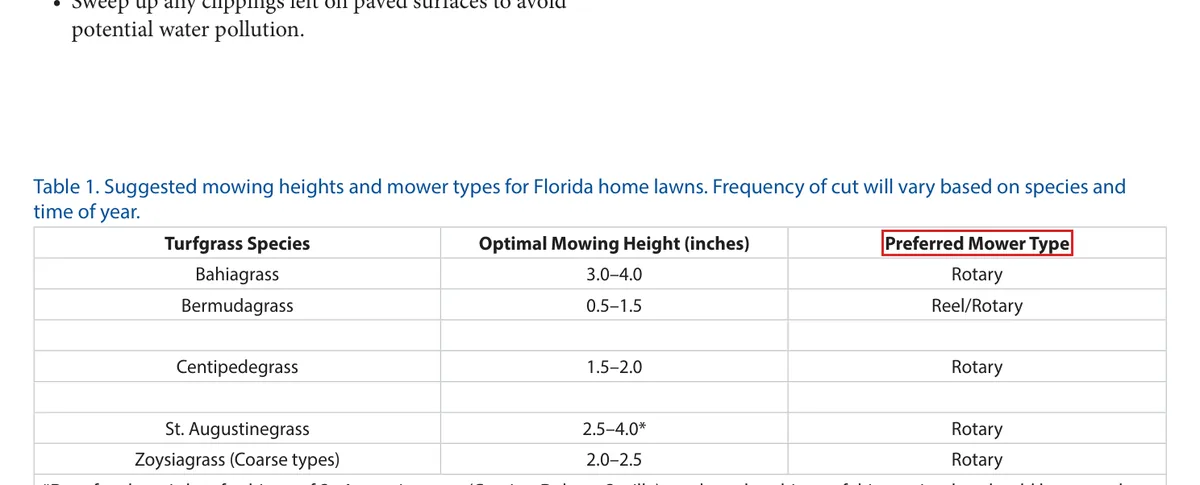
The EGO LM2130SP manual (p. 40), the Ryobi RY401018 manual (p. 13) and the Greenworks 25022 manual (p. 20) all carry nearly the same sentence: the average lawn should be 1-1/2 to 2 inches in cool months and about 2 to 3-1/4 inches in hot months (Greenworks says 3-1/2). None names a grass. For Kentucky bluegrass (2.5 to 3.5 in Arkansas) and tall fescue (2.5 to 4), 2 inches is below the extension floor, and Purdue says mowing below the optimum height restricts roots and invites weeds.
Toro’s own walk-behind manual takes the other side. The Toro 21321 manual (p. 16) says not to cut below 2 inches unless the grass is sparse or growth is slowing in late fall. Where a manual and an extension table disagree on height, use the extension figure for your species; the manual is the authority on the machine, not the grass.
How to mow a lawn, step by step
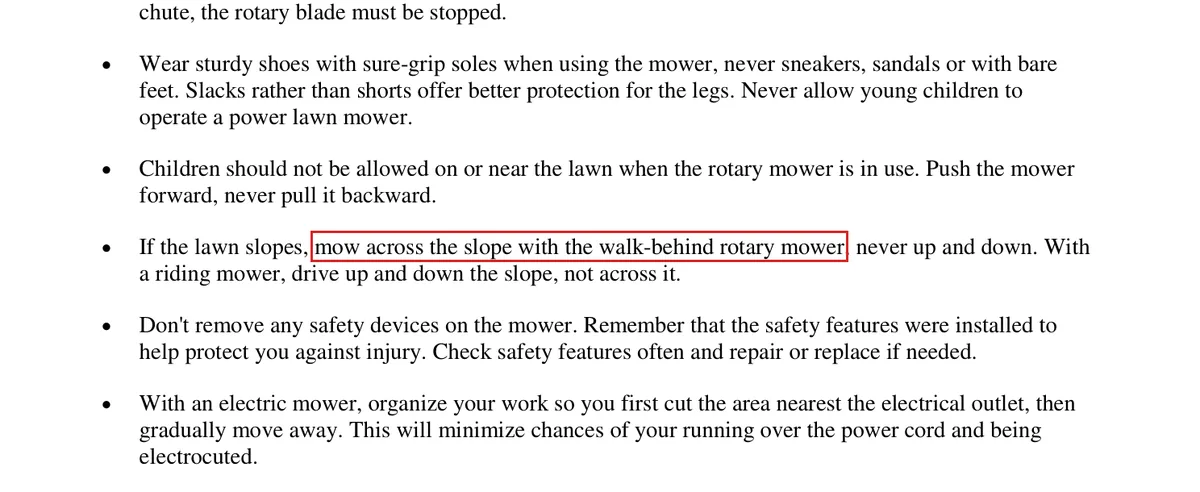
- Walk the lawn first. Pick up sticks, stones and wire; CPSC says objects thrown from under mowers have caused severe injuries and deaths. Wear sturdy shoes and long pants.
- Check that the grass is dry. Honda says to mow when the grass is dry to the touch but the soil is still moist (HRN216 manual, p. 9). Rules for a wet lawn are in our guide to mowing wet grass.
- Set the height with the engine off. Park on a driveway and measure from the pavement to the blade with a ruler (UF/IFAS ENH10); set all wheels to the same notch (Toro 21321, p. 13).
- Check the trigger height. If the grass is already over 1.5 times your setting, cut once at the highest setting at a slow walk and come back 2 to 3 days later (Honda) or 2 days later (Toro TimeCutter manual, p. 26).
- Aim the discharge. Plan passes so clippings do not blow toward roads, sidewalks, people or walls (Cub Cadet XT1 manual, p. 3). With a corded mower, start nearest the outlet and work away from it (CPSC).
- Mow the perimeter, then the interior. Two laps around the edge give you room to turn; then run straight passes, overlapping each by a few inches (Honda, p. 9).
- Keep speed and throttle right. Walk slower in thick grass (Toro, p. 17); on riders, run the engine at full throttle, since lower RPM tears the grass (Scag Cheetah II, p. 30).
- Trim, then clean up. Trim around beds and obstacles, then sweep or blow clippings off paved surfaces back onto the lawn; UF/IFAS says clippings that reach a storm drain could contribute to water pollution.
- Clean the deck. Toro’s TimeCutter manual says to clear clippings and dirt from under the deck after each use, because buildup eventually degrades the cut (p. 27).
The one-third rule in step 4 comes from a 1955 USDA root study; our page on how often to mow your lawn walks through that research and turns it into days between mows. In short, a 3-inch lawn is cut before it reaches 4.5 inches (Arkansas), and Purdue’s stricter example cuts at 4.
If you fell behind, step down instead of scalping. Arkansas says to raise the deck so the cut stays within one-third, then lower it over the next 2 or 3 mowings; scalping back in one pass leaves clumps that smother the grass below.
Which direction should you mow?
Change direction every time. UF/IFAS says alternating prevents wear patterns, reduces grain (grass lying over in one direction) and lowers the chance of scalping; Arkansas, Toro and Scag say the same. On a rectangle, that means rotating among 2 or 3 patterns (lengthwise, crosswise, diagonal) so the wheels do not track the same lines each week.
| Pattern question | What the source says | Source |
|---|---|---|
| Mulching with a Honda walk-behind | Counterclockwise pattern; split odd-shaped lawns into sections | Honda HRN216, p. 9 |
| Bagging with a Honda walk-behind | Clockwise pattern for the best pickup | Honda HRN216, p. 9 |
| EGO walk-behind | Do not mow in circles; travel back and forth | EGO LM2130SP, p. 40 |
| Stripes on a zero-turn | Alternate stripe pattern; vary stripe direction each mowing | Scag Cheetah II, p. 30 |
| Overlap | A few inches per pass; more overlap and a narrower swath in tall or thick grass | Honda HRN216, p. 9 |
| Every mowing | Mow in a different direction each time | UF/IFAS ENH10; Arkansas FSA6023 |
How do you mow a slope safely?
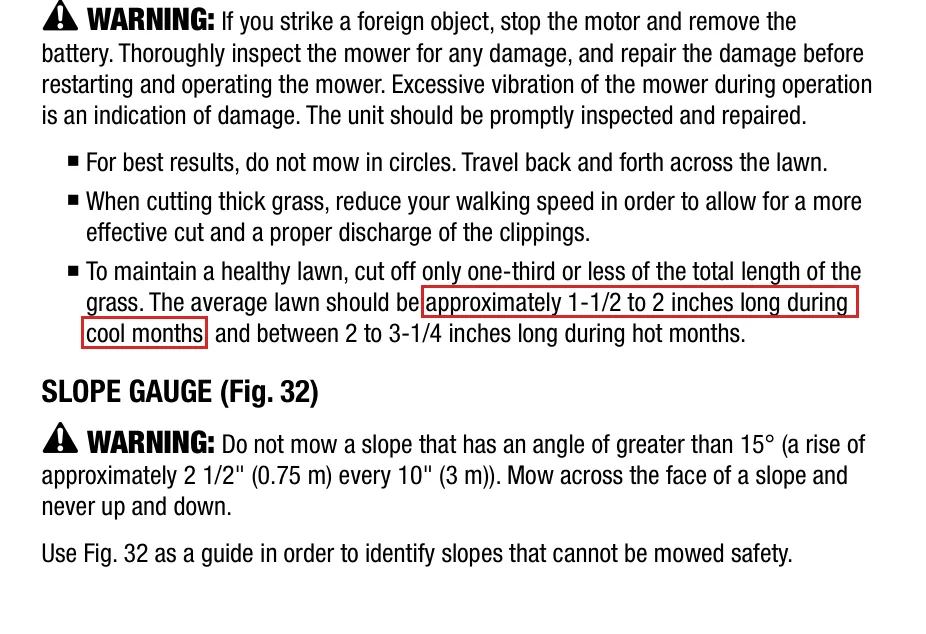
Direction on a slope depends on the machine. With a walk-behind rotary mower, mow across the slope, never up and down; with a riding mower, drive up and down, not across (CPSC Publication 5126). CPSC counts about 35,000 riding-mower injuries treated in emergency rooms a year (2012 to 2014) and about 90 deaths a year (2008 to 2010) (Publication 588).
Some zero-turn manuals reverse the riding mower rule: John Deere’s Z300-series ZTrak manual and Cub Cadet’s lapbar zero-turn manual both say to mow across slopes, while Husqvarna’s Z248F says up and down, and our zero-turn vs lawn tractor comparison lists the slope limit and direction from 8 operator’s manuals.
| Machine | Direction on a slope | Printed slope limit | Source |
|---|---|---|---|
| Walk-behind rotary (any) | Across the face | UGA: push mowers up to 20 degrees (36 percent) | CPSC 5126; UGA Extension |
| EGO LM2130SP walk-behind | Across the face, never up and down | 15 degrees | EGO manual, p. 40 |
| Riding mower or lawn tractor (any) | Up and down | UGA: unsafe above 27 percent | CPSC 588; UGA Extension |
| Cub Cadet XT1 / XT2 tractor | Up and down, not across | 15 degrees, measured with the manual’s slope gauge | Cub Cadet 769-10975A, p. 4 |
| Toro TimeCutter zero-turn | Avoid starting, stopping or turning on slopes | 15 degrees; stay 2 machine widths from drop-offs | Toro 3479-377, pp. 6 to 7 |
| Scag Cheetah II zero-turn | Back-up test before mowing | 15 degrees; stay 2 cut widths from drop-offs | Scag 03577, p. 2 |
Measure before you mow. UGA Extension lays a 10-foot tape level from the top of the slope and measures the drop at the bottom with a yardstick: a 3-foot drop over 10 feet is a 30 percent grade, too steep to ride. A 15-degree limit works out to about 32 inches of drop over 10 feet. Enter your drop below.
- Slope as percent grade
- 20
- Drop in feet over 10 ft
- 2.00
Limits: 15 degrees is 26.8 percent (about 32 inches over 10 ft), the limit printed in Cub Cadet, Toro, Scag and EGO manuals; UGA says riders are unsafe above 27 percent and push mowers can be used up to 20 degrees (36 percent, about 44 inches). Default 24 inches = 20 percent.
When should you not mow?
1Is the grass wet from rain, dew or irrigation?
YesWait until it is dry to the touch (Honda; CPSC; UF/IFAS). See our guide to mowing wet grass.
NoGo to the next question
2Is the lawn brown and dormant from drought?
YesSkip it. UC IPM says to avoid mowing under drought conditions.
NoGo to the next question
3Is it midday, above 90°F, with dry soil?
YesWait for early morning or early evening (Purdue AY-8-W).
NoGo to the next question
4Was the lawn seeded or sodded in the last few weeks?
YesUse first-cut rules: seed by height, sod by tug test (see when to mow new grass).
NoGo to the next question
5Is the grass more than 1.5 times your deck setting?
YesMow at the highest setting, then lower it over the next 2 or 3 mowings (Arkansas; Honda).
NoGo to the next question
6Do cut tips look gray or shredded after the last mow?
YesSharpen or replace the blade before mowing again (UC IPM; Purdue: 4 to 6 times a year).
NoMow: clear debris, set the height with a ruler, overlap each pass and change direction from last time.
Source: Purdue AY-8-W; UC IPM; UF/IFAS ENH10; Arkansas FSA6023; Honda HRN216 manual
Heat and drought are the two conditions extension sources name besides wet grass. Purdue says to avoid midday mowing when it is above 90°F and the soil is dry, and to wait for early morning or early evening. UC IPM says to avoid mowing under drought conditions. Toro adds a fire warning: in very dry weather, keep dry grass off the machine and follow local fire rules (21321 manual, p. 17).
A dull blade is the other reason to stop. UC IPM says a lawn cut with a dull blade turns gray soon after mowing, the torn tips yellow and brown, and the weakened turf is more prone to drought and disease. Purdue says blades may need sharpening 4 to 6 times a year; Arkansas says at least twice. Our guide to sharpening a mower blade has the angles and bolt torques by model.
A brand-new lawn follows different rules: seed is cut by height and sod by a tug test, set out grass by grass in when to mow new grass. If the question is the hour of the day, how early you can mow covers 47 city noise codes.
Should you bag or leave the clippings?
Leave them, unless you want them for mulch or compost. Purdue says clippings are mostly water, break down quickly and do not cause thatch. Arkansas reports that returning them supplies up to 2 lb of nitrogen per 1,000 sq ft a year and can cut fertilizer by 30 percent. In a Fort Worth study it cites, 147 homeowners who stopped bagging mowed 5.4 times a month instead of 4.1 but saved about 35 minutes per mowing.
Clumps are the exception: if a missed week leaves rows of wet clippings, rake or blow them out (UF/IFAS) or bag that one cut. Disposal rules, compost ratios and the 25 states with yard-waste landfill limits are in what to do with grass clippings.
How we compiled this
In November 2026 we read 3 extension mowing publications (Arkansas FSA6023, Purdue AY-8-W, UF/IFAS ENH10), a UC IPM page, 2 CPSC fact sheets and a UGA slope article, and took cutting-height ranges, pattern advice and slope limits from 11 operator manuals. Manual page numbers are PDF page numbers. We did not test any mower or measure any lawn; heights and limits are as printed, and the “Mow at” and reach columns are our arithmetic.
Frequently asked questions
How do you mow a lawn for beginners?
Clear sticks and stones, check the grass is dry, then set the deck with the engine off: measure blade to pavement with a ruler and match your grass (2.5 to 4 inches for tall fescue). Mow two laps around the edge, run straight overlapping passes, and change direction next time.
What is the 1/3 rule of mowing?
Never remove more than one-third of the leaf in one mowing. In practice, mow when grass reaches 1.5 times your setting: at 3 inches, mow before it reaches 4.5 inches (Arkansas FSA6023). It traces to a 1955 USDA study in which root growth stopped when more than 40 percent of the top was removed.
What are common lawn mowing mistakes to avoid?
Purdue names the three main ones: mowing too short, not often enough and with a dull blade. Others from the manuals: mowing wet grass, mowing a walk-behind up and down a slope, riding across one, and dropping a tall lawn to its normal height in one pass instead of over 2 or 3 mowings.
Is there a right way to mow a lawn?
Yes, within limits: the right height for the species, no more than one-third removed per cut, a sharp blade, and a different direction each time (UF/IFAS ENH10). Beyond that, follow your own mower’s manual on pattern; Honda recommends counterclockwise for mulching, while EGO says not to mow in circles.
Is 2 inches too low to cut grass?
For Kentucky bluegrass and tall fescue, yes: Arkansas puts both at 2.5 inches or more, and Toro’s 21321 manual says not to cut below 2 inches unless grass is sparse. For bermudagrass, zoysiagrass and centipedegrass, 2 inches is within or at the top of the range.
Is 4 inches too tall for grass?
Not for tall fescue, standard St. Augustinegrass or bahiagrass, which all top out at 4 inches in extension tables. It is too tall for bermuda, zoysia and centipede, kept at 2.5 inches or less. Check your deck too: the Greenworks 25022 tops out at 3.75 inches.
Sources
- University of Arkansas Cooperative Extension, FSA6023, Mowing Your Lawn, Current PDF. Accessed November 2026.
- Purdue University and University of Illinois, AY-8-W, Mowing, Dethatching, Aerifying and Rolling Turf, Current PDF. Accessed November 2026.
- UF/IFAS Extension, ENH10, Mowing Your Florida Lawn, Revised June 2018, reviewed April 2025. Accessed November 2026.
- University of California Statewide IPM Program, UC Guide to Healthy Lawns: Dull mower blades, Current online edition. Accessed November 2026.
- U.S. Consumer Product Safety Commission, Power Lawn Mowers fact sheet, Publication 5126, May 2015. Accessed November 2026.
- U.S. Consumer Product Safety Commission, Riding Lawnmowers fact sheet, Publication 588, Current PDF. Accessed November 2026.
- UGA Extension Forsyth County, Lawn mower safety on slopes and hills, March 28, 2025. Accessed November 2026.
- American Honda Motor Co., HRN216VKAA/HRN216VKPA Owner’s Manual, 00X31VR8 B103, 2020 to 2022. Accessed November 2026.
- American Honda Motor Co., HRX217 (HYA, HZA) Owner’s Manual, 00X31VH7 W600, Current PDF. Accessed November 2026.
- EGO Power+ (Chervon), LM2130SP/LM2130/LM2150SP 21in. Lawn Mower Operator’s Manual, Current PDF. Accessed November 2026.
- Ryobi (Techtronic Industries), RY401018 20 in. 40V Lawn Mower Operator’s Manual, Current PDF. Accessed November 2026.
- Ryobi (Techtronic Industries), RY40HPLM01 40V HP Brushless 21 in. Self-Propelled Mower Operator’s Manual, Current PDF. Accessed November 2026.
- Greenworks, 25022 20in 12A Electric Lawn Mower Owner’s Manual, Current PDF. Accessed November 2026.
- The Toro Company, 21in Recycler Lawn Mower 21321 Operator’s Manual, Form 3456-222, Current PDF. Accessed November 2026.
- The Toro Company, TimeCutter ZR4200T / ZS4200T Operator’s Manual, Form 3479-377, Current PDF. Accessed November 2026.
- Scag Power Equipment, Cheetah II (SCZII) Operator’s Manual, Part No. 03577, 2025. Accessed November 2026.
- Snow Joe, MJ502M 20-Inch Manual Reel Mower with Catcher Operator’s Manual, 2011. Accessed November 2026.
- Cub Cadet (MTD Products), XT1 and XT2 Enduro Series Tractor Operator’s Manual, Form 769-10975A, Current PDF. Accessed November 2026.