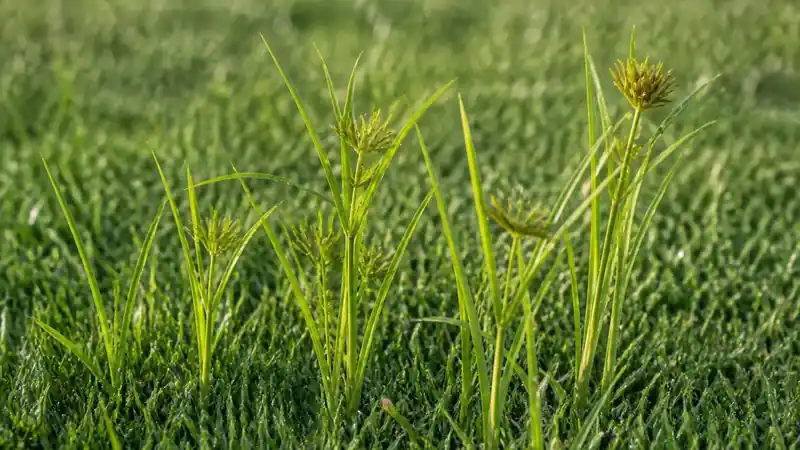
Nut grass is nutsedge, a sedge that spreads from buried tubers. Kill it with halosulfuron or sulfentrazone before the fifth leaf and before late June, repeat in 4 to 8 weeks, and dry out wet soil.
Key takeaways
- Nut grass is not a grass. Yellow nutsedge (Cyperus esculentus) and purple nutsedge (C. rotundus) have solid triangular stems and leaves in threes, so crabgrass and dandelion sprays miss them (Purdue TURF-45).
- One yellow nutsedge tuber produced 1,900 shoots and 6,900 tubers in a year in a Minnesota trial (Purdue Landscape Report), and UF/IFAS puts a season’s output at 4 to 12 million tubers per acre (UF/IFAS ENH1305).
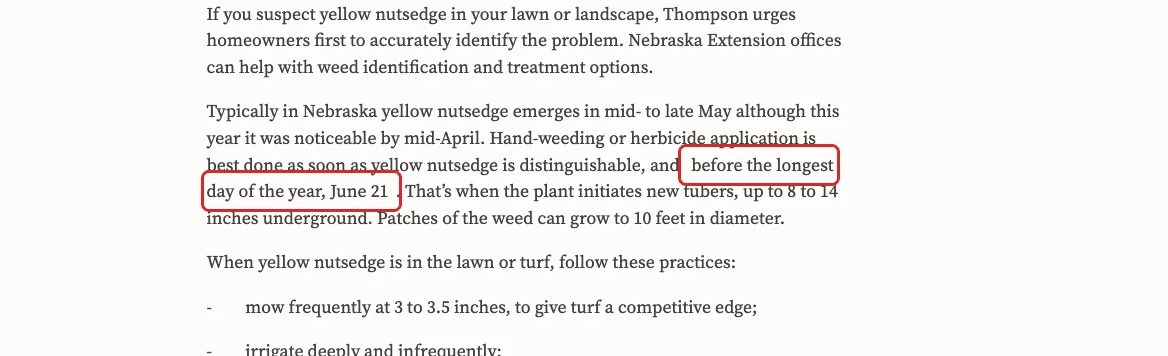
- Spray before the fifth leaf: after that stage, UC IPM says sedge herbicides kill the leaves but not the tubers (UC IPM pn7432). Nebraska Extension sets June 21 as the yellow nutsedge deadline because new tubers start then (UNL).
- Grass type picks the product. UGA rates halosulfuron safe on all 7 common lawn grasses it lists, but St. Augustinegrass is sensitive to sulfentrazone and Kentucky bluegrass and tall fescue to imazaquin (UGA Bulletin 978).
- Expect 2 to 3 years: Purdue says that is how long herbicide programs take to cut viable tubers in the soil by 90 percent (Purdue).
What is nut grass, and is it really a grass?
Nut grass is the common name for two perennial sedges, yellow nutsedge (Cyperus esculentus) and purple nutsedge (Cyperus rotundus). Neither is a grass: Purdue Extension notes the triangular stem you can feel by rolling it between your fingers, leaves arranged in threes, and a glossy, hairless leaf (Purdue TURF-45). The “nuts” are tubers on underground rhizomes, which is why the plant returns after mowing, pulling and frost.
| Measure | Value | Source |
|---|---|---|
| Height, unmowed | Up to 36 in (both species) | UF/IFAS ENH1305 |
| Yellow nutsedge leaf | About 0.5 in wide, 12 to 35 in long, long tapered tip | UF/IFAS |
| Purple nutsedge leaf | 0.2 to 0.5 in wide, abruptly pointed tip, darker green | UF/IFAS |
| Tubers per plant per summer | Several hundred (yellow) | Purdue |
| One tuber, one year (Minnesota trial) | 1,900 shoots and 6,900 tubers | Purdue Landscape Report |
| Tubers per acre per season | 4 to 12 million | UF/IFAS |
| Tuber formation begins | 4 to 6 weeks after emergence | UF/IFAS |
| Rhizome depth | 8 to 14 in; most tubers in the top 6 in | UC IPM |
| Tuber life in soil | 1 to 3 yr (UC IPM); more than 3 yr (Purdue) | UC IPM; Purdue |
| Soil temperature for sprouting | Above 43°F yellow; above 59°F purple | UC IPM |
| Patch size | Up to 10 ft across | UC IPM |
| U.S. range | Yellow: 48 states; purple: mainly Virginia to central Texas, plus AZ, CA, OR | UNL; UF/IFAS |
Nut grass grows fastest in summer heat, when cool-season lawns slow down, so it shows up as pale, upright tufts 2 or 3 days after mowing. In Indiana, Purdue says yellow nutsedge emerges from tubers in late April or May, about 2 weeks after crabgrass, and grows until the first frost. Frost kills the leaves, not the tubers that make next year’s crop.
The two species split by climate. NC State TurfFiles calls yellow nutsedge a North American native and one of the more cold-tolerant sedges (TurfFiles: yellow nutsedge), while purple nutsedge, native to India, is less cold tolerant and mostly a warm-season turf problem (TurfFiles: purple nutsedge). Nebraska Extension documents yellow nutsedge in 48 states, including Alaska.
How fast does nut grass spread?
Fast, and mostly underground. In a Minnesota field trial cited by Purdue, one yellow nutsedge tuber produced 1,900 shoots and 6,900 new tubers in a single season, and the Connecticut Agricultural Experiment Station repeats the same study’s figures (CAES fact sheet). Seed matters little: UT Extension says nutsedge seedheads contain few viable seeds, so tubers and rhizomes do the spreading.
| Starting point | Result after one growing season | Where | Source |
|---|---|---|---|
| 1 yellow nutsedge tuber | 1,900 shoots and 6,900 tubers | Minnesota field trial (Tumbleson and Kommedahl, 1961) | Purdue Landscape Report; CT Agricultural Experiment Station |
| 1 yellow nutsedge plant | Several hundred tubers | Indiana lawns | Purdue TURF-45 |
| 1 acre of yellow or purple nutsedge | 4 to 12 million tubers | Field studies cited by UF/IFAS | UF/IFAS ENH1305 |
| 1 green kyllinga plant | 100+ flowers and up to 5,000 seeds | California | UC IPM pn7459 |
How do you tell yellow nutsedge, purple nutsedge and kyllinga apart?
Dig one plant and look at the tubers. Yellow nutsedge forms one tan to brown tuber at the tip of each rhizome; purple nutsedge forms tubers in chains along the rhizome, covered in red to brown papery scales; green kyllinga forms no tubers at all (UF/IFAS ENH1305; UC IPM pn7459). Above ground, check the seedhead color and the leaf tip.
| Feature | Yellow nutsedge (Cyperus esculentus) | Purple nutsedge (Cyperus rotundus) | Green kyllinga (Kyllinga brevifolia) | Source |
|---|---|---|---|---|
| Tubers | One per rhizome tip; round, hard, 0.1 to 0.6 in, brown to black | Chains along the rhizome; 0.1 to 1.0 in long, red to brown papery scales | None; rhizomes only | UF/IFAS; UC IPM |
| Tuber taste | Little taste to slightly sweet (NC State); almond (UC IPM) | Bitter, peppery | No tubers | TurfFiles; UC IPM |
| Seedhead | Loose, yellow-brown to straw or golden spikelets | Loose, reddish-purple spikelets | Round green head about 3/8 in wide on a 2 to 8 in stalk | TurfFiles; UC IPM |
| Leaf tip | Long, gradually tapered | Blunter, abruptly pointed | Fine, short leaves | UF/IFAS; UT W260 |
| Leaf color | Light green to yellow-green, glossy | Dark green | Similar to yellow nutsedge, finer and shorter | UT W260; TurfFiles |
| Growth habit | Single upright plants above the turf | Single upright plants | Dense mats; flowers even at 3/4 in mowing | UC IPM |
| Cold tolerance | High; the northern nutsedge | Low; mainly the South and Southwest | Southeast to California, spreading | TurfFiles; TurfFiles |
| Ease of control | Easier | Much harder | Hard once mats form | TurfFiles; TurfFiles |
Young plants of the two nutsedges look alike, UF/IFAS warns, so wait for a seedhead or dig for tubers before buying a product. Tennessee Extension’s W260 adds that kyllinga can survive mowing under 0.25 inch and spreads by short rhizomes into mats, where the nutsedges stand as scattered single shoots. Kyllinga also blooms in a mowed lawn; the nutsedges rarely do.
Two other look-alikes show up in wet lawns. UC IPM lists tall flatsedge (Cyperus eragrostis), a tight clump under 1 foot across with no tubers, and UF/IFAS shows globe sedge (Cyperus croceus), which is often mistaken for yellow nutsedge. For grassy weeds that also stand above the lawn, our common lawn weeds chart sorts sedges from grasses and broadleaves.
Why does pulling nut grass make it worse?
Pulling removes the shoot but leaves the tubers and rhizomes, 8 to 14 inches down in UC IPM’s figures. Purdue says hand pulling “will not remove the tubers in the soil”, and UC IPM says a mature tuber can resprout more than 3 times (Purdue TURF-45; UC IPM pn7432). After a pull, each buried tuber sends up a fresh shoot, which reads as more nut grass.
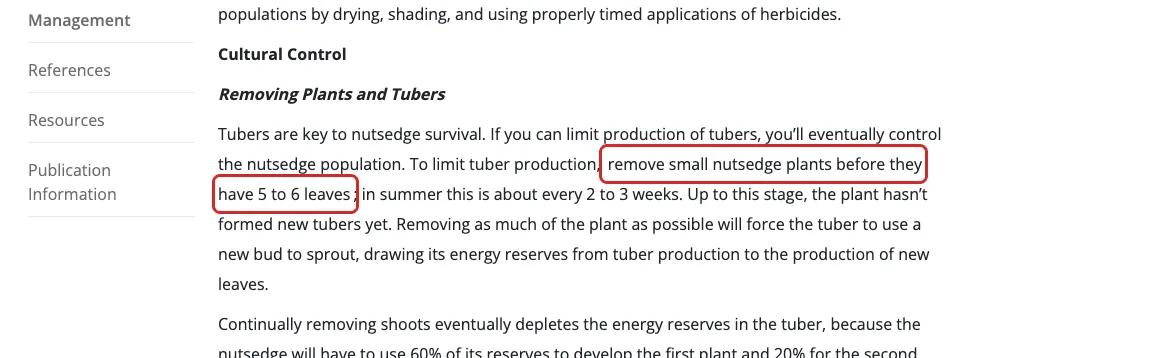
Pulling works only on young plants and only if you keep at it. UC IPM’s rule is to remove plants before they have 5 to 6 leaves, which in summer means every 2 to 3 weeks, because tubers have not formed yet. The first shoot uses 60 percent of a tuber’s reserves and the second 20 percent, so repeated removal starves it. In turf, UC IPM says to dig out small patches at least 8 inches deep, refill and reseed or sod.
| Common claim | What the primary source says | Source |
|---|---|---|
| “Pulling one plant makes 3 to 5 new ones” | No extension figure found for that ratio. Purdue: pulling leaves tubers in the soil; UC IPM: mature tubers resprout 3+ times | Purdue; UC IPM |
| “Tubers last up to 10 years” | Up to 10 years (Purdue Landscape Report, 2018); 1 to 3 years for most tubers (UC IPM); more than 3 years (Purdue TURF-45) | Purdue LR; UC IPM |
| “Yellow nutsedge tubers are oblong and hairy” | Round, hard and smooth, scaly only when immature (UF/IFAS); round and smooth, up to 7/16 in (UC IPM) | UF/IFAS; UC IPM |
| “Spray before June 21” for every nutsedge | UNL’s June 21 date is for yellow nutsedge; Arizona sprays purple nutsedge with burndown before the solstice and ALS herbicides after it | UNL; Arizona AZ1818 |
| “Mow high to beat nutsedge” | UNL: mow cool-season lawns at 3 to 3.5 in; Arizona: frequent low mowing in spring weakens purple nutsedge in warm-season turf | UNL; Arizona |
| “Landscape fabric stops it” | Black or clear plastic does not (leaf tips pierce it); nonwoven or woven polypropylene fabric under mulch suppresses it | UC IPM; UF/IFAS |
What kills nut grass in a lawn without killing the grass?
A sedge herbicide whose label lists both nutsedge and your lawn grass. For homeowners that usually means halosulfuron (SedgeHammer, EPA Reg. No. 81880-1) or sulfentrazone (Ortho Nutsedge Killer for Lawns, 239-2793), the two actives Purdue recommends (Purdue TURF-45). Broadleaf mixes and crabgrass killers do not touch nutsedge unless they add sulfentrazone, and Purdue rates those four-way mixes only fair.
The table compares 11 current EPA-accepted labels we downloaded from the EPA Pesticide Product Label System in October 2026. Rates are the lawn rates per 1,000 sq ft printed on each label; where a label gives only a per-acre figure, we converted it at 43,560 sq ft per acre. The label in your hand is the legal instruction, and it can differ from the version on file.
| Product (EPA Reg. No.) | Active ingredient | Sedges on the label | Lawn rate per 1,000 sq ft | Repeat and yearly limit | Lawn grasses to watch | Label |
|---|---|---|---|---|---|---|
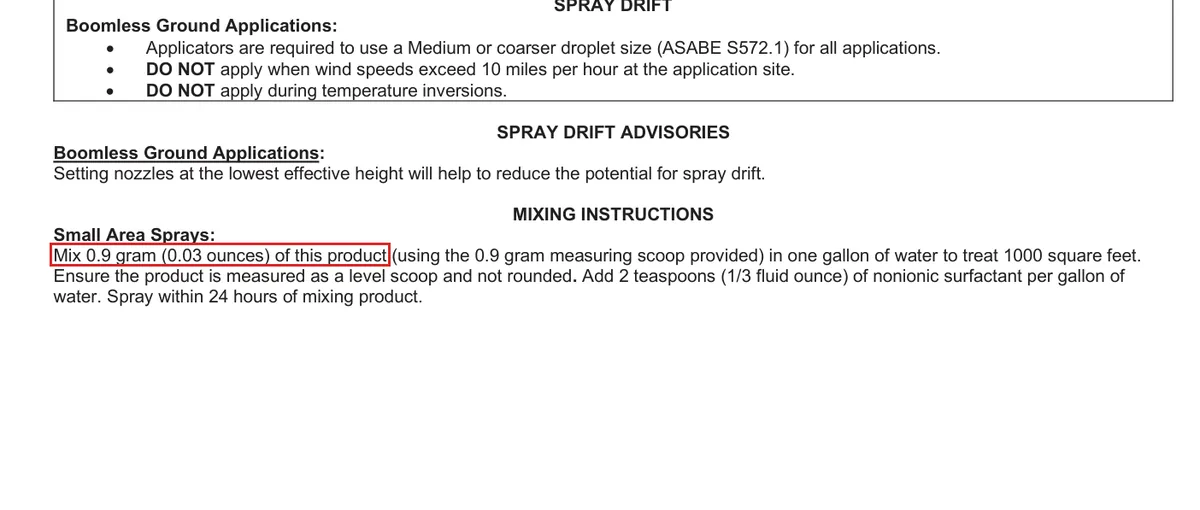
| SedgeHammer (81880-1) | Halosulfuron-methyl 75% | Yellow, purple, green kyllinga | 0.9 g scoop in 1 gal water + 2 tsp nonionic surfactant | 4 weeks apart; max 4 a year and 5 1/3 oz product per acre per 12 months | None excluded; 12 grasses listed incl. St. Augustine, centipede, tall fescue | Sept. 1, 2026 |
| SedgeHammer+ (81880-24) | Halosulfuron-methyl 5%, surfactant built in | Yellow, purple, green kyllinga (2 applications) | 0.5 oz (13.5 g) pouch in 1 gal water | 14 days minimum; second spray often 6 to 10 weeks; max 4 a year | None excluded; adds buffalograss | Aug. 28, 2020 |
| Ortho Nutsedge Killer for Lawns RTS2 (239-2793) | Sulfentrazone 1.4% | Yellow, purple (spot retreat), green kyllinga, globe sedge | 1 qt covers 5,000 sq ft; max 6.4 fl oz per 1,000 sq ft | Max 9.3 fl oz per 1,000 sq ft a year; New York: 1 application a year | 15 grasses listed incl. St. Augustine; home lawns only | Dec. 9, 2025 |
| Image consumer concentrate (73342-4) | Imazaquin 3.3% | Yellow, purple, green kyllinga, globe sedge | Up to 4 fl oz; spot mix 2.5 fl oz in 1 gal | Second spray at 6 weeks; max 2 a year, 8 fl oz per 1,000 sq ft | Only bermuda, St. Augustine, buffalo, zoysia, centipede; injures tall fescue; kills bahia and ryegrass | Aug. 30, 2024 |
| Basagran T&O (7969-326) | Bentazon 44% | Yellow only; label says purple is not controlled | 0.75 fl oz (5 tsp) in 1 to 2 gal at 6 to 8 in tall | 2 sprays 7 to 10 days apart; max 1.5 fl oz per 1,000 sq ft a year | None excluded; no mowing 5 days before or after (residential) | Sept. 11, 2024 |
| Dismiss Turf (101563-284, label printed as 279-3295) | Sulfentrazone 39.6% | Yellow, purple (split), green kyllinga, globe sedge | Cool-season 0.092 to 0.18 fl oz; warm-season 0.18 to 0.275 fl oz; no surfactant | Purple: second spray 35 days later; max 0.375 lb sulfentrazone per acre a year | May discolor St. Augustine and some zoysia, bahia; injury on some fescue cultivars | July 18, 2024 |
| Dismiss NXT (101563-315) | Sulfentrazone 31.77% + carfentrazone 3.53% | Yellow, purple (split), green kyllinga, globe sedge | Cool-season 0.115 to 0.230 fl oz; warm-season 0.230 to 0.344 fl oz | Purple: second spray 35 days later | Same discoloration notes as Dismiss | April 1, 2026 |
| Celero (59639-155, label text V-10142) | Imazosulfuron 75% | Yellow, purple, annual kyllinga | Spot: 0.25 to 0.33 oz in 1 to 2 gal + 2 tsp surfactant per gal | 21 days apart; max 2 a year, 28 oz per acre | Bahia, seashore paspalum, buffalo not listed; spray only at 65 to 90°F highs | April 17, 2020 |
| Vexis liquid (2217-1072) | Pyrimisulfan 1.24% | Yellow, purple, green kyllinga (repeat may be needed) | 1.2 to 1.7 fl oz | 30 days apart; max 2.5 fl oz per 1,000 sq ft a year | Floratam and Bitterblue St. Augustine listed after 7 nights above 50°F; no carpetgrass | April 17, 2026 |
| Tenacity (100-1267) | Mesotrione 40% | Yellow only (postemergence) | 0.092 to 0.184 fl oz + surfactant; spot 1 tsp in 2 gal | Second spray 2 to 3 weeks; 14 days minimum; max 2 a year | Bermuda, zoysia, bentgrass, seashore paspalum sensitive; St. Augustine only grown for sod | Sept. 28, 2022 |
| Certainty (59639-226) | Sulfosulfuron 75% | Yellow, purple, green kyllinga, globe sedge | Hand sprayer: 0.8 g scoop in 2 gal at 2 gal per 1,000 sq ft + surfactant | 4 weeks apart; max 2 a year | Kills tall fescue and perennial ryegrass; St. Augustine may be more sensitive | Nov. 7, 2024 |
Three label details change what you buy. The Basagran T&O label says outright that purple nutsedge is not controlled, and the Tenacity label lists only yellow nutsedge, so both fail in the Deep South and the Southwest where purple dominates. The Image label covers purple nutsedge but only on bermuda, St. Augustine, buffalo, zoysia and centipede lawns. Halosulfuron is the one active with no lawn grass excluded on its label.
Several of these are professional products. UC IPM marks Certainty, Monument, Tenacity and Dismiss CA as not available to home gardeners (UC IPM pn7432), and anyone spraying a customer’s lawn for pay needs a state applicator license; our pesticide applicator license guide covers the categories. Product-by-product prices for the homeowner sizes are in our lawn weed killer comparison.
Which nutsedge herbicides are safe on St. Augustine, centipede, bermuda and fescue?
Halosulfuron and bentazon are the only sedge actives that UGA’s Bulletin 978 rates tolerant on all 7 lawn grasses in its grid. St. Augustinegrass is rated sensitive to sulfentrazone, tall fescue sensitive to sulfosulfuron and imazaquin, and bahiagrass sensitive to imazaquin (UGA B-978, p. 10). Read the grid with the label: Dismiss lists St. Augustine with a discoloration warning, which UGA treats as a do-not-use.
| Active (example product) | Kentucky bluegrass | Bermuda | Bahia | Centipede | Tall fescue | St. Augustine | Zoysia |
|---|---|---|---|---|---|---|---|
| Halosulfuron (SedgeHammer) | T | T | T | T | T | T | T |
| Bentazon (Basagran T&O) | T | T | T | T | T | T | T |
| Sulfentrazone (Dismiss, Ortho Nutsedge Killer) | T | T | T | T | I | S | T |
| Sulfosulfuron (Certainty) | T | T | I | T | S | T | T |
| Imazaquin (Image) | S | T | S | T | S | T | T |
| Trifloxysulfuron (Monument) | S | T | S | S | S | S | T |
| Glyphosate (Roundup) | S | T only when dormant | S | S | S | S | S |
Grass-specific notes from the labels fill the gaps. Vexis is the only label in our set that names Floratam and Bitterblue St. Augustine, with a condition: spray after 7 nights in a row above 50°F (EPA 2217-1072). Tenacity allows St. Augustine only when grown for sod and calls bermuda and zoysia sensitive. Our profiles of St. Augustine grass and centipede grass carry each grass’s other herbicide limits.
Which products work on purple nutsedge and kyllinga?
Purple nutsedge and kyllinga are where products split. Tennessee Extension rated all 10 sedge products in its table excellent on yellow nutsedge, but on kyllinga SedgeHammer rated poor (60 percent or less) while Celero, Image, Katana and Monument rated excellent (UT W260, Table 1). For purple nutsedge, Arizona Extension found SedgeHammer, Scepter and Vexis held 2 to 4 weeks, and Monument, Katana, Certainty and Celero held longer than 4 to 6 weeks (AZ1818).
| Product | Active | Yellow nutsedge | Kyllinga | Labeled turf species in UT’s table | Source |
|---|---|---|---|---|---|
| Celero | Imazosulfuron | E | E | Bermuda, zoysia, centipede, St. Augustine, bentgrass, fine fescue, Kentucky bluegrass, ryegrass, tall fescue | UT W260 |
| Image | Imazaquin | E | E | Bermuda, zoysia, centipede, St. Augustine, seashore paspalum | UT W260 |
| Katana | Flazasulfuron | E | E | Bermuda, zoysia, centipede, seashore paspalum | UT W260 |
| Monument | Trifloxysulfuron | E | E | Bermuda, zoysia | UT W260 |
| Certainty | Sulfosulfuron | E | G | Bermuda, zoysia, centipede, St. Augustine, seashore paspalum | UT W260 |
| Dismiss | Sulfentrazone | E | G | Cool- and warm-season incl. St. Augustine | UT W260 |
| Dismiss NXT | Sulfentrazone + carfentrazone | E | G | Cool- and warm-season incl. St. Augustine | UT W260 |
| Dismiss South | Sulfentrazone + imazethapyr | E | G | Bermuda, zoysia, centipede | UT W260 |
| SedgeHammer | Halosulfuron | E | P | Cool- and warm-season incl. St. Augustine | UT W260 |
Speed differs as well. Purdue says sulfentrazone shows injury on yellow nutsedge within a few days and halosulfuron in about 2 weeks; UT puts complete desiccation at about 1 week for the Dismiss products and 3 to 4 weeks for SedgeHammer and Celero. Arizona adds a resistance rule for purple nutsedge: limit ALS-inhibiting herbicides, the group that includes halosulfuron, imazosulfuron and pyrimisulfan, to two summer applications.
When is the best time to spray nutsedge?
Spray yellow nutsedge in late spring to early summer, after most shoots are up but before June 21, and again 4 to 8 weeks later if it regrows. Nebraska Extension picked June 21, the longest day, because that is when the plant starts new tubers 8 to 14 inches down (UNL). NC State says new tubers are added from late June and early July (TurfFiles).
Leaf count is the field version of the same rule. UC IPM says the sedge herbicides must go on before the fifth-leaf stage, while the plant is still sending sugars from the leaves to new tubers; after that, “the herbicide will kill only the aboveground portion” (UC IPM pn7432). UGA’s halosulfuron window is the 3 to 8 leaf stage (UGA B-978), and the CAES Connecticut fact sheet uses the same 3 to 8 leaves.
Purple nutsedge in the low desert runs on a different calendar. Arizona Extension starts in spring with sulfentrazone burndown sprays every 7 to 14 days plus frequent low mowing, then switches to ALS herbicides (halosulfuron, imazosulfuron, sulfosulfuron, trifloxysulfuron and others) around July 4, with a second spray 4 to 6 weeks later. After the solstice, shorter days push sugars down to the developing tubers and the herbicide goes with them (Arizona AZ1818).
| When | Yellow nutsedge (cool-season and transition lawns) | Purple nutsedge (warm-season lawns) | Source |
|---|---|---|---|
| Soil above 43°F / 59°F | Tubers begin to sprout above 43°F; Indiana emergence late April to May | Tubers sprout above 59°F; Arizona emergence from February or March | UC IPM; Purdue; Arizona |
| 3 to 8 leaves, May to mid-June | First halosulfuron or sulfentrazone spray | Sulfentrazone burndown every 7 to 14 days, plus frequent low mowing | UGA; Arizona |
| By June 21 | First spray should be down; new tubers start | Solstice: switch point | UNL; Arizona |
| Late June to early July | Tuber production begins (NC State) | First ALS herbicide spray around July 4 | TurfFiles; Arizona |
| 4 to 8 weeks after first spray | Repeat if plants regrow (Purdue); mid-July (UNL); 6 to 10 weeks (UGA) | Second ALS spray 4 to 6 weeks later, about mid-August; stop at 2 ALS sprays a summer | Purdue; UGA; Arizona |
| Early August to September | Visible new tubers at rhizome tips (Connecticut) | Tubers maturing; judge results next spring | CAES; Arizona |
| First frost | Leaves die; tubers overwinter | Leaves brown; tubers overwinter | Purdue; UT W260 |
Heat matters too. Purdue says not to spray when the lawn is drought stressed or the air is 90°F or hotter, “especially sulfentrazone-containing products”, and UGA gives the same 90°F line for all postemergence lawn herbicides. UT Extension limits sedge sprays to actively growing plants, May through August in Tennessee (UT W260).
| Threshold | °F | What happens | Source |
|---|---|---|---|
| Yellow nutsedge tubers sprout | 43 | Soil stays above 43°F; spring emergence starts | UC IPM pn7432 |
| Purple nutsedge tubers sprout | 59 | Soil stays above 59°F | UC IPM pn7432 |
| Green kyllinga seed germinates | 65 | Soil about 65°F with adequate moisture | UC IPM pn7459 |
| Stop spraying | 90 | Air at or above 90°F or drought-stressed turf: skip postemergence sprays | Purdue; UGA B-978 |
How do you spray nutsedge step by step?
Spray young, actively growing nutsedge on a dry, calm day with the label rate in 1 gallon of water per 1,000 sq ft, add surfactant only where the label calls for it, leave the lawn unmowed for 2 days on each side, and recheck in 4 to 6 weeks. The steps below use the SedgeHammer label (EPA 81880-1) with the sulfentrazone differences noted.
- Confirm the species. Dig one plant: single tan tubers mean yellow nutsedge; chained tubers with papery scales mean purple; no tubers and a round green head mean kyllinga, where SedgeHammer rated poor in UT trials.
- Match the label to your grass with UGA Bulletin 978’s tolerance grid. St. Augustine lawns: halosulfuron, not sulfentrazone. Tall fescue lawns: halosulfuron, sulfentrazone or bentazon, never Image or Certainty.
- Time it. Spray at the 3 to 8 leaf stage (UGA), before June 21 for yellow nutsedge (UNL), with air under 90°F (Purdue) and no rain forecast within 4 hours (SedgeHammer label).
- Leave the lawn unmowed for 2 days before and 2 days after spraying, as the SedgeHammer label directs; the Basagran residential label says 5 days.
- Practice with water first. UGA says to spray 1 gallon of plain water over a measured 1,000 sq ft (20 by 50 ft) to learn your walking speed (UGA B-978).
- Mix one 0.9 g level scoop of SedgeHammer and 2 teaspoons of nonionic surfactant (at least 80 percent active) in 1 gallon of water per 1,000 sq ft, and spray within 24 hours. SedgeHammer+ needs no surfactant: one 0.5 oz pouch per gallon. Purdue says not to add surfactant to sulfentrazone products.
- Spray the nutsedge leaves evenly until wet, then keep irrigation off for at least 4 hours (CAES fact sheet; the Celero label says 4 hours before and after).
- Wait. Expect yellowing in about 2 weeks for halosulfuron and complete kill in 3 to 4 weeks; sulfentrazone burns down in about 1 week (UT W260).
- Recheck at 4 to 6 weeks and spray regrowth (SedgeHammer minimum interval: 4 weeks; Dismiss purple nutsedge split: 35 days). Stop at the yearly limit in the label table.
- Reseed or sod bare patches only after the label wait: 4 weeks for SedgeHammer, about 1 month for Dismiss and Ortho, 1 1/2 months for Image. Repeat the program the next May; Purdue expects 2 to 3 seasons.
The worked example below scales the label mix to a real lawn. The scoop rate of 0.9 g per 1,000 sq ft equals about 1.38 oz per acre, which is the top of SedgeHammer’s 2/3 to 1 1/3 oz range. That matters for the yearly cap: by our arithmetic, four full-scoop sprays on the same spot total about 5.5 oz per acre, a little over the 5 1/3 oz limit, so plan on three.
| Step | Input | Arithmetic | Result |
|---|---|---|---|
| Lawn and patch size | 6,000 sq ft lawn; nutsedge patches measured at 800 sq ft | Patch area ÷ 1,000 | 0.8 treatment units |
| SedgeHammer product | 0.9 g per 1,000 sq ft (label scoop) | 0.8 × 0.9 g | 0.72 g (a little under one scoop) |
| Water | 1 gal per 1,000 sq ft | 0.8 × 1 gal | 0.8 gal (about 3 quarts) |
| Nonionic surfactant | 2 tsp per gal | 0.8 × 2 tsp | 1.6 tsp |
| Same lawn, broadcast | 6,000 sq ft | 6 × 0.9 g; 6 × 1 gal; 6 × 2 tsp | 5.4 g (6 scoops), 6 gal water, 12 tsp (1/4 cup) surfactant |
| Per-acre equivalent | 0.9 g per 1,000 sq ft | 0.9 × 43.56 = 39.2 g ÷ 28.35 g per oz | 1.38 oz per acre per spray |
| Yearly cap check | Label: 5 1/3 oz per acre per 12 months | 5.33 ÷ 1.38 | 3.9 sprays: plan on 3 at the scoop rate |
| Bottle coverage | 1.33 oz bottle = 37.7 g | 37.7 ÷ 0.9 | About 42 treatments of 1,000 sq ft |
| Product cost | $64.48 for 1.33 oz (DoMyOwn, Oct. 28, 2026, from our lawn weed killer guide) | $64.48 ÷ 42 | About $1.54 per 1,000 sq ft per spray, before surfactant |
| Sulfentrazone check (Dismiss, warm-season) | Max 12 fl oz per acre per spray; 0.375 lb a year = 12 fl oz of a 4 lb/gal product | 12 ÷ 12 | One top-rate warm-season spray uses the whole year’s sulfentrazone, so purple nutsedge splits are 8 + 4 or 6 + 6 fl oz |
How do you get rid of nutsedge in flower beds and gardens?
In beds, dig or spot-spray rather than rely on mulch. Purdue says to dig around the base and lift the whole plant with its rhizomes (Purdue TURF-45), and UC IPM says a hoe must go 8 to 14 inches deep. Glyphosate works only on young plants and gives “limited suppression” (UC IPM), and it kills any lawn or bed plant it touches.
| Method | What it does to nutsedge | Limits | Source |
|---|---|---|---|
| Dig plant, rhizome and tuber | Removes the tuber if you go 8 to 14 in deep | Repeat every 2 to 3 weeks in summer; check for regrowth | UC IPM; Purdue |
| Glyphosate spot spray | Marginal to limited control; best on young, unmowed plants | Nonselective: kills turf and ornamentals it contacts; not for lawns | Purdue; UC IPM |
| Halosulfuron (SedgeHammer) | Labeled for nutsedge around established woody ornamentals in landscaped areas | Keep off desirable herbaceous plants; read the label site list | EPA label 81880-1 |
| Preemergents in ornamentals | Dichlobenil, S-metolachlor and dimethenamid-P reduce yellow nutsedge emergence | None controls purple nutsedge; S-metolachlor and dimethenamid-P are professional products | UC IPM |
| Organic mulch 2 to 3 in | Not effective | Nutsedge grows through pine bark, pine straw and chips | UF/IFAS ENH1305 |
| Black or clear plastic | Does not control | Sharp leaf tips pierce polyethylene | UC IPM |
| Polypropylene landscape fabric plus mulch | Suppresses both species | Breaks down over time; emerging plants still need removal | UC IPM; UF/IFAS |
| Shade from tall shrubs or groundcover | Reduces growth | Low groundcovers do not cast enough shade | UC IPM |
| Summer tilling and drying | Reduces purple nutsedge only | Not effective on yellow; only where nothing needs irrigation | UC IPM |
Check soil before it comes in. Purdue TURF-45 says yellow nutsedge tubers move in topsoil and fill dirt during construction and when people divide perennials (Purdue), and UF/IFAS finds both species in containers only when field soil or contaminated compost went into the mix. A bed that sprouts nutsedge the season after new topsoil arrived probably got its tubers from that load, so ask a supplier where the soil was dug before the next delivery.
How do you fix the wet soil that nutsedge loves?
Find the water source first. UC IPM says nutsedge presence “often indicates drainage is poor, irrigation is too frequent, or sprinklers are leaky” (UC IPM pn7432), and Tennessee Extension says long-term control in poorly drained areas is possible only once the drainage problem is fixed (UT W260). Herbicide on a soggy low spot buys one season.
| Wet-soil cause | How to confirm it | Fix | Source or GIR guide |
|---|---|---|---|
| Overwatering | Runoff, puddles and sedges after irrigation, the overwatering signs UF/IFAS lists | Water deeply and less often: about 1 in a week, rain included | UNL; our watering guide |
| Leaking or broken heads | One zone stays green and soggy; catch-cup test shows uneven output | Repair heads and valves before treating | UC IPM |
| Compacted soil | Screwdriver will not push in; water ponds | Core aerate to reduce compaction | UNL; when to aerate |
| Low spot or poor grade | Water stands for hours after rain | Regrade or topdress the dip | Leveling or topdressing |
| Clay or high water table | Water stands after every rain in the same strip | Subsurface drain to a lower outlet | French drain cost |
| Thin turf mowed too short | Bare soil between grass plants | Mow cool-season turf at 3 to 3.5 in and thicken the stand | UNL; Purdue |
Mowing height cuts both ways. Purdue says yellow nutsedge is worst in turf mowed too short, and UNL sets 3 to 3.5 inches for cool-season lawns, but Arizona Extension uses frequent low mowing in spring to drain purple nutsedge tubers in bermudagrass (Arizona AZ1818). Kyllinga thrives at 1 inch or less, NC State says (TurfFiles), so low mowing helps it. Mow for the turf species first; our lawn care schedule lists heights by grass.
Which nut grass control fits your lawn?
Pick by species, then by lawn grass, then by season. Yellow nutsedge in any lawn: halosulfuron before June 21. Purple nutsedge in a warm-season lawn: a two-spray program with a halosulfuron or imazaquin label that lists your grass. Kyllinga: imazaquin on warm-season grass, because SedgeHammer rated poor on kyllinga in Tennessee trials (UT W260). Beds: dig or spot-spray glyphosate.
| If your situation is | Do this | Why (source) |
|---|---|---|
| A few young shoots, under 5 leaves | Pull or dig them every 2 to 3 weeks through summer | No new tubers yet before 5 to 6 leaves (UC IPM) |
| Yellow nutsedge in a cool-season lawn, May to mid-June | Halosulfuron 0.9 g plus surfactant per 1,000 sq ft, or sulfentrazone at the label rate; repeat in 4 to 8 weeks | Before tubers start June 21 (UNL; Purdue) |
| Nutsedge in a St. Augustine lawn | Halosulfuron (or Image if not overseeded); skip sulfentrazone | UGA rates St. Augustine sensitive to sulfentrazone (UGA B-978) |
| Nutsedge in a tall fescue lawn | Halosulfuron, sulfentrazone or bentazon; never imazaquin or sulfosulfuron | Image may injure tall fescue; Certainty kills it (EPA 73342-4; EPA 59639-226) |
| Purple nutsedge in bermuda or zoysia, Southwest | Burndown in spring, then 2 ALS sprays about July 4 and mid-August | Arizona sequence; 2 ALS sprays a summer to slow resistance (AZ1818) |
| Green kyllinga mats | Imazaquin or a professional imazosulfuron or trifloxysulfuron label; fix wet spots | Rated excellent vs poor for SedgeHammer (UT W260) |
| Nutsedge comes back every year in the same wet spot | Fix drainage or irrigation before the next spray | Long-term control needs drainage fixed (UT W260; UC IPM) |
| Nutsedge in shrub or flower beds | Dig 8 to 14 in deep, or glyphosate on young plants; polypropylene fabric under mulch | Glyphosate kills what it touches; plastic does not stop leaf tips (UC IPM) |
| Air at or above 90°F, or drought-stressed lawn | Wait for cooler weather | Turf injury risk, especially sulfentrazone (Purdue) |
| You are spraying lawns for paying customers | Hold the state applicator license first | Professional products such as Certainty and Monument are not sold to homeowners (UC IPM) |
1Is it under 5 leaves with only a few plants?
YesPull or dig every 2 to 3 weeks; no new tubers have formed yet (UC IPM).
NoGo to the next question
2Is it in a flower bed or shrub border?
YesDig 8 to 14 in deep or spot-spray glyphosate on young plants; use polypropylene fabric under mulch.
NoGo to the next question
3Does it have a round green seedhead and no tubers (kyllinga)?
YesImazaquin on warm-season grass or a professional imazosulfuron or trifloxysulfuron label; SedgeHammer rated poor.
NoGo to the next question
4Is the lawn St. Augustine?
YesHalosulfuron (SedgeHammer) at 0.9 g per 1,000 sq ft; skip sulfentrazone, which UGA rates sensitive.
NoGo to the next question
5Is it purple nutsedge (chained tubers, purple seedhead) in warm-season turf?
YesTwo sprays: halosulfuron or imazaquin, then again 4 to 6 weeks later; max 2 ALS sprays a summer.
NoGo to the next question
6Does the patch sit in a spot that stays wet?
YesFix irrigation or drainage first, then spray.
NoYellow nutsedge in a cool-season lawn: halosulfuron or sulfentrazone at the 3 to 8 leaf stage, before June 21, repeated in 4 to 8 weeks.
Source: UC IPM pn7432; UT W260; UGA B-978; Arizona AZ1818; UNL; EPA label 81880-1
How we compiled this
We read 14 extension publications and pages (Purdue, UC IPM, NC State, UNL, UT, Arizona, UF/IFAS, UGA and the Connecticut Agricultural Experiment Station) and downloaded 12 EPA-accepted herbicide labels from the EPA Pesticide Product Label System in October 2026, citing 11. Label figures are quoted as printed; per-acre conversions and the worked example are our arithmetic. We did not spray or test any product.
| Question | Short answer | Source |
|---|---|---|
| What is it? | A sedge, yellow (C. esculentus) or purple (C. rotundus) nutsedge | Purdue |
| Spread | 1 tuber: 1,900 shoots and 6,900 tubers in a year | Purdue LR |
| Spray when | 3 to 8 leaves, before June 21 (yellow) | UGA; UNL |
| Lawn-safe active | Halosulfuron: tolerated by all 7 grasses UGA lists | UGA |
| Mix | 0.9 g + 2 tsp surfactant in 1 gal per 1,000 sq ft | EPA 81880-1 |
| Repeat | 4 to 8 weeks; 2 to 3 years to cut tubers 90% | Purdue |
This page is general information, not pesticide-application or legal advice. Labels change and some states restrict products; read the label on the product you buy, follow it, and check your state department of agriculture’s rules before you spray or hire an applicator.
Frequently asked questions
What kills nut grass permanently?
No single spray does. Purdue says 2 to 3 years of herbicide control cut viable yellow nutsedge tubers in the soil by 90 percent, because sprays kill growing plants but not dormant tubers. Combine a halosulfuron or sulfentrazone program, applied before tubers form in late June, with drainage and irrigation fixes so wet soil stops favoring it.
Is nut grass the same as nutsedge?
Yes. Nut grass, nutgrass and nutsedge are common names for yellow nutsedge (Cyperus esculentus) and purple nutsedge (Cyperus rotundus). UF/IFAS also lists chufa sedge, tiger nutsedge and earth almond for the yellow species, and coco grass, java grass and red nutsedge for purple. Both are sedges, not grasses, with triangular stems and leaves in ranks of 3 (UF/IFAS ENH1305).
Will nutsedge go away on its own?
The leaves die at the first frost, but the tubers survive the winter and sprout once soil warms past 43°F for yellow or 59°F for purple, UC IPM says. Untreated patches widen each summer, up to 10 feet across. Only removing young plants before 5 leaves or spraying before tubers form shrinks the tuber bank.
Does Roundup kill nutsedge?
Only partly, and it kills the lawn too. UC IPM (pn7432) says glyphosate gives limited suppression and needs repeat sprays on young, unmowed plants, and Purdue calls it marginal. Use it only as a spot spray in beds or before replanting. Roundup For Lawns contains no glyphosate, and Purdue rates its sulfentrazone mix only fair on yellow nutsedge.
Is there a pre-emergent for nutsedge?
Not for lawns. UC IPM pn7432 says no preemergence herbicide that controls nutsedge can be used on turf, though dichlobenil, S-metolachlor and dimethenamid-P reduce yellow nutsedge around some ornamentals. Sulfentrazone and mesotrione have some soil activity on sprouting tubers, Nebraska Extension says, but they are applied as postemergence lawn sprays.
Does sugar kill nutsedge?
We found no extension publication that tests sugar on nutsedge, and none of the 14 extension sources we read recommends it. The extension tools with documented results are removing plants before 5 leaves, labeled sedge herbicides before tubers form, polypropylene fabric under mulch in beds, and drying out wet soil.
Why does nutsedge grow in my lawn?
Wet soil and thin turf. UC IPM says nutsedge often signals poor drainage, irrigation that runs too often or leaky sprinklers, and Purdue says it is worst in turf mowed too short. Tubers also arrive in topsoil and fill dirt. Fix the moisture source, mow cool-season grass at 3 to 3.5 inches and thicken the lawn.
How long does it take SedgeHammer to kill nutsedge?
About 2 weeks to show yellowing and 3 to 4 weeks to kill the leaves, according to Purdue and UT Extension. Sulfentrazone products work faster, with injury in a few days and desiccation in about a week. Either may need a second spray: SedgeHammer at least 4 weeks after the first, up to 4 applications a year within the label’s yearly cap.
Sources
- Purdue Extension, Aaron Patton, TURF-45-W, A Problem Weed: Controlling Yellow Nutsedge in Lawns, Modified April 21, 2026. Accessed October 2026.
- Purdue Extension, AY-338-W, Sedge Control for Turf Professionals, 2017. Accessed October 2026.
- Purdue Landscape Report, Spotlight on Weeds: Yellow nutsedge (Cyperus esculentus), Sept. 10, 2018. Accessed October 2026.
- UC Statewide IPM Program, Pest Notes: Nutsedge, Publication 7432, June 2024. Accessed October 2026.
- UC Statewide IPM Program, Pest Notes: Green Kyllinga, Publication 7459, Current page. Accessed October 2026.
- NC State Extension, TurfFiles, Yellow Nutsedge, Updated Oct. 7, 2022. Accessed October 2026.
- NC State Extension, TurfFiles, Purple Nutsedge, Updated Oct. 7, 2022. Accessed October 2026.
- NC State Extension, TurfFiles, Green Kyllinga, Updated Oct. 7, 2022. Accessed October 2026.
- University of Nebraska-Lincoln, IANR News, Control yellow nutsedge before June 21, June 2, 2017. Accessed October 2026.
- University of Tennessee Extension, W260, Nutsedge and Kyllinga Species, Revised January 2019. Accessed October 2026.
- University of Arizona Cooperative Extension, AZ1818, Strategy for Nutsedge Control in Turf, April 2020. Accessed October 2026.
- UF/IFAS Extension, ENH1305, Biology and Management of Yellow and Purple Nutsedge in Ornamental Crop Production and Landscapes, Revised November 2023. Accessed October 2026.
- UGA Extension, Bulletin 978, Weed Control in Home Lawns, Reviewed July 2024. Accessed October 2026.
- Connecticut Agricultural Experiment Station, Yellow Nutsedge Control in Home Lawns With Cool Season Turfgrasses, Current fact sheet. Accessed October 2026.
- U.S. EPA PPLS, SedgeHammer label, EPA Reg. No. 81880-1, Accepted Sept. 1, 2026. Accessed October 2026.
- U.S. EPA PPLS, SedgeHammer+ label, EPA Reg. No. 81880-24, Accepted Aug. 28, 2020. Accessed October 2026.
- U.S. EPA PPLS, Ortho Nutsedge Killer for Lawns Ready-To-Spray2 label, EPA Reg. No. 239-2793, Accepted Dec. 9, 2025. Accessed October 2026.
- U.S. EPA PPLS, Image Herbicide Consumer Concentrate label, EPA Reg. No. 73342-4, Aug. 30, 2024. Accessed October 2026.
- U.S. EPA PPLS, Basagran T&O label, EPA Reg. No. 7969-326, Accepted Sept. 11, 2024. Accessed October 2026.
- U.S. EPA PPLS, Dismiss Turf Herbicide label (Sulfentrazone 4F), filed under EPA Reg. No. 101563-284, Accepted July 18, 2024. Accessed October 2026.
- U.S. EPA PPLS, Dismiss NXT label, EPA Reg. No. 101563-315, Amended April 1, 2026. Accessed October 2026.
- U.S. EPA PPLS, Celero (V-10142) label, EPA Reg. No. 59639-155, Accepted April 17, 2020. Accessed October 2026.
- U.S. EPA PPLS, Vexis Herbicide Liquid label, EPA Reg. No. 2217-1072, Amended April 17, 2026. Accessed October 2026.
- U.S. EPA PPLS, Tenacity label, EPA Reg. No. 100-1267, Accepted Sept. 28, 2022. Accessed October 2026.
- U.S. EPA PPLS, Certainty Turf Herbicide label, EPA Reg. No. 59639-226, Accepted Nov. 7, 2024. Accessed October 2026.