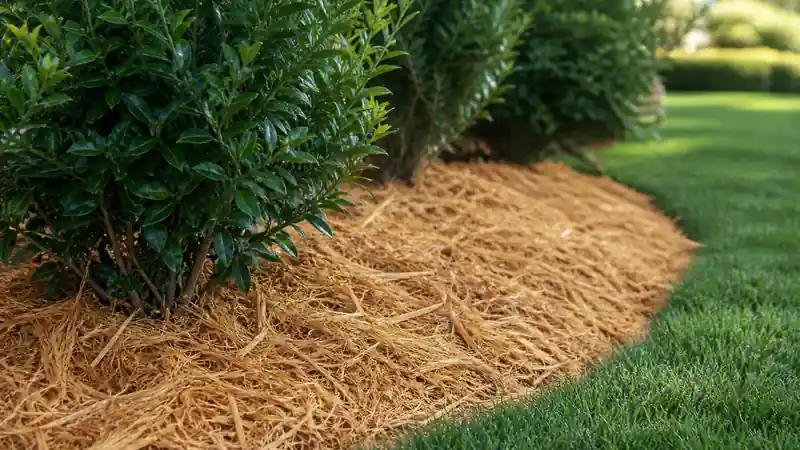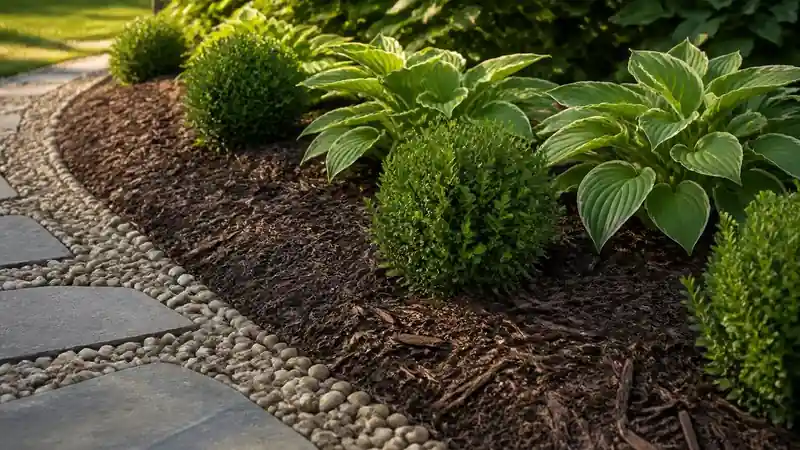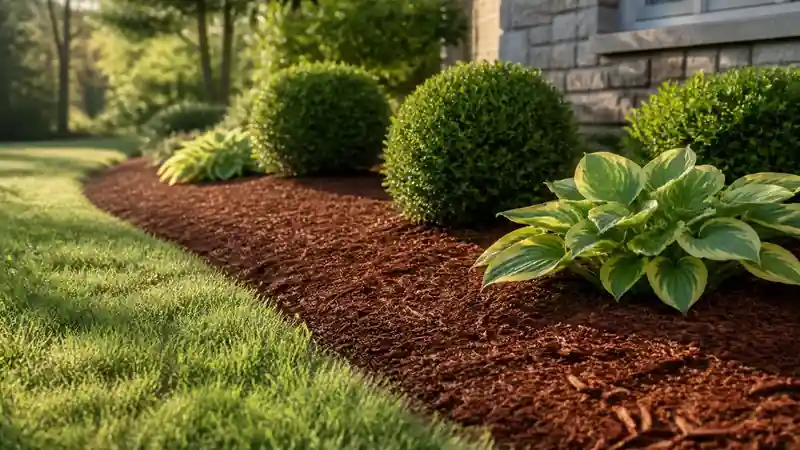
Cedar mulch works like other wood mulches: it holds moisture and blocks weeds about as well, costs a median $50 a cubic yard, and its bug-repelling oils fade. Termites still eat it, and shredded cedar spreads fire fast.
Key takeaways
- In a 2-year Oklahoma State trial, eastern redcedar mulch lost about 10.5 percent of its dry weight, against about 5 percent for cypress and pine bark nuggets and about 22 percent for pine (Maggard et al., HortTechnology 22(3), 2012).
- Termites ate every commercial wood mulch in a University of Missouri test, including cedar; cedar was only the least preferred when they had a choice (Pinzon et al., J. Environ. Hort. 24(1), 2006).
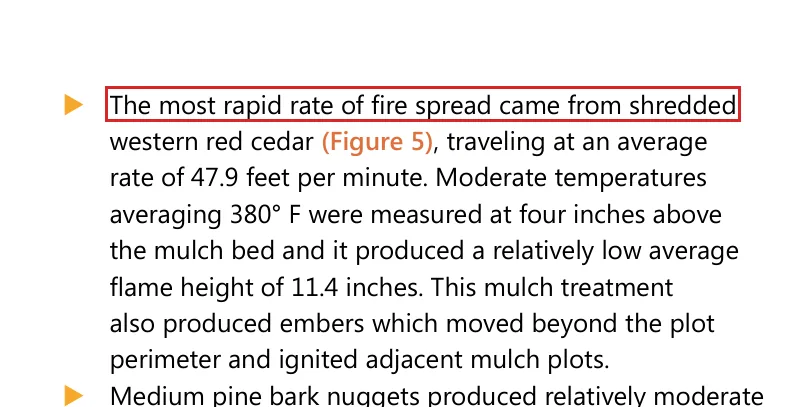
- Shredded western red cedar had the fastest fire spread of 8 mulches burned in Nevada, 47.9 ft a minute, and the study says to keep it more than 30 ft from a house (University of Nevada Extension SP-11-04).
- Federal law exempts plain cedar chips from pesticide registration only if any bug claim leaves out ticks (40 CFR 152.25(e)).
- Bulk cedar runs $45 a yard in central Texas and $85.79 to $99.95 for western red cedar in Minnesota, against a $40 national median for undyed hardwood (GIR price survey, Oct. 18, 2026).
10.5% dry weight eastern redcedar mulch lost in 2 years; cypress lost about 5% (Oklahoma State, 2012)
47.9 ft/min fire spread in shredded western red cedar, fastest of 8 mulches (Univ. of Nevada SP-11-04)
$50 median bulk price per cubic yard of cedar at 15 supply yards (GIR survey, Oct. 2026)
2 in most mulch within 12 in of a foundation in termite country (UF/IFAS IN651)
What is cedar mulch made of?
Cedar mulch is shredded or chipped wood and bark from trees sold as cedar, and none are true cedars (Cedrus). In the Northwest and upper Midwest it is usually western red cedar (Thuja plicata); in Texas and Oklahoma it is eastern redcedar or Ashe juniper (Juniperus). The species matters because most cedar research tested only one of them.
The long, stringy grade sold as gorilla hair is western red cedar bark: the University of Nevada fire study describes its sample, Mountain Magic Gorilla Hair, as machine-shredded western red cedar (SP-11-04). Oklahoma State tested eastern redcedar (Juniperus virginiana) bark and wood, and the Missouri termite study bought a Juniperus mulch (Maggard et al., 2012; Pinzon et al., 2006).
| Sold as | Species | Where it is the local cedar | Heartwood decay class (USDA Wood Handbook) | Studied as mulch in |
|---|---|---|---|---|
| Western red cedar, gorilla hair, cedar bark | Thuja plicata | Pacific Northwest; shipped to the Midwest and Rockies | Resistant | Univ. of Nevada fire study (2011) |
| Eastern redcedar, aromatic cedar | Juniperus virginiana | Oklahoma, Kansas, Missouri, the East | Resistant | Oklahoma State trials (2012) |
| Texas cedar, Hill Country cedar | Juniperus ashei (Ashe juniper) | Central Texas | Resistant (junipers) | Texas mosquito trial (Keck et al., 2014) |
| Southern redcedar | Juniperus silicicola | Florida and the Gulf coast | Resistant (junipers) | Univ. of Florida container trial (2008) |
| Cypress (for comparison) | Taxodium distichum | Florida, Louisiana | Resistant old growth; moderately resistant young growth | UF/IFAS trials (1999); Oklahoma State (2012) |
What are the pros and cons of cedar mulch?
The pros of cedar mulch are real but shared with other wood mulches: in a 2-year Oklahoma State trial, all 7 wood mulches kept soil moister than bare ground and cut weeds about equally. The cons are price where cedar is shipped in, up to $99.95 a yard, fast fire spread when shredded, and pest claims the research only partly supports.
| Common claim | What the research measured | Verdict | Source |
|---|---|---|---|
| Cedar lasts longer than other mulches | Redcedar lost about 10.5% dry weight in 2 years; cypress and pine bark nuggets about 5%, pine about 22%, red-dyed about 23% | Partly true: beats pine and dyed mulch, not cypress or pine bark | Maggard et al., 2012, Fig. 9 |
| Cedar keeps soil moist and cool | All 7 mulches kept more soil moisture than bare plots in dry spells; soil temperatures did not differ among mulch types | True, and equally true of other wood mulches | Maggard et al., 2012 |
| Cedar suppresses weeds | Mulches cut weed emergence 79% on average; redcedar leachate alone cut it 23%; the effect was mostly physical | True, mostly through cover, not chemistry | Maggard et al., J. Environ. Hort. 30(3), 2012 |
| Cedar repels insects | Two ant species avoided cedar mulch as a nest in the lab; Ashe juniper mulch did not change mosquito counts | Species-specific and unproven outdoors | Meissner and Silverman, 2001; Keck et al., 2014 |
| Cedar does not attract termites | Termites ate cedar in no-choice tests and survived 73% to 100% on every mulch; cedar was least preferred in choice tests | Termites eat it; it is just their last pick | Pinzon et al., 2006 |
| Cedar is allelopathic and stunts plants | Thuja compounds have no demonstrated negative effect on plants; all fresh mulches slowed lettuce seed germination | Myth for established plants; true of fresh mulch on seed | Chalker-Scott, 2007; Duryea et al., 1999 |
| Cedar acidifies soil | Redcedar mulch tested pH 5.6 against a soil pH of 6.4; woody mulch acidification is unlikely in real soils | Small, local effect at most | Maggard et al., 2012; Chalker-Scott, 2007 |
| Cedar is a fire risk | Shredded western red cedar spread fire at 47.9 ft a minute, the fastest of 8 mulches | True for the shredded grade | Quarles and Smith, SP-11-04 |
How long does cedar mulch last compared with cypress, pine bark and hardwood?
Cedar mulch outlasts pine and dyed hardwood mulch but not cypress or pine bark nuggets, based on the only side-by-side trial that included redcedar. Over 2 years in Stillwater, Oklahoma, redcedar lost about 10.5 percent of its dry weight; cypress and pine bark nuggets lost about 5 percent each (Maggard et al., 2012).
| Mulch | Dry weight lost in 2 years (approx.) | Statistical group | What the wood is |
|---|---|---|---|
| Cypress | 5% | C (slowest) | Bark and wood of Taxodium distichum |
| Pine bark nuggets | 5% | C (slowest) | Southern yellow pine bark |
| Eastern redcedar | 10.5% | BC | Juniperus virginiana bark and wood |
| Grand eucalyptus | 13.5% | B | Eucalyptus grandis bark and wood |
| Hardwood | 15.5% | BA | Maple and oak |
| Pine (bark and wood) | 21.5% | A (fastest) | Southern yellow pine |
| Red-dyed | 23% | A (fastest) | Maple and poplar |
Two Florida trials explain why decay is not the same as depth. In the University of Florida study, cypress and pine bark lost only 3 to 7 percent of their weight in a year, yet a 3.5 inch (9 cm) layer settled to about 6 cm (2.4 inches) after 2 years (Duryea, English and Hermansen, 1999; UF/IFAS FR052). Plan on topping up any bark mulch by roughly an inch every 2 years, cedar included; no trial has measured cedar settling directly.
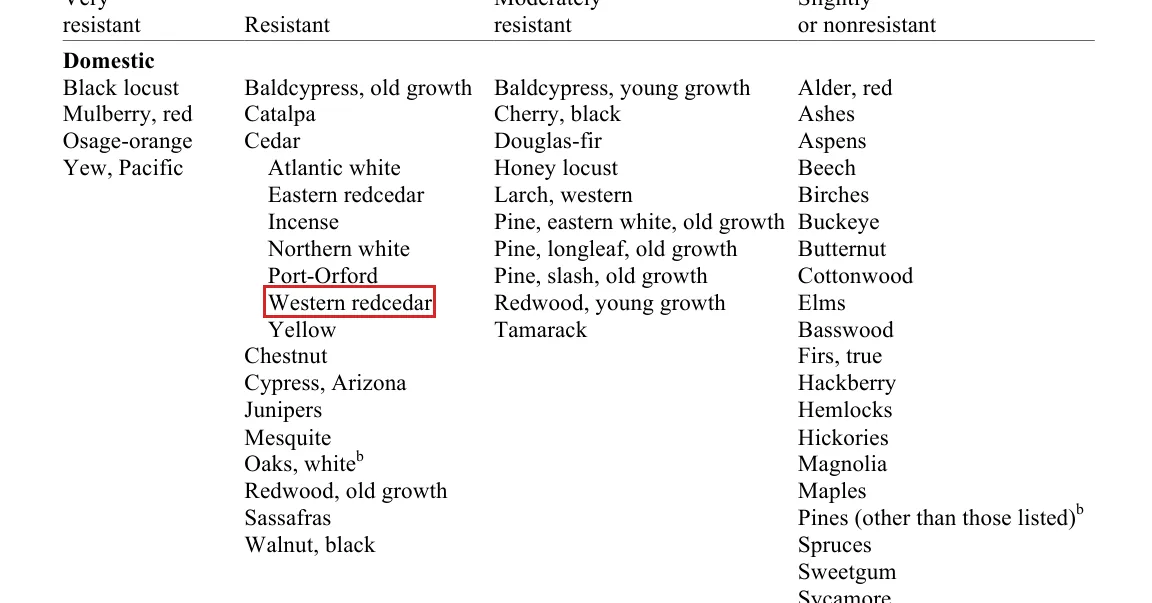
The heartwood argument for cedar is sound but incomplete. The USDA Wood Handbook rates western redcedar, eastern redcedar and the junipers as decay resistant, in the same class as old-growth baldcypress, while young-growth baldcypress is only moderately resistant (Table 14-1, 2021). Bagged mulch mixes bark and sapwood, and the same handbook says untreated sapwood of essentially all species has low decay resistance.
Does cedar mulch repel bugs?
Cedar mulch repels a few insect species under lab conditions, mostly while it is fresh, and no field study shows it keeping pests out of a yard. Argentine ants and odorous house ants avoided aromatic cedar mulch as a nest site in North Carolina State lab tests, but mosquito counts in Texas did not change with Ashe juniper mulch (Meissner and Silverman, 2001; Keck et al., 2014).
| Pest | Study and setting | Result | Holds up as the mulch ages? |
|---|---|---|---|
| Argentine ant | Meissner and Silverman, J. Econ. Entomol. 94(6), 2001, lab | Avoided cedar mulch as nesting substrate; all ants died when confined with it | Yes: mortality complete with mulch aged up to 140 days |
| Odorous house ant | Same study, lab | Avoided cedar mulch; killed by fresh mulch | No: mortality fell significantly as mulch aged |
| Ants beside buildings | Meissner and Silverman, J. Econ. Entomol. 96(3), 2003, field | Nest counts did not differ between aromatic cedar and cypress mulch | Not tested |
| Mosquitoes | Keck et al., Southwestern Entomologist 39(3), 2014, field, Texas | 4.8 vs 4.9 mosquitoes a night; fresh Ashe juniper mulch had no effect | Not applicable |
| Red imported fire ant | Chalker-Scott, 2007, review of lab work | Cedar shavings repelled fire ants in the lab | Not tested |
| Clothes moths | University of Kentucky Entfact ef609, extension guidance | Cedar chests seldom deter moths; the seal cannot hold repellent oil levels | Not applicable |
The law draws the same line. Under 40 CFR 152.25(e), natural cedar chips, shavings and blocks are exempt from federal pesticide registration only when they are pure, untreated cedar and any label claim is limited to repelling arthropods other than ticks. A colorant-coated cedar mulch sold with bug claims, or any product claiming to repel ticks, falls outside that exemption.
Cedarwood oil itself is a registered repellent: EPA’s 1993 fact sheet says it repels insects by a non-toxic mode of action, and EPA’s 2022 interim review notes its volatile nature means rapid dissipation (EPA RED Facts, 1993; EPA interim decision, 2022). That volatility is why any repellent effect should be strongest in fresh mulch.
Does cedar mulch attract termites?
Cedar mulch does not draw termites in, but it does not stop them either. In University of Missouri tests, eastern subterranean termites ate cedar when it was the only food, survived 73 to 100 percent on every mulch tested, and picked cedar last when given a choice of 7 mulches aged 0, 6 or 12 months (Pinzon, Houseman and Starbuck, 2006).
The authors’ summary is blunt: all commercially available wood mulches were equally palatable, and aged mulch was more palatable than fresh. LSU AgCenter entomologist Dennis Ring adds that the natural chemicals in cypress, redwood and cedar break down or leach out, leaving food the termites will eat (LSU AgCenter). What matters near a house is depth and spacing, not species.
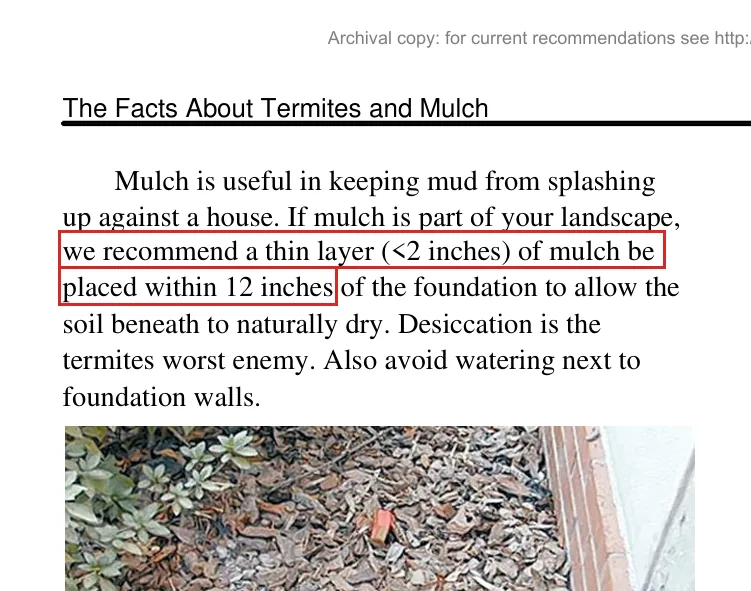
- Keep mulch within 12 inches of the foundation thinner than 2 inches so the soil there can dry (UF/IFAS IN651).
- Leave 6 inches of slab or foundation showing so mud tubes can be seen during inspections (LSU AgCenter).
- Do not dig into or pile mulch over the termiticide-treated strip, which LSU describes as 4 inches wide and 6 inches deep beside the slab (LSU AgCenter).
- Avoid watering next to foundation walls; wet soil there undoes the drying the thin layer is meant to allow (UF/IFAS IN651).
- Where termite pressure is high, leave a narrow strip of bare soil against the foundation, as Washington State University advises for all wood chips (WSU FS160E).
Can cedar mulch hurt plants or acidify the soil?
Cedar mulch does not harm established shrubs or trees, and its effect on soil pH is small. Chalker-Scott’s review found Thuja compounds have no demonstrated negative effect on plant materials, and Oklahoma State saw redcedar perform like the other wood mulches for trees and annuals over 2 years (Chalker-Scott, J. Environ. Hort. 25(4), 2007; Maggard et al., 2012).
| Measure | Eastern redcedar | Cypress | Pine bark / pine | Hardwood | Source |
|---|---|---|---|---|---|
| pH of the mulch itself | 5.6 | 6.0 | 4.5 | 7.9 | Maggard et al., 2012 |
| Soil pH change under mulch, Oklahoma (start 6.45) | Fell | Fell | Fell | Rose in year 1 | Maggard et al., 2012 |
| Soil pH after 1 year, Florida (start 5.0) | Not tested | 4.6 | 4.6 (pine bark) | 4.7 (utility prunings) | Duryea et al., 1999 |
| Weed emergence cut by mulch leachate alone | 23% | Not reported separately | Not reported separately | Not reported separately | Maggard et al., 2012 (JEH) |
| Lettuce germination slowed by fresh extract | Not tested | Yes | Yes (pine bark) | Yes (utility prunings) | Duryea et al., 1999 |
The seed-bed caution is real for every fresh wood mulch, not just cedar. In the Florida trial all 6 fresh mulches slowed lettuce germination, and by 9 months only pine straw and utility mulch still did (Duryea et al., 1999). Chalker-Scott also notes a thin nitrogen-poor zone at the mulch and soil interface, so she advises against high carbon mulches in annual and vegetable beds; under trees and shrubs, neither nitrogen loss nor growth suppression occurs. If a bed’s pH worries you, a lab soil test measures it directly instead of guessing from the mulch.
Is cedar mulch a fire risk near the house?
Shredded cedar is one of the most flammable mulches tested. In a University of Nevada burn of 8 mulches after 79 days outdoors, at about 100 °F and 13 percent humidity with 10 to 15 mph fans, shredded western red cedar spread fire at 47.9 ft a minute and threw embers that lit neighboring plots (Quarles and Smith, SP-11-04).
| Mulch (2 to 3 inch layer) | Fire result | Where the study allows it |
|---|---|---|
| Shredded western red cedar | Fastest spread, 47.9 ft/min; flames averaged 11.4 inches; about 380 °F 4 inches above the bed; embers ignited adjacent plots | More than 30 ft from the house |
| Shredded rubber | Hottest, over 630 °F; flames averaged over 3 ft | More than 30 ft from the house |
| Pine needles | Second most hazardous overall | More than 30 ft from the house |
| Medium pine bark nuggets | Moderate flame height and temperature; low spread rate | 5 to 30 ft, broken up by gravel, concrete or lawn |
| Composted wood chips | Mostly smoldered; slowest spread, under 0.3 ft/min | 5 to 30 ft; still combustible |
| Any mulch tested | All 8 were combustible | Not within 5 ft: use rock, gravel, concrete or pavers |
Cypress fared better in an Ohio test of 13 mulches: lit cigarettes ignited shredded cypress bark 2 times in 8 tries and shredded hardwood bark never, while a propane torch rated cypress 4.00 and hardwood 4.13 on a 7-point scale (Steward, Sydnor and Bishop, J. Arboric. 29(6), 2003). That study did not include cedar, so the two results cannot be ranked against each other. Rubber mulch burned hottest in both studies; its other trade-offs are in our guide to rubber mulch pros and cons.
Cedar vs cypress mulch: which is better?
Cypress mulch decomposed about half as fast as redcedar in the Oklahoma trial and costs a few dollars less per yard, so on performance alone it edges cedar. The case against cypress is its source: the Oklahoma State authors flag the harvesting of trees from intact, functioning ecosystems for mulch, naming cypress wetlands (Maggard et al., 2012).
| Factor | Cedar | Cypress | Source |
|---|---|---|---|
| Dry weight lost in 2 years | About 10.5% (eastern redcedar) | About 5% | Maggard et al., 2012 |
| Mulch pH | 5.6 | 6.0 | Maggard et al., 2012 |
| Heartwood decay class | Resistant | Resistant old growth; moderately resistant young growth | USDA Wood Handbook, Table 14-1 |
| Termites | Eaten in no-choice tests; least preferred in choice tests | Heartwood under 3% eaten; mulch eaten, and more so after 12 months | Pinzon et al., 2006; Duryea et al., 1999 |
| Fire | Shredded western red cedar: fastest spread of 8 mulches | Shredded cypress: lit by 2 of 8 cigarettes; torch rating 4.00 of 7 | SP-11-04; Steward et al., 2003 |
| Median bulk price, Oct. 2026 | $50 a cu yd (15 yards) | $46.50 a cu yd (4 yards) | GIR mulch price survey |
| Where it comes from | Eastern redcedar encroaches on fields and grasslands, so cutting it is often control work | Baldcypress from coastal wetland forests such as Louisiana’s | Schnelle, HortTechnology 33(6), 2023; Louisiana Science Working Group, 2005 |
Regeneration is the specific worry. Louisiana’s Governor’s Science Working Group reported that natural regeneration of baldcypress was poor to non-existent in south Louisiana swamps logged in the 1980s, named the new market for cypress mulch among the signs of renewed harvesting, and recommended delaying harvest on sites that will not regrow (Conner, Chambers et al., 2005). Ask the seller whether bagged cypress is mill residue or whole-tree chips.
How much does cedar mulch cost?
Bulk cedar mulch had a median posted pickup price of $50 a cubic yard at 15 supply yards checked Oct. 18, 2026, with the middle half at $47 to $80. That is $3.50 a yard more than cypress and $10 more than undyed hardwood at the median; the gap widens to $40 or more where western red cedar is trucked in (GIR mulch cost survey).
| Mulch type | Median per cu yd | Middle half | Yards sampled |
|---|---|---|---|
| Cedar (shredded, chips, gorilla hair) | $50 | $47 to $80 | 15 |
| Fir, hemlock or redwood bark | $56.25 | $47 to $69 | 9 |
| Pine bark, fines or nuggets | $47.50 | $43 to $55 | 6 |
| Cypress or cypress blend | $46.50 | $42 to $49 | 4 |
| Dyed black, brown or red | $42.50 | $40 to $49 | 24 |
| Natural (undyed) shredded hardwood | $40 | $31 to $45 | 23 |
Cedar prices split by species and freight. Native Texas cedar sells for $45 to $49.99 a yard, about what local hardwood costs there, while western red cedar at yards in Minnesota and Colorado runs $85.79 to $99.95. The 15 cedar listings below are the full sample.
Swipe the table sideways to see every column.
| Supply yard | Location | Product as listed | Price per cu yd |
|---|---|---|---|
| Southridge Farm & Nursery | Walpole, MA | Natural Cedar Mulch | $42.00 |
| Cheaper Than Dirt Landscape Supply | Belton, TX | Cedar mulch | $45.00 |
| Farr’s Landscape Supply | Nolanville, TX | Double Grind Cedar | $45.00 |
| Suburban Landscape Supply | Walled Lake, MI | Cedar Mulch | $46.50 |
| McCarty Mulch & Stone | Indianapolis, IN | Cedar Mulch | $48.00 |
| Portland Rock & Landscape Supply | Portland/Gresham, OR | Bark – Cedar Chips | $48.00 |
| Texas Garden Materials | Houston, TX | Cedar Mulch | $49.99 |
| Peach Country Tractor | Mullica Hill, NJ | Cedar Mulch, All Natural Cedar Chips | $50.00 |
| Mulch Center | Deerfield, IL | Cedar Grind | $57.00 |
| Sky Nursery | Shoreline, WA | Cedar Play Chips | $68.00 |
| Kirk Allen Landscape Supply | Stanhope, NJ | Cedar Mulch | $75.00 |
| KDCO | Medina, MN | Western Red Cedar Mulch | $85.79 |
| Direct Landscape Supply | Denver area, CO | Western Red Cedar Mulch | $90.00 |
| Bedrock Landscaping Material | Denver area, CO | Cascade Cedar Mulch (Gorilla Hair) | $95.00 |
| Plaisted Companies | Elk River, MN | Western Red Cedar Mulch | $99.95 |
What does a 200 sq ft bed cost in cedar?
A 200 sq ft bed at 3 inches needs 1.85 cubic yards (200 × 3 ÷ 324), about 25 two-cubic-foot bags. At the survey medians that is $92.59 in bulk cedar, $86.11 in cypress and $74.07 in undyed hardwood, before delivery; bagged cedar costs more per yard than bulk at every seller in the survey.
| Material | Price used | Cost for 1.85 cu yd | Source of price |
|---|---|---|---|
| Texas native cedar, bulk | $45 a cu yd | $83.33 | Farr’s and Cheaper Than Dirt, Oct. 2026 |
| Cedar, bulk, survey median | $50 a cu yd | $92.59 | GIR survey median |
| Western red cedar, bulk, Minnesota | $99.95 a cu yd | $185.09 | Plaisted Companies, Oct. 2026 |
| Cedar, 2 cu ft bags | $4.95 a bag × 25 bags | $123.75 | Bzak Landscaping, Cincinnati |
| Cypress, bulk, survey median | $46.50 a cu yd | $86.11 | GIR survey median |
| Undyed hardwood, bulk, survey median | $40 a cu yd | $74.07 | GIR survey median |
| Top-up every 2 years, 1 inch of cedar | $50 a cu yd × 0.62 cu yd | $30.86 | Assumes cedar settles like bark in UF/IFAS FR052 |
- Cubic yards
- 1.85
- 2 cu ft bags
- 25
Cubic yards = area x depth in inches / 324. Prices are posted supply-yard pickup prices checked Oct. 18, 2026 (GIR mulch cost survey); bag prices from Bzak (Cincinnati) and Sky Nursery (Shoreline, Wash.).
The calculator converts bed area and depth into cubic yards, 2 cu ft bags and a material cost range for each mulch type. For depth rules by mulch texture and around trees, use our mulch quantity guide; for the weight of a yard before you load a trailer, see how much mulch weighs. Mulch is one line in our full landscaping cost breakdown, and more bed and tree guides sit in the Turf and Trees hub.
Is cedar mulch safe for dogs?
No veterinary authority we found lists cedar or juniper mulch as toxic to dogs; the ASPCA toxic plant list has no Thuja or Juniperus entry as of October 2026. The documented risks are cocoa mulch, which contains theobromine, and swallowing large amounts of any mulch, which can cause bowel impaction (Merck Veterinary Manual; UW School of Veterinary Medicine).
Cocoa hull mulch carries about 9 mg of methylxanthines per gram, and the Merck Veterinary Manual lists mild signs from 20 mg per kg of body weight, so a 20 lb dog shows signs after roughly 20 g, under an ounce. For a dog that chews wood, the University of Wisconsin veterinarians’ warning applies to cedar too: large ingestions of any mulch can need surgery.
When should you use cedar mulch, and when should you skip it?
Use cedar where it costs under about $60 a yard, more than 30 ft from the house in fire country, and around established plants. Skip it if you are paying a freight premium for bug or termite control, because the studies above do not support either. Each row below turns one finding into a rule with its threshold.
| If your situation is | Do this | Why (source) |
|---|---|---|
| Bed within 5 ft of the house in a wildfire area | Use rock, gravel, pavers or irrigated lawn, not cedar or any wood mulch | All 8 mulches burned; none recommended within 5 ft (SP-11-04) |
| Bed 5 to 30 ft from the house in a wildfire area | Choose pine bark nuggets or composted chips; break beds up with gravel or lawn | Lower spread than shredded cedar (SP-11-04) |
| Mulch against a foundation in termite country | Any species, under 2 inches deep within 12 inches of the wall, with 6 inches of foundation showing | Termites eat cedar too (Pinzon 2006; IN651; LSU AgCenter) |
| Buying cedar to repel mosquitoes, ticks or termites | Do not pay extra for it | No mosquito effect; tick claims excluded by 40 CFR 152.25(e); termites eat it |
| You want the slowest-decaying mulch | Pine bark nuggets, or cypress from a known mill-residue source | About 5% loss in 2 years vs 10.5% for redcedar (Maggard 2012) |
| You live in Texas or Oklahoma | Buy local cedar | $45 to $49.99 a yard, at or under local hardwood (GIR survey) |
| Western red cedar costs over $80 a yard where you live | Use undyed hardwood or pine bark at $40 to $47.50 | Same moisture, temperature and weed results in trials (Maggard 2012) |
| Seeding annuals or vegetables | Keep fresh wood mulch, cedar included, off the seed row until seedlings are up | Fresh extracts of all 6 mulches slowed germination (Duryea 1999) |
| You want ground-nesting bees | Leave some sunny bare soil unmulched | Thick bark or wood mulch blocks nesting (USU Extension) |
1Is the bed within 5 ft of the house in a wildfire-prone area?
YesUse rock, gravel, pavers or irrigated lawn. No wood mulch, cedar included.
NoGo to the next question
2Is the bed 5 to 30 ft from the house in a wildfire-prone area?
YesUse pine bark nuggets or composted wood chips, broken up with gravel or lawn. Skip shredded cedar.
NoGo to the next question
3Are you buying cedar mainly to repel mosquitoes, ticks or termites?
YesDo not pay a premium for it. Keep any mulch under 2 inches within 12 inches of the foundation.
NoGo to the next question
4Does cedar cost more than about $60 a cubic yard where you live?
YesUse undyed hardwood ($40 median) or pine bark ($47.50) for the same moisture and weed results.
NoGo to the next question
5Do you need the slowest-decaying wood mulch?
YesUse pine bark nuggets, or cypress from a known mill-residue source.
NoCedar is a sound pick: spread 2 to 3 inches and top up about an inch every 2 years.
Source: Univ. of Nevada SP-11-04; UF/IFAS IN651; Maggard et al. 2012; GIR price survey Oct. 2026
How we compiled this
We read 14 primary documents in October 2026: 8 peer-reviewed mulch, termite, ant and fire studies, the USDA Wood Handbook, 4 extension publications (UF/IFAS, WSU, LSU AgCenter, University of Kentucky) and 40 CFR 152.25, plus EPA’s cedarwood oil reviews. Prices are 15 cedar and 4 cypress listings from our October 18, 2026 supply-yard survey. No mulch was tested for this page; decay percentages were read from a published chart and are approximate.
| Question | Short answer | Best evidence |
|---|---|---|
| Lasts longest? | Cypress and pine bark nuggets; cedar is mid-pack | Oklahoma State, 2 years |
| Repels bugs? | Some ants in the lab; not mosquitoes | Lab and field trials |
| Stops termites? | No; least preferred, still eaten | Univ. of Missouri |
| Fire risk? | Shredded cedar spread fastest | Univ. of Nevada burn |
| Hurts plants? | Not established ones | WSU review |
| Costs more? | $10 a yard over hardwood at the median | GIR survey, Oct. 2026 |
Frequently asked questions
What are the downsides of cedar mulch?
Price where it is shipped in ($85.79 to $99.95 a yard for western red cedar in Minnesota), fast fire spread when shredded (47.9 ft a minute in the Nevada burn), and pest claims that fade as the oils dissipate. It also decomposed twice as fast as cypress in the Oklahoma trial, so it is not the longest-lasting wood mulch.
Which plants do not like cedar mulch?
No study shows established plants failing under cedar; Washington State University says Thuja cedars have not been found to be allelopathic. Seeds are the exception for every fresh wood mulch: keep cedar off rows of sown annuals, vegetables and wildflowers until seedlings are up, and skip deep mulch where ground-nesting bees need bare soil.
Is cedar mulch good?
Yes, as a wood mulch: Oklahoma State found eastern redcedar provides similar benefits as other common wood mulches for moisture, soil temperature, weeds and plant growth. It is the better buy in Texas and Oklahoma ($45 to $49.99 a yard) than where western red cedar is shipped in.
Which is better, pine bark or cedar mulch?
Pine bark nuggets decomposed about 5 percent in 2 years against 10.5 percent for redcedar, burned more slowly in the Nevada study, and cost a median $47.50 a yard against $50 for cedar. Cedar’s edge is its color and, in Texas and Oklahoma, a lower local price.
How long does cedar mulch keep bugs away?
No study has measured how long cedar mulch repels insects outdoors. In lab tests, cedar mulch aged up to 140 days still killed Argentine ants, but its effect on odorous house ants fell significantly with age, and EPA notes cedarwood oil dissipates rapidly. Expect any effect to be strongest in the first months.
Is black cedar mulch dyed?
Yes. Black or brown cedar mulch is cedar coated with a colorant, so it is no longer untreated cedar. Under 40 CFR 152.25(e) the federal exemption for cedar chips covers only products that are not treated or combined with any other substance, so dyed cedar should not carry insect-repellent claims.
Sources
- Oklahoma State University (A.O. Maggard, R.E. Will, T.C. Hennessey, C.R. McKinley, J.C. Cole), Tree-based Mulches Influence Soil Properties and Plant Growth, HortTechnology 22(3):353 to 360, June 2012. Accessed October 2026.
- Oklahoma State University (A.O. Maggard, R.E. Will, T.C. Hennessey, J.C. Cole), Tree-Based Mulches and their Leachate Suppress Weed Seed Emergence, J. Environ. Hort. 30(3):146 to 149, September 2012. Accessed October 2026.
- University of Missouri (O.P. Pinzon, R.M. Houseman, C.J. Starbuck), Feeding, Weight Change, Survival, and Aggregation of Reticulitermes flavipes in Seven Varieties of Differentially-Aged Mulch, J. Environ. Hort. 24(1):1 to 5, March 2006. Accessed October 2026.
- University of Florida (M.L. Duryea, R.J. English, L.A. Hermansen), A Comparison of Landscape Mulches: Chemical, Allelopathic, and Decomposition Properties, J. Arboric. 25(2):88 to 97, March 1999. Accessed October 2026.
- University of Florida (M.L. Duryea, R.J. Huffman, R.J. English, W. Osbrink), Will Subterranean Termites Consume Landscape Mulches? J. Arboric. 25(3):143 to 150, May 1999. Accessed October 2026.
- UF/IFAS Extension (M.L. Duryea, P.J. Minogue), FR052, Landscape Mulches: How Quickly Do They Settle?, 2006 (EDIS journal record). Accessed October 2026.
- UF/IFAS Extension (F.M. Oi, M. Wheeler), ENY-832/IN651, The Facts About Termites and Mulch, March 2006 (EDIS journal record). Accessed October 2026.
- University of Nevada Cooperative Extension (S. Quarles, E. Smith), SP-11-04, The Combustibility of Landscape Mulches, 2011. Accessed October 2026.
- B.K. Steward, T.D. Sydnor and B. Bishop, The Ease of Ignition of 13 Landscape Mulches, J. Arboric. 29(6):317 to 321, 2003. Accessed October 2026.
- USDA Forest Service, Forest Products Laboratory, Wood Handbook, FPL-GTR-282, Chapter 14, Biodeterioration of Wood, Table 14-1, 2021. Accessed October 2026.
- U.S. Code of Federal Regulations, 40 CFR 152.25, Exemptions for pesticides of a character not requiring FIFRA regulation, paragraph (e) Natural cedar, current through October 2026. Accessed October 2026.
- U.S. EPA, R.E.D. Facts: Cedarwood Oil, EPA-738-F-93-008, September 1993. Accessed October 2026.
- U.S. EPA, Cedarwood Oil Interim Registration Review Decision, docket EPA-HQ-OPP-2022-0108, November 29, 2022. Accessed October 2026.
- North Carolina State University (C.A. Meissner, J. Silverman), Effects of Aromatic Cedar Mulch on the Argentine Ant and the Odorous House Ant, J. Econ. Entomol. 94(6):1526 to 1531, 2001. Accessed October 2026.
- North Carolina State University (C.A. Meissner, J. Silverman), Effect of Aromatic Cedar Mulch on Argentine Ant Foraging Activity and Nest Establishment, J. Econ. Entomol. 96(3):850 to 855, June 2003. Accessed October 2026.
- Keck et al., Effects of Cut Juniper Trees on Mosquito Populations in South Central Texas, Southwestern Entomologist 39(3):451, September 2014. Accessed October 2026.
- Washington State University (L. Chalker-Scott), Impact of Mulches on Landscape Plants and the Environment: A Review, J. Environ. Hort. 25(4):239 to 249, December 2007. Accessed October 2026.
- Washington State University Extension, FS160E, Using Arborist Wood Chips as a Landscape Mulch, January 2015. Accessed October 2026.
- LSU AgCenter (D.R. Ring), Integrated Pest Management of Termites in the Landscape, February 8, 2007. Accessed October 2026.
- University of Kentucky Entomology (M.F. Potter), Entfact ef609, Clothes Moths, revised March 2026. Accessed October 2026.
- Oklahoma State University (M.A. Schnelle), Eastern Redcedar: A United States Native Tree That Ranges from Useful, to a Nuisance, and Even Invasive, HortTechnology 33(6), 2023. Accessed October 2026.
- Governor’s Science Working Group on Coastal Wetland Forest Conservation and Use (Louisiana), Conservation, Protection and Utilization of Louisiana’s Coastal Wetland Forests, final report, April 30, 2005. Accessed October 2026.
- Merck Veterinary Manual, Chocolate Toxicosis in Animals, updated February 2026. Accessed October 2026.
- University of Wisconsin School of Veterinary Medicine, Spring Yard Prep: Watch for These 6 Possible Pet Hazards, 2026. Accessed October 2026.
- ASPCA Animal Poison Control Center, Toxic and Non-Toxic Plant List: Dogs, checked October 2026. Accessed October 2026.
- Utah State University Extension (J.H. Cane, USDA ARS), Gardening for Native Bees, current page. Accessed October 2026.
- The Green Industry Report, Mulch Cost per Yard in 2026 (supply-yard price survey and CSV), checked October 18, 2026. Accessed October 2026.