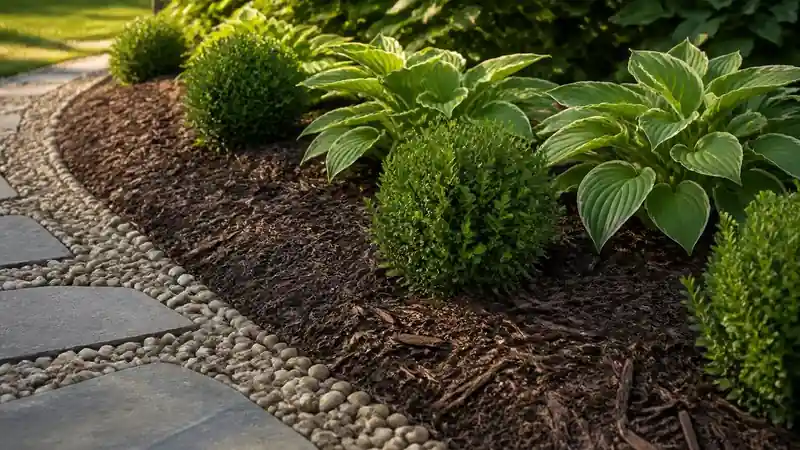
Cypress mulch decays slowly, losing 3 to 7 percent of its weight in a year, but bagged cypress is mostly young sapwood that termites eat, and wetland harvesting is why Florida’s extension program says not to use it.
Key takeaways
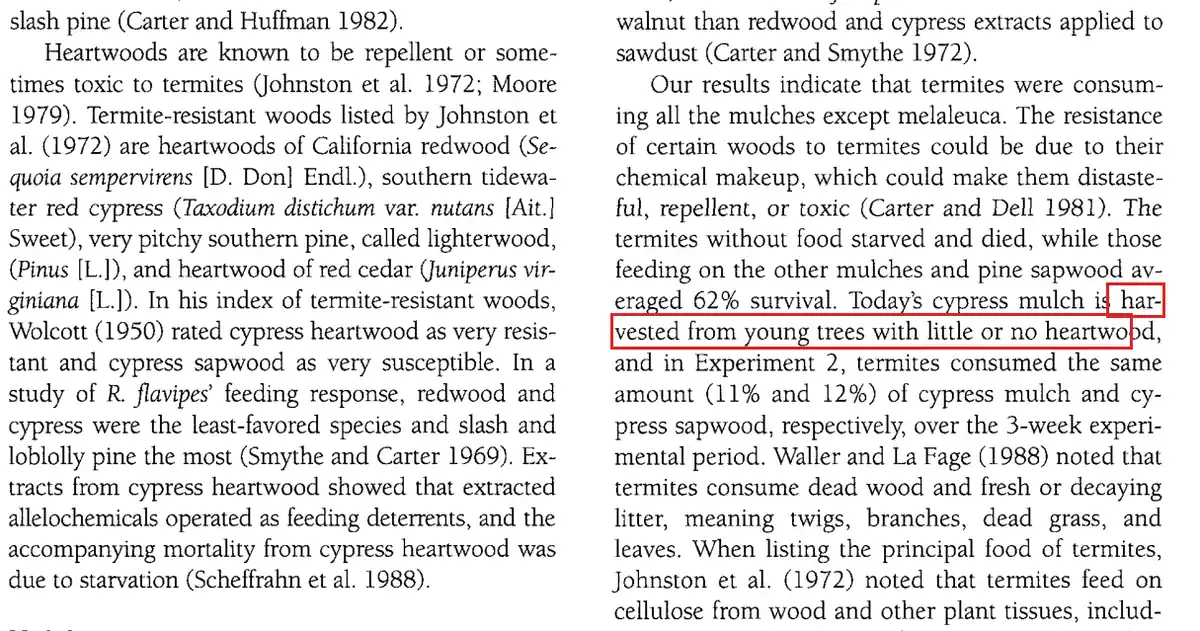
- Termites ate 11 percent of a store-bought cypress mulch sample and 12 percent of cypress sapwood in 3 weeks, but under 3 percent of cypress heartwood; the authors note that today’s cypress mulch comes from young trees with little or no heartwood (Duryea et al., J. Arboric. 25(3), 1999).
- Cypress lost 3 to 7 percent of its weight in a year in a University of Florida plot trial and kept 6 of its original 9 cm of depth after 2 years, the same as pine bark (Duryea et al., J. Arboric. 25(2), 1999; UF/IFAS FR052).
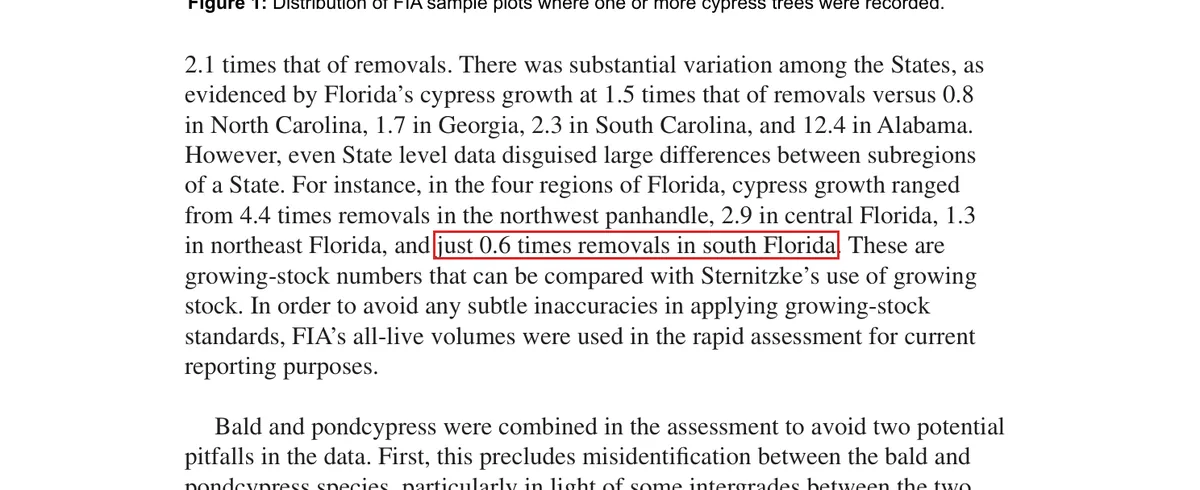
- Across 13 Southern states, cypress growth ran 2.1 times removals in 2008 Forest Service inventory data, but only 0.6 times in south Florida and 0.8 times in North Carolina (Brown, USDA Forest Service RMRS-P-56, 2009).
- The UF/IFAS Florida-Friendly Landscaping Program does not recommend cypress mulch and names melaleuca, pine straw and eucalyptus instead (FFL Principle 4, page modified April 2, 2026).
- Bulk cypress was posted at $32 to $49.99 a cubic yard at 4 supply yards in October 2026 (median $46.50), and a 2 cu ft bag at $5.50 (GIR price check, Oct. 2026).
11% of a cypress mulch sample eaten by termites in 3 weeks, vs 12% of cypress sapwood (UF, 1999)
6 of 9 cm cypress depth left after 2 years, tied with pine bark (UF/IFAS FR052)
0.6x cypress growth vs removals in south Florida, 2008 inventory (USDA Forest Service)
$46.50 median bulk price per cubic yard at 4 supply yards (GIR check, Oct. 2026)
What is cypress mulch made of?
Cypress mulch is shredded bark and wood of baldcypress (Taxodium distichum) and pondcypress, cut mostly in Florida and Louisiana, the two states that hold more than half of the South’s cypress area and volume (Brown, USDA Forest Service, 2009). It began as mill edgings, shavings and residue; demand later pulled in low-grade sawlogs and small whole trees.
The rot and insect resistance cypress is known for lives in heartwood from old trees. The USDA Wood Handbook rates old-growth baldcypress heartwood as resistant to decay and young-growth heartwood as only moderately resistant, and it says untreated sapwood of essentially all species has low resistance (FPL-GTR-282, Table 14-1, 2021). The Forest Service review credits the heartwood oil cypressene for that reputation.
Young trees are mostly sapwood. In the University of Florida termite study, the authors wrote that today’s cypress mulch is harvested from young trees with little or no heartwood, and termites ate the mulch at the same rate as cypress sapwood (Duryea, Huffman, English and Osbrink, 1999). No published mulch trial has tested a bag sold as cypress heartwood mulch.
What are the pros and cons of cypress mulch?
The pros of cypress mulch are measured ones: slow decay, little settling, color that held for a full year and the mildest seed-germination effect of 6 Florida mulches. The cons are wetland sourcing, sapwood that termites eat, mild soil acidification and a price that buys nothing pine bark does not (Duryea, English and Hermansen, 1999).
| Common claim | What the research measured | Verdict | Source |
|---|---|---|---|
| Cypress repels termites and insects | Termites ate 11% of cypress mulch and 12% of cypress sapwood in 3 weeks; heartwood under 3% | False for bagged mulch; true of old heartwood | Duryea et al., 1999 |
| Cypress lasts longer than other mulches | 3% to 7% weight loss in 1 year (eucalyptus 21%, utility chips 32%); about 5% in 2 years in Oklahoma vs about 22% for pine | True, but pine bark matched it in both trials | Duryea 1999; Maggard 2012 |
| Cypress keeps its color | Stayed pink for 12 months; eucalyptus, utility chips and pine straw turned pinkish gray | True in the Florida trial | Duryea 1999, Table 1 |
| Cypress blocks weeds better | After 1 year, weed numbers did not differ among the 6 mulches | No better than other mulches | Duryea 1999 |
| Cypress feeds the soil | Lowest nutrient concentrations of the 6 mulches tested | False: the poorest nutrient source | Duryea 1999 |
| Cypress acidifies soil | Soil fell from pH 5.0 to 4.6 under cypress in 1 year; 4.4 under pine straw | Mild; mid-pack | Duryea 1999 |
| Cypress mulch is sawmill waste | Industry says by-products of sawmilling go to mulch; a UF/IFAS forester said all sizes of trees are often fed into chippers | Both happen; the bag rarely says which | Mulch and Soil Council; UF News, 1996 |
UF/IFAS staff reported in 1996 that cypress in full sun can crust and shed water, and an Alachua County trial of 15 mulches over 6 months rated wood chips, pine bark and pine straw as high as cypress (University of Florida News, April 1996).
How long does cypress mulch last?
Cypress mulch stays at a useful depth for about 2 years. In a University of Florida plot trial, a 3.5 inch (9 cm) layer of cypress kept 6 cm, about 2.4 inches, after 2 years, the same as pine bark; melaleuca kept almost 7 cm and pine straw 1 cm (Duryea, UF/IFAS FR052). Plan a top-up of about 1 inch every 2 years.
| Mulch | Depth left after 2 years (from 9 cm) | Weight lost in 1 year | Source |
|---|---|---|---|
| Melaleuca | Almost 7 cm | 3% to 7% | FR052; Duryea 1999 |
| Cypress | 6 cm | 3% to 7% | FR052; Duryea 1999 |
| Pine bark | 6 cm | 3% to 7% | FR052; Duryea 1999 |
| Eucalyptus (E. grandis) | About 5 cm | 21% | FR052; Duryea 1999 |
| Utility-pruning chips | About 5 cm | 32% | FR052; Duryea 1999 |
| Pine straw | 1 cm | 3% to 7% | FR052; Duryea 1999 |
The slow decay comes from high lignin, the lowest nutrients of the 6 mulches and low winter respiration, not from heartwood (Duryea et al., 1999). In Oklahoma, cypress and pine bark nuggets decomposed slowest of 7 mulches, about 5 percent each in 2 years, against about 22 percent for pine (Maggard et al., HortTechnology 22(3), 2012). How much to add for a given depth is worked out in our guide to how much mulch you need.
Does cypress mulch attract or repel termites?
Cypress mulch neither repels termites nor draws them more than other wood mulch: it feeds them about the same. In a 3-week University of Florida test, eastern subterranean termites ate 11 percent of a cypress mulch sample and 12 percent of cypress sapwood, while they ate under 3 percent of cypress heartwood and melaleuca (Duryea et al., 1999).
| Part of the tree | Decay class (USDA Wood Handbook) | Eaten by termites in 3 weeks | Termites alive after 3 weeks | Source |
|---|---|---|---|---|
| Old-growth baldcypress heartwood | Resistant | Not tested | Not tested | Table 14-1 |
| Young-growth baldcypress heartwood | Moderately resistant | Under 3% (pondcypress heartwood) | Under 15% | Table 14-1; Duryea 1999 |
| Cypress sapwood | Low (sapwood of essentially all species) | 12% | 64% to 77% (pine and cypress sapwood) | Duryea 1999 |
| Store-bought cypress mulch (Gainesville, Fla.) | Not rated | 11% | Same as the other 5 mulches | Duryea 1999 |
| No food at all (control) | n/a | n/a | 8% | Duryea 1999 |
Termites ate every mulch in that experiment except melaleuca, and consumption tracked nitrogen and phosphorus (r = 0.91 and 0.96). LSU AgCenter entomologist Dennis Ring adds that the natural chemicals in cypress, redwood and cedar leach out, leaving food termites will eat (LSU AgCenter, Integrated Pest Management of Termites in the Landscape).
Placement matters more than species. These are the extension rules for mulch near a slab or pier foundation:
- Keep any mulch under 2 inches deep within 12 inches of the foundation so the soil there can dry (UF/IFAS IN651, 2006).
- Leave the termiticide-treated strip, about 4 inches wide and 6 inches deep beside the slab, uncovered and undisturbed (LSU AgCenter).
- Keep at least 6 inches of slab visible so mud tubes can be seen.
- Set shrubs at least 3 ft from the wall.
- Point sprinklers and drip lines away from the treated strip, and have the structure inspected for termites at least once a year.
Why is cypress mulch controversial?
Cypress mulch is controversial because much of it comes from wetland forests that regrow unreliably after clear-cutting. Stumps resprout on one-quarter to one-half of a former stand, seedlings need exact water levels, and 2008 Forest Service inventory data showed removals exceeding growth in south Florida and North Carolina (Brown, USDA Forest Service RMRS-P-56, 2009).
| Area | Cypress growth divided by removals, 2008 | Reading |
|---|---|---|
| South (13 states) | 2.1 | Growing faster than cut |
| Alabama | 12.4 | Growing faster than cut |
| South Carolina | 2.3 | Growing faster than cut |
| Georgia | 1.7 | Growing faster than cut |
| Florida, statewide | 1.5 | Growing faster than cut |
| Northwest Florida | 4.4 | Growing faster than cut |
| Central Florida | 2.9 | Growing faster than cut |
| Northeast Florida | 1.3 | Growing faster than cut |
| North Carolina | 0.8 | Cut faster than it grows |
| South Florida | 0.6 | Cut faster than it grows |
Louisiana’s Governor’s Science Working Group sorted coastal cypress-tupelo land into 3 regeneration classes. Class III sites, flooded too long or with soil salinity of 4 ppt or more for baldcypress seedlings, will not regrow; the group recommended delaying harvest there and a reviewed regeneration plan before cutting Class I or II land (Conservation, Protection and Utilization of Louisiana’s Coastal Wetland Forests, April 30, 2005).
On 16 harvested Louisiana sites, a median 10 percent of baldcypress stumps had live sprouts; in 8 north Florida wetlands, 23 to 54 percent sprouted 2 years after harvest (SWG, 2005; UF/IFAS Circular 1458). The Mulch and Soil Council counters that Louisiana cypress is growing 6 times faster than it is cut, with 400,000 trees planted a year; its page cites no data source (MSC, Is cypress mulch sustainable?).
| Date | What happened | Source |
|---|---|---|
| April 1996 | UF/IFAS specialists warn that clear-cutting feeds all sizes of cypress into mulch chippers | UF News |
| April 2005 | Louisiana Science Working Group recommends delaying harvest on Class III land | SWG report |
| November 2006 | Save Our Cypress Coalition starts pressing Walmart, Home Depot and Lowe’s | Coalition release, 2007 |
| September 6, 2007 | Walmart tells suppliers it will stop buying cypress mulch harvested, bagged or made in Louisiana from January 1, 2008 | Coalition release |
| November 24, 2008 | Coalition reports a Lowe’s temporary moratorium on coastal Louisiana cypress; Home Depot says it avoids the same source | Healthy Gulf update |
| 2009 | Forest Service review: Southwide cypress growth 2.1 times removals, south Florida 0.6 | RMRS-P-56 |
| October 2026 | Lowe’s published wood sourcing policy does not mention cypress; UF/IFAS still advises against cypress mulch | Lowe’s; UF/IFAS FFL |
Is cypress mulch acidic or bad for plants?
Cypress mulch nudges soil pH down slightly and does not harm plants in the trials. Soil under cypress in Florida dropped from pH 5.0 to 4.6 in a year while pine straw took it to 4.4, and in Oklahoma salvia survived 100 percent under cypress against 25 percent with no mulch and no herbicide (Duryea, 1999; Maggard, 2012).
Fresh extracts of all 6 Florida mulches slowed lettuce seed germination in the lab, and cypress was the least inhibiting; by the January sampling no mulch inhibited germination (Duryea et al., 1999). Before planting blueberries or azaleas into an old cypress bed, a soil test will show whether pH has moved enough to matter.
Fire risk is moderate: in an Ohio test of 13 mulches, lit cigarettes ignited shredded cypress bark 2 times in 8 tries and shredded hardwood never (Steward, Sydnor and Bishop, J. Arboric. 29(6), 2003). Rubber burned hottest in that study, as our rubber mulch pros and cons page details.
Is cypress or cedar mulch better?
Cypress mulch outlasts cedar in the only trial that tested both: about 5 percent dry-weight loss in 2 years against about 10.5 percent for eastern redcedar (Maggard et al., 2012). Cedar wins on sourcing where it comes from juniper clearing, and both lose their pest-resisting chemistry as the oils leach out. The cedar side is covered in our cedar mulch pros and cons.
| Factor | Cypress | Cedar | Pine bark | Source |
|---|---|---|---|---|
| Dry weight lost in 2 years (Oklahoma) | About 5% | About 10.5% (eastern redcedar) | About 5% (nuggets) | Maggard 2012, Fig. 9 |
| Termites | Ate 11% in 3 weeks (no choice) | Eaten; least preferred only with a choice | Eaten | Duryea 1999; GIR cedar page |
| Fire | Cigarettes lit 2 of 8 samples | Shredded western red cedar spread 47.9 ft a minute, fastest of 8 | Nuggets ignited infrequently | Steward 2003; Univ. of Nevada SP-11-04 |
| Median bulk price, Oct. 2026 | $46.50 (4 yards) | $50 (15 yards) | $47.50 (6 yards) | GIR mulch cost survey |
| Where it comes from | Baldcypress and pondcypress wetlands, Fla. and La. | Western red cedar or juniper; eastern redcedar often cut as grassland encroachment | By-product of pine pulp and lumber mills | USFS 2009; UF News 1996 |
How much does cypress mulch cost?
Bulk cypress mulch was posted at $32 to $49.99 a cubic yard at 4 supply yards in October 2026, before delivery, with a median of $46.50. A 2 cu ft bag at $5.50 works out to $74.25 a yard, so bagged cypress costs about 60 percent more than bulk (GIR price check).
| Seller | Location | Product | Posted price | Per cubic yard | Checked |
|---|---|---|---|---|---|
| Gaston Mulch | Gainesville area, Fla. | Cypress Blend Mulch | $32.00 a cu yd | $32.00 | 2026-10-30 |
| Taylor’s Landscape Supply | Summerville, S.C. | Natural Cypress | $45.00 a cu yd | $45.00 | 2026-10-18 |
| Cummin Landscape Supply | Atlanta area, Ga. | 100% Cypress Mulch | $48.00 a cu yd | $48.00 | 2026-10-30 |
| Ohio Mulch | Columbus area, Ohio | Playmat 100% Pure Cypress Chips | $49.99 a cu yd | $49.99 | 2026-10-18 |
| Mr. Mulch | Columbus, Ohio | Cypress Mulch, 2 cu ft bag | $5.50 a bag | $74.25 | 2026-10-30 |
A 200 sq ft bed at 3 inches needs 200 x 3 / 324 = 1.85 cubic yards, or 25 two-cubic-foot bags; the 2-year top-up of about 1 inch replaces the third of a layer the Florida settling trial lost (FR052). Every other mulch type is priced in our mulch cost survey.
| Mulch for a 200 sq ft bed | Price used | First fill, 3 in | Top-up, 1 in every 2 years | Source |
|---|---|---|---|---|
| Cypress, bulk median | $46.50 a cu yd | $86.11 | $28.70 | GIR check |
| Cypress, bulk low (cypress blend) | $32.00 a cu yd | $59.26 | $19.75 | Gaston Mulch |
| Cypress, 2 cu ft bags | $5.50 a bag | $137.50 | $49.50 | Mr. Mulch |
| Pine bark, bulk median | $47.50 a cu yd | $87.96 | $29.32 | GIR survey |
| Undyed hardwood, bulk median | $40.00 a cu yd | $74.07 | $24.69 | GIR survey |
What does cypress blend on a bag mean?
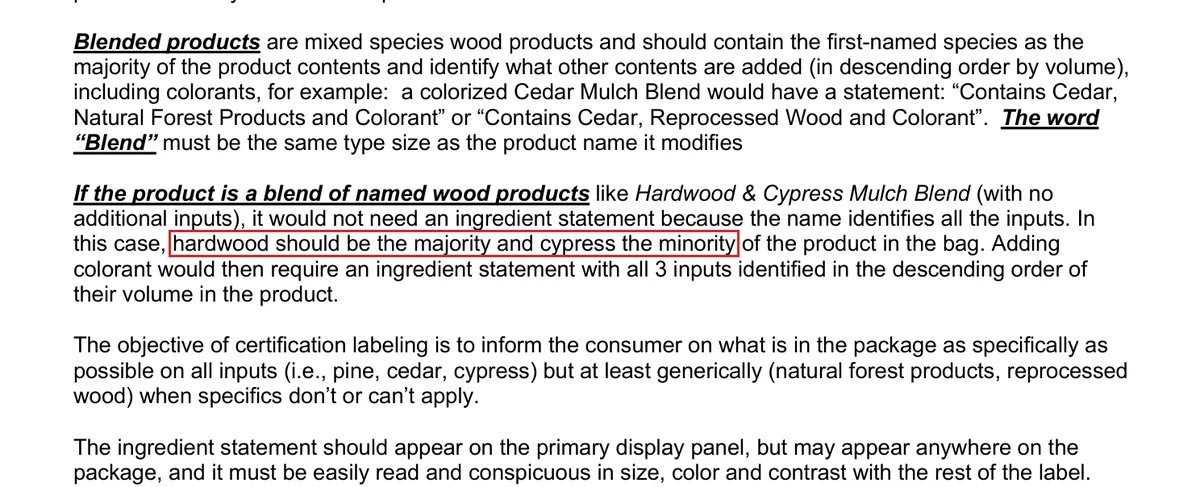
A cypress blend contains cypress plus other wood, and the first-named species should be the majority. Under the Mulch and Soil Council certification label rules adopted in July 2022, a Hardwood and Cypress Mulch Blend should be mostly hardwood, and any colorant forces an ingredient statement listing inputs by volume (MSC Ingredient Label Guidelines). Uncertified bags carry no such rule; color details are in our mulch color guide.
What can you use instead of cypress mulch?
The closest replacements for cypress mulch are pine bark, which matched cypress for settling and decay, and melaleuca, which settled least and was the termites’ least-preferred mulch in the Florida trials. Eucalyptus and utility chips decayed 21 and 32 percent in a year, so they need topping up sooner (Duryea et al., 1999; Duryea et al., 1999).
| Mulch | Where it comes from | Depth left after 2 years (of 9 cm) | Termites (UF lab) | Source |
|---|---|---|---|---|
| Cypress | Baldcypress and pondcypress, mill residue or whole trees | 6 cm | Eaten like sapwood | FR052; Duryea 1999 |
| Melaleuca | Removal of Melaleuca quinquenervia, a federal noxious weed | Almost 7 cm | Least preferred | 7 CFR 360.200; FR052 |
| Pine bark | Pine pulp and lumber mill by-product | 6 cm | Eaten | FR052; UF News 1996 |
| Eucalyptus | Eucalyptus grandis wood, often plantation grown | About 5 cm | Eaten, more than melaleuca | FR052; Maggard 2012 |
| Pine straw | Slash pine needles | 1 cm | Eaten | FR052 |
| Utility or arborist chips | Tree-care prunings (oak, cherry, some cedar and pine) | About 5 cm | Eaten most in Experiment 1 | FR052; Duryea 1999 |
Should you use cypress mulch?
Use cypress mulch only if you can confirm it is mill residue or from a managed source and you want slow decay at a low price; otherwise pine bark matches its settling and decay for about $1 more a yard. Skip it near foundations in termite country and in Florida yards following UF/IFAS guidance (FFL Principle 4; FR052).
| If your situation is | Do this | Why (source) |
|---|---|---|
| You follow Florida-Friendly Landscaping guidance | Use melaleuca, pine straw or eucalyptus | UF/IFAS does not recommend cypress mulch (FFL Principle 4) |
| The bag does not say mill residue or name a managed source | Buy pine bark instead | Same 6 cm depth after 2 years and 3% to 7% yearly decay (FR052) |
| The bed is within 12 in of a slab in termite country | Any mulch, under 2 in deep; keep 6 in of slab showing | Termites ate cypress mulch like sapwood (IN651; LSU AgCenter) |
| You want the slowest-settling mulch | Melaleuca, then cypress or pine bark | Almost 7 cm vs 6 cm left of 9 cm (FR052) |
| Cypress costs more than about $48 a yard locally | Undyed hardwood at a $40 median does the same job | Weed counts did not differ by mulch type (Duryea 1999) |
| You are buying a cypress blend | Read the ingredient statement; the first-named wood is the majority | MSC label guidelines, July 2022 |
| You want heartwood termite resistance | Do not pay for bagged cypress for that reason | Today’s mulch has little or no heartwood (Duryea 1999) |
1Is the yard in Florida and following Florida-Friendly Landscaping guidance?
YesUse melaleuca, pine straw or eucalyptus instead.
NoGo to the next question
2Is the bed within 12 inches of a slab foundation in termite country?
YesAny mulch under 2 inches deep, with 6 inches of slab visible. Cypress gives no termite protection.
NoGo to the next question
3Does the bag or seller confirm mill residue or a managed source?
Yes
NoBuy pine bark: same 6 cm depth left after 2 years.
4Is cypress more than about $48 a cubic yard where you buy?
YesUse undyed hardwood ($40 median) or pine bark ($47.50).
NoCypress is a reasonable pick: spread 2 to 3 inches and add about 1 inch every 2 years.
Source: UF/IFAS FFL Principle 4; UF/IFAS IN651 and FR052; Duryea et al. 1999; GIR price check Oct. 2026
How we compiled this
We read 15 primary documents in October 2026: 4 peer-reviewed mulch, termite and fire studies, the USDA Forest Service cypress inventory review, the USDA Wood Handbook, the Louisiana Science Working Group report, 4 UF/IFAS and LSU AgCenter extension publications, the Mulch and Soil Council’s label guidelines and cypress statement, 7 CFR 360.200 and Lowe’s wood sourcing policy. Prices are 5 posted cypress listings at supply yards, 3 re-checked on October 30, 2026. No mulch was tested for this page, and retailer pledges come from coalition releases.
| Question | Short answer | Basis |
|---|---|---|
| Lasts long? | Yes: 6 of 9 cm left after 2 years, tied with pine bark | UF/IFAS FR052 |
| Repels termites? | No: 11% eaten in 3 weeks, like sapwood | Duryea et al., 1999 |
| Acidic? | Mildly: soil pH 5.0 to 4.6 in a year | Duryea et al., 1999 |
| Sustainable? | Region-dependent: south Florida cut 0.6x growth | USDA Forest Service, 2009 |
| Price? | $46.50 median bulk; $5.50 per 2 cu ft bag | GIR check, Oct. 2026 |
Frequently asked questions
Is cypress mulch good?
Cypress mulch performs well in a bed: it lost only 3 to 7 percent of its weight in a year and kept 6 of 9 cm of depth after 2 years in Florida trials. It does no better than pine bark on those measures, it does not repel termites, and UF/IFAS advises against it because of wetland harvesting. Choose it only from a source you can confirm.
Why is cypress mulch bad?
The case against cypress mulch is mostly sourcing. Bald and pond cypress grow in wetlands that regrow unreliably, with removals exceeding growth in south Florida (0.6 times) and North Carolina (0.8) in 2008 Forest Service data. The bagged product is also mostly sapwood, so termites eat it about as readily as other wood mulch.
Does cypress mulch float or wash away?
It can on slopes and in drainage paths. Cypress mulch had a bulk density of 0.10 g per cubic centimeter in the Florida trial, lighter than pine bark at 0.11 and melaleuca at 0.14, and UF/IFAS staff reported in 1996 that it washes away in rain. Use a coarser grade or edging where water runs across the bed.
Is cypress mulch safe for vegetable gardens?
Cypress mulch had the mildest effect on seed germination of 6 mulches tested in Florida, and soil under it fell only from pH 5.0 to 4.6 in a year. It also had the lowest nutrient content, so it adds little to the soil as it breaks down. Keep it on paths and around transplants rather than over seeded rows.
Is cypress heartwood mulch worth paying more for?
Only if the heartwood is real. Termites ate under 3 percent of cypress heartwood in a 3-week University of Florida test, but the same authors found that bagged cypress mulch came from young trees with little or no heartwood. Ask the seller where the wood came from, such as reclaimed lumber or old-growth mill offcuts, and ask for it in writing.
Sources
- M.L. Duryea, J.B. Huffman, R.J. English and W. Osbrink (University of Florida), Will Subterranean Termites Consume Landscape Mulches?, Journal of Arboriculture 25(3):143 to 150, May 1999. Accessed October 2026.
- M.L. Duryea, R.J. English and L.A. Hermansen (University of Florida), A Comparison of Landscape Mulches: Chemical, Allelopathic, and Decomposition Properties, Journal of Arboriculture 25(2):88 to 97, March 1999. Accessed October 2026.
- UF/IFAS Extension (M.L. Duryea), Landscape Mulches: How Quickly Do They Settle?, FOR 69/FR052, 1999, reviewed 2006. Accessed October 2026.
- Oklahoma State University (A.O. Maggard and others), Tree-based Mulches Influence Soil Properties and Plant Growth, HortTechnology 22(3):353 to 360, June 2012. Accessed October 2026.
- USDA Forest Service (M.J. Brown), Evaluating Cypress Sustainability: FIA Data In the Hot Seat, Proceedings RMRS-P-56, 2009. Accessed October 2026.
- USDA Forest Products Laboratory, Wood Handbook, FPL-GTR-282, Chapter 14, Table 14-1, 2021. Accessed October 2026.
- Governor’s Science Working Group on Coastal Wetland Forest Conservation and Use (Louisiana), Conservation, Protection and Utilization of Louisiana’s Coastal Wetland Forests, final report, April 30, 2005. Accessed October 2026.
- UF/IFAS Florida-Friendly Landscaping Program, Principle 4: Mulch, page modified April 2, 2026. Accessed October 2026.
- University of Florida News, Cypress: From Wetlands and Wildlife Habitat to Flowerbeds and Front Yards, April 1996. Accessed October 2026.
- UF/IFAS Extension (S.W. Vince and M.L. Duryea), Planting Cypress, Circular 1458, 2004. Accessed October 2026.
- UF/IFAS Extension, The Facts About Termites and Mulch, ENY-832/IN651, 2006. Accessed October 2026.
- LSU AgCenter (D.R. Ring), Integrated Pest Management of Termites in the Landscape, accessed October 2026. Accessed October 2026.
- B.K. Steward, T.D. Sydnor and B. Bishop, The Ease of Ignition of 13 Landscape Mulches, Journal of Arboriculture 29(6):317 to 321, 2003. Accessed October 2026.
- University of Nevada Cooperative Extension, Combustibility of Landscape Mulches, SP-11-04, 2011. Accessed October 2026.
- Mulch and Soil Council, Ingredient Label Guidelines for MSC Certified Mulch, adopted July 2022. Accessed October 2026.
- Mulch and Soil Council, Is cypress mulch sustainable?, accessed October 2026. Accessed October 2026.
- Gulf Restoration Network (now Healthy Gulf), Wal-Mart Says No to Louisiana Cypress Mulch, press release, September 6, 2007. Accessed October 2026.
- Gulf Restoration Network (now Healthy Gulf), Save Our Cypress Campaign Update, Fall 2008, November 24, 2008. Accessed October 2026.
- Lowe’s, Lowe’s Wood Sourcing Policy, accessed October 2026. Accessed October 2026.
- eCFR, 7 CFR 360.200, Designation of noxious weeds, current as of October 2026. Accessed October 2026.
- Gaston Mulch, Taylor’s Landscape Supply, Cummin Landscape Supply, Ohio Mulch, Mr. Mulch, Posted cypress mulch prices (see dataset), checked October 18 and 30, 2026. Accessed October 2026.
This page is general information. Termite control and pesticide decisions belong to a licensed pest control operator; confirm local rules before treating soil near a foundation.