Rubber mulch cushions falls and lasts years: CPSC rates 6 inches to a 10-foot fall, against 7 feet for 9 inches of wood mulch. It costs 6 to 12 times more in bulk, adds no organic matter and burns hotter.
Key takeaways
- Playgrounds: the July 2025 CPSC handbook rates rubber mulch installed 8 inches deep and kept at 6 inches to a 10-foot critical height; wood mulch needs 12 inches installed, 9 kept, and reaches 7 feet (CPSC Pub. 325, Table 2). It now says to use rubber mulch only if it meets ASTM F3012.
- Certified nuggets go further: IPEMA lists GroundSmart and Vigoro nugget mulch at 4 inches for 10 feet, 5 inches for 12 feet and 6 inches for 16 feet, but shredded buffings from the same maker at 6 inches for 9 feet (IPEMA ASTM F3012 list, Oct. 28, 2026).
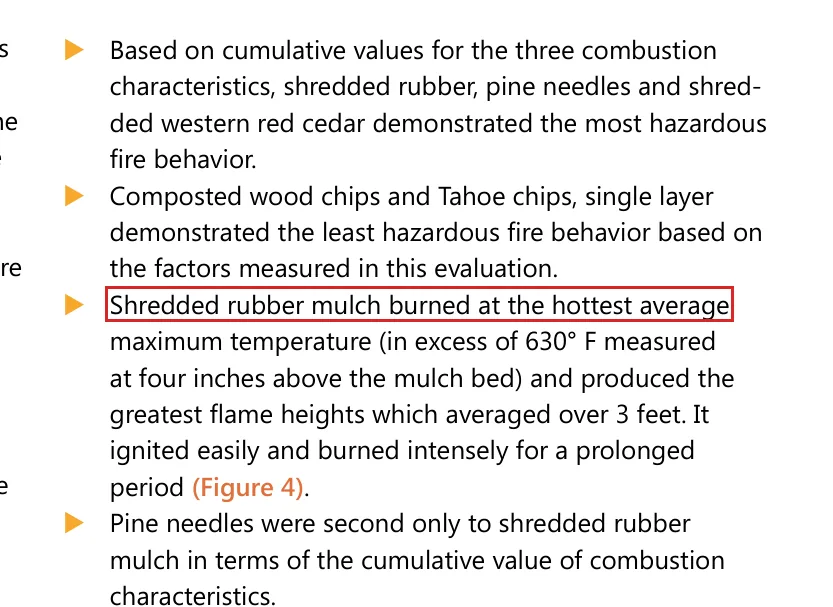
- Fire: in Nevada field burns, shredded rubber was the most hazardous of 8 mulches, topping 630°F 4 inches above the bed with flames averaging over 3 feet; the authors advise keeping it more than 30 feet from a house (University of Nevada SP-11-04).
- Zinc: tire tread is about 1 percent zinc by weight (USGS, Councell et al. 2004), and Connecticut lab tests leached 21 to 55 mg of zinc per kg of crumb rubber; WSU Extension says rubber mulch contains zinc levels that injure or kill plants (WSU FS163E).
- Price: seller pages listed rubber mulch at $10.12 to $13.32 per cubic foot in 75 to 77 cu ft pallets and $25.81 to $37.50 in single bags on Oct. 28, 2026, against $1.15 to $1.67 for bulk wood mulch in our mulch price survey.
- Health research is unfinished: CPSC says no specific chemical hazard from tire playground surfacing is known, but its risk assessment has not been published, and 21.3 percent of surveyed parents said their child had put loose playground material in their mouth (CPSC survey, 2019).
10 ft critical fall height for 6 inches of rubber mulch, vs 7 ft for 9 inches of wood mulch (CPSC Pub. 325, 2025)
630°F+ peak temperature 4 inches above burning shredded rubber, hottest of 8 mulches tested (Univ. of Nevada SP-11-04)
$10 to $13 per cu ft for rubber mulch by the pallet; bulk wood mulch runs $1.15 to $1.67 (seller pages, Oct. 28, 2026)
29% of U.S. ground tire rubber went to loose mulch in 2025, about 348,000 tons (USTMA, Oct. 27, 2026)
What is rubber mulch made of?
Rubber mulch is ground end-of-life tire rubber, sold as chunky nuggets or as stringy shreds called buffings, usually painted or coated. The U.S. Tire Manufacturers Association counted 273 million end-of-life tires in 2025; 1,201,000 tons went to ground rubber, and loose mulch took 29 percent of that, about 348,000 tons by our arithmetic (USTMA 2025 End-of-Life Tire Market Report, released Oct. 27, 2026).
Loose mulch is the second-largest ground rubber market after molded and extruded products (32 percent) and ahead of sports surfaces (26 percent) and rubber-modified asphalt (13 percent). USTMA reports mulch volume fell 10.0 percent from 2023 and adds that mulch is likely under-captured in state data, so treat the tonnage as a floor.
Steel belts are the main contaminant. California’s Office of Environmental Health Hazard Assessment (OEHHA) wrote in 2007 that crumb rubber production typically removes 99 percent of steel belting and bead wire (OEHHA, Evaluation of Health Effects of Recycled Waste Tires, 2007). Makers advertise the same figure: the Rubberific warranty promises mulch that is 99.9% wire-free, and Playsafer says its nuggets are 99.9% steel free and measure 1/2 to 5/8 inch (Rubberific warranty; Playsafer).
The playground standard for this material is ASTM F3012-22. It sets limits for particle size, extractable hazardous metals, total lead, tramp metal and sharp tramp metal, and says it does not cover accessibility or the release of organic chemicals (ASTM F3012-22 scope). An F3012 claim on a bag therefore speaks to wire and metals, not to the full chemical question.
What are the pros and cons of rubber mulch?
The pros are fall protection, weight and lifespan: 6 inches of rubber mulch protects to 10 feet in CPSC’s table, it does not float or blow away like bark, and makers guarantee color for 12 years. The cons are fire behavior, zinc, heat, no soil benefit and price, each documented in the sources below. The table sets each common claim against what the primary record shows.
| Claim you will see | What the primary source shows | Verdict | Source |
|---|---|---|---|
| Safer under swings than wood mulch | 6 in of rubber mulch protects to 10 ft; 9 in of wood mulch to 7 ft and 9 in of wood chips to 10 ft | True for depth needed | CPSC Pub. 325 (2025), Table 2 |
| CPSC recommends rubber mulch | CPSC lists it as appropriate for impact only, “not on other aspects … such as chemical exposure or ingestion”; 2025 edition requires ASTM F3012 | Overstated | CPSC Pub. 325, 2015 notice |
| Lasts forever, never decomposes | Bacteria and white-rot and brown-rot fungi can break rubber down; color warranties run 12 years and exclude normal weathering | Partly true | WSU, Chalker-Scott; Rubberific warranty |
| Keeps weeds out | Tire chips cut weeds 73 percent vs bare plots; wood chips cut them 93 to 99 percent, and warm-season weeds rose in the tire chips | Weaker than wood | Calkins et al., J. Environ. Hort. 1996 |
| Non-toxic and safe for plants | Zinc leached at 20,957 µg per kg in water and 55,010 µg per kg at pH 4.2 | Not supported for planting beds | CAES AC005, 2007, Table 3 |
| Won’t burn like wood | Rubber rated 7.00 of 7 for torch ignition, worst of 13 mulches; hottest and tallest flames of 8 in Nevada burns | False | Steward et al. 2003; UNR SP-11-04 |
| Hard to put out once burning | Steward: “extinguished with difficulty”; NIST: not more difficult to suppress than the other mulches tested | Disputed | Steward 2003; NIST TN 2228-upd1 |
Set side by side with wood mulch, rubber wins on depth per foot of fall height and on replacement frequency, and loses on price, fire and soil. Wood and bark mulch settle as they decay: in a University of Florida trial, 3.5 inches of pine bark or cypress was down to about 2.4 inches after two years (UF/IFAS trial, summarized in our depth guide). Rubber mulch has no comparable loss rate in the sources we found.
| Criterion | Rubber mulch | Wood mulch or chips | Source |
|---|---|---|---|
| Depth for a 10 ft fall, untested material | 6 in kept (8 in installed) | Wood chips: 9 in kept (12 in installed); wood mulch reaches only 7 ft | CPSC Pub. 325 (2025), Table 2 |
| Landscape bed depth | 1 to 2 in (makers) | 2 to 3 in fine mulch, 3 to 4 in coarse | GroundSmart; our depth guide |
| Price, bulk | $10.12 to $13.32 per cu ft (pallets) | $1.15 to $1.67 per cu ft ($31 to $45 per yd) | Rubbermulch.com; our mulch cost survey |
| Weight | About 2,000 lb per 77 cu ft (700 lb per yd) | About 400 to 600 lb per yd | our mulch weight guide |
| Fire, torch ignition rating (1 to 7) | 7.00 | Shredded hardwood bark 4.13; pine bark nuggets 3.13 to 3.25 | Steward et al. 2003, Table 2 |
| Zinc | About 1 percent of tread weight | Not a zinc source | USGS, Councell et al. 2004 |
| Organic matter added to soil | None | Yes, as it decays | WSU FS163E |
| Color life | 12-year color warranties (excludes normal weathering) | Fades within a season; refresh about 1 in | Rubberific warranty; our depth guide |
Is rubber mulch safe for playgrounds?
For falls, yes, at the right depth and with the right paperwork. The U.S. Consumer Product Safety Commission’s July 2025 Public Playground Safety Handbook rates untested rubber mulch at 8 inches installed and 6 inches maintained for a 10-foot critical height, and says rubber mulch should only be used if it meets ASTM F3012 (CPSC Pub. 325, July 2025). Chemical exposure is a separate question, covered in the next section.
| Loose-fill material (not impact-tested) | Install at least | Keep at least | Protects to critical height | Source |
|---|---|---|---|---|
| Rubber mulch | 8 in | 6 in | 10 ft | CPSC Pub. 325 (2025), Table 2 |
| Wood chips | 12 in | 9 in | 10 ft | same |
| Wood mulch (non-CCA) | 12 in | 9 in | 7 ft | same |
| Pea gravel | 12 in | 9 in | 5 ft | same |
| Sand | 12 in | 9 in | 4 ft | same |
The 2025 edition changed more than the layout. The 2010 handbook listed “shredded/recycled rubber” as appropriate surfacing with only a compressed depth, and a December 2015 CPSC notice added that the listing covered impact only (CPSC Pub. 325, 2010 edition with 2015 notice). Many rubber mulch guides still quote that older text.
| Topic | 2010 handbook (with 2015 notice) | July 2025 handbook | Source |
|---|---|---|---|
| Material name | Shredded/recycled rubber | Rubber mulch | Pub. 325, Table 2 |
| Depth columns | Compressed depth only: 6 in | Installed 8 in and compressed 6 in | Pub. 325, Table 2 |
| When Table 2 applies | All loose fill | Only when impact-tested materials with a maker critical height are not available | Pub. 325, §2.4.2.2 |
| Standard for rubber mulch | Test to ASTM F1292 | Meet ASTM F3012 and F1292; field test to ASTM F3313 after install | Pub. 325, §2.4 and tip 10 |
| Toddlers | Avoid loose fill for toddler playgrounds | Avoid loose fill for toddlers or children who often mouth objects; avoid untested tire rubber mulch on toddler playgrounds | Pub. 325, §2.4.2 and tip 10 |
| Chemical scope | Impact only, not chemical exposure or ingestion (2015 notice) | Untested tire rubber mulch “may contain hazardous metals or other substances of concern” | Pub. 325, tip 10 |
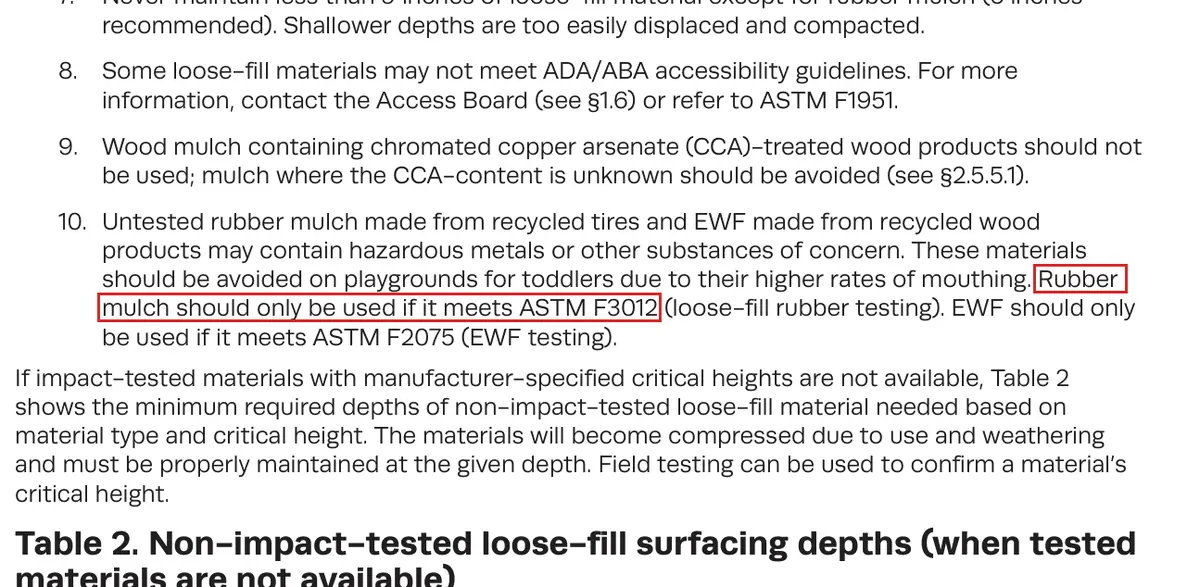
Tested products beat Table 2. The International Play Equipment Manufacturers Association (IPEMA) certifies loose-fill rubber to ASTM F3012 and F1292, and its list shows nuggets reaching 16 feet at 6 inches while shredded buffings stop at 9 or 10 feet (IPEMA certified products, read Oct. 28, 2026). Check the listing, not the bag: several sellers quote different heights than their own certifications.
| Product on the IPEMA F3012 list | Form | Certified depth and fall height | What the seller page says | Source |
|---|---|---|---|---|
| GroundSmart, Vigoro, NuPlay, Nuscape (LTR Products / IMC Outdoor Living) | Nugget | 4 in: 10 ft; 5 in: 12 ft; 6 in: 16 ft | IMC: “fall height ratings of up to 14 feet”; GroundSmart: up to 16 ft | IPEMA; GroundSmart |
| Rubberific, GroundSmart, Vigoro buffings (LTR Products) | Shredded | 6 in: 9 ft | Not stated per form | IPEMA |
| Playsafer Rubber Mulch (Rubberecycle) | Nugget | 4 in: 9 ft; 5 in: 11 ft; 6 in: 13 ft | “up to 12 ft”; FAQ on the same page says 12 in for 16 ft | IPEMA; Rubbermulch.com |
| Play Tread Rubber Mulch (PlaygroundEquipment.com) | Nugget | 6 in: 16 ft | “6-12 foot fall heights” at 6 in | IPEMA; PlaygroundEquipment.com |
| KinderMulch 3/4 (Recycled Rubber Products) | Nugget | 4 in: 10 ft | n/a | IPEMA |
| Loose Fill Rubber Buffing Mulch (Rubber Designs) | Shredded | 6 in: 10 ft | n/a | IPEMA |
Accessibility is a separate test. Under the 2010 ADA Standards, play-area surfaces on an accessible route must meet ASTM F1951 for wheelchair effort, and the U.S. Access Board says a product that passes does not mean similar products will (U.S. Access Board, Guide to Play Areas). GroundSmart says its nuggets pass F1951 at 4 inches compacted to 3.5 and at 7 inches compacted to 6 (GroundSmart); F3012 itself does not test accessibility.
Home swing sets follow CPSC’s older Outdoor Home Playground Safety Handbook, which asks for 9 inches of wood mulch, engineered wood fiber or shredded rubber under equipment up to 8 feet, filled to 12 inches at the start, and at least 6 inches under equipment shorter than 4 feet (CPSC Pub. 324). Ordering quantities for those depths are in our mulch depth and coverage guide.
Does rubber mulch get too hot to play on?
It can. The only primary temperature reading we found is informal: Connecticut Agricultural Experiment Station chemists placed black crumb rubber in sun at an air temperature of 88°F and measured 131°F inside the crumbs (CAES AC005, 2007). That was fine crumb, not mulch nuggets, and no study we found measured loose rubber mulch beside wood mulch in the same sun.
| Heat evidence | Finding | Limit | Source |
|---|---|---|---|
| Black crumb rubber in sun, 88°F air | 131°F inside the crumbs | One informal reading; crumb under 3 mm, not mulch | CAES AC005, 2007 |
| Dark surfacing in intense sun | Has blistered bare feet; check surface before play | No temperature given | CPSC Pub. 325, 2025 |
| Rubberized playground cushioning, dawn vs afternoon | Head injury criterion up almost 20 percent | One site, mostly poured rubber | OEHHA 2007 |
| Black tire chips over perennial beds | More purslane and crabgrass, tied to warmer soil | Soil temperature inferred, not measured | Calkins et al. 1996 |
CPSC’s 2025 handbook warns that dark surfacing in intense sun has blistered bare feet and tells supervisors to check whether surfacing feels hot before children play (CPSC Pub. 325, §2.2.7 and §2.4.2.1). OEHHA found heat also changes cushioning: on one rubberized playground, the head injury criterion rose almost 20 percent from dawn to afternoon (OEHHA 2007). Most of OEHHA’s 32 test sites were poured rubber, not loose mulch.
Is rubber mulch toxic?
No federal agency has called rubber mulch toxic or safe for daily play. EPA and CDC/ATSDR finished their tire crumb research for sports fields in April 2024, and CPSC is still weighing a risk assessment for playgrounds; its own page says further work “will depend on availability of resources and agency priorities” (CPSC Crumb Rubber Safety Information Center).
What is known comes from three sets of tests. EPA’s 2019 characterization found metals, semivolatile and volatile organic compounds in tire crumb, and the 2024 exposure report found blood metal levels in field users similar to the general population (EPA, Federal Research Action Plan). For playgrounds, CPSC’s contractor gathered toxicity values for nine chemicals detected in tire rubber, including zinc, lead, benzo(a)pyrene, hexavalent chromium and two phthalates (CPSC and University of Cincinnati, March 2022).
| Exposure studied | Finding | Source |
|---|---|---|
| One-time swallowing of 10 g of tire shreds by a 3-year-old | Only zinc exceeded its screening value; added cancer risk 1.2 in 10 million; “unlikely” to harm | OEHHA 2007, executive summary |
| Simulated stomach digestion, 21 hours at 37°C | 22 chemicals released; all at or below screening values | OEHHA 2007 |
| Hand-to-surface-to-mouth, ages 1 to 12 | Zinc and four PAHs at 3 times background or more; chrysene cancer risk 2.9 in 1 million, slightly above the 1 in 1 million benchmark | OEHHA 2007 |
| Skin contact (guinea pig test) | No sensitization | OEHHA 2007 |
| Field users’ blood and urine (sports fields) | Metals similar to the general population; no PAH metabolite difference vs grass fields | EPA and CDC/ATSDR, April 2024 |
| Children on playgrounds | CPSC risk assessment not published as of October 2026 | CPSC |
Do children put rubber mulch in their mouths?
Some do. In CPSC’s 2019 survey of 1,896 parents of children 5 and under, 21.3 percent of those who used loose-fill playgrounds said their child picked up loose material and put it in their mouth, rising to 49.4 percent for children aged 0 to 1 (CPSC playground surfacing survey, 2019). That is why the 2025 handbook steers loose fill away from toddlers.
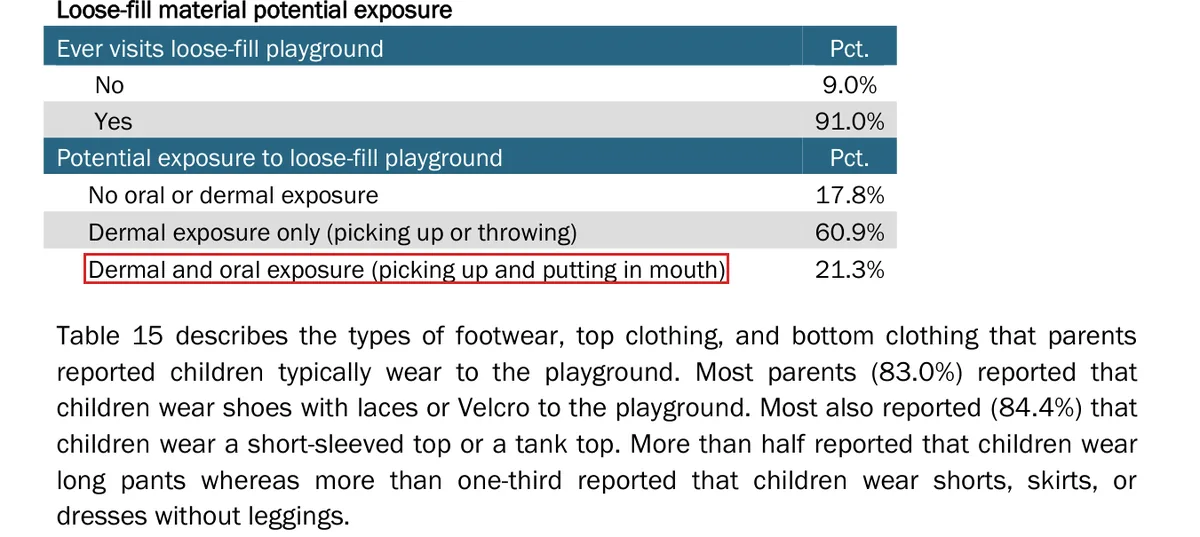
CPSC’s interim advice is practical: avoid mouthing, chewing or swallowing playground rubber, which “may pose a choking hazard, regardless of chemical exposure,” do not eat on the surface, limit time on extremely hot days and wash hands (CPSC).
Is rubber mulch safe for dogs?
No veterinary body has published rubber-specific guidance that we could find. Pet Poison Helpline warns that mulch in general can cause stomach irritation and “foreign body obstructions” when eaten (Pet Poison Helpline, Yard and Garden). For a dog that chews ground cover, the obstruction risk and the zinc in tire rubber are reasons to keep rubber mulch out of the dog run; our artificial turf vs real grass comparison covers that option.
Is rubber mulch bad for plants and soil?
In planting beds, the evidence leans against it. Washington State University Extension’s fact sheet FS163E says rubber mulch contains toxic levels of zinc that injure or kill plants, cites leaf yellowing and higher tree mortality where it was used, and found it less effective than wood chips at weed control (WSU FS163E, rev. December 2021).
| Zinc measurement | Value | Source |
|---|---|---|
| Zinc in tire tread | About 1 percent by weight | USGS, Councell et al. 2004 |
| Zinc in tire rubber, upper estimate | As much as 2 percent of tire mass | WSU, Chalker-Scott |
| Leached into water, 18 hours | 20,957 µg per kg of crumb | CAES AC005, Table 3 |
| Leached into pH 4.2 water, 18 hours | 55,010 µg per kg of crumb | CAES AC005, Table 3 |
| Leached, 17 crumb samples, pH-adjusted | 3,169 to 71,536 µg per kg | CAES 2009, Table 9 |
| Wipe samples on tire playgrounds | At least 3 times background | OEHHA 2007 |
The zinc comes from the tire itself: zinc oxide activates vulcanization, per OEHHA, so washing or aging does not remove it. In University of Colorado Denver column tests, zinc in the runoff fell from about 3 mg per liter to about 0.2 mg per liter, yet no leaching run significantly reduced the zinc left in the crumb (Rhodes, Ren and Mays, Environ. Sci. Technol. 2012).
Acid soil makes it worse, since Chalker-Scott notes metals are less tightly bound below neutral pH. If you already have rubber mulch in a bed and plants are yellowing, a lab soil test that reports zinc will tell you whether to pull it.
Weed control is the other gap. In a 3-year University of Minnesota trial on 12 perennial species, chipped tire mulch cut weeds by 73 percent against bare plots, while wood chips and the best herbicides cut them 93 to 99 percent; purslane and large crabgrass increased in the black tire chips, which the authors tied to warmer surface soil (Calkins, Swanson and Newman, J. Environ. Hort. 14(4), 1996).
Is rubber mulch a fire hazard?
Yes: three independent burn studies found rubber mulch ignites easily and burns more intensely than the wood mulches beside it. Nevada field burns ranked shredded rubber the most hazardous of 8 mulches, with temperatures above 630°F 4 inches over the bed and flames averaging more than 3 feet (Quarles and Smith, UNCE SP-11-04). The studies disagree on how hard it is to put out.
| Study | Test | Rubber result | Comparison | Source |
|---|---|---|---|---|
| Steward, Sydnor and Bishop, Ohio State, 2003 | Propane torch 15 s, rated 1 to 7 over 60 s; cigarettes | 7.00, worst of 13; ignited every time; 0 of 8 cigarette ignitions | Pine straw 6.88; shredded hardwood 4.13; brick chips 1.13 | J. Arboriculture 29(6) |
| Quarles and Smith, Nevada and UC Extension, 2008 burns | 8 ft plots, about 100°F, 13% humidity, 10 to 15 mph fans | Above 630°F at 4 in; flames over 3 ft; most hazardous of 8 | Shredded cedar 380°F, spread 47.9 ft per minute; composted chips under 0.3 ft per minute | SP-11-04 |
| NIST, 2022 | Wind-driven mulch beds next to a shed wall | Spot fires at the wall in under 4 minutes at medium and high wind; not harder to suppress than other mulches | Flames “considerably higher” than plant-based mulches | TN 2228-upd1, §4.1.3.4 |
Placement is the practical answer. Quarles and Smith advise no combustible mulch of any kind within 5 feet of a house and rubber, pine needles or shredded cedar only beyond 30 feet (SP-11-04). Oregon’s State Fire Marshal tells homeowners to use river rock, gravel or pavers in the 5-foot buffer (Oregon OSFM); our river rock cost guide prices that swap.
California’s Board of Forestry and Fire Protection adopted emergency Zone 0 rules on Aug. 19, 2026 that limit “combustible mulches” within 5 feet of an occupied structure, citing the NIST rubber tests (Board of Forestry notice, Aug. 20, 2026). As of October 2026 we could not confirm the rules had taken effect, and they do not name rubber, so check with your local fire agency.
Smoke is the last difference. NIST saw rubber burn with black smoke, then keep burning sporadically under a crust for more than an hour at low wind, flaring again when disturbed. Steward’s team judged ground rubber “far too easily ignited” for playgrounds, citing playground fires tied to cigarettes, even though cigarettes never lit their rubber plots.
How much does rubber mulch cost compared with wood mulch?
Rubber mulch ran $10.12 to $13.32 per cubic foot by the pallet and $25.81 to $37.50 per cubic foot in single bags on seller pages checked Oct. 28, 2026. Bulk wood mulch averaged $1.15 to $1.67 per cubic foot in our survey of 32 mulch sellers, so rubber costs 6 to 12 times more in bulk before any refresh savings.
| Seller and product | Form and size | Price | Per cu ft | How read | Source |
|---|---|---|---|---|---|
| Rubbermulch.com, Playsafer, cocoa brown | Nugget, 77 cu ft (2,000 lb) | $779 | $10.12 | Seller page | Rubbermulch.com |
| Rubbermulch.com, Rubberific shredded, brown | 75 cu ft pallet (50 bags) | $999 | $13.32 | Seller page | Rubbermulch.com |
| Rubbermulch.com, Playsafer, cocoa brown | Nugget, 39 cu ft (1,000 lb) | $529 | $13.56 | Seller page | Rubbermulch.com |
| Rubbermulch.com, Rubberific shredded, brown | 37.5 cu ft half pallet | $699 | $18.64 | Seller page | Rubbermulch.com |
| Rubbermulch.com, Playsafer, cocoa brown | Nugget, 1.55 cu ft bag (40 lb) | $40 | $25.81 | Seller page | Rubbermulch.com |
| Rubbermulch.com, Rubberific shredded, brown | 0.8 cu ft bag | $30 | $37.50 | Seller page | Rubbermulch.com |
| Playsafer.com, coated colors | Nugget, 2,000 lb sack | $799 | about $10.38* | Seller page | Playsafer |
| Playsafer.com, uncoated black | Nugget, 2,000 lb sack | $649 | about $8.43* | Seller page | Playsafer |
| PlaygroundEquipment.com, unpainted black | Nugget, 2,000 lb bag | $425 | about $5.52* | Seller page | PlaygroundEquipment.com |
| Home Depot, Vigoro black | Nugget, 75 cu ft (50 bags) | $749 | $9.99 | Google search listing, not opened | Home Depot |
| Home Depot, Vigoro black | Nugget, 0.8 cu ft bag | $5.97 | $7.46 | Google Shopping, not opened; likely a markdown | Home Depot |
| Tractor Supply, Viagrow no-dye | Nugget, 1.5 cu ft bag | $42.99 | $28.66 | Google Shopping, not opened | Tractor Supply |
- Cubic feet
- 33.3
- Cubic yards
- 1.23
- 0.8 cu ft bags
- 42
- 2,000 lb rubber sacks (77 cu ft)
- 0.43
Cubic feet = area × depth in inches ÷ 12. Rubber prices taken from Rubbermulch.com, Playsafer and PlaygroundEquipment.com pages Oct. 28, 2026; wood prices are the middle half of posted yard prices in our Oct. 18, 2026 mulch cost survey. Default: 200 sq ft at 2 in = 33.3 cu ft of rubber for $337 to $444.
The longevity argument needs arithmetic. Take a 200 sq ft bed: rubber at 2 inches, the landscape depth Rubbermulch.com recommends, needs 33.3 cubic feet once; wood at 3 inches needs 50 cubic feet, then a 1-inch refresh every second year, which matches the roughly half-inch-a-year settling in the University of Florida trial. Ten years of wood totals 116.7 cubic feet, or 4.32 cubic yards.
| Line | Rubber mulch, 2 in | Wood mulch, 3 in plus 1 in every 2nd year | Source |
|---|---|---|---|
| Volume, year 1 | 33.3 cu ft | 50 cu ft (1.85 cu yd) | 200 sq ft × depth ÷ 12 |
| Refreshes, years 3, 5, 7, 9 | None assumed | 4 × 16.7 cu ft = 66.7 cu ft | UF/IFAS settling trial (our depth guide) |
| 10-year volume | 33.3 cu ft | 116.7 cu ft (4.32 cu yd) | Arithmetic |
| Bought by the sack or bulk yard | $529 (Playsafer 1,000 lb, 39 cu ft) | $134 to $194 at $31 to $45 per yd, pickup | Rubbermulch.com; our survey |
| Bought in bags | $1,260 (42 Rubberific 0.8 cu ft bags at $30) | $229 to $333 at $53 to $77 per yd in bags | Rubbermulch.com; our survey |
| Big-box bags (unverified) | $251 to $420 (42 bags at $5.97 to $9.99) | n/a | Google Shopping listings, Oct. 28, 2026 |
- Rubber, Playsafer 1,000 lb sack at 2 in
- Rubber, 42 Rubberific 0.8 cu ft bags at 2 in
- Wood, bulk at $38 per yd, 3 in plus 1 in every 2nd year
- Wood, bagged at $65 per yd, same schedule
Source: Seller pages (Oct. 28, 2026) and The Green Industry Report mulch cost survey (Oct. 18, 2026); arithmetic by The Green Industry Report Wood lines use the midpoint of $31 to $45 (bulk) and $53 to $77 (bagged) per cubic yard. Excludes delivery, fabric and tax.
Show the numbers
| Rubber, Playsafer 1,000 lb sack at 2 in | Rubber, 42 Rubberific 0.8 cu ft bags at 2 in | Wood, bulk at $38 per yd, 3 in plus 1 in every 2nd year | Wood, bagged at $65 per yd, same schedule | |
|---|---|---|---|---|
| Year 1 | 529 | 1,260 | 70 | 120 |
| Year 2 | 529 | 1,260 | 70 | 120 |
| Year 3 | 529 | 1,260 | 94 | 160 |
| Year 4 | 529 | 1,260 | 94 | 160 |
| Year 5 | 529 | 1,260 | 117 | 201 |
| Year 6 | 529 | 1,260 | 117 | 201 |
| Year 7 | 529 | 1,260 | 141 | 241 |
| Year 8 | 529 | 1,260 | 141 | 241 |
| Year 9 | 529 | 1,260 | 164 | 281 |
| Year 10 | 529 | 1,260 | 164 | 281 |
On these numbers rubber does not catch up within 10 years; it comes close only when rubber is bought at big-box sale prices and wood in bags. Delivery narrows the gap a little, because a rubber sack ships once while wood is hauled five times; our mulch cost guide puts bulk delivery at $60 to $150 a load.
How long does rubber mulch last?
Makers promise color, not life: Rubberific, GroundSmart, Playsafer and Vigoro sellers advertise 12-year color guarantees, and the Rubberific warranty covers fading “over 100% of the surface” for 12 years from manufacture while excluding “color changes and/or fading which are a part of the normal weathering process” (Rubberific warranty). No primary study we found measured how much rubber mulch volume is lost per year.
“Permanent” is also not quite right. WSU’s Chalker-Scott notes that many bacteria can use rubber as their sole energy source and that white-rot and brown-rot fungi can detoxify the additives that slow them (WSU). In practice the loss you will see is displacement: CPSC tells playground owners to rake rubber back under swings and slide exits and to mark target depths on posts (CPSC Pub. 325, §4.3).
After 10 years the realistic picture is faded rubber with soil and leaf litter mixed in, which wood-style raking cannot separate. Removing it means hand or shovel work at about 700 lb per cubic yard, against 400 to 600 lb for most wood mulch in our mulch weight guide, and finding a hauler or transfer station that accepts tire-derived material.
Where should you use rubber mulch, and where not?
Use rubber mulch where cushioning and low upkeep matter and plants and flames do not: under play equipment, on paths and in unplanted areas well away from buildings. Avoid it in vegetable and perennial beds, around trees, within 30 feet of a house in fire country and on toddler playgrounds. The table and flowchart below hold the same thresholds.
| If your situation is | Do this | Why (source) |
|---|---|---|
| Public playground for ages 2 to 12 | Rubber mulch certified to ASTM F3012 and F1292 at its IPEMA depth (for example 6 in nuggets for 16 ft); field test to ASTM F3313 | CPSC 2025, tip 10; IPEMA |
| Untested rubber mulch only | Install 8 in, keep 6 in; covers fall heights to 10 ft | CPSC 2025, Table 2 |
| Toddler area (6 to 23 months) or children who mouth objects | Skip loose fill; use a unitary surface tested to ASTM F1292 | CPSC 2025, §2.4.2 |
| Play area on an accessible route | Ask for an ASTM F1951 report at the installed depth | U.S. Access Board |
| Backyard swing set up to 8 ft | 9 in of loose fill kept, 12 in at the start, or a certified product at its rated depth | CPSC Pub. 324 |
| Within 5 ft of a house or deck | No rubber or other combustible mulch; use rock, gravel or pavers | UNR SP-11-04; Oregon OSFM |
| 5 to 30 ft from a house in a wildfire area | Composted wood chips or pine bark nuggets, broken up by gravel or lawn | UNR SP-11-04 |
| Vegetable, perennial or tree beds | Wood chips or bark, not rubber | WSU FS163E; Calkins 1996 |
| Soil test reads acidic (below pH 7.0), or the bed drains to a pond or creek | Avoid rubber; metals bind less tightly in acid soil and tire leachate is most harmful to freshwater life | WSU; OEHHA 2007 |
| Unplanted path or decorative area, low fire risk | Rubber at 1.5 to 2 in is reasonable if the price fits | GroundSmart; Rubbermulch.com |
1Is the spot within 5 ft of a house, deck or fence?
YesNo rubber or other combustible mulch; use rock, gravel or pavers.
NoGo to the next question
2Is it 5 to 30 ft from a house in a wildfire area?
YesUse composted wood chips or pine bark nuggets, broken up by gravel or lawn.
NoGo to the next question
3Is it a planted bed, vegetable garden or tree ring?
YesUse wood chips or bark; rubber adds zinc and weeds control worse.
NoGo to the next question
4Is it under play equipment used by toddlers or children who mouth objects?
YesSkip loose fill; use a unitary surface tested to ASTM F1292.
NoGo to the next question
5Is it under play equipment for older children?
YesUse rubber mulch certified to ASTM F3012 and F1292 at its rated depth, or 8 in installed and 6 in kept for 10 ft.
NoAn unplanted path or decorative area: rubber at 1.5 to 2 in works if the price fits.
How we compiled this
We compiled this page from 24 primary documents read in October 2026: CPSC handbooks and surveys, EPA and OEHHA health studies, ASTM and Access Board scopes, the USTMA market report, burn and plant studies, the IPEMA certification list and maker warranties. Rubber prices came from seller pages on Oct. 28, 2026; big-box prices from Google listings are labeled. No mulch was burned, tested or installed; cost tables are arithmetic.
| Question | Short answer | Source |
|---|---|---|
| Depth under play equipment | 8 in installed, 6 in kept (10 ft); certified nuggets 6 in for up to 16 ft | CPSC; IPEMA |
| Landscape bed depth | 1.5 to 2 in | GroundSmart |
| Fire | Most hazardous of 8 mulches; keep 30 ft from a house | UNR SP-11-04 |
| Zinc | About 1 to 2 percent of tire weight | USGS; WSU |
| Price by the pallet | $10.12 to $13.32 per cu ft | Rubbermulch.com |
| Color warranty | 12 years, normal weathering excluded | Rubberific |
Frequently asked questions
What happens to rubber mulch after 10 years?
It is still there, faded and mixed with soil and leaves. Color warranties of 12 years exclude normal weathering (Rubberific), and WSU notes microbes do slowly break rubber down. Expect raked-back displacement under swings rather than decay, and plan on shovel removal at about 700 lb per cubic yard if you change your mind.
Does mold grow on rubber mulch?
No study we found measured mold on rubber mulch, so drainage is the variable to manage. CPSC’s 2025 handbook warns that poor drainage can cause protective surfacing, “particularly synthetic surfacing,” to fail early or develop mold, and calls for drainage regrading under loose fill.
Can weeds grow through rubber mulch?
Yes. In a 3-year University of Minnesota trial, chipped tire mulch cut weeds 73 percent against bare plots, while wood chips cut them 93 to 99 percent. Purslane and crabgrass increased in the black tire chips over time, likely from warmer soil.
What is better than rubber mulch?
It depends on the job. Under play equipment, engineered wood fiber meeting ASTM F2075 is the CPSC-named alternative. In planting beds, wood chips or bark beat rubber on weeds and soil. Within 5 feet of a house, river rock, gravel or pavers are the fire-safe choice (Oregon State Fire Marshal).
How deep should rubber mulch be in a flower bed?
Makers recommend 1 to 2 inches: GroundSmart lists 1 inch for shredded and 1.5 to 2 inches for nuggets, and Rubbermulch.com says 2 inches. At 2 inches, a 75 cu ft pallet covers about 450 sq ft, per Rubbermulch.com’s own coverage note.
Is black rubber mulch hotter than brown?
No primary study we found measured rubber mulch colors side by side. CPSC warns that dark surfacing in intense sun has blistered bare feet and suggests lighter colors or shade, and CAES measured 131°F inside black crumb rubber at an 88°F air temperature.
Sources
- U.S. Consumer Product Safety Commission, Public Playground Safety Handbook, Publication 325, July 2025. Accessed October 2026.
- U.S. Consumer Product Safety Commission, Public Playground Safety Handbook, Publication 325 (2010 edition with Dec. 29, 2015 notice), 2010; notice 2015. Accessed October 2026.
- U.S. Consumer Product Safety Commission, Outdoor Home Playground Safety Handbook, Publication 324, 2005. Accessed October 2026.
- U.S. Consumer Product Safety Commission and Fors Marsh Group, 2019 Survey of American Households: Child Interaction and Potential Exposure to Playground Surfacing Materials, Sept. 5, 2019. Accessed October 2026.
- U.S. Consumer Product Safety Commission and University of Cincinnati, Final Report on Technical Support Activities for a Screening-Level Risk Assessment of Playground Surfaces, May 20, 2021; staff statement March 1, 2022. Accessed October 2026.
- U.S. Consumer Product Safety Commission, Crumb Rubber Safety Information Center, page as of October 2026. Accessed October 2026.
- U.S. EPA, Federal Research on Recycled Tire Crumb Used on Playing Fields and Playgrounds, page as of October 2026; reports 2019 and April 2024. Accessed October 2026.
- California OEHHA for the Integrated Waste Management Board, Evaluation of Health Effects of Recycled Waste Tires in Playground and Track Products (archived PDF), January 2007. Accessed October 2026.
- ASTM International, F3012-22, Standard Specification for Loose-Fill Rubber for Use as a Playground Safety Surface, 2022. Accessed October 2026.
- U.S. Access Board, Guide to the ADA Accessibility Standards, Chapter 10: Play Areas, page as of October 2026. Accessed October 2026.
- International Play Equipment Manufacturers Association, Product certification search, ASTM F3012, read Oct. 28, 2026. Accessed October 2026.
- U.S. Tire Manufacturers Association, 2025 End-of-Life Tire Market Report, Oct. 27, 2026. Accessed October 2026.
- S. Quarles and E. Smith, University of Nevada and UC Cooperative Extension, SP-11-04, The Combustibility of Landscape Mulches, 2011, 4th printing 2016. Accessed October 2026.
- L. Steward, T. D. Sydnor and B. Bishop, Journal of Arboriculture 29(6): 317 to 321, The Ease of Ignition of 13 Landscape Mulches, November 2003. Accessed October 2026.
- K. Butler, E. Johnsson et al., NIST, Technical Note 2228-upd1, Wind-Driven Fire Spread to a Structure from Fences and Mulch, Dec. 12, 2022. Accessed October 2026.
- California Board of Forestry and Fire Protection, Notice of Proposed Emergency Action, Zone 0 Defensible Space, Aug. 20, 2026. Accessed October 2026.
- Oregon State Fire Marshal, Defensible Space, page as of October 2026. Accessed October 2026.
- M. I. Mattina et al., Connecticut Agricultural Experiment Station, AC005, Examination of Crumb Rubber Produced from Recycled Tires (archived PDF), August 2007. Accessed October 2026.
- X. Li, W. Berger, C. Musante and M. I. Mattina, CAES, 2009 Study of Crumb Rubber Derived from Recycled Tires, Final Report, revised May 5, 2010. Accessed October 2026.
- L. Chalker-Scott, Washington State University Extension, FS163E, Rubber Mulch Use in Home Gardens and Landscapes, revised December 2021. Accessed October 2026.
- L. Chalker-Scott, WSU Puyallup, The Myth of Rubberized Landscapes, n.d.. Accessed October 2026.
- T. Councell et al., USGS, Environmental Science and Technology 38: 4206 to 4214, Tire-wear particles as a source of zinc to the environment, 2004. Accessed October 2026.
- J. Calkins, B. Swanson and D. Newman, Journal of Environmental Horticulture 14(4): 221 to 227, Weed Control Strategies for Field Grown Herbaceous Perennials, December 1996. Accessed October 2026.
- D. Rhodes, J. Ren and D. Mays, Environmental Science and Technology 46(23): 12856 to 12863, Zinc leaching from tire crumb rubber (PubMed abstract), 2012. Accessed October 2026.
- Pet Poison Helpline, Yard and Garden, page as of October 2026. Accessed October 2026.
- International Mulch Company (IMC Outdoor Living), Rubberific Mulch 12-year limited warranty, 2012 version. Accessed October 2026.
- Rubbermulch.com, Brown Playsafer Rubber Mulch listing, price checked Oct. 28, 2026. Accessed October 2026.
- Rubbermulch.com, Rubberific Shredded Rubber Mulch, brown, listing, price checked Oct. 28, 2026. Accessed October 2026.
- Playsafer, Playsafer Rubber Mulch listing, price checked Oct. 28, 2026. Accessed October 2026.
- PlaygroundEquipment.com, Playground Rubber Mulch in Bulk, 2,000 lb, price checked Oct. 28, 2026. Accessed October 2026.
- GroundSmart (IMC Outdoor Living), Product resources and research, page as of Oct. 28, 2026. Accessed October 2026.
- GroundSmart (IMC Outdoor Living), Landscape rubber mulch, page as of Oct. 28, 2026. Accessed October 2026.