Foxtail grass in lawns is usually yellow, green or giant foxtail, summer annual Setaria weeds that sprout once soil nears 65°F: block them with a spring pre-emergent, then spot-kill escapes with a grass herbicide your lawn’s label allows.
Key takeaways
- Yellow and green foxtail seed can germinate once soil reaches 65°F, with an optimum of 70 to 85°F; seedheads form July to September and plants die at fall frost (Penn State Extension, May 2025).
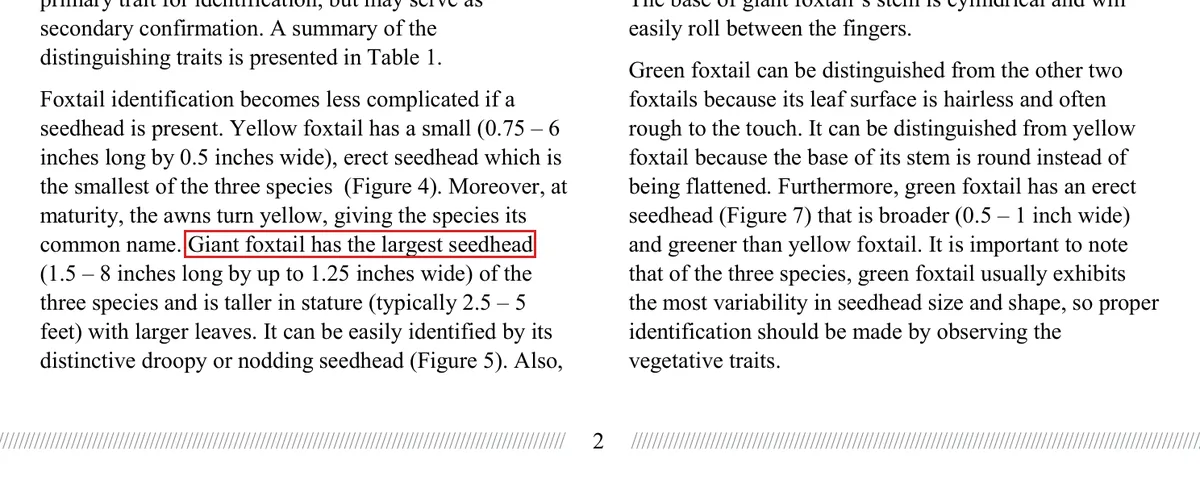
- Tell the three Setaria foxtails apart by the leaf: long silky hairs near the base (yellow), short dense hairs over the whole upper surface (giant), or no hairs (green). Giant foxtail carries the largest, nodding seedhead, up to 8 inches by 1.25 inches (University of Maryland FS-2023-0658).
- Seven EPA-registered turf labels list Setaria foxtails, but the postemergent choice depends on your grass: quinclorac (Drive XLR8, EPA Reg. No. 7969-272) excludes St. Augustinegrass, centipedegrass and bahiagrass (Drive XLR8 label), and none of the four postemergent labels reviewed here covers a home St. Augustinegrass lawn.
- Foxtail seed does not last: SARE puts seed bank losses at 72 to 93 percent a year in untilled soil, and yellow and green foxtail seed buried 1.7 inches under turf did not survive past three years (SARE, Manage Weeds On Your Farm). Two or three seed-free summers clear most of a lawn.
- The “foxtails” that injure dogs in the West are mostly wild barleys and bromes, not lawn Setaria, which UC weed scientists say is “not typically associated with animal injuries” (UC Weed Science, April 2021). In a UK study of 1,037 dog cases, 90.6 percent came June to September (Brant et al., 2021).
| Fact | Figure | Source |
|---|---|---|
| Soil temperature at which yellow and green foxtail can germinate | 65°F (optimum 70 to 85°F) | Penn State |
| Seedhead season, yellow and green foxtail | July to September | Penn State |
| Seeds per plant, foxtails as a group | 1,000 typical; 10,000 high | SARE |
| Seed bank loss per year, untilled soil | 72 to 93% | SARE |
| Best emergence depth | 0.5 inch; negligible below 4 inches | SARE |
| Bristles per spikelet cluster | Yellow 5 to 15; giant and green 1 to 3 | Illinois Extension |
| Dog grass-seed cases logged June to September (UK) | 940 of 1,037 (90.6%) | Brant et al., 2021 |
What is foxtail grass?
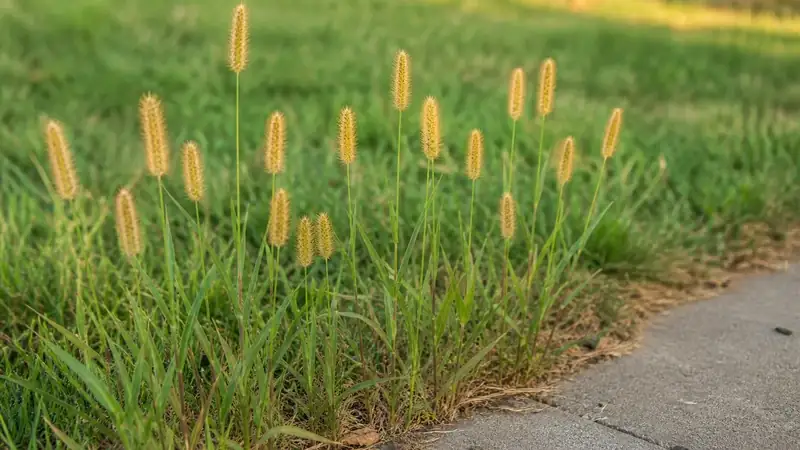
Foxtail grass is a common name for grasses with bristly, brush-shaped seedheads. In U.S. lawns it nearly always means three Setaria species: yellow foxtail (Setaria pumila, also listed as S. glauca), green foxtail (S. viridis) and giant foxtail (S. faberi). All three are non-native summer annuals found in every Illinois county (Illinois Extension).
NC State TurfFiles finds yellow foxtail infrequent in highly maintained turf but common in utility turf such as roadsides (NC State TurfFiles), so a foxtail patch usually marks thin or scalped turf.
The same name covers unrelated grasses. Foxtail barley (Hordeum jubatum) is a short-lived native perennial bunchgrass 1 to 3 feet tall (Colorado State Extension); hare barley (Hordeum murinum ssp. leporinum) is a winter annual whose barbed, needle-like awns injure animals (UC IPM). Knotroot foxtail (Setaria parviflora) looks like yellow foxtail but is a perennial with short, knotty rhizomes (University of Missouri IPM).
| Plant called foxtail | Scientific name | Life cycle | Where it shows up | Animal awn hazard | Source |
|---|---|---|---|---|---|
| Yellow foxtail | Setaria pumila (S. glauca) | Summer annual | Most common foxtail in lawns | Not typically linked to injuries | UMD; UC Weed Science |
| Green foxtail | Setaria viridis | Summer annual | Fields, waste areas, acidic soils | Not typically linked to injuries | UMD |
| Giant foxtail | Setaria faberi | Summer annual | Crop fields and waste areas | Not typically linked to injuries | UMD |
| Knotroot foxtail | Setaria parviflora | Perennial (rhizomes) | Pastures, hayfields, roadsides, lawns | Not documented | Missouri IPM; Weed Technology, 2023 |
| Foxtail barley | Hordeum jubatum | Short-lived perennial | Wet, saline or alkaline pasture and roadsides | Barbed awns lodge in mouth, nose, eyes, skin; spike 3 to 10 cm | Colorado State; UC IPM |
| Hare barley | Hordeum murinum ssp. leporinum | Winter annual | California grassland, roadsides, turf | Needle-like barbed awns | UC IPM |
How do you identify yellow, green and giant foxtail?
Check the ligule first, then the upper leaf surface. All three foxtails have a fringe-of-hairs ligule, about 1 mm long, where the leaf meets the stem (Penn State). Yellow foxtail has sparse, long, silky hairs near the leaf base and a flattened stem base; giant foxtail has short, dense hairs across the upper surface; green foxtail is hairless and often rough (UMD FS-2023-0658).
Seedheads confirm it. Yellow foxtail’s is erect, 0.75 to 6 inches long and 0.5 inch wide, with awns that turn yellow; giant foxtail’s is 1.5 to 8 inches long, up to 1.25 inches wide and droops; green foxtail’s is erect, 0.5 to 1 inch wide and the most variable, so University of Maryland Extension says to confirm green foxtail by its leaves (UMD). Color misleads: Illinois notes young foliage looks green and old foliage yellow on all three (Illinois Extension).
| Trait | Yellow foxtail | Green foxtail | Giant foxtail | Source |
|---|---|---|---|---|
| Upper leaf surface | Sparse long silky hairs near the base only | Hairless, often rough | Short, fine hairs densely over the surface | UMD |
| Leaf width | Under 1/2 inch | Under 1/2 inch | Up to 3/4 inch | Illinois |
| Stem base | Flattened, will not roll between fingers; may be purplish | Round, hairless | Round, rolls easily | UMD |
| Seedhead | Erect, 0.75 to 6 in. long, 0.5 in. wide; bristles turn yellow | Erect, 0.5 to 1 in. wide; most variable | Nodding, 1.5 to 8 in. long, up to 1.25 in. wide | UMD |
| Bristles per spikelet cluster | 5 to 15 | 1 to 3 (sometimes purple) | 1 to 3 | Illinois |
| Height | 1 to 3 ft (Illinois); 2 to 4 ft (UMD) | 1 to 2 ft (Illinois); up to 3 ft (UMD) | Usually 2.5 to 4 ft; up to 6.5 ft | Illinois; UMD |
| Seed weight | 1.9 to 4.2 mg | 0.6 to 1.5 mg | 1.6 mg | SARE |
| Where most common | Lawns | Fields; may signal low soil pH | Crop fields, waste areas | UMD |
Is it foxtail, crabgrass, timothy or knotroot foxtail?
Crabgrass and timothy have a membranous ligule, not a fringe of hairs; crabgrass seedheads split into 2 to 6 finger-like spikes, and timothy’s spike has no awns and grows from a bulb-like corm (UMD). Knotroot foxtail is the hard one: its seedhead matches yellow foxtail, so dig a plant and look for short rhizomes, which Missouri IPM calls the separating trait (Missouri IPM).
The split decides control. A pre-emergent stops knotroot foxtail growing from seed but not shoots from its rhizomes (Missouri IPM), so a patch that returns in the same spot every year after a pre-emergent is a sign of knotroot. Crabgrass control and its look-alikes are covered in our crabgrass identification and control guide, and the wider weed list is in our common lawn weeds ID chart.
When does foxtail grass germinate and go to seed?
Foxtail germinates later than crabgrass. Penn State gives 65°F soil as the point where yellow and green foxtail seed can germinate, with an optimum of 70 to 85°F, and seedlings keep emerging from spring into early or mid-summer (Penn State). Crabgrass starts when the upper inch of soil holds 55 to 58°F at daybreak for 4 to 5 days (Penn State, Sept. 2024).
Seedheads appear July to September, and plants die after the first fall frost (Penn State). SARE puts emergence to flowering at 5 to 13 weeks and flowering to viable seed at 2 to 3 weeks (SARE), so a seedhead you see in August can already be dropping live seed by early September. Soil temperature tracking by month is in our soil temperature guide.
| Question | What guides often say | What the primary source says | Source |
|---|---|---|---|
| When does foxtail germinate? | “Spring”, same time as crabgrass | Can germinate at 65°F soil; optimum 70 to 85°F; crabgrass at 55 to 58°F | Penn State foxtail; Penn State summer annuals |
| Lowest germination temperature | A single number | Significant germination begins at 50 to 59°F; above 86°F many seeds go into secondary dormancy | SARE |
| When to put down a pre-emergent | When forsythia blooms | Soil 50 to 55°F (WSU); Penn State says forsythia bloom is not always reliable | WSU Hortsense; Penn State |
| Are the seedhead hairs awns? | Yes, barbed awns | Setaria bristles surround the spikelet base; awns come from the spikelet tip | Illinois Extension |
| Is foxtail a perennial? | Annual or perennial | Yellow, green, giant: summer annuals; knotroot foxtail: perennial | UMD; Missouri IPM |
The practical reading: a pre-emergent applied for crabgrass at 50 to 55°F is already down before foxtail starts at about 65°F, but foxtail keeps emerging into midsummer, so the product’s residual, not its start date, decides whether July foxtail breaks through.
How do you prevent foxtail with a pre-emergent?
Apply a pre-emergent that lists foxtail before soil reaches 65°F, water it in, and keep the rate inside the label’s yearly maximum. Penn State names prodiamine, pendimethalin and dithiopyr as the spring pre-emergents for yellow and green foxtail (Penn State). Each of the four labels below lists Setaria foxtails by name, and each blocks grass seed for months.
| Active ingredient | Product (EPA Reg. No.) | Foxtails on label | Rate per 1,000 sq ft | Reseeding wait | Source |
|---|---|---|---|---|---|
| Prodiamine 40.7% | Barricade 4FL (100-1139) | Foxtails, annual | Yearly max 0.5 to 1.1 fl oz (tall fescue, warm-season); 0.23 to 0.70 (bluegrass, ryegrass) | 4 months at 16 fl oz/acre; 6 months at 24 (North); 12 months at 48 (South) | Barricade 4FL label |
| Pendimethalin 38.7% | Pendulum AquaCap (241-416) | Giant, green, yellow | 1.1 to 1.6 fl oz; repeat 0.86 to 1.1 after 5 to 8 weeks | At least 3 months | Pendulum label |
| Dithiopyr 24% | Dimension 2EW (62719-542) | Giant, green, yellow (pre-emergence only) | 0.37 to 0.73 fl oz (1 to 2 pints/acre); 6 pints/acre a year | 3 months after one application | Dimension 2EW label |
| Mesotrione 40% | Tenacity (100-1267) | Yellow foxtail (pre and post) | 0.09 to 0.18 fl oz (4 to 8 fl oz/acre); 16 fl oz/acre a year | None: labeled at seeding, except fine fescue | Tenacity label |
Steps for a spring application:
- Confirm your grass is on the label’s turf list and that you will not seed within the reseeding wait shown above.
- Apply when soil reaches 50 to 55°F (WSU), the same window as a crabgrass preventer; our lawn care schedule gives regional dates.
- Measure the lawn and weigh or meter product to the label rate; the worked example further down converts each rate for 5,000 sq ft.
- Water in with about 0.5 inch of irrigation or rain; Barricade 4FL asks for it within 14 days and Tenacity for 0.15 inch within 10 days (Barricade label; Tenacity label).
- Where foxtail broke through last July, split the yearly maximum and repeat 5 to 8 weeks later, as the Pendulum label allows (Pendulum label).
What kills foxtail in a lawn without killing the grass?
Selective grass herbicides do: quinclorac, fenoxaprop, topramezone and, for yellow foxtail, mesotrione. Penn State lists the first three for yellow and green foxtail in lawns (Penn State). Which one you may use depends on your turf species, and all work best on small plants: Pylex asks for application before the fourth tiller (Pylex label).
| Active ingredient | Product (EPA Reg. No.) | Foxtails on label | Rate per 1,000 sq ft | Key restrictions | Source |
|---|---|---|---|---|---|
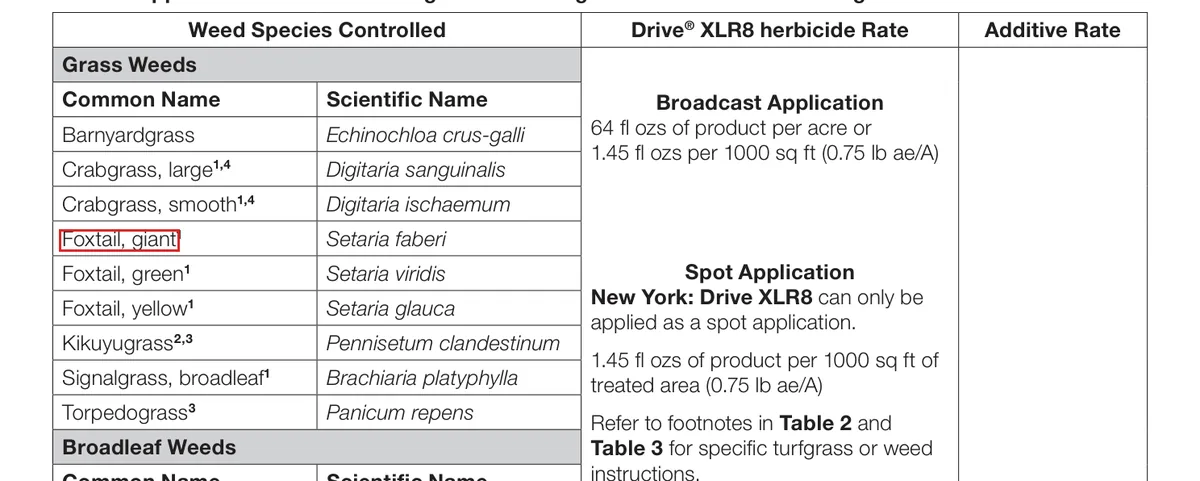
| Quinclorac 18.92% | Drive XLR8 (7969-272) | Giant, green, yellow | 1.45 fl oz plus 0.55 fl oz methylated seed oil | 2 to 4 tiller plants may need a second spray; bahia, carpet, centipede, St. Augustine, dichondra and colonial bentgrass susceptible | Drive XLR8 label |
| Fenoxaprop-p-ethyl 6.59% | Acclaim Extra (432-950) | Setaria spp. | 0.21 to 0.30 fl oz untillered; 0.46 at 1 to 2 tillers; 0.64 at 3 to 4; 0.90 at 4 to 5 | Labeled turf: bluegrass, ryegrass, fescues, zoysia, creeping bentgrass; not within 21 days after 2,4-D | Acclaim Extra label |
| Topramezone 29.7% | Pylex (7969-327) | Giant, green, yellow (yellow not in Calif.) | 0.023 fl oz (0.7 mL) to 2 tillers; 0.034 fl oz (1.0 mL) at 2 to 4 tillers, plus oil adjuvant | Labeled turf: bluegrass, fescues, ryegrass, centipede; bermuda marginally tolerant; 4 fl oz/acre a year | Pylex label |
| Mesotrione 40% | Tenacity (100-1267) | Yellow foxtail | 0.09 to 0.18 fl oz plus nonionic surfactant; repeat in 2 to 3 weeks | Bermuda, zoysia, bentgrass, kikuyu, seashore paspalum sensitive | Tenacity label |
Grass type narrows the list fast. The matrix below reads each label’s turf list; “no” means the grass is excluded, listed as susceptible or sensitive, or simply not listed. A shorter cross-weed comparison sits in our lawn weed killer guide.
| Your lawn | Quinclorac (Drive XLR8) | Fenoxaprop (Acclaim Extra) | Topramezone (Pylex) | Mesotrione (Tenacity) |
|---|---|---|---|---|
| Kentucky bluegrass | Yes | Yes | Yes | Yes (yellow foxtail) |
| Tall fescue | Yes | Yes | Yes | Yes (yellow foxtail) |
| Perennial ryegrass | Yes | Yes | Yes | Yes, 5 fl oz/acre |
| Fine fescue | Only in a blend | Yes | Yes | Yes, 5 fl oz/acre |
| Bermudagrass | Yes | No (label suppresses common bermuda) | Marginal: injury expected | No (sensitive) |
| Zoysiagrass | Yes | Yes, max 28 fl oz/acre per spray | No | No (sensitive) |
| Buffalograss | Yes | No | No | Yes (yellow foxtail) |
| Centipedegrass | No (susceptible) | No | Yes | Yes (yellow foxtail) |
| St. Augustinegrass | No (susceptible) | No | No | Sod farms only |
| Bahiagrass | No (susceptible) | No | No | No |
St. Augustinegrass and bahiagrass owners have no selective foxtail spray among these labels. Their tools are a pre-emergent that lists the grass (Barricade 4FL lists both) plus hand-pulling (Barricade label). For knotroot foxtail, the Weed Technology review notes fall-applied herbicides did not control plants from rhizomes, while a 2020 study it cites found pinoxaden above 95 percent control of yellow foxtail in turf (Dyer et al., 2023).
How much herbicide does a 5,000 sq ft lawn need?
Very little, which is where mixing errors start. At the label rates, a 5,000 sq ft lawn takes 7.25 fl oz of Drive XLR8 plus 2.75 fl oz of seed oil, but only 3.5 to 5.0 mL of Pylex (Drive XLR8; Pylex). A municipal bid tab shows what hired application costs.
| Product or service | Label rate used | Amount for 5,000 sq ft | Source |
|---|---|---|---|
| Barricade 4FL | 0.5 to 1.1 fl oz per 1,000 sq ft (yearly max, tall fescue) | 2.5 to 5.5 fl oz | label |
| Pendulum AquaCap | 1.1 to 1.6 fl oz per 1,000 sq ft | 5.5 to 8.0 fl oz | label |
| Dimension 2EW | 1 to 2 pints/acre = 0.37 to 0.73 fl oz per 1,000 | 1.8 to 3.7 fl oz | label |
| Drive XLR8 + methylated seed oil | 1.45 + 0.55 fl oz per 1,000 sq ft | 7.25 fl oz + 2.75 fl oz oil | label |
| Acclaim Extra, 1 to 2 tiller foxtail | 0.46 fl oz per 1,000 sq ft | 2.3 fl oz | label |
| Pylex | 0.7 to 1.0 mL per 1,000 sq ft | 3.5 to 5.0 mL | label |
| Tenacity | 4 to 8 fl oz/acre = 0.09 to 0.18 fl oz per 1,000 | 0.46 to 0.92 fl oz | label |
| Hired pre-emergent (municipal bid) | $75 to $165 per acre, 3 bidders | $8.61 to $18.94 (0.115 acre) | Middletown, Conn., Bid 2025-019, item 38 |
The bid prices are for city sports fields, so a residential visit with a minimum charge will cost more per square foot. Anyone applying herbicides to other people’s lawns for pay needs a state applicator license; the rules by state are in our pesticide applicator license guide.
This page is general information, not pesticide advice. The label is the law: read the full label for your product and state before you buy or spray, and follow its rates, turf list, protective equipment and re-entry rules.
How do you get rid of foxtail without herbicide?
Pull it before it seeds and thicken the turf so seedlings never get light. Foxtail has a fibrous root system (UMD), so small plants lift out by hand or with a trowel (Penn State). Mowing alone fails: SARE notes yellow foxtail cut at 2 inches forms many new tillers and short seed stalks (SARE).
- Pull or dig plants from June, before the July to September seedhead window (Penn State); bag any plant already carrying a seedhead.
- Mow at 2 inches or higher; Penn State gives that as the floor for most lawns (Penn State), and a taller canopy shades the 0.5-inch soil layer where foxtail emerges best (SARE).
- Clean the mower and shoes after working infested areas, since Penn State lists mowers, shoes, animal fur and renovation soil as the ways seed spreads (Penn State).
- Fill bare patches in late summer, when frost will kill any foxtail that sprouts with the new grass; seeding dates are in our overseeding guide.
- Do not till or core-dig deeply in infested beds: emergence is negligible below 4 inches, and turning soil lifts buried seed back into the top 2 inches (SARE depth data).
Vinegar and other contact sprays kill turf as well as weeds; the trade-offs are in our vinegar weed killer guide.
How long does foxtail seed last in a lawn?
Not long, by weed standards. SARE puts annual seed bank losses at 72 to 93 percent in untilled soil, and green and yellow foxtail seed buried 1.7 inches under turf did not survive beyond three years (SARE). Starting from one high-producing plant (10,000 seeds), the table shows what remains if no new seed is added.
| Years with no new seed | Seeds left at 72% loss a year | Seeds left at 93% loss a year |
|---|---|---|
| 0 (one plant at SARE’s high figure) | 10,000 | 10,000 |
| 1 | 2,800 | 700 |
| 2 | 784 | 49 |
| 3 | 220 | 3 |
| 4 | 61 | 0.2 |
- 72% loss a year
- 93% loss a year
Source: SARE, Manage Weeds On Your Farm: Foxtails (loss range); our arithmetic Seeds left = 10,000 x (1 minus annual loss) to the power of years. Values match the seed bank table.
Show the numbers
| 72% loss a year | 93% loss a year | |
|---|---|---|
| Year 0 | 10,000 | 10,000 |
| Year 1 | 2,800 | 700 |
| Year 2 | 784 | 49 |
| Year 3 | 220 | 3 |
| Year 4 | 61 | 0.20 |
One July of seedheads restarts the clock, which is why the pre-emergent plus pulling routine has to run unbroken for two to three summers.
Is foxtail grass dangerous to dogs?
The barbed seed that burrows into dogs is mostly a western wild barley or brome, not the lawn Setaria. UC weed scientists list hare barley, Mediterranean barley, foxtail barley, red brome, cheatgrass, ripgut brome and medusahead as the local “foxtails”, and say Setaria species “are not typically associated with animal injuries” (UC Weed Science, April 19, 2021).
The risk follows seed set. Hare barley flowers April through June (UC IPM), foxtail barley sets seed late May to August (Colorado State), and in UK practice records 940 of 1,037 grass-seed cases (90.6 percent) were logged June to September, with spaniels 7.7 times as likely as retrievers to present (Brant et al., Preventive Veterinary Medicine, 2021).
| Where the awn lodges or how often | Finding | Source |
|---|---|---|
| External ear canal | 51% of 182 dog and cat cases | Brennan and Ihrke, JAVMA 1983 |
| Other sites in the same series | Between toes, eye, nose, lumbar area, chest cavity | JAVMA 1983 |
| Share of that year’s foreign-body cases | 61% | JAVMA 1983 |
| Breeds over-represented | Springer and Brittany spaniels, golden retrievers, Airedales | JAVMA 1983 |
| UK cases by month | 90.6% June to September; odds in July about 176 times January | Brant et al., 2021 |
| Hare barley flowering | April through June | UC IPM |
| Foxtail barley seed set | Late May to August | Colorado State |
| Yellow and green foxtail seedheads | July to September | Penn State |
PetMD’s veterinarian-written guidance: pull a shallow awn from fur or skin with tweezers, but take the dog to a veterinarian for anything in the eye, nose or ear, or for toe swelling, repeated sneezing or head shaking (PetMD, Melissa Boldan, DVM, July 23, 2025). Check between toes, inside ear flaps and around the eyes after every walk through dry, seeding grass.
What should you do about foxtail in pastures and hay?
Graze or cut it before seed forms, and do not feed hay that carries seedheads. University of Maryland Extension warns that foxtail awns can lodge in the mouths and gums of horses and livestock eating dry hay (UMD). Colorado State says foxtail barley is safe to graze before seed and calls contaminated hay “unsafe for livestock” (Colorado State).
Oregon State adds that foxtail seed is still viable after 2 to 3 days in an animal’s gut, keeps a 3-inch minimum stubble on fescue or orchardgrass and 2 inches on ryegrass, and found mowing ineffective on its wild-barley foxtails (Oregon State Extension, July 2022). For knotroot foxtail in hay, Missouri IPM suggests pendimethalin (Prowl) for plants from seed and digging out sporadic patches with their rootstock (Missouri IPM).
Which foxtail control fits your lawn?
Match the tool to the grass and the calendar. Before soil reaches 65°F, prevention is cheap; once plants tiller, the label stage limits narrow; once seedheads appear in July, pulling and bagging beat spraying. The table and flowchart hold the same logic, built from the labels and extension sources above.
| If your situation is | Do this | Why (source) |
|---|---|---|
| Foxtail last summer, no seeding planned, soil under 55°F | Prodiamine, pendimethalin or dithiopyr at label rate, watered in | All three list foxtail; foxtail germinates from about 65°F (Penn State) |
| Seeding this spring (not fine fescue) | Mesotrione at seeding; skip prodiamine | Tenacity is labeled at seeding; Barricade needs 4 to 12 months (Tenacity; Barricade) |
| Cool-season lawn, foxtail under 4 tillers | Quinclorac, fenoxaprop or topramezone | All three list Setaria; best before tiller 4 (Pylex; Penn State) |
| Bermudagrass or zoysiagrass lawn | Quinclorac; fenoxaprop also on zoysia | Drive XLR8 rates both highly tolerant; Pylex excludes zoysia (Drive XLR8) |
| Centipedegrass lawn | Topramezone, or mesotrione for yellow foxtail | Drive XLR8 lists centipede as susceptible (Drive XLR8; Pylex) |
| St. Augustinegrass or bahiagrass lawn | Pre-emergent that lists the grass, then hand-pull | No selective foxtail spray on these labels covers them (Barricade) |
| Same patch returns after a pre-emergent | Dig a plant: rhizomes mean knotroot foxtail; remove the rootstock | Pre-emergents miss rhizome shoots (Missouri IPM) |
| Seedheads already showing (July onward) | Pull and bag; seed bare spots in late summer | Seed becomes viable 2 to 3 weeks after flowering (SARE) |
| Dog walks through dry, seeding grass | Check ears, toes and eyes after each walk; vet for ear, eye or nose | Ear canal is the top site at 51% (JAVMA 1983) |
1Are seedheads already showing (usually July to September)?
YesPull and bag the plants, then seed bare spots in late summer; spraying now rarely stops this year's seed (Penn State; SARE).
NoGo to the next question
2Does the same patch return every year even after a pre-emergent?
YesDig a plant. Short knotty rhizomes mean knotroot foxtail: remove plants with their rootstock (Missouri IPM).
NoGo to the next question
3Is soil still below about 55°F?
YesApply prodiamine, pendimethalin or dithiopyr (or mesotrione if seeding), at the label rate, watered in.
NoGo to the next question
4Is your lawn St. Augustinegrass or bahiagrass?
YesNo selective foxtail spray on these labels covers your grass: hand-pull now, pre-emergent next spring.
NoGo to the next question
5Is your lawn bermudagrass, zoysiagrass or buffalograss?
YesQuinclorac (Drive XLR8) on plants with fewer than 2 tillers; fenoxaprop is also labeled on zoysia.
NoGo to the next question
6Is your lawn centipedegrass?
YesTopramezone (Pylex), or mesotrione (Tenacity) for yellow foxtail.
NoCool-season lawn: quinclorac, fenoxaprop or topramezone before the 4th tiller, at the label rate.
Source: Drive XLR8, Acclaim Extra, Pylex, Tenacity and Barricade 4FL labels; Penn State; Missouri IPM
Not sure which grass you have? Match it first with our lawn grass identification guide, because three of the four postemergent labels above change their answer by turf species. Related weed, turf and tree guides sit in the Turf and Trees hub.
How we compiled this
We read seven EPA-accepted labels from the EPA Pesticide Product Label System for each foxtail listing, turf list, rate and reseeding interval; per-1,000 sq ft figures are our conversions at 43,560 sq ft per acre. Identification, germination and seed bank figures come from 13 extension and SARE publications and one Weed Technology review, and the dog data from two peer-reviewed veterinary studies and a veterinarian-written guide, all accessed October 2026. We ran no field trials.
| Stage | Window | Main tool | Source |
|---|---|---|---|
| Prevent | Soil 50 to 55°F, before foxtail’s 65°F start | Prodiamine, pendimethalin, dithiopyr or mesotrione | WSU; Penn State |
| Kill young plants | Before the 4th tiller | Quinclorac, fenoxaprop, topramezone, mesotrione (by lawn grass) | Pylex label |
| Stop seed | Before July to September seedheads | Pull, bag, mow at 2 in. or higher | Penn State |
| Run down the seed bank | 2 to 3 seed-free summers | Repeat the routine; overseed thin turf in late summer | SARE |
Frequently asked questions
Is foxtail grass a perennial or an annual?
Yellow, green and giant foxtail are summer annuals that die at the first fall frost and return only from seed (UMD). Knotroot foxtail is the exception: a perennial with short, knotty rhizomes that looks like yellow foxtail above ground (Missouri IPM). Foxtail barley, a different genus, is a short-lived native perennial bunchgrass (Colorado State).
What is the difference between foxtail and crabgrass?
Foxtail has a ligule made of a fringe of hairs and a single bristly, cylinder-shaped seedhead. Crabgrass has a membranous ligule and a seedhead split into 2 to 6 finger-like spikes (UMD). Crabgrass also germinates earlier, at 55 to 58°F soil, against about 65°F for foxtail (Penn State; Penn State), so one well-timed pre-emergent can cover both.
Should you mow foxtail grass?
Mowing alone will not stop it. SARE notes yellow foxtail cut at 2 inches responds with new tillers and short seed stalks (SARE), and mowing ripe seedheads spreads seed on the deck, as Penn State lists mowers among the ways seed moves (Penn State). Mow at 2 inches or higher to keep turf dense, and pull and bag plants once seedheads show in July.
Does pre-emergent stop foxtail?
Yes, if it lists foxtail and goes down before germination. Barricade 4FL, Pendulum AquaCap, Dimension 2EW and Tenacity all name foxtails on their EPA-accepted labels (Barricade; Pendulum). Dithiopyr will not control emerged foxtail (Dimension 2EW), and no pre-emergent stops knotroot foxtail shoots rising from rhizomes (Missouri IPM).
When is foxtail season for dogs?
It follows seed set in your area. California hare barley flowers April through June (UC IPM), foxtail barley seeds late May to August (Colorado State), and a UK study of 1,037 dog cases logged 90.6 percent from June to September (Brant et al., 2021). Risk peaks when seedheads dry and break apart, so check dogs after every walk through dry grass in those months.
Can horses eat hay with foxtail in it?
Avoid it. University of Maryland Extension warns foxtail awns can lodge in the mouths and gums of horses and livestock fed dry hay (UMD), and Colorado State calls hay contaminated with foxtail barley unsafe for livestock (Colorado State). Graze or cut infested fields before seedheads form, and inspect bought hay for bristly heads before feeding.
Sources
- Penn State Extension, Lawn and Turfgrass Weeds: Yellow Foxtail and Green Foxtail (Abbey, Landschoot, Delvalle), Updated May 19, 2025. Accessed October 2026.
- Penn State Extension, Control of Summer Annual Grass Weeds in Turfgrasses, Updated Sept. 30, 2024. Accessed October 2026.
- University of Maryland Extension, FS-2023-0658, Know Your Foxtails (Joseph, Kerner), May 2023. Accessed October 2026.
- University of Illinois Extension, Grasses at a glance: Foxtails, Current page. Accessed October 2026.
- NC State TurfFiles, Weeds in turf: Yellow foxtail, Current page. Accessed October 2026.
- Washington State University Hortsense, Weeds: Foxtail (Setaria spp.), Reviewed July 8, 2026. Accessed October 2026.
- SARE, USDA, Manage Weeds On Your Farm: Foxtails, Current edition. Accessed October 2026.
- University of Missouri IPM (Kevin Bradley), Knotroot foxtail, Aug. 24, 2023. Accessed October 2026.
- Weed Technology 36(6): 891 to 897 (Dyer, Henry, McCullough, Belcher, Basinger), Knotroot foxtail [Setaria parviflora]: a sly fox, Published online Jan. 3, 2023. Accessed October 2026.
- UC ANR, UC Weed Science blog, The many faces of foxtails, April 19, 2021. Accessed October 2026.
- UC Statewide IPM Program, Weed Gallery: Hare barley, Current page. Accessed October 2026.
- UC Statewide IPM Program, Weed Gallery: Foxtail barley, Current page. Accessed October 2026.
- Colorado State University Extension (Casey Matney), Foxtail barley, Dec. 2014, reviewed Aug. 2025. Accessed October 2026.
- Oregon State University Extension (Shelby Filley), Foxtail control in pastures and hayground, July 2022. Accessed October 2026.
- Journal of the American Veterinary Medical Association 182(11): 1201 to 1204 (Brennan, Ihrke), Grass awn migration in dogs and cats: a retrospective study of 182 cases, June 1, 1983. Accessed October 2026.
- Preventive Veterinary Medicine 197: 105499 (Brant, Singleton, Noble, Radford), Seasonality and risk factors for grass seed foreign bodies in dogs, 2021. Accessed October 2026.
- PetMD (Melissa Boldan, DVM), Foxtails: What They Are and Why They’re Harmful to Dogs, July 23, 2025. Accessed October 2026.
- Syngenta, EPA Reg. No. 100-1139, Barricade 4FL herbicide label (prodiamine 40.7%), EPA PPLS, EPA-accepted Feb. 21, 2024. Accessed October 2026.
- BASF, EPA Reg. No. 241-416, Pendulum AquaCap herbicide label (pendimethalin 38.7%), EPA PPLS, EPA-stamped July 2, 2020. Accessed October 2026.
- Corteva Agriscience, EPA Reg. No. 62719-542, Dimension 2EW herbicide label (dithiopyr 24%), EPA PPLS, EPA-accepted July 2, 2021. Accessed October 2026.
- Syngenta, EPA Reg. No. 100-1267, Tenacity herbicide label (mesotrione 40%), EPA PPLS, EPA-accepted Sept. 28, 2022. Accessed October 2026.
- BASF, EPA Reg. No. 7969-272, Drive XLR8 herbicide label (quinclorac 18.92%), EPA PPLS, EPA-stamped Nov. 1, 2019. Accessed October 2026.
- Bayer Environmental Science, EPA Reg. No. 432-950, Acclaim Extra herbicide label (fenoxaprop-p-ethyl 6.59%), EPA PPLS, PPLS label dated Aug. 24, 2016. Accessed October 2026.
- BASF, EPA Reg. No. 7969-327, Pylex herbicide label (topramezone 29.7%), EPA PPLS, EPA-stamped Sept. 12, 2018. Accessed October 2026.
- City of Middletown, Conn., Bid 2025-019 Turf Care Services, department review report (item 38, pre-emergent crab grass per acre), Printed March 24, 2026. Accessed October 2026.