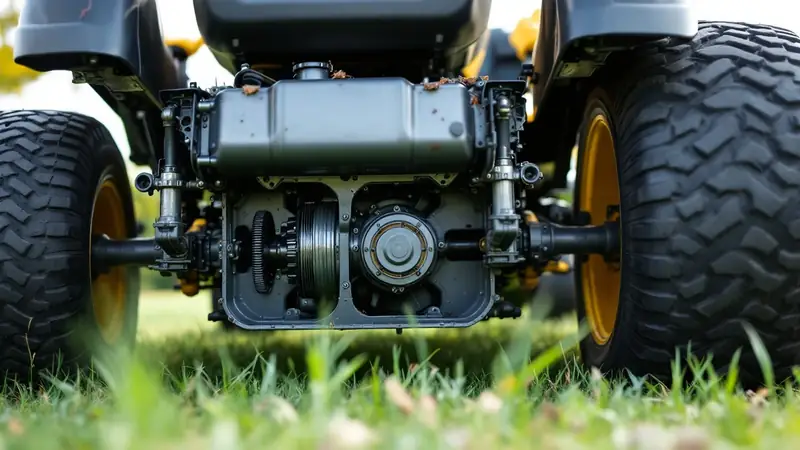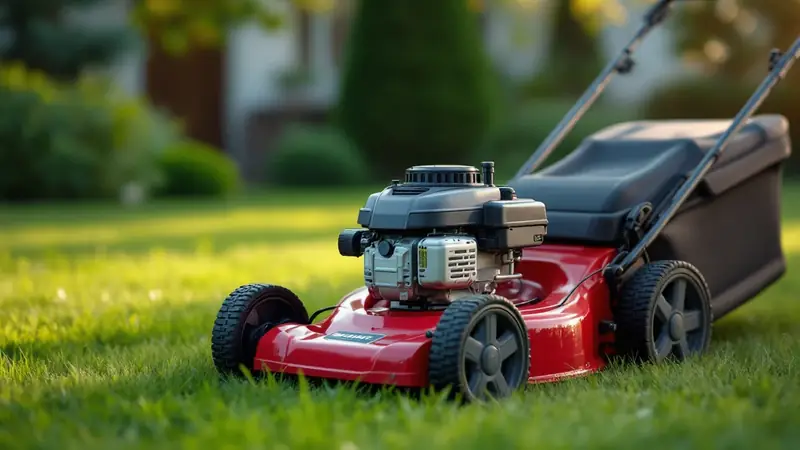
Lawn mower surging is the governor hunting: the engine revs up and down because the carburetor delivers a mixture that is too lean or, less often, too rich. Check fuel age, the cap vent, the air filter and the choke before the jets.
Lawn mower surging has one mechanism and about a dozen causes. The governor holds a set speed by opening and closing the throttle; when the fuel mixture is off, it overshoots, corrects and overshoots again, a rhythm technicians call hunting. Briggs & Stratton compares the governor to cruise control, and Kohler’s service manuals use the word hunting in two places: under an engine that runs lean and under one that runs rich (Kohler 14 690 01, p. 20).
That second entry is what the top-ranked guides miss. One blames a lean mixture for every surge; another puts a rich mixture from a dirty filter first. Kohler lists both, and Honda’s dealer check sheets split the lean causes by throttle position: idle, light load or full throttle. The table below sorts 14 symptom patterns from Kohler, Honda, Briggs & Stratton and Kawasaki documents that way, so the place and moment your mower surges points to one part instead of a full carburetor job.
Where and when it surges points to the part
Read across from the row that matches what you hear. Rows marked lean are fuel-starved, rows marked rich have too much fuel or too little air, and three rows are not mixture problems at all. Most of the 14 fixes need no carburetor removal; when the jets are the answer, the bowl-off and carburetor-off methods for each engine maker are in our guide on how to clean a lawn mower carburetor.
Swipe the table sideways to see every column.
| When it surges | Likely cause | Mixture | Quick test | Fix | Source |
|---|---|---|---|---|---|
| Surges for the first minutes after a cold start, choke lever not fully off | Choke partly closed while running | Rich | Move the choke fully to OFF or RUN; on an auto choke, watch the plate open as the engine warms | Free or adjust the choke linkage | Kohler SV470 to SV620 manual, p. 24 |
| Surges at idle only, steady at half throttle and above | Pilot jet, pilot jet air path or idle port partly clogged; idle stop set too low | Lean | Move the throttle from SLOW to half: if the hunting stops, the idle circuit is the suspect | Clean the pilot jet with a 0.3 mm needle (Honda); set idle to the engine spec | Honda GC/GCV135 to 190 check sheet; Honda GCV145 to 200 sheet |
| Surges at fast idle or light load, between idle and full throttle | Transition ports clogged | Lean | Hunts with the blades disengaged at part throttle, steadier at full throttle | Clean the transition ports (Honda uses a 0.5 mm needle) | Honda GCV145/170/200 carburetor repair sheet, 2018 |
| Surges at full throttle with no load, smooths out when the blade bites tall grass | Main jet, main nozzle or main nozzle air path partly clogged | Lean | Close the choke a little while it hunts: a smoother idle points lean | Clean the main jet; on Briggs float carburetors it sits in the bowl nut | Honda check sheet; Briggs carburetor guide, Jan. 2026 |
| Hunting gets worse the longer it runs, may stall, then restarts after a rest | Fuel tank cap vent blocked | Lean (fuel starved) | Run it with the cap loosened a quarter turn: if the surge fades, the vent is blocked | Clean or replace the cap | Kohler checklist item 2, p. 24; Kawasaki FR manual, p. 36 |
| Started surging after the mower sat a month or more | Stale fuel and varnish in the jets | Lean | Smell and look: dark, sour fuel or fuel older than 30 days | Drain tank and float bowl, refill with fresh gas at 10 percent ethanol or less | Honda GCV170 manual, p. 15; Briggs problem-solving tips |
| Surges with black, sooty smoke or a wet, sooty plug | Clogged air cleaner, dirt under the inlet needle, leaky float, plugged bowl vent | Rich | Pull the air filter and look at it against light | Clean or replace the filter; then needle, seat and float | Kohler XT manual, p. 20 |
| Pitch changes as the engine warms or when you press on the carburetor | Air leak at the carburetor or air cleaner base gasket | Lean | Check the mounting nuts for tightness and the gaskets for cracks | Tighten; replace gaskets | Kohler checklist item 4, p. 24 |
| Riding mower surges more on slopes or with the tank low | Fuel shut-off partly closed, tank screen, in-line filter or fuel pump hose restricted | Lean | Confirm the shut-off is fully open and fuel moves through a clear in-line filter | Replace the filter; check the pump vacuum hose | Kohler checklist item 3, p. 24; Kohler p. 16; Kawasaki FR p. 36 |
| Surges when the load changes (deck engaged or released, hills) after the carburetor is clean | Governor set too sensitive | Not mixture | Note whether it hunts only on load changes, not at a steady load | Dealer moves the governor spring to another lever hole | Kohler SV470 to SV620 manual, p. 32 |
| Speed wanders on a Briggs engine with grass packed around the flywheel screen | Pneumatic (air vane) governor airflow disturbed | Not mixture | Look at the flywheel screen and cooling fins with the plug wire off | Clean the screen, fins and air intake | Briggs governor FAQ, Apr. 2026 |
| Runs rich and uneven at high elevation | Standard carburetor too rich above 2,000 ft | Rich | You mow above 2,000 ft on a factory carburetor | Dealer fits the high-altitude part; reverse it below 2,000 ft | Honda GCV170 manual, p. 12 |
| Riding mower EFI engine drops to low idle and stays there, light on | Kawasaki reduced power mode: overheating, low oil pressure, throttle sensor fault | Not mixture | Check the malfunction light and oil lamp | Stop, clean the shroud, check oil; sensor faults go to a dealer | Kawasaki FS730V EFI manual, pp. 22, 42 |
| Battery mower blade speed rises in thick grass and drops on thin grass | Load sensing working as designed | Not a fault | Speed follows grass density, with no cutouts | None | EGO 2025 catalog, p. 17; Ryobi product page |

Honda’s dealer sheet for the GCV145, GCV170 and GCV200 is the most precise split we found: an unstable slow idle goes to the idle port or a throttle opening set too small, an unstable fast idle or light-load speed goes to the transition ports, and poor high-speed running goes to the main nozzle and air paths (Honda Motor Europe, edition 8469, Aug. 2018). The older American Honda check sheet for GC and GCV135 to 190 engines lists six causes for unstable speed at full throttle, from a dirty pilot screw to a clogged main nozzle air path.
Lean or rich: two checks before you open the carburetor
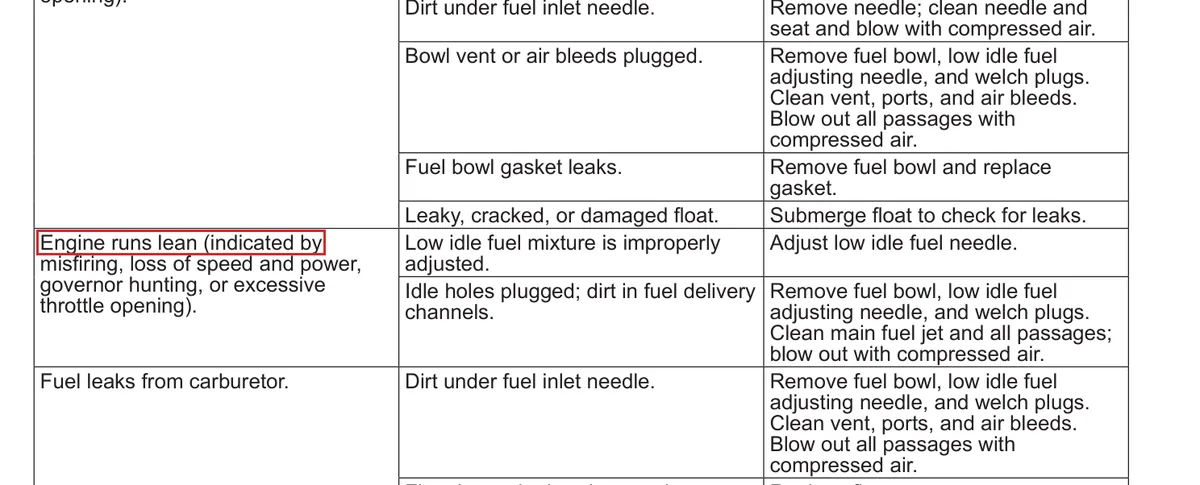
Kohler’s lean list is short: idle holes plugged and dirt in the fuel delivery channels, fixed by cleaning the main jet and passages with compressed air. Its rich list is longer: a clogged air cleaner, a choke partly closed while running, dirt under the fuel inlet needle, plugged bowl vents or air bleeds, and a leaky float (Kohler 14 690 01 Rev. G, p. 20). Both entries name the same four signs: misfiring, loss of speed and power, governor hunting and excessive throttle opening.
A lean mixture can also pop back through the carburetor while the engine runs; our guide to why a lawn mower is backfiring separates that from the single bang a riding mower makes at shutoff.
Black, sooty exhaust is the tie-breaker Kohler gives for rich running, and it is the sign that sends you to the air filter first. Our guide to what black, white and blue mower smoke means covers the plug and float checks for a rich engine in more depth.
The choke gives a second check. Because Kohler lists a partly closed choke as a rich cause (14 690 01, p. 20), closing the choke slightly while the engine hunts adds fuel. If the surge smooths out for those few seconds, the engine was lean; if it gets rougher or smokes, it was already rich. That is an inference from Kohler’s tables rather than a test any of these maker documents prints, so treat it as a pointer, not proof.
The checks in order, cheapest first
Kohler’s own carburetor checklist runs in the same order: fresh fuel, cap vent, fuel reaching the carburetor, gaskets and fasteners, air cleaner, then ignition, governor and controls, all before anyone adjusts or opens the carburetor (Kohler 20 690 01 Rev. J, p. 24). The times below are our estimates for a walk-behind mower with the plug wire off and the engine cool.
- Choke and fuel valve, 1 minute. Choke fully off once warm, fuel valve fully on. Honda GCV engines and Kohler riding engines both have a shut-off that can sit half open.
- Fuel age, 2 minutes. Honda says gas can deteriorate in as little as 30 days and limits its engines to 10 percent ethanol (E10). If the gas is older, drain the tank and float bowl; our guide on how to drain gas from a lawn mower covers each maker’s method, and which gas a lawn mower takes covers the refill.
- Cap vent, 5 minutes running. Outdoors, mower level, engine running: loosen the cap a quarter turn. If the hunting stops, clean or replace the cap. Tighten it before you mow.
- Air filter, 3 minutes. A paper element you cannot see light through, or an oily, packed foam element, is a rich cause on Kohler’s list. Do not run without it: Honda warns that dirt then enters the engine and causes rapid wear.
- Fasteners and gaskets, 5 minutes. Snug the carburetor and air cleaner base nuts; look for a cracked or missing gasket.
- Flywheel screen and fins, 5 minutes. On Briggs engines with an air vane governor, Briggs says a change in airflow affects the speed, so clear packed clippings.
- Jets, 30 to 60 minutes. Only now drop the float bowl or remove the carburetor. Pick the jet from the throttle position in the table above.
1Is it a battery mower whose blade speed rises in thick grass and drops on thin grass, with no cutouts?
YesNormal: EGO and Ryobi build in load sensing. Nothing to fix.
NoGo to the next question
2Is the choke anywhere but fully off, or the fuel valve not fully on?
YesOpen both fully. Kohler lists a partly closed choke as a rich cause of governor hunting.
NoGo to the next question
3Is the gas more than 30 days old, or above 10 percent ethanol?
YesDrain the tank and float bowl and refill with fresh E10 or less (Honda GCV170 manual, p. 15).
NoGo to the next question
4Does the surge fade with the fuel cap loosened a quarter turn?
YesBlocked cap vent: clean or replace the cap (Kohler p. 24; Kawasaki p. 36).
NoGo to the next question
5Is the air filter clogged, or is there black smoke?
YesRich: clean or replace the filter, then check the inlet needle and float (Kohler XT p. 20).
NoGo to the next question
6Are carburetor or air cleaner base nuts loose, or a gasket cracked?
YesAir leak, lean: tighten and replace gaskets (Kohler checklist item 4).
NoGo to the next question
7Does it hunt at idle only?
YesClean the pilot jet and idle port; set idle to the engine spec (Honda check sheets).
NoGo to the next question
8Does it hunt at full throttle with no load and smooth out in tall grass?
YesClean the main jet and main nozzle air path (Honda check sheet).
NoClean carburetor, fresh fuel and still hunting on load changes: governor sensitivity or linkage. Kohler says not to tamper with the governor setting; have a dealer check governed speed with a tachometer.
Source: Kohler 14 690 01 and 20 690 01; Honda check sheets; Kawasaki FR manual; read Nov. 20, 2026
If the mower then will not start at all, the steps are different; work through our lawn mower not starting checklist before adjusting anything, and use the choke and primer settings in our guide on how to start a lawn mower.
What each engine family’s manual adds
The four big engine makers agree on fuel, vent and filter, then diverge on what an owner may touch. Briggs & Stratton says carburetors built to EPA emission standards are factory set and not adjustable, and that only older, non-EPA carburetors take the 1 1/2 turn and 1 1/4 turn starting settings (Briggs carburetor guide, Jan. 2026). Kawasaki’s FR owner’s manual says not to tamper with the governor or carburetor settings and sends both faults to a dealer (Kawasaki FR651V to FR730V manual, p. 24).
Which of those settings your engine still has depends on its family, and our guide on how to adjust a lawn mower carburetor lists the preset turns, limiter caps and idle speeds for Briggs, Honda, Kohler, Kawasaki and Tecumseh engines.
| Engine family (document) | Governor | What the manual checks for hunting or uneven speed | Speeds printed | Owner-adjustable carburetor? |
|---|---|---|---|---|
| Briggs & Stratton walk-behind and riding | Mechanical, pneumatic (air vane) or electronic | Surging: fresh fuel, air filter, spark plug. Under overheating it adds a lean mix, a leaky gasket and a plugged tank vent or screen | None printed on these pages | No on EPA-era carburetors (factory set); older ones start at 1 1/2 turns high speed, 1 1/4 turns idle |
| Honda GCV145, GCV170, GCV200 | Centrifugal weight | Idle: pilot jet, idle port, throttle stop. Light load: transition ports. High speed: main nozzle, main air path, pilot jet air path | Maximum governed speed 2,800 to 3,100 rpm by engine type | Pilot screw sits under a limiter cap; Honda: tampering violates federal and California law |
| Kohler Courage XT (walk-behind) | Mechanical (governor gear) | Rich: air cleaner, choke, inlet needle, bowl vent, float. Lean: idle holes, fuel delivery channels | Low idle 1,800 rpm, plus or minus 75 | Main circuit fixed, no adjustment |
| Kohler Courage SV470 to SV620 (riding) | Mechanical (governor gear) | Same rich and lean lists, plus fuel shut-off, in-line filter, fuel pump; governor sensitivity | Low idle 1,200 rpm, plus or minus 75; governed idle 1,500 to 1,800 rpm | Main jet fixed; idle needle factory set |
| Kawasaki FR651V, FR691V, FR730V (riding) | Not stated in the owner’s manual | Blocked tank cap vent, blocked fuel filter or tube; carburetor and governor faults go to a dealer | None printed | No: mixture screws capped; do not tamper with governor or carburetor |
| Kawasaki FS730V EFI (riding) | Electronic (E-governor) | Reduced power mode drops to low idle; faulty E-governor goes to a dealer | None printed | No carburetor |
| EGO and Ryobi battery mowers | Electronic load sensing | Speed change in thick grass is designed behavior | EGO: up to 2,800 rpm blade speed on its 6 auto-sensing models | Not applicable |
The speeds explain why a hunting engine sounds so obvious. Honda builds GCV engines to a maximum governed speed of 2,800 to 3,100 rpm depending on type (Honda shop manual 62Z9L20, p. 2-2), while Kohler sets basic SV riding engines to a 1,200 rpm low idle and XT walk-behinds to 1,800 rpm, each plus or minus 75. A governor swinging a few hundred rpm either side of its target is audible as the vroom and droop owners describe. Checking the setting takes a tachometer, the tool Kohler lists for it.
Riding mowers: fuel pumps, governor sensitivity and EFI
Riding mower engines add parts a push mower lacks. Kohler’s SV troubleshooting list adds a fuel pump with a vacuum hose that can clog or leak, an in-line fuel filter and a shut-off valve (Kohler 20 690 01, pp. 16, 24), and Kawasaki’s FR manual pairs a blocked air vent in the tank cap with a blocked fuel filter or tube (Kawasaki FR manual, p. 36).
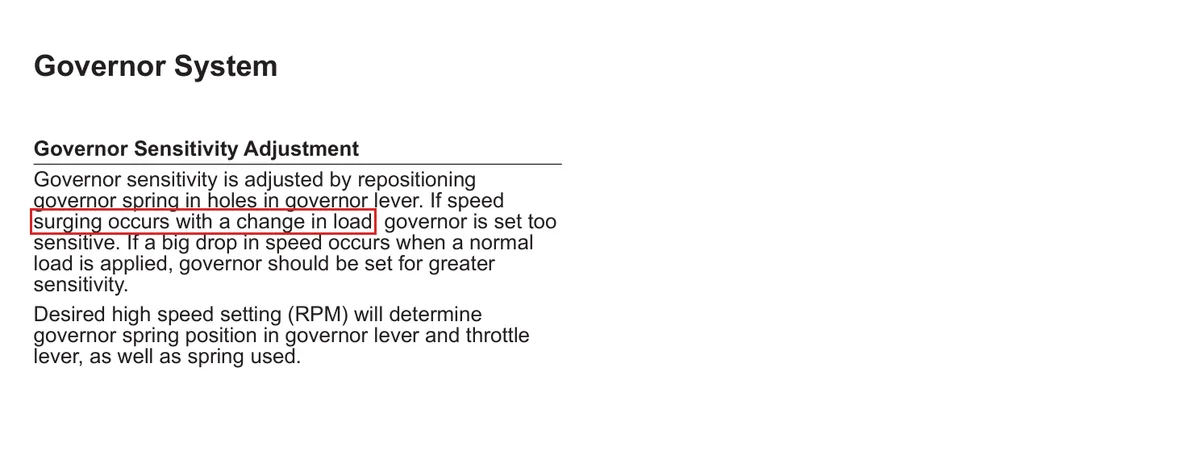
Governor sensitivity is the one cause that is a setting rather than dirt. Kohler adjusts it by moving the governor spring between holes in the governor lever: if speed surges with a change in load, the governor is too sensitive, and if speed drops sharply under a normal load, it needs more sensitivity (p. 32). The governor section warns against tampering with the governor setting, because overspeed is hazardous (p. 31).
That is dealer work, not a reason to bend linkage. Clean the fuel system first; a tractor that hunts only when the deck engages or releases, with a clean carburetor and fresh fuel, is the case Kohler’s page describes. EFI engines behave differently again. Kawasaki’s FS730V EFI drops to low idle in reduced power mode for overheating, low oil pressure or a throttle sensor fault, and says to stop as soon as safely possible (Kawasaki FS730V EFI manual, p. 22). A steady drop to idle with the light on is that mode, not a surge.
Battery mowers that change speed are working as designed
A battery mower that speeds up in thick grass and slows on thin grass is doing what its maker built it to do. EGO’s 2025 catalog lists Auto Sensing Variable Speed on six walk-behind models, each rated up to 2,800 rpm blade speed, and says the feature delivers optimal cutting speed to maximize battery runtime (EGO 2025 product catalog, p. 17). Ryobi lists load-sensing technology on its 40V brushless 20 in. self-propelled mower (Ryobi product page, Nov. 2026).
A cordless mower that cuts out, stops or will not restart is a different problem, and pack age and storage charge are the usual suspects; our guide to how long lawn mower batteries last gives the makers’ warranty and storage numbers.
When to hand it to a shop
Hand it over when the cheap checks pass and the hunting remains, when the fix would mean moving governor springs, or when a riding mower’s EFI light is on. Our lawn mower repair cost survey found posted carburetor cleaning prices of $40 to $105, and ask the shop whether it will check governed speed with a tachometer after cleaning, since that is the number Honda and Kohler publish.
How we compiled this
On Nov. 20, 2026 we read the troubleshooting, carburetor and governor sections of 11 maker documents: Kohler service manuals 14 690 01 and 20 690 01, two Honda carburetor check sheets, the Honda GCV145 to GCV200 shop manual and GCV170 owner’s manual, two Kawasaki engine owner’s manuals, and three Briggs & Stratton support pages. We added the EGO 2025 catalog and a Ryobi product page for battery mowers, and checked Google’s results for 7 phrasings of the query the same day. Page numbers are PDF page numbers. We did not test any mower; the minute estimates in the ordered checks are ours.
Frequently asked questions
How do you stop a lawn mower from surging?
Fix the mixture, not the governor. Drain fuel older than 30 days, refill with E10 or less, loosen the cap to test the vent, clean the air filter and open the choke fully. If it still hunts, clean the jet that matches where it surges: pilot jet at idle, main jet at full throttle.
Why is my lawn mower surging at low idle?
Honda’s 2004 and 2018 check sheets tie an unstable idle to a dirty pilot screw, a clogged pilot jet or its air path, a clogged idle port, or a throttle opening set too small. If raising the throttle to half stops the hunting, the idle circuit is the suspect, not the main jet.
What does a surging lawn mower sound like?
A steady, repeating rise and fall in engine speed with your hand off the throttle. A random stumble or pop is more often a misfire, which Kohler lists under a faulty spark plug or ignition module rather than governor hunting (20 690 01, p. 16).
Why does my mower still surge with a new carburetor?
A new carburetor replaces the jets but not the cap vent, fuel filter, shut-off, gaskets, air filter or governor. Kohler’s 6-item checklist (p. 24) puts all of those before the carburetor, and an air leak at a reused or missing mounting gasket leans the mixture on a new carburetor too.
Why does my lawn mower surge and then die?
A blocked fuel cap vent is the classic cause: Kohler lists a restricted cap vent under an engine that starts but does not keep running, and Kawasaki under no fuel to the combustion chamber (Kohler 20 690 01, p. 16; Kawasaki FR, p. 36). If loosening the cap keeps it running, replace the cap.
Sources
- Kohler Engines, Courage XT-6 to XT8 service manual, 14 690 01 Rev. G, pp. 13, 20, 21. Accessed November 2026.
- Kohler Engines, SV470 to SV620 service manual, 20 690 01 Rev. J, pp. 16, 24, 25, 31, 32. Accessed November 2026.
- American Honda, Carburetor Check Sheet, GC and GCV135/160/190, GS and GSV160/190 (OTR53863), 2004. Accessed November 2026.
- Honda Motor Europe, GCV145/170/200 Carburetor Repair Information, S2Z9L800, edition 8469, Aug. 2018. Accessed November 2026.
- Honda Motor Co., GCV145H, GCV170H, GCV200H shop manual, 62Z9L20, p. 2-2 (PDF p. 25). Accessed November 2026.
- American Honda, GCV170 and GCV200 owner’s manual, 00X37Z9V0002, pp. 9, 12, 15. Accessed November 2026.
- Briggs & Stratton, How does a small engine governor work?, updated Apr. 6, 2026. Accessed November 2026.
- Briggs & Stratton, Small engine problem solving tips (engine stalling, surging or running rough), 2026. Accessed November 2026.
- Briggs & Stratton, Carburetor repair, maintenance and adjustment how-to guide, updated Jan. 13, 2026. Accessed November 2026.
- Kawasaki Engines USA, FR651V, FR691V, FR730V owner’s manual, pp. 24, 36, 37. Accessed November 2026.
- Kawasaki Engines USA, FS730V EFI owner’s manual, pp. 22, 41, 42. Accessed November 2026.
- EGO Power+, 2025 product catalog, p. 17. Accessed November 2026.
- Ryobi, 40V brushless 20 in. self-propelled lawn mower product page, checked Nov. 20, 2026. Accessed November 2026.