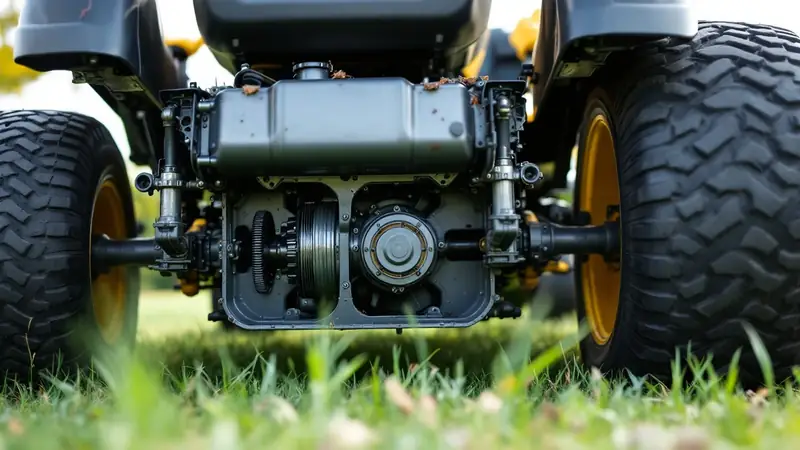
A riding mower won’t move most often because the transmission bypass rod is pulled out or the parking brake is locked; Deere’s troubleshooting chart lists only those two. Then check the drive belt, and purge air from a hydrostatic transaxle.
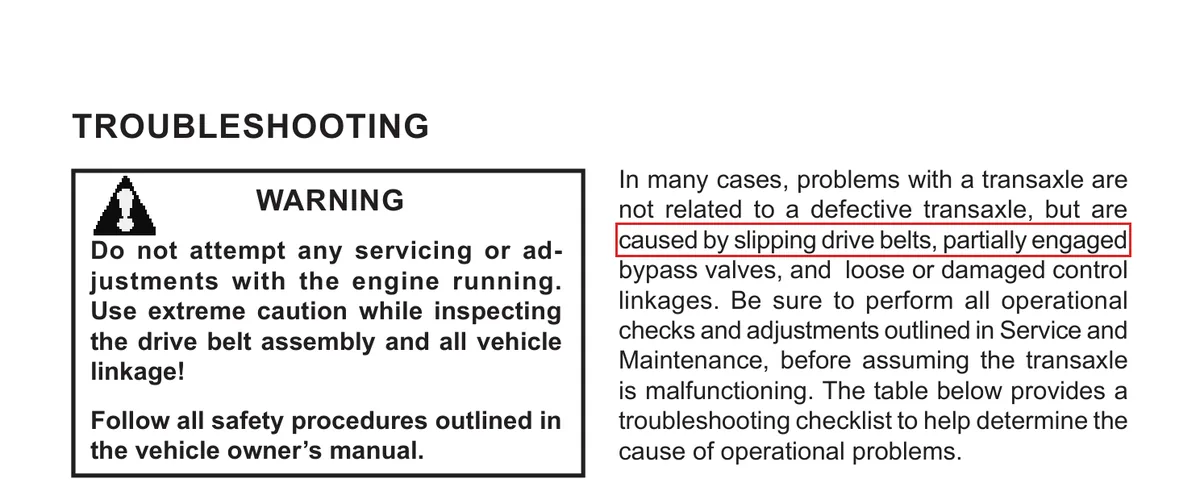
When a riding mower won’t move but the engine runs, the fault sits somewhere between the engine pulley and the wheels, and the transaxle is the last place to look. Deere’s 100-series manual gives just two causes for a tractor that “will not move with engine running”: a locked park brake and a pulled-out bypass rod (OMUC22642, p. 47). Hydro-Gear, which builds many of the transaxles, opens its troubleshooting chapter by saying many drive complaints come from slipping belts, partly engaged bypass valves and loose or damaged linkages rather than a failed unit (BLN-52441, p. 8).
The checks differ by drive type: a hydrostatic tractor has 1 transaxle and 1 bypass rod, a zero-turn has 2 of each, and a gear drive has shift keys and pulley keys that shear. The table sorts 15 symptoms by drive type, each tied to the maker page that names it. If your mower stops cutting rather than driving, the deck side is covered in our guide to a lawn mower belt that keeps coming off.
Why won’t my riding mower move? Causes by drive type
Swipe the table sideways to see every column.
| Drive type | Symptom | Likely cause | Check | Fix | Source |
|---|---|---|---|---|---|
| Hydrostatic tractor | Engine runs, no drive either way, tractor rolls freely when pushed | Transmission bypass rod pulled out (push mode) | Look at the rod at the rear of the frame: pulled out means bypass is open | Push the rod fully in, then restart | Deere OMUC22642 p. 47; Cub Cadet 769-10976 p. 9 |
| Hydrostatic tractor | No drive, or slow and labored, and the tractor is hard to push | Parking brake locked or partly engaged | Release the park brake; with the bypass open, the tractor should roll by hand | Release the brake; replace a broken or missing brake return spring | Deere OMUC22642 p. 47; Hydro-Gear BLN-52441 p. 8 |
| Zero-turn | Neither wheel drives | Both bypass (tow) levers left in the push position | Toro TimeCutter: lever forward through the slot is push, rearward is operate | Lock both levers rearward and down | Toro 3479-424 pp. 24, 25, 52 |
| Zero-turn | One wheel drives, the other is dead or weak | That side’s bypass lever partly open or sticking; unequal tire pressure; linkage or tracking off | Check the lever on the weak side, then rear tire pressure (Toro TimeCutter Max: 13 psi) | Close the lever; set equal pressure; adjust tracking | Hydro-Gear BLN-52441 p. 8; Toro 3483-555A pp. 5-20, 5-21 |
| All belt-driven | Engine runs, nothing moves, belt slack, off a pulley or broken | Traction (drive) belt off or broken | Engine off, key out: look under the frame between engine and transaxle | Reroute or replace by the maker’s part number; Cub Cadet sends XT1 drive belts to a dealer | Toro 3479-424 p. 52; Cub Cadet 769-10976 p. 29 |
| Hydrostatic, either type | Moves but weak, slows on hills, belt shiny or cracked | Belt slipping: worn belt, seized idler, weak idler spring | Inspect the belt, idler pulleys and idler springs | Replace the worn part; Hydro-Gear says slippage lowers input speed to the transaxle | Hydro-Gear BLN-52441 p. 9 |
| Hydrostatic, either type | Drives forward but not reverse, or the reverse | Control linkage bent or out of adjustment; drive belt slipping | Watch the control arm on the transaxle move when you press each pedal or lever | Repair or adjust the linkage; fix the belt | Hydro-Gear BLN-52441 p. 8 |
| Hydrostatic, either type | Weak or no drive after a short run, noisy, after an oil change or long storage | Air trapped in the hydraulic circuit | Did the unit sit, get opened or get oil added? | Run the purge procedure (steps below) | Hydro-Gear BLN-52441 p. 12; Tuff Torq purge sheet |
| Hydrostatic, either type | Drives cold, fades or stops once hot or on a long climb | Debris on the transaxle or cooling fan, low or broken-down oil, overload, low throttle | Look for packed grass on the fan and fins; note whether you mow, climb or tow at part throttle | Clean the fan and fins; run at full throttle; change oil on serviceable units; lighten the load | Hydro-Gear BLN-52441 p. 8; Deere OMUC22642 pp. 23, 27 |
| Hydrostatic tractor | Weak drive while towing a cart | Towed load beyond the maker’s rule | Deere 100 series: above 350 lb towed, press the forward pedal no more than halfway | Unload, run at full throttle, stay off slopes over 10 degrees while towing | Deere OMUC22642 p. 27 |
| Hydrostatic tractor | Creeps when neither pedal is pressed (often reported with poor drive) | Neutral (return to neutral) out of adjustment | Tractor moves with both pedals released on level ground | Dealer neutral adjustment (Cub Cadet); Hydro-Gear RTN procedure on ZT units | Cub Cadet 769-10976 p. 22; Hydro-Gear BLN-52441 p. 13 |
| Gear drive | In gear, engine runs, pulleys turn, wheels do not | Sheared key or loose set screw in the drive or driven pulley | Watch the transaxle input pulley: if it spins on its shaft, the key or set screw is gone | Replace the key and tighten the set screw | Tecumseh/Peerless 691218 pp. 5, 10 |
| Gear drive | Will not go into gear or shifts hard | Clutch or belt release not de-clutching; bent linkage; damaged shift keys | Shift with the engine off: if it shifts freely, the fault is outside the transaxle | Adjust clutch, brake and shift linkage before pulling the transaxle | Tecumseh Service Bulletin 304, p. 2 |
| Gear drive | Slips out of gear or no drive in one gear after shifting on a hill or while towing | Worn or broken shift keys | History of shifting while moving, on a slope or under load | Replace shift keys; Tecumseh treats this wear as abuse, not a warranty defect | Tecumseh Service Bulletin 304, p. 1 |
| Hydrostatic, either type | No drive after every check above, with whine or grinding | Internal pump, motor or gear failure | Bypass closed, brake off, belt tight, purged, still nothing | Get a written quote and compare it with the new price | Toro 3479-424 p. 52; Hydro-Gear BLN-52441 p. 8 |
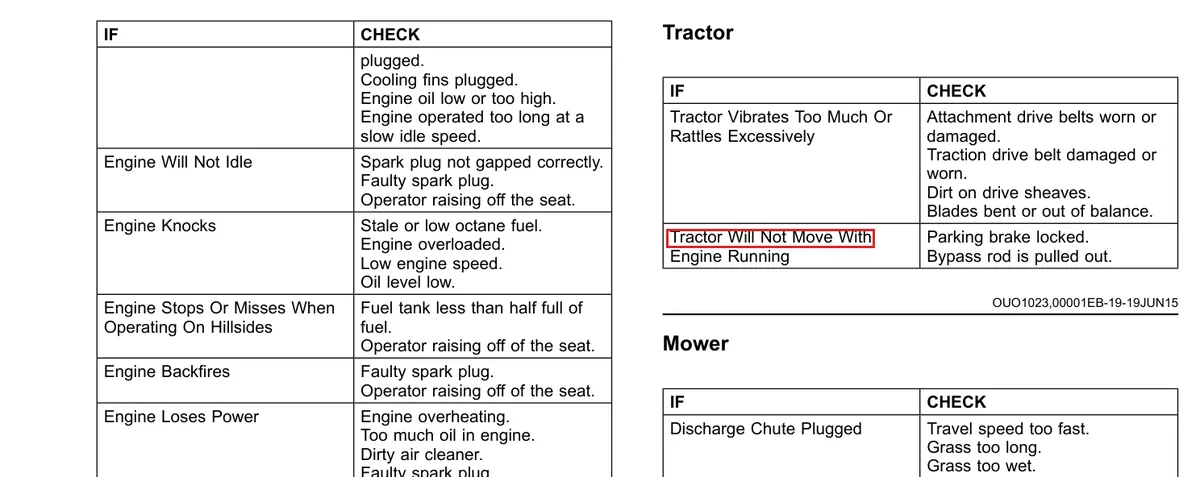
The bypass rod is first for a reason. It opens a valve that lets oil circulate freely inside the transaxle so the machine can be pushed, and Hydro-Gear limits that to short moves at a maximum of 2 mph (BLN-52441, p. 2). Cub Cadet’s XT1 manual adds that the transmission will not engage with the rod pulled out, and that a tractor that will not move on the pedals, or moves slowly, should be checked for an open bypass (Form 769-10976, p. 9). A rod pushed in only partway gives the slow, weak version of the fault.
Deere and Cub Cadet both warn against towing a hydrostatic tractor with its wheels on the ground; Deere says to move it by hand only, and to push the bypass rod back in before starting the engine (OMUC22642, p. 25; Cub Cadet, p. 9). For getting a dead mower onto a trailer instead, ramp angles and trailer ratings are in our guide to how much a riding lawn mower weighs.
Work through it in this order
1Is the bypass rod pulled out, or a zero-turn bypass lever in the push position?
YesPush the rod in or lock the levers in the drive position, then restart (Deere OMUC22642 p. 47; Toro 3479-424 p. 24).
NoGo to the next question
2Is the parking brake locked or dragging?
YesRelease it; replace a broken brake return spring (Hydro-Gear BLN-52441 p. 8).
NoGo to the next question
3Is the drive belt off, broken, glazed, or an idler or idler spring damaged?
YesReroute or replace the belt and the worn idler parts (Hydro-Gear p. 9; Toro p. 52).
NoGo to the next question
4Gear drive: does the input pulley spin on its shaft, or will it not shift?
YesReplace the sheared key; adjust clutch and shift linkage before pulling the transaxle (Peerless 691218; Tecumseh SB 304).
NoGo to the next question
5Does the control arm on the transaxle fail to move both ways when you press the pedal or lever?
YesRepair or adjust the control linkage (Hydro-Gear p. 8).
NoGo to the next question
6Is drive weak, noisy or fading after storage, an oil change or a short run?
YesPurge the air: bypass open, 5 or 6 slow strokes each way, bypass closed, repeat (Hydro-Gear p. 12).
NoGo to the next question
7Does it fade only when hot, climbing or towing?
YesClean the transaxle fan and fins, run at full throttle, reduce the load; change oil where the unit allows (Hydro-Gear p. 8; Deere pp. 23, 27).
NoLikely internal pump, motor or gear failure: get a written quote and compare it with half the price of a new mower.
- Park on level ground, engine off, key out. Find the bypass: a rod at the rear of the frame on most lawn tractors (Deere and Cub Cadet: pull out to push, push in to drive), or two levers beside the engine on a zero-turn (Toro TimeCutter: rearward and down to drive).
- Release the parking brake fully. Deere’s park-brake test is the reverse check: with the brake locked and the bypass open, the tractor must not roll (OMUC22642, p. 21).
- With the key out, look at the traction belt from below or behind: on its pulleys, tight, not glazed or cracked. Spin each idler by hand and look for a broken idler spring.
- Watch the control arm on the transaxle while a helper presses each pedal or lever with the engine off. If the arm does not move both ways, the linkage is the fault.
- Start the engine at full throttle and test again. If drive is weak, noisy or fades after a minute, purge the air.
- On a gear drive, shift with the engine off. If it shifts freely, the fault is the clutch, brake or shift linkage (Tecumseh SB 304); if the pulley spins on its shaft, the key has sheared.
How to purge a hydrostatic transmission
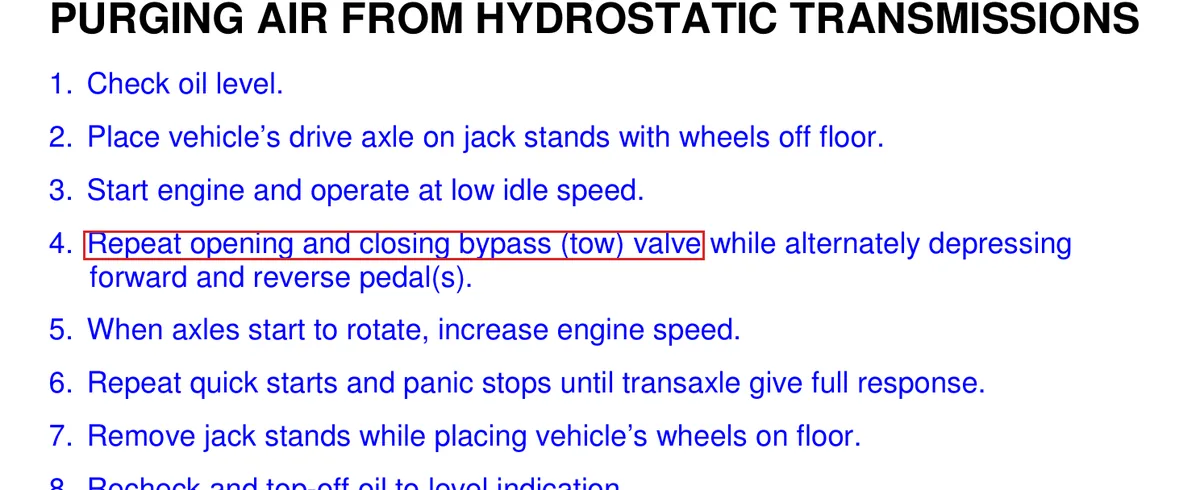
Hydro-Gear lists three symptoms of trapped air: noisy operation, lack of power or drive after short-term operation, and high operating temperature with excessive oil expansion, and says to purge any time the system has been opened or oil added (BLN-52441, p. 12). Its procedure, written for the ZT-2800 and repeated in the EZT and RT-310 manuals:
- Check the oil level first; on a sealed tractor unit you cannot, so go straight to step 2.
- Raise the drive wheels off the ground on jack stands if you can; otherwise use an open area with no bystanders. Release the brake.
- With the bypass open and the engine running, move the drive control slowly full forward and full reverse 5 or 6 times.
- Close the bypass and repeat 5 or 6 slow strokes each way. Stop the engine and top up oil if the unit has a fill point.
- Repeat steps 3 and 4 until the transaxle runs at normal noise and moves smoothly both ways at normal speed, then repeat on the ground.
Tuff Torq’s aftermarket sheet runs it differently: drive axle on jack stands, engine at low idle, open and close the tow valve while alternately pressing forward and reverse, raise engine speed once the axles turn, then make quick starts and stops until the transaxle gives full response (Tuff Torq purging sheet, p. 3). The same sheet says a K66 with a charge pump purges itself in the first strokes of the pedal, while a K62 must be purged before use.
Which transaxle is under your mower?
The transaxle model decides whether you can do anything beyond the purge. Deere’s S100 to S160 use a Tuff Torq TL200 and the S170 and S180 a Tuff Torq HD K46, and Deere calls the transmission sealed with no maintenance required (OMUC22642, pp. 35, 49). Cub Cadet says the same of the XT1: the fluid level cannot be checked and the fluid cannot be changed (p. 22). The model is printed on a label or cast into the case; Hydro-Gear decodes oil volume from characters 7 and 13 of its ZT-2800 model number.
| Transaxle | Found in (examples) | Maker rating | Fluid and service | Purge or shift rule | Source |
|---|---|---|---|---|---|
| Tuff Torq TL200 | Deere S100 to S160 | 130 lb-ft, 5.5 mph | Sealed: Deere says no maintenance | Bypass rod at the rear; dealer for anything inside | Tuff Torq 2024 card; Deere OMUC22642 pp. 35, 49 |
| Tuff Torq K46 (HD K46) | Deere S170, S180; many tractors | 171 lb-ft, 6 mph | Tuff Tech fluid; Tuff Torq suggests a change at 50 hours, then every 200; level 17 to 22 mm below the port lip, about 2 liters | Purge after any oil work | Tuff Torq K46 oil sheet; card |
| Tuff Torq K62 | Larger lawn and garden tractors | 217 lb-ft, 6.8 mph | Separate gear and hydro chambers, each with its own drain | Must be purged before use after an oil change | Tuff Torq K62/K66 sheet |
| Tuff Torq K66 | Garden tractors | 310 lb-ft, 7 mph | Remote expansion reservoir with a fill line | Charge pump self-purges in the first pedal strokes | Tuff Torq K62/K66 sheet |
| Hydro-Gear ZT-2200 (EZT) | Residential zero-turns (Deere Z320R) | Not printed in the manual | 20W-50 engine oil, 56 fl oz per unit | Purge after any oil change | Hydro-Gear BLN-52622 p. 10 |
| Hydro-Gear ZT-2800 | Residential and light commercial zero-turns | Up to 300 lb-ft; 1,000 lb gross vehicle weight | 20W-50; filter 52114; change at 75 to 100 hours, then every 400 | Bypass, then 5 or 6 slow strokes each way, bypass closed, repeat | Hydro-Gear BLN-52441 pp. 6, 11, 12 |
| Peerless 700, 800, 900, MST (gear) | Older gear-drive lawn tractors | Not hydraulic | Grease or oil fill per model, from the Peerless capacity chart | No purge; de-clutch before every shift | Tecumseh SB 304; Peerless 691218 |
The rating gap explains the “weak uphill” complaint. Tuff Torq rates the TL200 at 130 lb-ft of axle torque and the K72 at 405, more than three times as much, on the same product card (Tuff Torq, 2024). A TL200 tractor pulling a loaded cart up a slope runs closer to its limit, which is why Deere tells owners to press the forward pedal no more than halfway when towing over 350 lb, to avoid slopes over 10 degrees while towing, and to run at full throttle, since idling or low throttle while mowing, climbing or towing can overheat the transmission (OMUC22642, pp. 23, 27).
Zero-turn won’t move: two sides, two sets of checks
A zero-turn mower drives each rear wheel with its own pump and motor, so a fault on one side shows up as the mower spinning or pulling. Toro’s TimeCutter chart lists four causes for “the machine does not drive”: bypass valves open, traction belts worn, loose or broken, traction belts off the pulleys, and a failed transmission (Toro 3479-424, p. 52). Before blaming a pump for a weak side, set the rear tires equal: Toro specifies 13 psi for TimeCutter Max drive tires and adjusts tracking only for forward travel (Toro 3483-555A, pp. 5-20, 5-21).
Hydro-Gear’s ZT-2800 checklist puts a sticking bypass, bent linkage and a partly engaged brake under “vehicle does not drive or track straight” (BLN-52441, p. 8). Its return-to-neutral procedure lifts the drive tires, starts the engine at full speed with the linkage removed and rotates the control arm in 5-degree steps until the axle stops turning (p. 13). Model-by-model slope and speed limits are in our comparison of zero-turns and lawn tractors.
Gear-drive lawn tractor won’t move when in gear
Older and budget tractors with a shift lever use Peerless-type gear transaxles. Tecumseh’s handbook tells technicians to look first for loose drive belts, a worn or misadjusted clutch, and loose set screws or sheared keys in the drive and driven pulleys before removing the unit (Tecumseh/Peerless 691218, p. 5). A sheared pulley key gives the classic symptom: engine running, belt turning the pulley, pulley spinning on the input shaft, wheels still.
Shift keys are the internal weak point. Tecumseh Service Bulletin 304 says the 700, 800, 900 and MST units lock gears to the shaft with shift keys, that shifting on an incline, while towing or without de-clutching wears them out, and that it treats that wear as abuse rather than a warranty defect (SB 304, June 1996). Its test: if the unit shifts freely with the engine off, the cause is outside the transaxle, so check the clutch, shifter and brake linkage before pulling it.
Repair or replace when it is the transmission
No shop in our lawn mower repair cost survey posts a flat price for a transmission replacement, while a drive belt runs $115 to $229 and one shop posts a hydrostatic fluid and filter change at $160 (26 shop price lists, Oct. 2026). The same survey’s rule: when a single quote passes half the price of a comparable new mower, replace it. For a sealed TL200 or K46 that has failed after the purge, the quote is usually a whole transaxle, and how long riding mowers last is the other half of that decision.
An engine that dies when you press a pedal is an interlock fault, not a drive fault: see our guide to a lawn mower that is not starting.
With the deck running, an engine that stops as you press the reverse pedal is listed as a normal condition in Deere’s 100-series chart; that reverse interlock and the PTO clutch tests are covered in our guide to riding mower blades that won’t engage.
How we compiled this
On Nov. 21, 2026 we read the troubleshooting, maintenance and bypass sections of 11 maker documents: the Deere 100-series operator’s manual (OMUC22642), the Cub Cadet XT1 and XT2 manual (769-10976), two Toro TimeCutter manuals (3479-424, 3483-555A), Hydro-Gear’s ZT-2800 and ZT-2200 service manuals, four Tuff Torq aftermarket sheets and product card, and Tecumseh’s Service Bulletin 304 and Peerless technician’s handbook (691218). We checked Google’s results for 5 phrasings of the query the same day. We did not test any mower; the check order follows the makers’ own charts.
Frequently asked questions
What causes a riding lawn mower to not move?
In maker charts the most common causes are a transmission bypass rod or lever left in the push position, a locked or dragging parking brake, and a drive belt that is off, broken or slipping (Deere OMUC22642, p. 47; Toro 3479-424, p. 52). Air in a hydrostatic transaxle and internal failure come after those.
Why does my riding mower start but won’t move?
If the engine runs and the mower sits, power is not reaching the wheels: check the bypass rod, the parking brake and the traction belt in that order. On a gear drive, also check for a sheared key at the transaxle input pulley (Peerless 691218, p. 5).
How do you bleed air out of a hydrostatic transmission?
Hydro-Gear’s purge: with the bypass open and the engine running, move the drive control slowly forward and reverse 5 or 6 times, close the bypass and repeat, top up oil where possible, and repeat until it drives smoothly at normal speed (BLN-52441, p. 12).
Why won’t my zero-turn mower move forward or backward?
Toro lists open bypass valves, worn or broken traction belts, belts off the pulleys and a failed transmission (3479-424, p. 52). If only one side fails, check that side’s bypass lever, rear tire pressure and tracking first.
Why does my hydrostatic mower lose power when hot?
Hydro-Gear ties a hot-running unit to debris on the transaxle, a damaged cooling fan, low or contaminated oil, overload and trapped air (BLN-52441, p. 8). Deere adds that low throttle while mowing, climbing or towing can overheat the transmission (OMUC22642, p. 23).
Sources
- Deere & Company, 100 Series Lawn Tractors S100 to S180 operator’s manual, OMUC22642 Issue H0, pp. 21, 23, 25, 27, 35, 46, 47, 49. Accessed November 2026.
- Cub Cadet, XT1 and XT2 Enduro Series tractor operator’s manual, Form 769-10976, July 17, 2015; pp. 9, 22, 29. Accessed November 2026.
- The Toro Company, TimeCutter 42in riding mower operator’s manual, 3479-424 Rev A, pp. 24, 25, 52. Accessed November 2026.
- The Toro Company, TimeCutter Max or MyRIDE 50in or 54in operator’s manual, 3483-555A, pp. 5-20, 5-21. Accessed November 2026.
- Hydro-Gear, ZT-2800, ZT-3100, ZT-3200 service and repair manual, BLN-52441, Apr. 2023; pp. 2, 6, 8, 9, 11, 12, 13. Accessed November 2026.
- Hydro-Gear, ZT-2100 and ZT-2200 (EZT) service and repair manual, BLN-52622, Mar. 2023; p. 10. Accessed November 2026.
- Tuff Torq Corporation, Lawn and Garden Tractor Hydrostatic Transaxles product card, 2024. Accessed November 2026.
- Tuff Torq Aftermarket Services, K62/K66 oil change procedure and Purging Air from Hydrostatic Transmissions, pp. 1 to 3. Accessed November 2026.
- Tuff Torq Aftermarket Services, Changing and checking oil in the K46 with external reservoir housing (K46AM), pp. 1, 2. Accessed November 2026.
- Tuff Torq Services, K46/T40/TL200 transaxle bypass O-rings replacement procedure, 2017. Accessed November 2026.
- Tecumseh Products, Service Bulletin 304, Peerless transaxles and transmissions shifting problems, June 1996. Accessed November 2026.
- Tecumseh Products, Tecumseh/Peerless transmissions and transaxles technician’s handbook, 691218, pp. 5, 10. Accessed November 2026.