When lawn mower blades won’t engage, see whether a lever or an electric PTO switch engages them. Lever: check the cable and deck belt. Switch: check fuse, battery (12.4 V or more), seat and reverse interlocks, 12 V at the clutch, then coil ohms.
Lawn mower blades won’t engage for one of two reasons: power is not reaching the deck, or the clutch turns and the belt does not. Riding mowers and zero-turns engage the deck in one of two ways. A manual PTO uses a handle and cable to swing an idler pulley against the deck belt; an electric PTO uses a dash switch to energize a clutch on the engine crankshaft. Cub Cadet’s XT1 and XT2 manual covers both: push the manual handle forward on the fender, or pull the electric switch up (Cub Cadet 769-10976, pp. 15, 19, 20).
Most guides stop at telling you to test the clutch with a multimeter, but the pass numbers are not universal. Warner Electric’s GT-300 is in spec at 1.82 to 2.03 ohms, Warner’s bearing-mounted garden tractor clutch at 2.40 to 2.90, and Ogura’s GT1.5 at 2.79 to 3.22, so one clutch’s pass is another’s fail. The spec table below lists coil resistance, current draw and air gap for 12 Warner and Ogura clutch sizes from the makers’ own service sheets. If the belt keeps jumping off rather than never turning, that is covered in our guide to a lawn mower belt that keeps coming off; if the tractor will not drive either, start with why a riding mower won’t move.
Lawn mower blades won’t engage: symptom, test and fix
Match what you see when you pull the switch or push the lever. A click at the clutch means power arrived; silence means it did not, which points up the wiring rather than at the $449.91 clutch.
Swipe the table sideways to see every column.
| Symptom | Likely cause | Test and spec | Fix | Part (Cub Cadet MSRP, Nov. 26, 2026) | Source |
|---|---|---|---|---|---|
| Switch on, no click at the clutch, nothing else works either | Blown fuse | Pull and look. Toro TimeCutter 42: main F1 25 A, charge F2 15 A, under the seat | Replace with the same rating, then find the short; Toro says check the circuit | Fuse only | Toro 3479-424 p. 37 |
| No click; engine cranks slowly or the dash shows LO BATT | Low battery | Rested battery 12.4 V or more (Toro); Cub Cadet’s meter flags under 11.5 V | Charge, then retest; replace if it will not hold 12.4 V | None if it charges | Toro 3479-424 p. 50; Cub Cadet 769-10976 p. 16 |
| No click, battery and fuse fine | PTO switch, wiring, connector or relay | Engine running, PTO on: 12 to 14 V DC at the clutch connector (Warner); 12 V minimum (Ogura) | Under 12 V: trace back through connector, switch and harness | Cub Cadet PTO switches $42.60 to $77.92 | Warner P-1177-2-WE; Ogura checklist |
| 12 V reaches the clutch, still no engagement | Open or shorted coil | Engine off, plug apart, ohms across the clutch leads; compare with the model range below | Out of range or open: replace the clutch | Cub Cadet 917-04163A $449.91 | Warner P-1097-6 p. 4; Warner P-1759-WE p. 2 |
| Ohms in range but low current | Supply side, not the coil | Ammeter in series, PTO on: under 4.0 A (Warner bearing-mounted) or under 6 A (GT-300) | Fix battery, relay, switch or wiring | Varies by part | Warner P-1097-6 p. 5; P-1759-WE p. 3 |
| Clicks, slips, or pulls in only when cold | Air gap grown from wear | Feeler gauge in the 3 windows: Warner bearing-mounted 0.005 to 0.023 in.; Ogura brake-shroud 0.012 to 0.024 in. | Re-gap (set 0.012 in. on Warner bearing-mounted); MagStop over 0.125 in. = replace | None if adjustable | P-1097-6 pp. 5 to 7; Ogura checklist p. 2 |
| Clutch engages, blades do not turn | Deck belt off, broken or worn | Engine off, key out: look at the belt on every pulley | Refit or replace the belt | Cub Cadet 954-05087A belt $79.28 | Toro 3483-555A p. 7-4 |
| Blades start, then slow or stop in grass | Belt slipping: debris in sheaves, worn belt, wrong tension; clogged deck or bad spindle | Clean the sheaves and deck; turn each spindle by hand with the belt off | Clear debris, replace the worn belt or spindle | Varies by part | Deere OMUC22642 p. 47; Warner P-1177-2-WE p. 2 |
| Blades and engine stop when you back up | Reverse interlock working as designed | Deere RIO switch; Cub Cadet reverse caution mode on the key module | Turn the PTO off, restart, engage the override before reversing | None | OMUC22642 pp. 24, 47; 769-10976 pp. 17, 18 |
| Engine dies the moment you engage the blades, or when you shift in the seat | Seat switch or its plug | Toro test: blades on, rise slightly; engine off within 1 second. It should not stop while you sit | Reseat the plug; replace a switch that fails the test | Cub Cadet seat switch 925-05013 $30.88 | Toro 3483-555A pp. 4-4, 4-5; OMUC22642 p. 21 |
| Manual lever moves freely, belt stays slack | PTO cable unhooked at the deck, or idler stuck | Check the cable and its bow pin at the deck bracket | Refit the pin and cable; free the idler | Varies by part | 769-10976 p. 27 |
| Clutch slips and smells hot; dark residue on its face | Engine oil on the friction faces | Look for oil on the clutch and an oil leak above it | Fix the leak; clean and re-burnish, or replace if severe | Cub Cadet 917-04163A $449.91 | P-1097-6 p. 3; Ogura troubleshooting |
| Walk-behind: engine runs, blade will not spin with the lever on | Blade control cable out of adjustment or worn blade brake clutch | Honda HRX217: push the lever fully in one quick motion; cable adjusted at 25 h, then every 100 h or yearly | Adjust the cable; dealer for the clutch | Varies by model | Honda HRX217 manual pp. 8, 10 |
1Does a lever (not a switch) engage the blades?
YesManual PTO: check the PTO cable and its bow pin at the deck, the idler and the deck belt (Cub Cadet 769-10976 p. 27).
NoGo to the next question
2Do the blades stop only when you back up?
YesReverse interlock working as designed: use Deere's RIO switch or Cub Cadet's reverse caution mode (Deere OMUC22642 pp. 24, 47).
NoGo to the next question
3Does the engine die when you engage the blades or shift in the seat?
YesSeat switch or its plug: rerun the maker's seat test (Toro 3483-555A p. 4-5).
NoGo to the next question
4Is the fuse blown or the rested battery under 12.4 V?
YesReplace the fuse with the same rating and find the short; charge the battery (Toro 3479-424 pp. 37, 50).
NoGo to the next question
5Engine running, PTO on: under 12 V at the clutch connector?
YesFault is upstream: PTO switch, connector, relay or harness (Warner P-1177-2-WE; Ogura checklist).
NoGo to the next question
6Coil ohms outside your model's range, or open?
YesReplace the clutch (Warner P-1097-6, P-1759-WE; Ogura checklist).
NoGo to the next question
7Air gap outside the printed range?
YesRe-gap an adjustable clutch and burnish it; replace a MagStop over 0.125 in. (P-1097-6 pp. 5 to 7).
NoClutch is in spec: the belt, idler or a seized spindle is stopping the blades (Toro 3483-555A p. 7-4; Deere OMUC22642 p. 47).
Source: Warner Electric and Ogura service sheets; Deere, Toro and Cub Cadet operator's manuals
Is the mower stopping the blades on purpose?
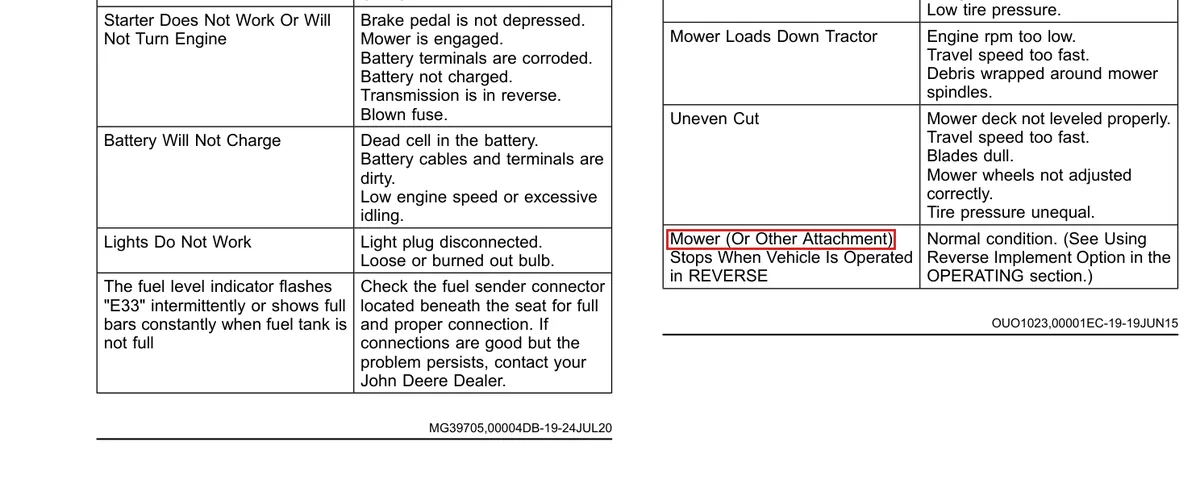
Rule out the interlocks first, because a deck stopped by design looks like a fault. Deere’s 100-series troubleshooting chart lists a mower that stops when the tractor is driven in reverse as a “normal condition.” The Reverse Implement Option (RIO) stops the attachment and the engine when you press the reverse pedal with the mower engaged, unless you first push and hold the RIO switch (Deere OMUC22642, pp. 24, 47). If the engine and mower stop mid-maneuver, Deere says to turn the attachment switch off, restart and engage again.
Cub Cadet uses a key position for the same job. With the key in Normal Mowing, the electric PTO clutch shuts off if you engage it with the drive pedal in reverse; the reverse push button on the ignition module lights a red indicator and allows reverse mowing until you turn the key back or leave the seat (769-10976, pp. 17, 18). On the same tractors the PTO drops out whenever you leave the seat with it on, brake set or not.
Seat switches cut the deck when weight comes off the seat. Toro’s TimeCutter MyRIDE test: start the engine, engage the blade-control switch and rise slightly; the engine should shut off within 1 second (Toro 3483-555A, pp. 4-4, 4-5). Deere runs the same check with the park brake locked (OMUC22642, p. 21). If the engine dies while you sit still, the switch or its plug is the suspect; Cub Cadet lists seat switch 925-05013 at $30.88. Toro says to replace damaged interlock switches, never bypass them. The PTO interlock also blocks cranking, which our guide to a Craftsman lawn mower that won’t start covers for the T100 series.
How do you test an electric PTO clutch?
Work from the battery toward the clutch and stop where a reading fails. All steps use a multimeter; only the voltage check runs the engine, so keep the leads clear of the pulley and belt.
- Battery at rest: 12.4 V or more. Toro says recharge below 12.4 V and expects 12.6 V from a full battery after 24 hours (Toro 3479-424, p. 50). Charging steps are in our guide on how to charge a lawn mower battery.
- Fuse: pull it and look. The Toro TimeCutter 42 has a 25 A main fuse and a 15 A charge-circuit fuse under the seat (p. 37); Deere’s 100 series keeps its fuse block under the left side panel (OMUC22642, p. 15).
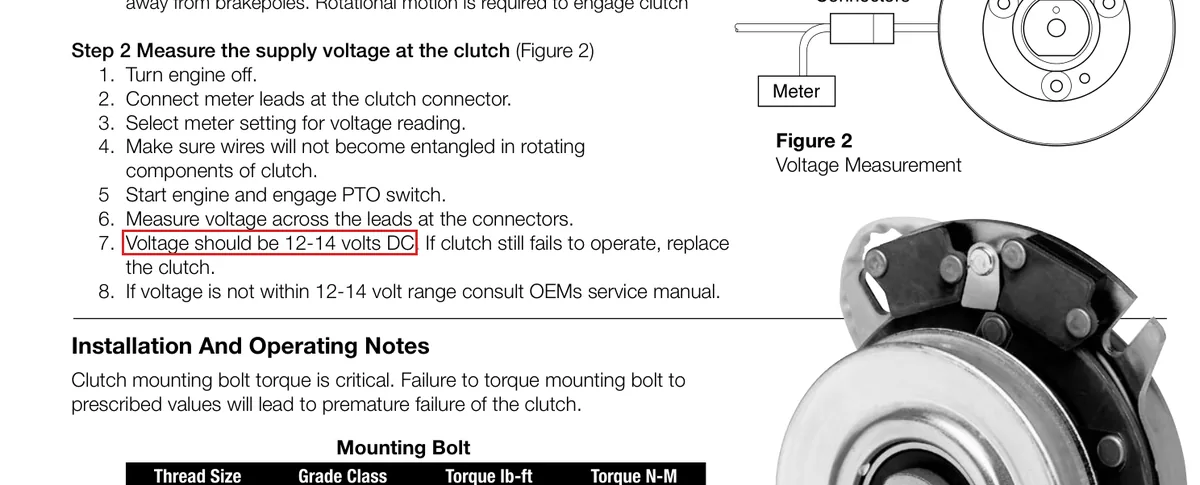
- Voltage at the clutch: engine running, PTO switch on, meter across the clutch connector. Warner wants 12 to 14 V DC (Warner P-1177-2-WE, p. 1); Ogura’s checklist says 12 V minimum. Under that, the fault is the battery, charging system, connector, harness or PTO switch.
- Coil resistance: engine and PTO off, connector apart, meter on ohms across the clutch leads, clutch near 70°F. Compare with your model in the spec table. Ogura says the reading should hold steady as you flex the leads; a jump means a broken lead wire (Ogura Clutch Checklist, p. 1).
- Current draw: meter on its 10 A scale, in series between the clutch terminal and the harness wire, PTO on. Warner’s bearing-mounted clutch should pull 4.0 A or more and the GT-300 6 A or more; less means the problem is upstream: battery, relay or switch (Warner P-1759-WE, p. 3).
- Air gap: engine off, feeler gauge through the 3 windows in the brake plate or shroud, never over a rivet joint (next section).
If resistance, current and gap all pass, Warner’s guide says the clutch is within factory specifications and is not the source of the problem (Warner P-1097-6, p. 5). Go back to the belt, idler and spindles.
Do not condemn a MagStop on the bench. Warner says that with 12 V applied on a bench, its armature may not pull away from the brake poles, because rotation is needed to engage it (P-1177-2-WE, p. 1). Ogura’s GT series is the opposite: if resistance and gap are in spec, 12 V on the bench should give a click (Ogura checklist, p. 2).
Battery age matters here, because a clutch that grabs on a fresh charge and fails after 20 minutes of mowing can be a weak battery or charging system, which both makers list first. How long a riding mower battery usually lasts, and how to load-test one, is in our guide on how long lawn mower batteries last.
What should a PTO clutch read in ohms?
Between about 1.6 and 3.4 ohms, depending on the model, and the band for any one model is narrow. Read the model off the clutch label, then compare.
| Maker | Clutch model or size | Coil resistance (ohms, about 70°F) | Current draw at 12 V | Air gap | Source |
|---|---|---|---|---|---|
| Warner Electric | Bearing-mounted garden tractor clutch (VX series) | 2.40 to 2.90 | 4.0 A or more | 0.005 to 0.023 in.; reset at 0.012 in. | P-1097-6, pp. 4 to 7 |
| Warner Electric | GT-300 | 1.82 to 2.03 | 6 A or more | 0.005 to 0.025 in.; set at 0.015 in. | P-1759-WE, pp. 2, 3 |
| Warner Electric | MagStop TG-105 (105 lb-ft) | 2.75 to 3.36 | Not given; 12 to 14 V at clutch | Not adjustable; replace over 0.125 in. | P-1177-2-WE, pp. 1, 2 |
| Warner Electric | MagStop TG-125 (125 lb-ft) | 2.56 to 3.12 | Not given; 12 to 14 V at clutch | Not adjustable; replace over 0.125 in. | P-1177-2-WE |
| Warner Electric | MagStop CMS-175 (175 lb-ft) | 2.32 to 2.84 | Not given; 12 to 14 V at clutch | Not adjustable; replace over 0.125 in. | P-1177-2-WE |
| Warner Electric | MagStop CMS-200 (200 lb-ft) | 1.66 to 2.02 | Not given; 12 to 14 V at clutch | Not adjustable; replace over 0.125 in. | P-1177-2-WE |
| Warner Electric | MagStop CMS-225 (225 lb-ft) | 1.67 to 2.05 | Not given; 12 to 14 V at clutch | Not adjustable; replace over 0.125 in. | P-1177-2-WE |
| Warner Electric | MagStop CMS-250 (250 lb-ft) | 1.63 to 1.99 | Not given; 12 to 14 V at clutch | Not adjustable; replace over 0.125 in. | P-1177-2-WE |
| Ogura | GT1, GT1A | 2.88 (plus or minus 5 percent) | Not given; 12 V minimum at clutch | 0.012 to 0.024 in. (brake shroud, 3 nuts) | Ogura Clutch Checklist |
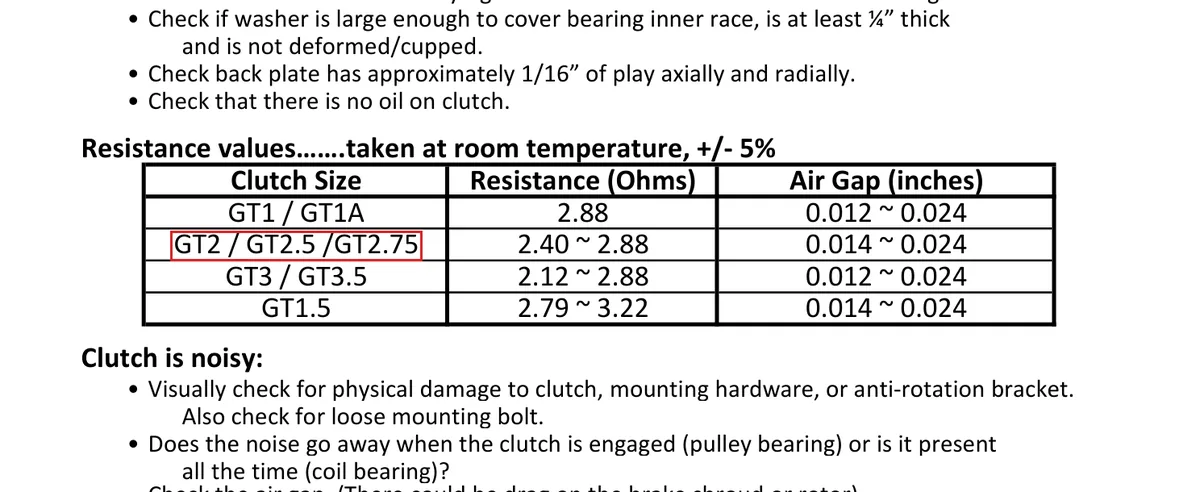
| Ogura | GT2, GT2.5, GT2.75 | 2.40 to 2.88 | Not given; 12 V minimum at clutch | 0.014 to 0.024 in.; GT2.75 brake plate not adjustable | Ogura Clutch Checklist |
| Ogura | GT3, GT3.5 | 2.12 to 2.88 | Not given; 12 V minimum at clutch | 0.012 to 0.024 in. (brake shroud, 3 nuts) | Ogura Clutch Checklist |
| Ogura | GT1.5 | 2.79 to 3.22 | Not given; 12 V minimum at clutch | 0.014 to 0.024 in.; brake plate not adjustable, flip plates | Ogura Clutch Checklist |
Two cautions. Resistance rises and current falls as the coil warms, so Warner’s values are taken at room temperature (P-1097-6, p. 5); test a cool clutch. And Ogura’s own troubleshooting web page says a coil should read “close to 3 to 4 ohms” (Ogura, Troubleshooting Electromagnetic Clutches and Brakes), while its mower clutch checklist gives 2.12 to 3.22 by size. For a GT-series mower clutch, use the checklist range: a GT3 at 2.5 ohms is in spec, not shorted.
Ohm’s law turns these into the current a healthy coil should draw: volts divided by ohms. A GT-300 at its 1.925-ohm midpoint draws 6.2 A at 12 V, which is why Warner sets its pass line at 6 A. Enter the voltage you measured at the clutch connector and pick your clutch; a current reading well under the result points to wiring or the switch, not the coil.
- Current a healthy coil should draw
- 6.2
Default: 12 V on a Warner GT-300 at 1.925 ohms = 6.2 A; Warner's pass line is 6 A or more. Warner's bearing-mounted clutch at 12 V and 2.65 ohms = 4.5 A, against a 4.0 A pass line. Current = volts divided by coil ohms (Ohm's law); a warm coil reads higher ohms and draws less.
When can you adjust the air gap, and when do you replace it?
Only some clutches adjust. On Warner’s bearing-mounted clutch the factory gap is 0.005 to 0.023 in.; to reset, put a 0.012 in. feeler gauge in each of the 3 windows, tighten the 3 nuts evenly until the gauges feel snug, remove them and check that the rotor turns freely (P-1097-6, pp. 5 to 7). The GT-300 is set with 0.015 in. shims, brake screws at 140 in-lb, and anything from 0.005 to 0.025 in. is acceptable (P-1759-WE, p. 2).
Ogura’s brake-shroud models (GT1, GT2.5, GT3.5) set at 0.012 to 0.024 in. through 3 nuts; if the rotor drags afterward, back each nut off 1/4 turn. Its brake-plate GT1.5 and GT2.75 cannot be adjusted: once wear stops engagement at 12 V, the plates can be flipped for more life (Ogura checklist, p. 2). Warner’s MagStop sheet gives no adjustment; a gap over 0.125 in. means the end of usable life.
A new or re-gapped clutch needs burnishing. Warner’s bearing-mounted procedure, deck attached: 5 engagements at 50 percent throttle, 10 seconds on and 10 off, then 5 more at 75 percent (P-1097-6, p. 5). The GT-300 gets 12 cycles at 25 percent, 5 at 50 percent and 5 at full throttle (P-1759-WE, p. 3). On engagement speed the documents differ: Warner’s MagStop sheet says engage below full rpm to extend clutch life, while Cub Cadet and Toro say set the throttle to fast first. Cub Cadet adds: never engage with the deck lowered in grass, which wears the belt and PTO clutch (769-10976, p. 20). Follow your tractor’s manual.
Lever-engaged deck: why won’t the blades turn?
On a manual PTO, the handle only tightens the belt, so a lever that moves freely over a slack belt points at the cable or idler. Cub Cadet’s manual-PTO decks hold the PTO cable to a deck bracket with a bow pin (769-10976, p. 27); with the pin out, the handle moves and the idler does not. Deere’s chart blames a slipping deck belt on debris in the sheaves, a worn belt or wrong tension, and a mower that loads down the tractor on debris wrapped around the spindles (OMUC22642, p. 47).
Toro’s MyRIDE chart for “the blades do not rotate” lists a worn, loose or broken belt, a belt off its pulley, and a faulty PTO switch or clutch, for which it sends owners to a dealer (3483-555A, p. 7-4). With the engine off, key out and belt removed, a blade that will not turn by hand points to a seized spindle, which Warner lists as a cause of clutch slip. A dull blade that bogs the deck is a separate job, covered in how to sharpen a lawn mower blade.
Push mower blade won’t engage
Most push mowers bolt the blade to the crankshaft, so there is nothing to engage. Mowers with a blade brake clutch, such as Honda’s HRX217 with its blade control lever, run the engine with the blade stopped. Honda says to hold the yellow button and push the lever forward in one quick, complete motion, which helps prevent stalling and extends the life of the blade control mechanism (Honda HRX217 owner’s manual, p. 8). Its schedule checks blade control operation before each use and every 100 hours or year, and adjusts the blade control cable at the first 25 hours and every 100 hours or year (p. 10).
What do the parts cost?
Cub Cadet’s list prices show why the tests run cheapest first: the cheapest PTO switch costs under a tenth of the $449.91 clutch, and a seat switch less.
| Part | Cub Cadet part no. | MSRP, Nov. 26, 2026 | Source |
|---|---|---|---|
| Electric PTO clutch | 917-04163A | $449.91 | Cub Cadet part page |
| PTO switch assembly | 925-04146A | $42.60 | Cub Cadet part page |
| PTO switch, yellow knob | 925-04175A | $47.66 | Cub Cadet part page |
| PTO switch, black knob | 925-1716A | $74.90 | Cub Cadet part page |
| PTO engagement switch | 925-3256A | $77.92 | Cub Cadet part page |
| Seat switch | 925-05013 | $30.88 | Cub Cadet part page |
| 46 in. deck belt, electric PTO | 954-05087A | $79.28 | Cub Cadet part page |
Warner warrants its GT-300 against defects for 1 year from purchase, and excludes damage from improper installation (P-1759-WE, p. 4); keep the receipt. What shops charge per hour to fit a clutch or belt is in our lawn mower repair cost survey.
How we compiled this
On Nov. 26, 2026 we read 11 maker documents: 4 Warner Electric and Ogura clutch service sheets, the Ogura troubleshooting web page, operator’s manuals for Deere’s 100 series, Toro’s TimeCutter 42 and TimeCutter MyRIDE, Cub Cadet’s XT1 and XT2 and Honda’s HRX217, plus 7 Cub Cadet part pages for list prices. We did not test any mower or clutch. Every ohm, amp, gap and voltage is as the maker prints it, with the page cited; the calculator’s current is Ohm’s law applied to the midpoint of each printed range.
Frequently asked questions
What would cause the PTO clutch not to engage?
Warner’s checklist lists low voltage (a weak battery, charging fault, bad wiring or PTO switch), zero voltage (blown fuse, broken lead, open coil, faulty switch) and an air gap grown too large from wear (Warner P-1097-6, p. 3). Check them in that order.
Why does my lawn mower run but the blades won’t engage?
With the engine running, either no power reaches the clutch or the clutch turns and the deck belt does not. Listen for a click when you pull the switch: no click points to the fuse, switch, wiring or seat interlock; a click points to the belt, gap or spindles.
When I engage the blades on my riding mower, it dies. Why?
Most often an interlock: on Deere 100-series tractors, pressing the reverse pedal with the mower engaged stops the engine unless the RIO switch is held, which Deere calls normal (OMUC22642, p. 47), and a seat switch that loses contact shuts it off within about 1 second (Toro 3483-555A, p. 4-5). Engaging at full load in tall grass can also stall it.
How many ohms should a PTO clutch have?
It depends on the model: 1.82 to 2.03 for a Warner GT-300, 2.40 to 2.90 for Warner’s bearing-mounted garden tractor clutch, and 2.12 to 3.22 across Ogura’s GT sizes. An open (infinite) reading means a broken coil or lead.
Should my PTO clutch spin freely?
With no power, the rotor should turn freely and the pulley should drag slightly against the brake. Warner says the rotor must turn freely after gapping (P-1097-6, p. 6), and Ogura says there should be some resistance turning the pulley by hand when the clutch is not powered (checklist, p. 2).
Sources
- Warner Electric, Garden Tractor Clutch Troubleshooting and Installation Guide, P-1097-6 (819-0458), distributor copy, July 2005; pp. 3 to 7. Accessed November 2026.
- Warner Electric, Airgap Adjustment and Electrical Specifications for Warner GT-300, P-1759-WE (819-0543), Oct. 2020; pp. 2 to 4. Accessed November 2026.
- Warner Electric, MagStop Clutch/Brake, P-1177-2-WE (819-0459), hosted by Ariens, Jan. 2022; pp. 1, 2. Accessed November 2026.
- Ogura Industrial Corp., Clutch Checklist, hosted by Ariens, pp. 1, 2. Accessed November 2026.
- Ogura Industrial Corp., Troubleshooting Electromagnetic Clutches and Brakes, web page. Accessed November 2026.
- Deere & Company, 100 Series Lawn Tractors operator’s manual, OMUC22642, pp. 15, 21, 24, 47. Accessed November 2026.
- The Toro Company, TimeCutter 42in riding mower operator’s manual, 3479-424, pp. 37, 50, 52. Accessed November 2026.
- The Toro Company, TimeCutter Max or MyRIDE 50in or 54in operator’s manual, 3483-555A, pp. 4-4, 4-5, 4-13, 7-4. Accessed November 2026.
- Cub Cadet, XT1 and XT2 Enduro Series tractor operator’s manual, Form 769-10976, July 17, 2015; pp. 15 to 20, 27. Accessed November 2026.
- American Honda Motor Co., HRX217 owner’s manual, pp. 8, 10. Accessed November 2026.
- Cub Cadet, Part pages: 917-04163A, 925-04146A, 925-04175A, 925-1716A, 925-3256A, 925-05013, 954-05087A, prices as listed Nov. 26, 2026. Accessed November 2026.