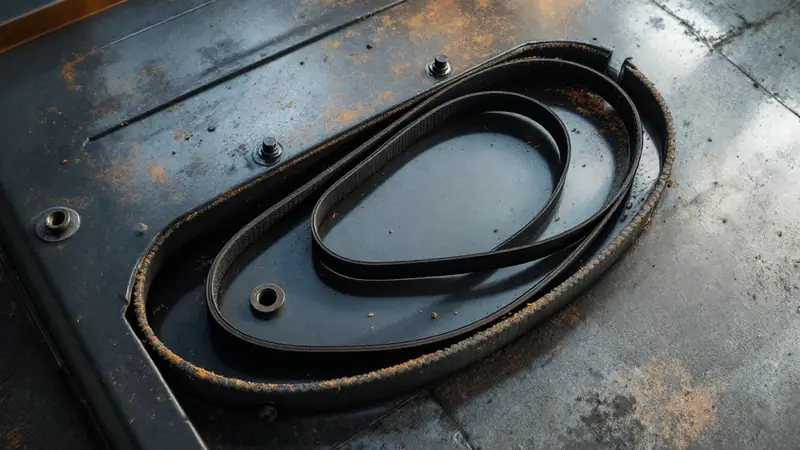
A lawn mower belt keeps coming off when something lets it climb out of its pulley grooves: a belt guide bent away from the belt, a wobbling idler or spindle pulley, a weak idler spring, or the wrong belt. Check them in that order.
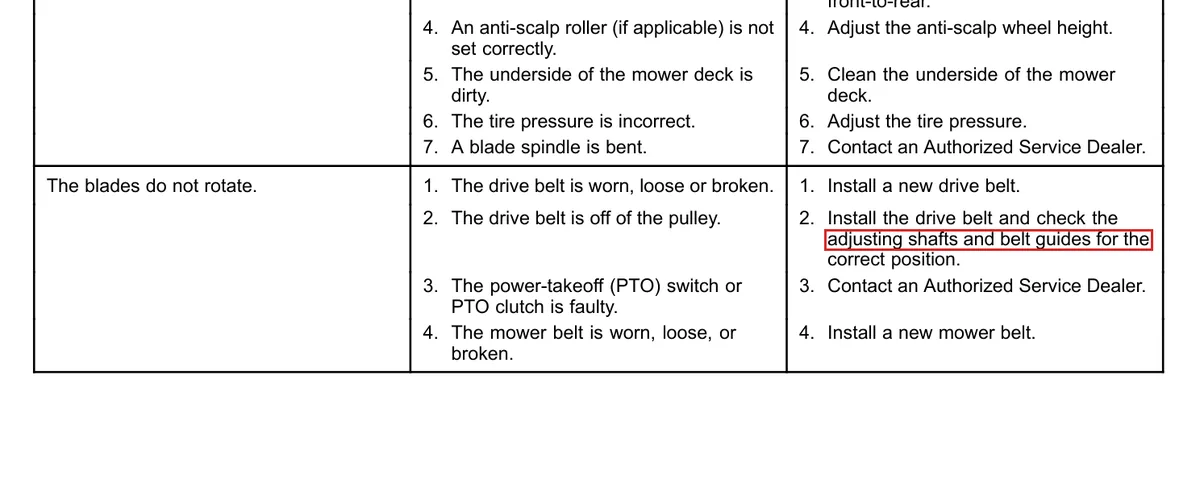
If your lawn mower belt keeps coming off, a new belt alone rarely fixes it, because something is steering the old one out of the grooves. Toro’s TimeCutter troubleshooting chart pairs a belt found off its pulley with one instruction: refit it, then check the adjusting shafts and belt guides for the correct position (Form 3479-424, p. 52). Deere’s 100-series chart adds debris in the sheaves, a worn belt and incorrect tension for a slipping belt, and damaged or misaligned sheaves for a deck that shakes (OMUC22642, p. 47).
The fix depends on a number most guides leave out: how close the guide sits to the belt. Toro wants 3/4 in between the guide and the engaged belt on its mid-size deck; Deere wants about 1/16 in on its JS walk-behinds. The second number that matters is belt length, which varies by more than 2 in between two Deere 42 in decks. Both sets of figures are in the tables below, with 15 causes tied to the manual page that names them. If the tractor will not drive at all, the traction side is covered in our guide to why a riding mower won’t move.
Why does my mower belt keep coming off? 15 causes from the manuals
Swipe the table sideways to see every column.
| Belt | Symptom | Likely cause | Check (with the maker’s number) | Fix | Source |
|---|---|---|---|---|---|
| Deck | Belt rides out of the groove at the engine pulley, often as the blades are switched off | Belt guide or keeper bent, loose or set too far from the belt | Measure the gap with a drill bit or feeler: Toro’s mid-size deck wants 3/4 in to the engaged belt; Deere’s JS walk-behinds about 1/16 in | Reset the guide to the manual’s gap and tighten its nut; replace a bent keeper | Toro 3459-808 p. 12; Toro 3479-424 p. 52 |
| Deck | Belt came off the first time the deck was mowed after removal or a belt change | Belt not routed through both engine-sheave guides, or not seated in every groove | Compare the routing with the deck decal; Deere S100: belt must pass through both belt guides at the engine sheave | Reroute with the idler released (Deere: 15 mm wrench on the idler nut) | Deere OMUC22642 pp. 35, 37, 38 |
| Deck | Blades stop, belt found off its pulley | Belt off the pulley because a guide or adjusting shaft has moved | Toro TimeCutter chart: after refitting, check the adjusting shafts and belt guides for the correct position | Refit the belt, then reset the guides | Toro 3479-424 p. 52 |
| Deck | A pulley rocks, grinds, runs hot or will not spin freely with the belt off | Worn idler bearing or spindle bearing (frozen idler or mandrel) | Belt off, spin each pulley by hand and rock its rim: any play, roughness or tilt fails | Replace the idler pulley or the spindle (mandrel) | Husqvarna TS 242 manual p. 27 |
| Deck | Deck vibrates and the belt walks off | Loose engine, idler or blade pulley; sheaves out of alignment | Check each sheave nut; Deere 42, 48 and 54 in decks: 47 N·m (35 lb-ft) | Tighten to spec; a damaged engine pulley or bent spindle goes to a dealer | Toro 3479-424 p. 52; Deere OMUC22642 pp. 38, 47 |
| Deck | Belt slaps, squeals or slips under load | Idler spring stretched, broken or unhooked; belt worn | Spring hooked on the deck hook with closed coils; Toro mid-size deck: 10 to 15 lb pull at 1/2 in deflection | Replace the spring or the belt; Toro uses spring tool 92-5771 | Toro 3459-808 p. 11; Toro 3479-424 p. 39 |
| Deck | New belt comes off, rides high or deep in the grooves | Wrong belt: aftermarket length off spec, or the wrong version for the deck | Match the part number, not the deck width: Cub Cadet lists 954-05022A for manual-PTO and 954-05087A for electric-PTO 46 in decks | Buy by model and serial number | Cub Cadet 769-10976 pp. 28, 31 |
| Deck | Belt glazed, cracked, frayed or burned | Worn or stretched belt | Inspect every 25 hours (Toro TimeCutter) or after 100 hours (Husqvarna TS 242) | Replace; Husqvarna says its belts are not adjustable | Toro 3479-424 p. 39; Husqvarna TS 242 p. 16 |
| Deck | Belt thrown when the blades are engaged in tall or wet grass | Engaging under load; low engine speed | Was the deck lowered in grass, or the throttle below full, at engagement? | Raise the deck or move to bare ground, full throttle, then engage | Cub Cadet 769-10976 p. 20; Deere OMUC22642 p. 47 |
| Deck | Grass and dirt packed under the belt shields | Debris in the sheaves or wrapped around spindles | Remove the belt shields and look | Clean the top of the deck and every sheave | Deere OMUC22642 pp. 38, 47 |
| Deck | Belt trouble began after hitting a stump, curb or rock | Bent blade spindle, bent deck hanger or deck out of level | Blade tip heights differ by more than 1/8 in after a new blade; deck front not 1/8 to 1/4 in lower than rear (Deere S100) | Level the deck; a bent spindle goes to a dealer | Toro 3479-424 p. 42; Deere OMUC22642 p. 19 |
| Traction drive | Tractor stops moving; drive belt off at the transmission pulley | Belt outside a belt keeper; debris restricting the clutch pedal shaft | Belt inside the keeper at the transmission input pulley; steering plate clear of debris | Reroute through every guide and keeper; clean the steering plate | Husqvarna TS 242 pp. 17, 22 |
| Self-propelled | Drive belt jumps off the transmission or engine pulley | Belt guide bent, often by prying the belt off without removing the guide | Guide straight and close: Deere JS26 to JS46 want about 1/16 in from the belt | Straighten or replace the guide; always remove it before taking the belt off | Toro 492-9333 p. 3-4; Deere OMGX24127 p. 22 |
| Self-propelled | Noisy drive, fast belt wear, belt jumps | Self-propel pulley loose on the crankshaft (broken keyway boss) | Pulley slides up and down on the crankshaft | Replace the pulley; align its bumps with the slots before torquing the blade nut | Toro 492-9333 p. 8-18 |
| Self-propelled | Slow drive, belt loose and slipping | Belt stretched; drive cable out of adjustment; debris in the belt area | Top speed has dropped since new | Deere JS: turn the thumbwheel counterclockwise to add tension; Toro HDX: adjust the cable, clean the belt area, replace the belt | Deere OMGX24127 p. 20; Toro 22225 manual |
Start with the guides: they cost nothing to reset, and a deck that is dropped, removed or knocked against a stump can bend one. Husqvarna’s TS 242 manual tells owners to confirm at setup that both belts are routed around the pulleys and inside all belt keepers, before the first mow (Husqvarna 114 14 43-28, p. 6). A belt that leaves at the moment you switch the blades off points to the engine-pulley guides, which exist to hold a slack belt in place.
Work through it in this order
1Did it start after the deck was removed, refitted or a new belt was installed?
YesRe-route by the deck decal: belt in every groove and through both engine-sheave guides (Deere OMUC22642 p. 37).
NoGo to the next question
2Is a belt guide or keeper bent, loose or set away from the belt?
YesReset it to the manual's gap: Toro mid-size deck 3/4 in to the engaged belt; Deere JS walk-behinds about 1/16 in.
NoGo to the next question
3With the belt off, does any pulley wobble, grind, drag or sit loose on its shaft?
YesReplace the idler or spindle; tighten sheave nuts (Deere 35 lb-ft) (Husqvarna p. 27; Toro p. 52).
NoGo to the next question
4Is the idler spring stretched, broken or unhooked?
YesReplace the spring; on non-adjustable decks a slipping belt is replaced, not tightened (Husqvarna p. 16).
NoGo to the next question
5Is the belt worn, or not the part number in your parts list?
YesFit the listed OEM part; deck width alone does not identify the belt (Cub Cadet p. 31).
NoGo to the next question
6Is grass packed under the covers or wrapped around a spindle?
YesClean the deck top and every sheave (Deere OMUC22642 p. 47).
NoGo to the next question
7Did it start after hitting something, or do blade tips differ by more than 1/8 in?
YesLevel the deck; a bent spindle or hanger goes to a dealer (Toro p. 42).
NoEngage the blades only at full throttle with the deck raised or on bare ground (Cub Cadet p. 20); if it still throws the belt, have a dealer check deck and spindle alignment.
Source: Toro 3479-424 and 3459-808, Deere OMUC22642 and OMM143122, Cub Cadet 769-10976, Husqvarna TS 242
- Park on level ground, disengage the blades, set the brake, remove the key. Put the deck lift lever in its lowest position so the idler is in reach (Deere OMUC22642, p. 35).
- Remove the belt shields or pulley covers. On Toro’s TimeCutter 42 you loosen the cover screws first (3479-424, p. 39). Clear packed grass from every sheave.
- Look at the belt in place: is it in the groove of every sheave and inside every guide? Note where it sits when it comes off, since that pulley is the suspect.
- Release the idler and lift the belt off. Deere turns the idler nut clockwise with a 15 mm wrench; Toro lifts the spring with tool 92-5771; Cub Cadet pivots the idler with a 3/8 in ratchet in a square hole (769-10976, p. 27).
- Spin each pulley by hand and rock its rim up and down. A pulley that tilts, grinds or drags gets replaced before the belt goes back on.
- Check the idler spring for stretched coils or a broken hook, and the idler arm for a bent pivot.
- Read the part number on the belt and compare it with the parts list for your model and serial number.
- Refit, set each guide to the manual’s gap, tighten sheave nuts (Deere: 35 lb-ft), and run the blades at full throttle on bare ground before mowing.
Belt guides and keepers: the gap your manual specifies
Guides and keepers are steel fingers or bent rods mounted a short distance from the belt. They do nothing while the belt is tight; their job is to hold a slack belt in its groove when the idler releases. Set too close, they rub the belt; set too far, the belt walks out. Deere’s JS manual also says not to overtighten the guide screws (OMGX24127, p. 22). The makers do not use one number, so a universal 1/8 in rule is wrong for at least 2 machines in this table.
| Machine (manual) | Guide | Specified gap or rule | Source |
|---|---|---|---|
| Deere JS26, JS36, JS46 walk-behind | Engine pulley guides on the drive belt | About 1/16 in from the belt (metric figure printed as 0.4 mm) | Deere OMGX24127, p. 22 |
| Toro 32, 36 and 48 in mid-size deck | Guide under the engine frame | 19 mm (3/4 in) from the engaged belt; the disengaged belt must not drag or fall off | Toro 3459-808, p. 12 |
| Deere S100 lawn tractor, 42 in deck | Two guides at the engine drive sheave | No figure: belt routed through both guides | Deere OMUC22642, p. 37 |
| Deere Z315E to Z330R ZTrak | Guide on the tension sheave | No figure: guide indexed as shown, sheave nut 47 N·m (35 lb-ft) | Deere OMUC31576, p. 41 |
| Husqvarna TS 242 lawn tractor | Belt guides and keepers, deck and drive | No figure: belt inside all guides and keepers | Husqvarna 114 14 43-28, pp. 6, 22 |
| Toro and Lawn-Boy walk power mowers | Transmission and engine pulley guides | No figure: guides force the belt off the engine pulley when the drive is released | Toro 492-9333, pp. 3-4, 5-3 |
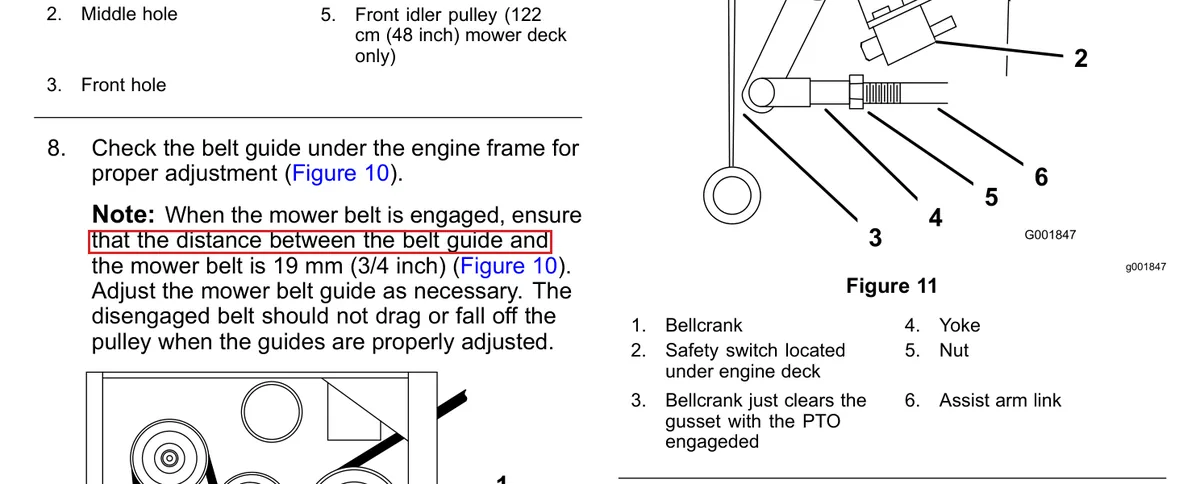
On decks without a printed gap, the working check is Toro’s: with the blades disengaged, the belt should neither drag on the guide nor fall off the pulley (Form 3459-808, p. 12). Toro also says that when you move its mid-size deck’s rear idler to a new hole to take up slack, the belt guide has to move with it. So a belt that falls off right after a tension adjustment points to a guide left in its old position.
Is it the right belt? Same deck width, different lengths
Deck width does not identify a belt. Deere’s S100 42 in deck takes GX20072 at 103.7 in, while its S240 42 in Accel Deep deck takes GX25232 at 101.3 in, a 2.4 in difference (Deere S100 reminder sheet; S240 parts guide). On 46 in decks, Troy-Bilt’s 954-04219 is 103.24 in and Cub Cadet’s 954-05022A is 108 in. A belt longer than listed leaves the spring-loaded idler less travel to take up slack, and Toro’s rule is that the belt must be tight enough not to slip under heavy load (Form 3459-808, p. 11).
| Part number | Fits (maker’s listing) | Length | Top width | List price, Nov. 21, 2026 | Source |
|---|---|---|---|---|---|
| Deere GX20072 | S100, 42 in deck | 103.7 in (2,635 mm) | 1/2 in (12.7 mm) | Not shown without a dealer | Deere parts listing; S100 42 in reminder sheet, May 2021 |
| Deere GX25232 | S240, 42 in Accel Deep deck | 101.3 in (2,573 mm) | 1/2 in (12.7 mm) | Not shown without a dealer | Deere parts listing; S240 parts guide, May 2023 |
| Cub Cadet 954-05021 | XT1/XT2 LT42, Craftsman T8000, Troy-Bilt Super Bronco 42 | 99.75 in | 1/2 in | $43.99 | Cub Cadet part page |
| Troy-Bilt 954-04219 | Two-blade 46 in decks, 2009 on | 103.24 in | 1/2 in | $51.29 | Troy-Bilt part page |
| Cub Cadet 954-05022A | 46 in decks, 2015 on, manual PTO | 108 in | 1/2 in | $55.99 | Cub Cadet part page |
| Cub Cadet 954-05087A | 46 in decks, electric PTO | 108 in | 1/2 in | $79.28 | Cub Cadet part page |
| Deere GX21395 | 54 in decks (D170, LA175 and others) | 161.4 in (4,099.6 mm) | 0.66 in (16.8 mm) | Not shown without a dealer | Deere parts listing |
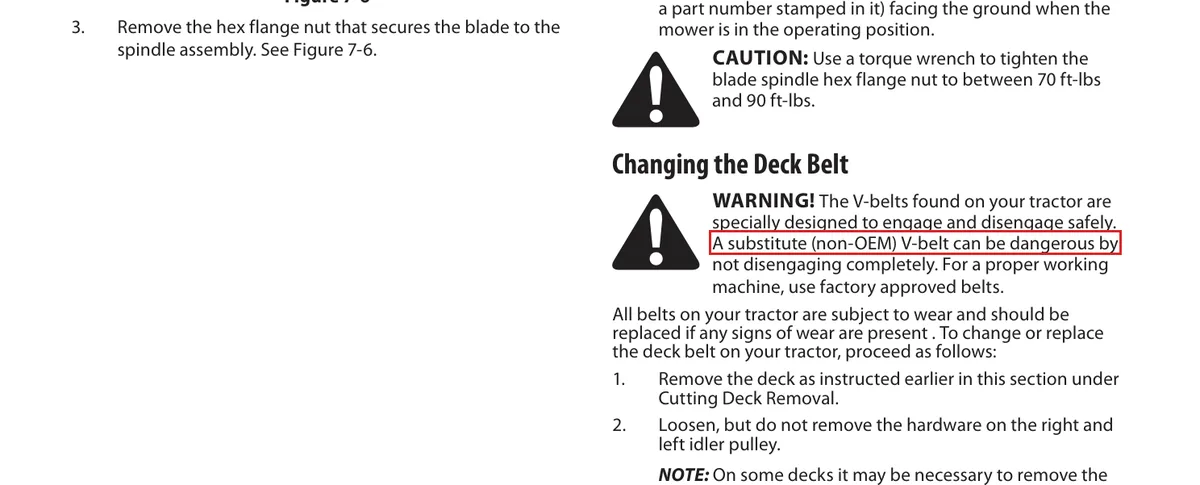
Cub Cadet lists two belts for its 46 in deck, both 108 in long: 954-05022A for a manual PTO and 954-05087A for an electric PTO (Form 769-10976, p. 31; Cub Cadet, $79.28 list). Length alone is not a safe match, and the same manual warns that a substitute non-OEM V-belt can be dangerous because it may not disengage completely (p. 28). For what a shop charges to fit one, our lawn mower repair cost survey puts an installed riding mower deck belt at $81 to $229.
Pulleys, idler spring and deck level
On the Toro TimeCutter, Cub Cadet XT1 and Husqvarna TS 242 a spring-loaded idler sets deck belt tension, and Husqvarna says its belts are not adjustable and should be replaced when they slip from wear (TS 242 manual, p. 16). A loose belt on these decks means a stretched belt, a tired spring or a worn idler. Toro’s commercial mid-size deck is the exception, with a turnbuckle set to 10 to 15 lb of pull at 1/2 in of deflection (Form 3459-808, p. 11).
A worn bearing lets a pulley tilt, and a tilted pulley feeds the belt off one edge. Husqvarna’s chart lists a frozen idler pulley and a frozen blade mandrel as causes of blades that will not turn (p. 27). Toro’s chart lists a loose engine, idler or blade pulley under abnormal vibration and sends a damaged engine pulley or a bent spindle to a dealer (3479-424, p. 52).
A bent spindle often shows first as a blade problem. Deere and Toro both say to replace a blade whose two tips differ by more than 1/8 in measured to flat ground, and Toro adds that if a new blade still varies by more than that, the blade spindle could be bent (Toro 3479-424, p. 42). Deere also sets the S100 deck 1/8 to 1/4 in lower at the front than the rear (OMUC22642, p. 19); the blade and deck checks are covered in how to sharpen a lawn mower blade and our guide on deck pitch figures from 3 manuals.
Load matters too. Cub Cadet says not to engage the deck while it is lowered in grass, because premature wear and possible failure of the belt and PTO clutch will result (Form 769-10976, p. 20). Deere lists low engine rpm and debris wrapped around the spindles for a mower that loads the tractor down; for tall or wet grass, our page on mowing wet grass gives the two-pass method Scag prints. A belt slipping hard enough to smell of burning rubber is one of the non-engine causes in our guide to a lawn mower smoking.
If the belt stays on and tight but the blades never start when you pull the switch, the fault is on the electric side; our guide to why lawn mower blades won’t engage lists the coil resistance and air gap for 12 Warner and Ogura PTO clutch sizes.
Self-propelled mower belt keeps coming off
A walk-behind’s drive belt runs from a small pulley on the crankshaft to a pulley on the transmission. On Toro’s three-speed walk-behind transmission, squeezing the control bar tilts the transmission back to tighten the belt, and guides at the engine pulley and atop the transmission force the belt to loop off the engine pulley when you let go (Toro Walk Power Mower Drive Systems Service Manual, Form 492-9333, p. 5-3). The guide holds the belt in place every time you release the bar, so check it first.
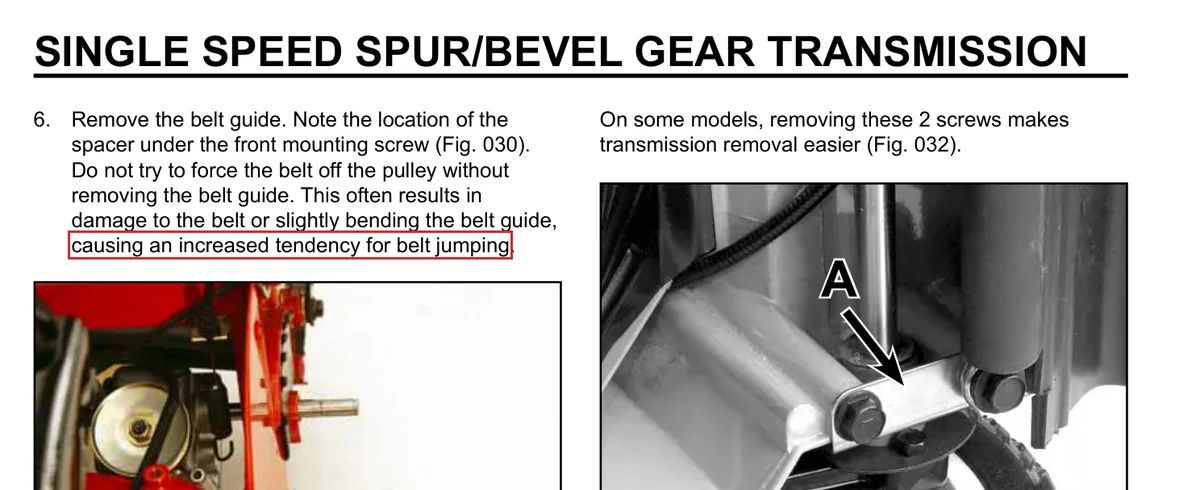
Toro’s service manual says not to force the belt off the pulley without removing the belt guide, because it often damages the belt or slightly bends the guide, causing an increased tendency for belt jumping (p. 3-4). It also says that if the crankshaft nut is tightened with the self-propel pulley’s bumps out of line with the slots, the pulley’s keyway boss breaks and the pulley slides on the crankshaft, causing noise, premature belt wear and belt jumping (p. 8-18).
Deere’s JS26, JS36 and JS46 manual sets the two engine-side guides about 1/16 in from the belt and says a drop in top speed from belt stretch is taken up at the handle thumbwheel, turned counterclockwise (OMGX24127, pp. 20, 22). Toro’s TurfMaster HDX chart adds debris in the belt area to a mower that will not self-propel (Model 22225 manual). Toro covers walk-mower belts for 90 days residential, so a second-season belt is a parts bill, as our self-propelled vs push mower guide notes.
If the belt stays on but the wheels still do not pull, the fault is usually cable slack, packed clippings or worn wheel pinions, and our checklist for a self-propelled mower that is not propelling gives the test for each.
How to put the belt back on a riding mower
- Engine off, key out, blades disengaged, deck at its lowest height (Toro TimeCutter: 1-1/2 in; Deere: lift lever at the lowest position).
- Remove the belt covers and clean the deck top and sheaves.
- Route the belt by the decal on the deck or the figure in the manual: Cub Cadet prints separate routing figures for its 42, 46 and 50/54 in decks (769-10976, p. 29).
- Release the idler (15 mm wrench on Deere, spring tool on Toro, 3/8 in ratchet on Cub Cadet) and slip the belt onto the last pulley, usually the engine or PTO pulley.
- On Cub Cadet’s manual-PTO decks, place the narrow V side of the belt into the PTO pulley and roll the pulley to the left until the belt is fully seated (p. 29).
- Refit the guides, the engine pulley keeper rod (Cub Cadet and Troy-Bilt) and the covers, and confirm the belt is in every groove.
- Engage the blades at full throttle on bare ground and watch the belt run before you mow.
If the belt rolls off again within the first 2 or 3 passes, go back to the flow above. A deck that keeps its belt but leaves uncut grass is a different fault, covered in lawn mower leaving uncut strips.
How we compiled this
On Nov. 21, 2026 we read 11 maker documents: operator’s manuals for Deere’s S100, Z300 ZTrak and JS walk-behinds, Toro’s TimeCutter 42, mid-size deck and TurfMaster HDX, Cub Cadet’s XT1 and Husqvarna’s TS 242, Toro’s walk power mower drive service manual and 2 Deere parts guides, plus 7 maker part pages for belt lengths and list prices. We did not test or measure any mower or belt; every gap, length and torque is as the maker prints it, with the page cited.
Frequently asked questions
Why does my belt keep falling off my riding lawn mower?
The usual causes are a bent or misplaced belt guide, a worn idler or spindle pulley, a weak idler spring and a belt that is not the listed part number. Toro’s chart says to check the adjusting shafts and belt guides whenever the belt is found off its pulley (3479-424, p. 52).
Why does my John Deere mower belt keep coming off?
Deere’s charts list debris in the sheaves, a worn belt, incorrect tension and damaged or misaligned sheaves (OMUC22642, p. 47). On the S100 the belt must run through both guides at the engine sheave (p. 37), and the deck sheave nuts are torqued to 35 lb-ft.
How do you adjust the belt tension on a riding lawn mower?
On most residential decks you do not: a spring-loaded idler sets it, and Husqvarna says its belts are not adjustable and should be replaced when they slip (TS 242, p. 16). Decks with a turnbuckle, such as Toro’s mid-size deck, are set to 10 to 15 lb at 1/2 in of deflection.
How do you put a belt back on a self-propelled lawn mower?
Remove the belt guide before working the belt on or off, as Toro’s service manual warns that prying past it bends the guide. Seat the belt on both pulleys, refit the guide (Deere JS: about 1/16 in from the belt) and adjust the drive cable.
Can I use an aftermarket mower deck belt?
Cub Cadet warns that a substitute non-OEM V-belt can be dangerous because it may not disengage completely (769-10976, p. 28). If you buy one, match the OEM part number and length exactly; two Deere 42 in deck belts differ by 2.4 in.
Sources
- The Toro Company, TimeCutter 42in riding mower operator’s manual, Form 3479-424 Rev A, pp. 39, 42, 52. Accessed November 2026.
- The Toro Company, 32, 36 and 48 in mid-size rear-discharge deck operator’s manual, Form 3459-808 Rev A, pp. 11, 12. Accessed November 2026.
- The Toro Company, Walk Power Mower Drive Systems Service Manual, Form 492-9333, pp. 3-4, 5-3, 8-18. Accessed November 2026.
- The Toro Company, 30in TurfMaster HDX walk-behind mower interactive manual, Model 22225, Troubleshooting. Accessed November 2026.
- Deere & Company, 100 Series Lawn Tractors operator’s manual, OMUC22642 Issue H0, pp. 19, 35, 37, 38, 47. Accessed November 2026.
- Deere & Company, MowMentum JS26, JS36, JS46 walk-behind mower operator’s manual, OMGX24127 L0, pp. 20, 22. Accessed November 2026.
- Deere & Company, Z315E to Z330R Residential ZTrak operator’s manual, OMUC31576 Issue G2, pp. 41, 50. Accessed November 2026.
- Deere & Company, S100 with 42 in deck maintenance reminder sheet, May 2021. Accessed November 2026.
- Deere & Company, S240 with 42 and 48 in Accel Deep deck replacement parts guide, May 2023. Accessed November 2026.
- Deere & Company, GX20072 mower drive flat belt part listing, read Nov. 21, 2026. Accessed November 2026.
- Deere & Company, GX25232 mower deck flat belt part listing, read Nov. 21, 2026. Accessed November 2026.
- Deere & Company, GX21395 mower deck drive flat belt part listing, read Nov. 21, 2026. Accessed November 2026.
- Cub Cadet, XT1 and XT2 Enduro Series tractor operator’s manual, Form 769-10976, pp. 20, 27, 28, 29, 31. Accessed November 2026.
- Cub Cadet, Riding mower 42-inch deck belt 954-05021, list price $43.99, Nov. 21, 2026. Accessed November 2026.
- Cub Cadet, Riding mower 46-inch deck belt 954-05022A, list price $55.99, Nov. 21, 2026. Accessed November 2026.
- Cub Cadet, Riding mower 46-inch deck belt 954-05087A, list price $79.28, Nov. 21, 2026. Accessed November 2026.
- Troy-Bilt, Riding mower 46-inch deck belt 954-04219, list price $51.29, Nov. 21, 2026. Accessed November 2026.
- Husqvarna, TS 242 lawn tractor operator’s manual, 114 14 43-28, pp. 6, 16, 17, 22, 27. Accessed November 2026.