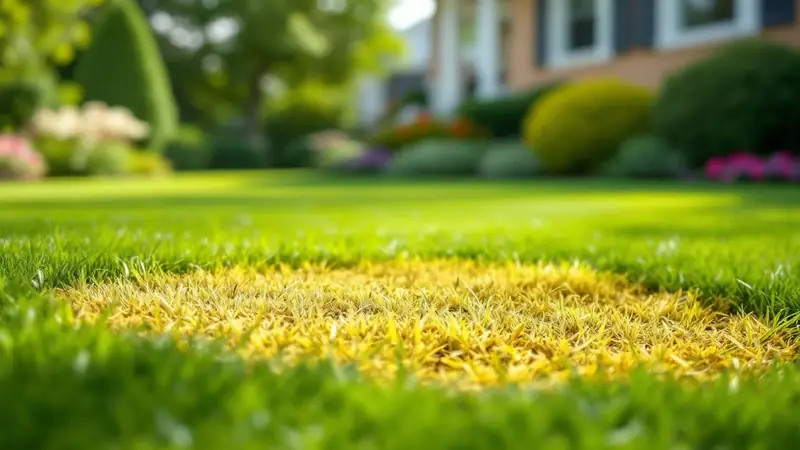
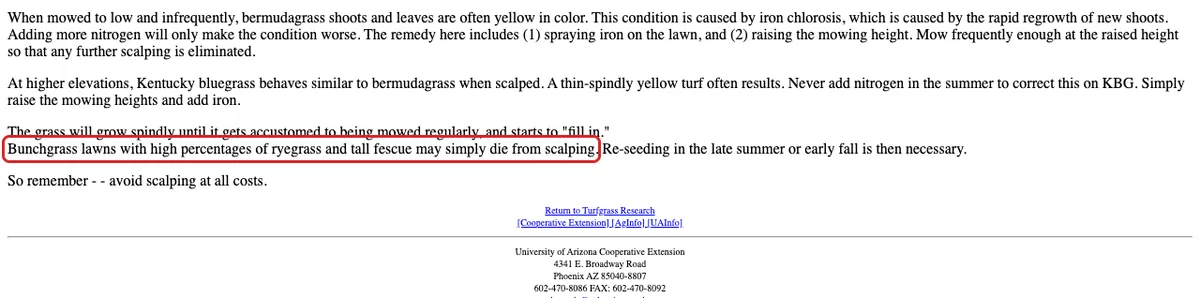
How to fix scalped lawn damage: raise the deck back to your grass’s normal height, keep the soil moist and skip extra nitrogen. Bermudagrass and Kentucky bluegrass regrow; tall fescue or ryegrass patches with dead crowns need reseeding in late summer or early fall.
Knowing how to fix scalped lawn damage starts with what the mower left behind. Bermudagrass keeps runners at the soil line and, in the words of University of Arizona turf specialist David Kopec, will “bounce back” quickly; tall fescue and perennial ryegrass are bunch grasses that “may simply die” (University of Arizona, July 2000). Below: 7 lawn grasses sorted by what they regrow from, plus two spring scalping trials and the deck specs from 3 mower manuals, none of which the top-ranking scalping guides print.
Scalping is the brown, stemmy look left when one mowing removes too much leaf: more than one-third, per Kansas State University, or more than 40 percent, per New Mexico State Guide H-505, which says it can expose stolons, crowns or bare soil. Heights by grass are in how to mow a lawn by grass type; dead or dormant tests are in how to revive dead grass.
Will scalped grass grow back? It depends on the grass
Regrowth comes from the crown, which Penn State describes as a white stem a fraction of an inch long sitting near the soil surface, and from stolons and rhizomes on spreading grasses (Penn State Extension). If crowns or runners survive, new leaves follow. If a bunch grass lost its crowns, nothing in that spot can regrow.
| Grass | Regrows from | Response to scalping (source wording) | Spring lowering before green-up? | After an accidental scalp |
|---|---|---|---|---|
| Kentucky bluegrass | Crowns; fills in after scalping | Thin, spindly, yellow turf that fills in once mowed regularly | No: keep 2 to 3 in (K-State) | Raise height, spray iron, no nitrogen in summer (Arizona) |
| Tall fescue | Crowns only (bunch grass) | “May simply die” in high-percentage fescue lawns | No: K-State says it performs best near 3 in | Check crowns; reseed bare spots in late summer or early fall (Arizona; K-State) |
| Perennial ryegrass | Crowns only (bunch grass) | Same as tall fescue | No: keep 2 to 3 in (K-State) | Same as tall fescue (Arizona) |
| Bermudagrass | Crowns, stolons and rhizomes | “Bounce back” quickly; new shoots often yellow from iron chlorosis | Yes: about 1 in just before green-up (Clemson HGIC 1216) | Raise height, iron for yellowing, no extra nitrogen (Arizona) |
| Zoysiagrass | Crowns, stolons and rhizomes | “Recovers slowly after damage” (K-State MF683) | With care: 1 to 1.5 in before green-up (Clemson HGIC 1217); UF says it “can be injurious” | Raise height and wait; expect the slowest warm-season recovery |
| St. Augustinegrass | Crowns and stolons; no rhizomes | Injury has “a more lasting impact” (Texas A&M EHT-144) | No: Clemson lowers it only to 2 to 2.5 in (HGIC 1218) | Raise to its normal height; test any lower cut on a small hidden area first |
| Centipedegrass | Crowns and surface stolons | “Does not recover from injury as quickly” as bermudagrass or zoysiagrass (Alabama Extension) | Light only: about 1 in before green-up (Clemson HGIC 1215) | Raise height; patch with centipede sod or plugs if runners do not close the gap |
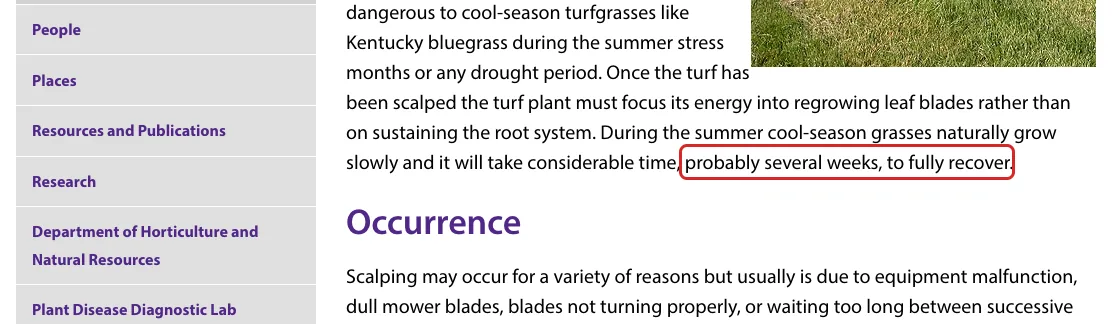
Season matters too. Kansas State says cool-season grass scalped in summer will take “probably several weeks” to fully recover (K-State). One top-ranking gardening site tells readers to reseed cool-season grass if no blades appear “in a few days”; on K-State’s timeline that is too early, so check the crowns before you buy seed.
How to fix a scalped lawn, step by step
- Read the pattern. Scalping everywhere means the deck is too low; scalping on humps, edges or one side of each pass points to the ground or the mower. The cause table in the next section matches 7 patterns to a fix.
- Raise the deck. Measure the real height on a flat garage floor from the floor to the blade’s cutting edge; K-State calls this the bench setting and notes that most homeowners do not know theirs (K-State). Reset it to your grass’s normal height from the table in our mowing height guide.
- Mow at the raised height before the grass passes 1.5 times that setting, the one-third rule in Arkansas FSA6023. Arizona says to mow often enough at the raised height that no further scalping happens. Intervals by season are in how often to mow a lawn.
- Water the root zone. Arkansas puts bermudagrass at 1 to 1.25 inches of water a week in summer, applied early in the morning so the soil is wet 4 to 6 inches deep (University of Arkansas).
- Hold the nitrogen; use iron for yellowing. Arizona says nitrogen makes the yellow regrowth on scalped bermudagrass worse and should never go on Kentucky bluegrass in summer for this (Arizona). For iron, Arizona’s rate is usually 2 to 4 oz of ferrous sulfate or chelated product per 1,000 sq ft in 1 to 3 gallons of water, per the label (Arizona, March 1998).
- Check crowns, then reseed only what died. Pull a few plants from the worst spot: firm roots and white crown tissue mean wait. On tall fescue and ryegrass with dead crowns, Arizona’s window for reseeding is late summer or early fall; rates are in how to overseed a lawn, and small bare spots follow our patchy grass repair steps.
- Fix the cause before the next mow, or the same rise or misset deck will scalp the lawn again at the next mowing.
1Is the lawn bermudagrass?
YesRaise the deck, water 1 to 1.25 inches a week, skip extra nitrogen; spray 2 to 4 oz iron per 1,000 sq ft if regrowth is yellow (Arizona; Arkansas).
NoGo to the next question
2Is it Kentucky bluegrass?
YesRaise the deck and add iron; no nitrogen in summer. Expect thin, spindly growth that fills in over several weeks (Arizona; K-State).
NoGo to the next question
3Is it zoysiagrass, St. Augustinegrass or centipedegrass?
YesRaise to the normal height and wait: all three recover more slowly than bermudagrass. Plug or sod spots runners do not close (K-State MF683; EHT-144; Alabama Extension).
NoGo to the next question
4Tall fescue or ryegrass: do pulled plants show firm roots and white crowns?
YesAlive. Raise the deck, keep the soil moist and wait several weeks (K-State).
NoDead crowns in a bunch grass: reseed those spots in late summer or early fall with the lawn's own grass (Arizona).
What causes lawn scalping?
K-State names equipment malfunction, dull blades and waiting too long between mowings, and warns that wide multi-blade decks “can easily get out of adjustment” (K-State).
| What you see | Likely cause | Fix | Source |
|---|---|---|---|
| Whole lawn brown and stemmy after one mow | Deck too low, or grass left to grow far past the one-third trigger | Raise the deck; after a missed week, step down over 3 or 4 mowings | K-State |
| Brown on humps, mounds and bed edges | High spots ride into the blade | Mow those spots higher now; level them in passes of topdressing | K-State |
| Strip along one side of every pass | Deck not level side to side, or uneven tire pressure | Level the deck; set tires to the manual’s psi | Toro TimeCutter manual, p. 39 and 45 |
| Scalps at the corners and turns | Turning fast lets the deck dig in | Slow down at turns and around obstacles | Cub Cadet |
| Scalping on a spongy lawn | Wheels sink into thatch and crowns sit high in it | Dethatch; see how to dethatch a lawn | Penn State |
| Ragged, torn tips beside scalped spots | Dull or bent blade | Sharpen or replace; see sharpening a mower blade | Cub Cadet |
| Scalping only at low settings on bermudagrass | Rotary deck too low for uneven ground | Keep a rotary at 1 to 2 in; under 1 in takes a reel mower several times a week; raise it on uneven lawns | Texas A&M; Arkansas |
Which mower settings stop repeat scalping?
Toro’s TimeCutter troubleshooting table lists 7 causes of an uneven cutting height, and 3 are settings an owner can check on a flat driveway: deck level, anti-scalp roller height and tire pressure (Toro Form 3479-377). The 3 manuals we read do not agree on deck pitch, so use your own manual’s number rather than a general rule.
The same 3 checks explain the opposite fault, a ribbon of taller grass along one side of every pass; our guide to a lawn mower leaving uncut strips lists the side-to-side limits Deere (1/8 in) and Toro (3/16 in) print.
A deck knocked out of level by the stump or curb that scalped the lawn can also bend a belt guide or a blade spindle, two of the causes Toro and Deere list when a mower deck belt keeps coming off.
| Setting | Toro TimeCutter | Scag Cheetah II | Cub Cadet XT1/XT2 |
|---|---|---|---|
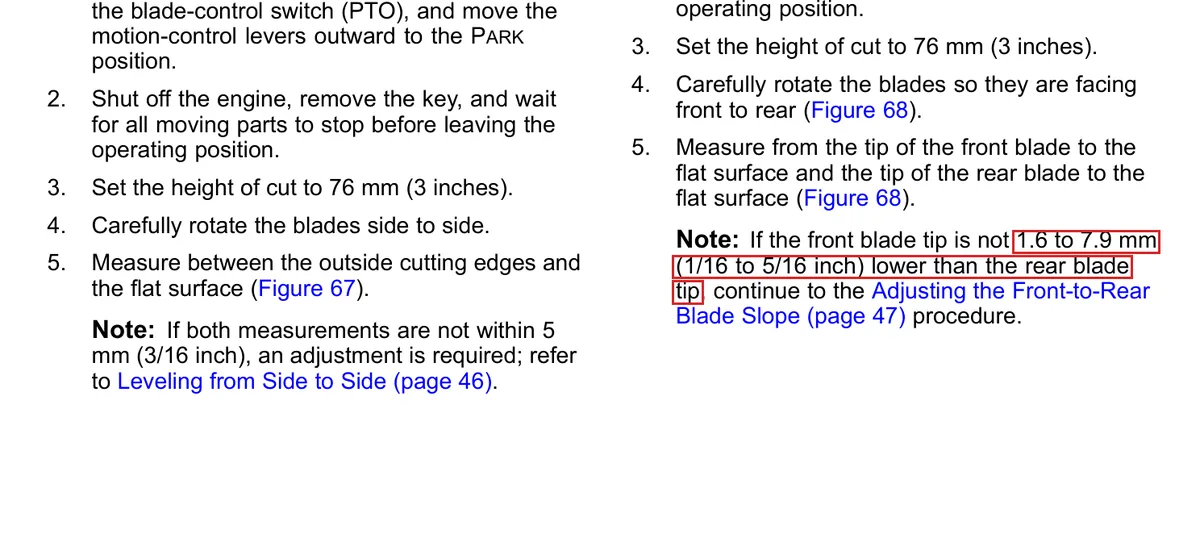
| Front-to-rear deck pitch | Front blade tip 1/16 to 5/16 in lower than rear, checked at 3 in | Front and rear of deck the same height | Front of deck 1/4 to 3/8 in lower than rear |
| Side-to-side level | Outside blade tips within 3/16 in | Deck top equal on both sides at your usual height | Both blade tips equal |
| Anti-scalp rollers or deck wheels | Upper hole at 2.5 in cut and below, lower hole at 3 in and above; rollers must not touch flat ground | Anti-scalp wheels on a floating deck (no gap figure given) | About 1/4 to 1/2 in above the ground at your usual height |
| Tire pressure | Front casters 30 psi (or sidewall, if lower); rear drive tires 13 psi | Drive tires 12 psi; casters flat-free | Equal pressure on all tires; see sidewall |
| Where it is | Toro TimeCutter ZR/ZS4200T, Form 3479-377, p. 24, 39, 45 to 47 | Scag Cheetah II, Part 03577, p. 13 and 33 | Cub Cadet XT1/XT2 Enduro, Form 769-10975A, p. 13, 24, 25 |
The anti-scalp rollers are a backstop, not a height setting: Cub Cadet says its deck wheels are “not designed to support the weight of the cutting deck” (Cub Cadet manual, p. 13), and Toro says to move them every time you change the cut height. Rollers that touch flat ground are set too low.
Should you scalp bermuda or zoysia in spring on purpose?
Spring scalping is a deliberate low cut on dormant warm-season grass to clear dead leaves so sun warms the soil. Two field trials put numbers on it: green-up came days sooner, not weeks, and the cultivar mattered as much as the scalp.
| Study | Grasses and site | Scalp height and date | Result | Source |
|---|---|---|---|---|
| Rimi and others, HortTechnology 21(2), 2011 | 8 seeded bermudagrass cultivars, Padova, Italy | 28 mm (1.1 in), rotary, March 13 | 80% green cover 8 to 18 days sooner in 7 cultivars; average 11 days; no gain in Yukon | HortTechnology |
| Serena and others, Crop, Forage & Turfgrass Management, Sept. 17, 2026 | 41 bermudagrass, 6 zoysiagrass, 8 seashore paspalum cultivars, Las Cruces, N.M., 2010 and 2011 | 0.5 in (1.3 cm), late February | Bermudagrass hit 50% cover up to 9 days sooner in one year; zoysiagrass sped up or slowed down by year; paspalum 7 to 8 days sooner | CFTM |
Extension calendars are more cautious than the trials. Clemson lowers bermudagrass to about 1 inch and zoysiagrass to 1 to 1.5 inches just before green-up (late April or early May in South Carolina) and bags the debris (Clemson HGIC 1216). New Mexico State’s H-505 frames the goal as removing 50 to 75 percent of the dead tissue, by a very low mowing or a verticutter (NMSU H-505). Bermudagrass timing is in our bermuda grass guide.
Zoysiagrass is the gray area. UF/IFAS says a green-up scalp to reduce thatch “can be injurious” (UF/IFAS LH011), and K-State’s MF683 says it works only if done every year from establishment, not when most roots sit in an old thatch layer (K-State MF683). Cultivar notes are in our zoysia grass guide.
Skip it on St. Augustinegrass, centipedegrass and every cool-season lawn. Texas A&M does not recommend spring scalping for St. Augustinegrass because it lacks rhizomes (EHT-144, 7/20); our St. Augustine grass guide has its 3.5 to 4 inch standard height. EHT-144 treats thatch over 0.5 inch as excess and describes vertical mowing to remove it instead.
How we compiled this
In November 2026 we read 24 primary documents: 18 extension publications from Kansas State, Arizona, New Mexico State, Penn State (2), Clemson (4 calendars), UF/IFAS, Texas A&M (2), Alabama and Arkansas (2); two peer-reviewed spring scalping trials; the operator’s manuals for the Toro TimeCutter, Scag Cheetah II and Cub Cadet XT1/XT2; and Cub Cadet’s scalping page. The Arizona pages date from 1998 and 2000. We did not mow or measure any lawn.
Frequently asked questions
Can grass recover from scalping?
Usually, if crowns or runners survived. Arizona says bermudagrass bounces back and Kentucky bluegrass fills in; ryegrass and tall fescue lawns may die and need reseeding in late summer or early fall (University of Arizona).
How long does it take for a scalped lawn to grow back?
We found no day count for an accidental scalp. K-State says cool-season grass scalped in summer needs “probably several weeks” (K-State). In spring trials, scalped bermudagrass reached 80 percent green cover 8 to 18 days sooner than unscalped plots (Rimi, 2011).
What should I put on my lawn after scalping?
Water, not a heavy feeding. Arizona advises iron, usually 2 to 4 oz of product per 1,000 sq ft, for yellow regrowth on scalped bermudagrass and Kentucky bluegrass, and warns that nitrogen makes the yellowing worse (Arizona).
Will grass grow back if you cut it too low?
Yes, if the cut stayed above the crown, which Penn State places near the soil surface (Penn State). Firm roots and white crown tissue mean it is alive.
What time of year do you scalp a lawn?
Only warm-season bermudagrass or zoysiagrass, just before spring green-up. Clemson’s calendar puts that in late April or early May in South Carolina, at about 1 inch for bermudagrass (Clemson HGIC 1216).
Sources
- Kansas State University, Lawn Problem Solver: Scalping Turf, updated March 27, 2026. Accessed November 2026.
- University of Arizona Cooperative Extension, David Kopec, Surviving Close Calls: Post Scalping Lawn Care, Turf Tips Vol. VII No. 7, July 2000. Accessed November 2026.
- University of Arizona Cooperative Extension, David Kopec, Iron Applications for Turf, Turf Tips Vol. V No. 3, March 1998. Accessed November 2026.
- New Mexico State University, Bernd Leinauer, Mowing Your Lawn, Guide H-505, current edition. Accessed November 2026.
- Penn State Extension, The Cool-Season Turfgrasses: Basic Structures, Growth and Development, current edition. Accessed November 2026.
- Penn State Extension, Managing Thatch in Lawns, current edition. Accessed November 2026.
- University of Arkansas Cooperative Extension, Bermudagrass (Lawns), current edition. Accessed November 2026.
- Texas A&M AgriLife Extension, Bermudagrass Home Lawn Management Calendar, current edition. Accessed November 2026.
- Clemson HGIC, HGIC 1216, Bermudagrass Yearly Maintenance Program, revised Nov. 2, 2018. Accessed November 2026.
- Clemson HGIC, HGIC 1217, Zoysiagrass Yearly Maintenance Program, revised Nov. 2, 2018. Accessed November 2026.
- Clemson HGIC, HGIC 1215, Centipedegrass Yearly Maintenance Program, updated Aug. 15, 2024. Accessed November 2026.
- Clemson HGIC, HGIC 1218, St. Augustinegrass Yearly Maintenance Program, revised Aug. 31, 2018. Accessed November 2026.
- UF/IFAS, LH011, Zoysiagrass for Florida Lawns, current edition. Accessed November 2026.
- Texas A&M AgriLife Extension, EHT-144, St. Augustinegrass Lawn Management, 7/20. Accessed November 2026.
- Kansas State University, MF683, Zoysiagrass in Kansas, current edition. Accessed November 2026.
- Alabama Cooperative Extension System, Home Lawns: Centipedegrass, current edition. Accessed November 2026.
- University of Arkansas, FSA6023, Mowing Your Lawn, current edition. Accessed November 2026.
- Rimi, Macolino and others, HortTechnology 21(2):230, Green-up of Seeded Bermudagrass Cultivars as Influenced by Spring Scalping, 2011. Accessed November 2026.
- Serena, Schiavon, Velasco Cruz and Leinauer, Crop, Forage & Turfgrass Management, Enhancing spring green-up of warm-season turfgrasses through late-winter scalping, Sept. 17, 2026. Accessed November 2026.
- The Toro Company, TimeCutter ZR4200T / ZS4200T Operator’s Manual, Form 3479-377, Rev A. Accessed November 2026.
- Scag Power Equipment, Cheetah II (SCZII) Operator’s Manual, Part No. 03577, 2025. Accessed November 2026.
- Cub Cadet (MTD), XT1 and XT2 Enduro Series Tractor Operator’s Manual, Form 769-10975A, current edition. Accessed November 2026.
- Cub Cadet, Why Am I Scalping My Grass?, checked November 2026. Accessed November 2026.