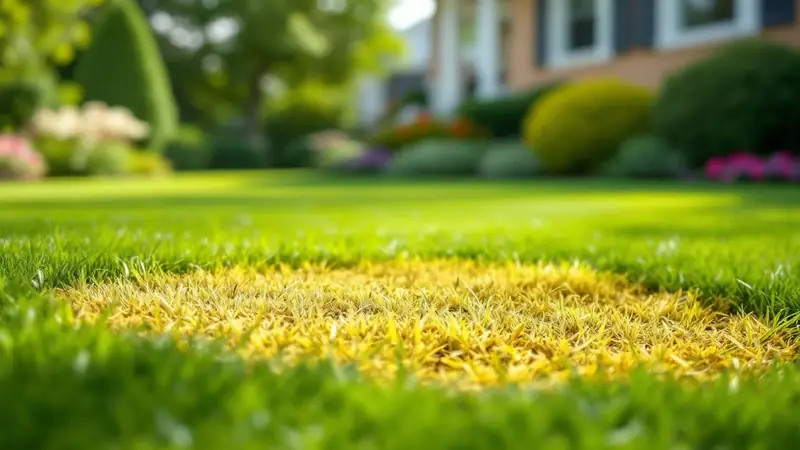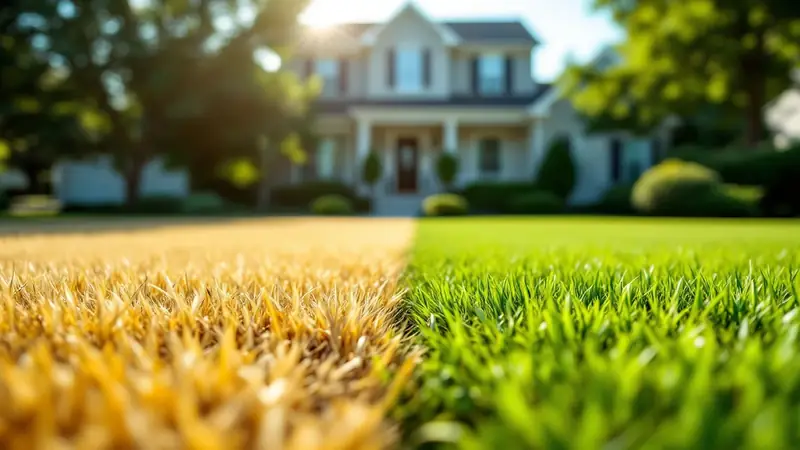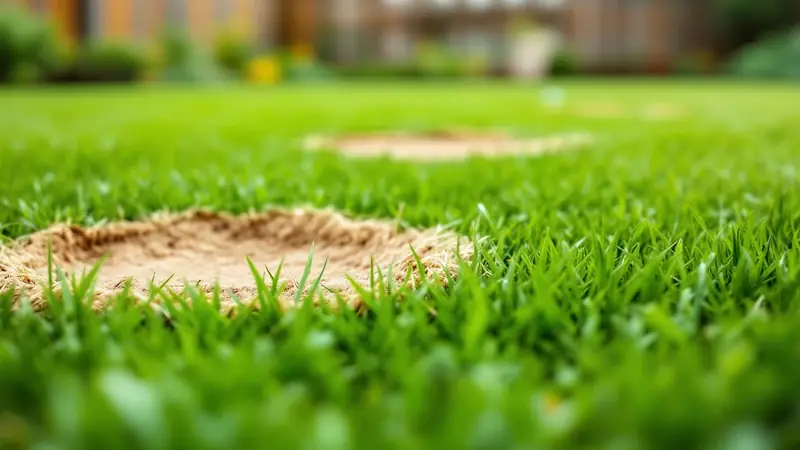
How to fix patchy grass: confirm the cause with a 10-minute test, then patch by grass type. Seed tall fescue, ryegrass and bluegrass spots on loosened bare soil; plug or sod bermuda, zoysia and St. Augustine; keep new seed moist until it sprouts.
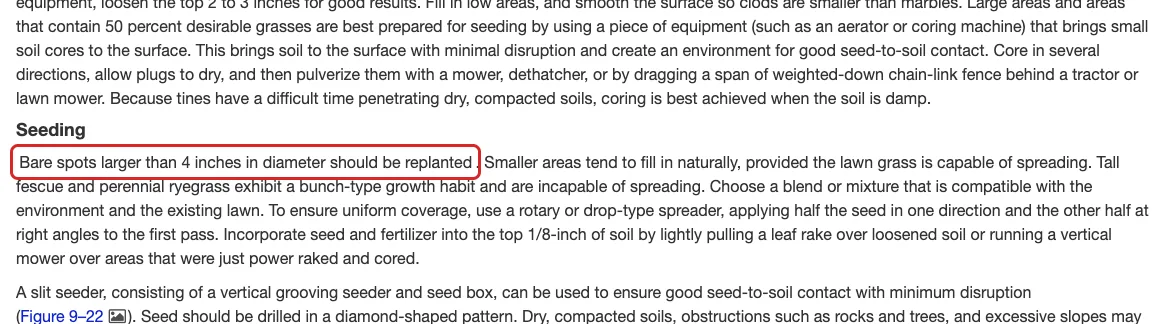
Learning how to fix patchy grass starts with the size and shape of each patch, because a spot that comes back has a cause still in place. NC State Extension says bare spots wider than 4 inches should be replanted, while smaller ones fill in on their own if the grass can spread; tall fescue and perennial ryegrass are bunch grasses and cannot. Wisconsin Extension sets the do-nothing line at a spot smaller than your fist, which fills in from the surrounding grass in a few weeks.
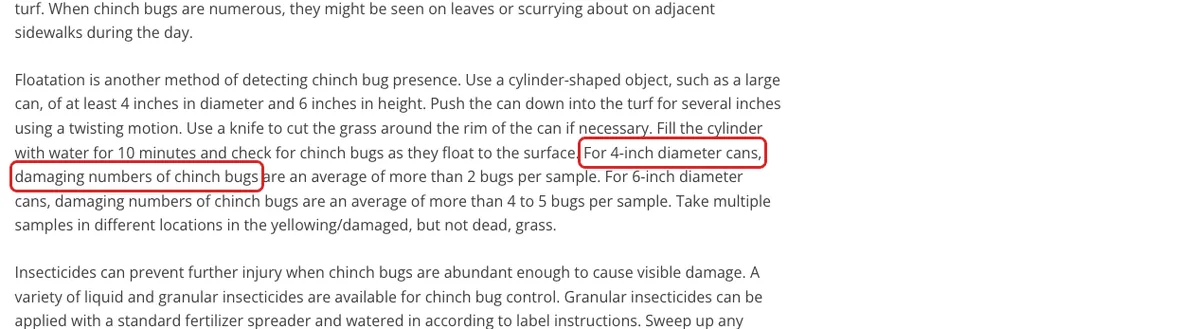
None of the top-ranked repair guides attaches a published threshold to the diagnosis. This page pairs 10 patch patterns with the field test and the published threshold that confirms each one, such as 5 to 10 grubs per square foot or more than 2 chinch bugs in a 4-inch float can, then sizes the repair per patch: ounces of seed, cubic feet of soil and plugs per square foot. Whole-lawn calls, such as whether brown grass is dormant or dead, live on our page about reviving dead or dormant grass.
What is causing the patches? Match the pattern
Run the test before you buy seed or a pesticide. In Cornell’s research in upstate New York, grub insecticide was needed only 20 percent of the time on home lawns and golf fairways (Cornell IPM), so a dead spot is not proof of a pest. Test at the edge of the patch, where grass is dying but not yet dead.
| Pattern you see | Likely cause | Test | Threshold that confirms it | Fix before patching | Source |
|---|---|---|---|---|---|
| Round straw-colored spot, often with a darker green rim, where a dog goes | Dog urine: nitrogen compounds and salts | Watch the spot: an old urine spot heals as a new one browns, and spots do not merge (LSU) | Turf still brown after the spot is watered deeply | Water to dilute salts; remove dead sod and 0.5 to 1 in of soil, then reseed or sod | Colorado State; LSU |
| Dead turf that lifts like carpet; birds, skunks or moles digging | White grubs eating roots | Lift a 1 sq ft section of turf at the patch edge and count grubs in the root zone | 5 to 10 grubs per sq ft (Penn State); 8 to 10 Japanese beetle, 5 to 8 European chafer, 3 to 4 May or June beetle (Cornell) | Treat only above threshold, then reseed | Penn State; Cornell |
| Irregular patches with a yellow halo in sunny St. Augustinegrass next to pavement, in hot, dry weather | Southern chinch bugs | Float test: a can at least 4 in wide and 6 in tall twisted into the turf, filled with water for 10 minutes | More than 2 bugs per 4 in can or 4 to 5 per 6 in can; damage at about 20 to 25 per sq ft | Control the bugs first, then plug or sod | Texas A&M |
| Roughly circular brown, tan or yellow patches 6 in to several feet across in hot, humid weather | Brown patch (Rhizoctonia) | Look for tan leaf lesions with a dark brown border, and gray cottony growth when leaves are wet | Nights consistently above 60 F, when NC State starts preventive sprays on tall fescue | Hold nitrogen to 0.5 lb per 1,000 sq ft while weather favors the disease; reseed in fall | NC State |
| Many small bleached spots that merge into larger areas | Dollar spot | Measure the spots | 1 to 2 in across on close-mowed turf; up to 8 in on lawns mowed higher | Treat the disease before reseeding | Mississippi State |
| Thin grass and bare soil under trees or on the north side of a building | Shade, plus tree-root competition | Count hours of direct sun on the spot in midsummer | St. Augustinegrass, the most shade-tolerant warm-season grass, needs about 4 hours of direct sun; bermudagrass needs the most light | Shade-tolerant grass, pruning, or mulch or a groundcover | Mississippi State |
| Worn paths and hard, thin areas where people or pets run | Soil compaction and traffic | Push a wire survey flag into moist, not saturated, soil until it bends | Bends before 4 in: compacted; 4 to 12 in: fair; 12 in or deeper: good | Core aerate, route traffic onto stepping stones or mulch, then seed | Rutgers; UMD |
| Patch with a sharp outline that browns first in dry spells, often near new construction | Buried debris, rock or old concrete | Push a rod or slender stake into the ground across the patch | An obstacle inside the root zone; turf roots typically grow at least 6 to 8 in deep | Dig it out, level the soil, replant | UMD |
| Brown or bare tops on humps and ridges right after mowing | Scalping by the mower | Check where the patches sit: mounds, vole runways, shallow tree roots | Cut below the grass’s height range; for tall fescue UMD says 3 to 4 in is best | Raise the deck, sharpen the blade, level the humps | UMD |
| Brown stripes that follow spreader passes, a spill shape, or a strip along a salted walk | Fertilizer, ice-melt salt or fuel | Match the shape to a spreader path, a fill-up spot or pavement runoff | Shape matches the spill; small gasoline spills evaporate, severe oil spills saturate the soil | Water to leach salts; remove and replace soil soaked by a severe oil spill | UMD |
Three causes leave round spots in southern lawns, and LSU AgCenter separates them by edge and spread: urine spots stay separate, chinch bug spots start small with irregular edges and merge, and brown patch starts as smooth-edged circles about a foot across that can also merge. Our lawn fungus identification guide covers 16 diseases and how to choose a fungicide, and our page on grub thresholds and treatment timing covers which grub killer fits which month.
1Does the dead turf peel back like carpet?
YesGrubs: count them in 1 sq ft; treat only above about 5 to 10 per sq ft, then reseed.
NoGo to the next question
2Is it St. Augustinegrass with a yellow halo, near pavement, in hot dry weather?
YesChinch bugs: float test; more than 2 bugs in a 4 in can means control them before plugging.
NoGo to the next question
3Is it a round spot where a dog goes, often with a greener rim?
YesDog urine: water it; if dead, remove 0.5 to 1 in of soil and reseed or sod.
NoGo to the next question
4Did roughly circular patches 6 in to several feet across appear in hot, humid weather?
YesBrown patch: see the lawn fungus guide; hold nitrogen to 0.5 lb per 1,000 sq ft.
NoGo to the next question
5Does a wire flag bend before 4 in in moist soil?
YesCompaction: core aerate and reroute traffic, then seed.
NoGo to the next question
6Does a rod hit rock, concrete or debris under a sharply outlined patch?
YesBuried debris: dig it out, level, replant.
NoGo to the next question
7Does the spot get less than about 4 hours of direct sun?
YesShade: shade-tolerant grass, pruning, or mulch or a groundcover.
NoGo to the next question
8Is the patch on a hump or ridge the mower hits?
YesScalping: raise the deck and level the hump.
NoNo cause found: patch it and watch whether it returns; if it does, send photos to your county extension office.
How do you run the field tests?
Four tests settle most patches and need only a spade, a can, a wire flag and a watch. Texas A&M AgriLife says to take several samples in yellowing, damaged grass, not in grass that is already dead.
- Grub count. Lift a 1 sq ft piece of turf at the edge of the patch with a spade and count the white, C-shaped grubs among the roots. Penn State Extension uses 5 to 10 per square foot as the usual threshold for a curative treatment; Cornell lists species thresholds from 3 to 4 for May and June beetles to 30 to 50 for black turfgrass ataenius, and samples in early to mid August in New York.
- Chinch bug float. Push a cylinder, such as a large can at least 4 inches wide and 6 inches tall, several inches into the turf at the yellowing edge with a twisting motion, fill it with water and wait 10 minutes. More than 2 bugs in a 4 inch can, or 4 to 5 in a 6 inch can, is a damaging number per Texas A&M. LSU’s faster version pours 1 tablespoon of lemon dish soap in 1 gallon of water on the edge; bugs surface in 5 to 10 minutes (LSU AgCenter).
- Wire-flag probe. Push a wire survey flag straight down in moist soil until the wire bends. Rutgers FS1313 rates bending before 4 inches as compacted and 12 inches or deeper as good. A metal rod that stops dead at the same depth across a sharply outlined patch points to buried debris instead (UMD Extension).
- Sun count. On a clear midsummer day, note each hour the patch gets direct sun. Mississippi State puts St. Augustinegrass at about 4 hours of direct sun or a full day of filtered light; our ranking of grasses by the hours of sun they need lists 14 grasses.
Will the patch fill in, or do you replant?
It depends on whether your grass spreads. Bermudagrass, zoysiagrass, St. Augustinegrass and centipedegrass run on stolons, and Kentucky bluegrass on rhizomes, so spots under 4 inches close on their own (NC State). Tall fescue and perennial ryegrass grow in clumps: a bare spot in them stays bare until you seed it. Patch with the grass already there. Colorado State warns against K31 tall fescue or annual ryegrass in a bluegrass or turf-type tall fescue lawn, and says mismatched seed leaves spots of a different color, texture or growth rate.
If the lawn shows raised clumps rather than bare patches, our guide on why grass is growing in clumps separates thin bunch-grass stands from weedy grasses such as orchardgrass, dallisgrass and Kentucky 31 tall fescue.
| Grass | Spreads into a spot? | Patch with | Rate or spacing | How long | Source |
|---|---|---|---|---|---|
| Tall fescue | No (bunch type) | Turf-type tall fescue seed; not K31 or annual ryegrass | 6 to 8 lb seed per 1,000 sq ft | Germinates in 6 to 12 days (UT) | K-State; Colorado State; UT W160-B |
| Perennial ryegrass | No (bunch type) | Perennial ryegrass seed | 4 to 6 lb seed per 1,000 sq ft | Germinates in 3 to 7 days | UT W160-B; NC State |
| Kentucky bluegrass | Yes, rhizomes; spots under 4 in fill | Bluegrass seed (marginally effective) or perennial ryegrass (more effective), per Colorado State | 2 to 3 lb seed per 1,000 sq ft | Germinates in 14 to 21 days | K-State; Colorado State; UT W160-B |
| Fine fescues (red, chewings, hard) | Not stated | Fine fescue seed only | 3 to 5 lb seed per 1,000 sq ft | Germinates in 6 to 14 days | Colorado State; UT W160-B |
| Bermudagrass | Yes, stolons and rhizomes | Plugs or sod; common types also by hulled seed at 1 to 2 lb | Plugs 12 to 24 in apart | Covers in 3 to 6 months at 12 in, 6 to 9 months at 24 in | UF/IFAS LH007; NC State |
| Zoysiagrass | Yes, slowly | Plugs or sod, from a sod farm or a hidden corner of the same lawn | Plugs on 8 to 12 in centers | At least one full season; Meyer and Emerald on 12 in centers often 3 years (NC State) | UF/IFAS LH011; NC State; Colorado State |
| St. Augustinegrass | Yes, stolons | Plugs, sod or sprigs; no seed is sold | Plugs 6 to 24 in apart | Closer spacing covers faster; no time given | UF/IFAS LH010; NC State |
| Centipedegrass | Yes, stolons | Plugs (2 in squares) or seed | Plugs on 12 in centers or 0.25 to 0.5 lb seed per 1,000 sq ft | Seed germinates in 10 to 20 days (UT) | NC State Table 9-4; UT W160-B |
For a thin patch where grass still grows, sow about half the rate: K-State gives 3 to 4 lb of tall fescue per 1,000 sq ft for overseeding against 6 to 8 lb on bare soil. If thin areas run across more than half the yard, it is an overseeding job; the steps and machines are in our guide on how to overseed a lawn.
How much seed, soil and plugs does each patch need?
Measure each patch as length times width in feet and add them. Pounds of seed equal square feet times the rate, divided by 1,000; multiply by 16 for ounces. At 7 lb of tall fescue per 1,000 sq ft, that is 0.112 oz, or about 3.2 grams, per square foot. Spread it with a hand spreader rather than by hand, the USGA advises, and do not double up: “more seed is better” is wrong, because seedlings need room to fill in.
- Seed (ounces)
- 2.24
- Seed (grams)
- 64
- Seed (pounds)
- 0.140
Raw, uncoated seed at extension rates. Coated seed and patch mixes: use the bag's own coverage. Soil: 1 cu ft covers 12 sq ft 1 inch deep. St. Augustinegrass has no seed; use plugs (1 per sq ft at 12 in centers, 4 at 6 in).
| Step | Input | Result |
|---|---|---|
| Patch area | Three dog spots: 2 x 2, 2 x 3 and 3 x 3 ft | 4 + 6 + 9 = 19 sq ft |
| Seed, tall fescue at 6 to 8 lb per 1,000 sq ft (K-State) | 19 x 6 / 1,000 to 19 x 8 / 1,000 | 0.114 to 0.152 lb = 1.8 to 2.4 oz (52 to 69 g) |
| Soil to remove and replace, 0.5 to 1 in deep (Colorado State) | 19 x 0.5 / 12 to 19 x 1 / 12 | 0.8 to 1.6 cu ft |
| Same 19 sq ft with a patch mix (Scotts EZ Seed Sun & Shade, 10 lb covers up to 225 sq ft) | 19 / 225 x 10 lb | 0.84 lb of product |
| One 3 x 3 ft spot in St. Augustinegrass, plugs on 12 in centers | 9 sq ft x (144 / 12 x 12) | 9 plugs |
| Same spot, plugs on 6 in centers | 9 sq ft x (144 / 6 x 6) | 36 plugs |
| Sod to cut 9 plugs of 2 x 2 in | 9 x 4 sq in / 144 | 0.25 sq ft of sod |
Soil for the patch can be a scoop from a garden bed, bagged soil or even potting mix stirred together with a couple of handfuls of seed, per Wisconsin Extension. The USGA Green Section (August 2026) prefers soil close to what is already there so the patch drains and dries like the rest of the lawn. Whole-lawn pounds and the pure-live-seed correction on a seed tag are in our guide to how much grass seed a lawn needs.
Patch kits or plain seed: what the labels say
Patch mixes bundle seed with mulch and fertilizer, so most of the weight is not seed. The USGA calls them effective but relatively expensive, says bags “contain very little actual seed,” and warns that some carry fast-sprouting ryegrass. Coverage printed on the labels shows the gap: the products below go down at 44 to 67 lb per 1,000 sq ft, against 6 to 8 lb of raw tall fescue.
| Product (maker page) | Bag | Label coverage | Spread per 1,000 sq ft | Grass on label | Price, Nov. 16, 2026 | Per sq ft covered |
|---|---|---|---|---|---|---|
| Scotts EZ Seed Patch & Repair Sun & Shade | 10 lb | Up to 225 sq ft | 44.4 lb | Kentucky bluegrass, perennial ryegrass, creeping red fescue, chewings fescue; 1-0-0 fertilizer | $51.49 at scotts.com; $33.99 to $54.99 at listed retailers | $0.15 to $0.24 |
| Scotts EZ Seed Patch & Repair Tall Fescue Lawns | 3.75 lb | Up to 85 sq ft | 44.1 lb | Tall fescue | $25.99 at scotts.com; $23.97 to $26.98 at listed retailers | $0.28 to $0.32 |
| Pennington One Step Complete Sun & Shade | 5 lb | Up to 75 sq ft (about 1 cup per sq ft) | 66.7 lb | Not listed on the product page | Not shown on the maker page | Not calculated |
| Raw turf-type tall fescue (K-State rate) | Any | 6 to 8 lb per 1,000 sq ft | 6 to 8 lb | Tall fescue | $2.00 to $4.20 a lb in our October 2026 grass seed price survey | $0.01 to $0.03 of seed |
Two practical points follow. A kit’s mix has to match your lawn: the Sun & Shade bag is a bluegrass, ryegrass and fine fescue blend, and Colorado State says ryegrass or fine fescue spots in a tall fescue lawn will look different. And the Scotts label tells you to cover the area so bare ground still shows and to use half as much on thin areas. For one or two dog spots the price gap is a few dollars; across 100 sq ft of patches it is about $15 to $32 of product against under $4 of raw seed, before straw and starter fertilizer.
Whether a dog-spot kit’s salt neutralizer adds anything is a separate question: we found no published test of it, and our page on fixing dog urine spots on a lawn covers the 8-hour watering window and the grasses that tolerate urine best.
How to reseed a bare patch, step by step
These steps fit tall fescue, ryegrass, bluegrass and fine fescue patches. Each carries the number the extension source attaches to it; the soil and seed quantities come from the calculator above.
- Pick the window. Cool-season patches do best from late summer to early fall (USGA), with soil at 50 to 70 F about 1 inch down (UMD Extension). Check the date of your last crabgrass preventer first: preemergence products stop grass seed too.
- Clear the spot. Rake out dead grass until soil shows; you need not remove every blade (Wisconsin). On urine-killed spots, lift the dead sod and 0.5 to 1 inch of soil (Colorado State).
- Loosen the soil. Work the top 4 to 6 inches with a rake, hoe or shovel, or 2 to 3 inches where hand tools cannot get deeper, and break clods smaller than marbles (NC State). If the wire flag bent before 4 inches, core aerate the area first; see our guide on how to aerate lawn soil.
- Level it. Fill the spot with soil until it sits flush with the lawn around it, so the mower does not scalp a hump or skip a hollow.
- Sow at the bare-soil rate. Weigh out the ounces from the calculator, spread half in one direction and half across it, and rake lightly to work it into the top 1/8 inch of soil (NC State); Pennington’s patch-mix label caps planting depth at 1/4 inch.
- Feed, firm and cover. Apply a starter fertilizer, tamp the soil for seed-to-soil contact and add a light layer of clean straw or mulch (USGA). UT puts a 1/8 to 1/4 inch layer of organic matter on as a mulch alternative (UT W160-B).
- Water lightly and often. Two light waterings a day, up to 4 in hot, windy weather, for 3 weeks (Iowa State), about 1/8 to 1/4 inch a day in total (UT). Minutes per sprinkler type are in our watering schedule for new grass seed.
- Mow when it is taller than the lawn. The USGA waits until new grass is slightly taller than the rest, typically 2 to 4 weeks after germination; UT starts bunch grasses at a 2 inch cut once plants average 3 inches (UT W160-B).
How to patch with plugs, sprigs or sod
Warm-season patches go in from late spring through summer while the grass is growing hard (USGA), and NC State allows warm-season sod once soil is above 55 F. If a spot is small and the rest of the lawn is growing well, the USGA says it may be worth holding off, since runners can close it; spots over 4 inches need plugs, sprigs or sod.
- Get matching grass. Buy plugs or a few pieces of sod of the same cultivar, or cut plugs from a hidden corner of your lawn (Colorado State). Edging trimmings work as sprigs if each piece has several leaves on a stem (USGA).
- Set plugs on a grid. Use pieces 2 inches or larger on 6 or 12 inch centers (NC State), in holes the same size, tamped in and watered (UF/IFAS LH010). NC State plants 1,000 sq ft of centipedegrass or zoysiagrass from 3 sq yd of sod cut into 2 inch squares.
- For a sod patch, cut to a clean edge. Square off the damaged area, then lower the soil so the new sod sits level with the lawn, not above it (USGA). Lay sod within 24 hours of delivery (NC State).
- Water until rooted. Bermudagrass sod knits to the soil in 2 to 3 weeks, after which UF/IFAS lengthens run times and waters less often (UF/IFAS LH007).
- Push the fill. NC State says twice-monthly nitrogen-only feeding at 0.5 lb N per 1,000 sq ft may help warm-season grass fill faster.
When the same spot fails twice after the cause was fixed, the USGA suggests switching that spot to mulch, stone or another landscape surface rather than reseeding it every year, the way golf courses end up rebuilding the turf at the ends of cart paths.
How we compiled this
In November 2026 we read 20 primary documents: extension publications and fact sheets from NC State (2), UF/IFAS (3), Texas A&M, Penn State, Cornell, Rutgers, Colorado State, the University of Maryland (2), Wisconsin, LSU, Mississippi State (2), Kansas State, Tennessee and Iowa State, plus the USGA Green Section’s August 2026 bare-spot article. Patch-kit coverage and prices come from 3 maker pages checked Nov. 16, 2026. Seed ounces, soil volumes, plug counts and per-square-foot product rates are our arithmetic from those figures. We did not test any product or lawn.
Frequently asked questions
Can patchy grass grow back?
In spreading grasses, yes: NC State says bare spots under 4 inches fill in naturally in bermudagrass, zoysiagrass, St. Augustinegrass and Kentucky bluegrass. Tall fescue and perennial ryegrass cannot spread, so their bare spots need seed. Grass that only looks brown may be dormant; our dormant or dead test sorts that out.
Can I just spread grass seed over existing grass?
Over thin grass, yes, at about half the bare-soil rate: K-State gives 3 to 4 lb of tall fescue per 1,000 sq ft. Over bare or dead patches, rake first: Wisconsin says pull off enough dead blades to see at least some soil, because seed needs soil contact.
How do you fix patchy grass from dog pee?
Water the spot to dilute the salts. If the grass is dead, Colorado State says remove the dead sod and 0.5 to 1 inch of soil, then reseed with the lawn’s own grass or patch with sod. It found no supplement or spray-on product proven to prevent dog spots.
How do you fix patchy grass in summer?
In a warm-season lawn, summer is the right time to plug or sod. In a cool-season lawn, wait: the USGA puts seeding in late summer to early fall and says new cool-season sod laid in midsummer is prone to drying out and dying.
How can I thicken a patchy lawn?
Overseed at half rate in the right season, mow higher and keep the blade sharp. UMD calls 3 to 4 inches the best height for tall fescue and suggests sharpening after every 10 hours of mowing, or at least twice a year.
Sources
- NC State Extension, Extension Gardener Handbook, Chapter 9: Lawns (seeding, plugging, Table 9-4), current edition. Accessed November 2026.
- University of Wisconsin-Madison Extension, Now is a great time to fixing dead spots in lawns, Apr. 28, 2026. Accessed November 2026.
- Colorado State University Extension, Dog Urine Damage on Lawns: Causes, Cures, and Prevention (GardenNotes #553), current page. Accessed November 2026.
- LSU AgCenter, John Monzingo, A Triple Threat to Southern Lawns, Feb. 18, 2025. Accessed November 2026.
- Texas A&M AgriLife Extension, Wizzie Brown and Molly Keck, Chinch Bug Management in Lawns, ENTO-PU-044, November 2024. Accessed November 2026.
- Penn State Extension, White Grubs in Home Lawns, current page. Accessed November 2026.
- Cornell University, New York State IPM Program, What’s Bugging You: Grubs (threshold table), current page. Accessed November 2026.
- Rutgers Cooperative Extension, FS1313, soil compaction and the wire-flag test, current page. Accessed November 2026.
- University of Maryland Extension, Lawn Problems Not Caused by Pests or Diseases, current page. Accessed November 2026.
- University of Maryland Extension, Starting a New Lawn, current page. Accessed November 2026.
- NC State Extension, TurfFiles, Brown Patch in Turf, current page. Accessed November 2026.
- Mississippi State University Extension, The Plant Doctor: Dollar Spot on Warm-Season Turfgrasses, current page. Accessed November 2026.
- Mississippi State University Extension, P2892, Selecting and Managing Turfgrass for Shade, current page. Accessed November 2026.
- UF/IFAS Extension, ENH19 (LH007), Bermudagrass for Florida Lawns, current edition. Accessed November 2026.
- UF/IFAS Extension, ENH5 (LH010), St. Augustinegrass for Florida Lawns, 2021. Accessed November 2026.
- UF/IFAS Extension, ENH11 (LH011), Zoysiagrass for Florida Lawns, 2022. Accessed November 2026.
- USGA Green Section Record, Vol. 64 Issue 15, John Petrovsky, Bringing Bare Spots in Your Lawn Back to Life, Aug. 22, 2026. Accessed November 2026.
- Kansas State University, Fall Turfgrass Recommendations and Tips (seeding rates), Aug. 2019. Accessed November 2026.
- University of Tennessee Extension, W160-B, Turfgrass Establishment: Seeding (rates and germination days), 2023 posting. Accessed November 2026.
- Iowa State University Extension and Outreach, How should I water a newly seeded lawn?, current page. Accessed November 2026.
- The Scotts Company, Scotts EZ Seed Patch & Repair Sun & Shade, product page (coverage, grass types, price), price checked Nov. 16, 2026. Accessed November 2026.
- The Scotts Company, Scotts EZ Seed Patch & Repair Tall Fescue Lawns, product page, price checked Nov. 16, 2026. Accessed November 2026.
- Pennington Seed, Pennington One Step Complete Sun & Shade, product page, checked Nov. 16, 2026. Accessed November 2026.