Why is my grass growing in clumps? Most often the clumps are a bunch-type grass: coarse pasture tall fescue in a bluegrass lawn, or tall fescue or ryegrass seeded too thin. Orchardgrass, dallisgrass, crabgrass and wet clippings cause the rest; each needs a different fix.
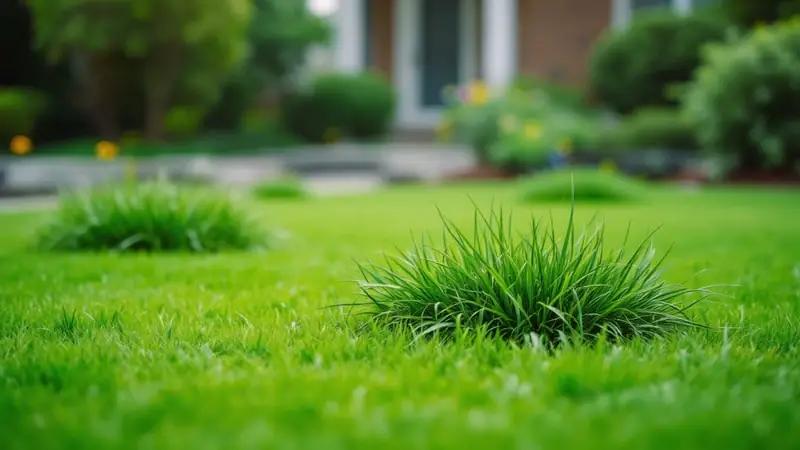
Why is my grass growing in clumps is an identification question before it is a lawn care one. Lawn grasses either spread sideways on rhizomes and stolons, like Kentucky bluegrass and bermudagrass, or thicken only by tillers from the crown, like tall fescue and perennial ryegrass. NC State Extension says the bunch types “are incapable of spreading” and that bare spots over 4 inches across must be replanted. So a clump is either a bunch grass with nothing around it, or a coarser grass that does not match the lawn it sits in.
Two of the lawn-company pages ranking for this question list soil pH, sandy soil, compaction or overwatering as causes, without a source. The 11 university sources we read tie clumps to growth habit, thin seeding and weedy grasses, told apart by marks on one pulled shoot: ligule, auricles, leaf folding and rhizomes. The 14-row table below sorts each cause by those marks and the month it stands out, with its fix and timing. For broadleaf weeds, use our lawn weed identification chart.
Which kind of clump is it? Start with the calendar
The month narrows it fastest. UW-Madison Extension notes that perennial grass weeds are already green in early spring as the lawn greens up, while crabgrass does not show as mature plants in April or May and dies off in fall. Colorado State PlantTalk 1529 adds that pasture tall fescue clumps often green up earlier than the bluegrass around them. Then pull one shoot and answer the questions in order.
1Do the clumps lift off with a rake, right after mowing?
YesClippings, not plants: avoid mowing wet grass (Toro 21442 manual), and rake or blow the clumps out.
NoGo to the next question
2Is the whole lawn tufts of one grass with bare soil between them?
YesA thin or uneven bunch-grass seeding: overseed in September at about half the new-lawn rate (3 to 4 lb tall fescue per 1,000 sq ft), in 2 passes at right angles.
NoGo to the next question
3Does the clump only appear in June or later and die back after the first frost?
YesA summer annual: crabgrass, or goosegrass if the stem base is flat and white or silver. Preemergent next spring; seed the gaps in fall.
NoGo to the next question
4Does the stem feel triangular when you roll it between your fingers?
YesYellow nutsedge, a sedge: use an herbicide labeled for sedges, such as halosulfuron, while it is actively growing.
NoGo to the next question
5Does a dug clump show short rhizomes with ring-like joints, in a warm region?
YesDallisgrass: dig young plants with the rhizomes, or follow a fall-start dallisgrass herbicide program.
NoGo to the next question
6Long claw-like auricles and long white rhizomes, with single plants spread through the lawn?
YesQuackgrass, not a clump: glyphosate spot spray in August, reseed late August to early September.
NoGo to the next question
7Claw-like auricles but no rhizomes, in a lawn seeded within the last year?
YesAnnual ryegrass from the seed mix: mow more often until a harsh winter or hot summer removes it.
NoGo to the next question
8Folded leaf, tall membranous ligule, no hair, light gray-green blades that outgrow the lawn?
YesOrchardgrass: dig 3 to 4 in deep or spot-spray glyphosate, then reseed once the clump is dead.
NoWide, dull, ribbed blades with short blunt auricles that green up before the lawn: pasture tall fescue. Dig 3 to 4 in deep, or spot-spray glyphosate (2.5 fl oz per gallon on label 71995-25) in August and reseed in late August to early September.
Clump identification table: 14 causes, the check and the fix
Swipe the table sideways to see every column.
| Clump or cause | When it stands out | Check on one shoot | Spreads by | Fix and timing | Source |
|---|---|---|---|---|---|
| Pasture tall fescue (Kentucky 31) in a bluegrass, fine fescue or ryegrass lawn | Greens up earlier than bluegrass in spring; clumps up to 2 ft across | Wide, stiff, dull blade with prominent veins; short membranous ligule; short, blunt auricles; leaf held near 90 degrees; tips shred when mowed | Tillers; very short rhizomes that do not spread | Dig 3 to 4 in deep, or spot-spray glyphosate in August and reseed late Aug. to early Sept. | UW-Madison; Illinois; Colorado State |
| Tall fescue lawn seeded too thin or unevenly | Whole lawn: tufts with bare soil between, worst in skipped spreader strips | Same collar marks as above on every plant; no other grass between tufts | No: bunch type, cannot fill spots over 4 in | Overseed in September at about half the 6 to 8 lb per 1,000 sq ft new-lawn rate, in 2 passes at right angles | K-State; NC State |
| Perennial ryegrass lawn | Clumpy after hot, humid summers | Check the seed label or records: ryegrass-heavy blend | No: bunch type | Reseed thin areas in fall; UK does not recommend it as the primary lawn grass | UK AGR-52; NC State |
| Annual ryegrass from a low-quality seed mix | First spring after seeding; wide blades shoot up between mowings | Clasping, claw-like auricles; coarse texture | No; persists until a harsh winter or hot summer | Mow more often until weather removes it; buy mixes without annual ryegrass | Purdue PPDL |
| Fine fescue (hard, Chewings, sheep) under foot traffic | Along paths and play areas | Very fine leaf texture | Slow lateral spread | Move the traffic or reseed that strip with a traffic-tolerant grass | UK AGR-52 |
| Orchardgrass | Spring to fall; outgrows the lawn between mowings | Leaf folded in the bud; tall membranous ligule; no hair on leaf or collar; light gray-green; 1/4 to 1/2 in wide with a boat-shaped tip | Tillers; dense fibrous roots | Dig 3 to 4 in deep, or spot-spray glyphosate; no selective option in cool-season lawns | Penn State; K-State; UMD |
| Dallisgrass | Warm months in the South and transition zone; stays green later than bermuda | Gray-green blades 1/4 to 1/2 in wide; ligule about 1/4 in; often purple stem bases; dug rhizome shows ring-like joints | Short rhizomes; clump widens slowly | Dig young plants with rhizomes; herbicide program by lawn type; see our dallisgrass herbicides by lawn type | UC IPM 7491 |
| Crabgrass | June to first frost; dies reddish-brown in fall | Light to medium green blades 1/2 to 3/4 in wide; membranous ligule; long sparse hairs at blade base | Annual: by seed | Preemergent next spring; seed the gaps it leaves in fall; see our crabgrass preventer dates | Penn State; UW-Madison |
| Goosegrass | Mid to late spring, 3 to 4 weeks after crabgrass, to first frost | Flattened white or silver stem base; ligule 1 to 1.5 mm, jagged and split in the center; no auricles | Annual: by seed | Preemergent timed later than for crabgrass; postemergent before tillers multiply; see our goosegrass timing and labels | Penn State |
| Yellow nutsedge (a sedge, not a grass) | Late April or May to first frost; grows above the lawn in summer | Stem feels triangular when rolled between the fingers | Tubers that overwinter in soil | Herbicide labeled for sedges, such as halosulfuron, while it is actively growing in summer; see our nutsedge control steps | Purdue TURF-45-W |
| Quackgrass (often mistaken for a clump) | Spring to fall | Long, claw-like clasping auricles; white, sharp-tipped rhizomes | Rhizomes: scattered single plants, not bunches | Glyphosate spot spray in August, reseed late Aug. to early Sept.; may need a second spray; see our quackgrass plan | UW-Madison |
| Creeping bentgrass (a patch, not a clump) | Soft, lighter or blue-green patches that brown when scalped | Thin, whitish ligule; fine stolons on the surface | Stolons | Mesotrione, 3 or 4 applications 7 to 10 days apart from September, or glyphosate and reseed | UW-Madison |
| Nimblewill or zoysiagrass (patches) | Straw-brown in spring and fall while the lawn is green | Nimblewill: short tapered blades, stems root at nodes; zoysia: ligule of hairs | Stolons (zoysia also rhizomes) | Mesotrione for nimblewill in bluegrass or tall fescue; glyphosate after green-up for zoysia; see our nimblewill trial results | UW-Madison |
| Clumps of wet clippings | Right after mowing | Loose cut blades lying on top of the lawn, not rooted | Not a plant problem | Mow when dry, raise the deck, rake or blow the clumps out; see our when wet grass is safe to mow | Toro 21442 manual |
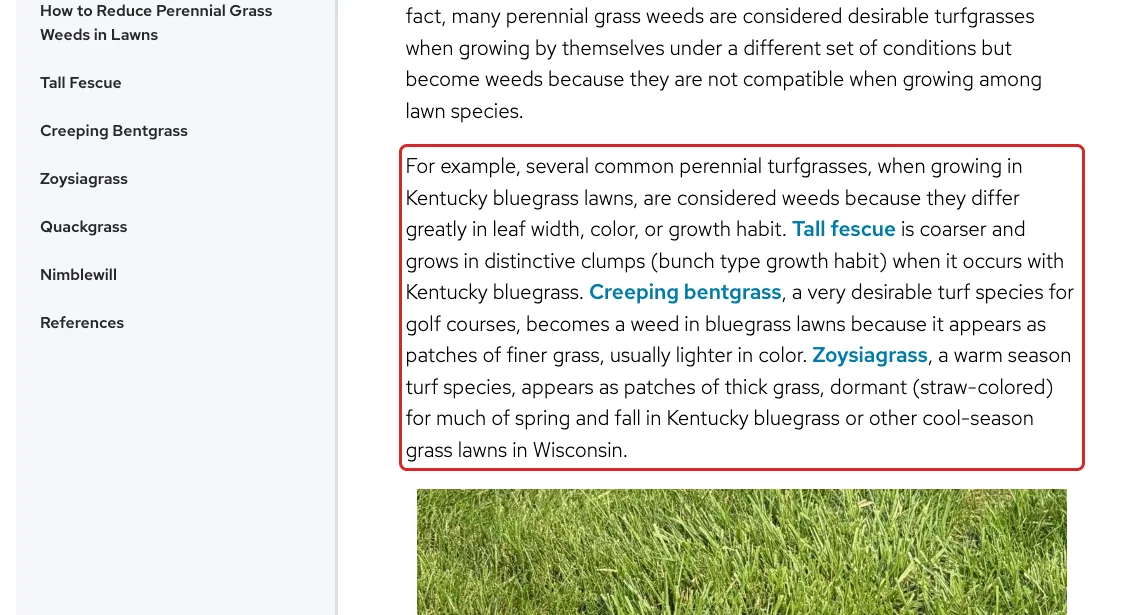
Coarse clumps in a bluegrass lawn: usually Kentucky 31 tall fescue
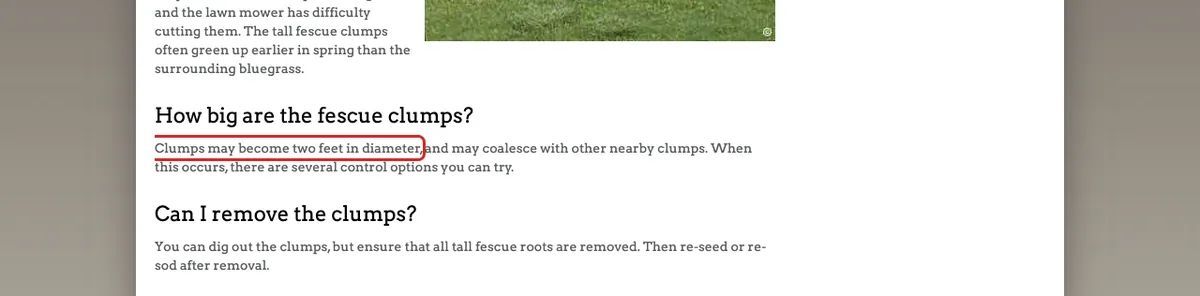
UW-Madison names older pasture tall fescue, with ‘Kentucky 31’ singled out, as the common weed in Kentucky bluegrass, fine fescue and perennial ryegrass lawns: a wider, more rigid blade with a dull upper surface and prominent veins, slightly taller growth, and ragged tips after mowing. Illinois Extension adds the collar check: a short membranous ligule and blunt auricles, wider and shorter than other grasses’, with stiff leaves held close to 90 degrees from the stem. Colorado State says clumps can reach 2 feet across and mowers struggle to cut them.
Seed is the usual route in. UW-Madison tells buyers to read the other-crop and weed seed percentages, which seed labels must disclose by law, and the University of Maryland says orchardgrass arrives the same way, in contaminated seed or straw mulch. Kentucky 31 is still sold for low-maintenance sites; our Kentucky 31 vs turf-type tall fescue trial scores show why it looks coarse next to lawn cultivars.
How to get rid of tall fescue clumps
No selective herbicide takes tall fescue out of a bluegrass lawn: UW-Madison says selective herbicides for perennial grass weeds “are rarely an option”, and the mesotrione it lists for bentgrass and nimblewill works “in Kentucky bluegrass and tall fescue lawns”, leaving the fescue alone. That leaves digging or a nonselective spot spray, then seed.
| Method | When | How | Then | Source |
|---|---|---|---|---|
| Dig it out | After a soaking rain or deep watering; late August if you will reseed | Lift the whole plant 3 to 4 in deep; root pieces left behind resprout | Fill the hole with soil, seed or sod; expect more than one round | UW-Madison; Iowa State |
| Glyphosate spot spray, late summer or fall | Actively growing, above 50°F; UW sprays in August, Iowa State in fall before the first frost | Wet the clump and a few inches beyond; 71995-25 lawn directions: 2.5 fl oz per gallon, 1 gallon per 300 sq ft | Respray if not dead in 2 to 4 weeks (Iowa State); label: reapply if green after 7 days, prepare soil at least 3 days after the last spray | UW-Madison; Iowa State; EPA label 71995-25 |
| Glyphosate spot spray, early spring | As the fescue greens up, before the bluegrass does | Same mix; dormant bluegrass may be relatively unharmed | Reseed or re-sod the dead clumps | Colorado State |
| Spray a rectangle, then sod | Any time the clumps are green | Spray a rectangle around the clumps so the dead area cuts out cleanly | Cut out the dead turf and lay a roll of sod | Colorado State |
| Dig, then spray regrowth | Dig first, wait several weeks | Spray only what regrows | Less herbicide than spraying every clump | Iowa State |
| Tall fescue in a bermudagrass lawn | Summer | Mow bermuda at 1 to 2 in and feed 1 lb N per 1,000 sq ft a month; spot-spray what survives | Selective labels exist but control is ‘hit-or-miss’ and many are for licensed applicators | NC State TurfFiles |
This page summarizes extension advice and one EPA label; it is not a product endorsement. The label is the law: glyphosate kills any lawn grass it wets, so read the current label of the product you buy, and see how long to wait before replanting after each grass killer.
The calculator turns clump count and width into spot area, seed and spray mix, at K-State’s 8 lb per 1,000 sq ft for tall fescue and 3 lb for Kentucky bluegrass.
- Spot area to kill and reseed (sq ft)
- 35.3
- Tall fescue seed at 8 lb per 1,000 sq ft (grams)
- 128
- Tall fescue seed at 8 lb per 1,000 sq ft (ounces)
- 4.52
- Kentucky bluegrass seed at 3 lb per 1,000 sq ft (grams)
- 48
- Spray mix at 1 gallon per 300 sq ft (fl oz)
- 15.1
Default: 20 clumps 12 in across make 35.3 sq ft of spots once a 3 in spray margin is added; that takes 128 g (4.52 oz) of tall fescue seed at 8 lb per 1,000 sq ft or 48 g of Kentucky bluegrass seed at 3 lb, and 15.1 fl oz of spray mix. Seed rates from K-State (2019); spray volume from EPA label 71995-25, read Nov. 2026. The 3 in margin is our assumption for Iowa State's 'a few inches beyond'. Dug clumps need the same seed; skip the spray line.
| Clump width | Spot width with 3 in margin | Spot area (sq ft) | Tall fescue seed, 8 lb rate | Bluegrass seed, 3 lb rate | Spray mix, 1 gal per 300 sq ft |
|---|---|---|---|---|---|
| 6 in | 12 in | 0.79 | 2.9 g | 1.1 g | 0.34 fl oz |
| 12 in | 18 in | 1.77 | 6.4 g | 2.4 g | 0.75 fl oz |
| 18 in | 24 in | 3.14 | 11.4 g | 4.3 g | 1.34 fl oz |
| 24 in | 30 in | 4.91 | 17.8 g | 6.7 g | 2.09 fl oz |
| 36 in | 42 in | 9.62 | 34.9 g | 13.1 g | 4.11 fl oz |
The whole lawn is tufts with bare soil between
That is a bunch-grass stand seeded too thin or unevenly, not a weed. K-State warns that too little seed can “result in clumpy turf”, and sets tall fescue at 6 to 8 lb per 1,000 sq ft for new areas and about half that for overseeding, against 2 to 3 lb for Kentucky bluegrass. It also advises seeding “a little on the heavy side with close overlapping” in passes in opposite directions, because tall fescue does not spread into strips a spreader misses.
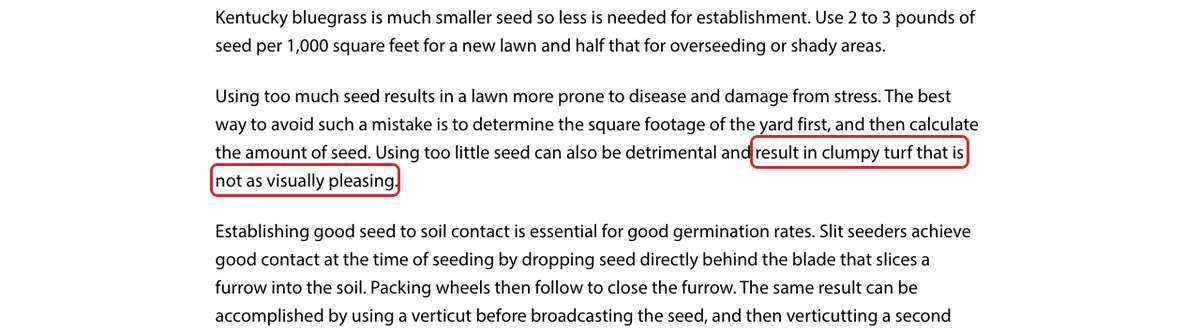
Fertilizer will not close the gaps. K-State’s fix is September overseeding: mow to 1 to 1.5 inches, remove the clippings, then slit-seed in 2 directions or core-aerate 3 to 4 passes before seeding. Our step-by-step overseeding guide with regional dates covers watering and the spring alternative.
Perennial ryegrass behaves the same way: University of Kentucky AGR-52 does not recommend it as a primary lawn grass, partly for “a tendency to be clumpy”, while for tall fescue it says clumping is not a problem once a dense stand is established.
Rhizomatous tall fescue (RTF) is sold as self-repairing. In a Kansas State test, 21 months after a 12-inch circle was cut, an RTF blend with 40 percent Labarinth still had 8.1 inches bare, Kentucky 31 had 9.1 inches and Kentucky bluegrass 0.4 inch; our page on which lawn grasses spread on their own has the full trial. If crowns now sit in lumps above eroded soil, topdress no more than 1/4 inch per pass on cool-season bunch grasses, per our lawn leveling guide.
Orchardgrass, dallisgrass and other grassy-weed clumps
Orchardgrass forms clumps by tillering, per Penn State Extension: light green to bluish-green leaves folded in the bud, a distinct membranous ligule, and no hair on the leaf or collar. K-State adds 1/4 to 1/2 inch blades with a boat-shaped tip, fast vertical growth and shredded tips, and says mesotrione, chlorsulfuron and metsulfuron failed to control it in cool-season turf. Dig 3 to 4 inches deep or spot-spray glyphosate, and seed once it is dead.
Dallisgrass is the warm-region clump. UC IPM Pest Notes 7491 says it widens slowly on short rhizomes whose joints look like concentric rings, the quickest way to tell it from crabgrass, and that its seed sprouts when soil reaches 60 to 65°F. Dig young plants with the rhizomes attached; for larger stands, our dallisgrass herbicide program by lawn type has the fall-start spray schedule.
Crabgrass and goosegrass are summer annuals that die after frost, so a clump that vanishes every winter is one of them. Penn State says goosegrass emerges 3 to 4 weeks after crabgrass and has a flattened white or silver stem base. Yellow nutsedge is not a grass: Purdue TURF-45-W says its stem feels triangular when rolled between the fingers. Quackgrass, by UW-Madison’s description, “does not form bunches or clumps” but runs as single plants on white rhizomes.
Clumps of cut grass on top of the lawn after mowing
If the clumps lift off with a rake, they are clippings. Toro’s 21442 mower manual says wet grass and leaves “tend to clump on the yard”, can plug the mower or stall the engine, and tells owners to avoid mowing in wet conditions. Rake or blow the clumps out once dry; our guide to mowing wet grass has the deck and discharge settings.
How we compiled this
In November 2026 we read 19 primary documents: extension pages and publications from UW-Madison, Iowa State, Colorado State, Illinois, Kansas State, Penn State, Maryland, Kentucky, NC State, Purdue and UC IPM, a Kansas State field study, a Toro operator’s manual and the EPA-accepted 71995-25 glyphosate label. We did not test products or identify grass samples. Calculator spot areas add a 3-inch spray margin, our assumption for Iowa State’s “a few inches beyond”.
Frequently asked questions
How do you get rid of clumpy grass?
Identify it first. Coarse perennial clumps such as tall fescue or orchardgrass are dug 3 to 4 inches deep or spot-sprayed with glyphosate in late summer, then reseeded in late August to early September (UW-Madison). Annual clumps such as crabgrass die at frost and need a preemergent next spring.
How do you fix a clumpy lawn?
If the whole lawn is tufts with soil between, overseed in September at about half the new-lawn rate: 3 to 4 lb of tall fescue per 1,000 sq ft, in passes at right angles (K-State). Fertilizer alone will not close the gaps, because tall fescue and ryegrass do not spread (NC State).
What is the grass that grows in clumps?
Bunch-type grasses: tall fescue, perennial and annual ryegrass, the hard, Chewings and sheep fine fescues, orchardgrass and dallisgrass. Kentucky bluegrass, bermudagrass, zoysiagrass and St. Augustinegrass spread by rhizomes or stolons instead (NC State).
Will clumpy grass spread and fill in on its own?
Not if it is a bunch grass. NC State says spots over 4 inches need replanting and that tall fescue and perennial ryegrass cannot spread; in a Kansas State test, tall fescue plots still had 8 to 9 inches of a 12-inch circle bare after 21 months.
What kills clumping tall fescue but not the rest of the lawn?
In a bluegrass lawn, nothing selective: dig the clumps or spot-spray glyphosate (UW-Madison, Iowa State), or spray as they green up before the bluegrass does (Colorado State). In bermudagrass, NC State mows at 1 to 2 inches and lets summer heat thin the fescue.
Sources
- UW-Madison Extension (Spangenberg; reviewed by Soldat), Perennial Grass Weeds in Lawns, Published March 2026. Accessed November 2026.
- Iowa State University Extension, Yard and Garden, How do I control tall fescue in my lawn?, Updated June 12, 2025. Accessed November 2026.
- Colorado State University Extension, PlantTalk Colorado, 1529, Tall Fescue as a Weed in Bluegrass Lawns, Current page, 2026. Accessed November 2026.
- University of Illinois Extension (Garrett), Identifying Tall Fescue, Grasses at a Glance, May 30, 2023. Accessed November 2026.
- Kansas State University Turfgrass, Fall turfgrass recommendations and tips, August 2019. Accessed November 2026.
- Kansas State University Turfgrass, Not many orchardgrass control options in turfgrass, May 2019. Accessed November 2026.
- Kansas State University (St. John et al.), Establishment rate and lateral spread of tall fescue cultivars and Kentucky bluegrass, 2009; field data 2005 to 2008. Accessed November 2026.
- Penn State Extension, Orchardgrass and Quackgrass, Updated Sept. 19, 2025. Accessed November 2026.
- University of Maryland Extension, Orchardgrass, Updated March 2, 2023. Accessed November 2026.
- UC Statewide IPM Program, Pest Notes: Dallisgrass, Publication 7491, Updated Sept. 2022. Accessed November 2026.
- Penn State Extension, Lawn and Turfgrass Weeds: Smooth Crabgrass and Large Crabgrass, Updated Sept. 10, 2025. Accessed November 2026.
- Penn State Extension, Lawn and Turfgrass Weeds: Goosegrass, June 6, 2025. Accessed November 2026.
- Purdue Extension (Patton), TURF-45-W, A Problem Weed: Controlling Yellow Nutsedge in Lawns, Modified April 21, 2026. Accessed November 2026.
- Purdue Plant and Pest Diagnostic Laboratory, Annual Ryegrass is appearing in many new lawns this spring, 2023. Accessed November 2026.
- University of Kentucky Cooperative Extension, AGR-52, Selecting the Right Grass for Your Kentucky Lawn, Issued August 2019. Accessed November 2026.
- NC State Extension, Extension Gardener Handbook, Chapter 9, Lawns, Current edition. Accessed November 2026.
- NC State Extension, TurfFiles (Vysocka), How Do I Get Tall Fescue Out of My Bermudagrass?, Aug. 28, 2008; updated Oct. 27, 2025. Accessed November 2026.
- U.S. EPA Pesticide Product and Label System (Monsanto), Roundup Weed & Grass Killer Super Concentrate master label, EPA Reg. No. 71995-25, Accepted Jan. 28, 2021. Accessed November 2026.
- The Toro Company, 22in Recycler Lawn Mower 21442 Operator’s Manual, Form 3445-588, 2021. Accessed November 2026.