How to kill dallisgrass: dig small clumps out with their rhizomes, or spot-spray a herbicide labeled for your lawn grass in early fall, again 4 to 6 weeks later and once more in spring. MSMA has been cancelled for home lawns since 2009.
How to kill dallisgrass depends on the grass you want to keep, because each selective herbicide that works on it is labeled for only some lawns. The Tribute Total label allows bermudagrass and zoysiagrass and bans St. Augustinegrass, centipedegrass and tall fescue; the Ornamec Over-The-Top label covers dallisgrass only in tall fescue. Glyphosate works on every lawn and kills the lawn grass it touches.
The top results for this question today are a Reddit thread, YouTube clips, a Facebook group and a herbicide maker’s 4-product article. None sets the label limits next to the measured results. The table below does that for 11 products: EPA Reg. No., the lawn grasses each label allows and the percent control from university field trials in Texas and Tennessee. If you are not yet sure what the clump is, compare it with our identification chart of 20 common lawn weeds, and if it dies back every winter, it is more likely crabgrass, a summer annual with a different control plan.
This page summarizes pesticide labels and published research; it is not a recommendation of any product. The label is the law: read the current label of the exact product you buy, and check whether your state requires a licensed applicator to use it.
Is it dallisgrass or crabgrass? Check 5 marks first
Dallisgrass (Paspalum dilatatum) is a warm-season perennial that grows in clumps from short, thick rhizomes, so it greens up in the same spot every spring, while crabgrass dies at the first fall frost (UT Extension SP642; UC IPM crabgrass). Dig one clump with a trowel: UC IPM says the rhizomes have short joints that look like concentric rings, the quickest way to tell it from crabgrass (UC IPM Pest Notes 7491).
| Mark | Dallisgrass | Crabgrass | Bahiagrass | Source |
|---|---|---|---|---|
| Life cycle | Perennial; regrows from rhizomes for years | Summer annual; dies at first frost | Perennial lawn and pasture grass | UT SP642; UC IPM crabgrass |
| Leaf | Gray-green, 1/4 to 1/2 in. wide, prominent midrib, rolled in the bud | Light green, no prominent midrib | Coarse, light to dark green | UC IPM 7491; UT SP642 |
| Ligule | Membrane about 1/4 in. long (up to 0.2 in. per NC State); no auricles | Membrane; no auricles | Short membrane with hairs | UC IPM 7491; NC State TurfFiles |
| Seedhead | Stalk 1 to 5 ft unmowed with 2 to 10 drooping branches set alternately; hairy spikelets in rows | 3 to 11 finger-like spikes leaving the stem 1/8 to 1/4 in. apart | 2 spikes (sometimes 3) in a V or Y | UC IPM 7491; UC IPM crabgrass; our bahia grass guide |
| Underground | Short rhizomes with ring-like joints | No rhizomes; roots at stem nodes | Short, stout stolons and shallow rhizomes | UC IPM 7491; UC IPM crabgrass |
| Does a crabgrass preventer stop it? | Only new seedlings; established clumps regrow | Yes, if applied before germination | Not a control target in bahia lawns | Texas A&M SCSC-PU-162; UC IPM 7491 |
NC State notes that field paspalum and thin paspalum look so much like dallisgrass that they are often misnamed, and the Manuscript label gives thin leaf paspalum a program of its own (NC State TurfFiles). A coarse, dark tuft that stays green all winter in a fescue lawn may be pasture-type tall fescue; our tall fescue profile shows how Kentucky 31 clumps differ from turf types.
Which herbicide kills dallisgrass without killing your lawn?
Match the label to your lawn grass first, then the timing. Of the 9 selective products below, 6 carry dallisgrass directions usable on bermudagrass lawns, 1 (Recognition) on St. Augustinegrass and centipedegrass lawns, 1 on tall fescue home lawns and none on bahiagrass, Kentucky bluegrass or perennial ryegrass lawns. Most promise only suppression, which the Monument 75WG label defines as significant activity, but not always at a level considered acceptable for commercial weed control.
| Product (EPA Reg. No.) | Active ingredient | Lawn grasses on the label | What the label says about dallisgrass | Rate on the label | Measured result (source) |
|---|---|---|---|---|---|
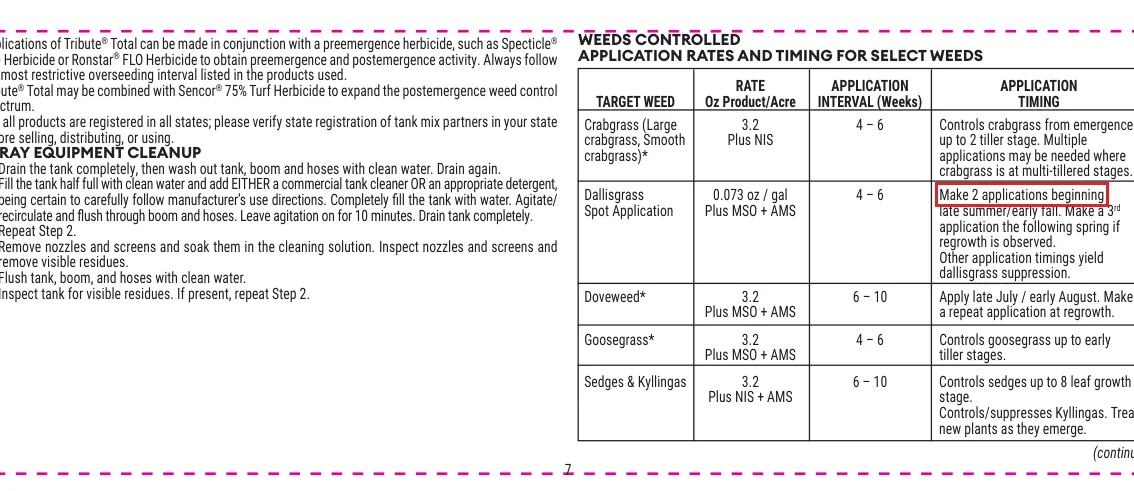
| Tribute Total (101563-147) | Thiencarbazone-methyl + foramsulfuron + halosulfuron-methyl | Bermudagrass, zoysiagrass; residential and commercial lawns | Control: 2 sprays 4 to 6 weeks apart from late summer or early fall, a 3rd next spring if regrowth; other timings give suppression | Spot 0.073 oz per gal + MSO + AMS; max 6.4 oz per acre a year | 92 to 97% at 37 weeks (Sept. then Oct.); 39 to 55% for one Oct. spray (Johnston and Henry) |
| Celsius WG (101563-141) + Revolver | Thiencarbazone-methyl + iodosulfuron + dicamba | Bermudagrass, zoysiagrass, St. Augustinegrass, centipedegrass, buffalograss | Suppress and/or control when mixed with Revolver at 2 fl oz per gal and MSO 1%, late summer or early fall; repeat if regrowth 30 to 60 days later | 0.085 to 0.113 oz (2.4 to 3.2 g) per gal, 1 gal per 1,000 sq ft; max 0.17 oz per 1,000 sq ft a year | 93% at 37 weeks, 2 sprays with foramsulfuron (Johnston and Henry) |
| Revolver (101563-53) | Foramsulfuron | Bermudagrass, zoysiagrass; buffalograss spot only; home lawns listed | Suppression, spot only, late summer or early fall; 2nd spot 7 to 14 days later, 3rd if regrowth | 1.5 to 2.0 fl oz per gal, spray to wet | 48% at 37 weeks alone (Johnston and Henry) |
| Monument 75WG (100-1134) | Trifloxysulfuron-sodium | Bermudagrass, zoysiagrass, buffalograss incl. home lawns (not California); St. Augustinegrass sod farms only | Suppression; repeat in 4 to 6 weeks | 0.53 oz per acre (15 g) | Less control than Revolver or Tribute Total (Texas A&M) |
| Recognition (100-1658) | Trifloxysulfuron-sodium 20.4% | Bermudagrass, zoysiagrass, buffalograss, St. Augustinegrass, centipedegrass, kikuyugrass; residential lawns except California | Suppression; repeat after 4 to 6 weeks if needed | 1.95 oz per acre (0.045 oz per 1,000 sq ft) + nonionic surfactant | No published dallisgrass percentage found |
| Manuscript (100-1626) | Pinoxaden | Bermudagrass, zoysiagrass incl. home lawns; St. Augustinegrass sod farms only | Control program: 19.2 fl oz per acre late summer or early fall, then Monument 0.53 oz per acre 4 to 6 weeks later and next spring; Adigor or MSO required | 19.2 fl oz per acre broadcast | UT: spot sprays 3 to 4 weeks apart needed for eradication (SP642) |
| Certainty (59639-226) | Sulfosulfuron | Bermudagrass (dallisgrass section) | Suppression only, mixed or rotated with MSMA at 2 lb a.i. per acre | 1.25 to 2.0 oz per acre | UC IPM: not an effective home-lawn dallisgrass treatment without MSMA (7491) |
| Fusilade II T&O (100-1084) | Fluazifop-P-butyl | Tall fescue, zoysiagrass; label says not for use on home lawns | Grass weeds in zoysia and tall fescue; repeat every 28 days; avoid July and August | 3 to 6 fl oz per acre | 79 to 93% at 52 weeks when sprayed at 175 GDD or 5 CDD (Elmore et al. 2013) |
| Ornamec Over-The-Top (2217-728) | Fluazifop-P-butyl 6.75% | Tall fescue for dallisgrass; not for California turf uses | One spring spray at 270 to 360 GDD from Jan. 1; label: effective control only in that range | 0.6 fl oz per 1,000 sq ft; spot 0.6 fl oz + 1/3 fl oz nonionic surfactant per gal per 1,000 sq ft | Same active ingredient as Fusilade II (Elmore et al. 2013) |
| MSMA (EPA MSMA page) | Monosodium methanearsonate | Not lawns: sod farms, golf course spots, highway rights-of-way, cotton | Home lawn use cancelled in 2009 | 2 lb a.i. per acre (Texas A&M) | 60 to 80% for up to 9 months, 3 sprays (Texas A&M) |
| Glyphosate, e.g. Roundup Super Concentrate (71995-25) | Glyphosate | Non-selective: kills any lawn grass it touches | Spot spray; or one spray on fully dormant bermudagrass while dallisgrass is still green | 2.5 fl oz per gal over 300 sq ft (tough weeds); lawn grass may be planted 3 days after | No percentage; UC IPM calls spot sprays often the fastest, easiest and cheapest option (7491) |
Three label details change the answer for many homeowners. The Celsius WG label says it is intended for licensed commercial applicators, and Texas A&M notes that its dallisgrass claim applies only with Revolver, which St. Augustinegrass and centipedegrass do not tolerate; applied alone there, Texas A&M calls it the only selective option that suppresses dallisgrass (Texas A&M). Monument and Recognition exclude California home lawns, and Fusilade II excludes all home lawns, which is why fluazifop reaches fescue lawns as Ornamec. Licensing rules by state are in our guide to the pesticide applicator license for lawn care.
1Does the clump die at the first frost and show no rhizomes when dug?
YesProbably crabgrass or another annual: a preemergent before spring germination, not this program.
NoGo to the next question
2Only a few clumps, or young plants without rhizomes?
YesDig each clump out with all rhizomes, backfill with topsoil and seed or plug the hole (UC IPM; Texas A&M).
NoGo to the next question
3Is the lawn bermudagrass or zoysiagrass?
YesTribute Total spot spray, or Celsius WG plus Revolver: first spray when the 24-hour average stays below 72°F for 3 days, second 4 to 6 weeks later, third at spring green-up (labels; Texas A&M).
NoGo to the next question
4Is the lawn St. Augustinegrass or centipedegrass?
YesRecognition (suppression on its label) or Celsius WG alone as a spot spray, per Texas A&M; or glyphosate spots and re-sod.
NoGo to the next question
5Is the lawn tall fescue?
YesOrnamec Over-The-Top at 0.6 fl oz per 1,000 sq ft once spring degree days reach 270 to 360, then overseed bare spots in fall.
NoBahiagrass, Kentucky bluegrass, ryegrass or a mixed lawn: no selective label option. Spot-spray glyphosate or dig, then reseed or re-sod (UC IPM).
Source: Herbicide labels; Texas A&M SCSC-PU-162; UC IPM 7491
What did the university trials measure?
The clearest numbers come from Texas Tech, where Johnston and Henry sprayed mature dallisgrass in bermudagrass at Lubbock in the falls of 2010 and 2011 and rated it 10 and 37 weeks later (HortScience 51(6), 2016). At 10 weeks no program looked good: every single Tribute Total spray rated 35% or lower. By the next summer, sequential sprays rated 92 to 97%.
Swipe the table sideways to see every column.
| Program | Turf, place, years | Dallisgrass control | Rated after | Source |
|---|---|---|---|---|
| Tribute Total, low rate, 2 sprays (Sept. then Oct.) | Bermudagrass, Lubbock TX, 2010 to 2012 | 92% | 37 weeks | Johnston and Henry 2016 |
| Tribute Total, high rate, 2 sprays (Sept. then Oct.) | Bermudagrass, Lubbock TX, 2010 to 2012 | 97% | 37 weeks | Johnston and Henry 2016 |
| Tribute Total, high rate, 1 spray in Sept. | Bermudagrass, Lubbock TX, 2010 to 2012 | 94% | 37 weeks | Johnston and Henry 2016 |
| Tribute Total, low rate, 1 spray in Sept. | Bermudagrass, Lubbock TX, 2010 to 2012 | 82% | 37 weeks | Johnston and Henry 2016 |
| Tribute Total, 1 spray in Oct. (either rate) | Bermudagrass, Lubbock TX, 2010 to 2012 | 39 to 55% | 37 weeks | Johnston and Henry 2016 |
| Foramsulfuron (Revolver), 2 sprays | Bermudagrass, Lubbock TX, 2010 to 2012 | 48% | 37 weeks | Johnston and Henry 2016 |
| Foramsulfuron + Celsius, 2 sprays | Bermudagrass, Lubbock TX, 2010 to 2012 | 93% | 37 weeks | Johnston and Henry 2016 |
| Any single Tribute Total spray, early rating | Bermudagrass, Lubbock TX, 2010 to 2012 | 35% or less | 10 weeks | Johnston and Henry 2016 |
| Tribute Total, 2 fall sprays + 1 spring spray | Bermudagrass, Knoxville TN, 2012 to 2013 | 79 to 88% | 41 weeks | Elmore, Golfdom 2015 |
| Tribute Total, 2 fall sprays, no spring spray | Bermudagrass, Knoxville TN, 2012 to 2013 | under 50% | 41 weeks | Elmore, Golfdom 2015 |
| Fluazifop, 1 spray at 175 GDD or 5 CDD | Tall fescue, Knoxville TN, 2010 and 2011 | 79 to 93% | 52 weeks | Elmore et al. 2013 |
| Fluazifop, 1 spray at 75, 375 or 775 GDD (2010) | Tall fescue, Knoxville TN | under 50% | 52 weeks | Elmore et al. 2013 |
| Mesotrione, tembotrione or topramezone alone | Tall fescue, Knoxville TN, 2010 and 2011 | under 65% | 52 weeks | Elmore et al. 2013 |
| Tribute Total, 3 sprays (2 fall, 1 spring) | Texas research summary | 60 to 80% | 9 months | Texas A&M SCSC-PU-162 |
| MSMA 2 lb a.i. per acre, 3 sprays | Texas research summary | 60 to 80% | up to 9 months | Texas A&M SCSC-PU-162 |
| Fluazifop, 1 fall spray | Tall fescue, Texas research summary | over 80% | 12 months | Texas A&M SCSC-PU-162 |
Two lessons hold across the studies. Timing beat product choice: pooled across rates, one September Tribute Total spray gave 88% control the next summer and one October spray gave 47% (Johnston and Henry). And the spring follow-up matters: in Knoxville, 2 fall sprays without a spring spray left control under 50% (Elmore, Golfdom). The popular topramezone (Pylex) idea did not hold up for dallisgrass in tall fescue, rating under 65% alone (Elmore et al. 2013).
When should you spray dallisgrass?
Start in early fall, when dallisgrass is still growing but moving sugars down to its rhizomes. Texas A&M sets the trigger: not before September, once the 24-hour average air temperature stays below 72°F for 3 days in a row, which falls in mid to late September in the Panhandle and North Texas and can slip into October in Central and South Texas (Texas A&M SCSC-PU-162). UC IPM uses about 70°F (UC IPM 7491).
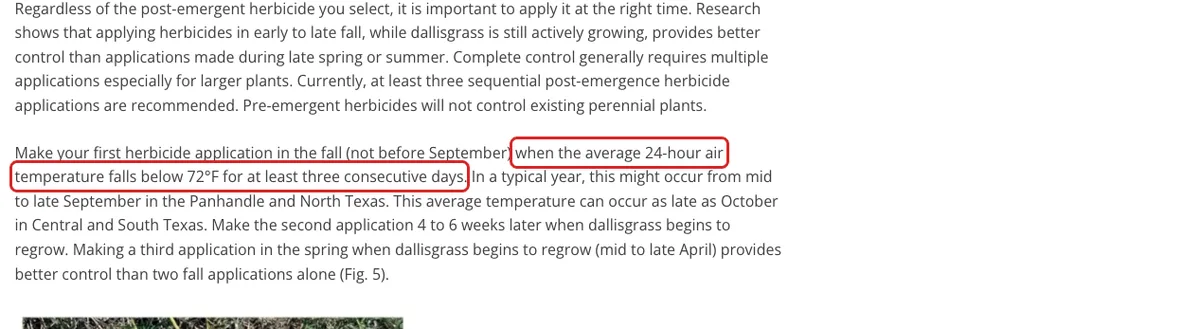
For bermudagrass and zoysiagrass lawns, the label and extension timings line up into one 3-spray program. Rates below are the Tribute Total label spot rate; swap in your product’s own label rate.
- Late August: flag every clump and stop any herbicide program that stresses the lawn; the Tribute Total label says not to spray turf under drought stress.
- First spray when the 24-hour average drops below 72°F for 3 days (Texas A&M): 0.073 oz Tribute Total per gallon with methylated seed oil at 0.5 to 1% and ammonium sulfate, sprayed until wet but not running off.
- Second spray 4 to 6 weeks later, when the clumps start to regrow (label and Texas A&M).
- Third spray next spring when the dallisgrass greens up: mid to late April in Texas, or 200 to 500 GDD in the Knoxville work, with 270 GDD suggested (Elmore, Golfdom).
- Judge the result in June, not in December: the label says control often shows only the following spring, and the Lubbock plots rated 35% or less at 10 weeks.
- Fill the holes. Bermudagrass and zoysiagrass spread in; tall fescue spots need seed, which Texas A&M says can go down 2 weeks or more after a fall fluazifop spray.
Tall fescue: count degree days for Ornamec
The Ornamec Over-The-Top label times its single dallisgrass spray by growing degree days: each day, add the high and low in °F, divide by 2 and subtract 50, counting from January 1 and ignoring zero or negative days; spray when the total reaches 270 to 360. A day at 68°F and 44°F adds (68 + 44) / 2 minus 50 = 6 GDD. Syngenta puts that window in the transition zone’s spring, and the Golfdom summary dates 270 GDD to late March through mid-April (Greencast, March 2026; Golfdom).
The research also found a fall window for fluazifop: one spray at 10 to 200 cooling degree days, typically mid-September to mid-October in the transition zone, gave over 80% control at 52 weeks (Elmore, Golfdom). The Ornamec label’s dallisgrass directions name only the spring range, so on a home lawn the label timing governs; a fall spray of a fescue-labeled fluazifop product for other grass weeds is a separate label use.
How much product goes in a spot sprayer?
Spot-treatment rates are written per gallon of water, and the numbers are small: Tribute Total’s 0.073 oz is about 2 grams. Pick your product and enter your sprayer volume; the tool multiplies the label’s per-gallon rate. At the default 1 gallon, that is 0.073 oz of Tribute Total, 0.085 to 0.113 oz of Celsius WG plus 2 fl oz of Revolver, or 0.6 fl oz of Ornamec.
- Product to measure (oz for dry, fl oz for liquid, as in the item you picked)
- 0.073
Default: 1 gallon of Tribute Total spot mix needs 0.073 oz of product. Rates from the labels linked on this page, read November 2026. Adjuvants (MSO, AMS, surfactant) are extra; your container's label overrides this tool.
Why can’t you use MSMA on a lawn anymore?
EPA cancelled MSMA use on residential lawns, athletic fields, parks, forestry, non-bearing fruit and nut trees and citrus in 2009, citing organic arsenic that converts to inorganic arsenic in soil and can reach drinking water (EPA MSMA page, updated July 17, 2026). The cancellation order ran in the Federal Register on Sept. 30, 2009; distributors could sell lawn-labeled stock bought before Dec. 31, 2009 until Dec. 31, 2010 (Arkansas FSA6145).
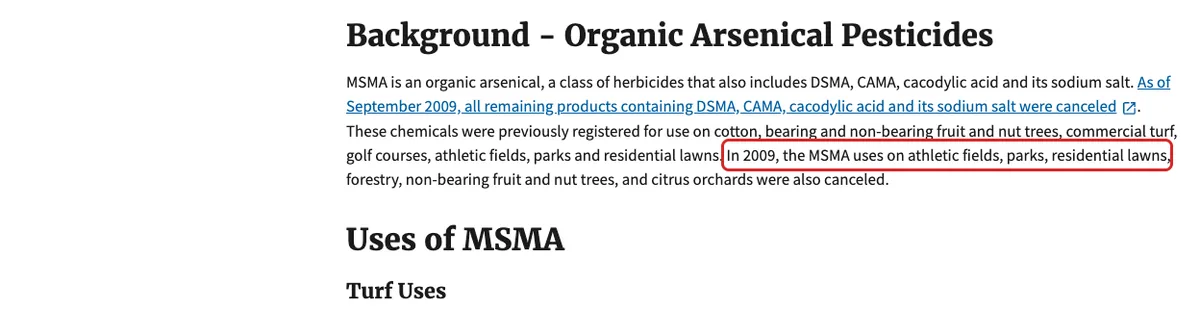
MSMA is still registered for 4 sites, under limits EPA lists: golf courses (spots of 100 sq ft, no more than 25% of the course a year), sod farms (1 to 2 broadcast sprays a season, 25-ft buffer from water), highway rights-of-way (2 sprays a year, 100-ft buffer) and cotton, and it may not be used in Florida except on cotton in 12 counties. EPA had set Dec. 31, 2013 as the end date for the turf uses, then postponed it pending a review of arsenic’s cancer mode of action (EPA). The same rule blocks MSMA on other perennial grass weeds; our johnsongrass control guide covers the label side.
Does Roundup kill dallisgrass, and can you dig it out?
Yes to both, at the cost of the lawn grass around it. On bermudagrass lawns there is one low-damage glyphosate window: bermudagrass goes dormant before dallisgrass, so a spot spray after the bermudagrass is fully brown but while dallisgrass leaves still show green can work, and UT Extension says that window usually lasts only about 2 weeks (UT SP642). Texas A&M sees it in the Panhandle and sometimes North Texas and pairs it with a spring selective spray (Texas A&M).
In a growing lawn, glyphosate kills every blade it wets. The Roundup Weed & Grass Killer Super Concentrate label (71995-25) calls for 2.5 fl oz per gallon on tough perennial weeds, sprayed over 300 sq ft, and allows planting lawn grass 3 days later; that label does not name dallisgrass, so choose a glyphosate label that lists it, as UC IPM advises. Our page on whether Roundup kills lawn grass covers drift and replanting.
Digging works best on young plants before they form rhizomes or set seed (UC IPM 7491). Texas A&M’s method: take the whole clump and its rhizomes with a shovel, backfill with topsoil and seed or plug the hole (Texas A&M). Clumps dug in summer and left on the surface do not regrow once every rhizome dries, and summer solarization under clear plastic cuts both seed and rhizome regrowth, per UC IPM.
How do you stop dallisgrass from coming back?
New dallisgrass comes from seed that sprouts once soil reaches 60 to 65°F in spring and summer (UC IPM 7491). UC IPM says crabgrass preemergents such as dithiopyr, prodiamine and pendimethalin also stop dallisgrass seedlings when watered in with about 1/2 inch of water; they do nothing to established clumps. Our guide to crabgrass killers that spare the lawn lists the products by lawn type.
UC IPM ties dallisgrass to low-maintenance turf watered with large amounts at long intervals, and notes that it responds strongly to nitrogen. Its prevention list: clean mowers after cutting infested sites, inspect sod before delivery and delay spring aeration where seed is in the soil. In tall fescue, fall interseeding raised fluazifop control at 4 of the timings tested (Elmore et al. 2013). Torpedograss, another rhizome-spreading weed grass of southern lawns, has its own plan in our guide to getting rid of torpedograss.
How we compiled this
In November 2026 we read 10 herbicide labels (current Envu or Syngenta copies, EPA-stamped PDFs and the PBI-Gordon specimen label dated 9-2026), EPA’s MSMA page and its 2009 Federal Register notice, 5 extension publications from UT, Texas A&M, UC IPM, Arkansas and NC State, and 2 peer-reviewed field studies. Percent control figures are the trial authors’ visual ratings; we sprayed and tested nothing. Prices are left out because these products sell through distributors at changing prices.
Frequently asked questions
How do you kill dallisgrass without killing grass?
Use a selective herbicide labeled for your lawn grass, sprayed in early fall, 4 to 6 weeks later and next spring. On bermudagrass or zoysiagrass that means products such as Tribute Total or Celsius WG plus Revolver; on tall fescue, fluazifop as Ornamec Over-The-Top.
What can I spray on dallisgrass to kill it?
Tribute Total is the one label we read that claims dallisgrass control on its own, on bermudagrass and zoysiagrass only. Most others claim suppression. Glyphosate kills it on any lawn but kills the lawn grass it touches as well.
Is dallisgrass hard to get rid of?
Yes. UT Extension says adequate control takes multiple applications over a two-year period, and UC IPM says eradication may take 2 to 3 years. In heavy infestations both suggest renovating the lawn instead.
Can Roundup kill dallisgrass?
Yes, as a spot spray, but it also kills the surrounding lawn. On bermudagrass, one spray after the bermudagrass is fully dormant while dallisgrass is still green limits the damage; UT says that window is about 2 weeks.
What will kill dallisgrass but not Bermuda?
Labels that allow bermudagrass and name dallisgrass include Tribute Total, Celsius WG with Revolver, Revolver, Monument 75WG, Recognition and Manuscript. In the Lubbock trial, two fall sprays of Tribute Total rated 92 to 97% control the next summer.
How do you kill dallisgrass in St. Augustine?
Options are narrow. Recognition’s label lists dallisgrass suppression on St. Augustinegrass, and Texas A&M says Celsius WG alone, as a spot spray, suppresses it there. Otherwise dig it out or spot-spray glyphosate and re-sod the gap.
Sources
- Envu, Tribute Total Herbicide label, EPA Reg. No. 101563-147, current label. Accessed November 2026.
- Envu, Celsius WG Herbicide label, EPA Reg. No. 101563-141, label leaflet 2023. Accessed November 2026.
- U.S. EPA (Envu), Revolver Herbicide label, EPA Reg. No. 101563-53, Nov. 20, 2024. Accessed November 2026.
- U.S. EPA (Syngenta), Monument 75WG Herbicide label, EPA Reg. No. 100-1134, June 30, 2021. Accessed November 2026.
- U.S. EPA (Syngenta), Recognition label, EPA Reg. No. 100-1658, Feb. 16, 2024. Accessed November 2026.
- U.S. EPA (Syngenta), Manuscript label, EPA Reg. No. 100-1626, Aug. 17, 2018. Accessed November 2026.
- U.S. EPA (Nufarm), Certainty Turf Herbicide label, EPA Reg. No. 59639-226, Aug. 9, 2021. Accessed November 2026.
- U.S. EPA (Syngenta), Fusilade II Turf and Ornamental Herbicide label, EPA Reg. No. 100-1084, Feb. 18, 2014. Accessed November 2026.
- PBI-Gordon, Ornamec Over-The-Top Grass Herbicide specimen label, EPA Reg. No. 2217-728, label 9-2026. Accessed November 2026.
- U.S. EPA (Monsanto), Roundup Weed & Grass Killer Super Concentrate master label, EPA Reg. No. 71995-25, Jan. 28, 2021. Accessed November 2026.
- U.S. EPA, Monosodium Methanearsonate (MSMA), an Organic Arsenical, updated July 17, 2026. Accessed November 2026.
- Federal Register, Organic Arsenicals; Product Cancellation Order and Amendments to Terminate Uses, Sept. 30, 2009. Accessed November 2026.
- University of Arkansas Cooperative Extension (Brosnan, Breeden, Patton), The Turfgrass Industry Officially Loses MSMA, FSA6145, undated PDF. Accessed November 2026.
- UT Extension (Breeden, Brosnan), Dallisgrass, SP 642, Feb. 2019. Accessed November 2026.
- Texas A&M AgriLife Extension (Elmore, Reynolds), Dallisgrass in Turfgrass: Control Guidelines for Professionals, SCSC-PU-162, Dec. 2015. Accessed November 2026.
- UC IPM (LeStrange, Roncoroni), Pest Notes: Dallisgrass, Publication 7491, updated Sept. 2022. Accessed November 2026.
- UC IPM, Pest Notes: Crabgrass, current page. Accessed November 2026.
- NC State Extension (Yelverton), Dallisgrass, TurfFiles, Nov. 8, 2017. Accessed November 2026.
- Johnston, C.R. and G.M. Henry, HortScience 51(6):754 to 756, Dallisgrass (Paspalum dilatatum) Control with Thiencarbazone-methyl, Foramsulfuron, and Halosulfuron-methyl in Bermudagrass Turf, June 2016. Accessed November 2026.
- Elmore, M.T. et al., Weed Technology 27:557 to 564, Seasonal Application Timings Affect Dallisgrass (Paspalum dilatatum) Control in Tall Fescue, 2013. Accessed November 2026.
- Golfdom (M. Elmore), Dallisgrass growth, identification and control, 2015. Accessed November 2026.
- Syngenta Greencast (L. Tredway), Four solutions for dallisgrass management in warm- and cool-season turf, March 18, 2026. Accessed November 2026.