Bahia grass is a coarse, deep-rooted warm-season grass for sunny, sandy, acidic Southern lawns: plant Argentine seed or sod, mow at 3 to 4 inches and feed just 1 to 2 lb of nitrogen per 1,000 sq ft yearly.
Key takeaways
- UF/IFAS recommends bahiagrass lawns get only 1 to 2 lb of nitrogen per 1,000 sq ft a year in every Florida region, mowed every 7 to 14 days at 3 to 4 inches with a rotary mower (UF/IFAS LH006, revised May 2026).
- Bahiagrass sod averaged 17 cents per sq ft at Florida farms in 2024, the lowest price of any grass in the survey, against 29 to 33 cents for St. Augustinegrass (UF/IFAS EP658).
- Argentine is the usual lawn cultivar: denser and darker than Pensacola, with shorter, less dense seedheads, and its apomictic seed comes up true to type (UF/IFAS LH006).
- Metsulfuron, one of the few herbicides that selectively removes bahia from other lawns, provides up to 90 percent control of Pensacola bahiagrass but very little suppression of Argentine (UF/IFAS FR400; UF/IFAS AG243).
- Bahia fails on high-pH soil (iron deficiency above pH 7.0), in salt (UF/IFAS rates its salt tolerance very poor) and under traffic, and its worst insect pest is the mole cricket (UF/IFAS LH006; UF/IFAS LH005).
3 to 4 in mowing height, rotary mower (UF/IFAS LH006)
1 to 2 lb nitrogen per 1,000 sq ft a year (UF/IFAS LH006)
5 to 10 lb seed per 1,000 sq ft (UF/IFAS LH013)
17¢ per sq ft, Florida farm sod, 2024 (UF/IFAS EP658)
| Key number | Value | Source |
|---|---|---|
| Scientific name | Paspalum notatum Flugge, a warm-season perennial from South America | UGA B1362 |
| Mowing height and interval | 3 to 4 in, every 7 to 14 days in active growth | UF/IFAS LH006 |
| Annual nitrogen, Florida lawns | 1 to 2 lb per 1,000 sq ft (LH006); 1 to 3 north and central, 1 to 4 south (EP353) | LH006; EP353 |
| Quick-release nitrogen cap per application, Florida | 0.7 lb per 1,000 sq ft (Rule 5E-1.003, F.A.C.) | UF/IFAS LH006 |
| Seeding rate | 5 to 10 lb per 1,000 sq ft | UF/IFAS LH013 |
| Seed that germinates within 30 days | 50 to 60 percent (TifQuik: most in 1 to 2 weeks) | UGA B1362 |
| Soil pH | Target 5.5; grows at 4.5 to 6.5; yellow and stunted above 6.5 | UF/IFAS AG342 |
| Florida sod price at the farm, 2024 | 17¢ per sq ft (north 22¢, central 17¢, south 12¢) | UF/IFAS EP658 |
| Florida sod acres in production, 2024 | 12,110, second only to St. Augustinegrass | UF/IFAS EP658 |
| Mole cricket action threshold | 2 or more surfacing within 3 minutes of a soap flush on 4 sq ft | UF/IFAS IN1021 |
What is bahia grass, and where does it grow?
Bahia grass (Paspalum notatum) is a long-lived, deep-rooted warm-season perennial from South America that the University of Georgia says grows extensively across the southeastern United States, mostly as pasture (UGA Extension B1362). It spreads by short, stout stolons and shallow rhizomes, sets abundant seed and persists on infertile sandy soil where other lawn grasses decline.
Florida is its center of gravity. UF/IFAS puts bahiagrass on about 2.5 million acres of Florida pasture, and AG342 adds more than four million acres across the Southeast (UF/IFAS AG243; UF/IFAS AG342). Alabama Extension counts about 1 million acres in that state (Alabama Extension ANR-2666). The NC State Plant Toolbox lists it for USDA hardiness zones 8a to 10b (NC State Plant Toolbox).
As a lawn grass, its footprint is smaller but still large: Florida farms had 12,110 acres of bahiagrass sod in production in 2024, two-thirds of it (8,120 acres) in south Florida (UF/IFAS EP658, Table 1). Profiles of the other Southern lawn grasses are in our Turf & Trees section.
| Florida region | Bahiagrass sod acres, 2024 | Farm price, 2024 (¢ per sq ft) | Source |
|---|---|---|---|
| North Florida (north of Ocala) | 1,625 | 22 | UF/IFAS EP658 |
| Central Florida | 2,365 | 17 | UF/IFAS EP658 |
| South Florida | 8,120 | 12 | UF/IFAS EP658 |
| State total or average | 12,110 | 17 | UF/IFAS EP658 |
What does bahia grass look like?
Bahia grass looks like an open, coarse, light-to-dark green turf topped in summer by thin stalks carrying a V- or Y-shaped seedhead of two spike-like racemes. NC State describes leaves up to 12 inches long and 0.2 inch wide with a sharp tip, and seed stalks up to 2 feet tall (NC State Plant Toolbox). Clemson calls the Y-shaped head its easiest identifying mark (Clemson HGIC 2316).
- Seedhead: two racemes (occasionally a third) forming a V or Y, often dusted with purple anthers in bloom (UF/IFAS AG342).
- Leaves and sheath: blades rolled in the bud, sometimes folded, with a few hairs on the margin near the base; the sheath is open, sharply creased and glossy (NC State Plant Toolbox).
- Runners: short, stout stolons and shallow rhizomes (UGA B1362); Clemson advises hand pulling only in moist soil so the roots come out (Clemson HGIC 2316).
- Argentine vs Pensacola: Pensacola has much narrower leaves than Argentine; Argentine is wider and darker green (UGA B1362, Figure 2).
Bahia is easiest to identify in summer, when UF/IFAS says seedhead production is heaviest during the long days (UF/IFAS LH006). Outside that window, check the leaf width: Pensacola types run about 0.2 inch wide, and Argentine leaves are wider and darker (NC State; UGA B1362).
Is bahia grass a lawn grass or a weed?
Bahia grass is both, depending on which state’s extension service you ask. UF/IFAS publishes a full lawn guide and calls bahia a good choice for large lots or anywhere without irrigation (UF/IFAS LH006), while NC State says it is never recommended as a lawn grass because of its open canopy, seedheads and hard mowing (NC State Extension Gardener Handbook). The table shows each position.
| Extension service | Position on bahia lawns | Key reason given | Source |
|---|---|---|---|
| UF/IFAS (Florida) | Recommended low-input lawn grass; Argentine preferred | Persists on infertile sand with little water or fertilizer | LH006 |
| NC State (North Carolina) | Never recommended for lawns; often a weed | Open canopy, unsightly seedheads, hard to mow; cold tolerance rated poor | Gardener Handbook, Table 9-1 |
| Clemson (South Carolina) | Treated as a weed in lawns (called highwaygrass) | Aggressive spread by seed and rhizomes | HGIC 2316 |
| University of Georgia | Pasture, hay and erosion grass | Most grazing-tolerant forage in Georgia | B1362 |
| Alabama Extension | Pasture, hay and seed crop | Low-input forage on about 1 million acres | ANR-2666 |
The split follows climate and soil. Bahia earns its place on Florida’s deep, acidic sands, where UF/IFAS rates its drought and nematode tolerance excellent (UF/IFAS LH005). In North Carolina, NC State rates its cold tolerance 2 of 6 (poor) and recommends other warm-season lawn grasses instead, so extension services there treat bahia as something to remove (NC State Table 9-1).
What are the downsides of bahia grass?
The downsides of bahia grass are an open, low-density canopy, tall seedheads that force mowing every 7 to 14 days in summer, poor wear tolerance, very poor salt tolerance and yellowing on soils above pH 7.0. UF/IFAS lists each of these, and adds that bahia turns brown in drought dormancy rather than staying green (UF/IFAS LH005; UF/IFAS LH006).
- Looks: UF/IFAS says current varieties do not produce a carpet-like, dense lawn, and LH005 rates bahia’s density low (LH006; LH005).
- Mowing: tough leaves and seed stalks need a sharp, heavy-duty rotary blade sharpened regularly (LH006); our guide to sharpening a lawn mower blade covers the method.
- Herbicides: weed-and-feed products containing atrazine or metsulfuron damage bahiagrass, and no herbicide selectively removes grassy weeds from it (LH006).
- Cold: NC State rates its cold tolerance 2 on a 1 to 6 scale (poor) (NC State Table 9-1).
Which bahia grass variety should you plant: Argentine, Pensacola or another?
For a lawn, plant Argentine bahia grass: UF/IFAS prefers it for turf because it forms a denser, darker sod with fewer, shorter seedheads than Pensacola and comes true from seed (UF/IFAS LH006). Pensacola is the hardier, cheaper seed for roadsides, pastures and north Florida, and Tifton 9, TifQuik and UF-Riata are forage selections bred from Pensacola. UF/IFAS Gardening Solutions also names Argentine as the popular home-lawn cultivar (UF/IFAS Gardening Solutions).
| Cultivar | Origin or release | Ploidy | Cold tolerance | Seed production and seedheads | Best use | Metsulfuron response | Mole cricket rating | Source |
|---|---|---|---|---|---|---|---|---|
| Argentine | Introduced from Argentina, 1944 | Tetraploid | Lower than Pensacola; loses color sooner in fall | Fair; fewer, shorter heads than Pensacola | Preferred lawn type in Florida | Very little suppression | Tolerant (can be low) | UF LH006; UGA B1362; Alabama ANR-2666; UF AG243; UF IN1021 |
| Pensacola | Found near Pensacola, Fla., docks, mid-to-late 1930s | Diploid | Good; holds color into fall | Good; more and taller heads than Argentine | Roadsides, pastures, low-budget lawns | Up to 90% control, regrows | Susceptible | UF LH006; UF AG342; Alabama ANR-2666; UF AG243; UF IN1021 |
| Tifton 9 | Pensacola selection, UGA and USDA, 1987 (UGA) or 1989 (UF) | Diploid | Good | Excellent | Forage; upright, thin sod | Severely injured (diploid) | Susceptible | UGA B1362; UF AG342; Alabama ANR-2666; UF IN1021 |
| TifQuik | From Tifton 9, USDA-ARS and UGA, selected for fast germination | Diploid | Excellent | Excellent | Forage; fastest germination | Severely injured (diploid) | Not rated | USDA ARS; Alabama ANR-2666; UF AG342 |
| UF-Riata | Pensacola selection, University of Florida, 2007 | Diploid | Good; longest growing season | Excellent | Forage | Severely injured (diploid) | Not rated | UF AG342; Alabama ANR-2666 |
| AU Sand Mountain | Pensacola selection, Auburn University | Diploid | Most winter-hardy tested in Georgia | Good | Forage, north Alabama and Georgia | Not rated | Susceptible (as Sand Mountain) | UGA B1362; Alabama ANR-2666; UF IN1021 |
| Wilmington | Collected in coastal North Carolina | Tetraploid | Cold-tolerant | Not rated | Narrow, dark leaves; UF says it may have turf potential | Not rated | Not rated | UF AG342 |
| Paraguay 22 | Introduced from Paraguay | Tetraploid | Less than Pensacola | Not rated | Former general-purpose turf; seed no longer sold | Very little suppression | Tolerant (can be low) | UGA B1362; UF AG342; UF IN1021 |
| Common | First introduced to Florida, 1913 | Tetraploid | Very susceptible to cold | Not rated | Not recommended for lawns | Very little suppression | Not rated | UF LH006; UF AG342; UF AG243 |
Two dates differ between sources, and neither changes the buying decision. UF/IFAS LH006 says Pensacola was selected in Pensacola in 1935, UGA says it arrived in the late 1930s, and AG342 says county agent E. H. Finlayson identified it in 1938 (LH006; B1362; AG342). UGA and Alabama date Tifton 9 to 1987; AG342 says 1989.
What is better, Pensacola or Argentine bahia grass?
Argentine is better for a home lawn and Pensacola is better for cold, low-care or very large areas. UF/IFAS says Argentine is darker, denser and more uniform because every seed is a genetic copy of its mother plant, while Pensacola holds color into fall, tolerates heat and cold better and produces more seedheads (UF/IFAS LH006). Argentine raw seed cost 71 percent more per pound than Pensacola in October 2026.
That price gap comes from two seller listings checked Oct. 19, 2026: Seed World sold raw Argentine at $359.95 per 50 lb ($7.20 per lb) and Hancock Seed sold raw Pensacola at $209.99 per 50 lb ($4.20 per lb). UGA adds that Argentine is less cold tolerant, a poorer seed producer and very susceptible to ergot, a seedhead disease that Alabama Extension links to livestock health problems (UGA B1362; ANR-2666).
How does bahia grass compare with St. Augustine, centipede and zoysia?
Bahia grass is the cheapest and one of the lowest-input Florida lawn grasses, and among the weakest in shade, salt and traffic. UF/IFAS’s species comparison rates bahia excellent for drought and nematode tolerance but very poor for salt and poor for wear, while St. Augustinegrass and zoysiagrass rate good to excellent in shade (UF/IFAS LH005). Bahia sod cost 17 cents per sq ft at Florida farms in 2024 (EP658).
| Trait | Bahiagrass | St. Augustinegrass | Centipedegrass | Zoysiagrass | Source |
|---|---|---|---|---|---|
| Establishment | Seed or sod | Sod or plugs only | Seed, sod, plugs | Sod, sprigs, plugs, some seed | UF/IFAS LH005 |
| Mowing height (in) | 3 to 4 | 2.5 to 4 (dwarfs lower) | 1.5 to 2 | 2 to 2.5 (coarse types) | UF/IFAS LH028 |
| Drought tolerance | Excellent | Good | Good | Excellent | LH005 |
| Shade tolerance | Fair | Good to excellent | Fair | Good to excellent | LH005 |
| Salt tolerance | Very poor | Good | Poor | Good | LH005 |
| Wear tolerance | Poor | Poor to fair | Fair | Good to excellent | LH005 |
| Nematode tolerance | Excellent | Good | Poor | Good | LH005 |
| Soil | Acid, sandy | Wide range | Acid, infertile | Wide range | LH005 |
| Nitrogen, north Florida (lb per 1,000 sq ft a year) | 1 to 3 | 2 to 4 | 0.4 to 2 | 2 to 3 | UF/IFAS EP353 |
| Florida farm sod price, 2024 (¢ per sq ft) | 17 | 29 to 33 | 32 | 37 to 47 | UF/IFAS EP658 |
| Maintenance level | Low | Medium | Low | Medium | LH005 |
Choose St. Augustinegrass if the lawn has trees or salt exposure; our St. Augustine grass guide compares its cultivars. For a low-input lawn on acidic soil north of Ocala, compare bahia with centipede grass, and for traffic, with zoysia grass or bermuda grass.
Which grass is better, bahia or St. Augustine?
St. Augustine is better where looks, shade or salt matter, and bahia is better where water, money and fertilizer are short. UF/IFAS rates St. Augustinegrass shade tolerance good to excellent and bahia fair, salt tolerance good against very poor, but bahia’s drought tolerance excellent against good (UF/IFAS LH005). Florida bahia sod cost 17 cents per sq ft in 2024, about half of St. Augustinegrass at 29 to 33 cents (EP658).
How do you plant a bahia grass lawn from seed or sod?
Plant bahia grass seed at 5 to 10 lb per 1,000 sq ft, no deeper than 1/4 to 1/2 inch, in spring or early summer, or lay sod for an instant lawn (UF/IFAS LH013; UGA B1362). Seed is cheap but slow: UGA says only 50 to 60 percent germinates within 30 days, and some waits until the next year. UF/IFAS does not recommend plugs or sprigs.
- Test the soil. Aim for pH 5.5 to 6.5; UF/IFAS AG342 says bahia turns yellow and stunted above 6.5 (UF/IFAS AG342; ANR-2666).
- Kill existing vegetation. Spray a non-selective herbicide; UGA says this sometimes takes two applications 4 to 6 weeks apart (UGA B1362).
- Till, level and let it settle. Pack the seedbed until footprints sink only about 1/4 inch, then spray weeds that emerge just before planting (UGA B1362).
- Pick the date. In north Florida plant in spring or early summer; south Florida can plant year-round (UF/IFAS LH006). Without irrigation, UF/IFAS AG342 points to the June to August rainy season.
- Sow or lay sod. Spread 5 to 10 lb of seed per 1,000 sq ft, half in each of two directions at right angles, rake it in and topdress 1/4 to 1/2 inch if practical (UF/IFAS LH013). Inspect pasture-cut bahia sod for weeds before you accept it (LH006).
- Water. Seed: light watering two or three times a day for about 2 weeks (LH013). Sod: the schedule in the timeline below.
- Hold the fertilizer. Wait 30 to 60 days after planting; UGA warns nitrogen at planting feeds annual grasses before the bahia emerges (LH006; B1362).
- Mow high, not with herbicides. No herbicide selectively removes annual grasses from new bahia, so mow above the seedlings; hold 2,4-D until they are 6 inches (Alabama) to 8 inches (UGA) tall (ANR-2666; B1362).
How long does bahia grass take to establish?
Bahia sod roots in 14 to 21 days and is established in 3 to 4 weeks; a seeded lawn takes most of a season, with half the seed possibly dormant at day 30 (UF/IFAS LH006; UGA B1362). TifQuik is the exception: in USDA field trials it emerged about 75 percent faster than Tifton 9 and Pensacola after 1 week (USDA ARS). Our grass seed germination guide compares other species.
| Time after planting | Sod | Seed | Source |
|---|---|---|---|
| Days 1 to 10 | Several 5 to 10 minute waterings a day | Light watering 2 to 3 times a day for about 2 weeks | LH006; LH013 |
| Days 11 to 20 | Once a day, 1/4 to 1/2 inch | Seedlings emerge unevenly | LH006; B1362 |
| Days 14 to 21 | Sod pegs down; first mowing | Mow above seedlings only if weeds overtop them | LH006; B1362 |
| Days 21 to 28 | Water 2 to 3 times a week, then as needed | Keep the surface moist | LH006 |
| Day 30 | Established | 50 to 60% of seed germinated (TifQuik: most by week 2) | B1362 |
| Days 30 to 60 | First fertilizer | First fertilizer | LH006 |
| Days 60 to 90 | Normal care | Pasture seedings close in 60 to 90 days when well fertilized | AG342; ANR-2666 |
How much does a bahia grass lawn cost to plant?
Seeding 1,000 sq ft of bahia grass costs about $21 to $72 in seed at UF/IFAS rates, against $120 to $220 for sod at Florida farm prices or $362 to $387 at retail pallet prices checked Oct. 19, 2026. Delivery charges ran 5 to 12 cents per sq ft in the USDA national sod report (USDA AMS). Our grass seed cost guide and sod installation cost guide price labor too.
| Option | Unit price | Quantity per 1,000 sq ft | Material cost per 1,000 sq ft |
|---|---|---|---|
| Pensacola, raw (Hancock, 50 lb $209.99) | $4.20 | 5 to 10 lb (UF/IFAS LH013 rate) | $21.00 to $42.00 |
| Argentine, raw (Seed World, 50 lb $359.95) | $7.20 | 5 to 10 lb (UF/IFAS LH013 rate) | $36.00 to $71.99 |
| Argentine, coated, at the seller’s label rate (Hancock, 50 lb $264.99) | $5.30 | 2 to 3 lb (Hancock label rate) | $10.60 to $15.90 |
| Argentine, coated, at a UF-equivalent rate (estimate) | $5.30 | 10 to 20 lb (LH013 rate doubled for about 50% coating weight) | $53.00 to $106.00 |
| Sod, Florida farm price, 2024 (south to north) | 12¢ to 22¢ per sq ft | 1,000 sq ft | $120.00 to $220.00 |
| Sod, Wekiva Farms pallet ($145.00 per 400 sq ft) | 36.25¢ per sq ft | 2.5 pallets | $362.50 |
| Sod, Gladiator Sod pallet ($154.95 per 400 sq ft) | 38.74¢ per sq ft | 2.5 pallets | $387.38 |
For a 5,000 sq ft front and back yard, one 50 lb bag of raw Pensacola ($209.99) covers it at UF/IFAS’s 10 lb rate. Raw Argentine at 5 to 10 lb needs 25 to 50 lb: $187.77 or $359.95 at Seed World. Sod needs 13 pallets of 400 sq ft: $2,014.35 at Gladiator Sod plus a $12 deposit per pallet, or $1,885.00 at Wekiva Farms.
The coated-seed label rate is the number to question. Hancock lists 2 to 3 lb of coated Argentine per 1,000 sq ft, while its coated Pensacola page says 5 to 10 lb for new lawns, the same as UF/IFAS LH013 for raw seed. If coating is half the weight, 2 to 3 lb of coated seed delivers 1 to 1.5 lb of seed, 10 to 30 percent of the 5 to 10 lb extension rate; budget for the higher rate on bare ground.
How do you mow, fertilize and water bahia grass?
Mow bahia grass at 3 to 4 inches every 7 to 14 days with a sharp rotary blade, fertilize with 1 to 2 lb of nitrogen per 1,000 sq ft a year in one to three applications, and water only when leaves fold or turn blue-gray, applying 1/2 to 3/4 inch (UF/IFAS LH006). UF/IFAS warns that overwatering weakens bahia and that it rarely needs the full nitrogen the Florida rule allows.
How high and how often should you mow bahia grass?
Mow bahia grass at 3 to 4 inches and never remove more than one-third of the blade: a lawn kept at 3 inches is cut when it reaches 4 to 4.5 inches (UF/IFAS LH006). In practice seedheads set the schedule, because UF/IFAS says low-maintenance bahia is often mowed just to remove them (UF/IFAS LH028). Leave clippings on the lawn; they do not cause thatch.
Bahia’s summer stalks are a day-length response shared with most lawn grasses; the seedhead calendar in why is my grass going to seed shows when each species heads out and why growth regulator sprays are off-label for home lawns.
| Mowing rule | Value | Source |
|---|---|---|
| Height | 3 to 4 in (rotary mower) | LH006; LH028 |
| Interval in active growth | 7 to 14 days (LH006, 2026); 7 to 17 days (older ENH10 reprint) | LH006; UF Gardening Solutions |
| Cut when grass reaches | 4 to 4.5 in for a 3 in lawn (one-third rule) | LH006 |
| North Carolina height | 2 to 4 in, high mowing frequency | NC State Table 9-1 |
| Blade | Sharp, heavy-duty rotary; sharpen regularly | LH006 |
| Clippings | Leave on the lawn | LH006 |
How much fertilizer does bahia grass need?
Bahia grass needs 1 to 2 lb of nitrogen per 1,000 sq ft a year in any Florida region, according to the May 2026 revision of UF/IFAS LH006, applied in one to three doses from spring green-up through fall (UF/IFAS LH006). The November 2025 Florida rule summary allows a slightly wider 1 to 3 lb in north and central Florida and 1 to 4 lb in south Florida (UF/IFAS EP353).
| Grass (north Florida) | Annual nitrogen, lb per 1,000 sq ft | Source |
|---|---|---|
| Bahiagrass | 1 to 3 (LH006: 1 to 2) | EP353; LH006 |
| Centipedegrass | 0.4 to 2 | EP353 |
| Zoysiagrass | 2 to 3 | EP353 |
| St. Augustinegrass | 2 to 4 | EP353 |
| Bermudagrass | 3 to 5 | EP353 |
Timing: make the first application in early April in central Florida and mid-April in north Florida; south Florida can feed year-round (UF/IFAS LH006). Florida’s Urban Turf Fertilizer Rule (5E-1.003, F.A.C.) caps quick-release nitrogen at 0.7 lb per 1,000 sq ft per application, and some Florida local governments restrict summer applications (LH006).
A worked example: a 16-4-8 fertilizer is 16 percent nitrogen, so 1 lb of nitrogen per 1,000 sq ft takes 1 ÷ 0.16 = 6.25 lb of product. A 5,000 sq ft lawn at UF/IFAS’s 2 lb annual maximum needs 62.5 lb of 16-4-8 a year, split into two applications of 31.25 lb. Pasture rates are far higher: UGA’s 100 to 200 lb of nitrogen per acre equals 2.3 to 4.6 lb per 1,000 sq ft (UGA B1362).
Yellow leaves on alkaline soil usually mean iron, not nitrogen. UF/IFAS says bahia develops iron deficiency above pH 7.0 and recommends 2 oz of ferrous sulfate in 3 to 5 gallons of water per 1,000 sq ft, repeated every 6 weeks; granular iron is mostly ineffective in Florida soils (UF/IFAS LH006).
How much water does bahia grass need?
Established bahia grass needs water only when it shows stress: leaf blades folding, wilting or turning blue-gray, or footprints that stay visible. Then apply 1/2 to 3/4 inch, which wets roughly the top 8 inches of soil (UF/IFAS LH006). Without irrigation, bahia goes brown and dormant in long droughts and greens up again after rain. UF/IFAS warns that overwatering weakens bahia and invites weeds.
What problems hit bahia grass lawns, and how do you fix them?
The problems that hit bahia grass lawns are mole crickets, iron chlorosis on alkaline soil, occasional dollar spot, nematodes and drought dormancy, plus weeds in thin stands. UF/IFAS calls the mole cricket the most serious insect threat to bahiagrass, and its IPM guide justifies treatment when 2 or more surface within 3 minutes of a soap flush (UF/IFAS LH006; UF/IFAS IN1021).
| Problem | What you see | Test or threshold | Fix | Source |
|---|---|---|---|---|
| Mole crickets (tawny, southern) | Rapid wilting, tunnels and mounds, dead patches with little root mass | Pour 3/4 oz dish soap in 1 gal water over a 2 x 2 ft square; act if 2 or more surface in 3 minutes | Labeled insecticide aimed at small summer nymphs after the April to June egg hatch; small nymphs are more susceptible than large ones in fall | UF/IFAS IN1021; LH006 |
| Iron chlorosis | Yellow blades on soil above pH 7.0 | Soil pH test | Ferrous sulfate, 2 oz in 3 to 5 gal per 1,000 sq ft, every 6 weeks | LH006 |
| Dollar spot | Spots several inches across | Visual | Light nitrogen, 1/2 lb per 1,000 sq ft | LH006 |
| Nematodes | Thin, slow turf with weak roots | Soil sample to the Florida Nematode Assay Lab | Lower nitrogen, deeper and less frequent watering, adequate potassium | LH006 |
| Drought dormancy | Brown, folded, blue-gray leaves | Footprints stay visible | 1/2 to 3/4 in of water, or let it go dormant | LH006 |
| Weed-and-feed injury | Yellowing after a combination product | Label lists atrazine or metsulfuron | Stop using it; bahia is damaged by both | LH006 |
| Thin turf in shade | Bare soil under trees | Shade tolerance rated fair | Replace with St. Augustinegrass or zoysiagrass, rated good to excellent in shade, or mulch | LH005 |
Cultivar matters for mole crickets. UF/IFAS IN1021 lists Pensacola, Tifton 9 and Sand Mountain as generally susceptible, and Argentine and Paraguay 22 as generally tolerant, though tolerance can be low (UF/IFAS IN1021, Table 1). Alabama Extension adds that tunneling is worst on sandy soil in late summer and early fall, as nymphs forage (ANR-2666).
Will bahia grass choke out weeds?
Established bahia grass suppresses many weeds once it closes in, but its open canopy lets more through than denser lawns. UGA says established bahiagrass can suppress most weeds, yet UF/IFAS rates its density low (UGA B1362; UF/IFAS LH005). The UF/IFAS control program for bahia lawns uses timed preemergents and a short list of safe postemergents:
| Weed problem | Product (active ingredient) | When | Source |
|---|---|---|---|
| Crabgrass, sandbur, goosegrass, annual bluegrass | Benefin, bensulide, oryzalin or prodiamine (preemergence) | By Feb. 1 (south Fla.), Feb. 15 (central), March 1 (north) | LH006 |
| Broadleaf weeds (spurge, knotweed, lespedeza) | 2,4-D, dicamba, MCPP | May; air 60°F to 85°F, moist soil | LH006 |
| Sedges | Halosulfuron | When actively growing | LH006 |
| Emerged grassy weeds | None selective: hand pull | Any time | LH006 |
| Weed-and-feed with atrazine or metsulfuron | Do not use on bahia | Never | LH006 |
How do you get rid of bahia grass without killing your lawn?
To get rid of bahia grass without killing your lawn, match the herbicide to your lawn grass: metsulfuron in bermudagrass, zoysiagrass, centipedegrass or St. Augustinegrass; sethoxydim in centipedegrass; atrazine in St. Augustinegrass or centipedegrass; imazaquin in most warm-season lawns (Clemson HGIC 2316). Start in May, repeat in 4 to 6 weeks, and expect weaker results on Argentine bahia.
| Herbicide (example product named by Clemson) | Bermudagrass | Centipedegrass | St. Augustinegrass | Tall fescue | Zoysiagrass | Key rule |
|---|---|---|---|---|---|---|
| Metsulfuron (Quali-Pro MSM Turf, Blindside, Fahrenheit) | Safe | Safe (reduced rate) | Safe to intermediate | Not registered | Safe | Nonionic surfactant at 2 tsp per gal; below 85°F; repeat in 4 to 6 weeks |
| Sethoxydim (Segment II) | Not registered | Safe | Not registered | Not registered | Not registered | 3+ weeks after green-up; 2 applications 3 weeks apart; no mowing 7 days before or after |
| Imazaquin (Image Kills Nutsedge) | Safe to intermediate | Intermediate | Intermediate | Not registered | Safe | Not during spring green-up; repeat after 6 weeks |
| Atrazine (Southern Ag Atrazine St Augustine Weed Killer) | Dormant only | Safe | Safe | Not registered | Not registered | Apply after 4 days at 65°F to 70°F; groundwater warning on sandy soil |
| Glyphosate (spot treatment) | Kills turf it touches | Kills turf it touches | Kills turf it touches | Kills turf it touches | Kills turf it touches | Several applications needed; replug the bare spots |
This section is general information, not pesticide advice. The label is the law: confirm that the product is labeled for your turfgrass and site, and follow its rate, temperature and re-entry rules.
Why doesn’t metsulfuron kill Argentine bahia grass?
Metsulfuron struggles with Argentine bahia grass because Argentine is a tetraploid, and UF/IFAS says tetraploid bahia is harder to control with selective herbicides than diploid Pensacola types, which metsulfuron severely injures (UF/IFAS AG342). UF pasture research found up to 90 percent control of Pensacola but very little suppression of Argentine, Paraguayan or Common bahia (UF/IFAS AG243).
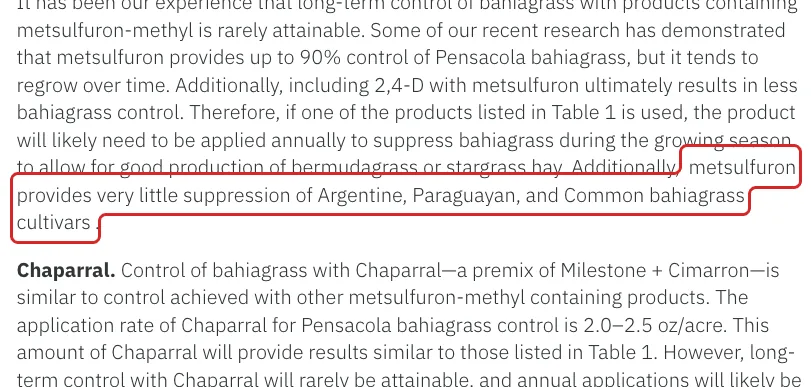
Even on Pensacola, UF/IFAS says long-term control with metsulfuron products is rarely attained: the bahia regrows, so annual treatment is likely, and adding 2,4-D reduces control (UF/IFAS AG243). Bahia also returns from seed; UF/IFAS notes a small share of its seed stays viable in soil for several years. The same pasture research found bahia rarely invades a healthy bermudagrass stand and moves in as stands thin and nitrogen runs short, so a dense, properly fed lawn is the long-term defense.
Trees set a second limit. Metsulfuron is absorbed by roots, and UF/IFAS documents dieback in live oaks, other oaks, ligustrum and palms after turf applications; roots spread about three times the drip line, and labels bar treatment over them (UF/IFAS FR400). Clemson adds: no reseeding or resodding for 8 weeks, and no woody plantings for a year in treated areas (Clemson HGIC 2316).
How do you remove bahia grass step by step?
Removing bahia grass takes a season of repeat work because it spreads by rhizomes and seed. Clemson recommends controlling rather than eradicating it, starting postemergent sprays in May while bahia is small, and refilling the bare spots with plugs or sprigs of your lawn grass so new weeds do not move in (Clemson HGIC 2316). The order below follows Clemson and UF/IFAS:
- Confirm it is bahia. Look for the V- or Y-shaped seedhead with two racemes (Clemson HGIC 2316).
- Map tree and shrub roots. Mark an area about three times each canopy’s width; keep metsulfuron out of it (UF/IFAS FR400).
- Pick the herbicide labeled for your lawn grass from the Clemson table above.
- Spray in May, below 85°F, with a nonionic surfactant at 2 teaspoons per gallon for metsulfuron products (Clemson HGIC 2316).
- Repeat in 4 to 6 weeks (metsulfuron) or 3 weeks (sethoxydim, two applications a season maximum) (Clemson HGIC 2316).
- Spot-kill survivors with glyphosate; Clemson says perennial weeds like bahia may need multiple applications of a 1.5 to 2 percent solution.
- Replug bare spots after the label’s waiting period (8 weeks after metsulfuron), and mow and fertilize the lawn grass at its own recommended rates so it closes over.
1Is it only a few clumps?
YesDig them out with the rhizomes, or spot-spray glyphosate and repeat; refill with plugs of your lawn grass (Clemson).
NoGo to the next question
2Is the lawn tall fescue?
YesNo selective herbicide is registered; spot-kill with glyphosate and reseed (Clemson).
NoGo to the next question
3Do oak, palm or shrub roots reach the area (about 3 times the canopy width)?
YesSkip metsulfuron; use atrazine (St. Augustine, centipede) or imazaquin per label (UF/IFAS FR400, Clemson).
NoGo to the next question
4Is the lawn centipedegrass?
YesUse sethoxydim 3+ weeks after green-up, twice, 3 weeks apart, or metsulfuron at the reduced rate (Clemson).
NoGo to the next question
5Is the invader a narrow-leaved, heavy-seeding Pensacola type?
YesSpray metsulfuron in May below 85°F with surfactant; repeat in 4 to 6 weeks (Clemson, UF/IFAS AG342).
NoArgentine bahia: expect partial control from metsulfuron; repeat applications, spot-treat survivors and thicken the lawn grass (UF/IFAS AG243).
What do popular bahia grass guides get wrong?
Popular bahia grass guides in the October 2026 top 10 overstate its shade and salt tolerance, set the mowing height too low, recommend more feedings than UF/IFAS does, and treat metsulfuron as a sure kill. The table pairs each claim with the land-grant source, so you can check it before you buy seed or spray. We found no errors in the UF/IFAS, UGA or NC State pages themselves, only differences between them.
| Claim in a top-ranking page | What the primary source says | Source |
|---|---|---|
| Bahia tolerates saline conditions (Wikipedia) | Salt tolerance very poor, the lowest of seven Florida lawn grasses | UF/IFAS LH005 |
| Bahia is tolerant of shade (Wikipedia) or more shade tolerant than most lawns (LawnPride) | Shade tolerance fair; St. Augustinegrass and zoysiagrass good to excellent. UF/IFAS AG243 says bahiagrasses do not tolerate shade; NC State rates it good | LH005; AG243; NC State |
| Mow at 2 to 3 inches (Scotts) | 3 to 4 inches; the higher cut builds deeper roots | LH006; LH028 |
| Feed 2 to 4 times a year (Scotts) | 1 to 3 applications totaling 1 to 2 lb of nitrogen per 1,000 sq ft a year | LH006 |
| Chinch bugs are the named insect pest (LawnPride) | Mole crickets are the most serious insect threat | LH006 |
| Coated Argentine seed at 2 to 3 lb per 1,000 sq ft (Hancock label) | 5 to 10 lb per 1,000 sq ft; Hancock’s coated Pensacola page also says 5 to 10 | LH013; Hancock |
| Metsulfuron controls bahiagrass, with no cultivar caveat (Clemson HGIC 2316) | Holds for Pensacola types; UF pasture research found very little suppression of Argentine, and regrowth is common | UF/IFAS AG243 |
Some differences are between primary sources rather than errors. LH006 dates bahia’s introduction to 1914 from Brazil, while UGA, AG342 and Clemson say 1913 (LH006; B1362). LH006 also describes a mole cricket soap test of 1 to 2 oz of detergent in 2 gallons over 2 sq ft, while IN1021 uses 3/4 oz in 1 gallon over 4 sq ft; the IN1021 version carries the action threshold.
Is bahia grass right for your yard?
Bahia grass is right for a sunny, sandy, acidic lot in Florida or the Gulf Coast where the owner wants low cost and little water or fertilizer and can live with seedheads. It is wrong for shade, salt spray, alkaline soil, heavy play traffic, HOA-standard lawns and the Carolina piedmont, where NC State never recommends it (UF/IFAS LH005; NC State).
| If your situation is | Do this | Why (source) |
|---|---|---|
| Sunny, sandy, acidic lot in Florida, no irrigation | Plant Argentine bahia from seed or sod | Drought tolerance excellent; persists on infertile sand (LH005; LH006) |
| Roadside, ditch bank or pasture edge where seedheads do not matter | Seed Pensacola at 5 to 10 lb per 1,000 sq ft | Raw Pensacola cost $4.20 per lb, Argentine $7.20 (Oct. 19, 2026) (Hancock; Seed World) |
| Trees shade much of the day | Choose St. Augustinegrass or zoysiagrass | Bahia shade tolerance fair; those two good to excellent (LH005) |
| Soil pH above 7.0 | Choose another grass, or plan foliar iron every 6 weeks | Iron deficiency above pH 7.0 (LH006) |
| Salt spray or salty irrigation water | Choose seashore paspalum, St. Augustinegrass, zoysiagrass or bermudagrass | Bahia salt tolerance very poor (LH005) |
| Daily dog or play traffic | Choose bermudagrass or zoysiagrass | Bahia wear tolerance poor; bermudagrass excellent (LH005) |
| North Carolina piedmont or colder | Choose centipedegrass, zoysiagrass or bermudagrass | NC State never recommends bahia lawns; cold tolerance poor (NC State) |
| Bahia invading a St. Augustine lawn near oaks | Use atrazine or imazaquin per label, not metsulfuron | Metsulfuron root uptake injures oaks and palms (FR400; Clemson) |
| Pensacola-type bahia in bermuda or zoysia, no trees nearby | Metsulfuron in May, repeat in 4 to 6 weeks | Diploids severely injured (AG342; Clemson) |
| You need cover this season | Lay bahia sod: 36¢ to 39¢ per sq ft retail in Florida | Sod pegs in 14 to 21 days (LH006; Gladiator Sod) |
1Is the area shaded for much of the day?
YesPlant St. Augustinegrass or zoysiagrass; UF/IFAS rates bahia shade tolerance only fair.
NoGo to the next question
2Is the soil pH above 7.0?
YesChoose another grass, or plan foliar iron every 6 weeks (UF/IFAS LH006).
NoGo to the next question
3Does the lawn get salt spray or salty irrigation water?
YesChoose seashore paspalum, St. Augustinegrass, zoysiagrass or bermudagrass; bahia salt tolerance is very poor.
NoGo to the next question
4Will the lawn take daily dog or play traffic?
YesChoose bermudagrass or zoysiagrass; bahia wear tolerance is poor.
NoGo to the next question
5Are you in the North Carolina piedmont or colder?
YesChoose centipedegrass, zoysiagrass or bermudagrass; NC State never recommends bahia lawns.
NoGo to the next question
6Do you need a dense, uniform lawn without seedheads?
YesChoose St. Augustinegrass or zoysiagrass; bahia density is low (UF/IFAS LH005).
NoPlant Argentine bahia from seed at 5 to 10 lb per 1,000 sq ft or from sod in spring to early summer, mow at 3 to 4 inches and feed 1 to 2 lb of nitrogen a year.
Source: UF/IFAS LH005, LH006 and LH013; NC State Extension Gardener Handbook, Table 9-1
Bahia is also a pasture grass, and pasture advice does not transfer to lawns. Forage stands are seeded at 8 to 30 lb per acre, fed 100 to 200 lb of nitrogen per acre and grazed or cut to 2 to 5 inches, and forage cultivars such as Tifton 9 and TifQuik are bred for yield rather than a tidy canopy (UGA B1362; UF/IFAS AG342). For a lawn, use the turf rates on this page.
How we compiled this
We compiled this page in October 2026 from 19 primary documents: UF/IFAS, UGA, Alabama, NC State and Clemson extension publications, a USDA ARS cultivar report, the UF/IFAS Florida sod survey and the USDA AMS sod report. We checked seven dated price pages from two seed sellers and two Florida sod farms on Oct. 19, 2026, and compared three widely read bahia guides against those sources. We did not grow, test or price any lawn ourselves.
Frequently asked questions
Is bahia grass a good lawn grass?
It is a good low-input lawn grass for sunny, sandy, acidic Florida and Gulf Coast lots, and a poor one elsewhere. UF/IFAS recommends it for large lots without irrigation (UF/IFAS LH006), but it forms an open, low-density turf with tall seedheads, and NC State never recommends it for lawns (NC State).
Will bahia grass spread on its own?
Yes, slowly. It spreads by short, stout stolons and shallow rhizomes (UGA B1362), and an unmowed lawn reseeds itself from summer seedheads (UF/IFAS LH006). UF/IFAS says its slow growth is why plugging leaves open soil that weeds take over, so bare spots fill faster from seed or sod.
Does bahia grass come back every year?
Yes. Bahia grass is a long-lived perennial that goes dormant and brown in winter and in long droughts, then regrows when warmth or rain returns (UGA B1362; UF/IFAS LH006). About 85 percent of its growth happens from April through September, according to UF/IFAS AG342 (AG342).
Is Argentine bahia grass the same as St. Augustine?
No. Argentine is a cultivar of bahiagrass (Paspalum notatum), sold as seed or sod, while St. Augustinegrass (Stenotaphrum secundatum) is a different species planted only as sod or plugs (UF/IFAS LH005). Bahia takes 1 to 2 lb of nitrogen a year; St. Augustinegrass takes 2 to 4 lb in north Florida (UF/IFAS EP353).
How long does it take Argentine bahia grass seed to sprout?
Expect 21 to 30 days in warm soil, with uneven emergence. UGA says 50 to 60 percent of bahia seed germinates within 30 days and some waits until the next year, because a waxy seed coat limits water uptake (UGA B1362). Hancock lists 21 to 30 days for its Argentine seed (Hancock).
Will Roundup kill bahiagrass?
Glyphosate, the main active in most Roundup concentrates, kills bahia it contacts, but one spray rarely finishes it. Clemson says perennial weeds like bahia may need multiple applications of a 1.5 to 2 percent solution, and that glyphosate also injures or kills any lawn grass it touches, so use it only for spot treatment or full renovation (Clemson HGIC 2316).
Can you mix bahia and St. Augustine?
Not by design. NC State says warm-season grasses are usually planted as a single variety rather than in blends (NC State), and the two need different mowing heights and nitrogen rates. Bahia seed sown into St. Augustinegrass becomes a weed that atrazine or imazaquin can suppress (Clemson HGIC 2316).
What is the best fertilizer for bahia grass?
A slow-release nitrogen fertilizer chosen from a soil test, applied at 1 to 2 lb of nitrogen per 1,000 sq ft a year (UF/IFAS LH006). Skip phosphorus if the soil test is high, add iron on soil above pH 7.0, and avoid weed-and-feed blends with atrazine or metsulfuron, which UF/IFAS says damage bahia.
Sources
- UF/IFAS Extension, ENH6/LH006, Bahiagrass for Florida Lawns, Revised May 2026. Accessed October 2026.
- UF/IFAS Extension, ENH04/LH005, Selecting a Turfgrass for Florida Lawns, Revised August 2025. Accessed October 2026.
- UF/IFAS Extension, ENH-03/LH013, Establishing Your Florida Lawn, Revised August 2025. Accessed October 2026.
- UF/IFAS Extension, ENH10/LH028, Mowing Your Florida Lawn, Revised June 2018. Accessed October 2026.
- UF/IFAS Gardening Solutions, Mowing Your Florida Lawn (reprint of ENH10), Current page. Accessed October 2026.
- UF/IFAS Gardening Solutions, Bahiagrass, Current page. Accessed October 2026.
- UF/IFAS Extension, ENH1089/EP353, Urban Turf Fertilizer Rule for Home Lawn Fertilization, Revised November 2025. Accessed October 2026.
- UF/IFAS Extension, ENH1394/EP658, Florida Sod Inventory and Pricing Report, 2025, 2024 survey data, published November 2025. Accessed October 2026.
- UF/IFAS Extension, SS-AGR-332/AG342, Bahiagrass (Paspalum notatum Flugge): Overview and Pasture Management, Revised July 2019. Accessed October 2026.
- UF/IFAS Extension, SS-AGR-257/AG243, Managing Bahiagrass in Bermudagrass, Stargrass, and Limpograss Pastures, Revised December 2012. Accessed October 2026.
- UF/IFAS Extension, FOR332/FR400, Metsulfuron-Methyl-Containing Herbicides Potentially Damaging Ornamentals when Applied to Turfgrass, Published April 2016. Accessed October 2026.
- UF/IFAS Extension, IPM-206/IN1021, Mole Cricket IPM Guide for Florida, Revised August 2021. Accessed October 2026.
- University of Georgia Cooperative Extension, Bulletin 1362, The Management and Use of Bahiagrass, Minor revisions July 7, 2023. Accessed October 2026.
- USDA Agricultural Research Service, AgResearch Magazine, TifQuik for Faster Forage, April 2008. Accessed October 2026.
- Alabama Cooperative Extension System, ANR-2666, Bahiagrass in Alabama, Reviewed February 2025. Accessed October 2026.
- NC State Extension Gardener Plant Toolbox, Paspalum notatum (Bahiagrass), Current page. Accessed October 2026.
- NC State Extension, Extension Gardener Handbook, Chapter 9: Lawns (Tables 9-1 and 9-4), Current edition. Accessed October 2026.
- Clemson Cooperative Extension, Home & Garden Information Center, HGIC 2316, Bahiagrass, Updated July 13, 2022. Accessed October 2026.
- USDA Agricultural Marketing Service, National Quarterly Sod Report (April 1 to June 30, 2026), Q2 2026, released July 17, 2026. Accessed October 2026.
- Hancock Seed, Hancock’s Pensacola Bahia Grass Seed, Raw (product price page), Price checked Oct. 19, 2026. Accessed October 2026.
- Hancock Seed, Hancock’s Pensacola Bahia Grass Seed, Coated (product price page), Price checked Oct. 19, 2026. Accessed October 2026.
- Hancock Seed, Hancock’s Argentine Bahia Grass Seed, Coated (product price page), Price checked Oct. 19, 2026. Accessed October 2026.
- Hancock Seed, Hancock’s Pensacola Bahia Fall and Winter Grass Seed Mix (coating-weight note), Page checked Oct. 19, 2026. Accessed October 2026.
- Seed World USA, Argentine Bahia Grass Seed, Raw (product price page), Price checked Oct. 19, 2026. Accessed October 2026.
- Gladiator Sod (New Port Richey, Fla.), Current Sod Prices, Price list checked Oct. 19, 2026. Accessed October 2026.
- Wekiva Farms (central Florida), Bahia Sod Pallet, 400 sq ft, Price checked Oct. 19, 2026. Accessed October 2026.
- Wikipedia, Paspalum notatum, Page as of October 2026. Accessed October 2026.
- Scotts Miracle-Gro, How to Plant and Care for a Bahia Grass Lawn, Page as of October 2026. Accessed October 2026.
- LawnPride, Bahia Grass lawn guide, Page as of October 2026. Accessed October 2026.