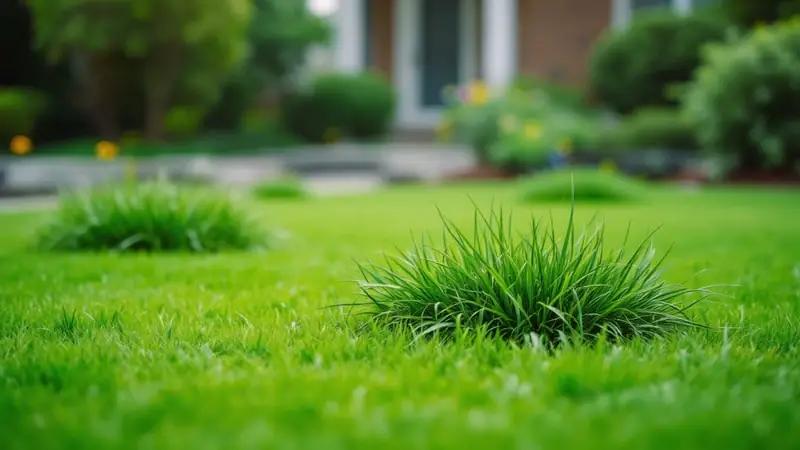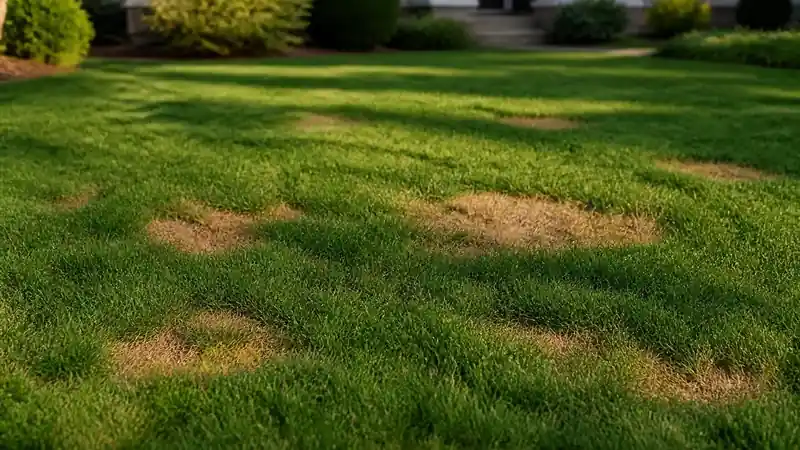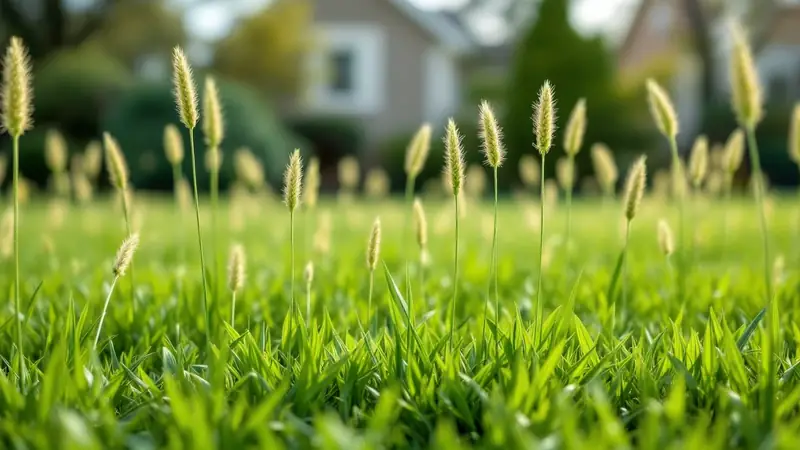
Why is my grass going to seed? Day length: cool-season grasses flower after a winter chill once spring days lengthen, and bahia and bermuda head out in the long days of summer. It is normal, and frequent mowing with a sharp blade shortens it.
If you are asking why is my grass going to seed, the short version is day length. Purdue turf scientist Zac Reicher writes that the flush of stalks in Kentucky bluegrass, tall fescue and perennial ryegrass is “induced primarily by daylength” and should last “only about a month” (Purdue, May 2007). Below is a seedhead calendar for 12 lawn grasses, the label check that rules out growth-regulator sprays for home lawns, and a correction to the “sterile hybrid seed” line repeated by several top results.
Seedheads are not a disease and not a sign the lawn needs replacing. They do cost something: Purdue says density usually drops while plants put energy into stalks, and the stalks mow ragged, leaving the lawn “a lighter green to white” after a cut (Purdue). Mowing cadence is covered in how often to mow a lawn by growth rate, and blade care in how to sharpen a lawn mower blade.
Why grass goes to seed: two switches, then a calendar
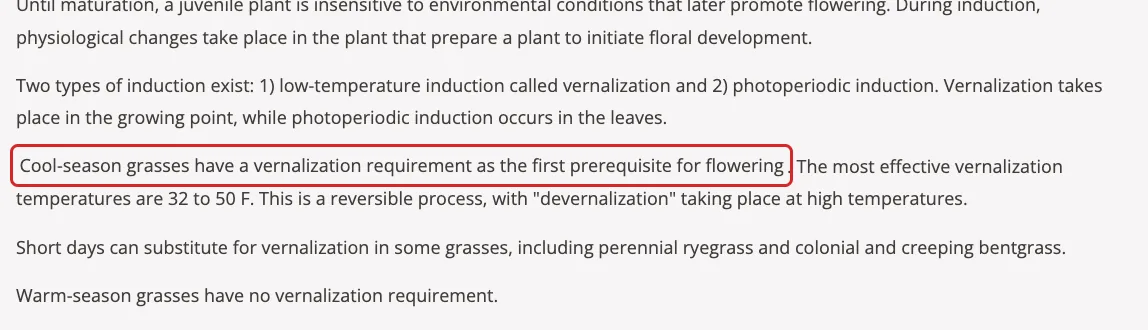
Cool-season grasses need two signals in a row. First comes vernalization, a cold period at 32 to 50°F that Oregon State calls “the first prerequisite for flowering” in cool-season grasses; short days can stand in for cold in perennial ryegrass. Then come long days: these are long-day plants that flower after day length passes “a critical number of hours” (Oregon State University Forage Information System).
For Kentucky bluegrass the number is published. Iowa State Extension puts it at 13 hours or more of daylight with average daily temperatures of 65 to 75°F (Iowa State, last reviewed May 2026). Our sunrise to sunset arithmetic shows a lawn at 40°N, around Columbus or Denver, passes 13 hours on about April 10 and stays above it until early September; the cool temperatures then decide when stalks appear.
- 30°N (Houston)
- 40°N (Columbus, Ohio)
- 45°N (Minneapolis)
- Iowa State threshold
Source: Green Industry Report calculation (Forsythe 1995 model, sunrise to sunset); threshold from Iowa State Extension Day length alone does not set the date: Iowa State also requires average daily temperatures of 65 to 75°F, which arrive in May across much of the north.
Show the numbers
| 30°N (Houston) | 40°N (Columbus, Ohio) | 45°N (Minneapolis) | Iowa State threshold | |
|---|---|---|---|---|
| Jan | 10.40 | 9.60 | 9.10 | 13 |
| Feb | 11.10 | 10.70 | 10.40 | 13 |
| Mar | 11.90 | 11.90 | 11.80 | 13 |
| Apr | 12.90 | 13.20 | 13.40 | 13 |
| May | 13.60 | 14.40 | 14.80 | 13 |
| Jun | 14.10 | 15 | 15.60 | 13 |
| Jul | 13.90 | 14.80 | 15.30 | 13 |
| Aug | 13.30 | 13.80 | 14.10 | 13 |
| Sep | 12.40 | 12.50 | 12.60 | 13 |
| Oct | 11.50 | 11.20 | 11.10 | 13 |
| Nov | 10.70 | 10 | 9.60 | 13 |
| Dec | 10.20 | 9.40 | 8.80 | 13 |
| Latitude (example city) | Day length passes 13 h | Day length falls below 13 h | Longest day (June 15) |
|---|---|---|---|
| 30°N (Houston) | April 20 | August 24 | 14.1 h |
| 35°N (Memphis) | April 15 | August 30 | 14.5 h |
| 40°N (Columbus, Ohio) | April 10 | September 3 | 15.0 h |
| 45°N (Minneapolis) | April 7 | September 7 | 15.6 h |
Stress plays a supporting role, not the lead. Purdue says intensity “is affected primarily by temperature,” which is why some springs bring a bumper crop (Purdue, May 2004). Iowa State adds that dry weather accentuates seedheads and that lawns getting “little or no nitrogen” make more, because high nitrogen delays maturation. Some cultivars also head more than others, so one patch can look worse than the rest.
Warm-season grasses skip the cold step: Oregon State says they have “no vernalization requirement” and are mostly short-day or day-neutral. The lawn species do not all fit that rule. UF/IFAS ties bahiagrass seedheads to “the long days of summer” (UF/IFAS ENH6, 2022), and a 2022 PeerJ greenhouse study cut time to flowering to 44 days for a common bermudagrass genotype grown under 22-hour days (Ji et al., PeerJ).
Seedhead calendar by grass type
Find your grass in the first column. The look column helps confirm it: Penn State notes Kentucky bluegrass carries a branched panicle and perennial ryegrass a spike (Penn State Extension). For warm-season lawns, two Texas A&M turf specialists tied heavy St. Augustinegrass stalks to infrequent mowing and low nitrogen (PLANTanswers).
| Grass | Type | When seedheads show | What triggers them | What the seedhead looks like | What to do | Source |
|---|---|---|---|---|---|---|
| Kentucky bluegrass | Cool-season | Late spring; Purdue reports it in May in Indiana and expects it to last about a month | Needs 13 hours or more of daylight plus average daily temperatures of 65 to 75°F; dry weather and low nitrogen increase it | Branched panicle (Penn State) | Mow more often at 2 to 2.5 inches or higher; do not drop the deck | Iowa State Extension; Purdue (2007) |
| Perennial ryegrass | Cool-season | Late spring into June; Purdue reported full production on June 12, 2013 | Winter chill or short days, then long days (Oregon State) | Flat spike with spikelets set right on the stem (Penn State) | Sharpen the blade; stalks resist decay and can stay visible about a month | Purdue Turf Tips (2013); Oregon State |
| Tall fescue | Cool-season | Late spring, with Kentucky bluegrass and perennial ryegrass (Purdue) | Winter chill, then long days (Oregon State) | Taller stalks rising unevenly above the cut, which mow ragged (Purdue) | Mow frequently with a sharp blade; it ends on its own | Purdue (2007); Oregon State |
| Annual bluegrass (Poa annua) | Cool-season weed | Boot stage typically late March or early April in New Jersey | Rutgers times sprays by growing degree days counted from Feb. 15; seed can become viable the same day it is pollinated | Whitish seedheads, often on short plants | Treat as a weed: how to get rid of Poa annua | Rutgers (Feb. 2017) |
| Bahiagrass, Pensacola | Warm-season | Summer, heaviest during the long days | Long days; Pensacola seed is sexual and it heads more than Argentine | Two spikes joined at the stalk in a distinct V, with tiny dark brown to black flowers (LSU AgCenter) | Mow at 3 to 4 inches; seedheads usually set the mowing cycle | UF/IFAS ENH6 (2022); LSU AgCenter |
| Bahiagrass, Argentine | Warm-season | Same season as Pensacola | Long days; seed forms by apomixis, so seedlings copy the mother plant | Slightly shorter, less dense heads than Pensacola | Same as Pensacola; the better lawn choice of the two | UF/IFAS ENH6 (2022) |
| Bermudagrass, common | Warm-season | Growing season; no month window in the extension pages we read | Day length: in a greenhouse, 22-hour days cut time to flowering to 44 days for one common genotype | 3 to 7 finger-like spikes with tiny pink to purple flowers | Mow at the normal low height more often | LSU AgCenter; Ji et al., PeerJ (2022) |
| Bermudagrass, hybrid (Tifway type) | Warm-season | Growing season; no month window in the extension pages we read | Crosses of common and African bermudagrass bred for turf | Same finger-like spikes, fewer of them | Seed from these crosses is often sterile, so plant sod or sprigs | Texas A&M AgriLife; Ji et al. (2022) |
| Zoysiagrass, Meyer | Warm-season | Late spring | Not established; K-State and Purdue were still modeling seedhead initiation in 2020 | Single red to purple spike with small white flowers (LSU); unmowed heads a distinctive dark purple (GCM) | Mow more often; golf courses time ethephon in late summer to early fall | K-State and Purdue, GCM (March 2020) |
| Centipedegrass | Warm-season | Growing season; no month window in the extension pages we read | Not stated in the sources we found | Slender single spike just above the leaves, small white flowers | Routine mowing manages them (Alabama Extension) | LSU AgCenter; Alabama Extension |
| St. Augustinegrass | Warm-season | Summer, and “not that uncommon” (Richard Duble, Texas A&M) | Infrequent mowing and low nitrogen make them worse, per two Texas A&M specialists | Thick single spike just above the leaves | Mow more often; no seed is sold, so plug or sod bare spots | PLANTanswers (Texas A&M specialists); Texas A&M EHT-144 |
| Buffalograss | Warm-season | Growing season | Plants are usually one sex | Males: pollen spikes 3 to 8 inches above the leaves; females: burs in the canopy | Vegetative cultivars are female, so little shows above the mowed canopy | Nebraska Extension G1946 |
Bahiagrass is the outlier. UF/IFAS says low-maintenance bahia lawns are often mowed “just to remove seedheads, rather than to cut leaf blades” (UF/IFAS ENH10), and the tough stalks need a sharp, heavy-duty rotary blade. UF/IFAS ENH6 sets bahia grass lawn mowing at every 7 to 14 days in active growth; if that cadence is unacceptable, the fix is a different grass, not a product.
Is it grass going to seed, or a weed?
Turf seedheads rise at roughly the same height across the whole lawn within a few days. A weed shows up in clumps and keeps its own look between mowings. Check the season and one stalk: Poa annua heads sit low and whitish in early spring, crabgrass fingers start 1/8 to 1/4 inch apart while bermudagrass fingers start at one point, and foxtail heads are bristly cylinders. Our crabgrass vs bermuda grass identification key sets the measurements side by side.
1Are stalks rising evenly across the whole lawn at about the same height?
Yes
NoClumps or patches point to a weed: compare the stalk with our crabgrass, foxtail, dallisgrass and nutsedge pages.
2Is it early spring and the heads are short, whitish and low in the canopy?
YesLikely annual bluegrass (Poa annua), a weed; its seed can be viable the day it is pollinated (Rutgers).
NoGo to the next question
3Is it late spring and the lawn is Kentucky bluegrass, tall fescue or perennial ryegrass?
YesNormal seasonal flowering. Mow more often at your usual height with a sharp blade; it ends in about a month (Purdue).
NoGo to the next question
4Is it summer on a bahiagrass lawn with V- or Y-shaped heads?
YesNormal for bahiagrass. Mow at 3 to 4 inches; seedheads will set your mowing cycle (UF/IFAS ENH6).
NoGo to the next question
5Do stalks carry 3 to 7 fingers from one point?
YesBermudagrass. If the fingers start 1/8 to 1/4 inch apart, it is crabgrass instead.
NoSingle spikes just above the leaves on a runner grass: centipedegrass or St. Augustinegrass. Mow more often (LSU AgCenter; Texas A&M).
Source: Purdue; Rutgers; UF/IFAS ENH6; LSU AgCenter; Texas A&M
Will the seed reseed my lawn?
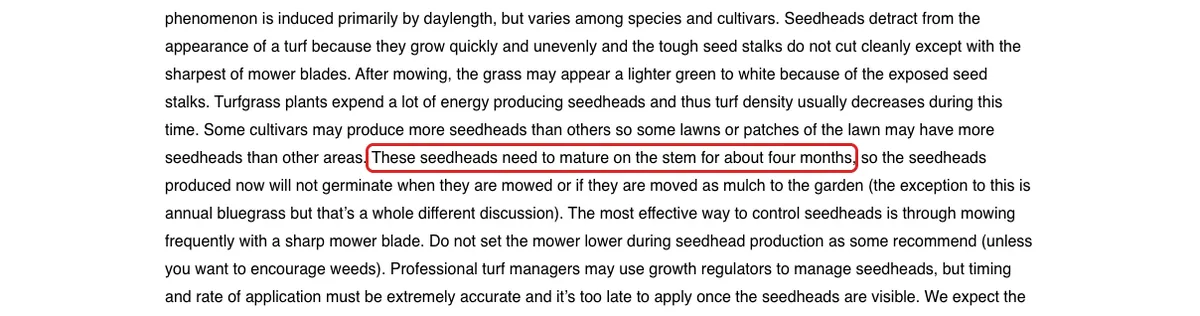
Almost never, and not for the reason most pages give. Kentucky bluegrass seed is not sterile: Oregon State says the species “generally produces seed apomictically,” so seedlings copy the parent (Oregon State BeaverTurf). The real barrier is time. Purdue says lawn seedheads “need to mature on the stem for about four months,” so heads cut in May will not germinate, even dumped in a garden as mulch.
| Common claim | What the primary source says | Source |
|---|---|---|
| Lawn seed is from hybrids, so it is sterile (Iowa State FAQ; two lawn-service blogs in the top 5) | Kentucky bluegrass “generally produces seed apomictically”: progeny are identical to the parent. Argentine bahiagrass also seeds by apomixis. Sterile seed fits hybrid bermudagrass. | Oregon State; UF/IFAS ENH6; Texas A&M |
| The seed will not grow because it is sterile | Seedheads “need to mature on the stem for about four months,” so heads mowed in May will not germinate, even as garden mulch | Purdue Turfgrass Science (2007) |
| Letting it go to seed thickens the lawn | “In reality, this does not work”: seeding diverts energy from runners, and the tall canopy shades out lower leaves | Iowa State (Dec. 6, 2024) |
| Drought or stress is what makes grass go to seed | Day length induces it; temperature sets how heavy the flush is; dry weather and low nitrogen only accentuate it | Purdue (2004); Iowa State |
| Mow lower to cut the seedheads off | Do not set the mower lower during seedhead production unless you want to encourage weeds; do not go under 2 to 2.5 inches on bluegrass | Purdue; Iowa State |
| Add extra nitrogen to get through the seeding phase | High nitrogen delays maturation and cuts seedheads, but one Texas A&M specialist who said so added: “Not that I recommend that” | Iowa State; PLANTanswers |
Two exceptions matter. Annual bluegrass seed “can become viable even if the seedhead is removed from the plant on the same day it is pollinated,” per Rutgers (Rutgers, Feb. 2017), which is why Poa annua spreads in mowed lawns. Unmowed bahiagrass “can reseed itself” (UF/IFAS ENH6). For bare spots, buy seed and follow how to overseed a lawn; why runners, not seed, fill most lawns is in does grass spread on its own.
How to stop grass from going to seed
You cannot switch flowering off in a home lawn, but 5 steps shorten and hide it:
- Mow more often at your normal height. Purdue calls frequent mowing with a sharp blade “the most effective way to control seedheads” (Purdue). Keep the one-third rule: a 3-inch lawn gets cut at 4.5 inches.
- Do not drop the deck. Purdue warns that lowering the mower during seedhead season encourages weeds; Iowa State says not to go below 2 to 2.5 inches on bluegrass and to cut tall, seeded grass at the highest setting first, then step it down (Iowa State). Heights for each species are in how to mow a lawn.
- Sharpen before the flush. Seed stalks “do not cut cleanly except with the sharpest of mower blades” (Purdue). Sharpen in April for cool-season lawns and before summer for bahia.
- Do not push nitrogen to fight it. Iowa State says high nitrogen delays maturation and cuts seedheads, yet the Texas A&M specialist who said the same added “Not that I recommend that.” Keep to the dates in when to fertilize your lawn.
- Wait about 4 weeks. Purdue expects cool-season production to last about a month; perennial ryegrass stalks can stay visible about a month after forming because they do not decompose easily (Purdue, June 2013).
What about growth regulator sprays?
Golf courses suppress seedheads with plant growth regulators, but timing is unforgiving and none of these products is labeled for a home lawn. Purdue says it is “too late to apply once the seedheads are visible.” On Meyer zoysiagrass, ethephon (Proxy) at 5 fl oz per 1,000 sq ft gave over 82 percent seedhead control in Indiana when sprayed Aug. 30 to Oct. 2 of the previous year, and under 21 percent after Oct. 9 (Hoyle, Patton, Fry and Kennelly, GCM, March 2020).
| Product (active ingredient) | EPA Reg. No. | Seedhead claim on label | Home lawn use? | Source |
|---|---|---|---|---|
| Proxy (ethephon 21.7%) | 432-1230 | Suppresses Poa annua and white clover seedheads; first spray before new seedheads emerge, 2 to 3 weeks to full effect | No: “For Commercial Use on Turf including Golf, Parks, and Sports Turf. Not For Residential Use.” | EPA PPLS label file |
| Primo Maxx (trinexapac-ethyl) | 100-937 | Partial seedhead suppression of annual bluegrass, bahiagrass and others in the 2015 label | No: the approved label dated June 19, 2023 limits it to golf courses and sod farms and says not to apply to lawns | Syngenta label (2023); EPA PPLS (2015) |
| Mefluidide 2-S plant growth regulator (mefluidide) | 2217-759 | Was used for Poa annua seedheads | No: registration cancelled; Rutgers notes the mefluidide product is no longer manufactured | Federal Register, Feb. 14, 2019; Rutgers |
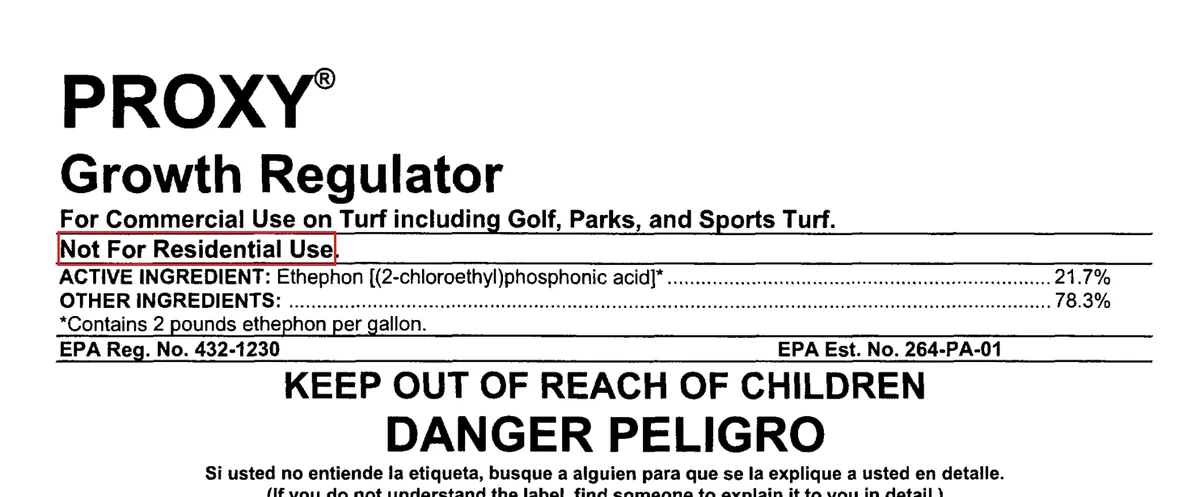
This page is general information, not pesticide advice. The label is the law: Proxy (EPA Reg. No. 432-1230) and Primo Maxx (EPA Reg. No. 100-937) exclude home lawns, so check the current label and your state pesticide rules before anyone applies a product.
How we compiled this
In November 2026 we read 21 extension publications and pages from Purdue, Iowa State, Oregon State, Penn State, Rutgers, UF/IFAS, Texas A&M, LSU, Alabama and Nebraska, 1 PeerJ paper, 1 GCM research report, 3 label files for 2 products and 1 Federal Register cancellation order, and checked the claims of the top 5 Google results against them. Day lengths are our own calculation, shown in the table above. We did not grow, mow or test any grass.
Frequently asked questions
Is it bad if your lawn grass goes to seed?
Not harmful, but not free. Iowa State says seeding draws carbohydrates from crowns and rhizomes and thins the stand, which lets weeds in (Iowa State). Mowing the heads off within the month limits the loss.
How do you stop grass from going to seed?
Mow more often at your normal height with a sharp blade, and wait about 4 weeks for the flush to end (Purdue). Growth regulators such as Proxy (EPA Reg. No. 432-1230) are labeled not for residential use.
What does grass that has gone to seed look like?
Thin stalks above the leaf canopy carrying a branched panicle (Kentucky bluegrass), a flat spike (perennial ryegrass), 3 to 7 finger-like spikes (bermudagrass) or 2 spikes in a V (bahiagrass), per Penn State and LSU AgCenter.
Will grass reseed itself if you let it grow?
Not in a lawn. Iowa State says “In reality, this does not work,” and Purdue says heads need about 4 months on the stem to mature. Unmowed bahiagrass is the exception UF/IFAS names.
Will my grass get thicker if I let it go to seed?
No. Iowa State says it gets thinner, because energy goes to flowers instead of runners and the tall canopy shades the lower leaves (Iowa State). Overseed with bought seed in late summer or early fall.
Why is my grass flowering in spring?
Cool-season grasses flower after a winter chill of 32 to 50°F once days lengthen past their threshold, 13 hours for Kentucky bluegrass (Oregon State; Iowa State). By our calculation, days pass 13 hours between April 7 at 45°N and April 20 at 30°N.
Sources
- Purdue University Turfgrass Science, Zac Reicher, Seedheads Make for Tough Mowing, May 16, 2007. Accessed November 2026.
- Purdue University Turfgrass Science, Zac Reicher, Bumper Crop of Seedheads This Year, May 23, 2004. Accessed November 2026.
- Purdue University Turfgrass Science, Perennial ryegrass seedheads: Now and Later, June 12, 2013. Accessed November 2026.
- Iowa State University Extension, Mike Agnew and Aaron Steil, Seed Head Development in Lawns, last reviewed May 2026. Accessed November 2026.
- Iowa State University Extension, Aaron Steil, Can I overseed my lawn naturally by letting it go to seed?, Dec. 6, 2024. Accessed November 2026.
- Oregon State University Forage Information System, Transition (developmental phases), current edition. Accessed November 2026.
- Oregon State University BeaverTurf, Kentucky Bluegrass (Poa pratensis L.), current edition. Accessed November 2026.
- Penn State Extension, The Cool-Season Turfgrasses: Basic Structures, Growth and Development, current edition. Accessed November 2026.
- Rutgers Center for Turfgrass Science, Annual Bluegrass Seedhead Suppression, Feb. 20, 2017. Accessed November 2026.
- UF/IFAS, Schiavon, Unruh and Kenworthy, ENH6, Bahiagrass for Florida Lawns, 2022. Accessed November 2026.
- UF/IFAS, Trenholm, Unruh and Cisar, ENH10, Mowing Your Florida Lawn, current edition. Accessed November 2026.
- Texas A&M AgriLife Extension, Bermudagrass Home Lawn Management Calendar, current edition. Accessed November 2026.
- Texas A&M AgriLife Extension, EHT-144, St. Augustinegrass Lawn Management, 7/20. Accessed November 2026.
- PLANTanswers (Texas A&M horticulture, Jerry Parsons), quoting Richard Duble and James McAfee, Strange growths in St. Augustine grass, undated. Accessed November 2026.
- LSU AgCenter, Identification of Turfgrass Species: Bermudagrass, current edition. Accessed November 2026.
- LSU AgCenter, Identification of Turfgrass Species: Centipedegrass, current edition. Accessed November 2026.
- LSU AgCenter, Identification of Turfgrass Species: St. Augustinegrass, current edition. Accessed November 2026.
- LSU AgCenter, Identification of Turfgrass Species: Bahiagrass, current edition. Accessed November 2026.
- LSU AgCenter, Identification of Turfgrass Species: Zoysiagrass, current edition. Accessed November 2026.
- Alabama Cooperative Extension System, Home Lawns: Centipedegrass, current edition. Accessed November 2026.
- University of Nebraska-Lincoln Extension, G1946, Establishing Buffalograss Turf in Nebraska, May 2009. Accessed November 2026.
- Hoyle, Patton, Fry and Kennelly, Golf Course Management, Zoysiagrass seedhead development and suppression, March 2020. Accessed November 2026.
- Ji et al., PeerJ, Effects of light application time on the growth and flowering of bermudagrass, 2022. Accessed November 2026.
- U.S. EPA Pesticide Product Label System, Proxy Growth Regulator, EPA Reg. No. 432-1230, label file dated March 6, 2009. Accessed November 2026.
- Syngenta, Primo Maxx Turf Growth Regulator label, EPA Reg. No. 100-937, approved June 19, 2023. Accessed November 2026.
- U.S. EPA Pesticide Product Label System, Primo Maxx label, EPA Reg. No. 100-937, Dec. 8, 2015. Accessed November 2026.
- Federal Register, EPA, Product Cancellation Order for Certain Pesticide Registrations (Doc. 2019-02385), Feb. 14, 2019. Accessed November 2026.
- NOAA Global Monitoring Laboratory, NOAA Solar Calculator, checked November 2026. Accessed November 2026.