Does grass spread on its own? Bermuda, zoysia, St. Augustine, centipede, buffalograss and Kentucky bluegrass do, by runners; tall fescue and perennial ryegrass grow in clumps. At Kansas State, bluegrass closed a 12-inch bare circle in 21 months; tall fescue left about 8 inches open.
The answer to “does grass spread on its own” changes by species because it comes down to one plant part. Grasses with stolons (runners on top of the soil) or rhizomes (stems under it) root new shoots sideways into bare ground; bunch grasses only add tillers at the base of the plant they already have. NC State puts the line for a lawn at 4 inches: bare spots smaller than that “tend to fill in naturally, provided the lawn grass is capable of spreading,” and tall fescue and perennial ryegrass “are incapable of spreading” (NC State Extension Gardener Handbook, ch. 9).
Most pages that answer whether grass spreads stop at that yes or no. The table below adds the speed: stolon growth in inches per week, bare-circle and plug measurements, and time to full cover, taken from 8 research studies and 11 extension and industry publications, with the conditions behind each number. If you do not know which grass you have, the ID key in our guide to the 14 common lawn grasses sorts it by how it spreads; if you already know the spot needs work, our guide to fixing patchy grass diagnoses the cause first.
Which lawn grasses spread on their own, and how fast?
Seven of these 10 lawn grasses spread sideways; tall fescue, perennial ryegrass and most fine fescues do not. Speed varies more than the yes or no suggests: hybrid bermudagrass sprigs covered bare soil in 6 weeks in a four-state trial (Munshaw et al., HortTechnology, 2017), while Meyer zoysia plugs on 12-inch centers often take three years in a North Carolina lawn (NC State).
Swipe the table sideways to see every column.
| Grass | Spreads by | Measured spread | Time to cover | Where and how measured | Source |
|---|---|---|---|---|---|
| Bermudagrass (hybrid Latitude 36) | Stolons and rhizomes | Sprigs at 200 to 800 bu/acre: 100% cover | 6 weeks | 4 Southern sites, summer 2015, research plots | Munshaw 2017 |
| Bermudagrass | Stolons and rhizomes | Plugs 12 in apart; 24 in apart | 3 to 6 months; 6 to 9 months | Florida lawn guidance | UF/IFAS LH007 |
| Zoysiagrass (Meyer) | Stolons and rhizomes | Stolons grew 1.1 to 1.5 in per week; 2.4 in plugs on 12 in centers reached 94.7% cover | About 16 weeks (June 5 to Sept. 24) | Manhattan, Kan., 2007; irrigated about 1 in a week, pre-emergent herbicide, unmowed | Okeyo et al. 2011 |
| Zoysiagrass (Meyer, Emerald) | Stolons and rhizomes | Plugs on 12 in centers | Often 3 years; 2 to 4 years | North Carolina lawns | NC State; AG-432 |
| Zoysiagrass (El Toro) | Stolons and rhizomes | Stolons at 12 bu per 1,000 sq ft: 90% cover in 3 months from June 15 planting | 3 to 4 months planted in June; over 9 months planted Sept. 15 (3 zoysias averaged) | Irvine, Calif., 1981 to 1982 | UC, Calif. Turfgrass Culture 38 |
| St. Augustinegrass (30 entries) | Stolons | 2 to 10% cover on July 2; 57 to 83% by Oct. 15 | Not full by Oct. 15 of the first season | NTEP plots, Auburn, Ala., 2017 | NTEP 21-14, Table 36 |
| Centipedegrass | Stolons | Seeded lawn | 2 to 3 years | North Carolina | NC State |
| Buffalograss (Hilite 24) | Stolons | Stolons grew 0.44 in per day in full sun | Full cover 3 months after planting 1 in plugs | Davis, Calif., 1989 | UC, Calif. Turfgrass Culture 45 |
| Buffalograss | Stolons | Pre-rooted plugs on 12 to 18 in centers | 6 to 12 weeks | Colorado guidance | Colorado State 7.224 |
| Bahiagrass | Short stolons and rhizomes | Mowing at 3 in twice a week cut lateral spread 21 to 27% vs unmowed | Not measured | North Carolina, 5 months, 2003 and 2004 | Henry et al. 2007 |
| Kentucky bluegrass (SR2284) | Rhizomes | 4 in plugs grew to 26 to 36 in across; 12 in bare circle shrank to 0.4 in | About 21 months | Manhattan and Olathe, Kan., 2006 to 2008 | St. John et al. 2009 |
| Tall fescue (5 cultivars incl. 3 sold as rhizomatous) | Tillers; short rhizomes | 4 in plugs grew to 11 to 13.5 in; 12 in circle still 7.2 to 9.1 in wide | Did not close in 21 months | Same K-State plots | St. John et al. 2009 |
| Perennial ryegrass | Tillers only | Bunch type | Does not fill bare spots | Extension classification | NC State |
| Fine fescues | Mostly tillers | “Most of the fine fescues are bunch type” | Mix with bluegrass to fill | Extension classification | NC State |
Two patterns hold across the table. Plots planted in June close fastest: the same three zoysias that covered in 3 to 4 months from a June planting took more than 9 months from a September one in California, and lawn guidance for Meyer plugs runs to years, not months. And within a species, cultivar matters: in the K-State zoysia trial, stolons on the fastest progeny grew 2.4 to 2.6 inches a week against 1.1 to 1.5 for Meyer (Okeyo et al., HortScience 46(1), 2011). Species detail lives in our guides to zoysia cultivars and establishment and bermudagrass planting rates.
How does grass spread: stolons, rhizomes or tillers?
Stolons run along the surface and root at each node; St. Augustinegrass, centipedegrass and buffalograss spread only this way. Rhizomes travel underground and send up shoots, which is how Kentucky bluegrass repairs itself. Bermudagrass, zoysiagrass and bahiagrass use both (NC State; UF/IFAS LH011). Tillers are new shoots from the crown, so a bunch grass thickens in place but cannot cross bare soil.
That is also the usual answer to why your grass is growing in clumps: a thin bunch-grass seeding leaves tufts with soil between them, while coarse clumps in a finer lawn are often pasture tall fescue or orchardgrass.
Running bamboo uses the same rhizome strategy at a larger scale, up to 15 feet a year in Fairfax County’s figures, as our explainer on why bamboo is a grass and not a tree shows.
The underground difference is large. In growth-chamber tests published in December 2025, Kentucky bluegrass rhizomes averaged more than 80 mm (3.1 in) after 4.3 months, while rhizomatous tall fescue averaged 3.1 mm (0.12 in) or less (Nwachukwu, Fry, Domenghini and Braun, Crop Science, 2025). Penn State describes established bluegrass as spreading “quickly via its extensive rhizome production” (Penn State Extension, 2025).
Does tall fescue spread? The 12-inch bare circle test
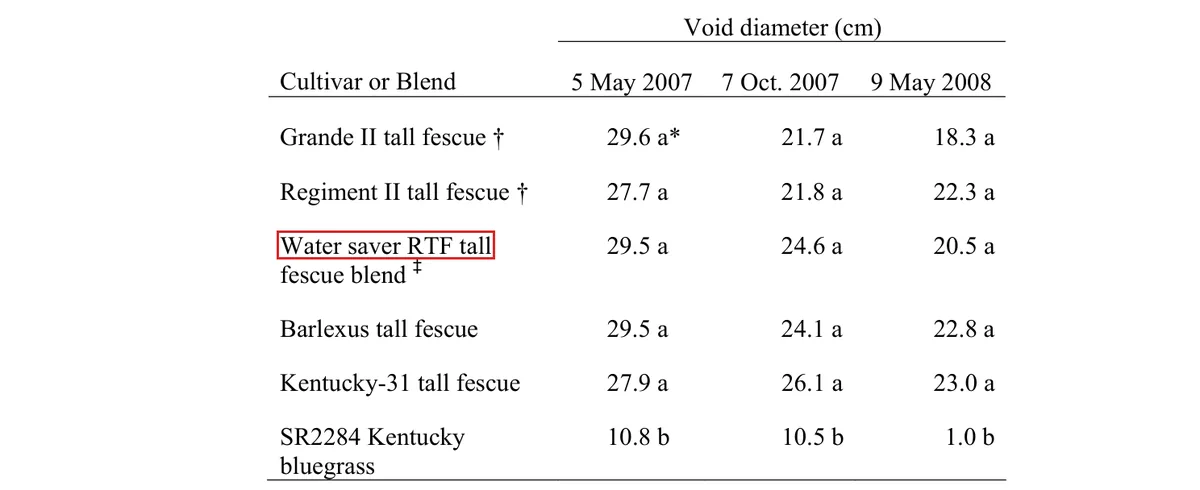
Tall fescue barely spreads, including the cultivars sold as rhizomatous. In St. John, Fry, Bremer and Keeley (2009), Kansas State researchers cut a 12-inch (30.5 cm) circle of sod out of 2005 plots of five tall fescues and SR2284 Kentucky bluegrass on July 28, 2006, refilled it with field soil and measured how much stayed bare. Plots got about 1.2 inches of water a week and were mowed at 3 inches.
| Grass | Bare circle left, May 2007 | Oct. 2007 | May 2008 | 4 in plug grew to, May 2008 |
|---|---|---|---|---|
| SR2284 Kentucky bluegrass | 4.3 in | 4.1 in | 0.4 in | 36.1 in |
| Grande II tall fescue (sold as rhizomatous) | 11.7 in | 8.5 in | 7.2 in | 12.4 in |
| Regiment II tall fescue (sold as rhizomatous) | 10.9 in | 8.6 in | 8.8 in | 12.0 in |
| Water Saver RTF blend (40% Labarinth) | 11.6 in | 9.7 in | 8.1 in | 11.7 in |
| Barlexus tall fescue | 11.6 in | 9.5 in | 9.0 in | 11.3 in |
| Kentucky-31 tall fescue | 11.0 in | 10.3 in | 9.1 in | 11.0 in |
- Kentucky bluegrass
- Kentucky-31 tall fescue
- RTF blend
- Grande II tall fescue
Source: St. John, Fry, Bremer and Keeley (2009), Table 3, Manhattan, Kan.; cm converted to inches Lower is better. No tall fescue differed significantly from another on any date.
Show the numbers
| Kentucky bluegrass | Kentucky-31 tall fescue | RTF blend | Grande II tall fescue | |
|---|---|---|---|---|
| Jul. 28, 2006 | 12 | 12 | 12 | 12 |
| May 5, 2007 | 4.30 | 11 | 11.60 | 11.70 |
| Oct. 7, 2007 | 4.10 | 10.30 | 9.70 | 8.50 |
| May 9, 2008 | 0.40 | 9.10 | 8.10 | 7.20 |
Bluegrass shrank the gap by about two thirds by the following May and closed it by the second spring. The tall fescues, rhizomatous or not, left a hole about 8 inches wide after 21 months, and the K-31 forage type was statistically no different from the newer turf types. Transplanted 4-inch plugs told the same story: bluegrass grew to 36.1 inches across at Manhattan and 25.8 inches at Olathe, where it was only hand-watered, against 11 to 13.5 inches for the fescues.
A breeder study cited by K-State found that Labarinth needed 20 months in the field before its rhizome production pulled ahead of other cultivars; the K-State fescues were over 32 months old by the last reading and still no faster (St. John et al. 2009). For a tall fescue lawn, plan to reseed any spot over 4 inches. Seeding rates and cultivar trial scores are in our tall fescue lawn guide, and thickening a whole thin lawn is covered in how to overseed a lawn.
How fast do warm-season grasses spread?
Bermudagrass is the fastest. Sprigs planted into prepared soil typically cover in 5 to 8 weeks (Sports Turf Managers Association bulletin), and Latitude 36 sprigs reached 100 percent cover by week 6 at every planting rate from 200 to 800 bushels per acre (Munshaw 2017). From plugs it is slower: UF/IFAS gives 3 to 6 months on 12-inch spacing and 6 to 9 months on 24-inch (UF/IFAS LH007).
St. Augustinegrass grows quickly but still needs most of a summer. In NTEP’s 2017 Auburn, Ala., plots, Floratam went from 4.3 percent cover on July 2 to 68.3 percent on Oct. 15, and the best of 30 entries reached 83.3 percent (NTEP report 21-14, Table 36). UF/IFAS spaces plugs 6 to 24 inches and says closer spacing covers faster and leaves less room for weeds (UF/IFAS LH010); cultivar and planting detail is in our St. Augustine grass guide.
Zoysiagrass shows the biggest gap between research and lawns. Meyer plugs on 12-inch centers planted June 5, 2007 at Manhattan, Kan., were 55.8 percent covered on Aug. 24 and 94.7 percent on Sept. 24, with stolons growing about 1.5 inches a week (Okeyo 2011). NC State’s lawn figure for the same spacing is “often three years” (NC State). The research plots were irrigated, weeded and planted at the start of summer; UF/IFAS warns that weeds “will dominate the bare areas between the plugs” without that care (UF/IFAS LH011).
Centipedegrass is slow too: NC State allows 2 to 3 years from seed (NC State), and UF/IFAS describes TifBlair as only “slightly faster” than other cultivars (UF/IFAS LH009). Buffalograss closes faster from plugs: Colorado State says pre-rooted plugs on 12 to 18 inch centers give complete cover in 6 to 12 weeks (Colorado State Extension 7.224).
What makes grass spread faster?
Sun, planting date and plant density moved spread rates the most in these trials; in the one trial that compared them directly, nitrogen rate mattered less than planting density.
| Factor | Measured effect | Where | Source |
|---|---|---|---|
| Sunlight | Buffalograss stolons grew 0.44 in a day in full sun, 0.24 in at 50% sun, 0.13 in at 30% sun | Davis, Calif., 1989 | Harivandi and Wu 1995 |
| Planting date | Zoysia that reached full cover in 3 to 4 months from a summer planting took over 9 months from Sept. 15 and over 11 months from March 26 | Irvine, Calif., 1981 to 1982 | Henry, Tjosvold and Gibeault 1988 |
| Nitrogen | 0 vs 44 lb N per acre per week (about 1 lb per 1,000 sq ft): a 7 percent difference in bermudagrass cover at 5 weeks | 4 Southern sites, 2015 | Munshaw 2017 |
| Planting density | Sprig rate showed differences in cover from the first rating; N differences appeared only after 2 weeks | Same trial | Munshaw 2017 |
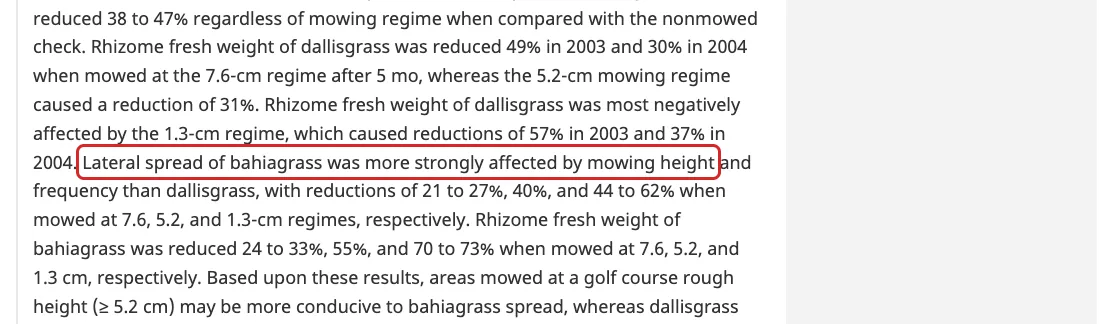
| Mowing height | Bahiagrass spread cut 21 to 27% at 3 in, 40% at 2 in, 44 to 62% at 0.5 in, vs unmowed | North Carolina, 2003 and 2004 | Henry et al. 2007 |
| Water | Bluegrass plugs reached 3 times tall fescue’s diameter with irrigation 2 to 3 times a week, 2 times with hose watering only; the authors link the gap to irrigation | Kansas, 2007 | St. John et al. 2009 |
Shade is the one most lawns can’t fix with a bag of fertilizer. Hilite 24 buffalograss at 30 percent sun grew stolons at less than a third of its full-sun rate, and Texoka under 50 percent sun covered less than half its plot by September (California Turfgrass Culture 45, 1995). For spots under trees, our guide to grass that grows in shade lists which species hold up.
For feeding, NC State’s rule for vegetatively planted warm-season grass is 0.5 to 1 lb of nitrogen per 1,000 sq ft every 3 to 4 weeks through the first season, and every 1 to 3 weeks “for the fastest spread” (NC State). Clemson adds a feeding 3 to 4 weeks after plugging (Clemson HGIC 1203). Munshaw’s data suggest the bigger lever is planting more sprigs or plugs: the top N rate made a 7 percent difference in cover, while all sprig rates finished at 100 percent by week 6.
Will grass spread if you don’t cut it, and does it reseed itself?
Unmowed grass can spread farther, but a lawn left to grow tall thins out. In the North Carolina study, bahiagrass mowed at 3 inches twice a week spread 21 to 27 percent less than unmowed plants, and at half an inch, 44 to 62 percent less (Henry, Burton and Yelverton, Weed Science, 2007). That argues for mowing at the top of your grass’s range, not for skipping the mower: the claim on some lawn sites that cutting grass makes it spread is not what this trial found.
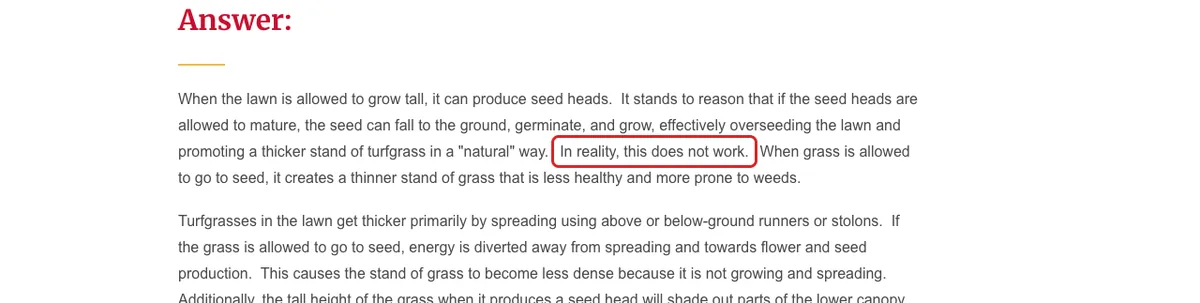
Letting a lawn go to seed does not fill bare spots either. Iowa State’s answer is direct: “In reality, this does not work.” Seedheads divert energy from runners, the tall canopy shades the lower leaves, and seed that drops rarely reaches bare soil with steady moisture (Iowa State Extension, December 2024). Many warm-season lawns cannot reseed at all: hybrid bermudas can only be propagated vegetatively (Munshaw 2017), only common bermudagrass is grown from seed (UF/IFAS LH007), and St. Augustinegrass seed is unavailable (NC State).
If stalks are already standing in the lawn, our explainer on why your grass is going to seed gives the seedhead months for 12 lawn grasses and Purdue’s reason mowed heads cannot sprout: they need about four months on the stem to mature.
Iowa State also says most modern turfgrasses are hybrids with sterile seed. That fits hybrid bermudagrass and the vegetatively planted zoysia and St. Augustine cultivars, which Clemson notes cannot produce viable seed (Clemson HGIC 1203). Tall fescue, perennial ryegrass and Kentucky bluegrass are sold as seed, so their seed can germinate; what stops them reseeding a lawn is that mowing removes seedheads before they mature and dropped seed seldom gets the soil contact and moisture Iowa State lists (Iowa State).
Will a bare spot fill in on its own?
It will if the spot is small, the grass spreads and there is growing season left. Start with the 4-inch line from NC State and the grass type, then the flow below gives the call.
1Is the lawn tall fescue, perennial ryegrass or a bunch-type fine fescue?
YesNo. Seed the spot in early fall. Tall fescue left about 8 inches of a 12-inch circle bare after 21 months at K-State, even the rhizomatous cultivars.
NoGo to the next question
2Is the spot under 4 inches across?
YesYes, if the grass is growing. NC State says spots that small fill in naturally in grasses that spread.
NoGo to the next question
3Is it Kentucky bluegrass?
YesSlowly: a 12-inch circle shrank to about 4 inches by the next May and closed in about 21 months. Seed it if you cannot wait two seasons.
NoGo to the next question
4Is it bermudagrass, St. Augustinegrass or buffalograss, with most of the summer still ahead?
YesLikely within the season. Water, and feed 0.5 to 1 lb N per 1,000 sq ft every 3 to 4 weeks (NC State); bermuda plugs on 12-inch centers close in 3 to 6 months (UF/IFAS).
NoPlug or sod it. Zoysia and centipede can take 2 to 4 years to close gaps in a lawn, and spots found in late summer stall until next year.
Source: NC State Extension Gardener Handbook ch. 9 and AG-432; St. John et al. 2009; UF/IFAS LH007
If the answer is to patch, our guide to fixing patchy grass sizes seed, plugs and soil per spot. For sodding a larger area, our sibling page on how much a pallet of sod weighs covers what a pallet covers and what it takes to move one.
How we compiled this
We read 8 research studies that measured how far or how fast lawn grasses spread: Kansas State’s tall fescue and zoysia trials, a 2025 Crop Science rhizome study, NTEP’s 2016 St. Augustinegrass test, two University of California establishment reports, a four-state bermudagrass sprigging trial and a North Carolina mowing study, plus 11 extension and industry publications from NC State, UF/IFAS, Colorado State, Clemson, Penn State, Iowa State and the Sports Turf Managers Association, all checked in November 2026. Metric values are converted to inches; we did not grow or measure any grass ourselves.
Frequently asked questions
Will grass spread if you don’t cut it?
Somewhat farther, but the lawn thins. Bahiagrass mowed at 3 inches spread 21 to 27 percent less than unmowed plants (Henry 2007), yet Iowa State says a lawn left to seed loses density. Mow at the top of your grass’s range instead.
How do you encourage grass to spread?
Give runners sun, water and nitrogen in summer. NC State feeds new warm-season grass 0.5 to 1 lb N per 1,000 sq ft every 3 to 4 weeks (NC State); plant plugs closer, and plant in early summer: zoysia covered in 3 to 4 months from a June planting in California against more than 9 from September.
How long does it take grass to spread?
Bermuda sprigs cover in 5 to 8 weeks and plugs on 12-inch centers in 3 to 6 months; buffalograss plugs in 6 to 12 weeks; Kentucky bluegrass closed a 12-inch gap in about 21 months; zoysia plugs take 2 to 4 years in North Carolina lawns.
Does grass self seed?
Not in a mowed lawn. Iowa State says letting a lawn go to seed thins it rather than thickening it (Iowa State), and hybrid bermudas, St. Augustine and most zoysia cultivars are planted only as sod, plugs or sprigs.
Which grass spreads the fastest?
Bermudagrass: hybrid sprigs reached full cover in 6 weeks in a four-state trial (Munshaw 2017). Among common cool-season lawn grasses, Kentucky bluegrass is the one NC State credits with the ability to spread and fill damaged areas.
Does rye grass spread?
No. Perennial ryegrass is a bunch grass that NC State calls incapable of spreading (NC State); a bare spot in it stays bare until reseeded. Our perennial ryegrass guide covers seeding rates.
Sources
- NC State Extension, Extension Gardener Handbook, Chapter 9: Lawns, 2022 edition, online. Accessed November 2026.
- St. John, Fry, Bremer and Keeley, Kansas State University, Establishment Rate and Lateral Spread of Festuca arundinacea Cultivars, International Turfgrass Society Research Journal 11:481 to 487, 2009. Accessed November 2026.
- Nwachukwu, Fry, Domenghini and Braun, Crop Science, Sod strength and rhizome characteristics of rhizomatous tall fescue, Dec. 17, 2025. Accessed November 2026.
- Okeyo, Fry, Bremer and others, HortScience 46(1):113 to 117, Stolon Growth Characteristics and Establishment Rates of Zoysiagrass Progeny, 2011. Accessed November 2026.
- Munshaw and others, HortTechnology 27(3):382, Nitrogen and Sprigging Rate Effects on Latitude 36 Hybrid Bermudagrass Establishment, 2017. Accessed November 2026.
- UF/IFAS Extension, LH007 (ENH19), Bermudagrass for Florida Lawns, current revision. Accessed November 2026.
- UF/IFAS Extension, LH010 (ENH5), St. Augustinegrass for Florida Lawns, 2021 revision. Accessed November 2026.
- UF/IFAS Extension, LH011 (ENH11), Zoysiagrass for Florida Lawns, 2022 revision. Accessed November 2026.
- UF/IFAS Extension, LH009 (ENH8), Centipedegrass for Florida Lawns, 2024 revision. Accessed November 2026.
- Sports Turf Managers Association, Sprigging Bermudagrass bulletin, undated. Accessed November 2026.
- Henry, Tjosvold and Gibeault, University of California, Zoysiagrass Establishment, California Turfgrass Culture 38(1 and 2), 1988. Accessed November 2026.
- Harivandi and Wu, University of California, Buffalograss: A Promising Drought-Resistant Turf for California, California Turfgrass Culture 45(1 and 2), 1995. Accessed November 2026.
- Colorado State University Extension, Fact sheet 7.224, Buffalograss Lawns, current. Accessed November 2026.
- National Turfgrass Evaluation Program, 2016 National St. Augustinegrass Test, Final Report NTEP No. 21-14, Table 36, 2017 data. Accessed November 2026.
- NC State Extension, AG-432, Zoysiagrass Lawn Maintenance Calendar, current. Accessed November 2026.
- Henry, Burton and Yelverton, Weed Science (Missouri State repository), Effect of mowing on lateral spread and rhizome growth of troublesome Paspalum species, 2007. Accessed November 2026.
- Iowa State University Extension and Outreach, Can I overseed my lawn naturally by letting it go to seed?, updated Dec. 6, 2024. Accessed November 2026.
- Clemson Cooperative Extension, HGIC 1203, Lawn Establishment, updated Feb. 29, 2024. Accessed November 2026.
- Penn State Extension, Kentucky Bluegrass, updated Sept. 8, 2025. Accessed November 2026.