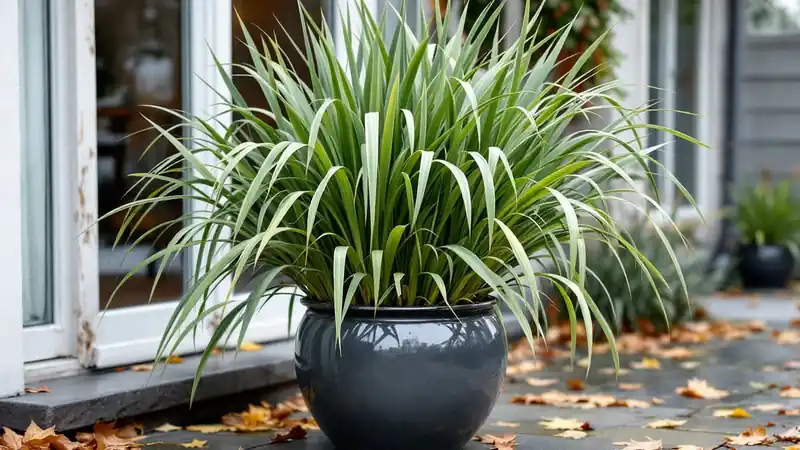
Does lemongrass come back? Only where winters stay mild: Missouri Botanical Garden rates it evergreen in USDA zones 10 and 11, with roots that may survive to zone 8b. Colder than that, frost kills it, so pot or divide it before the first freeze.
Does lemongrass come back after winter? It depends on one number: the average coldest night where you live. Lemongrass (Cymbopogon citratus) is a tropical perennial grass from southern India and Sri Lanka, and the Missouri Botanical Garden Plant Finder puts its line at zones 10 to 11 for evergreen survival and 8b for roots. The USDA’s 2023 hardiness map sets each zone from the average of each winter's lowest temperature from 1991 to 2020, so a zone 9b garden in Houston averages a 25 to 30°F low and a zone 8a garden in Atlanta averages 10 to 15°F. The table below turns 33 cities’ 2023 zones into a plain outcome.
Two more findings change what you plant. Extension and garden sources draw the hardiness line in 3 different places, from zone 8b to zone 10, and a 2026 laboratory test in the Journal of Medical Entomology found that live lemongrass drew mosquitoes toward it rather than repelling them. Both are covered further down.
Does lemongrass come back in your zone?
Read the zone as a ceiling on risk, not a promise. The USDA says its zones do not reflect the coldest it has ever been at a location, only the 30-year average low, so a zone 9a winter that averages 20 to 25°F will still bring colder nights some years. Zone 9 and 10 gardens lose leaves in a hard frost but usually keep the crown; Brooklyn Botanic Garden calls lemongrass root-hardy to about USDA Zone 9, where it goes dormant in a mild winter.
| 2023 USDA zone (average coldest night) | Lemongrass in the ground | What to do before winter | Basis |
|---|---|---|---|
| 11a and warmer (40°F and up) | Evergreen, grows all year | Cut back old clumps; divide every few years | MBG: evergreen in zones 10 to 11 |
| 10a to 10b (30 to 40°F) | Comes back; evergreen in most winters | Leave in the ground; cut to about 6 in when dormant | MBG; UC Master Gardeners, Sonoma |
| 9a to 9b (20 to 30°F) | Top dies back, roots usually regrow | Cut to 6 to 8 in, mulch the crown, pot a backup division | BBG: root-hardy to about zone 9; NC State: zones 9a to 9b listed |
| 8b (15 to 20°F) | Roots “may be hardy” | Treat the ground clump as a gamble; overwinter a division indoors | MBG; NC State lists 8b |
| 8a and colder (below 15°F) | Does not come back outdoors | Dig and pot before frost, save rooted bases, or root new stalks in spring | UW Madison Extension; Toronto Master Gardeners |
Find your own zone by ZIP code on the USDA Plant Hardiness Zone Map. The city rows below come from the 2023 ZIP code file that Oregon State University’s PRISM Climate Group publishes with the map, one downtown ZIP code per city.
Swipe the table sideways to see every column.
| City (ZIP code) | 2023 zone | Average coldest night, °F | Lemongrass outdoors | Plan |
|---|---|---|---|---|
| Key West, FL (33040) | 11b | 45 to 50 | Evergreen, grows all winter | Leave in the ground; trim brown tips in late winter |
| Miami, FL (33130) | 11a | 40 to 45 | Evergreen, grows all winter | Leave in the ground; trim brown tips in late winter |
| Honolulu, HI (96813) | 12b | 55 to 60 | Evergreen, grows all winter | Leave in the ground; trim brown tips in late winter |
| San Diego, CA (92101) | 11a | 40 to 45 | Evergreen, grows all winter | Leave in the ground; trim brown tips in late winter |
| Los Angeles, CA (90012) | 10b | 35 to 40 | Comes back; evergreen in most winters | Leave in the ground; cut back to about 6 in only if frost browns it |
| Fort Myers, FL (33901) | 10b | 35 to 40 | Comes back; evergreen in most winters | Leave in the ground; cut back to about 6 in only if frost browns it |
| Orlando, FL (32801) | 10a | 30 to 35 | Comes back; evergreen in most winters | Leave in the ground; cut back to about 6 in only if frost browns it |
| Tampa, FL (33602) | 10a | 30 to 35 | Comes back; evergreen in most winters | Leave in the ground; cut back to about 6 in only if frost browns it |
| Phoenix, AZ (85004) | 10a | 30 to 35 | Comes back; evergreen in most winters | Leave in the ground; cut back to about 6 in only if frost browns it |
| Houston, TX (77002) | 9b | 25 to 30 | Usually regrows from the roots | Cut to 6 to 8 in, mulch the crown, pot one division as a backup |
| New Orleans, LA (70112) | 9b | 25 to 30 | Usually regrows from the roots | Cut to 6 to 8 in, mulch the crown, pot one division as a backup |
| Jacksonville, FL (32202) | 9b | 25 to 30 | Usually regrows from the roots | Cut to 6 to 8 in, mulch the crown, pot one division as a backup |
| Tucson, AZ (85701) | 9b | 25 to 30 | Usually regrows from the roots | Cut to 6 to 8 in, mulch the crown, pot one division as a backup |
| Las Vegas, NV (89101) | 9b | 25 to 30 | Usually regrows from the roots | Cut to 6 to 8 in, mulch the crown, pot one division as a backup |
| Sacramento, CA (95814) | 9b | 25 to 30 | Usually regrows from the roots | Cut to 6 to 8 in, mulch the crown, pot one division as a backup |
| Fresno, CA (93721) | 9b | 25 to 30 | Usually regrows from the roots | Cut to 6 to 8 in, mulch the crown, pot one division as a backup |
| San Antonio, TX (78205) | 9a | 20 to 25 | Usually regrows from the roots | Cut to 6 to 8 in, mulch the crown, pot one division as a backup |
| Austin, TX (78701) | 9a | 20 to 25 | Usually regrows from the roots | Cut to 6 to 8 in, mulch the crown, pot one division as a backup |
| Charleston, SC (29401) | 9a | 20 to 25 | Usually regrows from the roots | Cut to 6 to 8 in, mulch the crown, pot one division as a backup |
| Savannah, GA (31401) | 9a | 20 to 25 | Usually regrows from the roots | Cut to 6 to 8 in, mulch the crown, pot one division as a backup |
| Seattle, WA (98104) | 9a | 20 to 25 | Usually regrows from the roots | Cut to 6 to 8 in, mulch the crown, pot one division as a backup |
| Portland, OR (97204) | 9a | 20 to 25 | Usually regrows from the roots | Cut to 6 to 8 in, mulch the crown, pot one division as a backup |
| Dallas, TX (75201) | 8b | 15 to 20 | Gamble: roots “may be hardy” | Mulch the crown and keep a potted division indoors |
| Atlanta, GA (30303) | 8a | 10 to 15 | Does not come back outdoors | Pot it, save rooted bases or root new stalks in spring |
| Raleigh, NC (27601) | 8a | 10 to 15 | Does not come back outdoors | Pot it, save rooted bases or root new stalks in spring |
| Washington, DC (20001) | 8a | 10 to 15 | Does not come back outdoors | Pot it, save rooted bases or root new stalks in spring |
| Nashville, TN (37201) | 7b | 5 to 10 | Does not come back outdoors | Pot it, save rooted bases or root new stalks in spring |
| Albuquerque, NM (87102) | 7b | 5 to 10 | Does not come back outdoors | Pot it, save rooted bases or root new stalks in spring |
| Philadelphia, PA (19107) | 7b | 5 to 10 | Does not come back outdoors | Pot it, save rooted bases or root new stalks in spring |
| New York, NY (10001) | 7b | 5 to 10 | Does not come back outdoors | Pot it, save rooted bases or root new stalks in spring |
| Chicago, IL (60602) | 6b | -5 to 0 | Does not come back outdoors | Pot it, save rooted bases or root new stalks in spring |
| Denver, CO (80202) | 6a | -10 to -5 | Does not come back outdoors | Pot it, save rooted bases or root new stalks in spring |
| Minneapolis, MN (55401) | 5a | -20 to -15 | Does not come back outdoors | Pot it, save rooted bases or root new stalks in spring |
Two patterns stand out. Most of Florida’s peninsula, coastal California and Phoenix sit in zone 10 or warmer, where the plant stays green; the Gulf Coast from Houston to Jacksonville sits in 9b, the band where Walter Reeves, the Georgia garden columnist, reports it is a perennial in south Georgia but killed by winter cold in Atlanta gardens. Seattle and Portland read 9a on the map, but UW Madison Extension notes lemongrass only grows slowly until the heat and humidity of summer arrive, so a cool summer limits size before winter does.
Why sources disagree: zone 8b, 9 or 10?
Each source answers a different question. Missouri Botanical Garden separates leaves from roots: the plant stays evergreen in zones 10 to 11 and the roots may survive to 8b. NC State’s Extension Gardener Plant Toolbox lists every half zone from 8b to 11b and still advises growers to overwinter it as a container plant. Retail pages often print a single range such as 9 to 10, which hides the fact that zone 9 survival means regrowth from roots, not green leaves.
| Source | What it says | Coldest zone for survival | Link and date |
|---|---|---|---|
| Missouri Botanical Garden Plant Finder | “Winter hardy to USDA Zones 10-11 where it is evergreen (roots may be hardy to Zone 8b)” | 8b roots; 10 to 11 leaves | MBG, current |
| NC State Extension Plant Toolbox | Zones 8b, 9a, 9b, 10a, 10b, 11a, 11b; “overwinter as a container plant but do not let it dry out” | 8b | NC State, current |
| Brooklyn Botanic Garden (Robert Newgarden) | “root-hardy to about USDA Zone 9 (California, central Florida) where it goes dormant” | 9 | BBG, March 1, 1999 |
| Clemson HGIC herb fact sheet | Hardy near the South Carolina coast, zones 9 to 10 | 9 | Clemson HGIC, updated Nov. 25, 2019 |
| UC Master Gardeners, Sonoma County | “damaged when temperatures drop into the 40’s”; cut to about 6 in in mild winter areas | Mild-winter areas only | UC ANR, current |
| UW Madison Extension (Susan Mahr) | “Frost will kill or severely damage the plants”; harvest or dig before nights reach freezing | Annual in Wisconsin | UW Madison, revised Oct. 2026 |
| Utah State University Extension | Tender perennial grown as an annual in cooler areas; save 6 in bulbous bases | Annual in northern Utah | USU, updated Dec. 2023 |
| UF/IFAS Gardening Solutions | Herbaceous perennial in Florida landscapes; leaves turn scarlet or dark red in fall and winter | Perennial statewide | UF/IFAS, current |
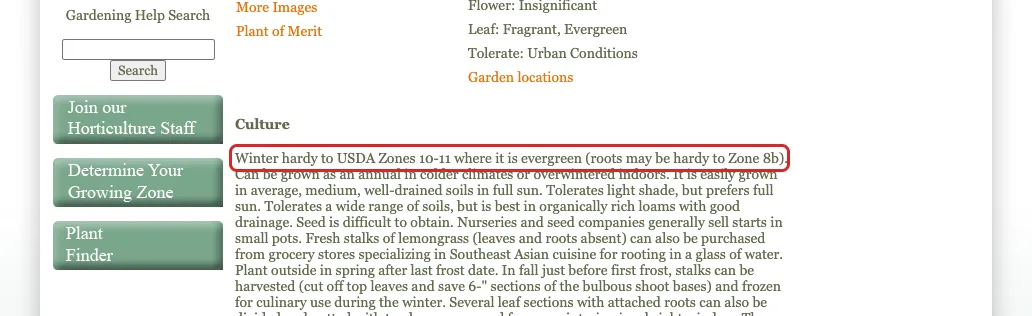
For planning, use Missouri Botanical Garden’s two lines. In zones 10 and 11 the clump keeps working as an edible ornamental through winter. In 8b to 9b, leave the clump in the ground if you accept losing it in a hard year, and carry one division indoors as insurance. For the same zone logic applied to a tropical ornamental, see our guide to overwintering purple fountain grass, which UF/IFAS treats as a perennial only in zones 9 to 11.
How cold can lemongrass get before it is damaged?
Leaves fail long before roots. The thresholds below come from extension and master gardener pages; none of them cites a controlled freezing test, so treat each as field guidance. The useful action trigger is the first fall night forecast below 50°F: Toronto Master Gardeners say to move it indoors as soon as night temperatures are sinking to 10°C.
| Temperature | What happens | Rule given | Source |
|---|---|---|---|
| Nights near 50°F (10°C) | Growth stalls; time to move pots in | Move indoors in fall; set out in spring only once nights stay above 10°C | Toronto Master Gardeners |
| Nights in the 40s°F | Leaf damage begins | Lemon grass “is damaged when temperatures drop into the 40’s” | UC Master Gardeners, Sonoma |
| 32°F (first frost) | Leaves killed or severely damaged | Harvest or dig “before overnight temperatures get to freezing” | UW Madison Extension |
| 15 to 20°F average low (zone 8b) | Roots at the edge of survival | Roots “may be hardy to Zone 8b” | MBG |
| About 41°F (5°C) indoors, dark | Dormant hold for cut-back clumps | Cut back and keep in a cool dark spot, or grow on as a houseplant | Toronto Master Gardeners |
The two cool numbers do not conflict once you separate the cases. A growing plant outdoors shows leaf burn in the 40s, while a clump already cut to stubs and kept nearly dry is resting; Brooklyn Botanic Garden describes storing potted clumps in the coolest part of the house or attached garage with watering reduced to a bare minimum. Red or purple fall leaves are not frost damage in Florida: UF/IFAS notes lemongrass turns scarlet or dark red in the fall and winter.
How to overwinter lemongrass
Pick a method by the space you have. A sunny south window or grow light keeps a potted plant growing; a cool garage or basement above freezing holds a cut-back clump; a refrigerator shelf of rooted bases needs no space at all. Our guide to hardy ornamental grasses by zone lists clump grasses that need none of this north of zone 8.
1Is your 2023 USDA zone 10a or warmer (average coldest night 30 F or above)?
YesLeave it in the ground. It stays evergreen in most winters (MBG); trim frost-browned leaves in late winter.
NoGo to the next question
2Is your zone 9a or 9b (20 to 30 F)?
YesCut it to 6 to 8 in, cover the crown with loose straw, and pot one division indoors as a backup. Roots usually regrow (BBG).
NoGo to the next question
3Is your zone 8b (15 to 20 F)?
YesTreat the ground clump as a gamble: roots may survive (MBG). Pot a division before nights fall below 50 F.
NoGo to the next question
4Do you have a sunny south window or a grow light?
YesDig, divide and pot it as a houseplant before nights reach 50 F; keep the mix evenly moist (NC State).
NoGo to the next question
5Do you have a cool garage or basement that stays above freezing?
YesCut to 8 in stubs, pot it and water a bare minimum until late winter (BBG).
NoHarvest and freeze the stalks (up to 6 months, USU) and root fresh grocery stalks in water next spring: roots in 2 to 3 weeks (UC Master Gardeners).
| Method | Best for | Key numbers | Source |
|---|---|---|---|
| Pot as a houseplant | A south window or grow light | Pot a division before nights reach 50°F; keep soil evenly moist | NC State; MBG |
| Cut back and hold cool | A garage or basement above freezing | Cut to 8 in stubs, pot, water a bare minimum, move to a sunny window when growth starts in late winter | BBG |
| Save rooted bases | No space | Keep 6 in sections of the bulbous base with roots attached; pot with top leaves removed | MBG; USU |
| Leave it in the ground | Zones 9 to 11 (8b as a gamble) | Cut back to about 6 in when dormant; growth resumes as the weather warms | UC Master Gardeners, Sonoma |
| Start over in spring | Any zone | Root grocery stalks in water: roots in 2 to 3 weeks, new stalks within 3 months | UC Master Gardeners, Sonoma; UW Madison |
Pot it as a houseplant
- Dig the clump while nights are still above 50°F, the trigger Toronto Master Gardeners use. Cut the leaves back so the pot is easier to handle.
- Divide it. Missouri Botanical Garden pots several leaf sections with attached roots; one division per 6 to 8 in pot is enough for spring.
- Use a draining container mix, not garden soil. The ingredient panels to look for are in our comparison of potting soil vs potting mix.
- Set it in the brightest window. NC State says do not let it dry out; Utah State adds that indoor plants will not produce as many stalks because of low light.
- Watch for spider mites, which Missouri Botanical Garden calls a serious pest on indoor plants. Rinse leaves with a strong water spray at the first yellow speckling.
Evenly moist is not soggy. Wet mix in a warm room is where fungus gnat larvae breed, and our page on getting rid of fungus gnats in potting soil gives the 1 to 2 inch dry-down rule that also suits lemongrass. Indoor pots drain best with the air space described in what well-drained soil means for pots.
Cut it back and hold it cool
This is Brooklyn Botanic Garden’s method for its own herb garden: before killing frosts, cut the plant to eight-inch stubs, dig and pot it, and store it cool with watering cut to a bare minimum. When the clump shows signs of life in late winter, move it to a warm, sunny window and resume normal watering. BBG plants it back out in mid-May after a two-week hardening-off in shade.
Save rooted bases or start from grocery stalks
- At harvest, keep a 6 inch section of the bulbous shoot base with roots attached, as Utah State Extension describes; pot several for spring starts.
- For grocery stalks, choose ones with the base intact. Brooklyn Botanic Garden says to look for true stem where leaf sheaths are attached below the pseudostem.
- Stand them in 3 to 4 in of water near a window and change the water weekly; UC Master Gardeners in Sonoma County expect roots to form in 2-3 weeks.
- Pot each stalk in a gritty mix once it has 3 to 4 roots. New stalks should emerge within 3 months.
Kitchen backup: Utah State Extension says cut lemongrass can be frozen up to 6 months, so a fall harvest covers winter cooking even if the plant is lost.
Leave it in the ground in zones 9 to 11
In mild-winter areas UC Master Gardeners cut the grass back to about 6 in when it is dormant or nearly so, and growth resumes as the weather warms. In zone 8b or 9a, a loose straw layer over the cut crown helps on the coldest nights; no extension source we found gives a mulch depth for lemongrass, so use the perennial-bed depths in how deep to spread mulch and pull it back from the crown in spring.
Lemongrass, East Indian lemongrass and citronella grass
Hardiness pages and repellent claims often mix up four plants. UW Madison Extension notes that two of the 55 species in the genus Cymbopogon are sold as lemongrass, while EPA’s 1997 reregistration fact sheet says oil of citronella is distilled from Cymbopogon nardus and Cymbopogon winterianus, two different grasses. The citronella plant in garden center pots is often a scented geranium, not a grass at all.
| Species | Common name | Use | Hardiness or note (source) |
|---|---|---|---|
| Cymbopogon citratus | West Indian lemongrass | The cooking herb sold in garden centers and grocery stores | Zones 10 to 11 evergreen, roots to 8b (MBG) |
| Cymbopogon flexuosus | East Indian lemongrass, cochin or Malabar grass | Cooking and oil; its oil keeps longer and goes into perfume | No extension zone found; grown the same way (UW Madison) |
| Cymbopogon nardus | Citronella grass, Ceylon type | Source of Ceylon-type oil of citronella | EPA R.E.D. Facts, Feb. 1997 |
| Cymbopogon winterianus | Java citronella | Source of Java-type oil of citronella | EPA R.E.D. Facts, Feb. 1997 |
| Pelargonium citrosum | Citronella-scented geranium | Not a grass; did not repel mosquitoes in 16 weeks of field trials | Novelo et al., J. Med. Entomol., 2026 |
Does a lemongrass plant keep mosquitoes away?
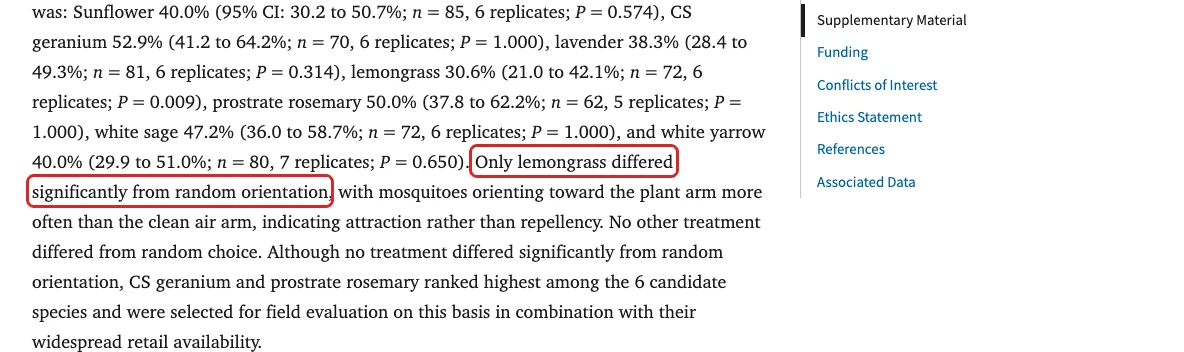
No, and one study found the reverse. In Y-tube olfactometer tests by the Sacramento-Yolo Mosquito and Vector Control District, published in the Journal of Medical Entomology in July 2026, only 30.6 percent of mosquitoes released near live lemongrass chose the clean-air arm (n = 72, P = 0.009). The authors wrote that this indicates attraction rather than repellency. No other plant tested differed from random choice.
| Live plant in the test arm | Mosquitoes choosing clean air, % | Mosquitoes released (n) | P value vs random choice |
|---|---|---|---|
| Citronella-scented geranium | 52.9 | 70 | 1.000 |
| Prostrate rosemary | 50.0 | 62 | 1.000 |
| White sage | 47.2 | 72 | 1.000 |
| Sunflower (non-repellent reference) | 40.0 | 85 | 0.574 |
| White yarrow | 40.0 | 80 | 0.650 |
| Lavender | 38.3 | 81 | 0.314 |
| Lemongrass (Cymbopogon citratus) | 30.6 | 72 | 0.009 |
The repellent is the distilled oil, not the leaf. EPA lists citronella oil and lemongrass oil among the minimum-risk active ingredients in 40 CFR 152.25(f), and a review in Malaria Journal found citronella-based repellents protect from host-seeking mosquitoes for about two hours. A UF/IFAS Extension agent put it plainly in 2025: unless you extract the oils and apply them like a spray, these plants are not doing much just sitting in your garden. Grow lemongrass to eat; use an EPA-registered repellent and empty standing water for mosquitoes.
This page is general information, not pesticide advice. If you use any insect repellent, the label is the law: apply it only as its label directs.
How big does lemongrass get before winter?
Size depends on summer heat. Missouri Botanical Garden says a cold-climate plant typically reaches 2 to 3 feet tall and as wide in one growing season; UF/IFAS gives six feet tall and four feet wide in Florida, and UW Madison Extension describes clumps up to 6 feet in diameter in the tropics. A clump that size is the reason to divide in fall: a 6 to 8 inch division carries indoors, the whole clump does not. Harvest stalks once they are about half an inch thick, and take no more than one third of a clump at a time, the UC Master Gardeners limit.
Lemongrass does not run like bamboo. It spreads slowly by tillering, which BBG says keeps it completely controllable in the cooler-climate garden, and the UF/IFAS assessment of non-native plants lists it as not a problem species in north, central and south Florida. Compare the running grasses in our page on bamboo as a grass.
How we compiled this
In November 2026 we read 16 primary documents: Missouri Botanical Garden, NC State, Brooklyn Botanic Garden (1999), Clemson HGIC, UW Madison, Utah State, UF/IFAS (3 pages), UC Master Gardeners Sonoma and Toronto Master Gardeners pages; the USDA ARS 2023 hardiness map release; EPA’s 1997 oil of citronella fact sheet; 40 CFR 152.25; and two peer-reviewed papers (Novelo et al. 2026, Maia and Moore 2011). City zones come from PRISM’s 2023 ZIP code file, one downtown ZIP per city. The outcome column is our mapping, not a field trial: we did not grow or freeze plants.
Frequently asked questions
Should lemongrass be cut back in the fall?
Only if you are moving it or it has gone dormant. North of zone 9, cut it to about 8 inch stubs when you dig and pot it (BBG). In zones 9 to 11, cut it back to about 6 inches when it is dormant, and growth resumes as the weather warms (UC Master Gardeners).
Will lemongrass come back after a freeze?
In zones 9 to 11 the roots usually regrow after a frost kills the leaves; Missouri Botanical Garden says roots may survive to zone 8b. In zone 8a and colder, a ground clump will not come back, so pot a division or root new stalks in spring (MBG).
Will lemongrass regrow after cutting?
Yes. Cut stalks at ground level once they are about half an inch thick (UW Madison); Utah State says harvesting older stalks first promotes new ones. Take no more than one third of a clump at a time (UC Master Gardeners).
Is lemongrass a perennial in zone 7?
Not outdoors. Zone 7 averages a coldest night of 0 to 10°F on the 2023 USDA map, below the zone 8b root line Missouri Botanical Garden gives. Philadelphia, Nashville and Albuquerque (7b) need to pot it, save rooted bases or replant each spring.
Does lemongrass flower?
Rarely. Missouri Botanical Garden lists it as rarely flowering, NC State’s toolbox says it does not flower, and BBG’s plant never did. UW Madison notes flowers seldom appear on plants grown as annuals and rarely set seed (UW Madison).
Sources
- Missouri Botanical Garden Plant Finder, Cymbopogon citratus, current. Accessed November 2026.
- NC State Extension Gardener Plant Toolbox, Cymbopogon citratus, current. Accessed November 2026.
- Brooklyn Botanic Garden (Robert Newgarden), Lemon Grass: A Very Versatile Herb, March 1, 1999. Accessed November 2026.
- Clemson Cooperative Extension HGIC, Herbs fact sheet (lemongrass entry), updated Nov. 25, 2019. Accessed November 2026.
- University of Wisconsin Madison Extension (Susan Mahr), Lemongrass, revised October 2026. Accessed November 2026.
- Utah State University Extension (Linse and Drost), How to Grow Lemongrass in Your Garden, updated Dec. 14, 2023. Accessed November 2026.
- UF/IFAS Gardening Solutions, Lemongrass, current. Accessed November 2026.
- UF/IFAS Assessment of Non-Native Plants, Cymbopogon citratus, current. Accessed November 2026.
- UF/IFAS News, Florida experts break down the buzz on the myth of mosquito-repelling plants, Aug. 6, 2025. Accessed November 2026.
- UC Master Gardener Program of Sonoma County, Lemongrass, current. Accessed November 2026.
- Toronto Master Gardeners, How to Grow Lemongrass, current. Accessed November 2026.
- Walter Reeves (Georgia garden columnist), Lemon Grass: Winterizing, undated. Accessed November 2026.
- USDA Agricultural Research Service, USDA Unveils Updated Plant Hardiness Zone Map, Nov. 15, 2023. Accessed November 2026.
- USDA ARS and Oregon State University, USDA Plant Hardiness Zone Map (ZIP lookup), 2023 map. Accessed November 2026.
- PRISM Climate Group, Oregon State University, phzm_us_zipcode_2023.csv (2023 hardiness zones by ZIP code), 2023 map, 1991 to 2020 data. Accessed November 2026.
- Novelo M, Brodigan J, Clack W, Fowles T, Wheeler SS, Evaluation of 2 ornamental plants for spatial repellency of host-seeking mosquitoes, J. Med. Entomol. 63(4): tjag131, July 2026. Accessed November 2026.
- U.S. EPA, R.E.D. Facts: Oil of Citronella, EPA-738-F-97-002, February 1997. Accessed November 2026.
- eCFR, 40 CFR 152.25, Exemptions for pesticides of a character not requiring FIFRA regulation, current. Accessed November 2026.
- Maia MF, Moore SJ, Plant-based insect repellents: a review of their efficacy, development and testing, Malaria Journal 10 (Suppl 1): S11, 2011. Accessed November 2026.
- The Green Industry Report, lemongrass hardiness by city dataset (CSV), compiled November 2026.