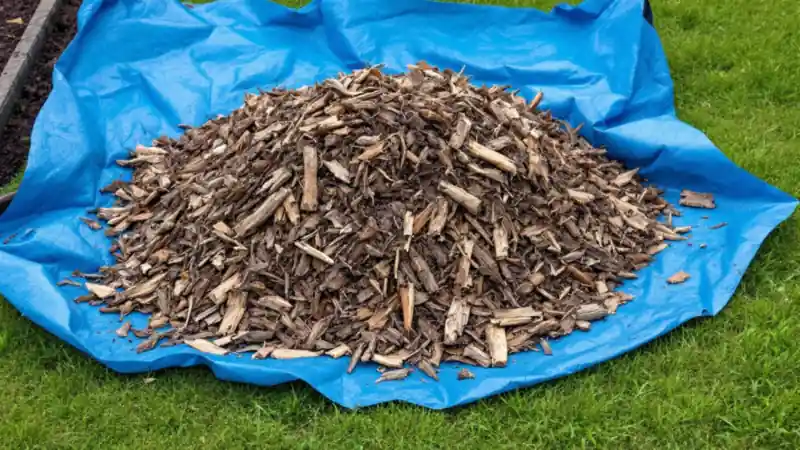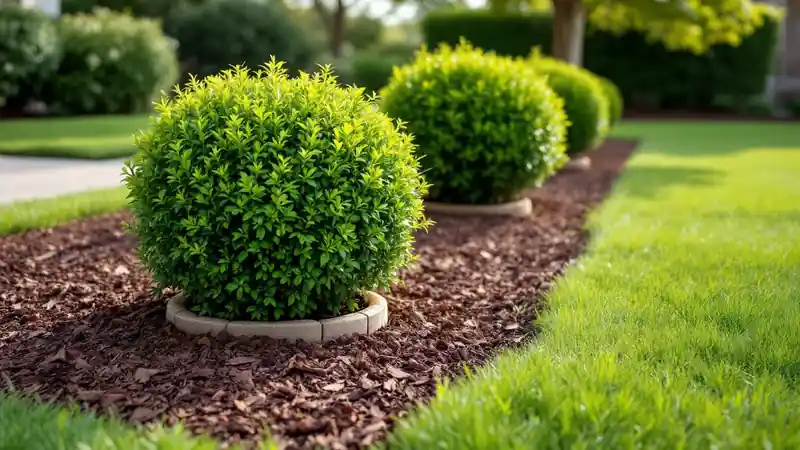
How deep should mulch be? 2 to 3 inches for fine or shredded mulch, 3 to 4 inches for coarse wood chips, measured after settling. Keep it under 2 inches by the foundation and lay 12 inches under play equipment.
How deep should mulch be depends on two things you can check: how coarse the pieces are and how well the soil drains. We lined up published depths for 14 materials from 9 extension sources: for ordinary beds every figure lands inside 1 to 4 inches, and only the weed-control and very coarse rows go deeper. The finer the mulch and the wetter the soil, the lower in that band you go. Depth is also the biggest lever on your order: 4 inches takes twice the mulch of 2, which our mulch calculator and coverage chart convert into yards and bags.
The ceiling has thinner evidence than most guides admit. A December 2025 systematic review in Arboriculture & Urban Forestry (Martin, Klein, Koeser and Hauer) found only 11 peer-reviewed studies that varied mulch depth around trees. The authors report “few negative effects” at 2 to 4 inches and “often negative side effects” past 4. The depth table, the 8 trials behind it and the settling rates that tell you how deep to lay each material are below.
Mulch depth by material
Particle size sets the depth. UC IPM says coarse mulch can go up to 4 inches and fine mulch, which packs tightly, only about 2, and that pieces bigger than 1 1/2 inches need 6 inches or more before they shade the soil. Fresh sawdust is the extreme: Iowa State keeps it to 1 inch or less so it does not crust and shed water.
Swipe the table sideways to see every column.
| Mulch | Texture | Depth | Why the limit | Source |
|---|---|---|---|---|
| Arborist wood chips, coarse | Mixed chips, bark and leaves | 3 to 4 in | Coarse pieces leave air gaps, so more depth is needed to shade out weeds | ISA; Morton Arboretum |
| Wood chips or shredded bark, well-drained soil | Medium to coarse | 3 to 4 in | Thin layers do not hold moisture or stop weeds | Iowa State |
| Wood chips or shredded bark, heavy soil | Medium to coarse | 2 to 3 in | Deeper layers can waterlog clay | Iowa State |
| Fine or composted mulch | Fine, packs tight | 2 to 3 in | Fine particles mat and seal; UC IPM puts fine mulch at about 2 in | ISA; UC IPM |
| Bark mulch (pine or hardwood) | Nuggets to shredded | 1 to 3 in | Maryland caps all organic mulch at 3 in total | Univ. of Maryland |
| Pine straw (needles) | Long, loose needles | 2 to 3 in | Settles to about half in 1 year in Florida, so lay it at the top of the band | Univ. of Maryland; UF/IFAS FOR 69 |
| Shredded leaves | Fine once shredded | 2 to 3 in | Decompose quickly | Univ. of Maryland |
| Grass clippings | Very fine, wet | 1 to 2 in | Thick fresh layers mat, smell and shed water | Univ. of Maryland; CSU |
| Compost used as a mulch | Fine | About 1 in | Breaks down within a year | Univ. of Maryland |
| Cocoa bean shells | Light, small | 1 to 2 in | Toxic to dogs that eat it | Iowa State |
| Fresh sawdust | Very fine | 1 in or less | Crusts and blocks water if deeper | Iowa State; Univ. of Maryland |
| Gravel, stone or lava rock | Stones under 1/2 in work as mulch | 1 in (Maryland) to 4 in (CSU, for weed control) | Stones over 1/2 in let weeds and runoff through | Univ. of Maryland; CSU |
| Coarse wood chips for weed control | Coarse | 4 to 6 in | Chalker-Scott’s ornamental-site figure; 8 to 12 in for restoration sites | WSU, Chalker-Scott |
| Large organic pieces over 1 1/2 in | Very coarse | 6 in or more | Gaps let light reach weed seeds at shallower depths | UC IPM |
Two rows need context. Pine straw is lofty when spread and settles fastest of six mulches in the Florida trial below, so lay it 3 to 4 inches deep to keep 2 a year later; our pine straw vs mulch comparison covers its cost and fire record. Rock is the widest split: Maryland says a 1 inch layer, while Colorado State wants wood chips, gravel and other mulch at 4 inches for weed control, with stones no bigger than 1/2 inch.
If you are choosing between the two, our mulch vs rock soil heat and cost data compares them over 10 years. Rubber mulch sold for beds comes with each maker’s own depth; the 6 to 8 inch figures quoted online are playground numbers, covered below.
Mulch depth by situation
Soil drainage moves the number more than material does. Iowa State gives 3 to 4 inches of chips or shredded bark on well-drained sites and 2 to 3 inches on heavy soils, and the International Society of Arboriculture warns that more than 2 inches of organic mulch on wet soil can slow drying. Weed pressure pushes the other way: CSU puts weed-suppressing mulch at 4 inches and Washington State’s Linda Chalker-Scott at 4 to 6.
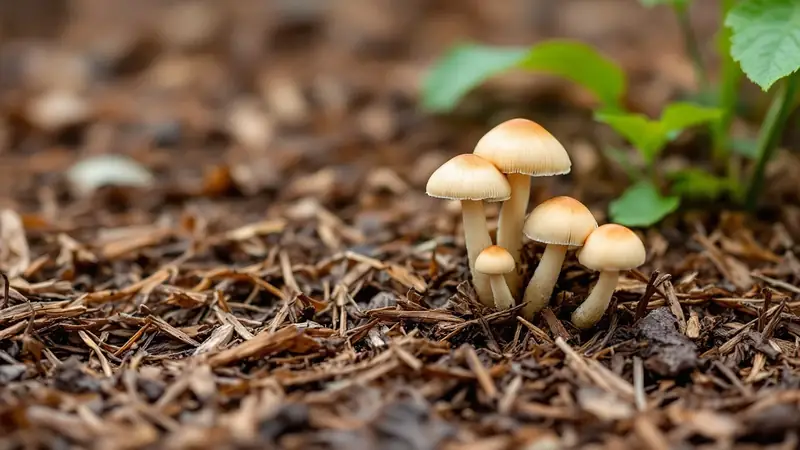
Depth also feeds the fungi: Rutgers ties layers of 4 inches or more to stinkhorns, slime mold and artillery fungus, which is why thinning the bed is step 4 in our guide on how to get rid of mushrooms in mulch.
| If the spot is | Depth to keep | Source |
|---|---|---|
| Bed or tree ring on well-drained soil | 3 to 4 in of coarse chips; 2 to 3 in of fine mulch | ISA brochure; Iowa State FAQ |
| Heavy clay or poorly drained soil | 2 to 3 in at most; ISA: over 2 in on wet soil can slow drying | Iowa State; ISA |
| Shallow-rooted shrubs such as boxwood | 1 in maximum | Univ. of Maryland |
| Total layer, old plus new, any organic mulch (Maryland) | 3 in maximum | Univ. of Maryland |
| Within 12 in of the foundation | Under 2 in, with a 6 in inspection gap below siding | UF/IFAS ENY-832 |
| Within 5 ft of a house where wildfire is a risk | No combustible mulch: rock, gravel, concrete or pavers | Univ. of Nevada SP-11-04 |
| Heavy annual weed pressure | 4 in (CSU) to 4 to 6 in (WSU) of coarse chips | CSU; WSU |
| Bed that still measures 2 to 3 in | Add nothing; rake to loosen and refresh color | Univ. of Maryland; ISA |
| Public playground, wood chips (non-impact-tested) | 12 in installed, 9 in kept: 10 ft critical height | CPSC Pub. 325 (2025), Table 2 |
Weeds have their own page: what mulch trials measured on weeds from 1 to 10 inches. The short version from Cornell: keep 2 to 4 inches to cut annual weed germination, and expect yellow nutsedge and thistles to push through anyway.
1Is the spot within 5 feet of the house in a wildfire-prone area?
YesUse rock, gravel, concrete or pavers there, not wood, straw or rubber mulch (Nevada SP-11-04).
NoGo to the next question
2Is it within 12 inches of the foundation?
YesKeep mulch under 2 inches and leave 6 inches of foundation showing below the siding (UF/IFAS ENY-832).
NoGo to the next question
3Does a trowel already find your target depth (2 to 3 inches fine, 3 to 4 coarse)?
YesAdd nothing. Rake it loose and pull it 3 to 10 inches off trunks.
NoGo to the next question
4Is it a playground fall zone?
YesInstall 12 inches of wood chips to keep 9, or follow the impact-tested product's depth (CPSC Pub. 325).
NoGo to the next question
5Is the soil heavy clay or slow to drain, or the mulch fine or shredded?
YesTop up to 2 to 3 inches in total (Iowa State; ISA).
NoCoarse chips on well-drained soil: top up to 3 to 4 inches in total, 4 to 6 where weeds are heavy (CSU; WSU).
Source: UF/IFAS ENY-832; Nevada SP-11-04; Iowa State; ISA; CPSC Pub. 325 (2025); CSU; WSU
What happens when mulch is too deep?
Too deep is mostly a water problem, not an oxygen one. In Greenly and Rakow (1995), soil oxygen under 10 inches of wood mulch averaged 18.9 percent against 19.8 percent in bare soil, a gap the authors found not significant, and Watson and Kupkowski (1991) measured no oxygen loss under 18 inches of wood chips after 2 years. Fine material is different: Iowa State says fine mulch piled over 10 inches deep will likely block oxygen because the mulch consumes it.
| Trial and trees | Depths tested (in) | What changed with depth |
|---|---|---|
| Greenly and Rakow 1995, white pine and pin oak | 0, 3, 6, 10 | Shoot growth best at 3 in; soil oxygen 19.8% bare vs 18.9% at 10 in (not significant); summer soil 70.5°F bare vs 65.3°F at 10 in; weed cover 3.5% at 10 in |
| Watson and Kupkowski 1991, established trees, Illinois | 18 (settled to 14 to 16) | After 2 years, oxygen diffusion and soil temperature matched bare soil; roots grew up into the mulch |
| Stafne and others 2009, young peach trees (via review) | 0, 2, 4, 6 | Mortality under 5% at 2 in or less, 15% at 4 in, 35% at 6 in in a record-wet year |
| Arnold and others 2005, green ash and goldenraintree, Texas | 0, 3, 6, 9 | Soil water potential -5.8 kPa under 3 in, -9.1 bare, -16.2 under 9 in (rain blocked); mortality rose with depth from 3 in |
| Pellett and Heleba 1995 (via review) | 0, 2, 4 | Growth slower at 4 in than at 2 in |
| Hild and Morgan 1993 (via review) | 0, 3, 6 | No difference in height, crown width or survival after 18 months |
| Gilman and Grabosky 2004 (via review) | 0, 3, 6 over the root ball | No difference in trunk caliper growth |
| Sun and others 2023 (via review) | 0, 2, 4, 8 | 2 in gave the best fine roots at 6 months; 4 and 8 in overtook it by months 9 to 12 |
The measured harm clusters past 4 inches, and water runs through it. Stafne’s peach losses rose to 35 percent at 6 inches during record rainfall, and Arnold’s Texas trees did best at 3 inches, with soil water potential at minus 16.2 kPa under 9 inches of pine bark against minus 5.8 under 3, because the thick layer kept rain and irrigation out. Growth effects are smaller: Greenly’s shoots peaked at 3 inches and fell below the unmulched trees at 10, while two trials (Hild and Morgan; Gilman and Grabosky) found no depth effect at all.
A water line laid under the mulch sidesteps part of that: the Saving Water Partnership covers soaker hose with 2 to 3 inches of mulch rather than burying it, and our soaker hose vs drip irrigation guide shows which lines may go below the soil.
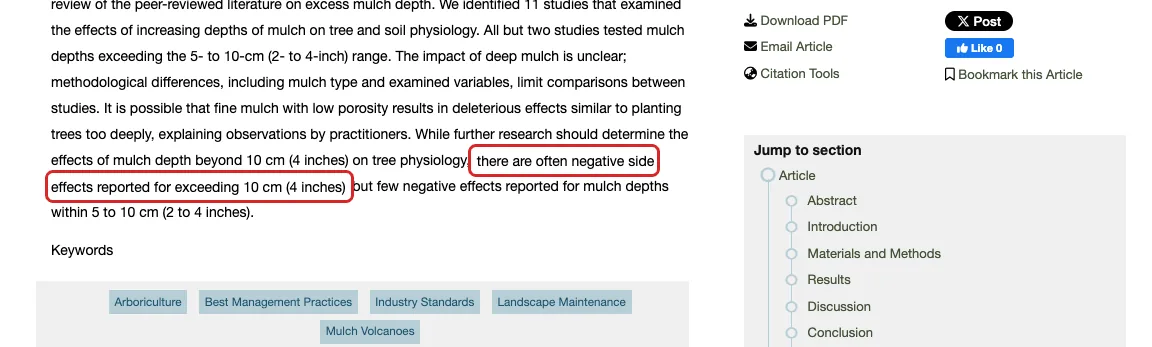
Cooler soil is the likely mechanism. Summer soil under 10 inches averaged 65.3°F against 70.5°F bare in Greenly’s plots, and the authors suggest slower spring warming under 6 and 10 inches cut root growth. That fits the review’s conclusion: there is no proven maximum, few recorded downsides at 2 to 4 inches and more beyond. The wood chips vs mulch trial comparison shows how chips and shredded mulch differ at the same depth.
How far should mulch be from tree trunks and the house?
Depth at the trunk is a separate rule from depth in the bed. Penn State Extension says to pull mulch 3 to 5 inches back from young trees and 8 to 10 inches from mature ones, and to spread a volcano out to the drip line so it is no deeper than 4 inches. Our guide on how to mulch around trees and fix a mulch volcano covers ring size and the trunk-wound study.
| Keep mulch off | Clearance | Source |
|---|---|---|
| Young trees | 3 to 5 in | Penn State; Cornell |
| Mature trees | 8 to 10 in (Penn State); 8 to 18 in (Cornell) | Penn State; Cornell |
| Any tree trunk (single figure) | 3 in (Maryland); 6 in (Iowa State, CSU) | Univ. of Maryland; Iowa State; CSU |
| House siding (termite inspection gap) | 6 in of exposed foundation | UF/IFAS ENY-832 |
| House wall, wildfire areas | 5 ft with no combustible mulch | SP-11-04 |
Next to the house, two different hazards set two distances. For termites, UF/IFAS ENY-832 recommends under 2 inches of mulch within 12 inches of the foundation and a 6 inch inspection gap below siding, and says layers over 4 to 6 inches hide that gap. For fire, the University of Nevada burned 8 mulches and found all of them combustible, so SP-11-04 advises rock, gravel, concrete or pavers within 5 feet of the house.
How much does mulch settle?
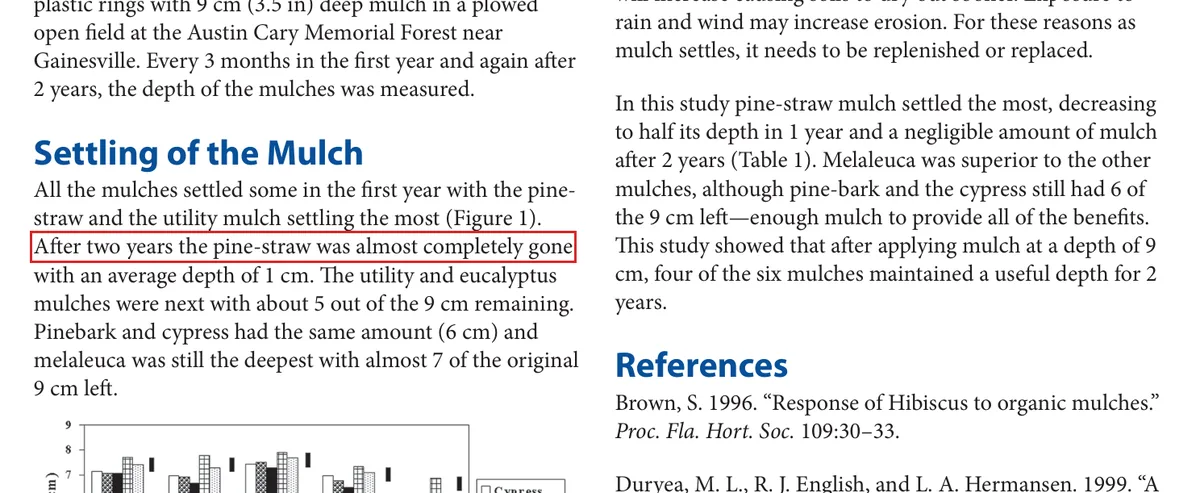
Mulch thins out, so the depth you spread is not the depth you keep. In UF/IFAS FOR 69, six mulches were laid 9 cm (3.5 inches) deep near Gainesville, Florida and measured for 2 years. Pine bark and cypress kept 6 cm, melaleuca almost 7, eucalyptus and utility chips about 5, and pine straw 1 cm after losing half its depth in year 1.
| Mulch | Laid (cm) | Left after 2 years (cm) | Left (in) | Lost |
|---|---|---|---|---|
| Melaleuca | 9 | Almost 7 | About 2.8 | About 22% |
| Pine bark | 9 | 6 | 2.4 | 33% |
| Cypress | 9 | 6 | 2.4 | 33% |
| Eucalyptus | 9 | About 5 | About 2.0 | About 44% |
| Utility prunings (oak, cherry chips) | 9 | About 5 | About 2.0 | About 44% |
| Pine straw | 9 | 1 (half gone after year 1) | 0.4 | 89% |
Read it as a laying guide. To still have 2 inches of bark after 2 Florida summers, lay about 3 inches (2 ÷ 6/9); utility chips need about 3.6 inches (2 ÷ 5/9). Pine straw cannot hold 2 years, so lay 3 to 4 inches and expect to top up every year. Decay is slower in cooler climates, which is why measuring each spring, the step our mulch timing guide ties to soil temperature, beats a calendar.
How deep should playground mulch be?
Under play equipment, mulch is fall protection and the numbers jump. The July 2025 CPSC Public Playground Safety Handbook Table 2 lists 12 inches installed and 9 inches compressed for wood chips, wood mulch, pea gravel and sand, and 8 inches installed with 6 compressed for rubber mulch, when the product has no maker’s impact test. Loose fill “will compress at least 25% over time,” the handbook says, which is why 12 inches is laid to keep 9.
| Material (not impact-tested) | Install (in) | Keep at least (in) | Protects to a fall height of (ft) |
|---|---|---|---|
| Wood chips | 12 | 9 | 10 |
| Wood mulch (non-CCA) | 12 | 9 | 7 |
| Rubber mulch | 8 | 6 | 10 |
| Pea gravel | 12 | 9 | 5 |
| Sand | 12 | 9 | 4 |
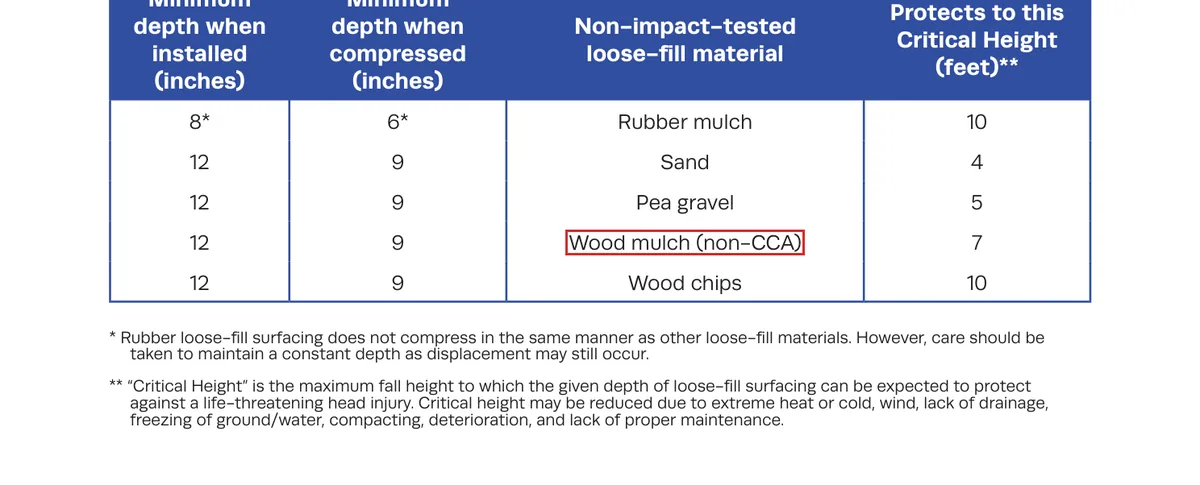
Wood chips at 9 inches are rated to a 10 foot fall, wood mulch only to 7. Rubber’s lower depth comes with conditions: CPSC says it should meet ASTM F3012 and be kept away from toddlers, which our rubber mulch playground and safety review sets out.
How to measure mulch depth and top it up
- Push a trowel or ruler straight down to the soil in 3 or 4 spots and average the readings. Penn State’s field check: no deeper than the heel of your hand, generally 2 to 4 inches.
- Pull any mulch touching trunks or stems back 3 to 5 inches on young trees and 8 to 10 inches on mature ones before adding anything.
- If the bed reads at or above your target from the table, add nothing. Rake to break matted layers and turn up darker material instead.
- Subtract: inches to add = target depth minus what you measured. Most beds need about 1 inch a year.
- Order it: cubic yards = square feet × inches to add ÷ 324. One 2 cubic foot bag covers 24 square feet 1 inch deep.
- Spread it level, feathered thin at trunks and within 12 inches of the foundation.
- Mulch (cubic feet)
- 16.7
- Mulch (cubic yards)
- 0.62
- 2 cu ft bags
- 9
- 3 cu ft bags
- 6
Cubic yards = sq ft x inches / 324. Measure the old layer first; keep the total under 2 inches within 12 inches of the foundation.
| Bed area | Add 1 inch | Add 2 inches | Add 3 inches |
|---|---|---|---|
| 100 sq ft | 0.31 cu yd (5 bags) | 0.62 cu yd (9 bags) | 0.93 cu yd (13 bags) |
| 200 sq ft | 0.62 cu yd (9 bags) | 1.23 cu yd (17 bags) | 1.85 cu yd (25 bags) |
| 500 sq ft | 1.54 cu yd (21 bags) | 3.09 cu yd (42 bags) | 4.63 cu yd (63 bags) |
| 1,000 sq ft | 3.09 cu yd (42 bags) | 6.17 cu yd (84 bags) | 9.26 cu yd (125 bags) |
If the old layer is matted, sour-smelling or already over 4 inches, removing some comes before topping up; the sibling guide on whether you should remove old mulch covers when.
A sour smell has a measurable cause: hardwood mulch that fermented in a deep pile can fall to pH 1.8 to 2.5, and our guide to why mulch smells sour, like manure or like ammonia matches each odor to its cause and fix.
How we compiled this
We read 19 primary documents in November 2026: 14 extension and arboretum publications (Iowa State, Maryland, Penn State, Colorado State, Cornell, UC IPM, UF/IFAS, Nevada, WSU, Morton Arboretum), the ISA brochure, the 2025 CPSC handbook, 3 depth trials (Greenly and Rakow, Watson and Kupkowski, Arnold) and the December 2025 systematic review, our source for the 5 trials marked via review. No mulch was laid or measured for this page. Fahrenheit, inch and percent conversions are our arithmetic.
Frequently asked questions
What is the 3-3-3 rule for mulch?
A memory aid for trees: a ring at least 3 feet across, 3 inches deep, kept 3 inches from the trunk. It matches Maryland’s 3 inch depth cap and trunk gap, though Penn State wants 8 to 10 inches of clearance on mature trees.
What is the best depth for mulch?
About 3 inches for most beds: inside every source’s band, and the depth where Greenly and Rakow measured the best shoot growth. Use 2 inches for fine mulch or clay, 4 for coarse chips.
Is 2 inches of mulch enough?
For fine or shredded mulch, heavy soil and annual beds, yes. For coarse chips, 2 inches leaves gaps; UC IPM and Iowa State put coarse material at 3 to 4 inches.
Adding flowers to a bed that is already mulched does not change the target depth: the steps for planting flowers in mulch rake the layer back, set the roots in soil and return the same 2 to 3 inches.
Can you put mulch on too thick?
Yes. Past 4 inches, trials recorded more tree deaths in wet years (15 percent at 4 inches, 35 at 6 in one peach trial), and fine mulch over 10 inches can starve soil of oxygen (Iowa State).
What is a common mistake when applying mulch?
Piling it against trunks into a volcano and adding a full new layer every year for color. Pull it 3 to 10 inches off trunks and add only the difference to your target.
Can I just lay mulch over dirt?
Yes. Mulch goes straight on bare soil; CSU says mulch at the right depth needs no fabric or paper under it. Pull existing weeds first, since runners like nutsedge push through 3 inches.
Sources
- A. J. F. Martin, R. W. Klein, A. K. Koeser and R. J. Hauer, Arboriculture & Urban Forestry, Does Excess Mulch Depth Lead to Poor Tree Growth and Condition, Root Girdling, and Decay? A Systematic Literature Review, December 2025. Accessed November 2026.
- K. M. Greenly and D. A. Rakow, Journal of Arboriculture 21(5), The Effect of Wood Mulch Type and Depth on Weed and Tree Growth and Certain Soil Parameters, 1995. Accessed November 2026.
- G. W. Watson and G. Kupkowski, Journal of Arboriculture 17(9), Effects of a Deep Layer of Mulch on the Soil Environment and Tree Root Growth, 1991. Accessed November 2026.
- M. A. Arnold, G. V. McDonald and D. L. Bryan, Arboriculture & Urban Forestry 31(4), Planting Depth and Mulch Thickness Affect Establishment of Green Ash and Bougainvillea Goldenraintree, 2005. Accessed November 2026.
- M. L. Duryea and P. J. Minogue, UF/IFAS Extension, Landscape Mulches: How Quickly Do They Settle? (FOR 69), Rev. May 2017, reviewed Jan. 2024. Accessed November 2026.
- U.S. Consumer Product Safety Commission, Public Playground Safety Handbook, Publication 325, July 2025. Accessed November 2026.
- F. M. Oi and M. Wheeler, UF/IFAS Extension, The Facts About Termites and Mulch (ENY-832), Rev. June 2023. Accessed November 2026.
- S. L. Quarles and E. Smith, University of Nevada Cooperative Extension, The Combustibility of Landscape Mulches (SP-11-04), 2011. Accessed November 2026.
- Iowa State University Extension and Outreach, How deep should the mulch layer be around trees and shrubs?, Updated March 3, 2022. Accessed November 2026.
- Iowa State University Extension and Outreach, Using Mulch in the Garden, Current page. Accessed November 2026.
- International Society of Arboriculture, Proper Mulching Techniques (Trees Are Good brochure), Current file. Accessed November 2026.
- University of Maryland Extension, Mulching Trees and Shrubs, Current page. Accessed November 2026.
- University of Maryland Extension, Excess Mulch Problems, Current page. Accessed November 2026.
- Penn State Extension, Mulching Landscape Trees, Current page. Accessed November 2026.
- Colorado State University Extension, Mulching, Current page. Accessed November 2026.
- The Morton Arboretum, How to Mulch Trees and Shrubs, Current page. Accessed November 2026.
- UC Statewide IPM Program, Pest Notes: Weed Management in Landscapes, Publication 7441, Current page. Accessed November 2026.
- L. Chalker-Scott, Washington State University, Wood Chip Mulch: Landscape Boon or Bane?, n.d.. Accessed November 2026.
- Cornell University, Turfgrass and Landscape Weed ID: Mulch, Current page. Accessed November 2026.